9) National income equals gross domestic product
A) plus sales taxes.
B) plus government transfer payments.
C) minus the consumption of fixed capital.
D) minus government transfer payments.
10) Depreciation is
A) the value of worn-out equipment, machinery, and buildings.
B) the value of the decrease in business inventory stocks.
C) the value of the addition to the capital stock.
D) the decline in the value of the stock market, net of dividends.
11) Suppose that in 2016, the national income in the United States was $200 billion, depreciation was $15
billion, personal taxes were $20 billion, and transfer payments were $10 billion. Gross domestic product
in 2016 is
A) $185 billion.
B) $215 billion.
C) $220 billion.
D) $245 billion.
12) The best measure of the income households actually have available to spend is
A) personal income.
B) disposable personal income.
C) national income.
D) net national income.
13) Disposable personal income equals personal income
A) minus personal tax payments.
B) plus government transfer payments.
C) minus personal tax payments plus government transfer payments.
D) minus government transfer payments plus personal tax payments.
Table 8-27
National income
$1,000
Retained earnings not paid as dividends
50
Transfer payments
40
Interest on government bonds
20
Personal taxes
30
The components of national income for an economy are represented in Table 8-27 above. All values are
in billions of dollars.
14) Refer to Table 8-27. What is the level of personal income for this economy?
A) $1,140 billion
B) $1,010 billion
C) $990 billion
D) $860 billion
15) Refer to Table 8-27. What is the level of disposable personal income for this economy?
A) $1,080 billion
B) $1,010 billion
C) $980 billion
D) $860 billion
16) National income is equal to
A) personal income minus personal taxes.
B) GDP minus depreciation.
C) disposable personal income plus depreciation plus personal taxes.
D) GNP plus depreciation.
17) Gross national product is defined as
A) the value of final goods and services produced within the United States.
B) the value of final goods and services produced outside of the United States.
C) the value of final goods and services produced by residents of the United States even if the
production takes place outside of the United States.
D) the value of final goods and services produced within the United States, by United States residents.
18) If a U.S. firm produces cars in Mexico, that production should count towards
A) U.S. GNP.
B) Mexico’s GNP.
C) U.S. GDP.
D) It will not affect either U.S. GNP or U.S. GDP.
19) If a German firm produces cars in the United States, that production should count towards
A) U.S. GNP.
B) German GDP.
C) U.S. GDP.
D) both U.S. GNP and German GDP.
20) Which of the following would increase GNP in the United States?
A) an increase in the production of U.S.-owned General Motors cars made in Mexico
B) an increase in the production of Japanese-owned Toyota cars in Mexico
C) an increase in the production of Japanese-owned Toyota cars in the U.S.
D) an increase in the production of Mexican-owned Grupo Minsa corn in the U.S.
21) When lumber from Brazilian forests is used by a U.S.-owned company to produce furniture in
Canada, the value of the furniture produced will be counted as a final good in
A) U.S. GDP.
B) Canada’s GDP.
C) Brazil’s GDP.
D) Brazil’s GNP.
22) When Ford increases the production of cars in Romania, which of the following occurs?
A) GDP in the United States rises.
B) GNP in the United States rises.
C) GNP in Romania rises.
D) Both A and C occur.
23) National income is defined as
A) gross national product plus transfer payments.
B) gross national product less retained earnings plus transfer payments.
C) gross domestic product less retained earnings plus transfer payments.
D) gross domestic product less the consumption of fixed capital.
24) Personal income is defined as
A) national income less retained earnings plus transfer payments and plus interest on government
bonds.
B) national income plus retained earnings less transfer payments and less interest on government
bonds.
C) national income less depreciation.
D) national income less personal taxes.
25) Disposable personal income is defined as
A) personal income less personal taxes plus indirect sales taxes.
B) personal income less transfer payments plus personal taxes.
C) personal income less personal taxes.
D) personal income less depreciation.
26) National income is derived from gross domestic product by
A) subtracting retained earnings from gross domestic product.
B) adding personal taxes and depreciation to gross domestic product.
C) subtracting depreciation from gross domestic product.
D) adding personal income and transfer payments to gross domestic product.
27) An increase in national income could by caused by which of the following?
A) an increase in depreciation
B) an increase in personal taxes
C) a decrease in personal income
D) an increase in gross domestic product
28) Which of the following would increase disposable personal income?
A) a decrease in transfer payments received
B) a decrease in taxes paid
C) a decrease in personal income
D) All of the above would increase disposable income.
29) Gross domestic product is generally ________ national income.
A) greater than
B) less than
C) equal to
D) unrelated to
Table 8-28
Billions of
Dollars
GDP
$3,250
Depreciation
300
Retained
earnings
1,000
Personal
income
2,500
Transfer
payments
50
30) Refer to Table 8-28. Based on the table above, what is national income for this economy?
A) $1,950 billion
B) $2,250 billion
C) $2,950 billion
D) $3,550 billion

Table 8-29
Billions of
Dollars
GDP
$5,250
Transfer
Payments
50
Retained
earnings
700
Depreciation
1,250
31) Refer to Table 8-29. Based on the table above, what is national income for this economy?
A) $4,700 billion
B) $4,000 billion
C) $3,150 billion
D) $2,450 billion
Table 8-30
Billions of
Dollars
GDP
$3,250
Depreciation
300
Retained
earnings
1,000
Personal tax
payments
500
Transfer
payments
80
32) Refer to Table 8-30. Based on the table above, what is personal income for this economy?
A) $1,950 billion
B) $2,030 billion
C) $2,450 billion
D) $5,130 billion
33) The total value of production from Ford’s manufacturing plant in Cologne, Germany would be
included in Germany’s gross national product.
34) Transfer payments are subtracted from national income to get to personal income.
35) For developed countries like the United States, GDP will always exceed GNP.
36) The values of real GDP and real GNP are almost the same for the United States.
37) The values of real GDP and real GNP are almost the same in countries where a significant fraction of
domestic production takes place in foreign-owned firms.
38) Disposable personal income is equal to personal income minus personal tax payments.
80
39) What are the differences between national income, personal income, and disposable personal
income?
40) Explain the difference between Gross Domestic Product and Gross National Product. Give an
example of each.
81
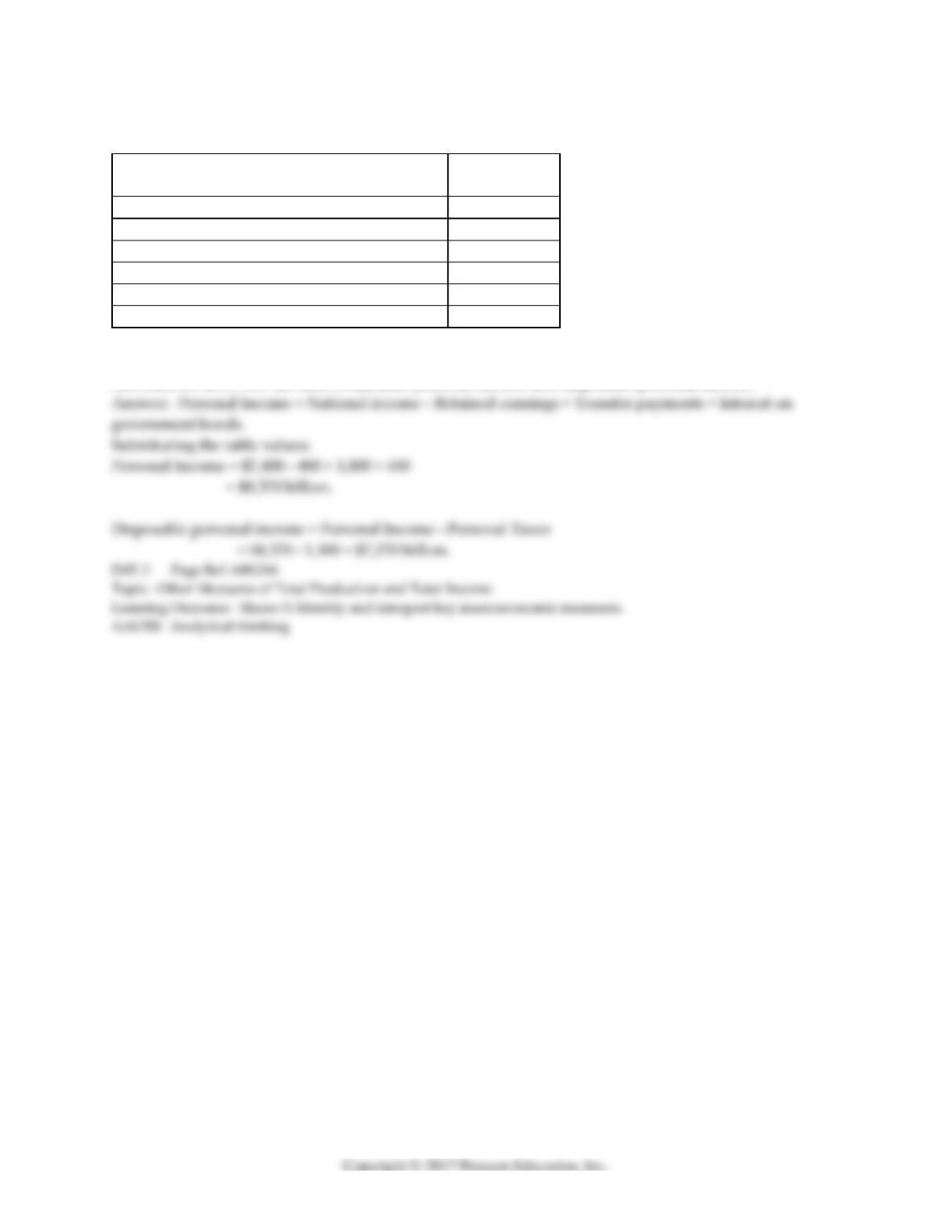
Table 8-31
Billions of
Dollars
National income
$7,400
Retained earnings
480
Depreciation
660
Interest on government bonds
450
Transfer payments
1,000
Personal taxes
1,100
41) Refer to Table 8-31. The table above represents hypothetical data from the National Income
Accounts for 2015. Use the data to calculate personal income and disposable personal income.
82
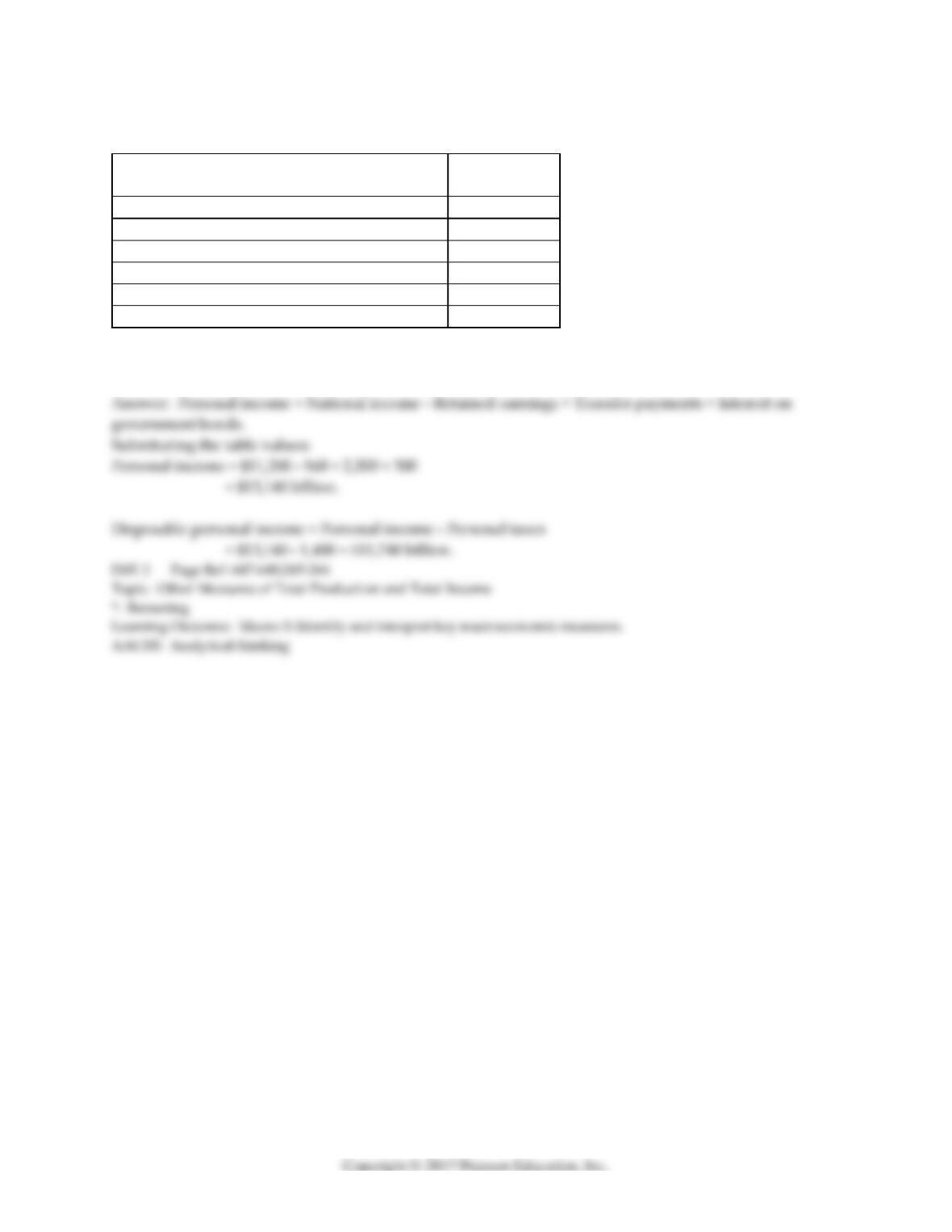
Table 8-32
Billions of
Dollars
National income
$11,200
Retained earnings
560
Depreciation
700
Interest on government bonds
300
Transfer payments
2,200
Personal taxes
1,400
42) Refer to Table 8-32. The table above represents hypothetical data from the National Income
Accounts for 2015. Use the data to calculate personal income and disposable income.