30) If a country passes a labor law limiting the number of hours of work per week, GDP would ________
and leisure would ________.
A) decrease; increase
B) increase; increase
C) decrease; decrease
D) increase; decrease
31) If China decides to enact laws to clean up the environment, what would be the effect on GDP?
A) GDP would increase reflecting the fact that the environment would be cleaner.
B) GDP would decrease if the pollution controls reduce productivity by more than the cost of the
controls.
C) GDP would increase as the citizens of China were made happier as the environment was cleaned up.
D) GDP would increase as the environmental costs of pollution were not included in the calculation of
GDP.
32) Because workers in the United States work fewer hours per week, on average, than they did over
100 years ago,
A) workers in the United States are worse off than they were over 100 years ago.
B) workers in the United States earn less income than they did over 100 years ago.
C) GDP is lower than it would be if U.S. workers worked the same workweek they had 100 years ago.
D) GDP is higher than it would be if U.S. workers worked the same workweek they had 100 years ago.
33) Developing countries with large informal sectors tend to have firms that invest less in capital
equipment.
34) If income is unequally distributed in an economy, increases in GDP may not raise well-being in an
economy.
35) Real GDP per capita is calculated by dividing the value of real GDP for a country by the country’s
adult population.
36) GDP is not a complete measure of well-being.
37) The size of the underground economy as a percent of GDP is larger in the United States as compared
to poorer countries such as Zimbabwe.
38) If an increase in crime causes households to spend money on police and security systems, GDP will
rise.
39) The underground economy — the informal sector — can be a significant drag on the economies of
developing countries. Why are firms in the informal sector often less efficient than firms in the formal
sector?
40) Even though it is generally true that the more goods and services people have, the better off they
are, GDP provides only a rough measure of well-being. Assuming language is not an issue, what other
factors besides GDP might you consider when deciding where to live and work?
41) Over the last 50 years, has the ratio of household production to gross domestic product in the
United States increased or decreased? Consider the effect of the increased number of women working
outside the home, and the effect of advances in technology in household production such as
microwaves, coffee makers, power tools, etc.
42) Give two reasons why GDP does not reflect total production in an economy.
43) What is the underground economy and how could it hurt an economy? How does it hurt
developing economies?
44) China’s current rate of GDP growth is quite rapid. Its current growth rate is probably three times
that of the United States. However, the levels of pollution are much higher in China. Would you
consider China to be better off than the United States given this information? Why or why not?
8.3 Real GDP versus Nominal GDP
1) Nominal GDP is GDP in a given year
A) adjusted for inflation.
B) adjusted for anticipated inflation.
C) valued in the prices of that year.
D) valued in the prices of the base year.
2) Real GDP is GDP in a given year
A) adjusted only for anticipated inflation.
B) adjusted only for unanticipated inflation.
C) valued in the prices of that year.
D) valued in the prices of the base year.
Table 8-11
Year
Guns
Produced
Price of Guns
Butter
Produced
Price of
Butter
2007
80
$5
40
$4
2016
90
6
60
10
Consider the following data for Tyrovia, a country that produces only two products: guns and butter.
3) Refer to Table 8-11. Real GDP for Tyrovia for 2016 using 2007 as the base year equals
A) $1,140.
B) $880.
C) $690.
D) $560.
4) Refer to Table 8-11. Nominal GDP for Tyrovia in 2016 equals
A) $1,140.
B) $880.
C) $690.
D) $560.
Table 8-12
Year
Nominal
GDP
Real GDP
2013
$7,400
$7,537
2014
7,813
7,813
2015
8,301
8,165
2016
8,760
8,516
5) Refer to Table 8-12. Consider the following data on nominal GDP and real GDP (values are in
billions of dollars): The base year used in calculating real GDP is
A) 2013.
B) 2014.
C) 2015.
D) 2016.
Table 8-13
Year
Oranges
Produced
Price of
Oranges
Shirts
Produced
Price of
Shirts
2013
1,800
$0.90
110
$30.00
2015
2,000
1.00
110
35.00
Consider the data shown above for Vicuna, a country that produces only two products: oranges and
shirts.
6) Refer to Table 8-13. Real GDP for Vicuna for 2013 using 2015 as the base year equals
A) $4,620.
B) $5,100.
C) $5,650.
D) $5,850.
7) Refer to Table 8-13. Nominal GDP for Vicuna for 2013 equals
A) $4,920.
B) $5,100.
C) $5,300.
D) $5,850.
8) If the quantity of goods and services produced in the economy decreases,
A) it may be possible for real GDP to increase.
B) real GDP would certainly increase.
C) it may be possible for nominal GDP to increase.
D) nominal GDP would certainly increase.
9) Suppose that nominal GDP in 2016 was less than real GDP in 2016. Given this information, we know
for certain that
A) the price level in 2016 was greater than the price level in the base year.
B) the price level in 2016 was less than the price level in the base year.
C) real GDP in 2016 was less than real GDP in the base year.
D) real GDP in 2016 was greater than real GDP in the base year.
10) Which of the following could cause nominal GDP to decrease, but real GDP to increase?
A) The price level rises and the quantity of final goods and services produced rises.
B) The price level falls and the quantity of final goods and services produced rises.
C) The price level rises and the quantity of final goods and services produced falls.
D) The price level falls and the quantity of final goods and services produced falls.
11) Which of the following could cause nominal GDP to increase, but real GDP to decrease?
A) The price level rises and the quantity of final goods and services produced rises.
B) The price level rises and the quantity of final goods and services produced falls.
C) The price level falls and the quantity of final goods and services produced rises.
D) The price level falls and the quantity of final goods and services produced falls.
12) If real GDP in 2016 (using 2009 prices) is lower than nominal GDP of 2015, then
A) prices in 2016 are lower than prices in 2015.
B) nominal GDP in 2016 equals nominal GDP in 2015.
C) prices in 2016 are higher than prices in 2015.
D) real GDP in 2016 is larger than real GDP in 2015.
13) To examine how the total production of an economy has changed over time, it would be better to
examine
A) real GDP.
B) nominal GDP.
C) GDP at current prices.
D) the GDP deflator.
14) If prices in the economy rise, then
A) the purchasing power of a dollar rises.
B) the purchasing power of a dollar stays constant.
C) the purchasing power of a dollar declines.
D) the purchasing power of a dollar cannot be determined.
15) Real GDP will increase
A) only if the price level rises.
B) only if the price level falls.
C) only if the quantity of final goods and services produced rises.
D) if either the price level rises or the quantity of final goods and services produced rises.
16) If nominal GDP is $5 trillion and real GDP is $4 trillion, the GDP deflator is
A) 12.5.
B) 80.
C) 125.
D) 800.
17) The GDP deflator is the
A) difference between real GDP and nominal GDP multiplied by 100.
B) difference between nominal GDP and real GDP divided by 100.
C) ratio of real GDP to nominal GDP multiplied by 100.
D) ratio of nominal GDP to real GDP multiplied by 100.
18) Nominal GDP will increase
A) only if the price level rises.
B) only if the price level falls.
C) only if the quantity of final goods and services produced rises.
D) if either the price level or the quantity of goods and services produced rises.
19) The GDP deflator is a measure of the
A) total production of the economy adjusted for inflation.
B) total production of the economy unadjusted for inflation.
C) average level of prices of final goods and services in the economy.
D) average level of prices of intermediate goods and services in the economy.
20) If nominal GDP exceeds real GDP for a specific year, then the GDP deflator must be
A) equal to 100.
B) greater than 100.
C) less than 100.
D) less than 0.
21) The GDP deflator in year 2 is 105, using year 1 as the base year. This means that, on average, the
cost of goods and services is
A) 5% higher in year 2 than in year 1.
B) 105% higher in year 2 than in year 1.
C) 5% higher in year 1 than in year 2.
D) 105% higher in year 1 than in year 2.
22) If the GDP deflator is less than 100, then for that year nominal GDP ________ real GDP.
A) equals
B) is greater than
C) is less than
D) may be greater than or less than
Table 8-14
Year
Nominal
GDP
Real GDP
2015
14,078
13,254
2016
14,441
13,312
23) Refer to Table 8-14. Consider the following data on nominal GDP and real GDP (values are in
billions of dollars): The GDP deflator for 2016 equals
A) 92.2.
B) 102.6.
C) 108.5.
D) 109.1.
Table 8-15
Year
Nominal
GDP
Real GDP
2014
$13,399
$12,976
2015
14,078
13,254
2016
14,441
13,312
24) Refer to Table 8-15. Consider the following data on nominal GDP and real GDP (values are in
billions of dollars): The GDP deflator for 2015 equals
A) 94.1.
B) 105.1.
C) 106.2.
D) 108.5.
25) The measure of production that values production using current prices is called
A) value-added GDP.
B) nominal GDP.
C) real GDP.
D) underground GDP.
26) The ________ is a measure of the price level and is calculated by dividing ________ by ________ and
multiplying by 100.
A) CPI; real GDP; nominal GDP
B) GDP deflator; real GDP; nominal GDP
C) GDP deflator; nominal GDP; real GDP
D) PPI; nominal GDP; real GDP
E) PPI; real GDP; nominal GDP
27) The measure of production that values output using base-year prices is called
A) real GDP.
B) nominal GDP.
C) value-added GDP.
D) underground GDP.
28) The drawback to calculating real GDP using base-year prices is that
A) real GDP in one year is not comparable to real GDP in another year.
B) relative prices change over time and these are not reflected in base-year prices, and this distorts GDP.
C) relative prices change over time and these changes are reflected in base-year prices.
D) quality changes are reflected in base-year prices.
29) Nominal GDP is another term for
A) inflation-adjusted GDP.
B) real GDP.
C) constant-dollar GDP.
D) current-dollar GDP.
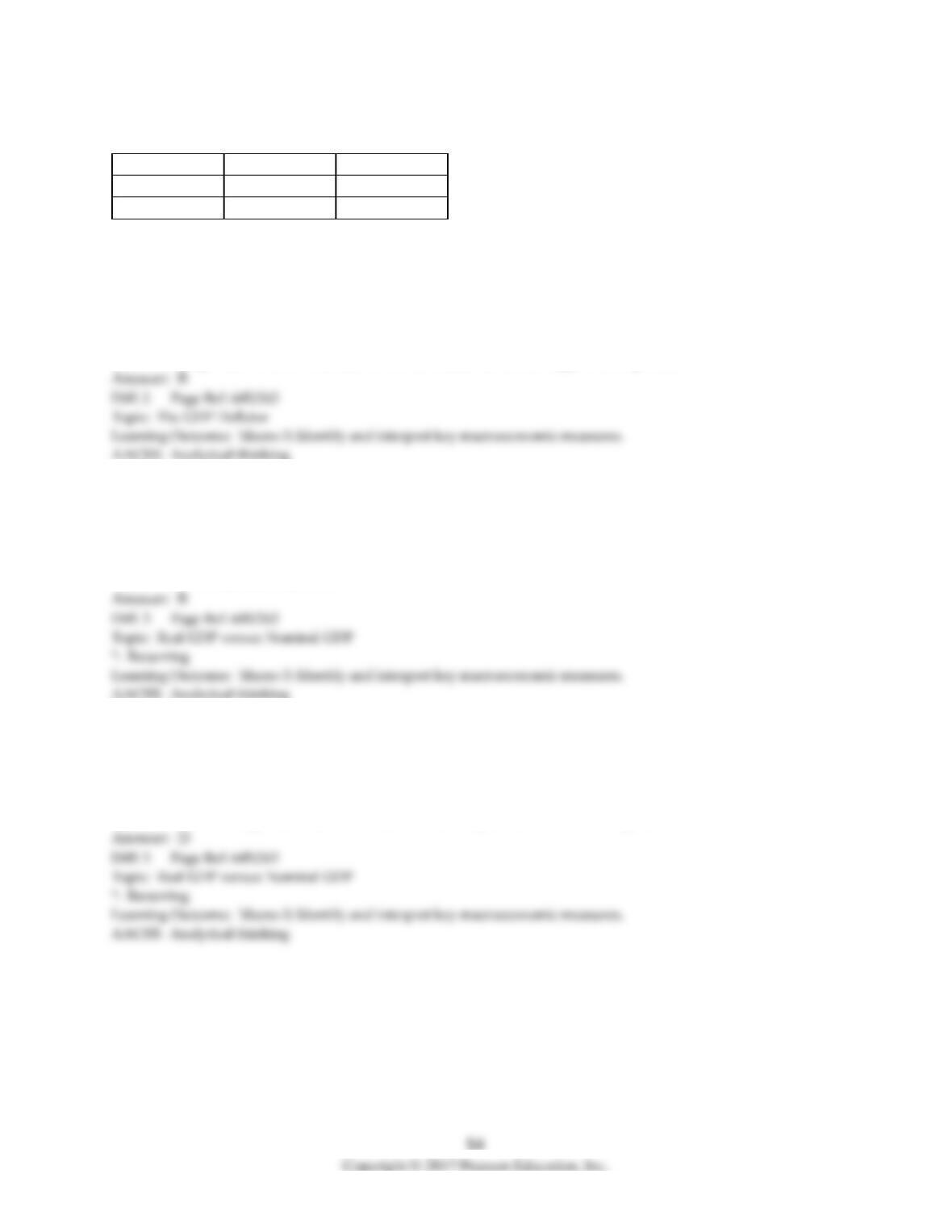
Table 8-16
2015
2016
Nominal GDP
$10,000
$12,000
Real GDP
9,500
10,500
30) Refer to Table 8-16. Given the information above, what can we say has happened in the economy
from 2015 to 2016?
A) The price level has fallen.
B) The price level has risen.
C) The price level has remained constant.
D) Not enough information is available to determine what has happened to prices.
31) In periods when prices are falling, on average,
A) real GDP will grow slower than nominal GDP.
B) real GDP will grow faster than nominal GDP.
C) real GDP will grow as fast as nominal GDP.
D) one cannot calculate real GDP.
32) If prices are rising on average, then
A) real GDP will always be equal to nominal GDP.
B) real GDP will be greater than nominal GDP in the years after the base year.
C) real GDP will be less than nominal GDP in the years before the base year.
D) real GDP will be greater than nominal GDP in the years before the base year.
33) If real GDP increases we know for sure that
A) output has risen.
B) prices have risen.
C) prices have risen but output has remained constant.
D) prices have remained constant.
Table 8-17
2011
2016
Product
Quantity
Price
Quantity
Price
Movies
20
$6.00
30
$7.00
Burgers
100
2.00
90
2.50
Bikes
3
1,000.00
6
1,100.00
A very simple economy produces three goods: movies, burgers, and bikes. The quantities produced and
their corresponding prices for 2011 and 2016 are shown in the table above.
34) Refer to Table 8-17. What is nominal GDP in 2016?
A) $3,320
B) $3,690
C) $6,360
D) $7,035
35) Refer to Table 8-17. What is nominal GDP in 2011?
A) $3,320
B) $3,690
C) $6,360
D) $7,035
36) Refer to Table 8-17. What is real GDP in 2016, using 2011 as the base year?
A) $3,320
B) $3,690
C) $6,360
D) $7,035
Table 8-18
2011
2016
Product
Quantity
Price
Quantity
Price
Camera
100
$10
120
$12
Legal services
50
15
45
20
Books
200
40
210
45
A very simple economy produces three goods: cameras, legal services, and books. The quantities
produced and their corresponding prices for 2011 and 2016 are shown in the table above.
37) Refer to Table 8-18. What is real GDP in 2016, using 2011 as the base year?
A) $28,885
B) $11,790
C) $11,200
D) $10,275
38) Refer to Table 8-18. What is real GDP in 2016, using 2016 as the base year?
A) $28,885
B) $11,790
C) $11,200
D) $10,275
39) Refer to Table 8-18. What is nominal GDP in 2016 when 2011 is the base year?
A) $28,885
B) $11,790
C) $11,200
D) $10,275
40) Refer to Table 8-18. What is the GDP deflator in 2016 if 2016 is the base year?
A) 120
B) 118
C) 100
D) 87
41) Refer to Table 8-18. What is the GDP deflator in 2011 if 2016 is the base year?
A) 187
B) 87
C) 8.7
D) 0.87
42) If the GDP deflator rises from 185 to 190, what is the rate of inflation between the two years?
A) 270%
B) 50%
C) 5%
D) 2.7%
43) If the GDP deflator is 142, by how much have prices changed since the base year?
A) Prices have increased by 42%.
B) Prices have increased by 142%.
C) Prices have decreased by 4.2%.
D) Prices have increased by 58%.
44) An inflation rate of 5% between 2015 and 2016 would be implied by a change in the GDP deflator
from ________ in 2015 to ________ in 2016.
A) 105; 115
B) 200; 205
C) 400; 420
D) 375; 390
45) To make the calculation of real GDP more accurate, in 1996 the BEA switched to using
A) base-year prices.
B) current prices.
C) chain-weighted prices.
D) market prices.
46) When the BEA calculates real GDP using the average of prices in the current year and the year
preceding it, and this average changes from year to year, this is called calculating GDP using
A) chained-weighted prices.
B) fixed-weight prices.
C) current-year prices.
D) fixed base-year prices.
47) Which of the following is a true statement about real and nominal GDP?
A) If nominal GDP increases from one year to the next, we know that production of goods and services
has risen.
B) Nominal GDP is a better measure than real GDP in comparing changes in the production of goods
and service year after year.
C) Increases in average prices do not affect the calculation of nominal GDP.
D) If real GDP increases from one year to the next, we know that production of goods and services has
risen.
48) If nominal GDP rises we can say that
A) production has risen and prices remain constant.
B) prices have risen and production remains constant.
C) production has risen or prices have risen or both have risen.
D) production has fallen and prices have risen.
49) The GDP deflator is equal to
A) real GDP divided by nominal GDP.
B) nominal GDP divided by real GDP, multiplied by 100.
C) nominal GDP divided by real GDP.
D) real GDP divided by nominal GDP, multiplied by 100.
50) Under what circumstances would the GDP deflator be less than 100 after the base year?
A) The GDP deflator will be less than 100 if there has been inflation relative to the base year.
B) The GDP deflator will be less than 100 if there has been inflation of less than 2% per year relative to
the base year.
C) The GDP deflator will be less than 100 if there has been deflation relative to the base year.
D) There are no circumstances under which the GDP deflator could be less than 100.
Table 8-19
2015
2016
Nominal GDP
$10,000
$12,000
Real GDP
9,500
10,500
51) Refer to Table 8-19. Given the information above, calculate the GDP deflator in 2016.
A) 114
B) 105
C) 95
D) 87
52) Refer to Table 8-19. Given the information above, calculate the GDP deflator in 2015.
A) 87
B) 95
C) 105
D) 114
Table 8-20
2015
2016
Nominal GDP
$10,000
$12,000
Real GDP
9,500
10,500
53) Refer to Table 8-20. Given the following information, calculate the rate of increase in the price level
from 2015 to 2016.
A) 8.6%
B) 7.9%
C) -7.9%
D) -8.6%