1
Macroeconomics: Policy and Practice, 2e (Mishkin)
Chapter 8 Business Cycles: An Introduction
8.1 Business Cycle Basics
1) Arthur Burns and Wesley Mitchell first described business cycles as ________.
A) fluctuations in consumer preferences
B) fluctuations in the price of bicycles
C) fluctuations in aggregate economic activity
D) all of the above
E) none of the above
2) In a business cycle, a period from peak to trough may be referred to as ________.
A) an expansion
B) a recurrence
C) a contraction
D) all of the above
E) none of the above
3) In a business cycle, a period from peak to trough may be referred to as ________.
A) a contraction
B) a recession
C) a depression
D) all of the above
E) none of the above
4) In a business cycle, a period from trough to peak may be referred to as ________.
A) a contraction
B) an expansion
C) a recurrence
D) all of the above
5) A recession can manifest itself with ________.
A) a decrease in consumer spending
B) a decrease in industrial production
C) a lengthy period of falling GDP
D) all of the above
E) none of the above
6) Examining U.S. business cycles over time reveals that they ________.
A) occur at regular intervals
B) are of uniform duration
C) are of similar magnitude
D) all of the above
E) none of the above
7) Economists use the term “potential output” to refer to ________.
A) a level of output that has not yet been achieved
B) the maximum level of output of which an economy is capable
C) the sum of finished goods plus goods in production that will be finished within the year
D) the level of output that occurs when all prices are fully adjusted
E) none of the above
8) Economic activity that is above potential output ________.
A) signals that potential output is about to increase
B) is not possible
C) results from an economic shock to which the economy has yet to adjust fully
D) occurs near the trough, rather than the peak, of a business cycle
E) none of the above
9) The difference between aggregate economic activity and potential output is called ________.
A) the business cycle
B) the output gap
C) a recession
D) a trough
E) a co-movement
10) A procyclical variable ________.
A) moves up during expansions and down during contractions
B) moves up during contractions and down during expansions
C) moves in the opposite direction of aggregate economic activity
D) all of the above
E) none of the above
11) A countercyclical variable ________.
A) moves up during expansions and down during contractions
B) is another term for an acyclical variable
C) moves in the same direction as aggregate economic activity
D) all of the above
E) none of the above
12) A leading countercyclical variable ________.
A) reaches a peak before the peak of the business cycle
B) reaches a trough before the peak of the business cycle
C) reaches a trough along with the trough of a business cycle
D) all of the above
E) none of the above
13) A leading variable ________.
A) reaches a peak or trough before the turning point of the business cycle
B) reaches a peak or trough after the turning point of the business cycle
C) reaches a peak or trough at the same time as the turning point of the business cycle
D) all of the above
E) none of the above
14) A lagging variable ________.
A) reaches a peak or trough before the turning point of the business cycle
B) reaches a peak or trough after the turning point of the business cycle
C) reaches a peak or trough at the same time as the turning point of the business cycle
D) all of the above
E) none of the above
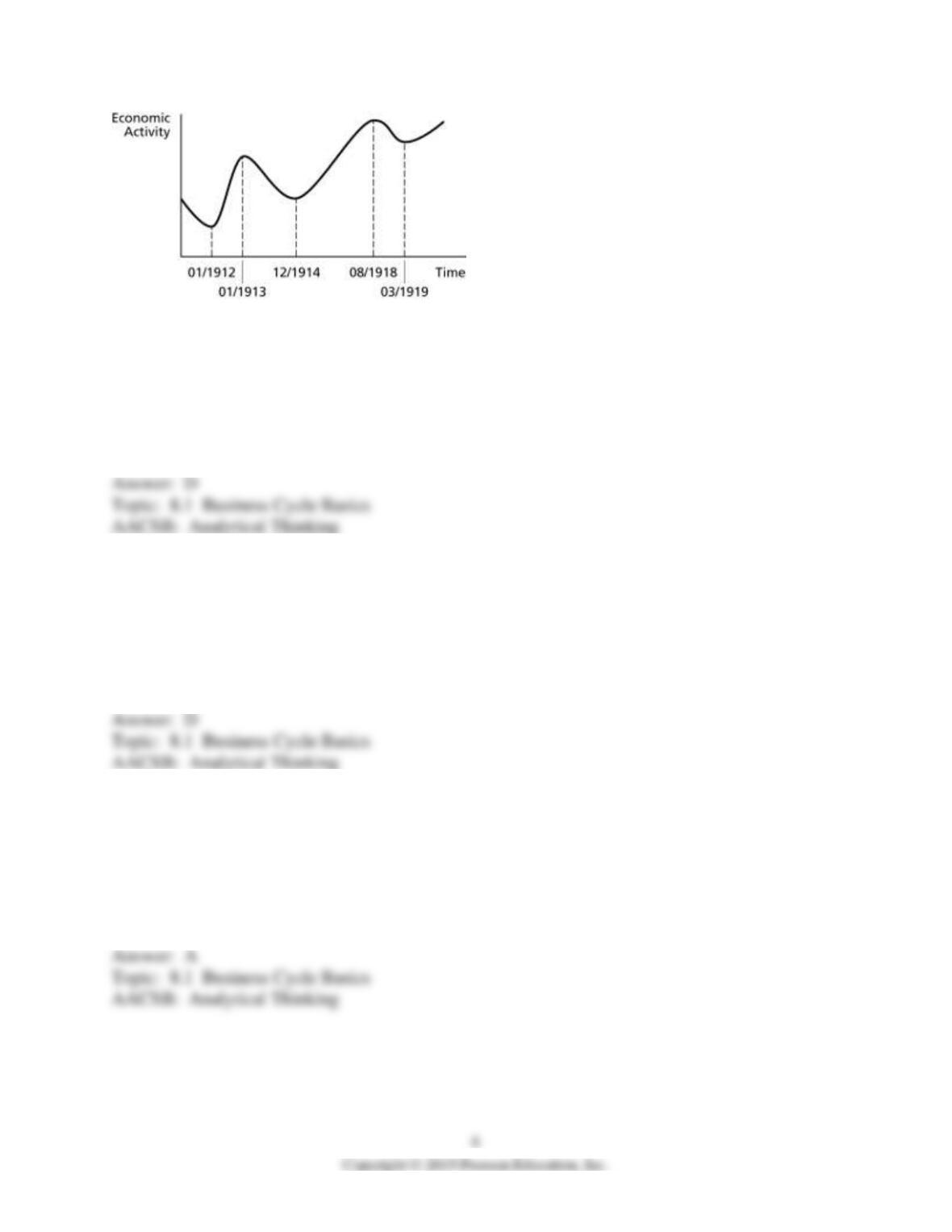
15) According to the graph above, the expansion that began in December 1914 had a duration of
________.
A) 51 months
B) 4 years
C) 3 years
D) 44 months
E) 20 months
16) According to the graph above, the last expansion to occur before the outbreak of World War
I in 1914 had a duration of ________.
A) 23 months
B) 44 months
C) 3 years
D) 12 months
E) 20 months
17) Referring to the graph above, an economic variable that had peaked in December 1911,
November 1914, and February 1919 is likely a ________ variable.
A) leading countercyclical
B) leading procyclical
C) lagging countercyclical
D) lagging procyclical
E) none of the above
18) Referring to the graph above, an economic variable that had peaked in December 1912, and
July 1918 is likely a ________ variable.
A) leading countercyclical
B) leading procyclical
C) lagging countercyclical
D) lagging procyclical
E) none of the above
19) Referring to the graph above, an economic variable that had peaked in December 1912,
November 1914, and February 1918 is likely a ________ variable.
A) leading countercyclical
B) leading procyclical
C) lagging countercyclical
D) lagging procyclical
E) none of the above
20) The Conference Board does a good job predicting recessions for reasons that include
________.
A) a focus on fewer than five leading variables
B) exclusive use of real-time data
C) revisions of the components of its monthly index
D) all of the above
E) none of the above
21) Many economic variables are classified according to their relation to the business cycle.
What are the principal categories? Variables in which category(ies) are of greatest help in
forecasting changes in the economy?
22) To understand what causes the business cycle, leading variables alone are of interest.
Coincident and lagging variables merely display the consequences of changes in the economy.
Respond.
8.2 Macroeconomic Variables and the Business Cycle
1) GDP is a good proxy for the business cycle itself since ________.
A) its real consumption spending component is procyclical and coincident
B) its real investment spending component is procyclical and coincident
C) it typically goes up in a boom and down in a recession
D) all of the above
E) none of the above
2) A characteristic of the unemployment rate is that ________.
A) it typically goes up in a recession
B) it typically goes down in a boom
C) it is not clear whether it is a leading or a lagging indicator
D) all of the above
E) none of the above
3) A characteristic of the inflation rate is that ________.
A) it typically goes down in a boom
B) it typically goes up in a recession
C) it is a lagging indicator
D) all of the above
E) none of the above
4) A characteristic of stock prices is that ________.
A) they tend to go up on the upswing of the cycle
B) they tend to go down on the downswing of the cycle
C) they are a leading indicator
D) all of the above
E) none of the above
5) The interest rates paid on Treasury bills ________.
A) go down in booms
B) go up in recessions
C) are a coincident indicator
D) all of the above
E) none of the above
6) Interest rates spreads between long-term and short-term Treasury bills ________.
A) are countercyclical
B) are good predictors of recessions
C) are a lagging indicator
D) all of the above
E) none of the above
7) Interest rates spreads between long-term and short-term Treasury bills ________.
A) are procyclical
B) are not a good predictor of recessions
C) are a lagging indicator
D) all of the above
E) none of the above
8) Interest rates spreads between corporate and government bonds ________.
A) are procyclical
B) have the same characteristics as the government interest rate spreads
C) are countercyclical
D) all of the above
E) none of the above
9) Which of these economic variables is procyclical?
A) consumer spending
B) stock prices
C) the government bond spread
D) all of the above
E) none of the above
10) Which of these economic variables is procyclical and coincident?
A) consumer spending
B) stock prices
C) the government bond spread
D) all of the above
E) none of the above
11) Which of these economic variables is procyclical?
A) inflation
B) unemployment
C) the credit spread
D) all of the above
E) none of the above
12) Which of these economic variables is procyclical?
A) unemployment
B) the credit spread
C) investment spending
D) all of the above
E) none of the above
13) Which of these economic variables is countercyclical?
A) investment spending
B) unemployment
C) demand for foreign products
D) all of the above
E) none of the above
14) The credit spread between government bonds and corporate bonds is ________.
A) countercyclical and coincident
B) procyclical and coincident
C) procyclical and lagging
D) countercyclical and leading
E) acyclical
15) Economic globalization has seen ________.
A) business cycles in the rest of the world synchronize with those of the U.S.
B) financial markets become more integrated over time
C) financial disruptions spread more easily among countries
D) all of the above
E) none of the above
16) Economic globalization has seen ________.
A) a decoupling of the business cycle among many countries
B) financial markets become more integrated over time
C) how international financial disruptions can be more easily contained
D) all of the above
E) none of the above
17) If events in a single country cause its economic activity to move up or down through a
business cycle, what difference(s) might it make that the economy is closely integrated with
other economies in the world?
10
18) Why is the credit spread countercyclical and coincident?
8.3 A Brief History of U.S. Business Cycles
1) What did the U.S. business cycles in the early 1890s and early 1930s have in common?
A) rapid industrialization
B) persistently high inflation
C) high consumer confidence
D) all of the above
E) none of the above
2) What did the U.S. business cycles in the early 1890s and early 1930s have in common?
A) the spread of bank failures
B) severe recessions
C) high unemployment and low inflation, even deflation
D) all of the above
E) none of the above
3) What does the U.S. business cycle experience suggest about periods of war?
A) the economy tends to boom during the period of war
B) after the war is over, the economy typically experiences a downturn
C) they are associated with good economic times
D) all of the above
E) none of the above
4) From 1945 until 1973, the U.S. economy experienced ________.
A) rapid inflation
B) no major recessions or depressions
C) minimal interaction with the global economy
D) all of the above
E) none of the above
5) In the 1970s, the U.S. economy ________.
A) grew at a faster pace than in the previous decade
B) experienced low inflation
C) experienced increases in unemployment
D) all of the above
E) none of the above
6) The “Great Moderation” refers to ________.
A) sharp declines in asset prices
B) the long economic expansion of the 1960s
C) the mild economic recoveries of the 1970s and early 1980s
D) the “oil tax” of the 1970s
E) none of the above
7) The years from 1933 to 1937 are notable for ________.
A) high unemployment, despite rapid growth of real output
B) low unemployment, despite sluggish output growth
C) persistent deflation, despite rising unemployment
D) the creation of the Federal Reserve System
E) none of the above
8) During the 1970s in the U.S. ________.
A) the inflation rate peaked at over 14%
B) oil prices quadrupled
C) the unemployment rate rose above 8%
D) all of the above
E) none of the above
9) The U.S. economy of the 1970s is typically referred to as ________.
A) “The Great Depression”
B) “The Great Inflation”
C) “The Great Moderation”
D) all of the above
E) none of the above
10) The U.S. economy of the late 1920s and early 1930s is typically referred to as ________.
A) “The Great Depression”
B) “The Great Inflation”
C) “The Great Moderation”
D) all of the above
E) none of the above
11) The U.S. economy of the mid 1980s through 2007 is typically referred to as ________.
A) “The Great Depression”
B) “The Great Inflation”
C) “The Great Moderation”
D) all of the above
E) none of the above
12) During the U.S. Great Moderation, ________.
A) the volatility in the inflation rate declined by 50%
B) the volatility in the rate of growth of real output declined by 33%
C) the economy stabilized from the higher uncertainty of the 1970s
D) all of the above
E) none of the above
13) During the Great Recession of 2007-2009, the U.S. ________.
A) experienced unprecedented declines in household wealth
B) the unemployment rate more than doubled
C) experienced the most severe economic downturn since the Great Depression
D) all of the above
E) none of the above
13
14) The policies of the U.S. Federal Reserve probably helped to cause ________.
A) the long contraction of the 1870s
B) the severe recession of the 1890s
C) the recession in 1918-1919
D) all of the above
E) none of the above
15) The years from 1945 to 1973 are notable for ________.
A) a Great Moderation
B) generally low inflation
C) brief, but severe, recessions
D) all of the above
E) none of the above
16) The years from 1945 to 1973 are notable for ________.
A) the Great Inflation
B) the creation of the Federal Reserve System
C) frequently high unemployment
D) all of the above
E) none of the above
17) During the period from 1970 to the present, the U.S. economy experienced a Great Inflation,
a Great Moderation, and a Great Recession. How does this sequence illustrate the concept of a
“business cycle”?
8.4 Time Horizons in Macroeconomics
1) John Maynard Keynes ________.
A) questioned the classical view that economies move quickly to their long run equilibrium
levels
B) advocated focusing on short run fluctuations
C) carved out macroeconomics as a distinct field in the 1930s
D) all of the above
E) none of the above
2) The classical view believes that ________.
A) economies move slowly to their long run equilibrium levels
B) a rise in the quantity of money leads to increases in saving and investment
C) a rise in the quantity of money has no impact on economic activity
D) all of the above
E) none of the above
3) Classical economists believe that ________.
A) it takes a long time for economic variables to reach equilibrium
B) short-run fluctuations are too infrequent and mild to be of much interest
C) real variables like output and investment are not determined by nominal variables
D) all of the above
E) none of the above
4) Keynesians believe ________.
A) that economies move quickly to their long run equilibrium levels
B) that the government should pursue active policies to stabilize economic fluctuations
C) that the long run is more important than short-run fluctuations
D) all of the above
E) none of the above
5) According to the flexible price framework ________.
A) economic fluctuations determine long-run outcomes
B) a change in the money supply has no effect on real output
C) a change in inflation alters the amount of real investment
D) all of the above
E) none of the above
6) According to the flexible price framework ________.
A) an increase in inflation raises real savings
B) an increase in the money supply raises real output
C) an increase in inflation lowers real investment
D) all of the above
E) none of the above
7) According to the flexible price framework ________.
A) aggregate output is determined by the production function with given levels of capital and
labor
B) the interest rate is solely determined by the interaction of savings and investment
C) nominal and real variables are completely independent
D) all of the above
E) none of the above
8) Keynesian economists ________.
A) observe that prices respond slowly to changes in supply and demand
B) believe that the classical dichotomy does not hold in the short run
C) believe that monetary policy affect aggregate output and the real interest rate
D) all of the above
E) none of the above
9) Keynesian economists ________.
A) believe that the classical dichotomy does not hold in the long run
B) believe that only the interaction between savings and investment affects the real interest rate
C) observe that prices are “sticky”
D) all of the above
E) none of the above
10) Keynesian economists ________.
A) observe that prices are perfectly flexible
B) believe that the classical dichotomy never holds
C) believe that only the interaction between savings and investment affects the real interest rate
D) all of the above
E) none of the above
16
11) Rapid growth of the money supply might seem appropriate to ________ economists, because
________.
A) Keynesian; it can hasten the economy’s return to a long-run equilibrium
B) Keynesian; the resulting inflation will have no effect on real output
C) classical; stabilizing fluctuations contributes to long-run growth
D) classical; it will make prices more flexible
E) none of the above
12) Prices that adjust slowly to their long-run equilibrium ________.
A) help the economy to avoid economic fluctuations
B) call for policies that focus on short-run fluctuations
C) are conducive to maintaining low inflation
D) all of the above
E) none of the above
13) An increase in the price level that leads to no expansion of economic activity ________.
A) is consistent with classical models
B) implies that there has been no change in the money supply
C) is a strictly short-run phenomenon
D) all of the above
E) none of the above
14) How does rapid price adjustment, as assumed in classical models, result in separation of real
from nominal variables (the classical dichotomy)?
17
15) How does slow price adjustment, as assumed in Keynesian models, result in real economic
variables being affected by nominal variables?
16) Describe how Keynesian economics is a cyclical phenomenon. Is it leading, lagging, or
coincident? Procyclical or countercyclical?
8.5 Price Stickiness
1) In a perfectly competitive market ________.
A) the goods purchased are assumed to be standardized products
B) prices adjust quickly to equilibrium
C) buyers and sellers are price takers
D) all of the above
E) none of the above
2) In a perfectly competitive market ________.
A) most goods and services are not standardized
B) prices adjust slowly to equilibrium
C) buyers and sellers do not set prices and can only decide how much to buy and sell
D) all of the above
E) none of the above
18
3) Under monopolistic competition ________.
A) many goods and services are not standardized
B) prices adjust slowly to equilibrium
C) even if there is substantial competition in the market, some firms can set prices
D) all of the above
E) none of the above
4) Under monopolistic competition ________.
A) the goods purchased are assumed to be standardized products
B) it is good (or brand) differentiation that likely accounts for some price stickiness
C) buyers and sellers do not set prices and can only decide how much to buy and sell
D) all of the above
E) none of the above
5) Under monopolistic competition ________.
A) prices are flexible, because producers can change them as often as they wish
B) prices are flexible, because producers can never set a price other than the market price
C) prices are flexible, because producers adopt Keynesian policies
D) all of the above
E) none of the above
6) Menu costs ________.
A) are the cost a firm bears when it changes its prices
B) are one source of price stickiness because changing prices involves many hidden costs
C) are one source of price stickiness because firms may not want to change their “menus” too
often and risk alienating customers
D) all of the above
E) none of the above
7) Rational inattention refers to ________.
A) the risk a firm runs when they do not pay attention to their customers
B) firms making infrequent price decisions because of the time and effort those decision require
C) the cost to the firm of losing sales from alienating customers
D) all of the above
E) none of the above
8) Which of these is an example of rational inattention?
A) submitting a paper with a few typos, knowing that they won’t affect the grade
B) sleeping in later than you had intended
C) a firm delaying price changes to avoid losing customers
D) a firm being unsure of its competitors’ prices
E) a firm changing prices so often its customers stop noticing
9) Menu costs are an important source of price stickiness because ________.
A) printing menus is costly
B) putting items “on sale” reduces firms’ revenue
C) frequent price changes may lead to losing customers
D) all of the above
E) none of the above
10) Staggered price setting ________.
A) leads to frequent price adjustments
B) occurs when firms fail to consider the behavior of their competitors
C) is generally illegal
D) all of the above
E) none of the above
11) Staggered price setting ________.
A) refers to the lack of coordination by firms in changing prices
B) reduces price stickiness
C) has been proven to occur in all sectors of the economy
D) all of the above
E) none of the above
12) Empirical evidence shows that prices are sticky ________.
A) in all sectors of the economy
B) in hardly any sectors of the economy
C) except in response to changes within individual markets
D) all of the above
E) none of the above
20
13) Empirical evidence that changes in monetary policy do not cause rapid price adjustments
________.
A) is consistent with the Keynesian emphasis on short-run economic fluctuations
B) suggests that policymakers need not worry much about inflation
C) remains limited and unconvincing
D) is consistent with the classical dichotomy
E) none of the above
14) Apply the concepts of menu costs and staggered price setting to the labor market.
15) Do you think that prices are more or less sticky today than 50 years ago? Why?
8.6 Road Map for Our Study of Business Cycles
1) There are no questions for this section.