International Economics, 9e (Husted/Melvin)
Chapter 8 Commercial Policy: History and Practice
8.1 Multiple-Choice Questions
1) The Constitution of the United States grants ________ the authority to regulate commerce and
to impose tariffs.
A) Congress
B) the President
C) the Supreme Court
D) the U.S. Trade Representative
2) The Constitution of the United States expressly forbids
A) import tariffs.
B) export tariffs.
C) import quotas.
D) export quotas.
3) The last major trade bill designed to adjust the general level of U.S. tariffs was passed in
A) 1828.
B) 1916.
C) 1930.
D) 1988.
4) In the United States, in the early 1800s,
A) Southern farmers favored high tariffs while Northern manufacturers opposed them.
B) all sectors opposed high tariffs.
C) all sectors favored high tariffs.
D) Southern farmers opposed high tariffs while Northern manufacturers favored them.
5) Which statement best describes U.S. tariff history between 1800 and 1940?
A) Tariffs were relatively high throughout, especially during wars, with peaks in 1828 and 1930.
B) Tariffs were relatively low throughout, especially during wartime.
C) Tariffs were relatively high throughout, especially during wars, with lows in 1828 and 1930.
D) None of the above.
6) The ________ is an international organization that sets rules of conduct for international
commerce.
A) International Trade Commission (ITC)
B) World Trade Organization (WTO)
C) International Trade Agreement (ITA)
D) World Bank
7) The ________ serves as a forum for international negotiations, such as the Kennedy Round,
aimed at lowering barriers to trade.
A) International Trade Commission (ITC)
B) World Trade Organization (WTO)
C) International Trade Agreement (ITA)
D) World Bank
8) ________ is defined in U.S. law as selling a product in a foreign country at a price that is less
than fair value.
A) Subsidizing
B) Countervailing
C) Exporting
D) Dumping
9) ________ is defined as first pricing below fair value to drive domestic firms from the market
and then pricing as monopolists.
A) Predatory subsidization
B) Monopoly subsidization
C) Predatory dumping
D) Monopoly dumping
10) Under U.S. law, foreign ________ is (are) illegal in U.S. markets.
A) dumping and export subsidies
B) dumping only
C) export subsidies only
D) None of the above are illegal
11) It is ________ profit maximizing for firms to dump in foreign markets.
A) never
B) sometimes
C) always
12) Resolution of dumping cases in the U.S. involve investigations by
A) the Justice Department and the International Trade Commission.
B) the Justice and Commerce Departments.
C) the Justice Department only.
D) the Commerce Department and the International Trade Commission.
13) The effect of antidumping laws is to
A) put a floor on foreign prices.
B) lower consumer surplus in the importing country.
C) encourage domestic firms to allege dumping even when it might not be true.
D) All of the above.
14) Countervailing duty cases involve allegations of
A) foreign monopoly pricing.
B) foreign export subsidies.
C) foreign barriers to U.S. exports.
D) All of the above.
15) Section 301 cases involve allegations of
A) foreign monopoly pricing.
B) foreign export subsidies.
C) foreign barriers to U.S. exports.
D) All of the above.
16) One result of the Uruguay Round was the formation of an organization known as the
________, which is responsible for setting trade rules and settling trade disputes between
members.
A) World Commercial Council (WCC)
B) World Trade Organization (WTO)
C) International Trade Organization (ITO)
D) United World Trade Council (UWTC)
17) In U.S. trade law, the ________ allows for the imposition of restrictions on fairly traded
imports that cause or threaten harm to domestic industry.
A) escape clause
B) countervailing duty
C) GATT
D) fair trade law
18) Prior to the Uruguay Round agreement, the GATT was criticized because
A) it had no mechanism for enforcing its rules.
B) prominent segments of world trade, including trade in agriculture and services, were not
covered by GATT rules.
C) member countries could veto GATT rulings not in their interests.
D) All of the above.
19) In the past twenty years or so, all major U.S. trade legislation has typically included all of the
following except
A) negotiating authority for the President to try to achieve new trade agreements.
B) new U.S. trade barriers in the form of dumping or countervailing duty laws.
C) new U.S. trade barriers in the form of uniformly higher tariffs on all goods.
D) expanded laws calling on the President and USTR to investigate and challenge unfair trading
practices of foreign countries.
20) ________ protection, similar to the escape clause in U.S. law, refers to temporary protection
given to local industries facing competition from fairly traded foreign products.
A) Safeguards
B) Countervailing duty
C) Fair trade
D) Competitive trade
21) A major stumbling block to the completion of the Uruguay Round was a disagreement
between the United States and the EU over rules covering international trade in
A) services.
B) steel.
C) agricultural products.
D) textiles.
22) Which of the following issues were not discussed in the recent Doha trade talks?
A) Eliminating export subsidies from agricultural products.
B) Eliminating high tariffs and tariff escalation.
C) Solving the conflicts of providing cheaper medicines to developing countries while promoting
research and development.
D) Establishing the basic framework for an all-encompassing world free trade agreement.
5
23) Bananas in the European Union often retail for twice more than they do in the U.S. What is
the most likely explanation for this fact?
A) A complicated system of tariffs and quotas that the EU has imposed to control the imports of
bananas.
B) More significant freight costs to ship bananas from Central America.
C) Larger markup by European retailers.
D) None of the above.
24) Which of the following was one of the most important achievements of the Uruguay Round
of trade talks?
A) The creation of the WTO.
B) The creation of the IMF.
C) The creation of the World Bank.
D) The creation of the GATT organization for international trade.
25) As of 2008, the members of the WTO account for what percentage of world trade?
A) 3 percent.
B) 23 percent.
C) 57 percent.
D) 97 percent
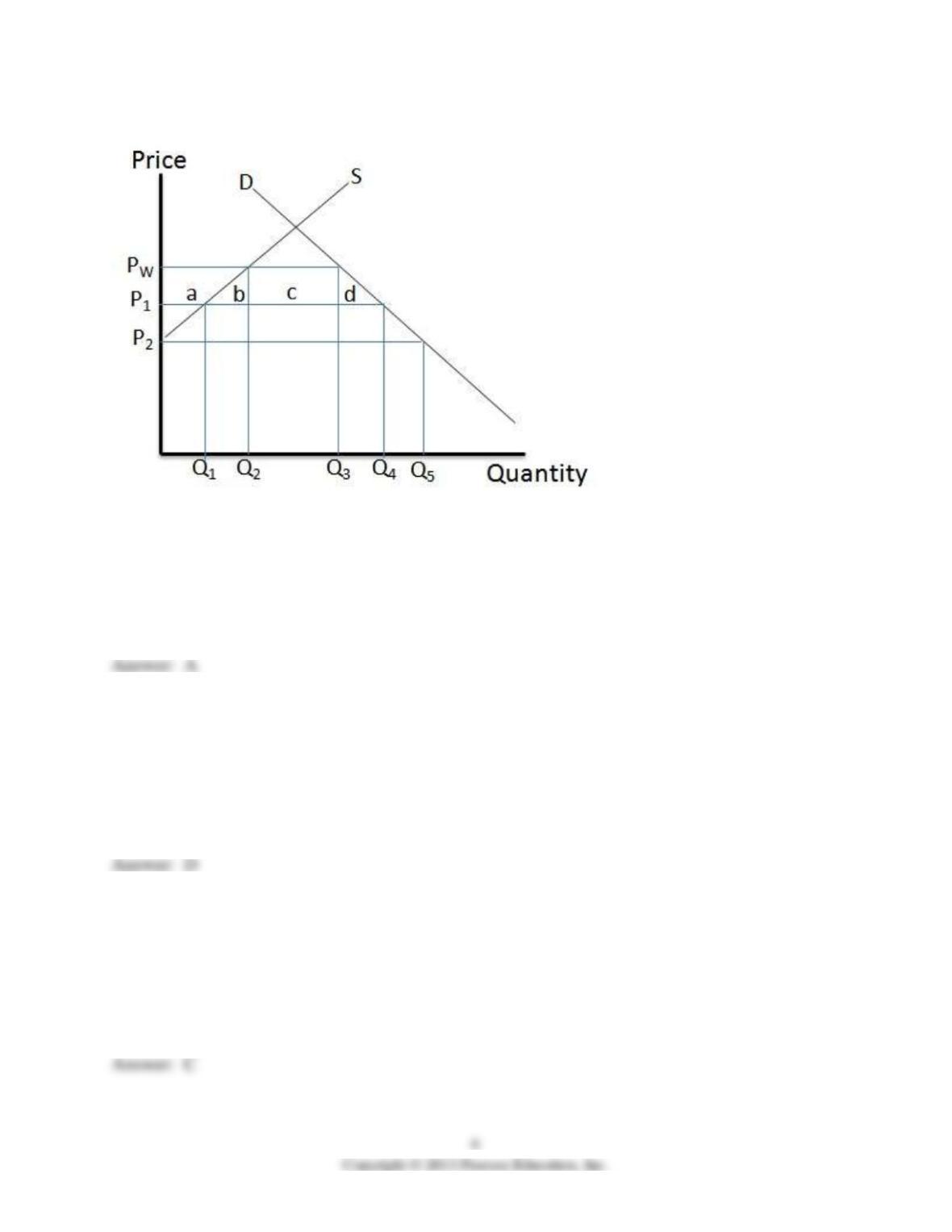
Answer the question(s) below based on the following diagram.
26) Refer to the diagram above, which represents a country’s supply and demand for an
internationally traded good. If PW is the world price, and a foreign country engages in dumping
by selling at P1, the country’s consumer surplus will ________ by ________.
A) increase; abcd
B) decrease; abcd
C) increase; bcd
D) decrease; a
27) Refer to the diagram above, which represents a country’s supply and demand for an
internationally traded good. If PW is the world price, and a foreign country engages in dumping
by selling at P1, the country’s producer surplus will ________ by ________.
A) increase; abcd
B) decrease; abcd
C) increase; bcd
D) decrease; a
28) Refer to the diagram above, which represents a country’s supply and demand for an
internationally traded good. If PW is the world price, and a foreign country engages in dumping
by selling at P1, the country’s total social surplus will ________ by ________.
A) increase; abcd
B) decrease; abcd
C) increase; bcd
D) decrease; a
7
29) Refer to the diagram above, which represents a country’s supply and demand for an
internationally traded good. If PW is the world price, and a foreign country engages in dumping
by selling at P2, total domestic production will ________ to ________.
A) increase; Q2
B) decrease; zero
C) increase; Q5
D) increase; Q3
30) Refer to the diagram above, which represents a country’s supply and demand for an
internationally traded good. If PW is the world price, and a foreign country engages in dumping
by selling at P2, total domestic consumption will ________ to ________.
A) increase; Q2
B) decrease; zero
C) increase; Q5
D) increase; Q3
8.2 True or False Questions
1) Except for the Smoot-Hawley tariff, U.S. tariff levels have always been relatively low.
2) According to the Constitution, the President sets tariff rates.
3) The last trade bill to set overall tariff rates for the United States was the Smoot-Hawley Tariff
of 1930.
4) In terms of overall welfare, dumping is good for the importing country.
5) Predatory dumping is a common problem in the United States.
6) Dumping can never be a profit maximizing strategy for a firm to follow.
7) Current U.S. trade law allows for U.S. barriers against both fairly and unfairly traded foreign
goods.
8) The Uruguay Round was unsuccessful in its attempt to strengthen international protection of
intellectual property rights.
9) One of the outcomes of the Uruguay Round is the formation of the World Trade Organization
now sets new trade rules and has more power than the old GATT to enforce the rules it sets.
10) Recently, there has been a sharp reduction in the use of antidumping and countervailing duty
laws in the United States.
11) According to U.S. law, domestic firms can obtain protection from foreign dumping, even if
this protection is harmful to overall U.S. welfare.
12) Predatory dumping by foreign firms is a very common phenomenon in U.S. markets.
13) As of 2008, the members of the WTO account for 97 percent of the world’s international
trade.
14) Most recently, the GATT agreement has replaced the WTO as the main institution promoting
international trade.
15) The Doha Round of international trade talks concluded in 2007 with the successful
establishment of a general free trade agreement between developing and developed nations.
8.3 Essay Questions
1) Write an essay on the role of Congress in U.S. trade policy since 1930.
2) Write an essay on the role of the WTO in today’s international economy.
9
3) Briefly describe some of the current policies the United States has in place to limit both fairly
and unfairly traded goods.
4) What is meant by predatory dumping? How likely is it for this to occur in the United States?
Discuss.
5) What has happened to the free trade agenda in the last few years, and in particular to the fate
of the Doha Round of trade negotiations?