CHAPTER 08—RISK AND RATES OF RETURN
Bloom’s: Comprehension
Multiple Choice: Conceptual
102. Assume that the risk-free rate, rRF, increases but the market risk premium, (rM − rRF), declines with the net effect
being that the overall required return on the market, rM, remains constant. Which of the following statements is
CORRECT?
a.
The required return of all stocks will increase by the amount of the increase in the risk-free rate.
b.
The required return will decline for stocks that have a beta less than 1.0 but will increase for stocks that have a
beta greater than 1.0.
c.
Since the overall return on the market stays constant, the required return on each individual stock will also
remain constant.
d.
The required return will increase for stocks that have a beta less than 1.0 but decline for stocks that have a beta
greater than 1.0.
e.
The required return of all stocks will fall by the amount of the decline in the market risk premium.
8-4 The Relationship Between Risk and Rates of Return
FOFM.BRIG.16.08.04 – The Relationship Between Risk and Rates of Return
United States – BUSPROG.FOFM.BRIG.16.03 – Analytic skills
United States – OH – DISC.FOFM.BRIG.16.07 – Risk and return
Bloom’s: Comprehension
103. Assume that to cool off the economy and decrease expectations for inflation, the Federal Reserve tightened the
money supply, causing an increase in the risk-free rate, rRF. Investors also became concerned that the Fed’s actions would
lead to a recession, and that led to an increase in the market risk premium, (rM − rRF). Under these conditions, with other
things held constant, which of the following statements is most correct?
a.
The required return on all stocks would increase by the same amount.
b.
The required return on all stocks would increase, but the increase would be greatest for stocks with betas of
less than 1.0.
c.
Stocks’ required returns would change, but so would expected returns, and the result would be no change in
stocks’ prices.
d.
The prices of all stocks would decline, but the decline would be greatest for high-beta stocks.
e.
The prices of all stocks would increase, but the increase would be greatest for high-beta stocks.
8-4 The Relationship Between Risk and Rates of Return
FOFM.BRIG.16.08.04 – The Relationship Between Risk and Rates of Return
United States – BUSPROG.FOFM.BRIG.16.03 – Analytic skills
United States – OH – DISC.FOFM.BRIG.16.07 – Risk and return
Bloom’s: Application
CHAPTER 08—RISK AND RATES OF RETURN
104. Which of the following statements is CORRECT?
a.
If a stock has a beta of to 1.0, its required rate of return will be unaffected by changes in the market risk
premium.
b.
The slope of the Security Market Line is beta.
c.
Any stock with a negative beta must in theory have a negative required rate of return, provided rRF is positive.
d.
If a stock’s beta doubles, its required rate of return must also double.
e.
If a stock’s returns are negatively correlated with returns on most other stocks, the stock’s beta will be
negative.
8-4 The Relationship Between Risk and Rates of Return
FOFM.BRIG.16.08.04 – The Relationship Between Risk and Rates of Return
United States – BUSPROG.FOFM.BRIG.16.03 – Analytic skills
United States – OH – DISC.FOFM.BRIG.16.07 – Risk and return
Bloom’s: Comprehension
Multiple Choice: Conceptual
105. Assume that investors have recently become more risk averse, so the market risk premium has increased. Also,
assume that the risk-free rate and expected inflation have not changed. Which of the following is most likely to occur?
a.
The required rate of return for an average stock will increase by an amount equal to the increase in the market
risk premium.
b.
The required rate of return will decline for stocks whose betas are less than 1.0.
c.
The required rate of return on the market, rM, will not change as a result of these changes.
d.
The required rate of return for each individual stock in the market will increase by an amount equal to the
increase in the market risk premium.
e.
The required rate of return on a riskless bond will decline.
8-4 The Relationship Between Risk and Rates of Return
FOFM.BRIG.16.08.04 – The Relationship Between Risk and Rates of Return
United States – BUSPROG.FOFM.BRIG.16.03 – Analytic skills
United States – OH – DISC.FOFM.BRIG.16.07 – Risk and return
Bloom’s: Application
Multiple Choice: Conceptual
106. Which of the following statements is CORRECT?
a.
A graph of the SML as applied to individual stocks would show required rates of return on the vertical axis
and standard deviations of returns on the horizontal axis.
b.
The CAPM has been thoroughly tested, and the theory has been confirmed beyond any reasonable doubt.
Multiple Choice: Conceptual
CHAPTER 08—RISK AND RATES OF RETURN
c.
If two “normal” or “typical” stocks were combined to form a 2-stock portfolio, the portfolio’s expected return
would be a weighted average of the stocks’ expected returns, but the portfolio’s standard deviation would
probably be greater than the average of the stocks’ standard deviations.
d.
If investors become more risk averse, then (1) the slope of the SML would increase and (2) the required rate of
return on low-beta stocks would increase by more than the required return on high-beta stocks.
e.
An increase in expected inflation, combined with a constant real risk-free rate and a constant market risk
premium, would lead to identical increases in the required returns on a riskless asset and on an average stock,
other things held constant.
8-4 The Relationship Between Risk and Rates of Return
FOFM.BRIG.16.08.04 – The Relationship Between Risk and Rates of Return
United States – BUSPROG.FOFM.BRIG.16.03 – Analytic skills
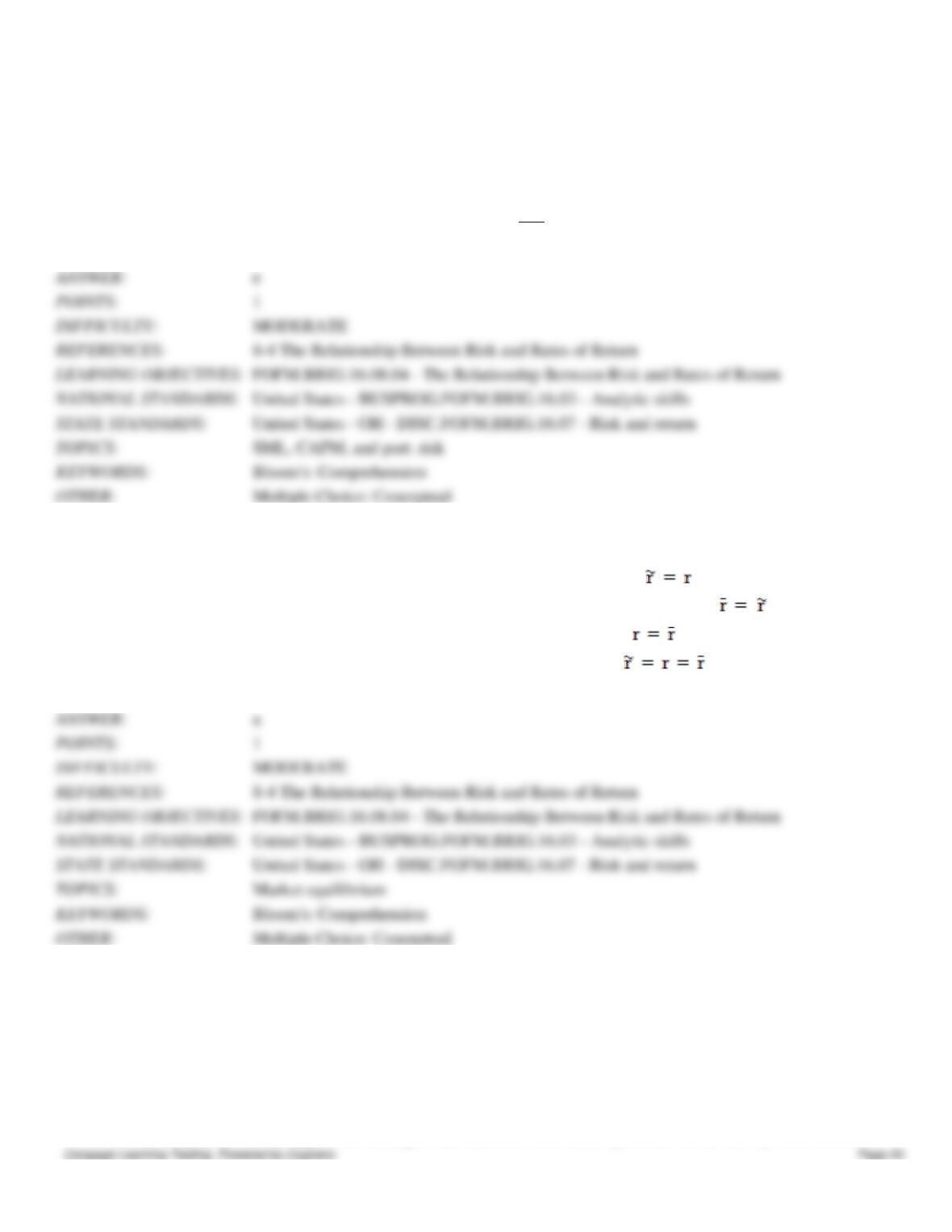
United States – OH – DISC.FOFM.BRIG.16.07 – Risk and return
Bloom’s: Comprehension
Multiple Choice: Conceptual
107. For markets to be in equilibrium, that is, for there to be no strong pressure for prices to depart from their current
levels,
a.
The expected rate of return must be equal to the required rate of return; that is, .
b.
The past realized rate of return must be equal to the expected future rate of return; that is, .
c.
The required rate of return must equal the past realized rate of return; that is, .
d.
All three of the above statements must hold for equilibrium to exist; that is, .
e.
None of these statements is correct.
8-4 The Relationship Between Risk and Rates of Return
FOFM.BRIG.16.08.04 – The Relationship Between Risk and Rates of Return
United States – BUSPROG.FOFM.BRIG.16.03 – Analytic skills
United States – OH – DISC.FOFM.BRIG.16.07 – Risk and return
Market equilibrium
Bloom’s: Comprehension
Multiple Choice: Conceptual
108. Which of the following statements is CORRECT?
a.
When diversifiable risk has been diversified away, the inherent risk that remains is market risk, which is
constant for all stocks in the market.
b.
Portfolio diversification reduces the variability of returns on an individual stock.
c.
Risk refers to the chance that some unfavorable event will occur, and a probability distribution is completely
described by a listing of the likelihoods of unfavorable events.
d.
The SML relates a stock’s required return to its market risk. The slope and intercept of this line cannot be
controlled by the firms’ managers, but managers can influence their firms’ positions on the line by such actions
CHAPTER 08—RISK AND RATES OF RETURN
as changing the firm’s capital structure or the type of assets it employs.
e.
A stock with a beta of −1.0 has zero market risk if held in a 1-stock portfolio.
FOFM.BRIG.16.08.00 – Comprehensive
United States – BUSPROG.FOFM.BRIG.16.03 – Analytic skills
United States – OH – DISC.FOFM.BRIG.16.07 – Risk and return
Risk concepts
Bloom’s: Comprehension
Multiple Choice: Conceptual
109. You observe the following information regarding Companies X and Y:
•
Company X has a higher expected return than Company Y.
•
Company X has a lower standard deviation of returns than Company Y.
•
Company X has a higher beta than Company Y.
Given this information, which of the following statements is CORRECT?
a.
Company X has more diversifiable risk than Company Y.
b.
Company X has a lower coefficient of variation than Company Y.
c.
Company X has less market risk than Company Y.
d.
Company X’s returns will be negative when Y’s returns are positive.
e.
Company X’s stock is a better buy than Company Y’s stock.
FOFM.BRIG.16.08.00 – Comprehensive
United States – BUSPROG.FOFM.BRIG.16.03 – Analytic skills
United States – OH – DISC.FOFM.BRIG.16.07 – Risk and return
Risk measures
Bloom’s: Evaluation
Multiple Choice: Conceptual
110. Stocks A and B both have an expected return of 10% and a standard deviation of returns of 25%. Stock A has a beta
of 0.8 and Stock B has a beta of 1.2. The correlation coefficient, r, between the two stocks is +0.6. Portfolio P has 50%
invested in Stock A and 50% invested in B. Which of the following statements is CORRECT?
a.
Portfolio P has a standard deviation of 25% and a beta of 1.0.
b.
Based on the information we are given, and assuming those are the views of the marginal investor, it is
apparent that the two stocks are in equilibrium.
c.
Portfolio P has more market risk than Stock A but less market risk than B.
d.
Stock A should have a higher expected return than Stock B as viewed by the marginal investor.
e.
Portfolio P has a coefficient of variation equal to 2.5.
CHAPTER 08—RISK AND RATES OF RETURN
8-3 Risk in a Portfolio Context: The CAPM
FOFM.BRIG.16.08.03 – Risk in a Portfolio Context: The CAPM
United States – BUSPROG.FOFM.BRIG.16.03 – Analytic skills
United States – OH – DISC.FOFM.BRIG.16.07 – Risk and return
Portfolio risk
Bloom’s: Analysis
Multiple Choice: Conceptual
111. The risk-free rate is 6% and the market risk premium is 5%. Your $1 million portfolio consists of $700,000 invested
in a stock that has a beta of 1.2 and $300,000 invested in a stock that has a beta of 0.8. Which of the following statements
is CORRECT?
a.
If the stock market is efficient, your portfolio’s expected return should equal the expected return on the market,
which is 11%.
b.
The required return on the market is 10%.
c.
The portfolio’s required return is less than 11%.
d.
If the risk-free rate remains unchanged but the market risk premium increases by 2%, your portfolio’s required
return will increase by more than 2%.
e.
If the market risk premium remains unchanged but expected inflation increases by 2%, your portfolio’s
required return will increase by more than 2%.
8-4 The Relationship Between Risk and Rates of Return
FOFM.BRIG.16.08.04 – The Relationship Between Risk and Rates of Return
United States – BUSPROG.FOFM.BRIG.16.03 – Analytic skills
United States – OH – DISC.FOFM.BRIG.16.07 – Risk and return
Port. risk and ret. relationships
Bloom’s: Analysis
Multiple Choice: Conceptual
112. Stock A has an expected return of 10% and a standard deviation of 20%. Stock B has an expected return of 13% and
a standard deviation of 30%. The risk-free rate is 5% and the market risk premium, rM − rRF, is 6%. Assume that the
market is in equilibrium. Portfolio AB has 50% invested in Stock A and 50% invested in Stock B. The returns of Stock A
and Stock B are independent of one another, i.e., the correlation coefficient between them is zero. Which of the following
statements is CORRECT?
a.
Stock A’s beta is 0.8333.
b.
Since the two stocks have zero correlation, Portfolio AB is riskless.
c.
Stock B’s beta is 1.0000.
d.
Portfolio AB’s required return is 11%.
e.
Portfolio AB’s standard deviation is 25%.
CHAPTER 08—RISK AND RATES OF RETURN
a is correct. Stock A’s required return is 10% = 5% + b(6%), so b = 5%/6% = 0.83333.
8-4 The Relationship Between Risk and Rates of Return
FOFM.BRIG.16.08.04 – The Relationship Between Risk and Rates of Return
United States – BUSPROG.FOFM.BRIG.16.03 – Analytic skills
United States – OH – DISC.FOFM.BRIG.16.07 – Risk and return
Port. risk and ret. relationships
Bloom’s: Analysis
Multiple Choice: Conceptual
113. Stock A has a beta of 1.2 and a standard deviation of 25%. Stock B has a beta of 1.4 and a standard deviation of 20%.
Portfolio AB was created by investing in a combination of Stocks A and B. Portfolio AB has a beta of 1.25 and a standard
deviation of 18%. Which of the following statements is CORRECT?
a.
Stock A has more market risk than Portfolio AB.
b.
Stock A has more market risk than Stock B but less stand-alone risk.
c.
Portfolio AB has more money invested in Stock A than in Stock B.
d.
Portfolio AB has the same amount of money invested in each of the two stocks.
e.
Portfolio AB has more money invested in Stock B than in Stock A.
8-4 The Relationship Between Risk and Rates of Return
FOFM.BRIG.16.08.04 – The Relationship Between Risk and Rates of Return
United States – BUSPROG.FOFM.BRIG.16.03 – Analytic skills
United States – OH – DISC.FOFM.BRIG.16.07 – Risk and return
Port. risk and ret. relationships
Bloom’s: Analysis
Multiple Choice: Conceptual
114. Which of the following statements is CORRECT?
a.
If Mutual Fund A held equal amounts of 100 stocks, each of which had a beta of 1.0, and Mutual Fund B held
equal amounts of 10 stocks with betas of 1.0, then the two mutual funds would both have betas of 1.0. Thus,
they would be equally risky from an investor’s standpoint, assuming the investor‘s only asset is one or the other
of the mutual funds.
b.
If investors become more risk averse but rRF does not change, then the required rate of return on high-beta
stocks will rise and the required return on low-beta stocks will decline, but the required return on an average-
risk stock will not change.
c.
An investor who holds just one stock will generally be exposed to more risk than an investor who holds a
portfolio of stocks, assuming the stocks are all equally risky. Since the holder of the 1-stock portfolio is
exposed to more risk, he or she can expect to earn a higher rate of return to compensate for the greater risk.
CHAPTER 08—RISK AND RATES OF RETURN
d.
There is no reason to think that the slope of the yield curve would have any effect on the slope of the SML.
e.
Assume that the required rate of return on the market, rM, is given and fixed at 10%. If the yield curve were
upward sloping, then the Security Market Line (SML) would have a steeper slope if 1-year Treasury securities
were used as the risk-free rate than if 30-year Treasury bonds were used for rRF.
e
CHALLENGING
8-4 The Relationship Between Risk and Rates of Return
FOFM.BRIG.16.08.04 – The Relationship Between Risk and Rates of Return
United States – BUSPROG.FOFM.BRIG.16.03 – Analytic skills
United States – OH – DISC.FOFM.BRIG.16.07 – Risk and return
Bloom’s: Analysis
Multiple Choice: Conceptual
115. Taggart Inc.’s stock has a 50% chance of producing a 25% return, a 30% chance of producing a 10% return, and a
20% chance of producing a −28% return. What is the firm’s expected rate of return?
a.
9.41%
b.
9.65%
c.
9.90%
d.
10.15%
e.
10.40%
c
EASY
8-2 Stand-Alone Risk
FOFM.BRIG.16.08.02 – Stand-Alone Risk
United States – BUSPROG.FOFM.BRIG.16.03 – Analytic skills
United States – OH – DISC.FOFM.BRIG.16.07 – Risk and return
Expected return
Bloom’s: Analysis
Multiple Choice: Problem
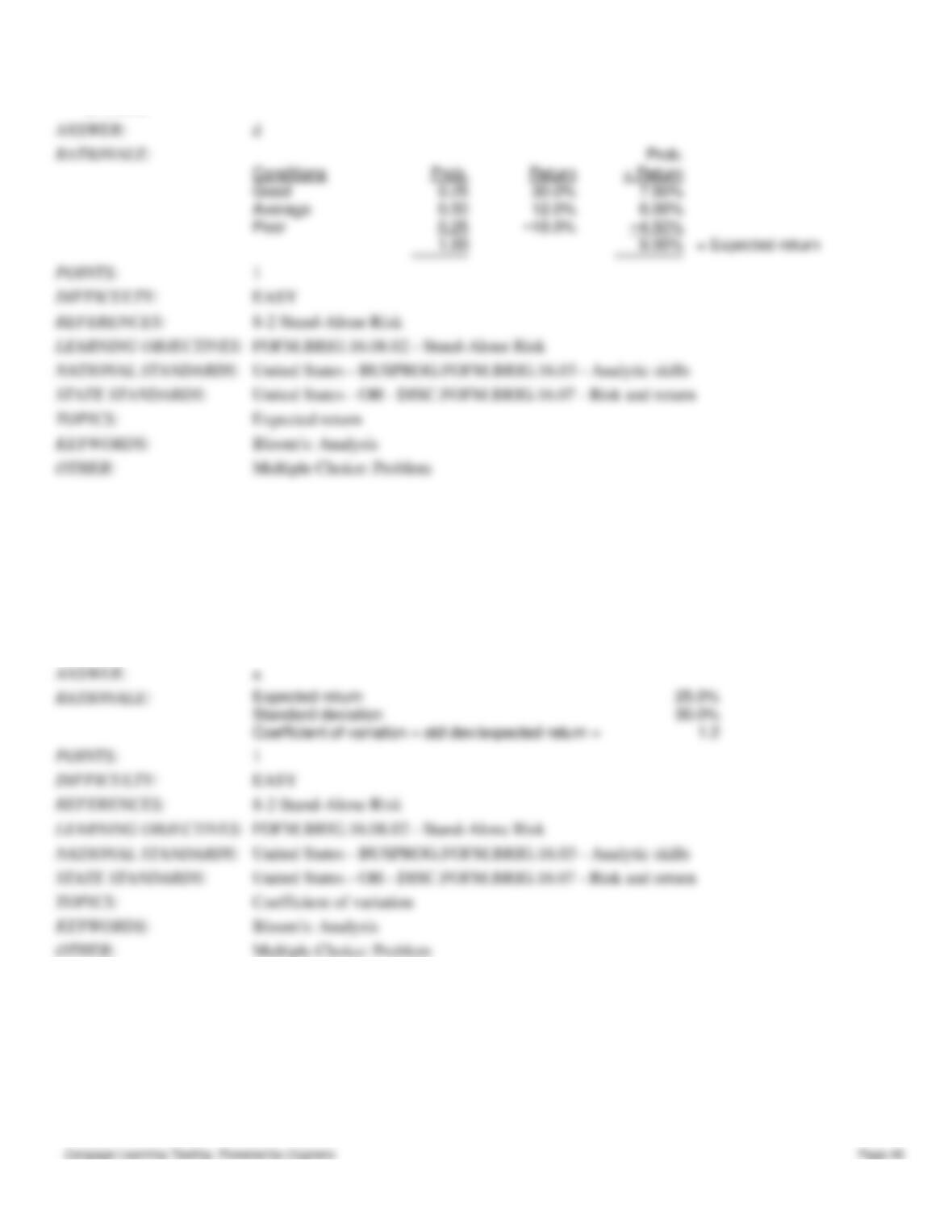
116. Dothan Inc.’s stock has a 25% chance of producing a 30% return, a 50% chance of producing a 12% return, and a
25% chance of producing a −18% return. What is the firm’s expected rate of return?
a.
7.72%
b.
8.12%
c.
8.55%
d.
9.00%
CHAPTER 08—RISK AND RATES OF RETURN
e.
9.50%
EASY
117. Cheng Inc. is considering a capital budgeting project that has an expected return of 25% and a standard deviation of
30%. What is the project’s coefficient of variation?
a.
1.20
b.
1.26
c.
1.32
d.
1.39
e.
1.46
a
EASY
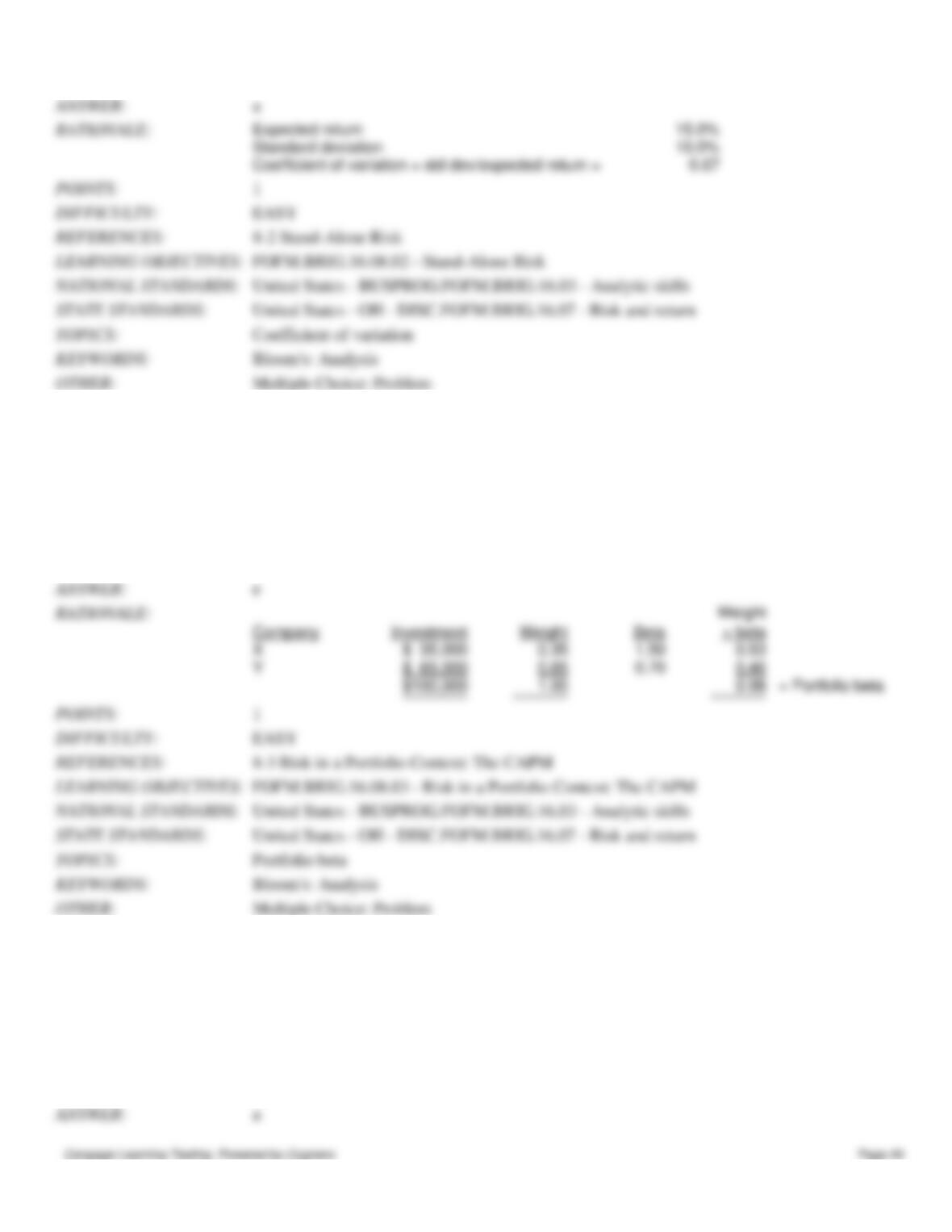
118. Bae Inc. is considering an investment that has an expected return of 15% and a standard deviation of 10%. What is
the investment’s coefficient of variation?
a.
0.67
b.
0.73
c.
0.81
d.
0.89
e.
0.98
CHAPTER 08—RISK AND RATES OF RETURN
a
EASY
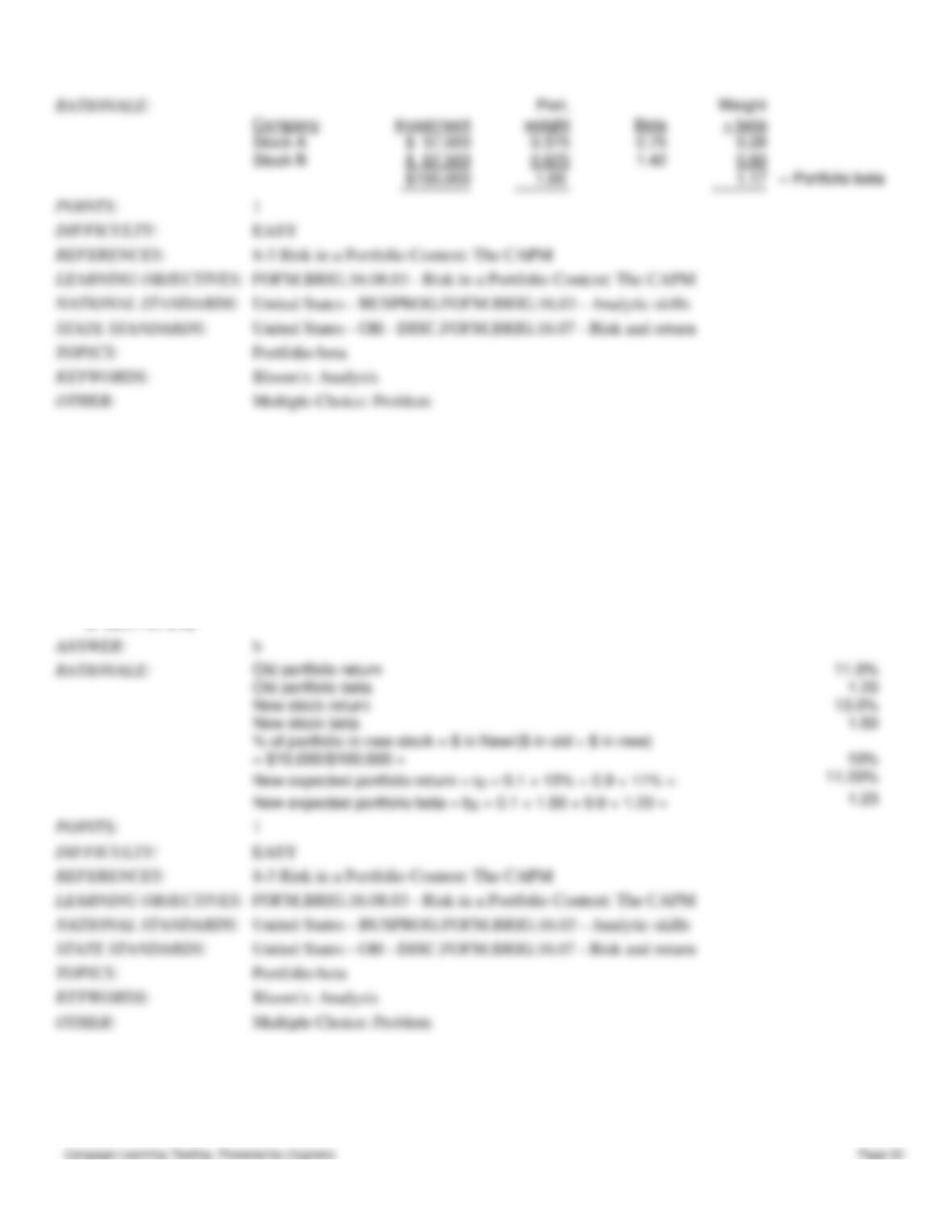
119. Bill Dukes has $100,000 invested in a 2-stock portfolio. $35,000 is invested in Stock X and the remainder is invested
in Stock Y. X’s beta is 1.50 and Y’s beta is 0.70. What is the portfolio’s beta?
a.
0.65
b.
0.72
c.
0.80
d.
0.89
e.
0.98
e
EASY
120. Tom O’Brien has a 2-stock portfolio with a total value of $100,000. $37,500 is invested in Stock A with a beta of
0.75 and the remainder is invested in Stock B with a beta of 1.42. What is his portfolio’s beta?
a.
1.17
b.
1.23
c.
1.29
d.
1.35
e.
1.42
a
CHAPTER 08—RISK AND RATES OF RETURN
121. Assume that you hold a well-diversified portfolio that has an expected return of 11.0% and a beta of 1.20. You are in
the process of buying 1,000 shares of Alpha Corp at $10 a share and adding it to your portfolio. Alpha has an expected
return of 13.0% and a beta of 1.50. The total value of your current portfolio is $90,000. What will the expected return and
beta on the portfolio be after the purchase of the Alpha stock?
a.
10.64%; 1.17
b.
11.20%; 1.23
c.
11.76%; 1.29
d.
12.35%; 1.36
e.
12.97%; 1.42
EASY
8-3 Risk in a Portfolio Context: The CAPM
FOFM.BRIG.16.08.03 – Risk in a Portfolio Context: The CAPM
United States – BUSPROG.FOFM.BRIG.16.03 – Analytic skills
United States – OH – DISC.FOFM.BRIG.16.07 – Risk and return
Bloom’s: Analysis
Multiple Choice: Problem
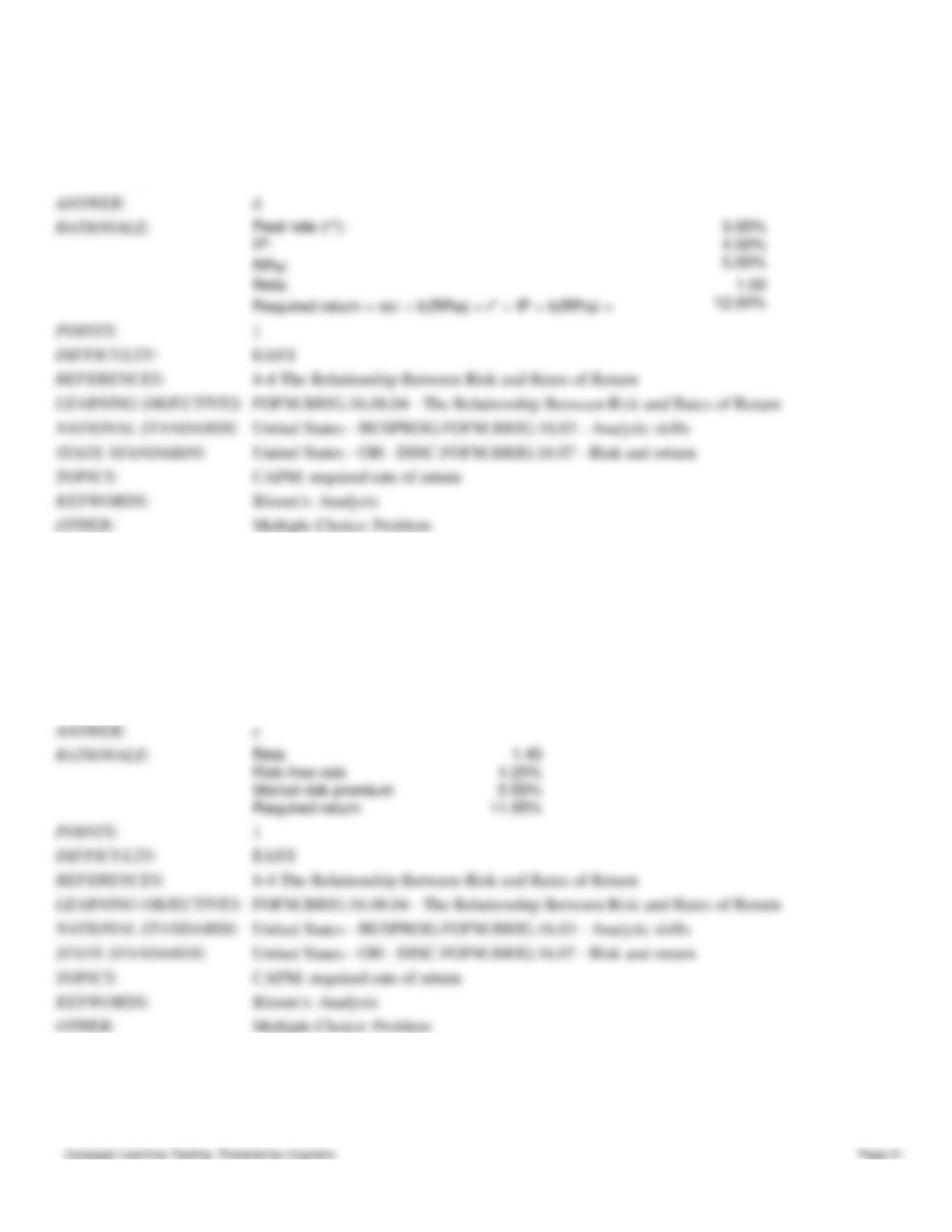
122. Calculate the required rate of return for Climax Inc., assuming that (1) investors expect a 4.0% rate of inflation in the
future, (2) the real risk-free rate is 3.0%, (3) the market risk premium is 5.0%, (4) the firm has a beta of 1.00, and (5) its
realized rate of return has averaged 15.0% over the last 5 years.
a.
10.29%
EASY
8-3 Risk in a Portfolio Context: The CAPM
FOFM.BRIG.16.08.03 – Risk in a Portfolio Context: The CAPM
United States – BUSPROG.FOFM.BRIG.16.03 – Analytic skills
United States – OH – DISC.FOFM.BRIG.16.07 – Risk and return
Portfolio beta
Bloom’s: Analysis
Multiple Choice: Problem
CHAPTER 08—RISK AND RATES OF RETURN
b.
10.83%
c.
11.40%
d.
12.00%
e.
12.60%
EASY
123. Cooley Company’s stock has a beta of 1.40, the risk-free rate is 4.25%, and the market risk premium is 5.50%. What
is the firm’s required rate of return?
a.
11.36%
b.
11.65%
c.
11.95%
d.
12.25%
e.
12.55%
c
EASY
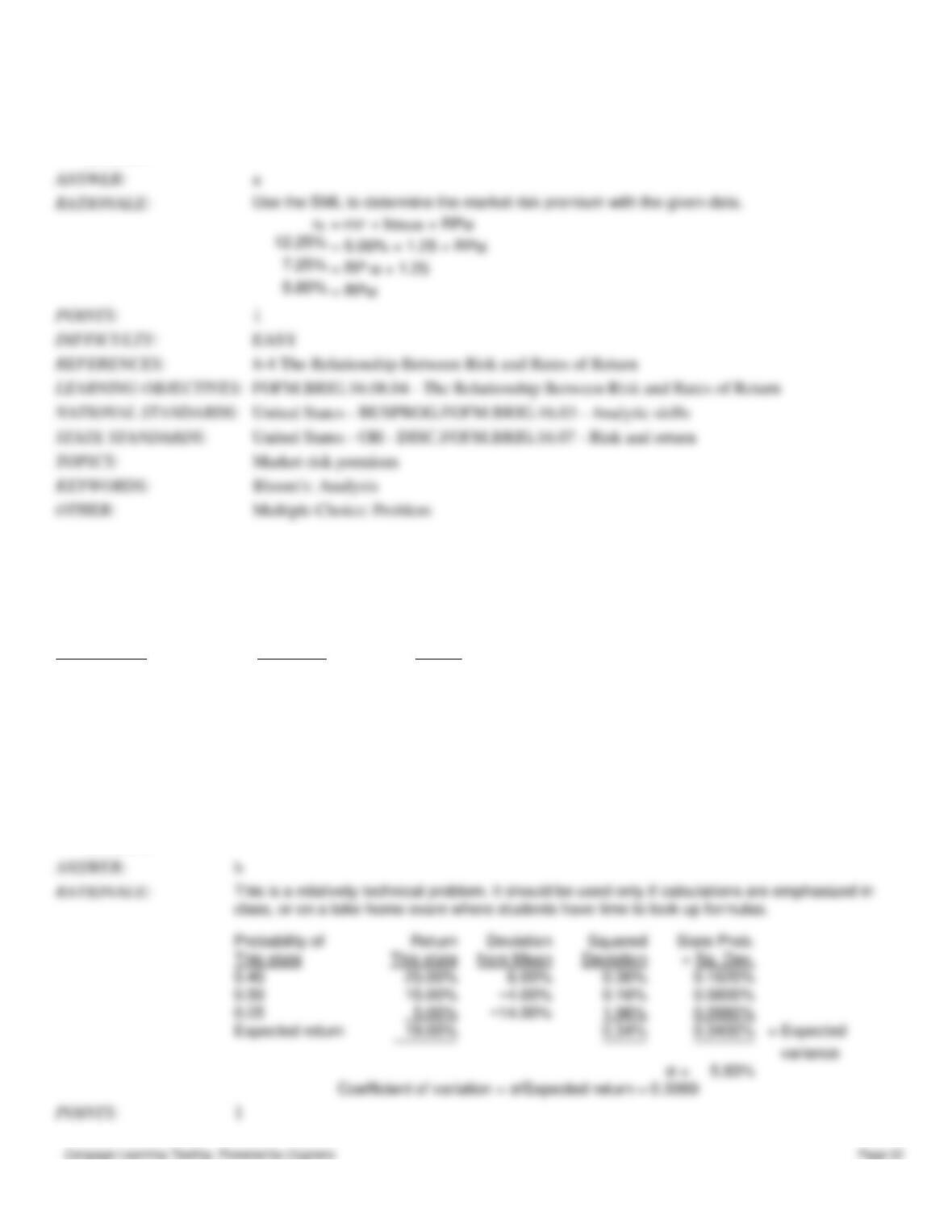
124. Porter Inc’s stock has an expected return of 12.25%, a beta of 1.25, and is in equilibrium. If the risk-free rate is
5.00%, what is the market risk premium?
a.
5.80%
b.
5.95%
CHAPTER 08—RISK AND RATES OF RETURN
c.
6.09%
d.
6.25%
e.
6.40%
a
EASY
8-4 The Relationship Between Risk and Rates of Return
FOFM.BRIG.16.08.04 – The Relationship Between Risk and Rates of Return
United States – BUSPROG.FOFM.BRIG.16.03 – Analytic skills
United States – OH – DISC.FOFM.BRIG.16.07 – Risk and return
Market risk premium
Bloom’s: Analysis
Multiple Choice: Problem
125. Roenfeld Corp believes the following probability distribution exists for its stock. What is the coefficient of variation
on the company’s stock?
Probability
Stock’s
State of
of State
Expected
the Economy
Occurring
Return
Boom
0.45
25%
Normal
0.50
15%
Recession
0.05
5%
a.
0.2839
b.
0.3069
c.
0.3299
d.
0.3547
e.
0.3813
CHAPTER 08—RISK AND RATES OF RETURN
126. Jim Angel holds a $200,000 portfolio consisting of the following stocks:
Stock
Investment
Beta
A
$ 50,000
0.95
B
50,000
0.80
C
50,000
1.00
D
50,000
1.20
Total
$200,000
What is the portfolio’s beta?
a.
0.938
b.
0.988
c.
1.037
d.
1.089
e.
1.143
MODERATE
127. Jill Angel holds a $200,000 portfolio consisting of the following stocks. The portfolio’s beta is 0.875.
Stock
Investment
Beta
A
$ 50,000
0.50
MODERATE
CHAPTER 08—RISK AND RATES OF RETURN
B
50,000
0.80
C
50,000
1.00
D
50,000
1.20
Total
$200,000
If Jill replaces Stock A with another stock, E, which has a beta of 1.50, what will the portfolio’s new beta be?
a.
1.07
b.
1.13
c.
1.18
d.
1.24
e.
1.30
MODERATE
8-3 Risk in a Portfolio Context: The CAPM
FOFM.BRIG.16.08.03 – Risk in a Portfolio Context: The CAPM
United States – BUSPROG.FOFM.BRIG.16.03 – Analytic skills
United States – OH – DISC.FOFM.BRIG.16.07 – Risk and return
Portfolio beta
Bloom’s: Analysis
Multiple Choice: Problem
128. Mike Flannery holds the following portfolio:
Stock
Investment
Beta
A
$150,000
1.40
B
50,000
0.80
C
100,000
1.00
D
75,000
1.20
Total
$375,000
What is the portfolio’s beta?