5) If nominal Gross Domestic Product (GDP) in 2001 was $1 trillion, nominal Gross Domestic
Product (GDP) in 2018 was $2 trillion, and the 2001 and 2018 price indexes were 100 and 250
respectively
A) real Gross Domestic Product (GDP) increased between 2001 and 2015.
B) real Gross Domestic Product (GDP) decreased between 2001 and 2015.
C) real Gross Domestic Product (GDP) remained constant.
D) we cannot draw any conclusions about changes in real Gross Domestic Product (GDP).
6) If nominal Gross Domestic Product (GDP) in 2018 was $3,000 billion, and the price level
index was 330 (2000 = 100), then real Gross Domestic Product (GDP) in terms of the price level
in 2018 was about
A) $105 billion.
B) $4,220 billion.
C) $909 billion.
D) $537 billion.
7) The difference between nominal and real values is that real values take into account
A) depreciation.
B) changes in the composition of output.
C) changes in prices between years.
D) the presence of durable goods.
8) The nominal value of Gross Domestic Product (GDP) is expressed in
A) inflation-adjusted prices.
B) constant dollars.
C) base-year dollars.
D) none of the above.
9) Adjusting nominal Gross Domestic Product (GDP) for price changes from a base year yields
A) current Gross Domestic Product (GDP).
B) real Gross Domestic Product (GDP).
C) constant disposable income.
D) Gross Domestic Product (GDP) net of relative price changes.
10) Constant dollar Gross Domestic Product (GDP)
A) is the same as nominal Gross Domestic Product (GDP).
B) is nominal Gross Domestic Product (GDP) divided by the price index.
C) is equal to real GDP multiplied by the overall price level.
D) all of the above.
11) Suppose 2010 is the base year. From 2010 to 2018, the price index increases from 100 to
102.5. If nominal Gross Domestic Product (GDP) is $2,800 in 2018, then the real Gross
Domestic Product (GDP) in 2018 is
A) $2,700.
B) $2,800.
C) $2,732.
D) $2,870.
12) If Gross Domestic Product (GDP) and other national income accounts are expressed in
nominal values, then they are
A) measured in real values.
B) measured in market prices at which goods actually sold.
C) measured in constant prices instead of actual market prices.
D) readily comparable to Gross Domestic Product (GDP) figures for other years.
13) The price-corrected value for Gross Domestic Product is
A) real Gross Domestic Product (GDP).
B) net Gross Domestic Product (GDP).
C) net national product.
D) per capita income.
14) Nominal income per person in the United States in 1960 was about $2,800 per year, while in
1990 nominal income per person was about $21,000. This indicates that
A) nominal income was about 7.5 times greater in 1990, but we can’t tell if this increase is due to
inflation, economic growth, or a combination of the two.
B) people enjoyed a standard of living about 7.5 times higher in 1990 than in 1960.
C) a dollar in 1960 was worth less than a dollar in 1990.
D) the average person would consider him/herself about 7.5 times happier in 1990 than in 1960.
15) If deflation is occurring and nominal Gross Domestic Product (GDP) is increasing over time,
then real Gross Domestic Product (GDP) is
A) decreasing.
B) increasing at the same rate as nominal Gross Domestic Product (GDP).
C) increasing more slowly than nominal Gross Domestic Product (GDP).
D) increasing faster than nominal Gross Domestic Product (GDP).
16) To determine how well an economy is doing, it is better to use
A) nominal Gross Domestic Product (GDP) figures.
B) real Gross Domestic Product (GDP) figures.
C) Gross Domestic Product (GDP) figures measured by the expenditure approach.
D) Gross Domestic Product (GDP) figures measured by the income approach.
17) Nominal values are
A) measured in terms of actual market prices at which the goods are sold.
B) based on inflation-adjustments.
C) based on Gross Domestic Product (GDP) per capita.
D) measured in terms of total purchasing power.
18) Per capita real Gross Domestic Product (GDP) is
A) real Gross Domestic Product (GDP) divided by the population.
B) real Gross Domestic Product (GDP) divided by a price index.
C) real Gross Domestic Product (GDP) minus depreciation.
D) population divided by real Gross Domestic Product (GDP).
19) Per capita real Gross Domestic Product (GDP)
A) does not tell us the welfare level in the country.
B) tells us the overall welfare conditions of all the country’s citizens.
C) gives only the welfare of the country’s corporations.
D) gives only the welfare of the richest areas of the country.
20) Suppose Country A and Country B each have the same real Gross Domestic Product (GDP),
equal to $440 billion. Country A has 100 million people and Country B has 175 million people.
In this situation, per capita real Gross Domestic Product (GDP) is
A) the same in both countries.
B) higher in Country A.
C) higher in Country B.
D) an irrelevant factor.
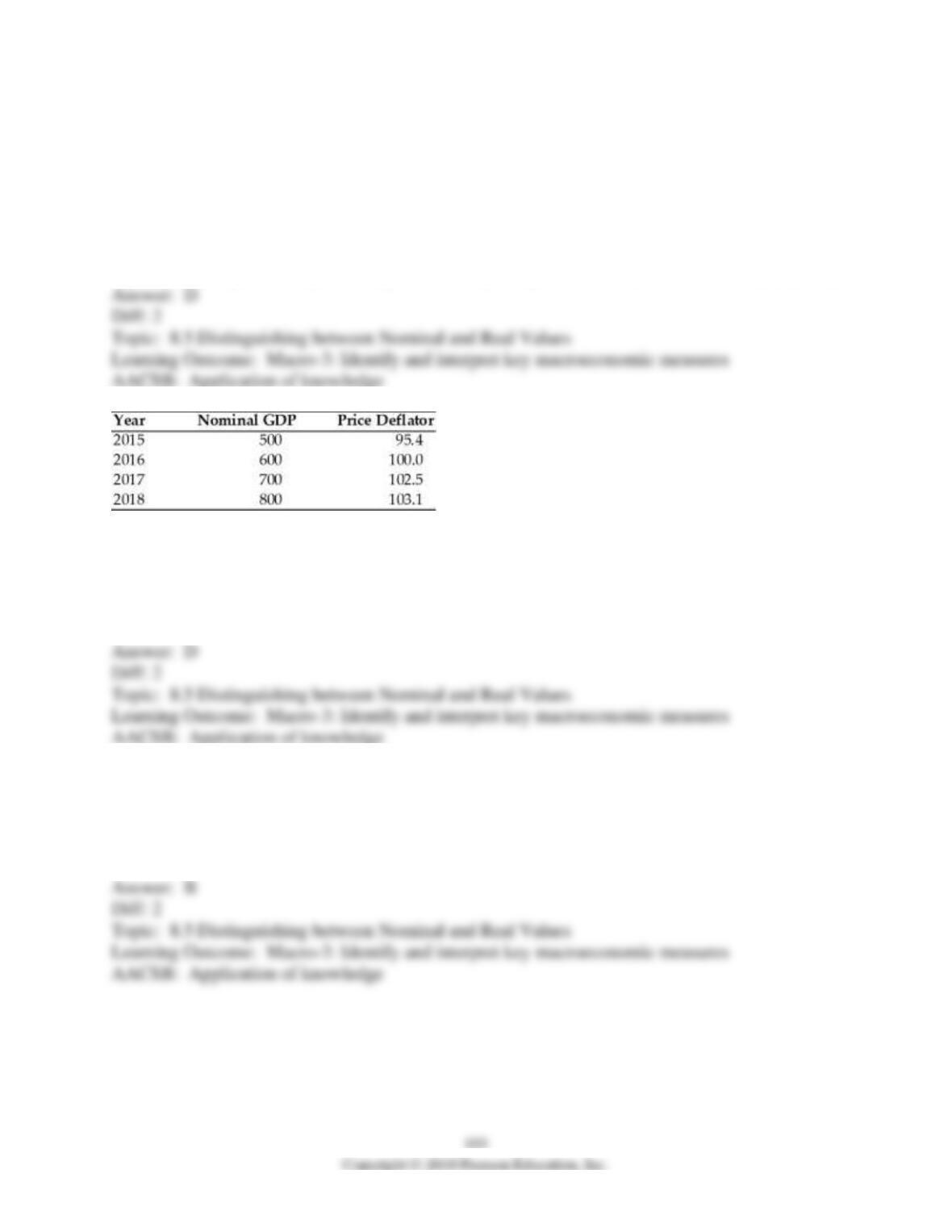
21) Suppose that the following occurred in two countries during the past decade. Country A, real
Gross Domestic Product (GDP) rose 40 percent and population rose 46 percent; Country B, real
Gross Domestic Product (GDP) increased 80 percent and population increased 75 percent. Based
on this information, which is TRUE?
A) Both countries have experienced growth in per capita real Gross Domestic Product (GDP).
B) Neither country has experienced growth in per capita real Gross Domestic Product (GDP).
C) Chances for an improved standard of living are greater in Country A.
D) Only Country B has experienced growth in its per capita real Gross Domestic Product (GDP).
22) Refer to the above table. Real GDP in 2015 is
A) 190.8.
B) 477.
C) 500.
D) 524.1.
23) Refer to the above table. Real GDP in 2017 is
A) 146.4.
B) 682.9.
C) 700.
D) 717.5.
24) Refer to the above table. Real GDP in 2018 is
A) 103.1.
B) 128.9.
C) 775.9.
D) 824.8.
25) Refer to the above table. All real GDP numbers are expressed in terms of the purchasing
power of dollars in
A) 2015.
B) 2016.
C) 2017.
D) 2018.
26) When GDP and other national income accounts are measured in nominal values, then they
A) are measured in current market prices.
B) are measured in real values.
C) are not comparable because they are not in real terms.
D) should be converted into money values before comparing them over time.
27) Between two years, GDP at constant prices increased by 5 percent while GDP at current
prices increased by 8 percent. Based on this information, the price level
A) increased by 3 percent.
B) increased by 13 percent.
C) decreased by 3 percent.
D) decreased by 13 percent.
28) The GDP deflator is equal to.
A) nominal GDP divided by real GDP.
B) nominal GDP multiplied by real GDP.
C) nominal GDP minus real GDP.
D) nominal GDP plus real GDP.
29) Which of the following represents how real GDP is calculated?
A) nominal GDP multiplied by the GDP deflator
B) nominal GDP divided by the population
C) nominal GDP divided by the PPI, the producer price index
D) nominal GDP divided by the GDP deflator
30) The nominal value of an economic variable is
A) the consumer price index.
B) the producer price.
C) expressed in terms of actual market prices at which goods are sold.
D) computed by taking the nominal value and dividing by the appropriate price index.
31) The real value of an economic variable is
A) the consumer price index.
B) the producer price.
C) expressed in terms of actual market prices at which goods are sold.
D) computed by taking the nominal value and dividing by the appropriate price index.
32) Constant dollars are
A) the same as current dollars.
B) dollars corrected for general price level changes.
C) what nominal GDP is measured in.
D) when an individual does not receive a cost of living increase.
33) The values of variables such as GDP expressed in current dollars are referred to as
A) the price index.
B) a deflator.
C) nominal values.
D) real values.
34) Measurement of economic values after adjustments have been made for changes in the
average of prices between years in known as
A) the price index.
B) a deflator.
C) nominal values.
D) real values.
35) Real GDP is
A) the nominal value of all real goods produced in the nation in a year.
B) Nominal GDP corrected for changes in the average of overall prices.
C) a misnomer since all GDP figures have to be in dollar values.
D) the value of output in current dollars.
36) Comparing two countries’ nominal GDP over time is likely to be misleading if one wants to
determine whether standards of living are better in one country because
A) the figures must be adjusted for different types of currency.
B) the figures must be adjusted for price changes and population differences.
C) the figures must be adjusted to account for production differences.
D) NDP instead of GDP should be used.
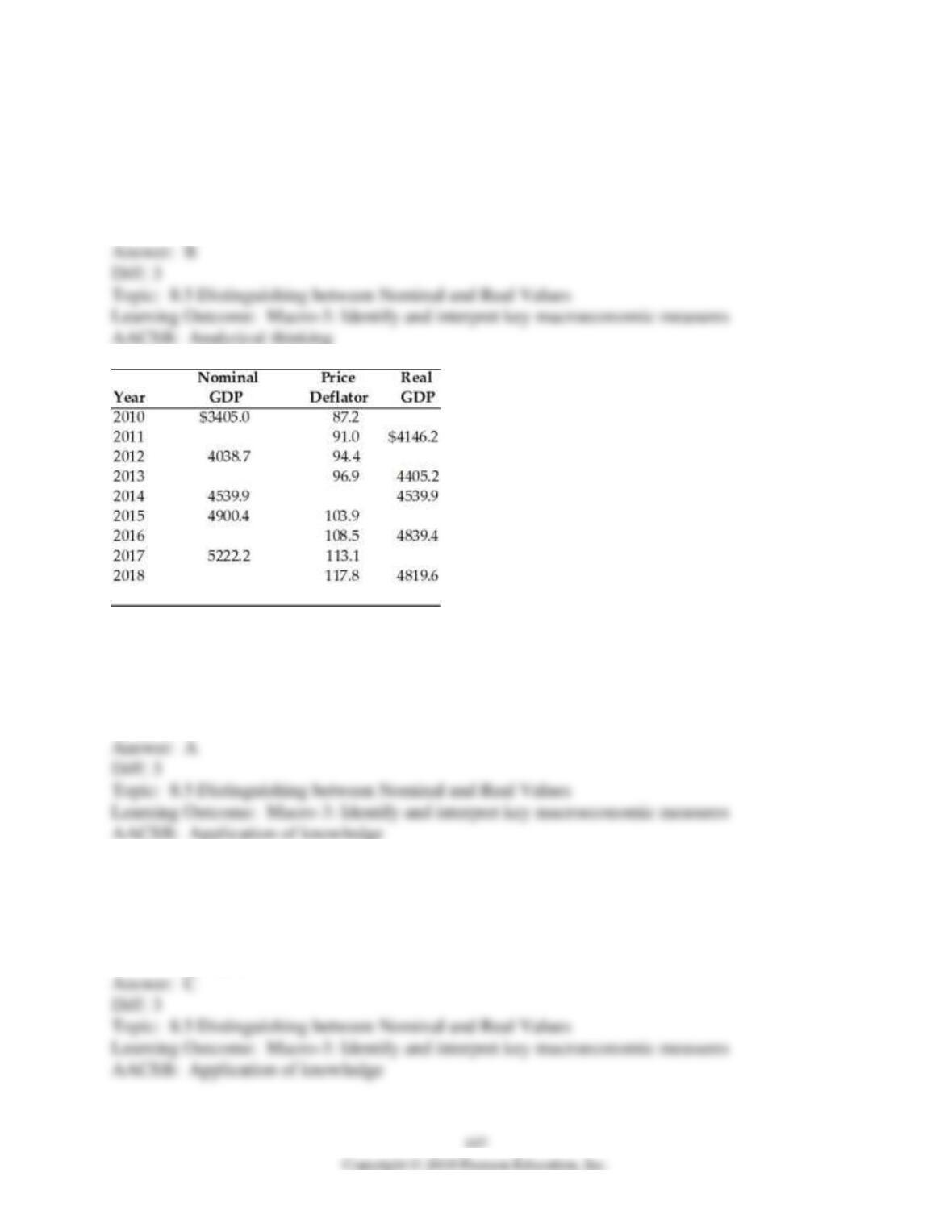
37) Refer to the above table (figures in billions). The value of the GDP deflator in 2014 is
A) 100.
B) 102.
C) 104.
D) uncertain without more information.
38) Refer to the above table (figures in billions). Between 2014 and 2015 real GDP
A) increased by $191.7 billion.
B) increased by $1.76 billion.
C) increased by $176.17 billion.
D) increased by $360.5 billion.
39) Refer to the above table (figures in billions). The nominal GDP for 2018 is
A) $4819.6 billion.
B) $4091.3 billion.
C) $5677.5 billion.
D) uncertain without more information.
40) Refer to the above table (figures in billions). Real GDP for year 2017 was
A) $4819.6 billion.
B) $5222.2 billion.
C) $4617.3 billion.
D) uncertain without more information.
41) If a nation’s nominal GDP is $3,257 million and its price level is 110, then its real GDP is
A) $1960.9 million.
B) $24.67 million.
C) $2960.9 million.
D) $2467.42 million.
42) Suppose nominal GDP in Greece decreased by 5% in 2018. Given this information, we know
with certainty that
A) the aggregate price level in Greece decreased in 2018.
B) real GDP in Greece decreased in 2018.
C) both the aggregate price level AND real GDP decreased in Greece in 2018.
D) more information is needed to answer this question.
43) Nominal GDP is calculated using
A) the market prices during the year under consideration.
B) the prices from some base year to adjust for price changes.
C) the average of prices from the three preceding years.
D) the prices from the preceding year.
44) Real GDP is
A) nominal GDP adjusted for depreciation.
B) nominal GDP adjusted for price changes.
C) nominal GDP adjusted for transfer payments.
D) nominal GDP adjusted for indirect business taxes.
45) Measuring total aggregate production in current dollars uses which of the following
measures?
A) real personal income
B) real gross domestic product
C) nominal gross domestic product
D) nominal net domestic product
46) Assume that the nominal GDP for a given year is equal to $12,400 billion and the GDP
deflator equals 112. Real GDP for that year is approximately
A) $13,888.0 billion.
B) $12,512.0 billion.
C) $11,071.4 billion.
D) $12,228.1 billion.
47) Constant dollars are dollars
A) corrected for general price level changes.
B) measured in terms of current-year prices.
C) issued by the U.S. Treasury with values that fail to change even in the face of inflation or
deflation.
D) issued by the Federal Reserve with values that fail to change even in the face of inflation or
deflation.
48) When one converts nominal GDP to real GDP, one takes into account which of the
following?
A) changes in the population
B) changes in the quality of goods
C) changes in the distribution of income
D) none of the above
49) Measuring total aggregate production in constant dollars uses which of the following
measures?
A) real personal income
B) real gross domestic product
C) nominal gross domestic product
D) nominal net domestic product
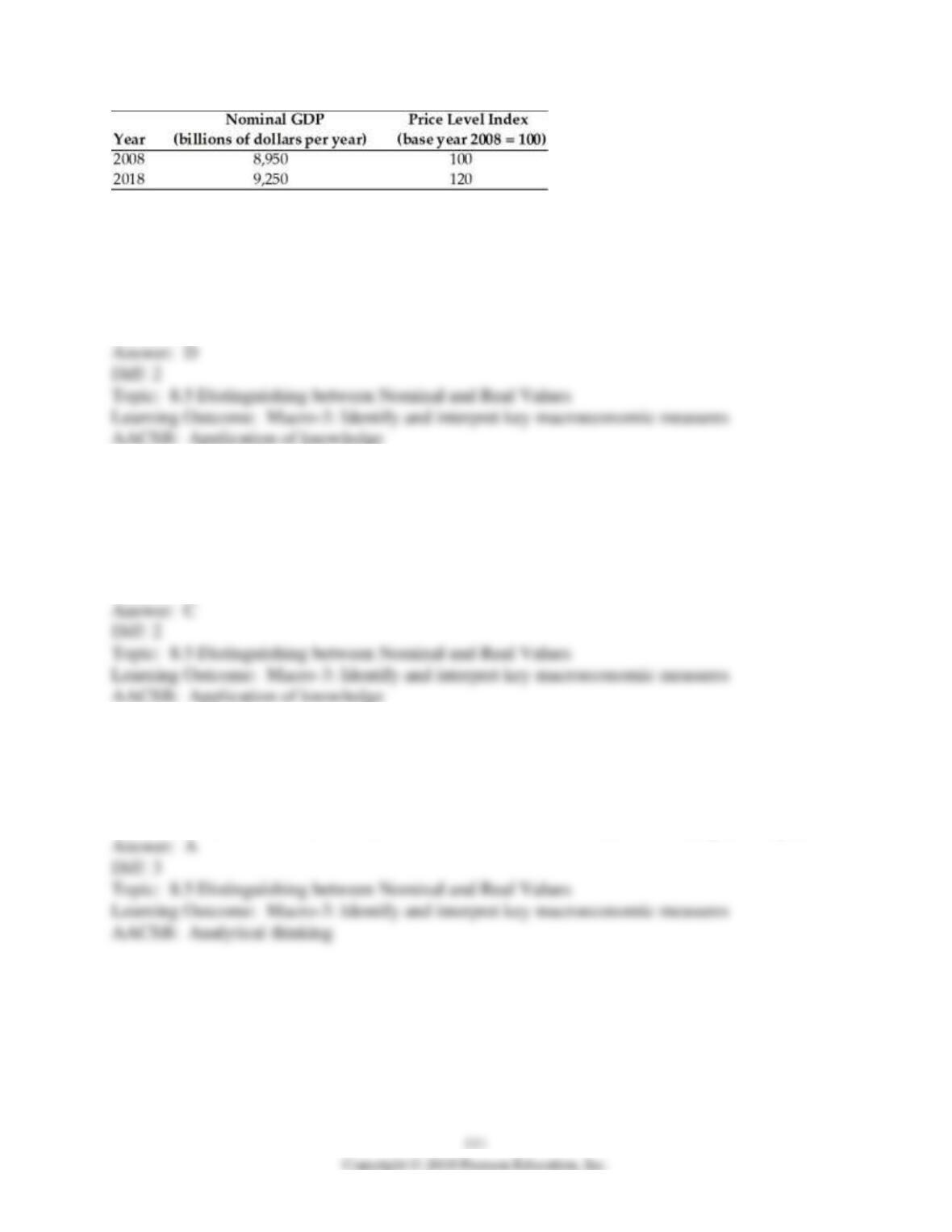
50) Using the data in the above table, what is the real GDP for year 2008 (in billions of constant
dollars)?
A) 9,250
B) 8,500
C) 7,708
D) 8,950
51) Using the data in the above table, what is the real GDP for year 2018 (in billions of constant
dollars)?
A) 9,250
B) 8,500
C) 7,708
D) 8,950
52) Which of the following statements is TRUE?
A) During periods of inflation, nominal GDP increases more rapidly than does real GDP.
B) Nominal values are expressed in constant dollars.
C) Real values are expressed in current dollars.
D) Increases in real GDP are evidence that the distribution of wealth is becoming more equal.
53) The most accurate way to compare standards of living throughout the world is to look at
A) total Gross Domestic Product (GDP).
B) GNP.
C) purchasing power parity.
D) foreign exchange rates.
54) The foreign exchange rate is
A) an adjustment that takes into account differences in the true cost of living across countries.
B) the price of one currency in terms of another.
C) another name for purchasing power parity.
D) part of the circular flow diagram.
55) Comparing GDP across countries is unrealistic unless we make adjustment in exchange rates
to take into account differences in the cost of living via
A) real GDP.
B) purchasing power parity.
C) price index.
D) international GDP.
56) Purchasing power parity refers to
A) adjustments in GDP figures to put everything into one common currency for comparison
sake.
B) adjustments in exchange rate conversions that take into account differences in inflation rates
across countries.
C) adjustments in exchange rate conversions that take into account the differences in true cost of
living across countries.
D) calculating real, per capita GDP in dollars.
57) The problem with using foreign exchange rates to convert one country’s GDP into dollars is
that
A) the values of currencies are not comparable.
B) exchange rates do not reflect differences in inflation rates.
C) not all goods and services are sold on world markets.
D) the dollar has been losing value over the last twenty years.
58) To find the U.S. dollar equivalent of a given amount of Mexican pesos, you would have to
know
A) per capita GDP in Mexico.
B) per capita GDP in the United States.
C) per capita GDP in both the United States and Mexico.
D) the foreign exchange rate between dollars and pesos.
59) A purchasing power parity index would help you
A) predict changes in U.S. real GDP.
B) identify those goods and services that are becoming relatively more important in chain-
weighted GDP.
C) make international comparisons of living standards.
D) estimate the growth rate of U.S. personal income.
60) The foreign exchange rate
A) is the price of one good or service as compared to a similar good or service.
B) is the same as the price of a product in U.S. dollars.
C) is not relevant when comparing the GDPs of various countries.
D) is the price of one currency in terms of another.
61) Of the following, which country has the highest annual real GDP per capita according to the
International Monetary Fund and World Bank?
A) China
B) Italy
C) United States
D) Brazil
62) Purchasing power parity exists when domestic currency
A) maintains a fixed exchange rate with a foreign currency.
B) is not convertible to a foreign currency.
C) buys more goods at home than abroad.
D) buys as many goods abroad as at home.
63) Assume that a Ford truck sells for $30,000 in the United States and that the exchange rate is
$1 = 0.8 euro. For purchasing power parity to hold, the same car in Germany should sell for
A) 24,000 euros.
B) 30,000 euros.
C) 36,250 euros.
D) 37,500 euros.
64) How many U.S. dollars does a U.S. importer need to pay for an invoice of 1 million yen
when the price of 1 yen is $0.006?
A) $1,666 million
B) $1.66 million
C) $166.7
D) $6,000
65) Which of the following allows us to compare average levels of real production per person in
different nations in a way that adjusts for differences in true costs of living?
A) nominal GDP based on purchasing power parity
B) per capita real GDP based on purchasing power parity
C) real GDP based on foreign exchange rates
D) per capita nominal GDP based on foreign exchange rates
66) Suppose you know that a certain country with a growing population has experienced steady
growth in real per capita GDP. What do you then also know to be TRUE?
A) The distribution of income in this country has become relatively more equal.
B) The growth in goods and services produced and exchanged in the marketplace has outpaced
the growth in population.
C) This country exports more than it imports.
D) This country imports more than it exports.
67) The adjustment in exchange rate conversions that takes into account differences in the true
cost of living across countries is called
A) nominal purchasing power.
B) purchasing power parity.
C) raw purchasing power.
D) currency-adjusted purchasing power.
68) The most meaningful way to compare per capita Gross Domestic Product (GDP) across
countries is to
A) use foreign exchange rates to convert each country’s per capita Gross Domestic Product
(GDP) into dollars. Then compare.
B) first adjust each country’s per capita Gross Domestic Product (GDP) to exclude all the goods
and services that are not exchanged with other countries.
C) assume that the cost of living in each country is the same as the United States’ cost of living.
D) first use purchasing power parity to factor in each country’s true cost of living.
69) Is looking at changes in gross domestic product over time a good way to determine whether
the people in a country are experiencing an increase in their standards of living? Why or why
not?
70) How can we compare standards of living across countries?