13) Explain why total utility is maximized when the marginal utility per dollar on all goods is
equal.
14) To maximize utility, why does a consumer consume the combination of goods that equates
marginal utility per dollar on the different goods rather than just equating the marginal utility of
the different goods?
15) Suppose that Arnold spends all his income on bratwursts and piano lessons and his marginal
utility per dollar on bratwursts is lower than that on piano lessons. Is Arnold maximizing his
utility? Why or why not?
16) Suppose that Alyssa spends all her income on video games and DVDs and her marginal
utility per dollar from video games equals that from DVDs. Is Alyssa maximizing her utility?
Now, suppose that the price of a DVD falls. Should Alyssa change the combination of goods she
consumes? If yes, how? Explain.
17) If Jack is a utility maximizer, shouldn’t a fall in the price of popcorn cause an increase in his
marginal utility of popcorn?
18) What is the water and diamonds paradox of value and what is its resolution?
19) Explain the paradox of value.
20) “Water is very inexpensive. Thus the marginal and total utility of water is small.” Analyze
the previous statements.
21) Does the fact that diamonds, which we do not need to survive, are more expensive than
water, which is a necessity, constitute a violation of utility maximization?
22) Why does gold, which is a relatively nonessential item, have a higher price than water, which
is essential to life?
23) A consumer allocates his budget according to rules of utility maximization. What are the
rules of utility maximization and how do they explain the paradox of value, which is that
diamonds are expensive but useless, while water is inexpensive but essential?
24) “Because the price of a diamond is much greater than the price of a gallon of water, the
consumer surplus from diamonds is greater than the consumer surplus from water.” Is the
previous analysis CORRECT? Explain your answer.
25) Does the fact that diamonds are so expensive imply that the demand curve for diamonds has
a positive slope? Use marginal utility theory to answer the question.
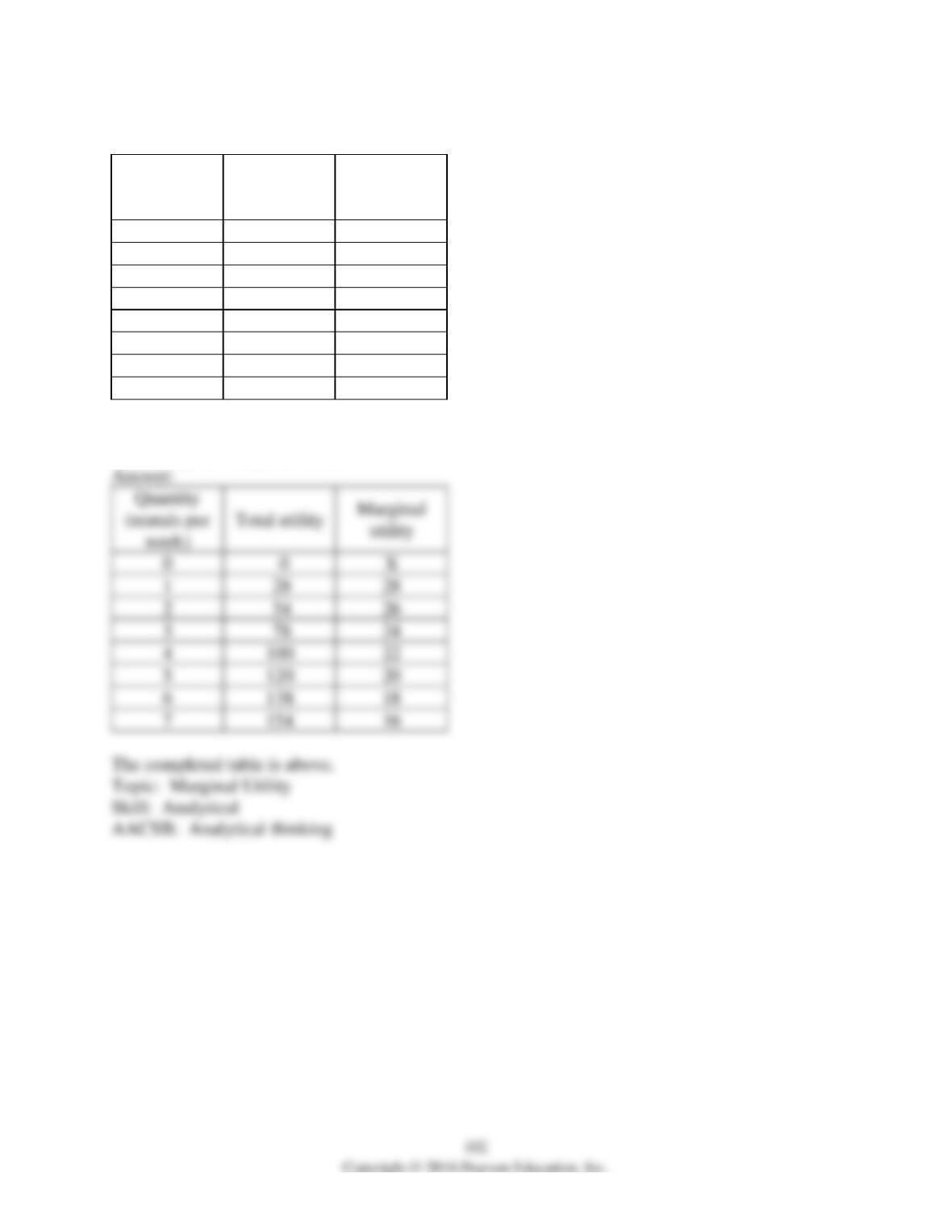
7 Numeric and Graphing Questions
Quantity
(rentals per
week)
Total utility
Marginal
utility
0
0
X
1
28
____
2
54
____
3
78
____
4
100
____
5
120
____
6
138
____
7
154
____
1) Amy has the total utility values given above for DVD rentals a week. Complete the table by
calculating her marginal utilities.
Quantity
(rentals per
week)
Total utility
Marginal
utility
0
X
1
2
3
4
100
5
120
6
138
7
154
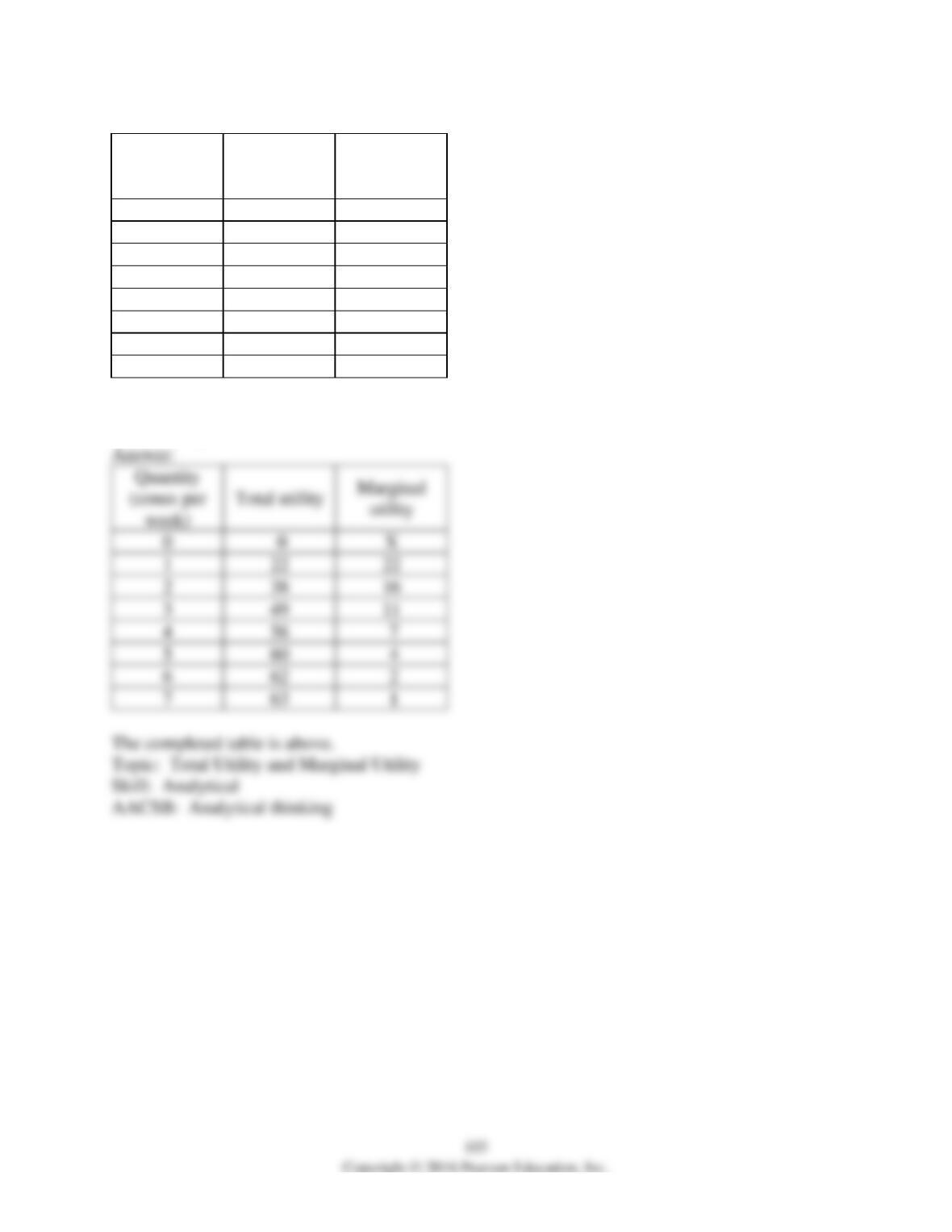
Quantity
(cones per
week)
Total utility
Marginal
utility
0
0
X
1
22
____
2
38
____
3
____
11
4
56
____
5
____
4
6
62
____
7
63
____
2) The table above gives the utility Andy receives from different quantities of vanilla ice cream
cones. Complete the table.
Quantity
(cones per
week)
Total utility
Marginal
utility
0
0
X
1
2
3
4
7
5
4
6
2
7
1
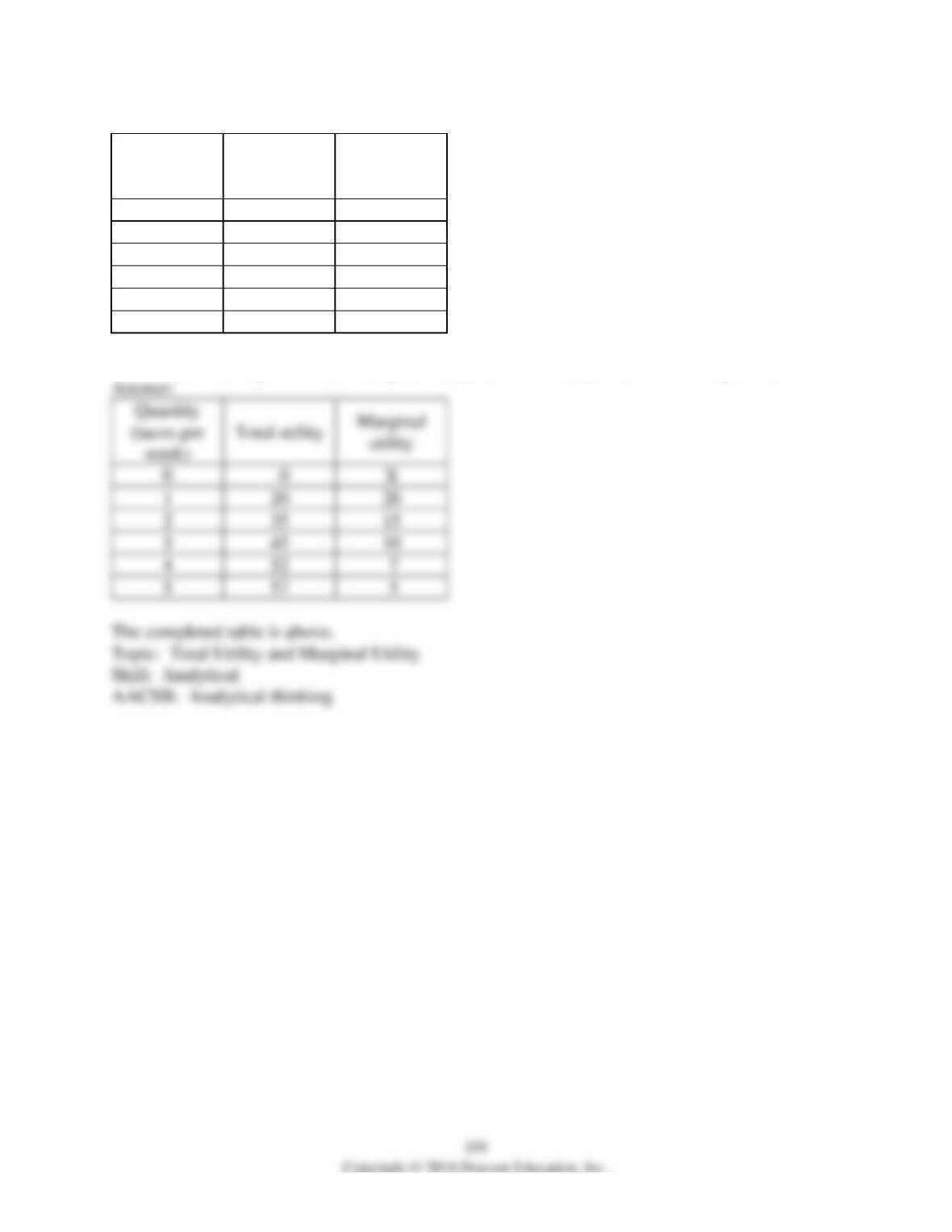
Quantity
(tacos per
week)
Total utility
Marginal
utility
0
0
X
1
____
20
2
35
____
3
45
____
4
52
____
5
57
____
3) The table above gives Jessie’s marginal utility and total utility from tacos. Complete the table.
Quantity
(tacos per
week)
Total utility
Marginal
utility
0
X
1
2
3
4
7
5
5
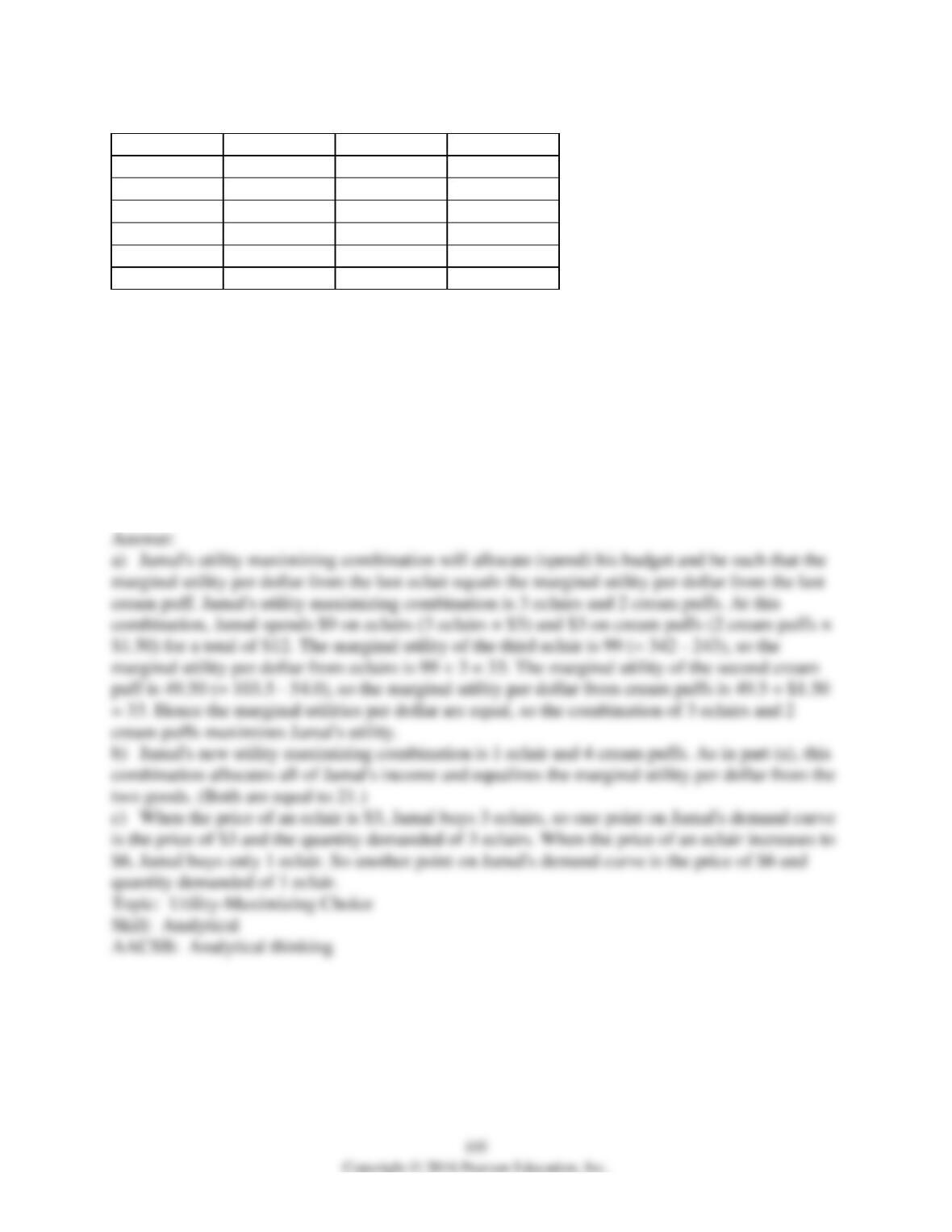
Eclairs Cream puffs
Quantity
Total utility
Quantity
Total utility
0
0
0
0
1
126
1
54.0
2
243
2
103.5
3
342
3
145.5
4
414
4
177.0
5
441
5
196.5
4) The table gives the total utility Jamal derives from the consumption of eclairs and cream
puffs. Jamal has $12 to spend on these two confectionery goods. The price of an eclair is $3 and
the price of a cream puff is $1.50.
a) Jamal’s budget is $12. In order for Jamal to maximize his utility, how many eclairs and cream
puffs should he buy?
b) Suppose the price of an eclair increase to $6. Jamal’s income does not change and neither
does the price of a cream puff. What combination of eclairs and cream puffs will Jamal buy
now?
c) Using your answers to parts (a) and (b), derive two points on Jamal’s demand curve for
eclairs.
Pants Belts
Quantity
Marginal
utility
Quantity
Marginal
utility
1
220
1
85
2
180
2
65
3
140
3
45
4
100
4
25
5
60
5
15
5) Tris is shopping for pants and belts. He has a budget of $100. The price of a pair of pants is
$20 and the price of a belt is $5. His marginal utility schedules are above. What combination of
pants and belts does Tris buy? Explain your answer.
Ice cream Romance novels
Quantity
Total utility
Quantity
Total utility
1
95
1
170
2
180
2
320
3
255
3
450
4
320
4
560
5
375
5
650
6
420
6
720
6) The table above shows Danielle’s utility from ice cream and romance novels.
a) What is Danielle’s marginal utility from the 4th novel?
b) The price of ice cream is $5 per gallon and a novel is $10. If Danielle’s budget for these two
goods is $50 and she buys 2 gallons of ice cream, how many novels can she buy? If she buys 6
gallons of ice cream, what is her marginal utility per dollar spent on novels?
c) Which combination of the two goods is better: 4 gallons of ice cream and 3 novels or 6
gallons of ice cream and 2 novels?
7) Ricardo likes to rent DVDs and attend concerts. The DVDs cost $4 and the concerts cost $40.
Ricardo’s marginal utility from the last DVD is 20 units. Ricardo is maximizing his utility. What
is his marginal utility from the last concert he attended?
8) Suppose Abe is allocating his entire income and he receives 100 units of utility per dollar
from the tenth slice of pizza and 200 units of utility per dollar from his second soda. Is Abe
maximizing his utility? Should Abe change his consumption of pizza and soda?
9) For a consumer, the marginal utility of good A is 25 and its price is $5. The marginal utility of
good B is 60 and its price is $12. The consumer has allocated his entire budget. Is this consumer
maximizing his total utility? Explain your answer.
10) If Mark’s marginal utility per dollar spent on the last taco is 15 and his marginal utility per
dollar spent on the last burrito is 20 units, what should Mark do to increase his total utility?
11) Suppose Jenny’s marginal utility of fish is 40 and her marginal utility from chips is 20. The
price of fish is $10 and the price of chips is $1. What should Jenny do to maximize her utility?
Explain your answer.
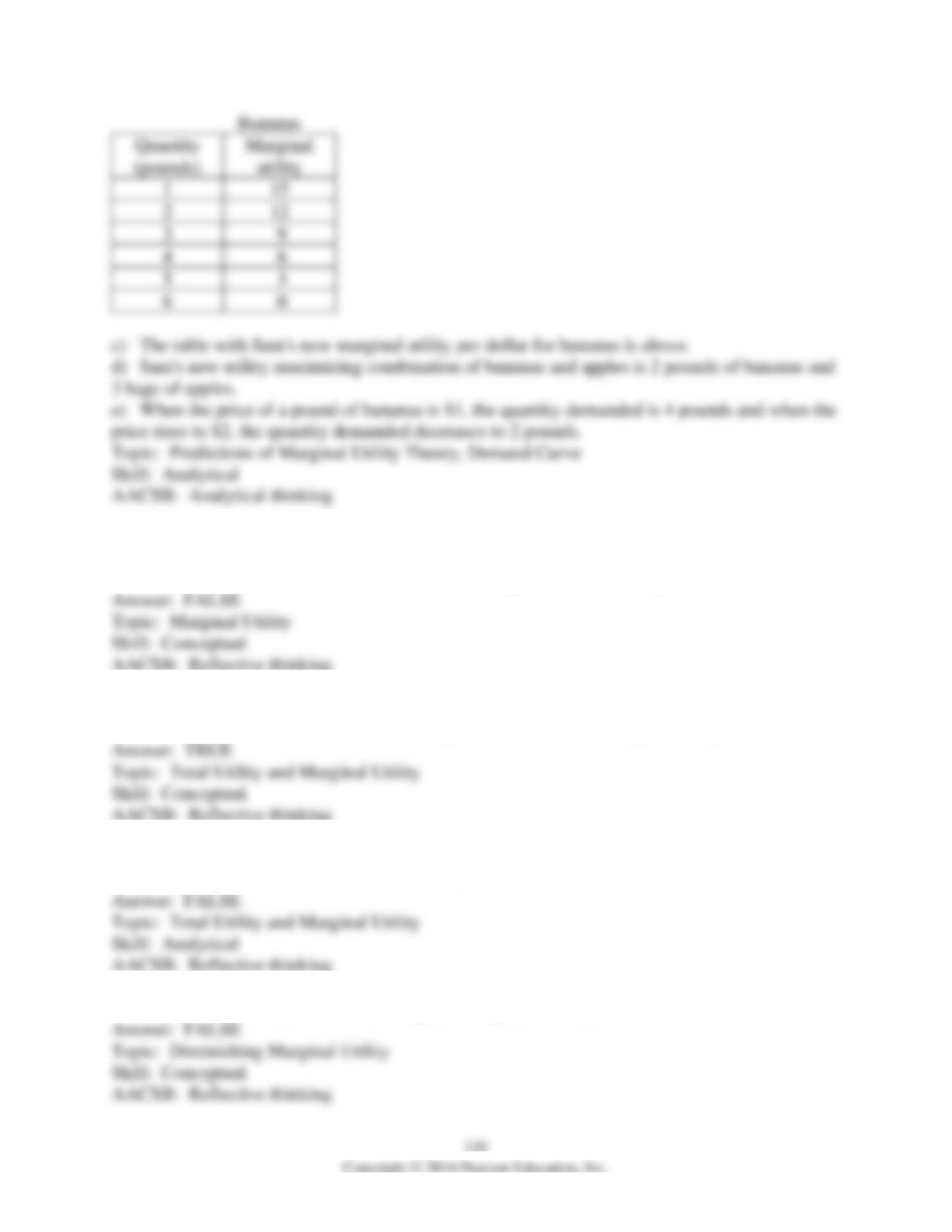
Bananas Apples
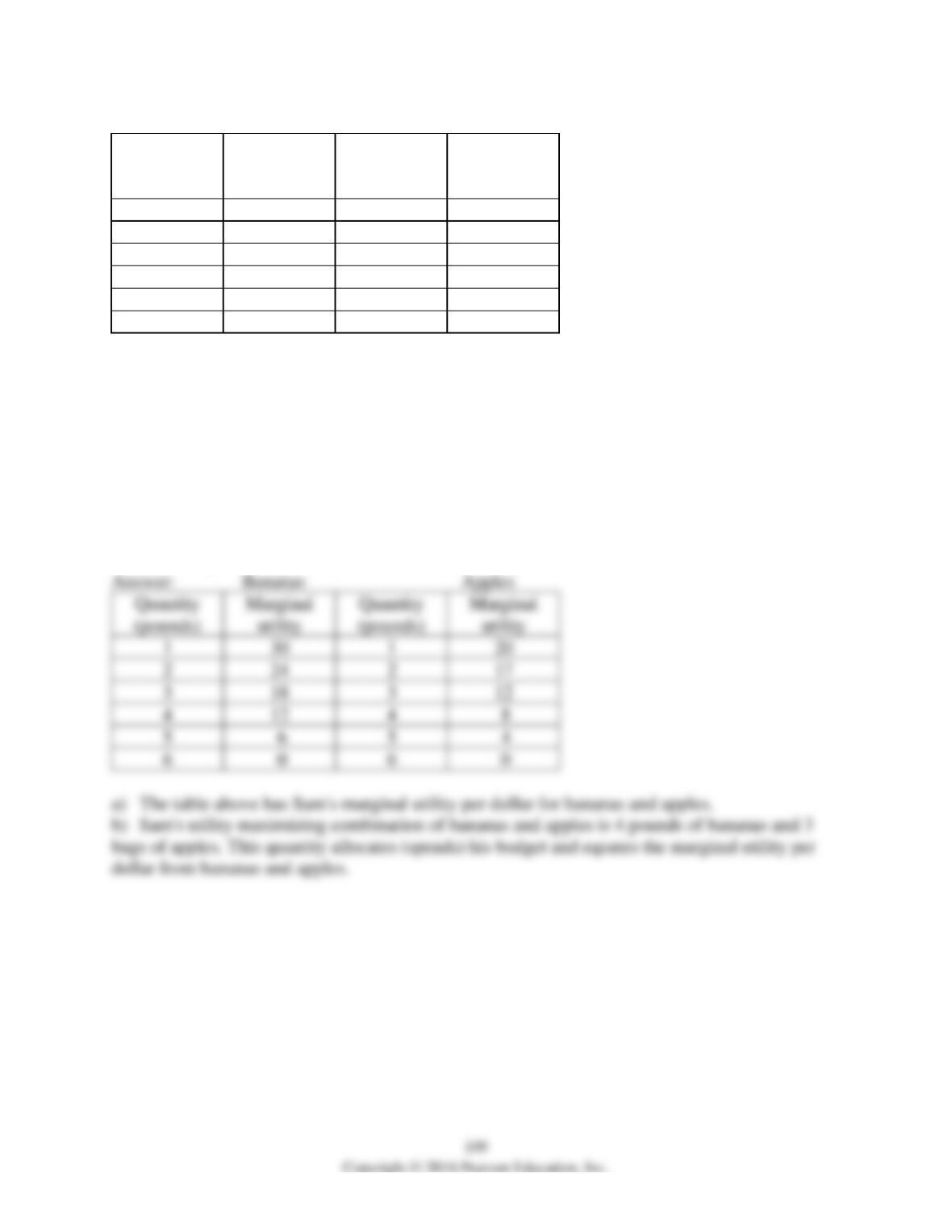
12) The table above gives Sam’s marginal utility schedule for bananas and apples. Sam’s fruit
budget is $10.
a) If bananas cost $1 per pound and apples cost $2 per bag, what is Sam’s marginal utility per
dollar for all quantities of both goods?
b) What is the utility maximizing combination of bananas and apples for Sam?
c) If the price of bananas increases to $2 per pound, how does Sam’s marginal utility per dollar
for bananas change?
d) At the banana price of $2 per pound, what is the new utility maximizing combination of
bananas and apples for Sam?
e) List two points on Sam’s demand curve for bananas.
Quantity
(pounds)
Marginal
utility per
dollar
Quantity
(pounds)
Marginal
utility per
dollar
1
30
1
40
2
24
2
34
3
18
3
24
4
12
4
16
5
6
5
8
6
0
6
0
1
30
1
20
2
24
2
17
3
18
3
12
4
12
4
5
5
6
6
8 True or False
1) Total utility is the benefit received from consuming an extra unit of a good.
2) According to the principle of diminishing marginal utility, as an individual consumes more
and more of a good or service, the total utility increases while the marginal utility decreases.
3) Tom’s marginal utility from a Sobe exceeds his marginal utility of crackers. Therefore, his
total utility of Sobe must exceed his total utility of crackers.
4) Marginal utility diminishes as consumption of a good decreases.
5) If Tom’s total utility from watching one more minute of television increases but the increase
for each additional minute is smaller than the previous minute, he has diminishing marginal
utility.
6) As a person consumes more and more slices of pizza, the marginal utility of each extra slice
diminishes.
7) A consumer will maximize utility when all income is spent and the marginal utility is equal
for all goods.
8) When Kathryn spends her entire budget and equates marginal utility per dollar across all
goods, then Kathryn’s total utility is maximized.
9) If it costs $6.00 to go to the movies and $25.00 to go to a hockey game, Tom is maximizing
his utility between movies and hockey if his marginal utility of movies is 12 units and his
marginal utility from hockey is 25.
10) If it costs $6.00 to go to the movies and $25.00 to go to a hockey game, Tom is maximizing
his utility between movies and hockey if his marginal utility of movies is 12 units and his
marginal utility from hockey is 50.
11) A consumer’s total utility is maximized when the total utility per dollar from all goods is
equalized.
12) If Dana spends all her income on ice cream and Mountain Dew and her marginal utility per
dollar from ice cream is greater than her marginal utility per dollar from Mountain Dew, she
should buy more ice cream and less Mountain Dew.
13) If the price of a good increases, a consumer will substitute away from the relatively more
expensive good, which will increase the marginal utility for that good and bring the consumer
back to equilibrium.
14) When Tom’s income increases, his demand curve for Mountain Dew shifts rightward
because the higher income increases his marginal utility of Mountain Dew.
15) The Paradox of Value is resolved by the willingness for an individual to pay a high price for
a good or service that has a high marginal utility per dollar.
16) Tom’s marginal utility of Mountain Dew exceeds his marginal utility of crackers at his
consumer equilibrium. Therefore, his consumer surplus from Mountain Dew must exceed his
consumer surplus from crackers.
9 Extended Problems
Quantity
(per year)
Utility from
CDs
(units)
Utility from
DVDs
(units)
0
0
0
1
50
70
2
92
130
3
126
180
4
152
220
5
170
250
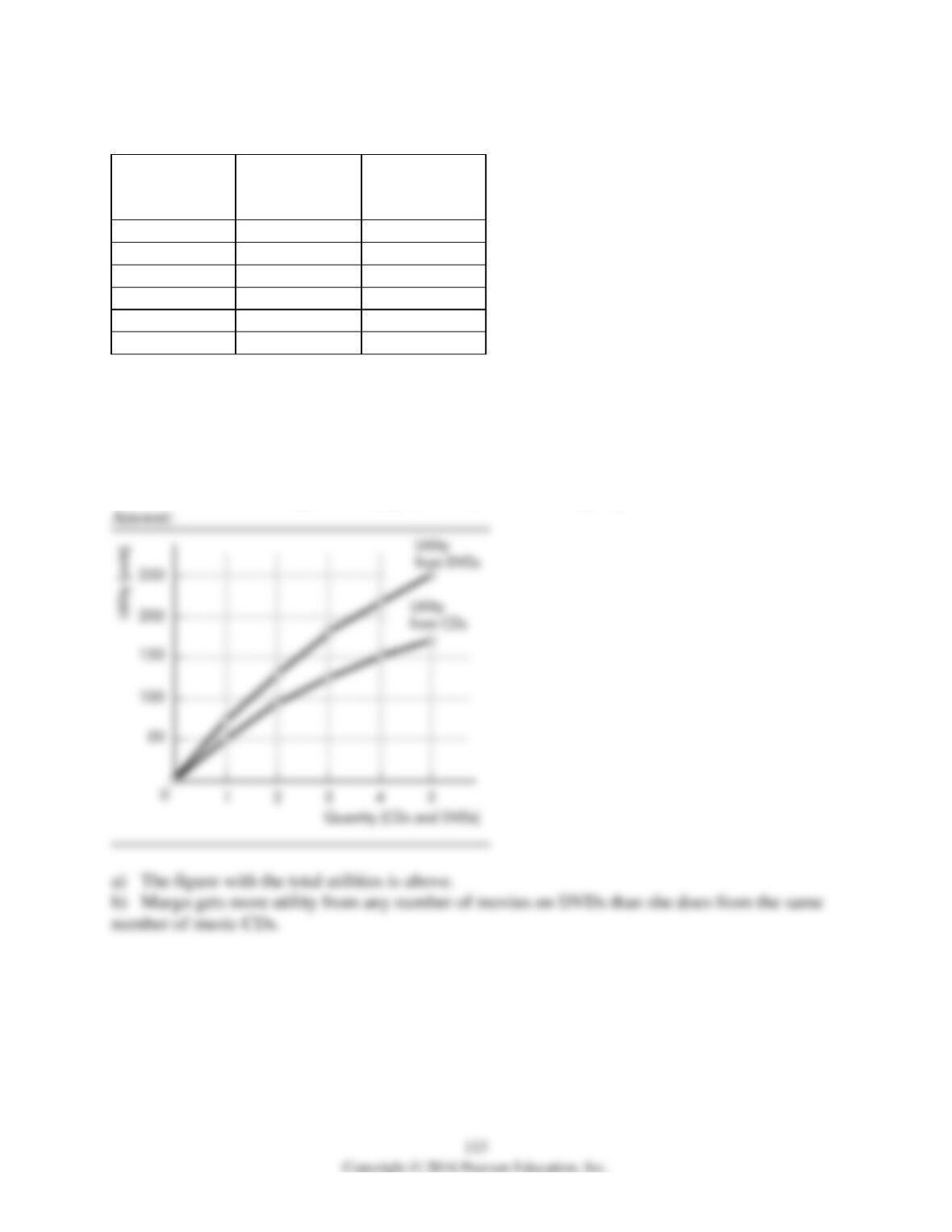
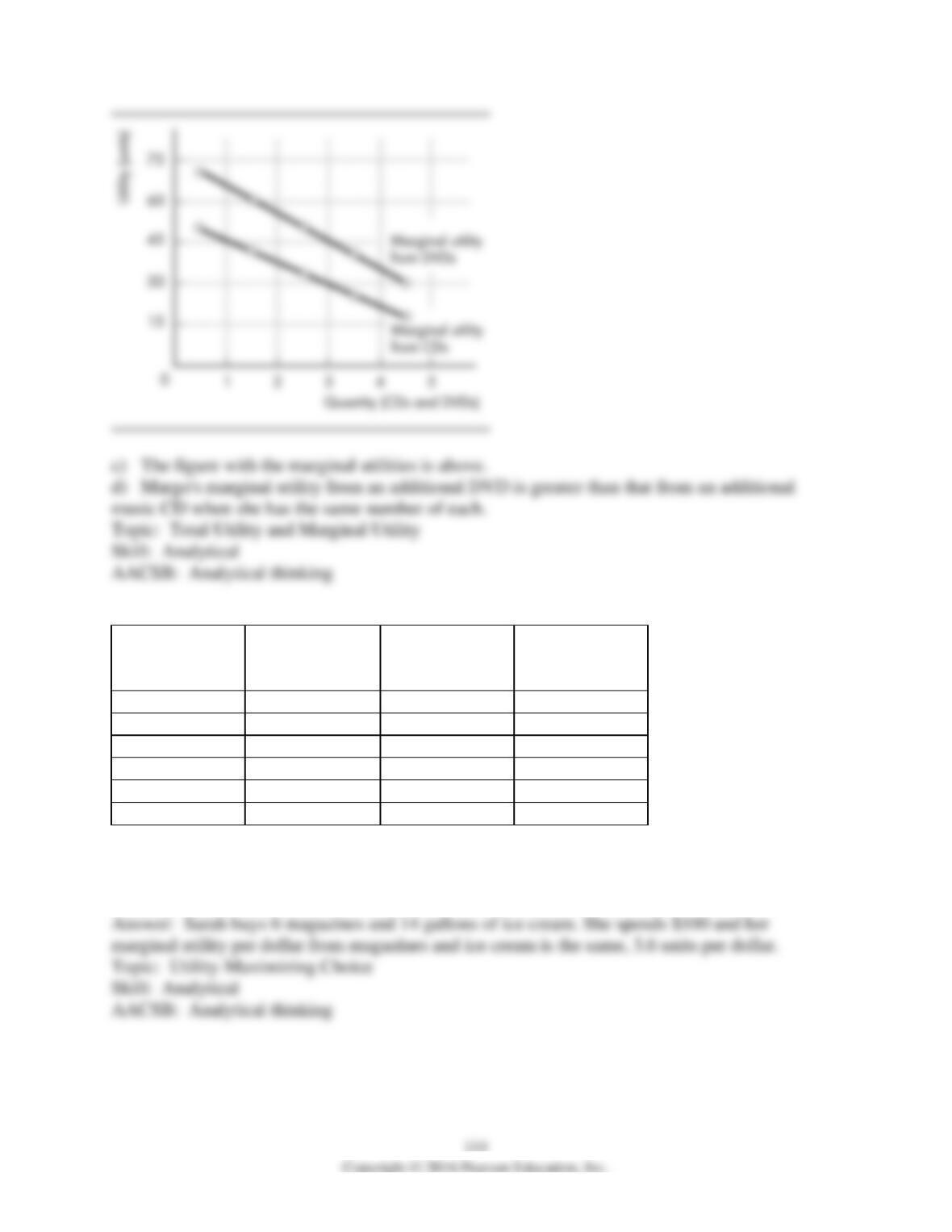
1) Margo buys music CDs and movies on DVDs. The table above shows her total utility from
each good.
a) Draw graphs showing Margo’s utility from music CDs and from movies on DVDs.
b) Compare the two utility graphs. Describe Margo’s preferences.
c) Draw graphs that show Margo’s marginal utility from music CDs and from movies on DVDs.
d) What do the two marginal utility graphs tell you about Margo’s preferences?
Quantity
(magazines per
year)
Utility from
magazines
(units)
Quantity
(gallons of ice
cream per year)
Utility from ice
cream
(units)
0
0
0
0
4
80
4
120
8
152
8
224
12
216
12
312
16
272
16
384
20
320
20
440
2) Sarah spends $100 a year on magazines and ice cream. The table above shows her utility from
each good. If the price of a magazine is $5 and the price of ice cream is $5 per gallon, how does
Sarah spend the $100?