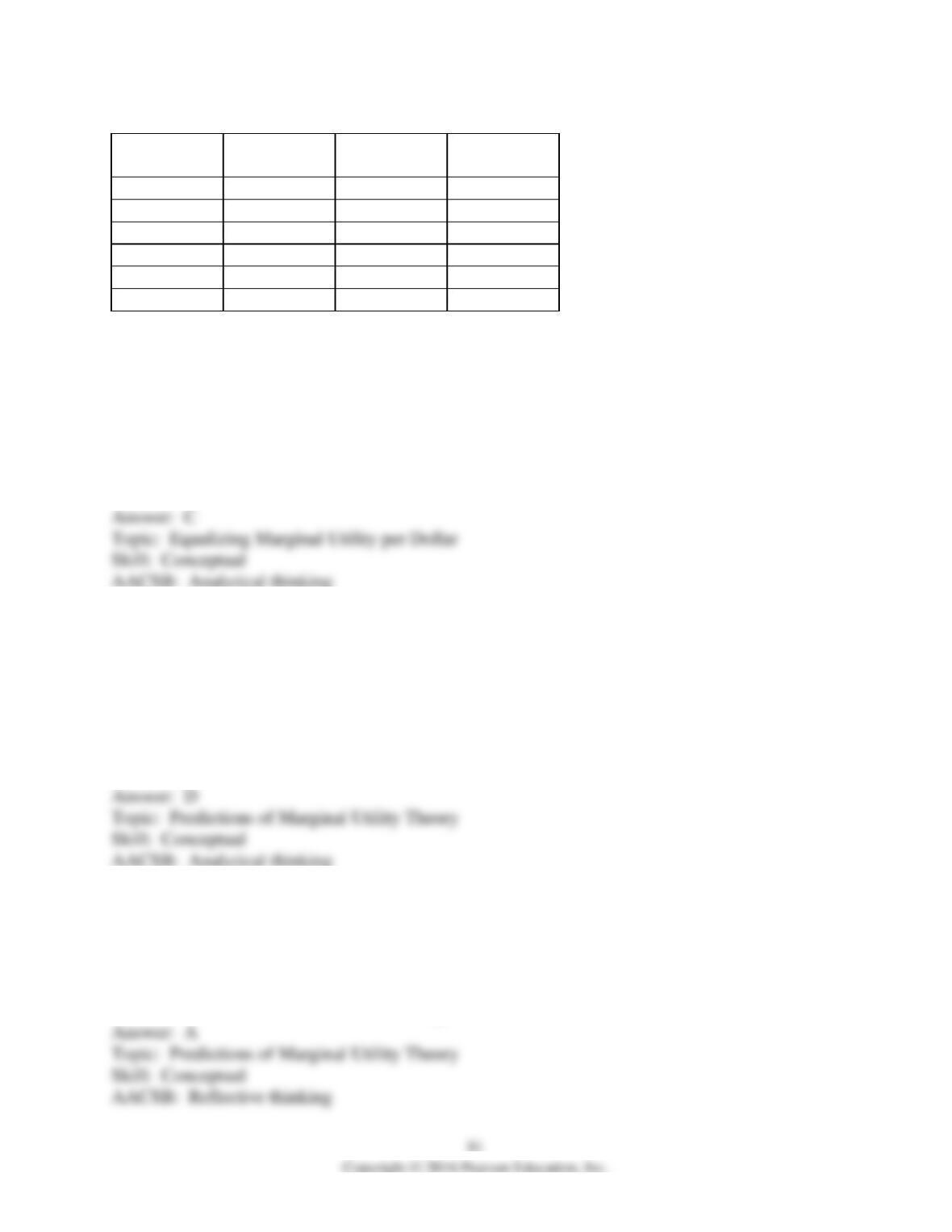
Sub sandwiches Mountain Dew
Quantity
Marginal
utility
Quantity
Marginal
utility
0
0
0
0
1
54
1
30
2
44
2
22
3
24
3
18
4
20
4
12
5
12
5
6
36) The above table gives Sue’s marginal utility schedules for sub sandwiches and Mountain
Dew, the only products Sue consumes. Suppose the price of a sub sandwich is $4 each and the
price of a Mountain Dew is $2 each. Sue’s income is $12. If Sue is at a consumer equilibrium,
she eats ________ sub sandwich(es) and drinks ________ Mountain Dews.
A) 0; 6
B) 1; 4
C) 2; 2
D) 3; 0
37) The above table gives Sue’s marginal utility schedules for sub sandwiches and Mountain
Dew, the only products Sue consumes. Suppose initially the price of a sub sandwich is $4 each
and the price of a Mountain Dew is $2 each. Sue’s income is $12. If the price of subs rises to $6
each, Sue will consume
A) more Mountain Dews.
B) fewer subs.
C) fewer Mountain Dews so that she can still afford to buy two subs.
D) Both answers A and B are correct.
38) Sue consumes only sub sandwiches and Mountain Dew. Subs and Mountain Dew are
complements. If the price of a sub sandwiches increases
A) Sue will move upward along her demand curve for subs.
B) Sue will move downward along her demand curve for subs.
C) Sue’s demand curve for subs will shift leftward.
D) Sue’s demand curve for subs will shift rightward.
39) Sue consumes only sub sandwiches and Mountain Dew. Subs and Mountain Dew are
complements. If the price of a Mountain Dew increases
A) Sue’s demand curve for sub sandwiches will shift rightward.
B) Sue will move downward along her demand curve for Mountain Dews.
C) Sue will move upward along her demand curve for Mountain Dews.
D) Both answers A and C are correct.
40) Betty consumes only milkshakes and sandwiches and maximizes her total utility. Suppose
that the prices of a milkshakes and sandwiches both double and at the same time Betty’s income
doubles. Betty buys ________ sandwiches and her marginal utility from sandwiches ________.
A) more; increases
B) fewer; decreases
C) more; decreases
D) the same number of; remains the same
41) Andy spends $30 a week on movies and magazines. The price of a movie is $8, the price of a
magazine is $2, and Andy sees 3 movies a week and buys 3 magazines. The price of a magazine
increases to $4 and Andy’s brother gives him $6 a week so that he can still see 3 movies a week
and buy 3 magazines. In this situation, Andy will see ________ movies a week and buy
________ magazines.
A) fewer than 3; fewer than 3
B) 3; 3
C) fewer than 3; more than 3
D) more than 3; fewer than 3
42) Sam consumes only sandwiches and soda and maximizes his total utility. Suppose that the
price of a sandwich falls. At the new consumer equilibrium, Sam substitutes ________ for
________. Sam’s marginal utility from soda ________ and his marginal utility per dollar spent
on sandwiches ________.
A) sandwiches; soda; increases; increases
B) soda; sandwiches; decreases; increases
C) sandwiches; soda; increases; decreases
D) soda; sandwiches; stays the same; stays the same
43) The paradox of value is illustrated by the fact that
A) a pound of bread is cheaper than a pound of gold.
B) teens buy designer jeans.
C) if diamonds were free they would no longer be useful for engagement rings.
D) gold and diamonds occupy little space.
44) The paradox of value refers to the fact that
A) different consumers value the same items differently.
B) the value of a good depends on its total utility.
C) water costs little, while diamonds cost a lot.
D) water brings little consumer surplus.
45) The water and diamonds paradox of value
A) is that water is essential for life and yet is cheap, whereas diamonds are totally nonessential
and yet are expensive.
B) points out that we generally have a low total utility of water and a high total utility of
diamonds.
C) is resolved by the principle that market price is determined by total utility, not marginal
utility.
D) none of the above
46) The diamond-water paradox of value can be explained by
A) distinguishing between total utility and marginal utility.
B) water’s high level of utility relative to diamonds.
C) water’s low price relative to diamonds.
D) the fact that utility cannot be measured.
47) The paradox of value can be resolved by distinguishing between
A) quantity demanded and quantity supplied.
B) supply and quantity supplied.
C) normative and positive statements.
D) total utility and marginal utility.
48) The paradox of value between diamonds and water is explained by the fact that the
A) total utility of diamonds exceeds the total utility of water.
B) marginal utility of diamonds exceeds the marginal utility of water.
C) total utility of diamonds exceeds the marginal utility of water.
D) marginal utility of diamonds exceeds the total utility of water.
49) With respect to water and diamonds, water
A) has a higher marginal utility than diamonds.
B) has a lower marginal utility than diamonds.
C) is cheaper than diamonds because it has a lower total utility.
D) is cheaper than diamonds because it has a higher total utility.
50) According to the paradox of value, expensive goods, such as gemstones, provide consumers
with
A) high total utility and low marginal utility.
B) low total utility and low marginal utility.
C) low total utility and high marginal utility.
D) high marginal utility and high total utility.
51) The water and diamonds paradox of value results from
A) the concept of deadweight loss.
B) the “law of demand.”
C) diminishing marginal utility.
D) the elasticity of demand.
52) Water is cheap and diamonds are expensive because water has a ________, and diamonds
have a ________.
A) low total utility; high total utility
B) low marginal utility; high marginal utility
C) high marginal utility; low marginal utility
D) low marginal utility and a low total utility; high marginal utility and a high total utility
53) Water has a ________ marginal utility and brings a ________ consumer surplus; diamonds
have a ________ marginal utility and bring a ________ consumer surplus.
A) small; small; large; large
B) large; large; small; small
C) small; large; large; small
D) large; small; small; large
54) Michael consumes only steak and lobster. Suppose that the price of steak rises. After
Michael is back at equilibrium, compared to the situation when steak was cheaper, the marginal
utility from the last steak will
A) have increased.
B) not have changed.
C) have decreased.
D) not be comparable with the marginal utility before the price hike.
55) Marginal utility theory predicts that a rise in the price of a banana results in
A) the demand curve for bananas shifting rightward.
B) the demand curve for bananas shifting leftward.
C) a movement upward along the demand curve for bananas.
D) a movement downward along the demand curve for bananas.
56) Which of the following statements is TRUE?
A) Marginal utility theory predicts that an increase in a consumer’s income increases
consumption of all goods.
B) It is possible to derive the law of demand—that a higher price decreases the quantity
demanded—using marginal utility theory.
C) Marginal utility theory makes no prediction about a consumer’s responses to hikes in the
prices of the goods and services he or she consumes.
D) Marginal utility theory predicts that all goods are normal goods and that all goods are
substitutes for each other.
57) Because we cannot observe or measure utility
A) the predictions of marginal utility theory cannot be verified.
B) marginal utility theory is incomplete and so its predictions might not be valid.
C) marginal utility theory must be derived from assumptions about demand curves because
demand curves can be measured.
D) None of the above answers are correct.
58) The fact that rubies are more expensive than milk reflects the fact that for most consumers
A) the total utility from rubies exceeds that from milk.
B) the marginal utility from rubies equals that from milk.
C) more milk is consumed than rubies.
D) a quart of rubies is considered to be prettier than a quart of milk.
59) Marginal utility theory shows us that water, which is very common, has a ________
marginal utility and a ________ total utility.
A) small; large
B) large; small
C) large; large
D) small; small
60) Rembrandt paintings are expensive and not as vital for life as milk, which is cheap. Marginal
utility theory explains this paradox of value: The total utility from a Rembrandt painting is
________ than the total utility from milk, and the marginal utility from a Rembrandt painting is
________ than the marginal utility from milk.
A) smaller; smaller
B) smaller; larger
C) larger; smaller
D) larger; larger
61) We can explain the paradox of value as follows: The consumer surplus from water, which is
cheap, is ________ than the consumer surplus from gold, which is expensive; the total utility
from gold is ________ than the total utility from water; and the marginal utility per dollar spent
on water ________ the marginal utility per dollar spent on gold.
A) greater; less; equals
B) smaller; less; equals
C) greater; greater; greater than
D) less; greater; greater than
1) A behavioral economist will explain Tom’s donation to charity by saying that Tom is
displaying ________.
A) the endowment effect
B) bounded rationality
C) bounded self-interest
D) bounded will power
2) Suppose that Richard has just told you that he would not pay more than $100 dollars for one
of his favorite baseball cards. You offer to give him $110 dollars for his card and he refuses.
What consumer choice theory or effect explains this result?
A) the endowment effect
B) bounded rationality
C) bounded self-interest
D) bounded will power
3) According to a behavioral economist, people who are unwilling to sell the last pound of rice
they purchased for the same price that they paid for it are displaying ________.
A) the endowment effect
B) bounded rationality
C) bounded self-interest
D) bounded will power
4) The tendency of people to value something more highly when they own it is called the
A) wealth effect.
B) endowment effect.
C) path dependent effect.
D) endorsement effect.
5) If you exhibit endowment effect, then you
A) decide rationally when making decisions about selling but not when making decisions about
buying.
B) have a strong attachment to things you already own.
C) buy something you cannot afford.
D) decide rationally when making decisions about buying but not when making decisions about
selling.
6) If Sean thinks that the choice between going to Olive Garden or Red Lobster is simply too
confusing, a behavioral economist will explain that Sean is showing ________.
A) the endowment effect
B) bounded rationality
C) bounded self-interest
D) bounded will power
7) Neuroeconomics is
A) the study of the activity of a human brain when the person makes economic decision.
B) the study of how people behave when they face scarcity.
C) the study of situations in which people act economically irrationally.
D) the study of how people make decisions at the margin.
8) Gene plays another hour of computer games rather than study for the hour even though he
knows that the next day, when he takes his test, he will regret his decision. Gene is showing
________.
A) the endowment effect
B) bounded rationality
C) bounded self-interest
D) bounded will power
9) Lucky buys hats for $20 but Lucky will not sell one of her hats for less than $35. Lucky is
________.
A) displaying the endowment effect
B) making decisions using her prefrontal cortex
C) exhibiting bounded self-interest
D) showing unbounded will power
10) Neuroeconomics is
A) the study of the activity of a human brain when the person makes economic decision.
B) the study of how people behave when they face scarcity.
C) the study of situations in which people act economically irrationally.
D) the study of how people make decisions at the margin.
5 News Based Questions
1) The cost of basics like milk, bread, potatoes and bananas has jumped in the past year, forcing
families to nix luxuries, steer away from organic goods and buy more house brands. “I think it’s
affecting everybody,” said Elize Joseph 48, a nursing attendant. “To spend $40 on groceries is
nothing. It doesn’t go a long way.” When food prices increase, what will happen to Elize’s total
utility?
A) It increases.
B) It stays the same.
C) It decreases.
D) It cannot be determined without knowing her total income.
2) At Revolution Doughnuts in Fort Collins, Colorado, a cup of coffee or a doughnut is $1.
Suppose Hannah loves going to Revolution Doughnuts. She spends $5 a day at the shop on 3
doughnuts and 2 cups of coffee. Is Hannah maximizing her total utility?
A) No.
B) Maybe, but I need to know more about Hannah’s income.
C) Yes.
D) Maybe, but I need to know more about Hannah’s marginal utility per dollar for each of the
two goods.
3) At Revolution Doughnuts in Fort Collins, Colorado, a cup of coffee or a doughnut is $1.
Suppose Hannah loves going to Revolution Doughnuts. Currently, her marginal utility per dollar
from doughnuts is 14 and her marginal utility per dollar from coffee is 10. Is Hannah
maximizing her total utility?
A) No, she needs to buy more doughnuts and less coffee.
B) No, she needs to buy more coffee and fewer doughnuts.
C) Yes, she is maximizing utility.
D) No, she needs to buy fewer doughnuts and less coffee.
4) At Revolution Doughnuts in Fort Collins, Colorado, a cup of coffee or a doughnut is $1.
Suppose Hannah loves going to Revolution Doughnuts. Currently, her marginal utility per dollar
from doughnuts is 14 and her marginal utility per dollar from coffee is 14. Is Hannah
maximizing her total utility?
A) No, she needs to buy more doughnuts and less coffee.
B) Yes, she is maximizing utility.
C) No, she needs to buy more coffee and fewer doughnuts.
D) No, she needs to buy fewer doughnuts and less coffee.
5) At Revolution Doughnuts in Fort Collins, Colorado, a cup of coffee or a doughnut is $1.
Suppose Hannah loves going to Revolution Doughnuts and usually buys 2 doughnuts and 1 cup
of coffee. On the way to the shop, Hannah finds an extra $2 dollars in change in her car and buys
an extra doughnut and cup of coffee. This means
A) doughnuts are an inferior good and coffee is a normal good for Hannah.
B) doughnuts are a normal good and coffee is an inferior good for Hannah.
C) doughnuts and coffee are normal goods for Hannah.
D) doughnuts and coffee are inferior goods for Hannah.
6) The Denver Broncos is a football team in the NFL, the Colorado Crush is an arena football
team, and the Highlands Ranch Falcons is a local High School team. Broncos tickets cost about
$415, the Crush cost between $30 and $85 and Falcons tickets are $6. What do the prices per unit
tell you about the marginal utility from each of these football games?
A) The marginal utility will be equal from each game.
B) The marginal utility will be greatest from a Crush game.
C) The marginal utility will be greatest from a Falcons game.
D) The marginal utility will be greatest from a Broncos game.
7) The Denver Broncos is a football team in the NFL, the Colorado Crush was an arena football
team, and the Highlands Ranch Falcons is a local High School team. Broncos tickets cost about
$415, Crush tickets cost between $30 and $85 and Falcons tickets are $6. What does marginal
utility theory predict about the marginal utility per dollar from each of these football games?
A) The marginal utility per dollar will be greatest for the Broncos.
B) The marginal utility per dollar will be equal for all games.
C) The marginal utility per dollar will be greatest for the Crush.
D) The marginal utility per dollar will be greatest for the Falcons.
8) The state Department of Agriculture raised the minimum price for a gallon of milk in the city
on Tuesday to $4.37. “If you’ve got two or three kids and you’re living on a fixed income and
you’re paying half your income on rent,” Gioia said, “then you’re really in a bind and you’re
making choices you should never have to make.” If even after this price increase Gioia’s
marginal utility per dollar is higher for milk than for other goods, what should Gioia do?
A) increase her consumption of milk
B) decrease her consumption of milk
C) not change her consumption of milk
D) increase her consumption of milk only if her income increases
Hours per day
Total utility
from friends
and family
Total utility
from breaking
a sweat
1
10
14
2
19
22
3
24
28
4
28
33
5
30
34
At 37, actor Matthew McConaughey said he only needed “friends and family” to keep him happy
and that he avoided “false drama” at all costs. How did you maintain that bod? “I don’t really
have a workout regimen I follow. I just live my life. My goal is to break a sweat each day.”
People June 25, 2007
Mr. McConaughey said he only needed friends and family and to break a sweat each day to keep
him happy. The table above shows the total utility he gets from spending time with friends and
family and breaking a sweat.
9) Mr. McConaughey has the afternoon, 5 hours, to spend doing whatever he wants. How much
time does Mr. McConaughey spend with his friends and family and how much time does he
spend breaking a sweat to maximize his total utility?
A) 3 hours with friends and family and 2 hours breaking a sweat
B) 2 hours with friends and family and 3 hours breaking a sweat
C) 0 hours with friends and family and 5 hours breaking a sweat
D) 3 hours with friends and family and 4 hours breaking a sweat
10) Which statement is TRUE about Mr. McConaughey’s marginal utility from spending time
with family and friends and breaking a sweat?
A) The marginal utility Mr. McConaughey gets from the first hour of spending time with his
family is less than the marginal utility from the first hour of breaking a sweat.
B) The marginal utility Mr. McConaughey gets from the third hour of spending time with his
family is less than the marginal utility from the fourth hour of breaking a sweat.
C) The marginal utility Mr. McConaughey gets from the fourth hour of spending time with his
family is greater than the marginal utility from the fourth hour of breaking a sweat.
D) The marginal utility Mr. McConaughey gets from the second hour of spending time with his
family is greater than the marginal utility from the first hour of breaking a sweat.
11) Does Mr. McConaughey’s marginal utility from spending time with family and friends and
from breaking a sweat obey the principle of diminishing marginal utility?
A) No, neither obeys the principle of diminishing marginal utility.
B) Only breaking a sweat obeys the principle of diminishing marginal utility.
C) Yes, they both obey the principle of diminishing marginal utility.
D) Only spending time with friends and family obeys the principle of diminishing marginal
utility.
12) If Mr. McConaughey has 7 hours to spend with friends and family and breaking a sweat, he
will maximize his utility if he spends
A) 2 hours with family and friends and 5 hours breaking a sweat.
B) 5 hours with family and friends and 5 hours breaking a sweat.
C) 4 hours with family and friends and 3 hours breaking a sweat.
D) 3 hours with family and friends and 4 hours breaking a sweat.
13) Jake has already bought his hockey gear for the season, but when he is in the sports store, he
falls in love with a different hockey stick and buys it even though it means he can’t go out to
dinner later with his friends which he would have preferred. This example illustrates the
________ aspect of behavioral economics.
A) bounded rationality
B) bounded self-interest
C) empowerment effect
D) bounded will-power
14) Janae donates $50 to the local Humane Society. This means she can’t buy that new pair of
shoes, which according to her utility schedule, would have maximized her utility. This example
illustrates the ________ aspect of behavioral economics.
A) bounded self-interest
B) bounded rationality
C) bounded will-power
D) empowerment effect
1) Is “utility” another word for the cost we give up when we consume a good?
2) How can you compute the total utility derived from consuming five hamburgers using
marginal utilities?
3) How are total and marginal utility related?
4) Are your total and marginal utility of ice cream schedules determined by the price of ice
cream?
5) “Diminishing marginal utility means a downward sloping total utility curve.” True or false?
Explain.
6) What does “diminishing marginal utility” mean?
7) “As Rob consumes more dates over the course of a day, it is likely that his marginal utility
from date consumption will rise.” Is the previous statement likely correct or incorrect?
8) Explain the concept of consumer equilibrium.
9) If a consumer is consuming a combination of goods and services on his budget line, has the
consumer allocated his or her entire budget?
10) What are the two conditions that are met if a consumer is maximizing utility?
11) You are studying with a friend, and your friend says “To maximize utility, a consumer must
consume the combination of goods so that the marginal utility of good X equals the marginal
utility of good Y.” Explain whether your friend’s statement is correct or incorrect.
12) What is the utility-maximizing rule?