119) The table above gives Jane’s total utility from magazines and CDs. The price of a magazine
is $4 and the price of a CD is $10 and Jane’s budget is $88. What is Jane’s total utility when she
maximizes her utility?
A) 70 units
B) 1516 units
C) 2536 units
D) 2586 units
Pizza Pepsi
Quantity
Marginal
utility
Quantity
Marginal
utility
0
0
0
0
1
20
1
30
2
16
2
8
3
10
3
7
120) The above table shows Priscilla’s marginal utility from the two goods she consumes, pizza
and Pepsi. The price of a slice of pizza is $2 and of a can of Pepsi is $1. Suppose Priscilla has $6
to spend. Which combination of pizza and Pepsi will maximize Priscilla’s utility?
A) 3 slices of pizza
B) 2 slices of pizza and 2 cans of Pepsi
C) 3 cans of Pepsi and 1 slice of pizza
D) 1 slice of pizza and 3 cans of Pepsi
121) The above table shows Priscilla’s marginal utility from the two goods she consumes, pizza
and Pepsi. The price of a slice of pizza is $2 and of a can of Pepsi is $1. Suppose Priscilla has $6
to spend. If Priscilla chooses to eat 3 slices of pizza
A) she is maximizing her total utility.
B) she is not equating marginal utility per dollar for pizza and Pepsi.
C) she is not at a consumer equilibrium.
D) Both answers B and C are correct.
122) The above table shows Priscilla’s marginal utility from the two goods she consumes, pizza
and Pepsi. The price of a slice of pizza is $2 and of a can of Pepsi is $1. Suppose Priscilla has $6
to spend. If Priscilla is consuming 1 slice of pizza and 2 cans of Pepsi, which of the following is
CORRECT?
A) Priscilla is maximizing her utility.
B) Priscilla should increase her consumption of Pepsi to maximize her utility.
C) Priscilla should increase her consumption of pizza to maximize her utility.
D) None of the above answers is correct.
Magazines Chocolate bars
Quantity
Marginal
utility
Quantity
Marginal
utility
1
50
8
26
2
42
10
23
3
34
12
20
4
26
14
17
5
18
16
14
6
10
18
11
7
4
20
8
123) Sonya’s budget for magazines and chocolate bars is $50. Her marginal utility from these
goods is shown in the table above. If the price of a magazine is $5 and the price of a chocolate
bar is $2.50, which of the following combinations maximizes Sonya’s utility?
A) 1 magazine and 18 chocolate bars
B) 2 magazines and 20 chocolate bars
C) 3 magazines and 14 chocolate bars
D) 5 magazines and 10 chocolate bars
124) Sonya’s budget for magazines and chocolate bars is $50. Her marginal utility from these
goods is shown in the table above. The price of a magazine is $5 and the price of a chocolate bar
is $2.50. Sonya currently buys 3 magazines and 14 chocolate bars. To maximize her utility, she
should
A) buy more chocolate bars and fewer magazines.
B) buy more magazines and fewer chocolate bars.
C) buy more of both goods.
D) stay with the current combination of goods.
125) Sonya’s budget for magazines and chocolate bars is $50. Her marginal utility from these
goods is shown in the table above. The price of a magazine is $5 and the price of a chocolate bar
is $2.50. Sonya currently buys 2 magazines and 16 chocolate bars. To maximize her utility, she
should
A) buy more chocolate bars and fewer magazines.
B) buy more magazines and fewer chocolate bars.
C) buy more of both goods.
D) stay with the current combination of goods.
126) Sonya’s budget for magazines and chocolate bars is $50. Her marginal utility from these
goods is shown in the table above. The price of a magazine is $5 and the price of a chocolate bar
is $2.50. Sonya currently buys 4 magazines and 12 chocolate bars. To maximize her utility, she
should
A) buy more chocolate bars and fewer magazines.
B) buy more magazines and fewer chocolate bars.
C) buy more of both goods.
D) stay with the current combination of goods.
127) Sonya’s budget for magazines and chocolate bars is $50. Her marginal utility from these
goods is shown in the table above. The price of a magazine is $5 and the price of a chocolate bar
is $2.50. Sonya currently buys 2 magazines and 12 chocolate bars. To maximize her utility, she
should
A) buy more chocolate bars and fewer magazines.
B) buy more magazines and fewer chocolate bars.
C) buy more of both goods.
D) stay with the current combination of goods.
128) If Bobby decides that his marginal utility per dollar spent on vanilla ice cream exceeds his
marginal utility per dollar spent on chocolate ice cream, he should then
A) buy more chocolate ice cream and less vanilla ice cream.
B) buy more vanilla ice cream and less chocolate ice cream.
C) buy all the vanilla ice cream he can.
D) never buy chocolate ice cream.
129) Katie has a choice of spending $6.00 for another hamburger, which has a marginal utility of
30, or $9.00 for another pizza. For her to choose the pizza, it would have to have a marginal
utility of at least
A) 9.
B) 30.
C) 31.
D) 46.
130) Kumiko is not at her consumer equilibrium because she sees too many movies and buys too
few books. As she moves toward her consumer equilibrium, her marginal utility from movies
will ________ and her marginal utility from books will ________.
A) decrease; decrease
B) increase; decrease
C) decrease; increase
D) increase; increase
131) Kumiko is not at her consumer equilibrium because she sees too many movies and buys too
few books. As she moves toward her consumer equilibrium, her total utility from movies will
________ and her total utility from books will ________.
A) decrease; decrease
B) increase; decrease
C) decrease; increase
D) increase; increase
132) Teddy buys only chocolate chip cookies and hot chocolate and spends all of his income on
the two items. Suppose that Teddy’s marginal utility per dollar from cookies exceeds that from
hot chocolate. Teddy can make himself better off if he buys
A) more cookies and less hot chocolate.
B) fewer cookies and more hot chocolate.
C) an equal amount of cookies and hot chocolate.
D) only hot chocolate.
133) Joshua consumes only apples and bread and is in consumer equilibrium. Joshua reads that
eating bread is healthy, so his total utility from each loaf of bread increases. At his new
consumer equilibrium Joshua would consume
A) more apples and less bread.
B) fewer apples and more bread.
C) some combination of apples and bread corresponding to a lower ratio of the marginal utility
of bread to the marginal utility of apples.
D) the same quantity of apples and the same quantity of bread.
Quantity
Marginal utility
of DVD rentals
Marginal utility
of movies
3
100
152
4
90
150
5
80
147
6
70
143
7
60
140
8
50
135
9
40
128
134) Becky decides to spend $50 per month on DVD rentals and movie tickets. Her marginal
utility schedules from these two goods are shown in the table above. The price of a DVD rental
is $2.50, and the price of a movie ticket is $5. Suppose Becky rents 8 DVDs and buys 6 movie
tickets per month. She
A) cannot increase her total utility because she already gets the maximum possible utility from
DVD rentals and movies within her budget.
B) can increase her total utility if she rents more DVDs and buys more movie tickets.
C) can increase her total utility if she rents more DVDs and buys fewer movie tickets.
D) can increase her total utility if she rents fewer DVDs and buys more movie tickets.
135) Becky decides to spend $50 per month on DVD rentals and movie tickets. Her marginal
utility schedules from these two goods are shown in the table above. The price of a DVD rental
is $2.50, and the price of a movie ticket is $5. Becky maximizes her utility if she rents ________
DVDs per month and buys ________ movie tickets per month.
A) 6; 7
B) 4; 8
C) 8; 6
D) 5; 7
136) Tom spends $20 a month on CDs and magazines. The price of a CD is $6 and the price of a
magazine is $4. When Tom maximizes his utility, the marginal utility from CDs is ________ the
marginal utility from newspapers.
A) the same as
B) 1/2
C) 20 times
D) 1 1/2 times
137) Tom spends all his income on comics and cola and maximizes his total utility. If the price
of a comic is $4 and the price of a can of cola is $1, then the ratio of the ________ is 4.
A) marginal utility from cola to the marginal utility from comics
B) marginal utility from comics to the marginal utility from cola
C) number of comics Tom buys to the number of cola Tom buys
D) total utility from comics to the total utility from cola
138) John and Sally have identical preferences except that Sally’s utility is exactly 10 times
John’s for each basket of goods. If they have the same income and face the same prices
A) Sally will consume 10 times the amount that John consumes.
B) Sally will receive 1/10 the satisfaction of John.
C) both will consume the same amount of all goods.
D) John and Sally will have equal total utility.
139) Economists using marginal utility theory assume that consumers’ objectives are to
A) maximize their total utility.
B) maximize their marginal utility.
C) maximize their income.
D) none of the above.
140) Which of the following is NOT an assumption of marginal utility theory?
A) People derive utility from their consumption.
B) More consumption yields more total utility.
C) Marginal utility diminishes with more consumption.
D) Utility can be measured and the units of utility are precisely defined.
141) As more of a good is consumed, its marginal utility ________ and its total utility ________.
A) rises; rises
B) rises; falls
C) falls; rises
D) falls; falls
142) Jeannie’s marginal utility from her 4th book in a month is 50. Her marginal utility from her
5th book
A) is greater than 50.
B) equals 50.
C) is less than 50.
D) might be more than, less than, or equal to 50 but more information is needed.
143) When Alex eats 1 slice of pizza, his total utility is 80; when Alex eats 2 slices of pizza, his
total utility is 120. Alex’s marginal utility from the second pizza is
A) 200.
B) 80.
C) 60.
D) 40.
144) The marginal utility from the first burrito Bobby consumes is larger than the marginal
utility from the first taco Bobby consumes. As a result
A) tacos are an inferior good for Bobby.
B) Bobby will never consume tacos.
C) Bobby will consume a taco only if the price of a taco is less than the price of a burrito.
D) burritos and tacos are substitute goods for Bobby.
145) Sergio consumes only beef and snails and is maximizing his utility. If the price of beef is
less than the price of snails, then we definitely know that
A) Sergio buys more beef than snails.
B) Sergio buys more snails than beef.
C) the marginal utility from the last pound of beef purchased is greater than the marginal utility
from the last pound of snails purchased.
D) the marginal utility from the last pound of snails purchased is greater than the marginal utility
from the last pound of beef purchased.
146) Tommy buys only soda and pizza and is buying the amounts that maximize his utility. The
marginal utility from a soda is 5 and the price of a soda is $1. The marginal utility from a slice of
pizza is 10. The price of a slice of pizza must be
A) $10.
B) $2.
C) $1.
D) some amount that cannot be calculated without more information.
147) Shaniq buys only soda and pizza and is buying the amounts that maximize her utility. The
marginal utility from a soda is 30 and the price of a soda is $2. The marginal utility from a slice
of pizza is also 30. The price of a slice of pizza must be
A) $30.
B) $2.
C) $1.
D) some amount that cannot be calculated without more information.
148) Katie finds that the marginal utility from a compact disc is 30 and the marginal utility from
a pizza is 10. The price of a compact disc is $15 and the price of a pizza is $10. In order to
increase her utility, Katie should
A) consume more compact discs and fewer pizzas.
B) consume fewer compact discs and more pizzas.
C) not change her consumption of pizza and compact discs.
D) consume fewer compact discs and fewer pizzas.
149) Bianca consumes apples and bananas and is in consumer equilibrium. The marginal utility
of the last apple is 10 and the marginal utility of the last banana is 20. If the price of an apple is
$0.50, then what is the price of a banana?
A) $0.10
B) $0.25
C) $0.50
D) $1.00
Total utility from
Quantity
(hours)
Golf
Tennis
1
40
40
2
70
70
3
90
90
4
100
100
150) The above table shows Sue’s total utility from golf and tennis. If the price of each hour of
golf is twice the price of each hour of tennis, and Sue plays four hours of tennis, then Sue plays
A) one hour of golf.
B) two hours of golf.
C) three hours of golf.
D) four hours of golf.
3 Predictions of Marginal Utility Theory
1) Marginal utility theory is used in the derivation of the
A) negative slope of demand curves.
B) negative slope of supply curves.
C) positive slope of demand curves.
D) positive slope of supply curves.
2) The predictions of marginal utility theory
A) contradict the idea that the demand curve slopes downward.
B) support the idea that the demand curve slopes downward.
C) support the idea that the supply curve slopes upward.
D) contradict the idea that the supply curve slopes upward.
3) In consumer equilibrium, Harold consumes pizza, sodas, and other goods. Pizza and soda are
complements for Harold. The price of a pizza rises while his income remains the same. Harold
then consumes
A) more pizza and less soda.
B) more pizza and more soda.
C) less pizza and less soda.
D) less pizza and more soda.
4) Teddy buys only chocolate chip cookies and hot chocolate and spends all of his income on the
two items. Suppose the price of a cookie rises. According to marginal utility theory, Teddy buys
A) more cookies.
B) fewer cookies.
C) more hot chocolate.
D) an equal amount of cookies and hot chocolate.
5) Teddy buys only chocolate chip cookies and hot chocolate and spends all of his income on the
two items. Suppose the price of a cookie rises. According to marginal utility theory, Teddy will
buy
A) more cookies and less hot chocolate, which decreases his marginal utility from cookies and
increases his marginal utility from hot chocolate.
B) more cookies and less hot chocolate, which increases his marginal utility from cookies and
decrease his marginal utility from hot chocolate.
C) fewer cookies and more hot chocolate, which decreases his marginal utility from cookies and
increases his marginal utility from hot chocolate.
D) fewer cookies and more hot chocolate, which increases his marginal utility from cookies and
decreases his marginal utility from hot chocolate.
6) Bianca consumes pizza. Marginal utility theory predicts that when the price of pizza increases
A) Bianca’s total utility from pizza will increase.
B) Bianca will buy less pizza.
C) Bianca’s marginal utility from pizza will increase.
D) Bianca’s demand curve for pizza will shift leftward.
7) The only goods you consume are pizza and soda. Both are normal goods. You consider pizza
and soda to be substitutes. Which of the following will lead you to eat more pizza?
A) The price of a pizza falls.
B) The price of a soda falls.
C) The price of a soda rises.
D) Both answers A and C are correct.
8) Using marginal utility theory, when the price of a gallon of milk falls, a consumer will buy
A) the same amount of milk as before and buy more of all other goods.
B) more milk.
C) more milk only if its marginal utility is increasing.
D) more milk only if its marginal utility is constant.
9) When the price of popcorn falls, before there is any change in consumption, the
A) marginal utility of popcorn definitely increases.
B) marginal utility per dollar from popcorn definitely increases.
C) total expenditure on popcorn definitely rises.
D) entire total utility of popcorn curve definitely shifts rightward.
10) Suppose the price of soda is $2 each and the price of a pizza slice is $4 each. David
maximizes his utility by buying only sodas and pizza. He buys 5 sodas and 10 slices of pizza. If
the price of a soda increases to $3 each, David will
A) decrease the number of sodas bought and the demand curve for sodas will shift leftward.
B) decrease the number of sodas bought and move along the demand curve for soda.
C) buy more pizza and move along the demand curve for pizza.
D) buy less pizza and the demand curve for pizza will shift leftward.
11) Ricardo buys cola and popcorn. Cola sells for $0.50 a can and popcorn sells for $1 per bag.
He is in consumer equilibrium. The price of a cola jumps to $1 per can. In his new consumer
equilibrium, Ricardo’s
A) marginal utility of cola will be equal to his marginal utility of popcorn.
B) marginal utility per dollar spent will be 2.
C) total utility will be higher.
D) marginal utility of cola will decrease.
12) Marginal utility theory concludes that a decrease in the price of a good increases the quantity
demanded and
A) increases the demand for substitutes.
B) decreases the demand for complements.
C) increases the total expenditure on the good.
D) increases total utility.
13) Marginal utility theory predicts that when the price of one good rises, the demand for another
good is a substitute increases. This change occurs because of
A) an increase in the marginal utility per dollar from the substitute good.
B) an increase in the marginal utility of the substitute good.
C) a decrease in the marginal utility per dollar from the good whose price has risen.
D) a decrease in the marginal utility of the good whose price has risen.
14) Marginal utility theory predicts that as the price of coffee rises, the ________ a substitute for
coffee ________ and the ________ coffee ________.
A) supply of; increases; demand for; decreases
B) supply of; decreases; supply of; increases
C) demand for; increases; quantity demanded of; decreases
D) demand for; decreases; demand for; increases
15) Roberta spends all of her income on two items, staplers and paper clips. If the price of a
stapler increases, there will be a ________ Roberta’s demand curve for staplers and a ________
Roberta’s demand curve for paper clips.
A) rightward shift of; leftward shift of
B) leftward shift of; movement along
C) movement along; rightward shift of
D) movement along; leftward shift of
16) Joe consumes pizza and movies. Pizza and movies are substitutes. According to marginal
utility theory, if the price of a pizza rises then
A) the demand curve for pizza shifts leftward.
B) the demand curve for pizza shifts leftward and the demand curve for movies shifts rightward.
C) there is an upward movement along the demand curve for pizza.
D) there is an upward movement along the demand curve for pizza and the demand curve for
movies shifts rightward.
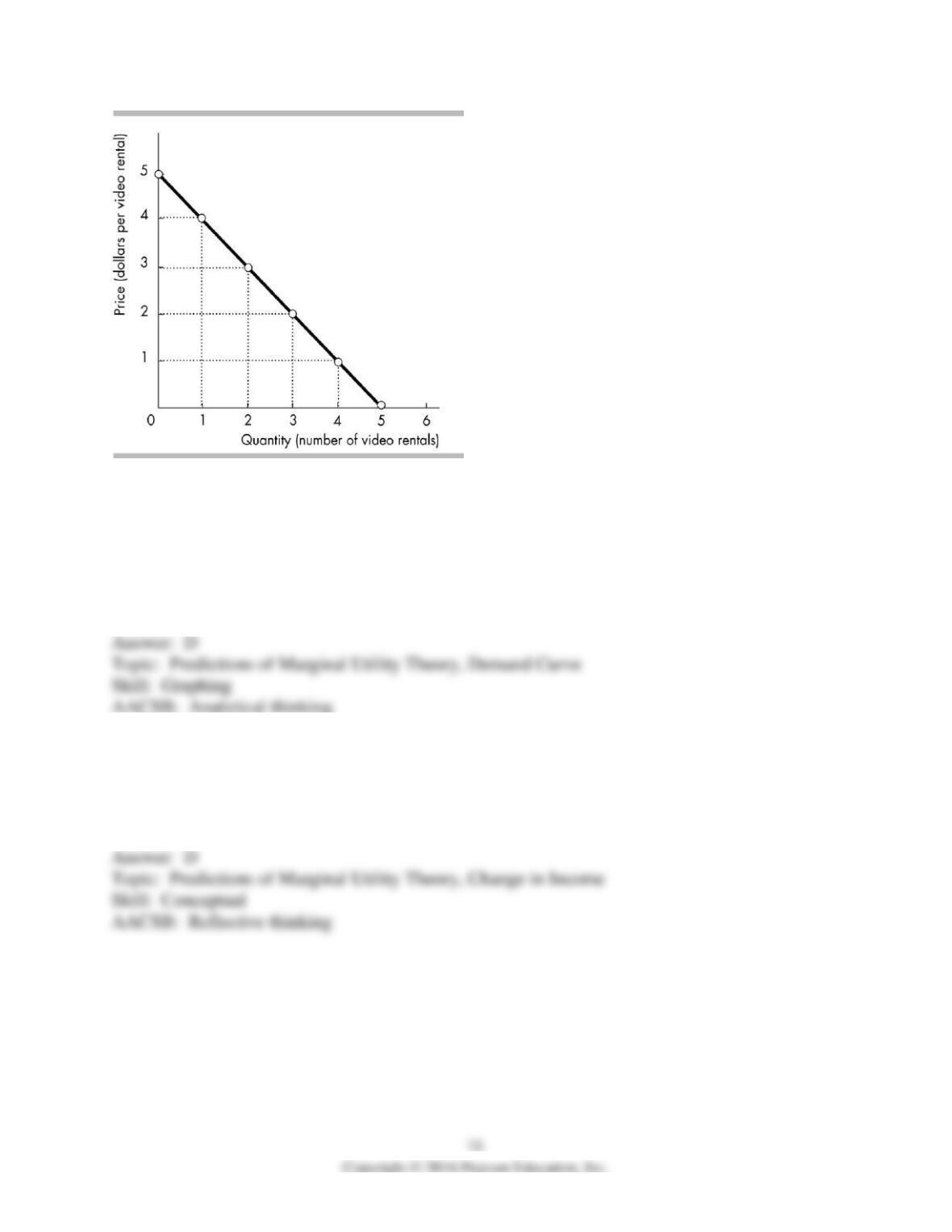
17) Gunther rents Nintendo games and videos. The marginal utility from his last Nintendo game
is 10 and that from his last video is 5. Nintendo games rent for $2 each. Gunther’s demand curve
for games is shown in the figure above. How many videos a week does Gunther rent?
A) 1
B) 2
C) 3
D) 4
18) When economists speak of normal goods they mean goods for which
A) the demand curve slopes downward.
B) marginal utility is positive.
C) marginal utility decreases as consumption increases.
D) demand decreases when incomes fall.
19) Renee consumes pizza and rice. An increase in her income causes her to consume fewer
pizzas and more rice. The change in pizzas consumed means that
A) her total utility from consuming pizzas had been negative.
B) her marginal utility from consuming pizzas had been negative.
C) her marginal utility from consuming pizzas had been zero.
D) pizza is an inferior good for Renee.
20) Marginal utility theory predicts that when income increases a
A) person’s total utility will not change.
B) person might increase the consumption of some normal goods and decrease the consumption
of other normal goods.
C) person’s consumption of normal goods will increase.
D) None of the above answers is correct because marginal utility theory does not address how
demand changes in response to changes in income.
21) The only goods you consume are pizza and soda. Both are normal goods. For you, pizza and
soda are substitutes. Which of the following leads you to buy more of both goods?
A) The price of a pizza falls.
B) The price of a soda falls.
C) Your income increases.
D) Both answers A and B are correct.
22) Marginal utility theory predicts that if a consumer’s income decreases, the consumer
A) buys fewer normal goods.
B) buys fewer inferior goods.
C) buys more of all goods.
D) might either increase or decrease purchases of normal goods.
23) Marginal utility theory predicts that an increase in income means that the consumption of
A) all goods will increase.
B) normal goods will increase and consumption of inferior goods will decrease.
C) inferior goods will increase and consumption of normal goods will decrease.
D) None of the above answers is correct.
24) According to marginal utility theory, a rise in income will
A) increase a consumer’s total utility.
B) increase consumption of all goods.
C) increase the marginal utility of all goods.
D) None of the above answers is correct.
25) Marginal utility theory predicts that
A) when the price of a good rises, the quantity demanded of that good decreases.
B) if the price of one good rises, the demand for a substitute good increases.
C) if income increases, the demand for a normal good increases.
D) All of the above answers are correct because all are predictions of marginal utility theory.
26) Emma consumes only tacos and pizza. They are substitute goods for her. The price of a taco
falls. Emma will buy ________ tacos and her marginal utility from the last slice of pizza she eats
________.
A) more; does not change
B) more; decreases
C) the same quantity; does not change
D) less; increases
27) Lucy buys only magazines and CDs. Both are normal goods. Lucy’s income decreases, but
the prices of magazines and CDs do not change. Marginal utility theory predicts that Lucy will
________.
A) buy fewer magazines and fewer CDs
B) substitute magazines for CDs
C) increase her marginal utility from both magazines and CDs by buying more magazines and
CDs
D) buy more magazines and more CDs
28) Jeremiah spends all of his income on oranges and cookies, which are normal goods. If
Jeremiah’s income decreases, he will buy ________ oranges and ________ cookies. His
marginal utility from oranges will ________ and his marginal utility from cookies will
________.
A) fewer; fewer; decrease; increase
B) more; more; decrease; decrease
C) the same quantity of; fewer; remain constant; decrease
D) fewer; fewer; increase; increase
29) Steve is in a consumer equilibrium. Then, the price of steak increases from $6 a pound to $8
a pound. Steve decreases the number of pounds of steaks he buys each week ________.
A) and decreases his total utility
B) only if his income also decreases
C) so that the marginal utility per dollar spent on steaks is the same as it was when the price was
$6 a pound
D) so that both his total utility and his marginal utility from steak fall
30) Which of the following statements is TRUE?
A) Utility units are observable.
B) Total utility is equal to marginal utility.
C) Utility is gained whenever someone wants a good.
D) Marginal utility theory assumes that marginal utility diminishes as more of any good is
consumed.
31) Kirk consumes normal goods. If Kirk’s income decreases and the prices of all goods remain
unchanged, in his new consumer equilibrium, his marginal utility from each good will ________
and his total utility will ________.
A) increase; increase
B) increase; decrease
C) decrease; increase
D) decrease; decrease
32) Patty spends $10 a week on bagels and soda. The price of a bagel is $2 and the price of soda
is $1 a can. Patty buys 2 bagels and 6 cans of soda. Her marginal utility from bagels is 20 units.
The price of a bagel rises to $3 and the price of a can of soda rises to $1.50. Patty now buys
________ bagels and her marginal utility from bagels ________. She buys ________ cans of
soda and her marginal utility from soda ________.
A) fewer than 2; increases; fewer than 6; increases
B) 2; is 20 units; 6; is 10 units
C) fewer than 2; is 20 units; fewer than 6; is 10 units
D) fewer than 2; decreases; fewer than 6; decreases
Pizza Pepsi
Quantity
Marginal
utility
Quantity
Marginal
utility
0
0
0
0
1
20
1
30
2
16
2
8
3
10
3
7
33) The above table shows Priscilla’s marginal utility from the two goods she consumes, pizza
and Pepsi. A slice of pizza costs $4 and a can of Pepsi $2. Suppose Priscilla has $12 to spend.
Which of the following leads Priscilla to switch her choices of pizza and Pepsi?
A) an increase in the price of pizza to $6 per slice
B) a decrease in the price of Pepsi to $1 per can
C) an increase in Priscilla’s income
D) All of the above will cause Priscilla to change her choices.
34) The above table shows Priscilla’s marginal utility from the two goods she consumes, pizza
and Pepsi. A slice of pizza costs $4 and a can of Pepsi $2. Suppose Priscilla has $12 to spend. If
the price of pizza decreases, Priscilla’s preferences (her marginal utility schedule) for pizza
A) will increase.
B) will decrease.
C) will not change.
D) may increase or decrease depending on what happens to the price of Pepsi.
35) The above table shows Priscilla’s marginal utility from the two goods she consumes, pizza
and Pepsi. Initially, a slice of pizza costs $4 and a can of Pepsi $2. Suppose Priscilla has $12 to
spend. If the price of pizza falls to $2, Priscilla will choose to
A) consume more pizza.
B) consume more Pepsi.
C) consume less pizza.
D) Both answers A and B are correct.