16
11) If a competitive firm is in short-run equilibrium, then
A) profits equal zero.
B) it will not operate at a loss.
C) an increase in its fixed cost will have no effect on profit.
D) an increase in its fixed cost will have no effect on output as long as revenue can cover its variable cost.
12) If a competitive firm is in short-run equilibrium, then
A) profits equal zero.
B) economic profits will be positive.
C) economic profits will be negative.
D) All of the above are possible in the short-run.
13) Suppose TC = 10 + (0.1 ∗ q2). If p = 10, the firm’s profits will be
A) 240.
B) 250.
C) 260.
D) -10 because the firm will shut down.
14) Suppose TC = 10 + (0.1 ∗ q2). If there are 100 identical firms in the market, the market supply curve is
A) Q = 1000 ∗ p.
B) Q = 500 ∗ p.
C) Q = 100 ∗ p.
D) Q = 10.
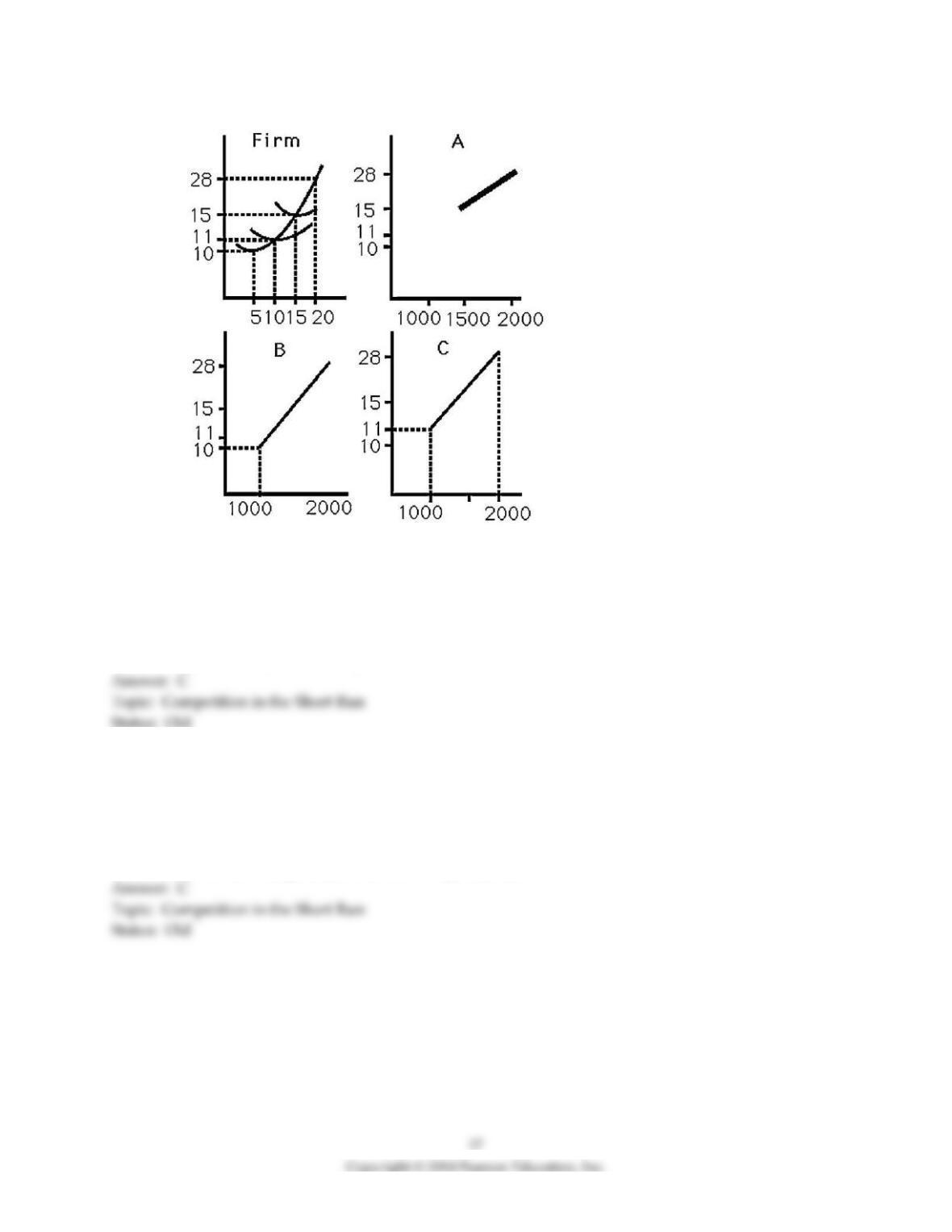
15) The above figure shows the cost curves for a typical firm in a market and three possible market
supply curves. If there are 100 identical firms, the market supply curve is best represented by
A) curve A.
B) curve B.
C) curve C.
D) either curve A or B, but definitely not C.
16) If a firm is currently in short-run equilibrium earning a profit, what impact will a lump-sum tax have
on its production decision?
A) The firm will decrease output to earn a higher profit.
B) The firm will increase output but earn a lower profit.
C) The firm will not change output but earn a lower profit.
D) The firm will not change output and earn a higher profit.
17) Suppose that once a well is dug, water flows out of it continuously without any additional effort.
Customers collect their water and pay a per gallon fee when they leave the site of the well. In the short
run, the competitive firm in this market
A) will not shut down because variable costs are zero.
B) has no fixed costs.
C) faces diminishing marginal returns.
D) can act as a price setter.
18) Suppose that once a well is dug, water flows out of it continuously without any additional effort.
Customers collect their water and pay a per gallon fee when they leave the site of the well. In the short
run, the competitive firm in this market
A) has no variable costs.
B) has no fixed costs.
C) will shut down.
D) can produce water at no cost.
19) If a competitive firm cannot earn profit at any level of output during a given short-run period, then
which of the following is LEAST likely to occur?
A) It will shut down in the short run and wait until the price increases sufficiently.
B) It will exit the industry in the long run.
C) It will operate at a loss in the short run.
D) It will minimize its loss by decreasing output so that price exceeds marginal cost.
20) In deciding whether to operate in the short run, the firm must be concerned with the relationship
between price of the output and
A) total cost.
B) average variable cost.
C) total fixed cost.
D) the number of buyers.
21) There are currently N identical firms in a market. If it is a perfectly competitive market, the short-run
market supply curve at any given price is
A) N times the supply of an individual firm.
B) N – 1 times the supply of an individual firm.
C) N plus the supply of an individual firm.
D) It cannot be determined from the information provided.
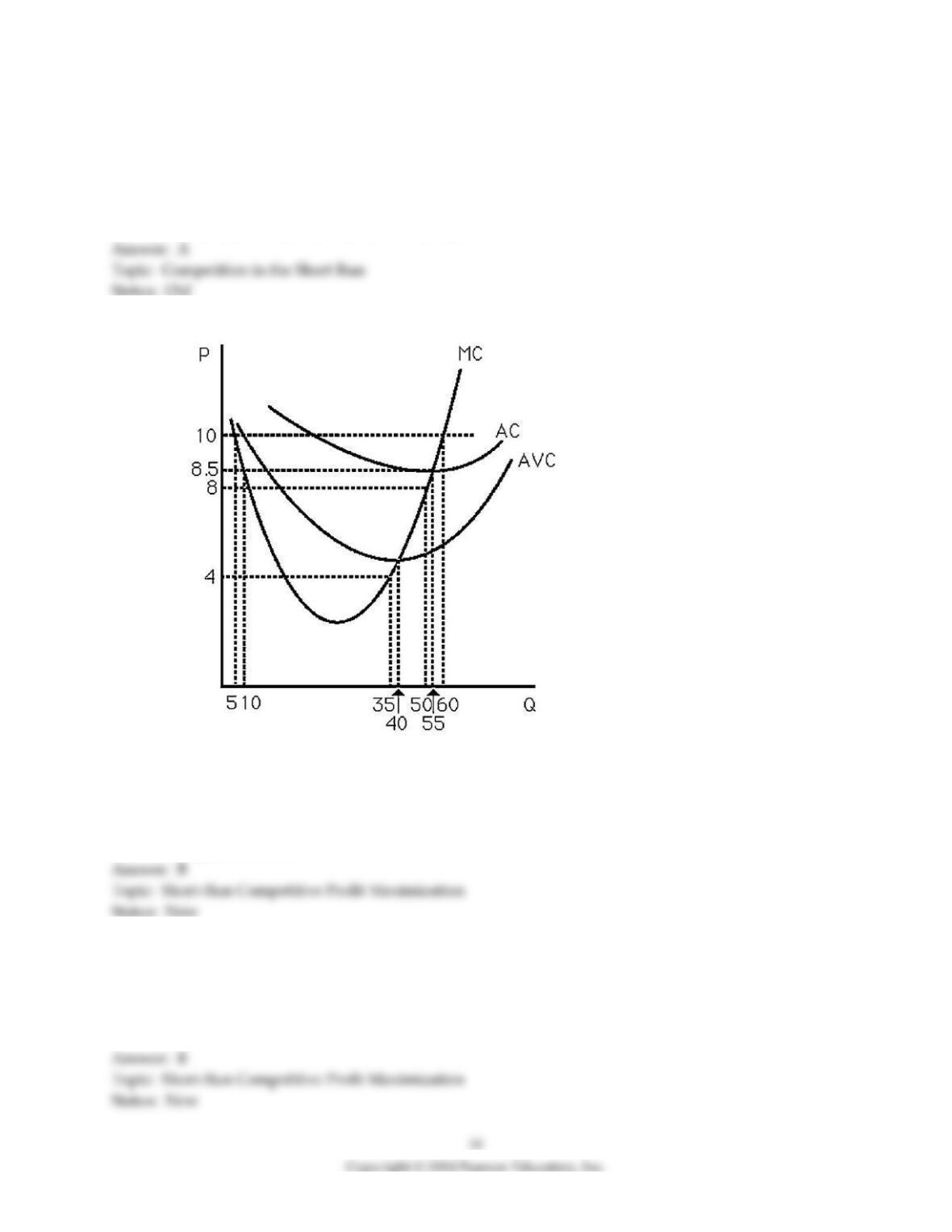
22) The above figure shows the cost curves for a typical firm in a competitive market. If p = 10, then
A) the firm will maximize its profit by producing 5 units.
B) the firm will maximize its profit by producing 60 units.
C) producing 5 or 60 units will yield equal profits.
D) Not enough information.
23) The above figure shows the cost curves for a typical firm in a competitive market. If price = 8.5, then
A) the firm will produce 10 units.
B) the firm will produce 55 units.
C) the firm will earn positive profits.
D) None of above.
24) The above figure shows the short run cost curves for a typical firm in a competitive market. If price =
8, then the firm
A) is earning positive profits.
B) should produce 50 units.
C) should shut down.
D) None of above.
25) The above figure shows the short run cost curves for a typical firm in a competitive market. If price =
4, then the firm
A) is earning positive profits.
B) should produce 35 units.
C) should shut down.
D) None of above.
For the following, please answer “True” or “False” and explain why.
26) If a firm cannot earn profits in the short run, it will shut down.
27) If the market price in a competitive market is below the minimum of average variable cost, the firm
will shut-down.
28) If a competitive firm has to pay a lump sum tax, it will produce less.
29) A competitive firm’s supply curve is identical to its marginal cost curve.
30) If a firm in a competitive market is currently producing a quantity where price exceeds the marginal
cost, the firm should lower its price.
31) The above figure shows the cost curves for a typical firm in a competitive market. From the graph,
estimate the firm’s profits when price equals $10 per unit.
32) The above figure shows the cost curves for a typical firm in a competitive market. If there are 200
identical firms, estimate the market quantity supplied when p = 4, 8, and 10.
22
33) If a firm operates at a loss, the loss is equal to TC – TR. If the firm shuts down instead, its loss is equal
to FC. Given this, show that price must exceed AVC for the firm to operate at a loss and not shut down.
34) Suppose a firm has the following total cost function TC = 100 + 2 q2. If price equals $20, what is the
firm’s output decision? What are its short-run profits?
35) Draw a graph that shows how the short-run shut-down price changes when an input price increases.
36) Suppose there are 1000 identical wheat farmers. For each, TC = 10 + q2. Derive the market supply
curve.
37) Suppose there are 1000 identical wheat farmers. For each, TC = 10 + q2. Market demand is Q = 600,000
– 100p. Derive the short-run equilibrium Q, q, and p. Does the typical firm earn a short-run profit?
38) Consider a competitive firm with the short-run cost function
C(q) = 20 + 6q + 5q2
The firm faces a market price of p for its output.
a. Derive the firm’s profit maximizing condition. Is the sufficient second order condition satisfied?
b. Suppose a specific tax of t (t < p) is levied on only this firm in the industry. What is the profit
maximizing level of output as a function of p and t? (Assume the price is high enough that the firm does
not shut down)
c. How does the output change as the tax increases? Use calculus to determine the relevant comparative
static.
d. How does the firm’s profit chance as the tax increases? Again, use calculus to determine the relevant
comparative static. Show that profit decreases as t increases.
39) Suppose that there are 80 firms in a market, each with the following cost function:
C(q) = 100 + 4q2
a. Derive the short-run market supply curve.
b. Suppose the market demand is
QD = 1280 – 30p
Find the equilibrium market quantity and price.
c. How much output will each firm produce? How much profit is each firm making?
8.4 Competition in the Long Run
1) Markets with hit-and-run entry and exit experience
A) barriers to entry.
B) firms entering whenever they can make a profit and exiting when they cannot make a profit.
C) steady long-run economic profit.
D) a very steady number of firms.
2) In the long run, profits will equal zero in a competitive market because of
A) constant returns to scale.
B) identical products being produced by all firms.
C) the availability of information.
D) free entry and exit.
3) Assuming a horizontal long-run market supply curve, which of the following statements is (are) TRUE
about competitive firms in the long run?
A) p = MC
B) p = AC
C) profit = 0
D) All of the above.
4) Long-run market supply curves are upward sloping if
A) firms are identical.
B) the number of firms is restricted in the long run.
C) input prices fall as the industry expands.
D) All of the above.
5) Long-run market supply curves are downward sloping if
A) firms are identical.
B) the number of firms is restricted in the long run.
C) input prices fall as the industry expands.
D) All of the above.
6) If firms in a competitive market are not identical, then the long-run market supply curve will be
A) horizontal.
B) upward sloping.
C) downward sloping.
D) undetermined.
7) If firms in a competitive market are not identical, then an increase in cost will
A) shift marginal cost to the right.
B) push the most inefficient firms out of the market.
C) push the most efficient firms out of the market.
D) Need more information.
8) Suppose that for each firm in the competitive market for potatoes, long–run average cost is minimized
at 20¢ per pound when 500 pounds are grown. If the long–run supply curve is horizontal, then
A) some firms will enjoy long-run profits because they operate at minimum average cost.
B) the long-run price will be 20¢ per pound.
C) each consumer will purchase $100 worth of potatoes.
D) the long-run price will be set just above 20¢ per pound.
9) Suppose that for each firm in the competitive market for potatoes, long–run average cost is minimized
at 20¢ per pound when 500 pounds are grown. The demand for potatoes is Q = 10,000/p. If the long-run
supply curve is horizontal, then how many firms will this industry sustain in the long run?
A) 0
B) 100
C) 50,000
D) There is not enough information to answer.
10) Suppose that for each firm in the competitive market for potatoes, long-run average cost is minimized
at 20¢ per pound when 500 pounds are grown. The demand for potatoes is Q = 10,000/p. If the long-run
supply curve is horizontal, then how much will consumers spend, in total, on potatoes?
A) $0
B) $500
C) $10,000
D) $50,000
11) Suppose that for each firm in the competitive market for potatoes, long-run average cost is minimized
at 20¢ per pound when 500 pounds are grown. The demand for potatoes is Q = 10,000/p. If the long-run
supply curve is horizontal, then how many pounds of potatoes will be consumed in total?
A) 0
B) 500
C) 10,000
D) 50,000
For the following, please answer “True” or “False” and explain why.
12) If firms in a competitive market are identical, the long-run market supply curve is horizontal.
13) The long-run supply curve in a competitive market is upward sloping.
14) If the shut down rule, p < AVC, is the same in the short run and the long run, explain why the shut
down prices may be different.
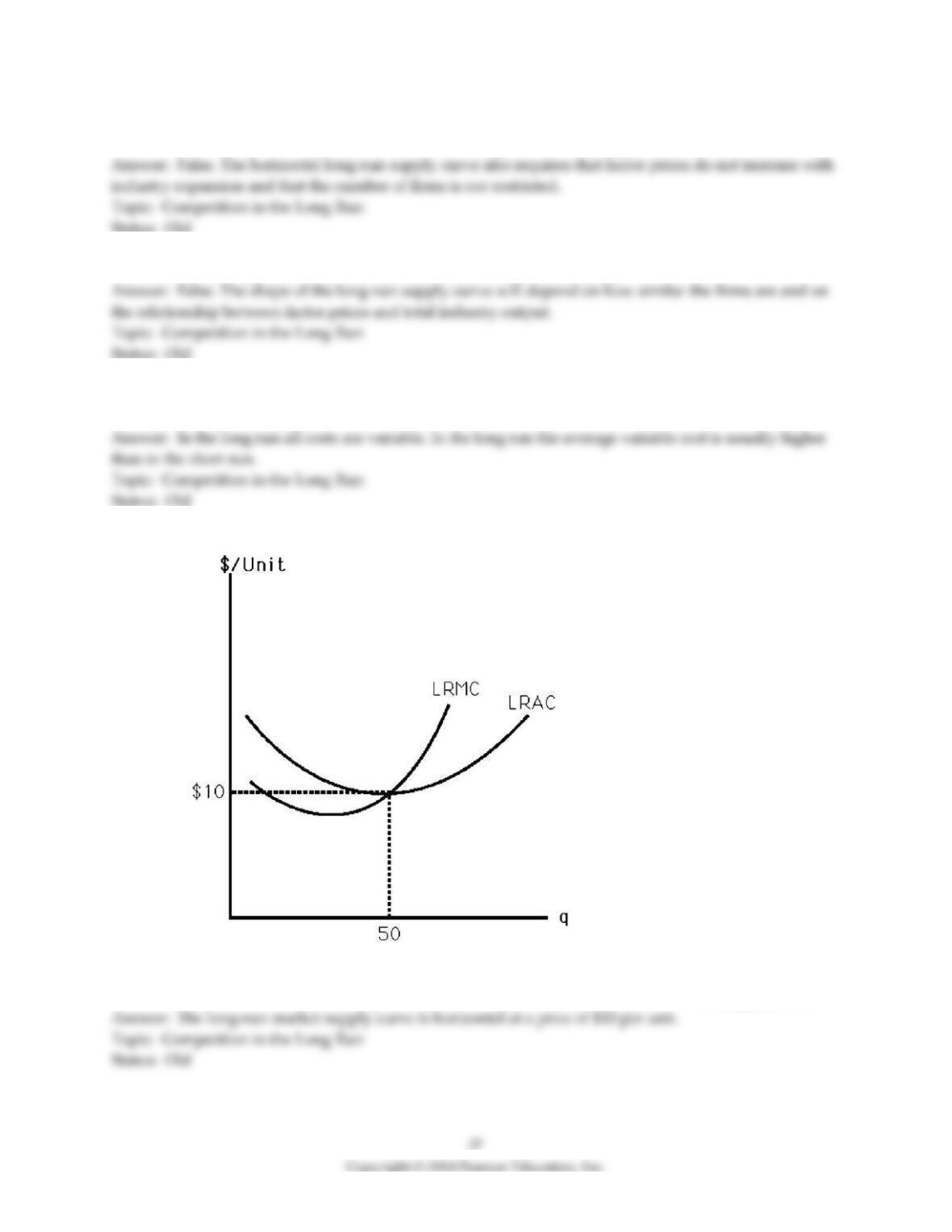
15) The above figure shows the long-run cost curves for a typical firm in a competitive market. If the
number of firms is unrestricted and input costs are constant, derive the long-run market supply curve.
28
16) All the supply of peppermint oil is produced from mint plants grown in one county by several
competitive growers (the number of growers is not limited). The quality of land in the county varies
greatly. Would you expect the long-run market supply curve to slope upward, downward, or remain
constant? Why?
17) Suppose an industry has no fixed costs. Draw two graphs side by side for the industry. In the left
graph draw a U-shaped average cost curve and the corresponding marginal cost curve. In the right
graph, draw a downward-sloping market demand curve. Also in the right graph, draw a short-run
supply curve that would generate positive profit, and the long-run supply curve that would result.
18) Suppose all firms in a competitive market are currently in both short-run and long-run equilibrium.
What impact will a lump sum tax have on each firm in the short run? in the long run?
19) Suppose market demand is Q = 1000 – 4p. If all firms have LRAC = 50 – 5q + q2, how many identical
firms will there be when this industry is in long-run equilibrium?
20) All firms in a competitive industry have the following long-run total cost curve:
C(q) = q3 – 10q2 + 36q
where q is the output of the firm.
a. Compute the long run equilibrium price. What does the long-run supply curve look like if this is a
constant cost industry? Explain.
b. Suppose the market demand is given by Q = 111 – p. Determine the long-run equilibrium number of
firms in the industry.
21) Firms in the sandbox industry have the long-run cost curve
C(q) = F + 6q + 5q2
Where F is a positive constant. The sandbox industry has a market demand of p = 90 – 2q
a. Suppose F = 20. What is the competitive equilibrium price, quantity and number of firms?
b. Suppose F is actually an accreditation fee established by the sandbox sellers association. A firm that
avoids this fee will not be able to operate in the industry, and is therefore mandatory. How does the
equilibrium price and number of firms vary with F? You do not have to use calculus, but explain whether
each increases or decreases with F. How does the profit of each firm vary with F?