98. If the marginal cost curve is U-shaped
a. there are no productivity gains from specialization, only diminishing marginal product.
b. average fixed costs are continually decreasing.
c. there are productivity gains from specialization before diminishing marginal product sets in.
d. the average total cost curve is continually upward sloping.
e. the average variable cost curve is a straight line.
99. When the average variable cost curve is upward sloping, what must be true about the marginal cost
curve?
a. It is U-shaped.
b. It is above the average variable cost curve.
c. It is upward sloping.
d. It is below the average variable cost curve.
e. It is a straight line.
100. The change in total cost given a change in output is also known as ________ cost.
a. differential d. short-run
b. marginal e. long-run
c. average
101. If the marginal product of labor is increasing, the marginal cost of output must be
a. decreasing. d. unchanged.
b. constant. e. increasing.
c. equal to average total cost.
102. If a firm experiences diminishing marginal product of labor, its marginal cost
a. increases at an increasing rate. d. decreases at a constant rate.
b. decreases at a decreasing rate. e. increases at a decreasing rate.
c. increases at a constant rate.
103. If a firm experiences productivity gains from employee specialization, its marginal cost
a. increases at an increasing rate. d. decreases at a constant rate.
b. decreases at an increasing rate. e. increases at a decreasing rate.
c. decreases at a decreasing rate.
104. Pablo owns a record store. His total costs are $1.2 million per year, his variable costs are $750,000,
and his fixed costs are $450,000 per year. Last year, Pablo sold 1,200 records. If Pablo sells 1,250
records this year (50 more than last year) and his average total cost increases to $1.28 million, we
know that the
a. average total cost of selling 1,250 records is $1,000.
b. average variable cost of selling records has decreased.
c. average fixed cost of selling records is unchanged.
d. marginal cost of those 50 records is $80,000.
e. marginal cost of those 50 records is $1.28 million.
105. Should a firm always produce the level of output where marginal cost is lowest?
a. Yes. That is the level of output where costs are lowest.
b. No. That is the level of output where employees are most efficient.
c. No. Firms should produce where marginal cost equals average variable cost.
d. No. That might be the best choice, but it depends on the firm’s profits.
e. Yes. Any other level of output will have higher marginal cost.
106. Where would we find a firm’s minimum efficient scale of production?
a. at the lowest point on its long-run average total cost curve
b. at the highest point on its long-run average total cost curve
c. in the middle of its long-run average total cost curve
d. at the highest point on its long-run average fixed cost curve
e. in the middle of its long-run average variable cost curve
107. It is important for a firm to know its minimum efficient scale of production because that is where
a. it faces the least amount of competition.
b. its tax burden will be lowest.
c. long-run costs are minimized.
d. long-run average total cost is greatest.
e. it turns into a monopoly.
108. How will a firm know if it has grown too large, that is, when it has exceeded its minimum efficient
scale of production?
a. Its long-run average costs begin to decrease.
b. Its long-run average costs begin to increase.
c. Its market power begins to diminish.
d. The number of other firms in the market rises.
e. All of its workers quit and go to work for the competition.
109. Refer to the following table. What is the total cost of producing five units of the good?
Output Total Fixed Cost Total Variable Cost Total Cost Average
Fixed Cost Average Variable Cost Average Total Cost Marginal
Cost
1 $500 $200 — — — — —
2 — — $800 — — — —
3 — — $875 — — — $25
4 — — $925 — — — —
5 — — ???? $100 — — —
6 — $450 — — — — —
a. $1,050 d. $825
b. $950 e. $1,000
c. $1,025
110. Refer to the following table. What is the average variable cost of producing three units of the
good?
Output Total Fixed Cost Total Variable Cost Total Cost Average Fixed Cost
Average Variable Cost Average Total Cost Marginal Cost
1 — — — — — — —
2 — — $600 — — — —
3 — — — — ????? — $20
4 — $440 — — — — —
5 $500 — — — — — —
a. $80 d. $20
b. $120 e. $420
c. $140
111. Which of the following is an example of a long-run cost for a manufacturing firm?
a. the purchase of additional raw materials
b. hiring more employees
c. an increase in the size of its factory
d. paying higher tax rates
e. increasing the size of its management team
112. The long-run average total costs for a firm are equal to short-run average total costs when
a. the long-run average total cost curve is declining.
b. the long-run average total cost curve is at a minimum point.
c. the long-run average total cost curve is increasing.
d. production is maximized.
e. production is at any point along the long-run average cost curve.
113. Which of the following is a question that a firm must answer in the long run but not in the short
run?
a. What is the profit-maximizing level of output?
b. How many workers should it hire?
c. What is the optimal amount of capital to employ?
d. What prices should it charge for its products?
e. How much should it pay its workers?
114. If a firm’s average total costs decrease as it increases its scale of production, the firm is
experiencing
a. economies of scale.
b. diseconomies of scale.
c. increasing returns from specialization.
d. diminishing marginal product.
e. constant returns to scale.
115. Lukas owns a bookstore. He currently sells 1,200 books per year. If he doubles the size of his store
so he can sell 2,400 books per year and his long-run average total cost per book decreases, we
know that Lukas is experiencing
a. diseconomies of scale. d. economies of scale.
b. diminishing marginal product. e. constant returns to scale.
c. increasing marginal product.
116. Annabelle owns an Italian ice shop. If she decided to expand the size of her shop so that she could
sell more Italian ices, how would she know if she is experiencing economies of scale in the long
run?
a. Her long-run average cost of selling each Italian ice remains unchanged.
b. Her long-run average cost of selling each Italian ice decreases.
c. Her long-run average cost of selling each Italian ice increases.
d. Her long-run total cost of selling Italian ices increases.
e. Her long-run fixed cost of selling Italian ices increases.
117. Josephina owns a boxing gym. She recently expanded the size of her gym by adding another
boxing ring and moving into a larger building so that she can serve more clients. How would
Josephina know if she is experiencing economies of scale from increasing the size of her boxing
gym?
a. Her average cost per client increases.
b. Her total cost increases.
c. Her average cost per client remains the same.
d. Her average cost per client decreases.
e. Her total cost remains unchanged.
118. Which is the best example of economies of scale?
a. the local power company d. a parking garage
b. the pizza business e. a small family farm
c. the restaurant industry
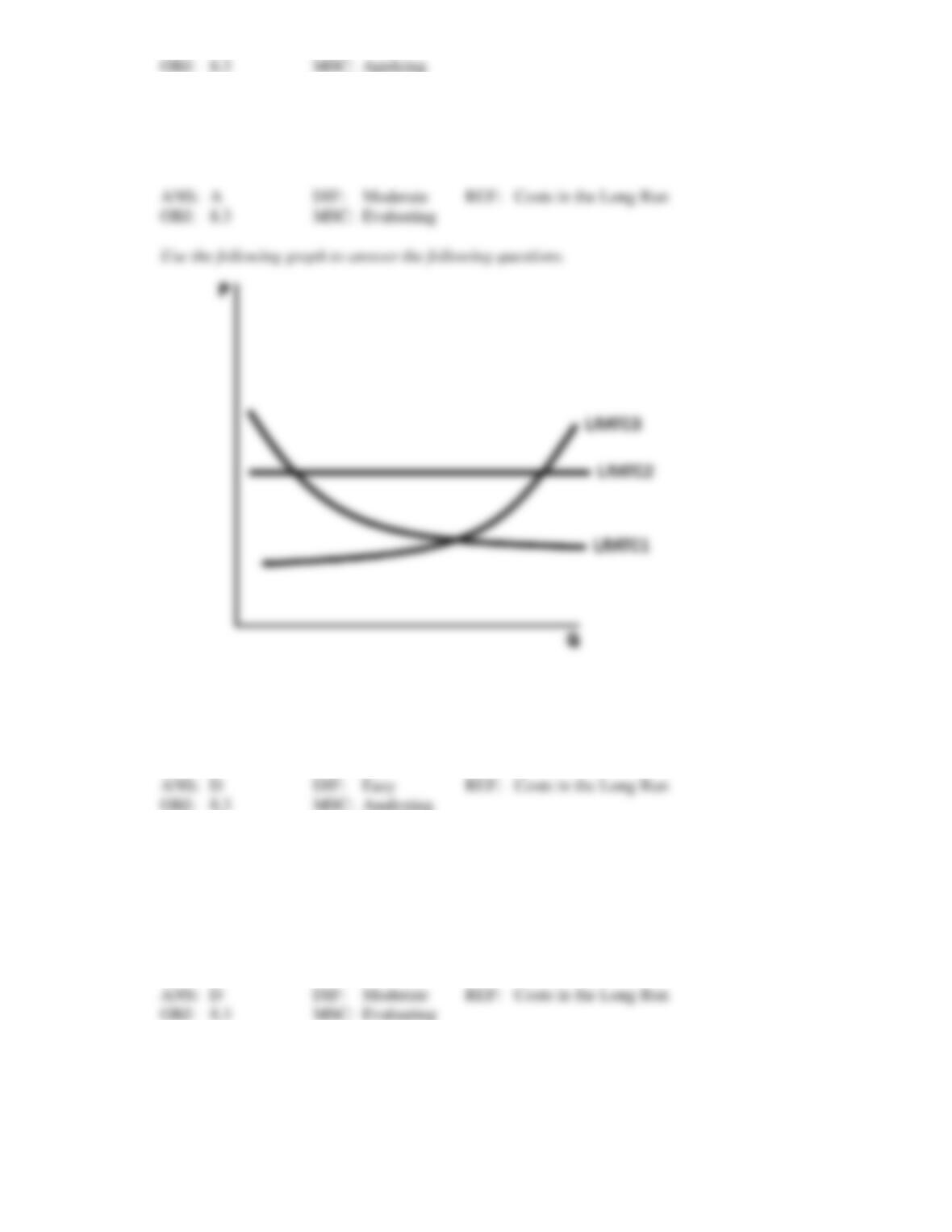
119. Which of the curves depicts economies of scale?
a. LRATC1 and LRATC3 d. LRATC1
b. LRATC2 e. LRATC3
c. LRATC2 and LRATC3
120. A firm expands its scale of production and finds that its long-run average total cost curve looks
like LRATC1. It might look this way because the firm
a. adds several additional layers of management, which increase its costs.
b. is able to pay its employees more.
c. has to pay higher rent.
d. is able to negotiate lower prices with its suppliers.
e. is able to sell more output.
121. If the firm expanded its scale of production and found that its average costs decreased, which of
the curves would reflect this situation?
a. LRATC2 and LRATC3 d. LRATC3
b. LRATC2 e. LRATC1 and LRATC2
c. LRATC1
122. A firm expands its scale of production and finds that it is able to negotiate better prices with its
suppliers. Which of the curves best applies to this firm?
a. LRATC1 d. LRATC1 and LRATC2
b. LRATC2 e. LRATC2 and LRATC3
c. LRATC3
123. A firm expands its scale of production and finds that its long-run average total cost curve looks
like LRATC3. It might look this way because the firm
a. is able to pay its employees less.
b. adds several additional layers of management, which increase its costs.
c. is able to reduce its tax burden.
d. is able to produce output more efficiently.
e. is able to sell more output.
124. If the firm expanded its scale of production and found that its average costs increased, which of the
curves would reflect this situation?
a. LRATC1 and LRATC3 d. LRATC1
b. LRATC2 e. LRATC2 and LRATC3
c. LRATC3
125. If the firm expanded its scale of production and found that its average costs did not change, which
of the curves would reflect this situation?
a. LRATC1 and LRATC2 d. LRATC1
b. LRATC3 e. LRATC1 and LRATC3
c. LRATC2
126. When firms grow larger, they sometimes acquire more market power, meaning that they have
greater ability to negotiate lower prices with their suppliers. This ability to negotiate lower prices
with their suppliers leads to
a. diseconomies of scale. d. constant returns to scale.
b. diminishing marginal returns. e. increasing marginal returns.
c. economies of scale.
127. If a firm’s long-run average total costs increase as it increases its scale of production, the firm is
experiencing
a. economies of scale.
b. constant returns to scale.
c. increasing returns from specialization.
d. diminishing marginal product.
e. diseconomies of scale.
128. A firm is considering changing its plant size. It calculates the amount of output it would be able to
produce and the total cost for various plant sizes, as shown in the accompanying table. If the firm
is currently using plant size C, the firm is experiencing which of the following?
Plant Size Quantity Total Cost ($)
A 1 10
B 10 80
C 100 900
D 200 2,000
E 500 5,500
F 1,000 15,000
a. economies of scale d. diminishing marginal product
b. diseconomies of scale e. increasing marginal product
c. constant returns to scale
129. Which is the best example of diseconomies of scale?
a. the local power company d. a parking garage
b. the pizza business e. a small family farm
c. the restaurant industry
130. Samantha owns a gas station. If she moves into a larger lot but finds that her average costs have
increased in the long run, we know that Samantha is experiencing
a. increasing marginal product. d. constant returns to scale.
b. diminishing marginal product. e. economies of scale.
c. diseconomies of scale.
131. Matilda owns an office supply store. If she decided to expand the size of her store in order to sell
more supplies, how would she know if she is experiencing diseconomies of scale?
a. Her total cost of selling supplies decreases.
b. Her average cost of selling supplies increases.
c. Her total cost of selling supplies remains unchanged.
d. Her average cost of selling supplies remains unchanged.
e. Her average cost of selling supplies decreases.
132. When firms grow larger, they sometimes add many additional layers of managers between the top
executives and the entry-level employees. Because these managers do not actually produce any
output themselves, we expect more layers of management to lead to
a. diminishing marginal returns. d. constant returns to scale.
b. diseconomies of scale. e. increasing marginal returns.
c. economies of scale.
133. Joshua owns a suit store. He currently sells around 10,000 suits per year. If he increases the size of
his store so that he can display and sell even more suits, and his long-run average total cost
remains unchanged, we know that Joshua is experiencing
a. diseconomies of scale. d. constant returns to scale.
b. diminishing marginal product. e. economies of scale.
c. increasing marginal product.
134. Rahim owns a candy factory. If he decided to expand the size of his factory so that he could make
more candy, how would he know if he is experiencing constant returns to scale?
a. His long-run average cost of making each piece of candy remains unchanged.
b. His long-run total cost of making candy decreases.
c. His long-run average cost of making each piece of candy decreases.
d. His long-run total cost of making candy remains unchanged.
e. His long-run average cost of making each piece of candy increases.
135. Jamal owns a coffee roasting company. He buys raw coffee beans, roasts them, grinds them, and
sells them to stores. He recently moved into a larger factory so that he can sell coffee to more
stores. How would Jamal know if he is experiencing constant returns to scale from increasing the
size of his factory?
a. His long-run average cost per pound of coffee remains the same.
b. His long-run total cost of roasting coffee remains the same.
c. His long-run total cost of roasting coffee decreases.
d. His long-run average cost per pound of coffee increases.
e. His long-run average cost per pound of coffee decreases.
136. When a firm grows larger, many additional layers of managers are sometimes added that do not
actually produce any output. At the same time, the firm gains additional bargaining power over the
prices it pays to its suppliers. If both of these factors have an equal effect, we would expect this
firm to experience
a. diminishing marginal returns. d. economies of scale.
b. diseconomies of scale. e. increasing marginal returns.
c. constant returns to scale.
137. If a firm experiences economies of scale, its long-run average cost curve is
a. a horizontal line. d. upward sloping.
b. downward sloping. e. U-shaped.
c. a vertical line.
138. If a firm experiences diseconomies of scale, its long-run average cost curve is
a. upward sloping. d. a horizontal line.
b. downward sloping. e. U-shaped.
c. a vertical line.
139. Geoffrey owns a wedding dress store. If he increases the size of his store and experiences constant
returns to scale as a result, his long-run average total cost curve should be
a. vertical. d. downward sloping.
b. upward sloping. e. U-shaped.
c. horizontal.
140. Rebecca owns a fitness gym. If she increases the size of her fitness gym and experiences
diseconomies of scale as a result, her long-run average total cost curve should be
a. vertical. d. upward sloping.
b. downward sloping. e. U-shaped.
c. horizontal.
141. Timothy owns a landscaping company. If he increases the size of his company and experiences
constant returns to scale as a result, his long-run average total cost curve should be
a. vertical. d. horizontal.
b. downward sloping. e. U-shaped.
c. upward sloping.
142. Hubert owns a scooter store. Last year his average cost of selling a scooter was $1,000. If he
expands the size of his store this year and sees his average cost remain the same, his long-run
average total cost curve should be
a. horizontal. d. downward sloping.
b. upward sloping. e. U-shaped.
c. vertical.
143. Shawn owns a stroller store. Last year his average cost of selling a stroller was $1,000. If he
expands the size of his store this year and sees his average cost increase to $1,050, his long-run
average total cost curve should be
a. horizontal. d. downward sloping.
b. U-shaped. e. upward sloping.
c. vertical.
144. Ting owns a diamond shop. Last year her average cost of selling a diamond was $900. If she
expands the size of her store this year and sees her average cost decrease to $850, her long-run
average total cost curve should be
a. vertical. d. downward sloping.
b. upward sloping. e. U-shaped.
c. horizontal.
145. If a firm experiences gains from specialization as it increases its scale of production, we would
expect its long-run average cost curve to be
a. upward sloping. d. vertical.
b. horizontal. e. U-shaped.
c. downward sloping.
146. If a firm adds multiple layers of management as it increases its scale of production, thus adding to
its costs, we would expect its long-run average cost curve to be
a. downward sloping. d. vertical.
b. horizontal. e. U-shaped.
c. upward sloping.
147. When a firm is at its efficient scale of operation it produces the
a. maximum rate of output at which long-run average cost is at a minimum.
b. minimum rate of output at which long-run average cost is at a minimum.
c. maximum rate of output where we have lowest long-run marginal cost.
d. minimum rate of output where we have lowest long-run marginal cost.
e. minimum rate of output where we have highest long-run marginal cost.
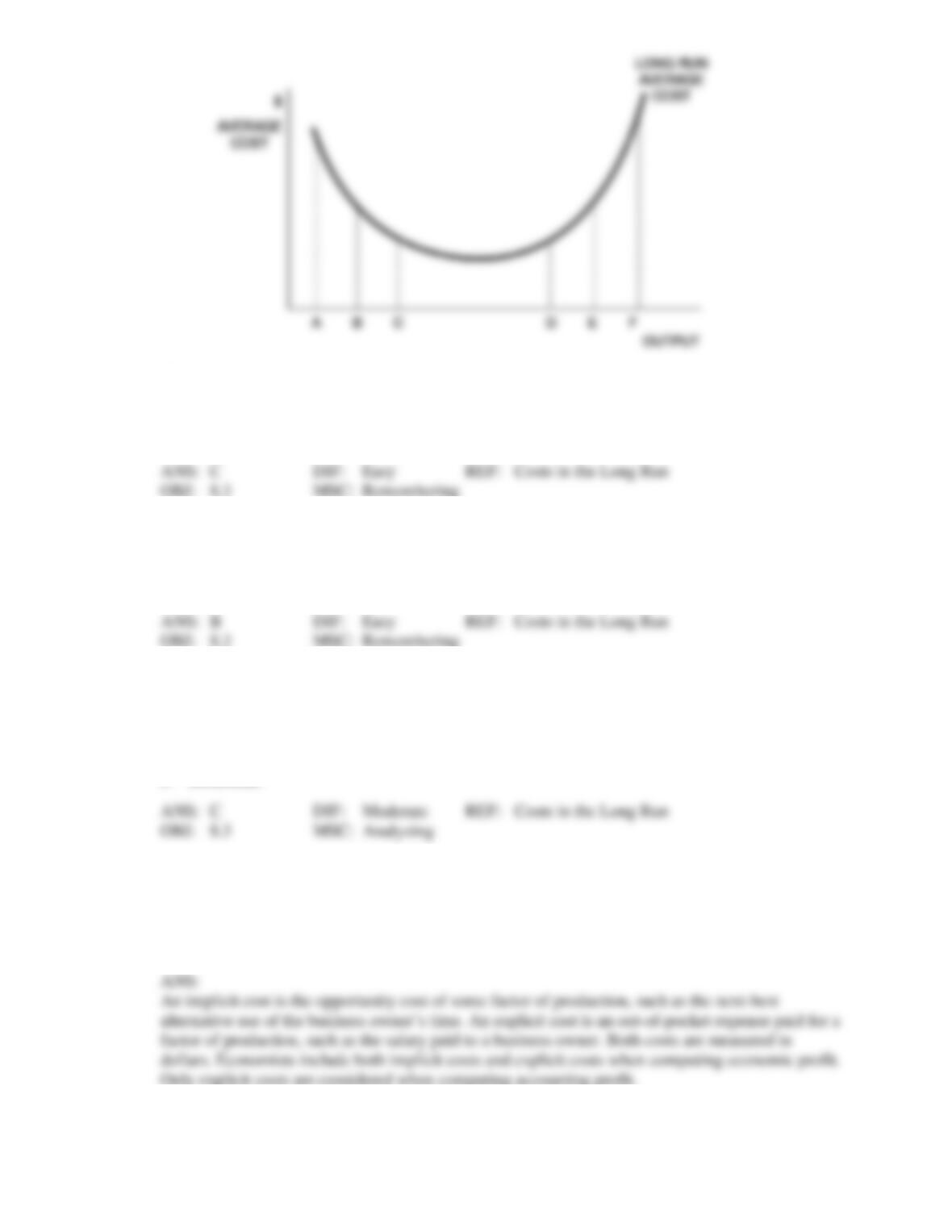
148. The long-run cost curve between points A and B illustrates
a. efficient scale. d. diminishing marginal product.
b. diseconomies of scale. e. constant returns to scale.
c. economies of scale.
149. The long-run cost curve between points E and F illustrates
a. efficient scale. d. diminishing marginal product.
b. diseconomies of scale. e. constant returns to scale.
c. economies of scale.
150. If a firm experiences some gains from specialization as it expands its scale of production, and adds
additional layers of management as it does so, assuming they have the same effect, we would
expect its long-run average total cost curve to be
a. downward sloping. d. vertical.
b. upward sloping. e. U-shaped.
SHORT ANSWER
1. Explain the difference between an implicit cost and an explicit cost, and how both costs relate to
economic and accounting profits.
2. What is an implicit cost?
3. How will a firm know when it has reached its minimum efficient scale of production?
4. Explain why it is important for a firm to know its efficient scale of production.
5. Quinn owns a DVD store. Give some examples of Quinn’s fixed costs for the store.
6. Explain what would happen to a graphed production function if the firm used more automation.
7. Describe what a production function is and what would happen if a firm becomes less efficient
because of a law that requires a certain number of workers per unit of capital.
8. Explain what a production function is. Is the production function an economic or technological
relationship?
9. What is the concept of diminishing marginal product?
10. Explain what the marginal product curve for a labor input typically looks like.
11. What is the difference between average variable cost and average total cost? Be sure to explain
each of the cost concepts in your answer.
12. Explain the relationship between the marginal cost curve and the average cost curve.
13. Explain the relationship between the marginal cost curve and the marginal product curve.
14. What determines the shape of the short-run cost curves?
15. Why is the long-run average cost curve important to a firm?
16. What causes diseconomies of scale for a firm?
17. What creates economies of scale for a firm?
18. If an industry is experiencing average costs that are always declining as the output increases, what
would you expect the efficient scale to be?
19. Is it possible for a firm to experience both economies of scale and diminishing marginal product at
the same time? Explain.
20. Explain how the long-run average cost curve is constructed graphically.
21. Kareem owns a bike store. If Kareem decides to double the size of his bike store, his rent will
increase as well. Is this increase in rent a short-run cost or a long-run cost?
22. How are long-run costs different from short-run costs?
23. What are economies of scale?
24. Explain the differences between diminishing marginal returns and diseconomies of scale.
25. Lisette owns a bakery. If she expands the size of her bakery but her average total cost of producing
bread remains unchanged in the long run, what is Lisette experiencing?