Chapter 08 – Pure Competition in the Short Run
8-1
CHAPTER 8
Pure Competition in the Short Run
A. Short-Answer, Essays, and Problems
1. How does pure competition differ from other basic market models?
2. What are some examples of the four different market structures?
3. What are four characteristics of pure competition?
4. Why can’t an individual firm raise its price by reducing output or lower its price to increase sales volume in
a purely competitive market?
5. How would you describe the demand curve for the purely competitive firm? For the industry?
6. What is the difference between average, total, and marginal revenue? What is the shape of the total and
marginal revenue curves for the individual competitive firm?
7. Why does price equal marginal revenue for the purely competitive firm? What is the relationship to the
demand curve for the firm?
8. Below is a demand schedule facing an individual firm. Complete the table by computing average revenue,
total revenue, and marginal revenue. Then answer the following two questions: (a) How can you tell
whether a firm is operating in a market that is purely competitive? (b) What relationship exists between
average revenue and marginal revenue?
Price Quantity demanded Average revenue Total revenue Marginal revenue
$30 0 $_____ $_____ —
30 1 _____ _____ $_____
30 2 _____ _____ _____
30 3 _____ _____ _____
30 4 _____ _____ _____
30 5 _____ _____ _____
30 6 _____ _____ _____
9. An airline is flying between two cities. The airline has the following costs associated with the flight:
Crew $4000 Plane daily depreciation $2000
Fuel 1000 Plane daily insurance 2000
Landing fee 1000
The airline has an average of 40 passengers paying an average of $200 for this flight. Do you think the
airline should be flying between the two cities? Evaluate from a short-run perspective.
Chapter 08 – Pure Competition in the Short Run
8-2
10. Fill in the following table for a product in a purely competitive market. The market price for the good is
$32. Use the total revenue–total cost approach to evaluate at what quantity the firm can maximize its
profits.
Total
product
outputTotal
fixed
cost Total
variable
cost
Total cost
Total revenue
Profit/ Loss
0 $50 $ 0 $_____ $_____ $_____
1 50 5 _____ _____ _____
2 50 15 _____ _____ _____
3 50 30 _____ _____ _____
4 50 50 _____ _____ _____
5 50 75 _____ _____ _____
6 50 105 _____ _____ _____
7 50 140 _____ _____ _____
8 50 185 _____ _____ _____
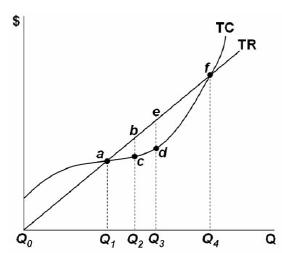
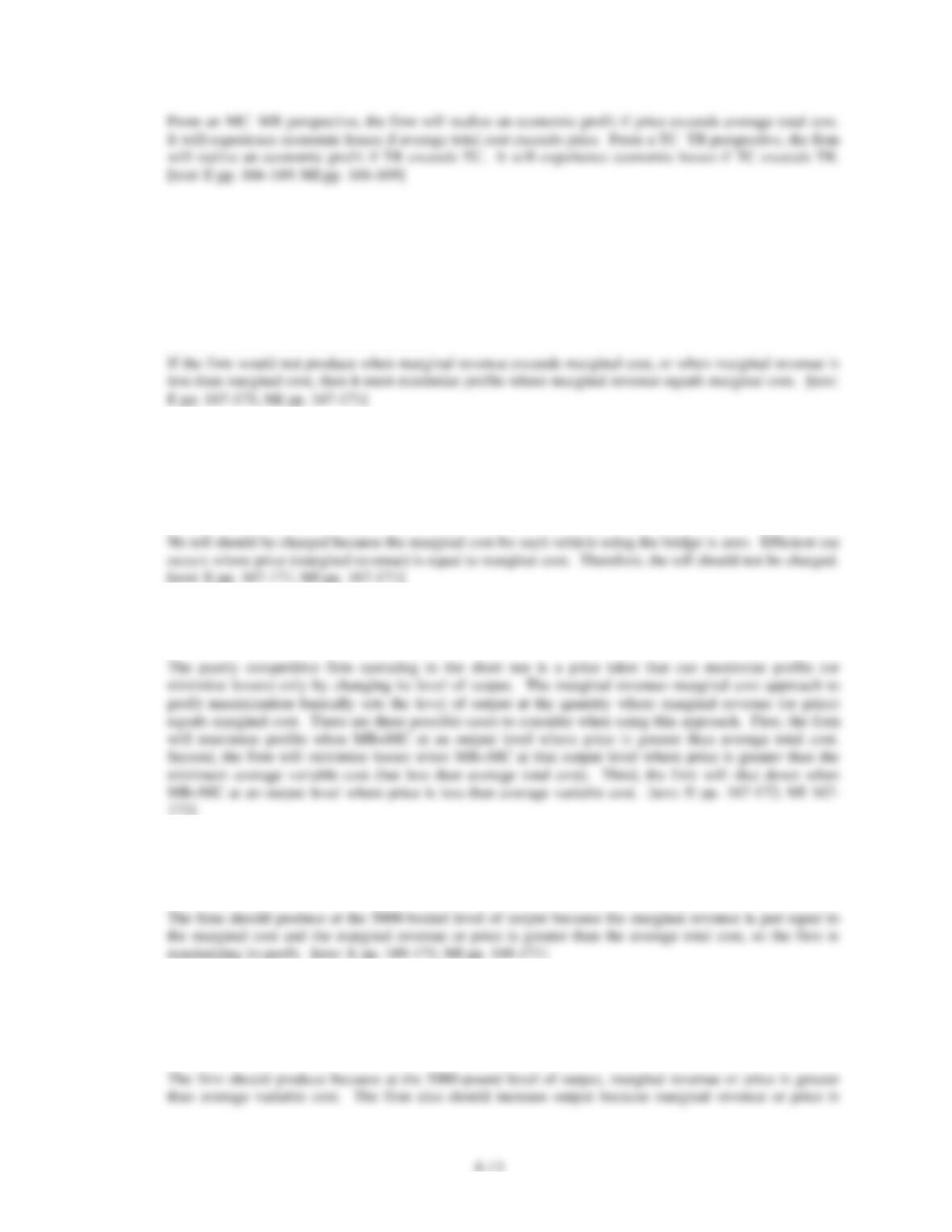
11. Use the graph below to identify: (a) break-even points; (b) the profit-maximizing level of output; and, (c)
letters showing largest difference between total revenue and total costs and the output level.
12. What conditions are necessary to determine if the purely competitive firm should produce in the short run?
State the marginal revenue and marginal cost conditions and the total revenue and total cost conditions.
13. What quantity should the purely competitive firm produce to maximize profits? Analyze from a total
revenue and total cost perspective and a marginal revenue and marginal cost perspective.
14. Under what conditions will a purely competitive firm realize an economic profit? Give a response from a
marginal revenue and marginal cost perspective and from a total revenue and total cost perspective.
15. Why is the level of output at which marginal revenue equals marginal cost the profit-maximizing output?
16. Suppose a bridge for automobiles was constructed across a river and all the costs associated with its
construction have been paid. The amount of traffic is such that there are no foreseeable problems of
overcrowding in the use of the bridge. Assume, also, that the extra cost associated with traffic crossing the
bridge is for all practical purposes equal to zero. What toll should be charged to achieve the most efficient
use of the bridge?
17. Explain the marginal revenue and marginal cost approach to profit maximization and use it to describe
profit, loss, and shut down situations for the purely competitive firm.
Chapter 08 – Pure Competition in the Short Run
8-3
18. Tomato Farms is selling tomatoes in a purely competitive market. Its output is 5000 bushels, which sell for
$15 a bushel. At this level of output, the marginal cost is $15 a bushel and average total cost is $14.50 a
bushel. Should the firm increase output, decrease output, or not produce? Why?
19. Good Grapes is selling grapes in a purely competitive market. Its output is 5000 pounds, which it sells for
$5 a pound. At the 5000-pound level of output, the average variable cost is $4.00, the marginal cost is
$4.25, and the average total cost is $4.50 a pound. Should the firm increase output, decrease output, or not
produce? Why? How should the firm determine the optimal level of output?
20. Doggy Treats is selling dog treats in a purely competitive market. Its output is 800 treats, which it sells for
$10 a treat. At the 800-treat level of output, the marginal cost is $11, the average variable cost is $9.00, and
the average variable cost is $8.00. Should the firm increase output, decrease output, or not produce? Why?
How should the firm determine that optimal level of output?
21. Shazam, a maker of magic wands, is selling in a purely competitive market. Its output is 500 wands, which
sell for $10 each. At this level of output, the marginal cost is $10 and the average variable cost is $12.
Should the firm increase output, decrease output, or not produce? Why?
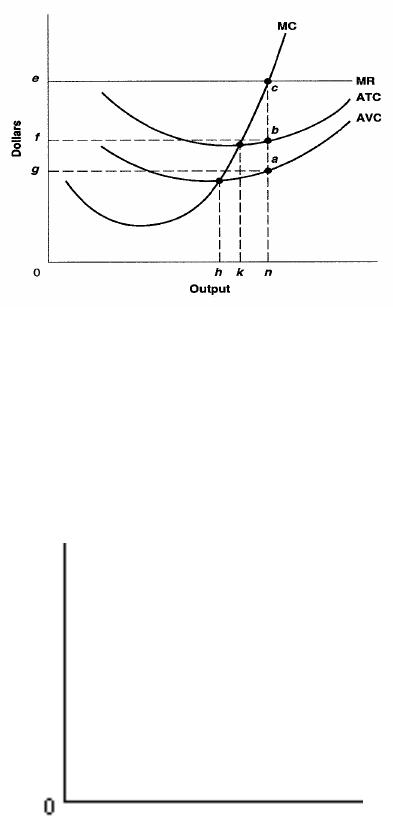
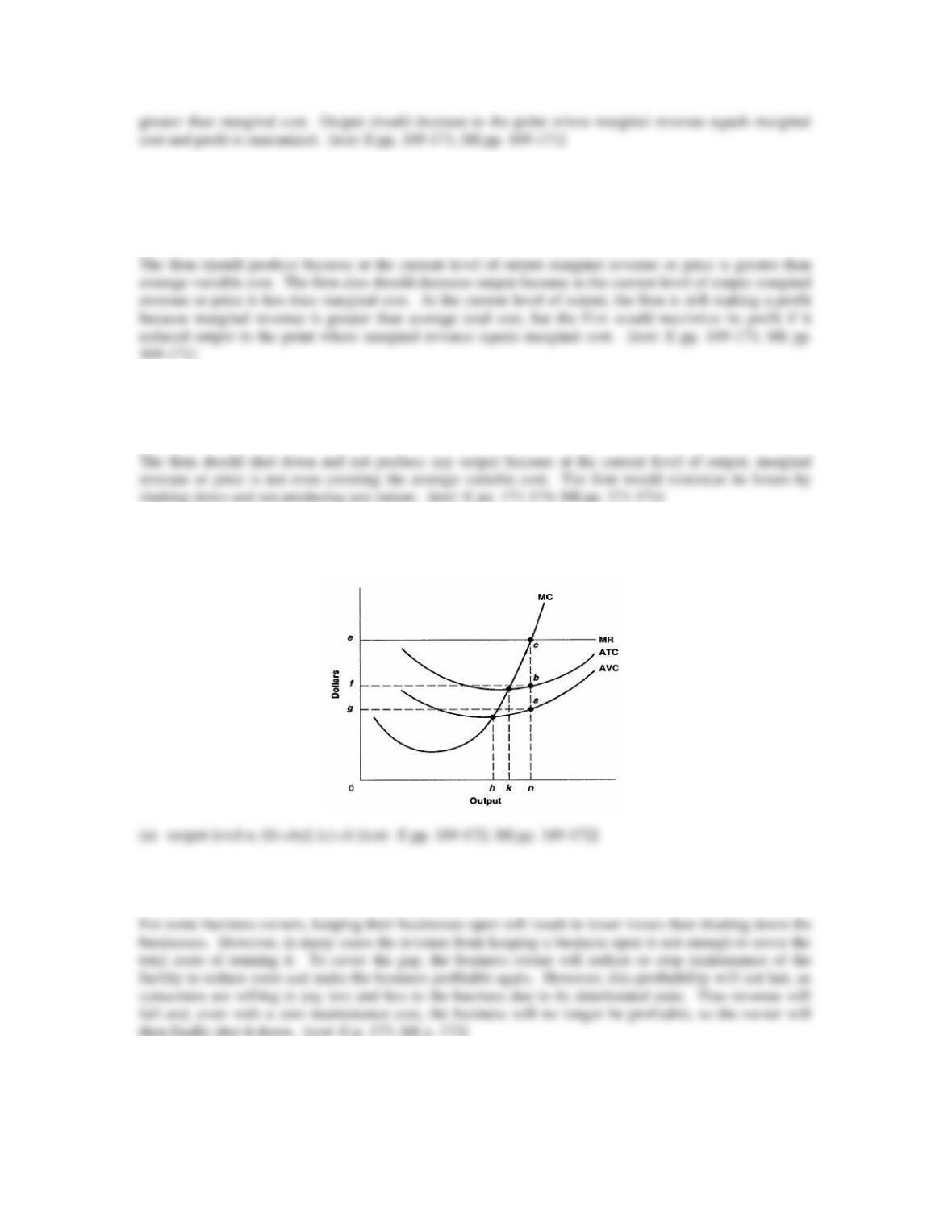
22. Use the graph and the letters in it to answer these questions: (a) What is the profit-maximizing level of
output? (b) What is the area of economic profit? (c) What is the per-unit amount of profit at the profit–
maximizing level of output?
23. (Consider This) Why might a business owner keep their business open but let it deteriorate, rather than
shut it down? Will this profitability last?
24. What is the relationship between marginal cost and the short-run supply curve for the purely competitive
firm?
25. Draw a graph of the short-run cost curves for a purely competitive firm that shows a short-run supply curve
for the individual firm. Identify the shutdown point, the break-even point, the profit-maximizing point, and
the levels of output associated with those points.
Chapter 08 – Pure Competition in the Short Run
8-4
Chapter 08 – Pure Competition in the Short Run
8-5
26. How will the marginal and average cost curves of the typical pure competitor shift or change as a result of
the following events: (a) an increase in wages of all labor; (b) an increase in the rental payments on office
machinery; (c) a technological advance; (d) an increase in sales taxes; (e) an increase in property taxes; and
(f) a decline in the price of a basic raw material?
27. The agricultural market for corn can be characterized as a purely competitive industry. How might the
following events affect the short-run cost curves and output for a firm in the industry?
(a) A reduction in the cost of fertilizer that is sold to corn farmers.
(b) The Internal Revenue Service (IRS) changes tax laws which increase the amount of depreciation that
farmers can deduct for equipment.
(c) The market price of corn falls.
28. Assume a single firm in a purely competitive industry has variable costs as indicated in the following table
in column 2. Complete the table and answer the questions.
(1)
Total
product(2)
Total
var. cost(3)
Total
cost (4)
AFC (5)
AVC (6)
ATC (7)
MC
0 $ 0 $ 40 $_____ $_____ $_____
1 55 _____ _____ _____ _____ $_____
2 75 _____ _____ _____ _____ _____
3 90 _____ _____ _____ _____ _____
4 110 _____ _____ _____ _____ _____
5 135 _____ _____ _____ _____ _____
6 170 _____ _____ _____ _____ _____
7 220 _____ _____ _____ _____ _____
8 290 _____ _____ _____ _____ _____
(a) At a product price of $52, will this firm produce in the short run? Explain. What will its profit or loss
be?
(b) At a product price of $28, will this firm produce in the short run? Explain. What will its profit or loss
be?
(c) At a product price of $22, will this firm produce in the short run? Explain. What will its profit or loss
be?
(d) Complete the following short-run supply schedule for this firm.
Product price Quantity supplied Profit (+)
or loss (−)
$72 _____ $_____
52 _____ _____
45 _____ _____
28 _____ _____
22 _____ _____
15 _____ _____
Assume there are 500 identical firms in this industry, that they have identical cost data as the firm above,
and that the industry demand schedule is as follows:
Price Quantity demanded
$72 2500
52 3500
45 4000
Chapter 08 – Pure Competition in the Short Run
8-6
28 5200
22 5900
15 6700
(e) What will the equilibrium price be?
(f) What will the equilibrium output for each firm be?
(g) What will profit or loss be per unit?
(h) What will profit or loss be per firm?
29. Assume that a purely competitive firm has the schedule of costs given in the table below.
Output TFC TVC TC
0 $500 $ 0 $ 500
1 500 150 650
2 500 200 700
3 500 260 760
4 500 340 840
5 500 450 950
6 500 590 1090
7 500 770 1270
8 500 1000 1500
9 500 1290 1790
10 500 1650 2150
(a) Complete the table below to show the total revenue and total profit of the firm at each level of output
the firm might produce. Assume market prices of $50, $150, and $250.
Market price = $50 Market price = $150 Market price = $250
Output Total revenue Profit (+) or loss (−) Total revenue Profit (+) or loss (−)
Total revenue Profit (+) or loss (−)
0 $_____ $_____ $_____ $_____ $_____ $_____
1 _____ _____ _____ _____ _____ _____
2 _____ _____ _____ _____ _____ _____
3 _____ _____ _____ _____ _____ _____
4 _____ _____ _____ _____ _____ _____
5 _____ _____ _____ _____ _____ _____
6 _____ _____ _____ _____ _____ _____
7 _____ _____ _____ _____ _____ _____
8 _____ _____ _____ _____ _____ _____
9 _____ _____ _____ _____ _____ _____
10 _____ _____ _____ _____ _____ _____
(b) Indicate what output the firm would produce and its profits in the following table.
Price Quantity supplied Profit (+)
or loss (−)
$ 50_____ $_____
150 _____ _____
250 _____ _____
30. Assume that a purely competitive firm has the schedule of average and marginal costs given in the table
below.
OutputAFC AVC ATC MC
0
1 $600 $200 $800 $200
2 300 150 450 100
3 200 140 340 120
4 150 145 295 160
5 120 160 280 220
6 100 180 280 280
7 86 205 291 360
8 76 232 314 460
9 66 276 342 580
10 60 320 380 720
(a) In the table below, complete the supply schedule for the competitive firm and state what the economic
profit will be at each price.
Chapter 08 – Pure Competition in the Short Run
8-7
Price Quantity supplied Profit (+)
or loss (−)
$580_____ $_____
460 _____ _____
360 _____ _____
280 _____ _____
220 _____ _____
160 _____ _____
120 _____ _____
(b) If there are 100 firms in the industry and all have the same cost schedule, complete the market supply
schedule in the table below.
Quantity
demanded
PriceQuantity
supplied
500 $580 _____
600 460 _____
700 360 _____
800 280 _____
900 220 _____
1000 160 _____
1100 120 _____
Answer the following questions: (1) What will the equilibrium price and quantity of the product be? (2)
What will the profits of each firm be? (3) Will firms tend to enter or leave the industry in the long run?
Explain.
Chapter 08 – Pure Competition in the Short Run
8-8
31. Assume that a purely competitive firm has the schedule of total fixed and total variable costs given in the
table below. Fill in the total cost column.
Output TFC TVC TC
0 $500 $ 0 $_____
2 500 200 _____
4 500 340 _____
6 500 590 _____
8 500 1000 _____
10 500 1650 _____
(a) Complete the table below to show the total revenue and total profit of the firm at each level of output
the firm might produce. Assume market prices of $50, $150, and $250.
Market price = $50 Market price = $150 Market price = $250
Output Total revenue Profit (+) or loss (−) Total revenue Profit (+) or loss (−)
Total revenue Profit (+) or loss (−)
0 $_____ $_____ $_____ $_____ $_____ $_____
2 _____ _____ _____ _____ _____ _____
4 _____ _____ _____ _____ _____ _____
6 _____ _____ _____ _____ _____ _____
8 _____ _____ _____ _____ _____ _____
10 _____ _____ _____ _____ _____ _____
(b) Indicate what output the firm would produce and its profits in the following table.
Price Quantity supplied Profit (+)
or loss (−)
$ 50_____ $_____
150 _____ _____
250 _____ _____
32. (Last Word) Why do high fixed costs force firms to shut down temporarily or shut down forever?
Chapter 08 – Pure Competition in the Short Run
B. Answers to Short-Answer, Essays, and Problems
1. How does pure competition differ from other basic market models?
2. What are some examples of the four different market structures?
3. What are four characteristics of pure competition?
4. Why can’t an individual firm raise its price by reducing output or lower its price to increase sales volume in
a purely competitive market?
Chapter 08 – Pure Competition in the Short Run
8-10
5. How would you describe the demand curve for the purely competitive firm? For the industry?
6. What is the difference between average, total, and marginal revenue? What is the shape of the total and
marginal revenue curves for the individual competitive firm?
7. Why does price equal marginal revenue for the purely competitive firm? What is the relationship to the
demand curve for the firm?
8. Below is a demand schedule facing an individual firm. Complete the table by computing average revenue,
total revenue, and marginal revenue. Then answer the following two questions: (a) How can you tell
whether a firm is operating in a market that is purely competitive? (b) What relationship exists between
average revenue and marginal revenue?
Price Quantity demanded Average revenue Total revenue Marginal revenue
$30 0 $_____ $_____ —
30 1 _____ _____ $_____
30 2 _____ _____ _____
30 3 _____ _____ _____
30 4 _____ _____ _____
30 5 _____ _____ _____
30 6 _____ _____ _____
Chapter 08 – Pure Competition in the Short Run
8-11
[text: E pp. 165-166; MI pp. 165–166]
9. An airline is flying between two cities. The airline has the following costs associated with the flight:
Crew $4000 Plane daily depreciation $2000
Fuel 1000 Plane daily insurance 2000
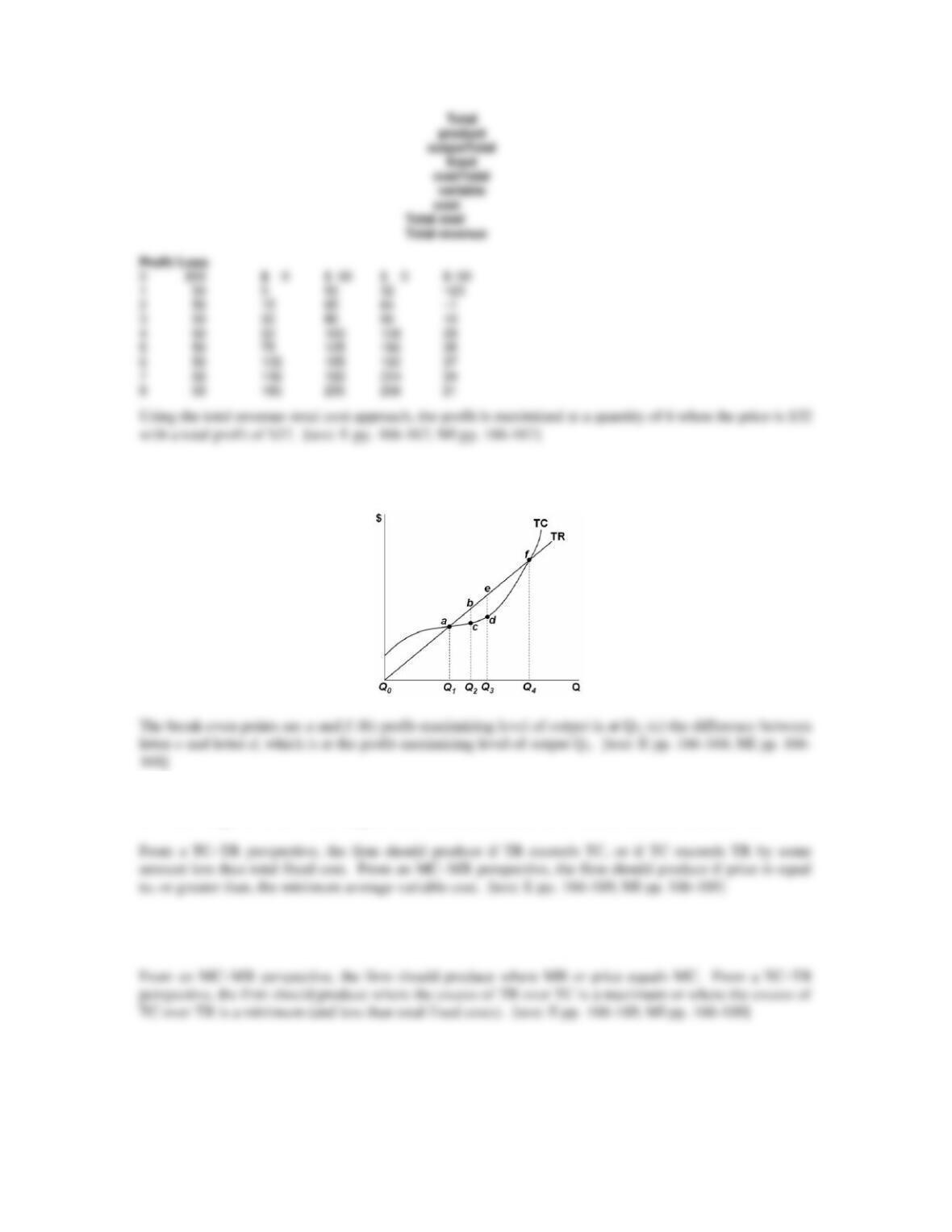
10. Fill in the following table for a product in a purely competitive market. The market price for the good is
$32. Use the total revenue–total cost approach to evaluate at what quantity the firm can maximize its
profits.
Total
product
outputTotal
fixed
cost Total
variable
cost
Total cost
Total revenue
Profit/ Loss
0 $50 $ 0 $_____ $_____ $_____
1 50 5 _____ _____ _____
2 50 15 _____ _____ _____
3 50 30 _____ _____ _____
4 50 50 _____ _____ _____
5 50 75 _____ _____ _____
6 50 105 _____ _____ _____
7 50 140 _____ _____ _____
8 50 185 _____ _____ _____
Chapter 08 – Pure Competition in the Short Run
8-12
11. Use the graph below to identify: (a) break-even points; (b) the profit-maximizing level of output; and, (c)
letters showing largest difference between total revenue and total costs and the output level.
12. What conditions are necessary to determine if the purely competitive firm should produce in the short run?
State the marginal revenue and marginal cost conditions and the total revenue and total cost conditions.
13. What quantity should the purely competitive firm produce to maximize profits? Analyze from a total
revenue and total cost perspective and a marginal revenue and marginal cost perspective.
14. Under what conditions will a purely competitive firm realize an economic profit? Give a response from a
marginal revenue and marginal cost perspective and from a total revenue and total cost perspective.
Chapter 08 – Pure Competition in the Short Run
15. Why is the level of output at which marginal revenue equals marginal cost the profit-maximizing output?
The easiest way to explain this is to explain why it cannot be otherwise. If marginal revenue exceeds
marginal cost, then the firm can add to its profits by expanding production until marginal revenue no longer
exceeds marginal cost (either because the price declines eventually or diminishing returns set in and
marginal cost rises or both). If, on the other hand, marginal revenue is below marginal cost, it would not be
rational for the firm to expand production to this level. Why add more to your costs than you add to your
revenues since that means smaller profits?
16. Suppose a bridge for automobiles was constructed across a river and all the costs associated with its
construction have been paid. The amount of traffic is such that there are no foreseeable problems of
overcrowding in the use of the bridge. Assume, also, that the extra cost associated with traffic crossing the
bridge is for all practical purposes equal to zero. What toll should be charged to achieve the most efficient
use of the bridge?
17. Explain the marginal revenue and marginal cost approach to profit maximization and use it to describe
profit, loss, and shut down situations for the purely competitive firm.
18. Tomato Farms is selling tomatoes in a purely competitive market. Its output is 5000 bushels, which sell for
$15 a bushel. At this level of output, the marginal cost is $15 a bushel and average total cost is $14.50 a
bushel. Should the firm increase output, decrease output, or not produce? Why?
19. Good Grapes is selling grapes in a purely competitive market. Its output is 5000 pounds, which it sells for
$5 a pound. At the 5000-pound level of output, the average variable cost is $4.00, the marginal cost is
$4.25, and the average total cost is $4.50 a pound. Should the firm increase output, decrease output, or not
produce? Why? How should the firm determine the optimal level of output?
Chapter 08 – Pure Competition in the Short Run
8-14
20. Doggy Treats is selling dog treats in a purely competitive market. Its output is 800 treats, which it sells for
$10 a treat. At the 800-treat level of output, the marginal cost is $11, the average variable cost is $9.00, and
the average variable cost is $8.00. Should the firm increase output, decrease output, or not produce? Why?
How should the firm determine that optimal level of output?
21. Shazam, a maker of magic wands, is selling in a purely competitive market. Its output is 500 wands, which
sell for $10 each. At this level of output, the marginal cost is $10 and the average variable cost is $12.
Should the firm increase output, decrease output, or not produce? Why?
22. Use the graph and the letters in it to answer these questions: (a) What is the profit-maximizing level of
output? (b) What is the area of economic profit? (c) What is the per-unit amount of profit at the profit–
maximizing level of output?
23. (Consider This) Why might a business owner keep their business open but let it deteriorate, rather than
shut it down? Will this profitability last?
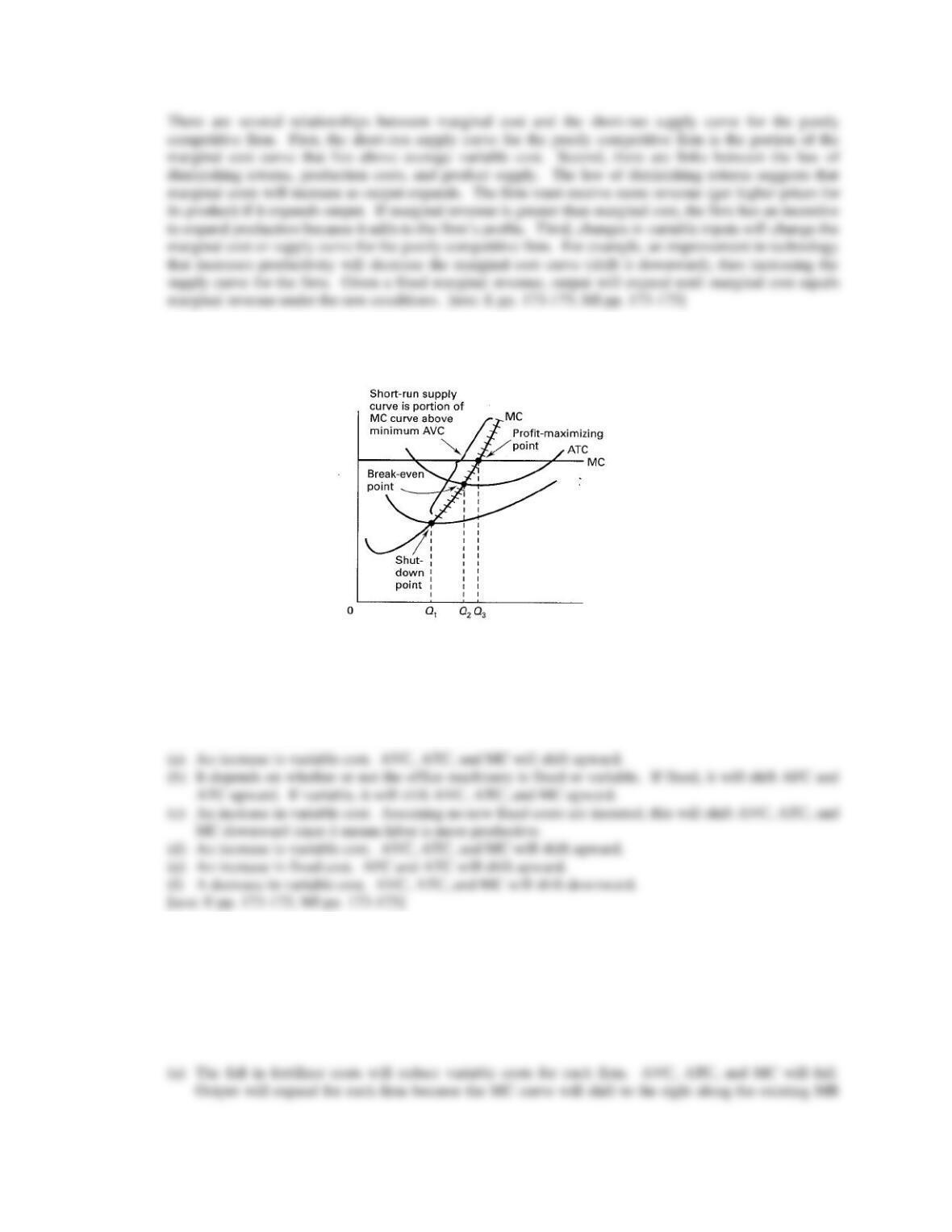
24. What is the relationship between marginal cost and the short-run supply curve for the purely competitive
firm?
Chapter 08 – Pure Competition in the Short Run
8-15
25. Draw a graph of the short-run cost curves for a purely competitive firm that shows a short-run supply curve
for the individual firm. Identify the shutdown point, the break-even point, the profit-maximizing point, and
the levels of output associated with those points.
[text: E pp. 173-175; MI pp. 173-175]
26. How will the marginal and average cost curves of the typical pure competitor shift or change as a result of
the following events: (a) an increase in wages of all labor; (b) an increase in the rental payments on office
machinery; (c) a technological advance; (d) an increase in sales taxes; (e) an increase in property taxes; and
(f) a decline in the price of a basic raw material?
27. The agricultural market for corn can be characterized as a purely competitive industry. How might the
following events affect the short-run cost curves and output for a firm in the industry?
(a) A reduction in the cost of fertilizer that is sold to corn farmers.
(b) The Internal Revenue Service (IRS) changes tax laws which increase the amount of depreciation that
farmers can deduct for equipment.
(c) The market price of corn falls.
MR
Chapter 08 – Pure Competition in the Short Run
8-16
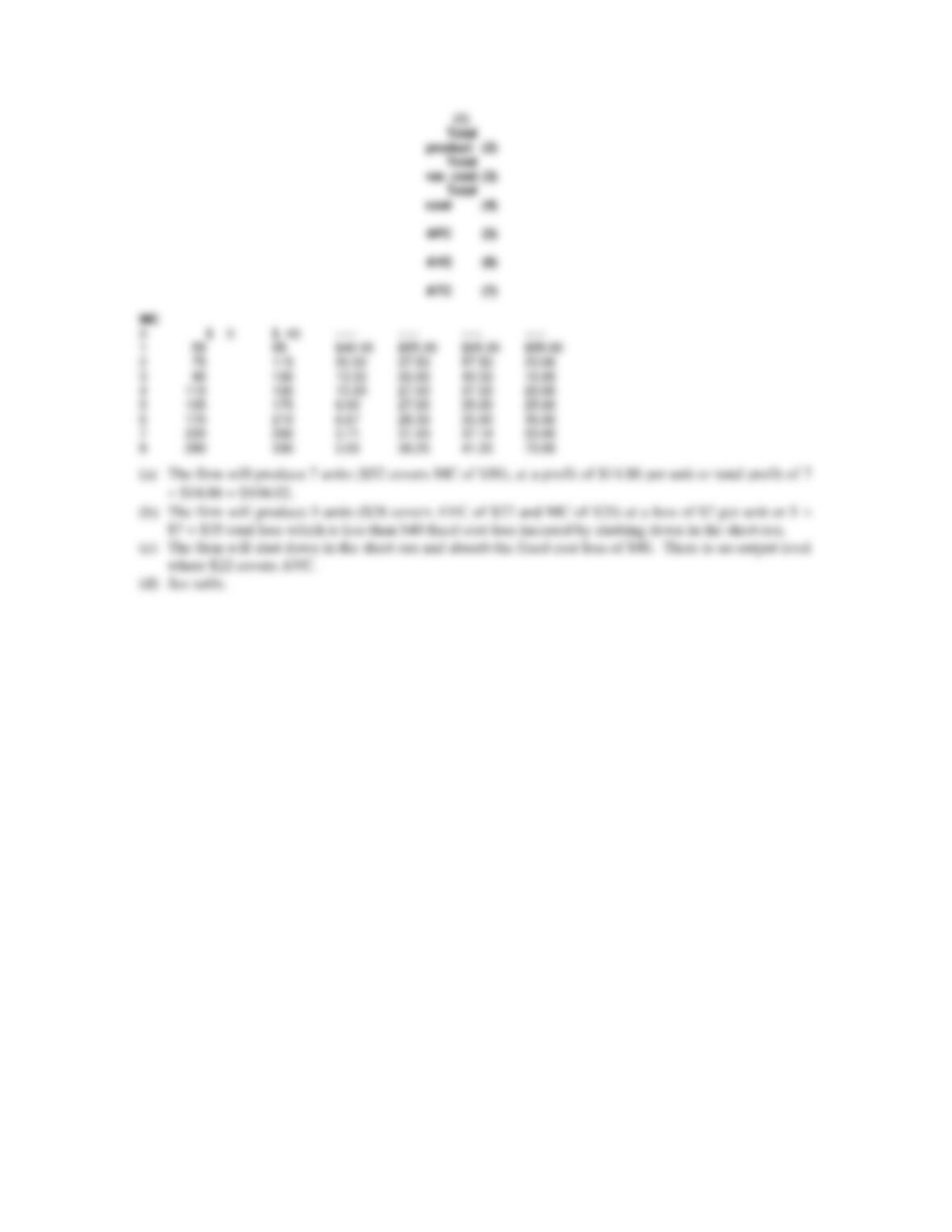
28. Assume a single firm in a purely competitive industry has variable costs as indicated in the following table
in column 2. Complete the table and answer the questions.
(1)
Total
product(2)
Total
var. cost(3)
Total
cost (4)
AFC (5)
AVC (6)
ATC (7)
MC
0 $ 0 $ 40 $_____ $_____ $_____
1 55 _____ _____ _____ _____ $_____
2 75 _____ _____ _____ _____ _____
3 90 _____ _____ _____ _____ _____
4 110 _____ _____ _____ _____ _____
5 135 _____ _____ _____ _____ _____
6 170 _____ _____ _____ _____ _____
7 220 _____ _____ _____ _____ _____
8 290 _____ _____ _____ _____ _____
(a) At a product price of $52, will this firm produce in the short run? Explain. What will its profit or loss
be?
(b) At a product price of $28, will this firm produce in the short run? Explain. What will its profit or loss
be?
(c) At a product price of $22, will this firm produce in the short run? Explain. What will its profit or loss
be?
(d) Complete the following short-run supply schedule for this firm.
Product price Quantity supplied Profit (+)
or loss (−)
$72 _____ $_____
52 _____ _____
45 _____ _____
28 _____ _____
22 _____ _____
15 _____ _____
Assume there are 500 identical firms in this industry, that they have identical cost data as the firm above,
and that the industry demand schedule is as follows:
Price Quantity demanded
$72 2500
52 3500
45 4000
28 5200
22 5900
15 6700
(e) What will the equilibrium price be?
(f) What will the equilibrium output for each firm be?
Chapter 08 – Pure Competition in the Short Run
8-17
(g) What will profit or loss be per unit?
(h) What will profit or loss be per firm?
Chapter 08 – Pure Competition in the Short Run
8-18
Chapter 08 – Pure Competition in the Short Run
8-19
Chapter 08 – Pure Competition in the Short Run
8-20