CHAPTER 8: Business Costs and Production
MULTIPLE CHOICE
1. What needs to be done to ensure that a company is profitable?
a. The company needs to maximize revenue.
b. The company needs to minimize costs.
c. The company needs to both minimize costs and maximize revenue.
d. The company needs to both maximize costs and minimize revenue.
e. The company needs only to provide products that customers want.
2. A restaurant owner just found out that his pizza bistro is losing money. What is one possible
explanation for this loss?
a. The revenue isn’t being maximized.
b. The costs aren’t being maximized.
c. The revenue isn’t being minimized.
d. The costs and the revenue aren’t both being maximized.
e. The costs and the revenue aren’t both being minimized.
3. Total revenue minus total cost is equal to
a. producer surplus. d. profit.
b. dividends. e. retained earnings.
c. consumer surplus.
4. Which of the following statements is FALSE?
a. Implicit costs are unique to the individual firm.
b. Explicit costs are easy to measure.
c. Implicit costs are opportunity costs.
d. An explicit cost is a nonmonetary opportunity cost.
e. An implicit cost is nonmonetary.
5. Which of the following statements is true?
a. An implicit cost is monetary.
b. An explicit cost is an opportunity cost.
c. Economists consider all costs to be explicit costs.
d. Implicit and explicit costs are always equal.
e. Economists consider only some costs to be implicit costs.
6. Explicit costs are
a. the opportunity cost of the means of production.
b. always paid out of pocket.
c. always greater than implicit costs.
d. never greater than implicit costs.
e. what a business sacrifices in order to produce a good.
7. The out-of-pocket expenses incurred in producing a good are also known as
a. implicit costs. d. capital costs.
b. fiduciary costs. e. wages and prices.
c. explicit costs.
8. Which of the following is true about explicit costs?
a. They are the opportunity costs of production.
b. They are out-of-pocket expenses.
c. They are not measured in terms of dollars.
d. They are not included when measuring economic profit.
e. They are not included when measuring accounting profit.
9. An explicit cost for a business that manufactures bicycles would be the
a. value of the products that the firm’s employees could produce at another company.
b. salary that the owner of the business could earn elsewhere.
c. goods and services provided by the government with the taxes the firm pays.
d. wages paid to employees.
e. various products that could be made with the steel used to make bicycles.
10. If a firm has total costs of $535,000 and its implicit costs are $165,000, how much are its explicit
costs?
a. $3,242 d. $700,000
b. $120,000 e. $308
c. $370,000
11. Remi owns a small pizza restaurant, where he works full-time in the kitchen. His total revenue last
year was $100,000, and his rent was $3,000 per month. He pays his one employee $2,000 per
month, and the cost of ingredients and overhead averages $500 per month. Remi could earn
$35,000 per year as the manager of a competing pizza restaurant nearby. His total explicit costs
last year were
a. $24,000. d. $66,000.
b. $6,000. e. $72,000.
c. $60,000.
12. Lisette is the owner of a bakery that earns zero economic profit. Last year, her total revenue was
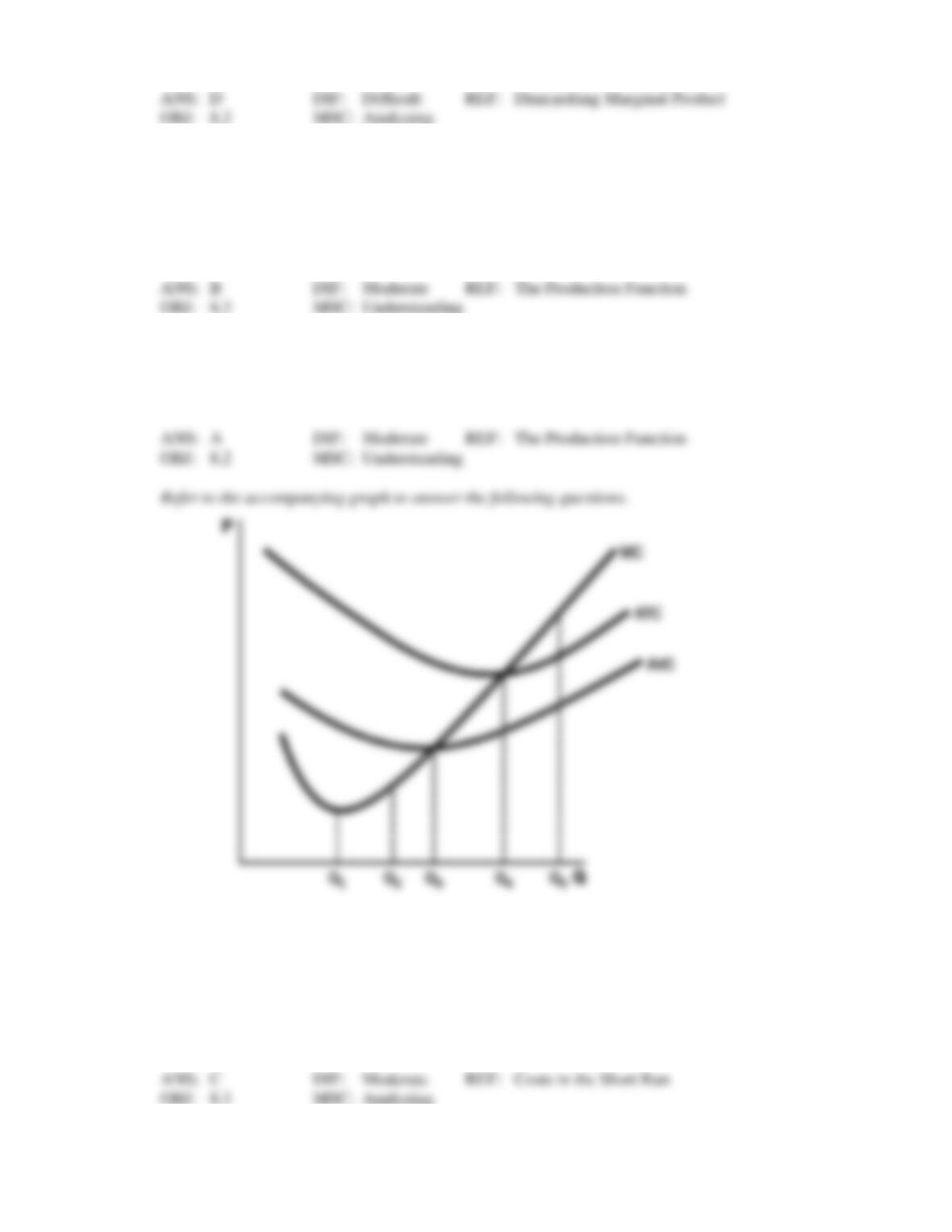
$145,000, her rent was $12,000, her labor costs were $65,000, and her overhead expenses were
$15,000. From this information, we know that her total explicit costs were
a. $80,000. d. $77,000.
b. $92,000. e. $53,000.
c. $15,000.
13. Implicit costs are
a. the opportunity cost of the means of production.
b. always paid out of pocket.
c. never greater than explicit costs.
d. always greater than explicit costs.
e. not measured in terms of dollars.
14. Implicit costs can be difficult to measure because
a. business owners cannot always observe them directly.
b. they are not measured in dollars.
c. they are always very expensive.
d. they are always greater than explicit costs.
e. they include expenses like taxes.
15. If a firm generates $240,000 in revenue, earns $120,000 in economic profit, and its explicit costs
are $80,000, how much are its implicit costs?
a. $160,000 d. $60,000
b. $80,000 e. $120,000
c. $40,000
16. Ramona owns a small coffee shop, where she works full-time. Her total revenue last year was
$100,000, and her rent was $3,000 per month. She pays her one employee $2,000 per month, and
the cost of ingredients and overhead averages $500 per month. Ramona could earn $35,000 per
year as the manager of a competing coffee shop nearby. Her total implicit costs last year were
a. $100,000. d. $66,000.
b. $35,000. e. $72,000.
c. $60,000.
17. Jeremy is the owner of a makeup parlor that earns zero economic profit. Last year, his total
revenue was $145,000, his rent was $12,000, his labor costs were $65,000, and his overhead
expenses were $15,000. From this information, we know that his total implicit costs were
a. $145,000. d. $65.000.
b. $53,000. e. $15,000.
c. $92,000.
18. Economists consider both explicit costs and implicit costs when measuring economic profit. The
reason they consider implicit costs is that
a. they are more conservative than accountants, who consider only accounting costs.
b. most businesses forget to pay their implicit costs.
c. a business must cover its opportunity costs as well as its out-of-pocket expenses to be truly
profitable.
d. implicit costs are typically far larger than explicit costs.
e. implicit costs include expenses like taxes and fees to the government.
19. Accountants consider only explicit costs when measuring accounting profit. The reason they
ignore implicit costs is that
a. implicit costs are typically very small.
b. explicit costs are always greater than implicit costs.
c. implicit costs are not out-of-pocket expenses.
d. implicit costs are tax deductible.
e. implicit costs cannot be measured in terms of dollars.
20. Accounting profit is equal to
a. total revenue minus explicit costs.
b. total revenue minus implicit costs.
c. explicit costs plus implicit costs.
d. explicit costs minus implicit costs.
e. total revenue minus implicit costs and explicit costs.
21. Accounting profit ignores which of the following?
a. implicit costs d. taxes paid
b. labor costs e. explicit costs
c. capital costs
22. A firm’s accounting profit is always greater than its economic profit because
a. economic profit considers implicit costs, which accounting profit does not.
b. accounting profit considers explicit costs, which economic profit does not.
c. economic profit is always zero, no matter what kind of firm it is.
d. accounting profit considers implicit costs, which economic profit does not.
e. accounting profit is always positive, no matter what kind of firm it is.
23. Luciana is the owner of a nail salon. Last year, her total revenue was $145,000, her rent was
$12,000, her labor costs were $65,000, and her overhead expenses were $15,000. From this
information, we know that her accounting profit was
a. $145,000. d. $15,000.
b. $53,000. e. $27,000.
c. $65,000.
24. Jackie is the owner of a furniture store. Last year, her total revenue was $525,000 and her total
labor costs were $200,000. Her overhead expenses, including insurance and legal fees, were
$175,000. The rent on the building was $45,000. Jackie could earn $105,000 per year working at a
nearby furniture distributor. From this information, we know that her accounting profit was
a. $525,000. d. $175,000.
b. $375,000. e. $105,000.
c. $150,000.
25. Kumar owns a small seafood restaurant, where he works full-time in the kitchen. His total revenue
last year was $100,000, and his rent was $3,000 per month. He pays his one employee $2,000 per
month, and the cost of ingredients and overhead averages $500 per month. Kumar could earn
$35,000 per year as the manager of a competing seafood restaurant nearby. His total accounting
profit last year was
a. −$1,000. d. $34,000.
b. $100,000. e. $35,000.
c. $72,000.
26. Economic profit is equal to
a. total revenue minus explicit costs.
b. total revenue minus implicit costs.
c. explicit costs plus implicit costs.
d. total revenue minus implicit costs and explicit costs.
e. explicit costs minus implicit costs.
27. A firm’s economic profit is always less than its accounting profit because
a. accounting profit considers explicit costs, which economic profit does not.
b. economic profit considers implicit costs, which accounting profit does not.
c. economic profit is always zero, no matter what kind of firm it is.
d. accounting profit considers implicit costs, which economic profit does not.
e. accounting profit is always positive, no matter what kind of firm it is.
28. If we were told that a firm earns positive accounting profit and nothing else, what would we know
is true about its economic profit?
a. It is positive because whenever accounting profit is positive, so is economic profit.
b. It cannot be determined without knowing the firm’s implicit costs.
c. It is zero because all firms earn zero economic profit regardless of the industry.
d. It is equal to its accounting profit.
e. It is negative because its accounting profit is probably not high enough to earn positive
economic profit.
29. Karolina owns a small diner, where she works full-time in the kitchen. Her total revenue last year
was $100,000, and her rent was $3,000 per month. She pays her one employee $2,000 per month,
and the cost of ingredients and overhead averages $500 per month. Karolina could earn $35,000
per year as the manager of a competing diner nearby. Her total economic profit last year was
a. $34,000. d. $65,000.
b. −$1,000. e. −$35,000.
c. $20,000.
30. Hannah is the owner of a party store. Last year, her total revenue was $145,000, her rent was
$12,000, her labor costs were $65,000, and her overhead expenses were $15,000. If she could earn
$53,000 working for another party store nearby, we know that her economic profit was
a. $145,000. d. $0.00.
b. $53,000. e. $15,000.
c. $12,000.
31. Belinda is the owner of a department store. Last year, her total revenue was $525,000 and her total
labor costs were $200,000. Her overhead expenses, including insurance and legal fees, were
$175,000. The rent on the building was $45,000. Belinda could earn $105,000 per year working at
a nearby department store. If her total revenue increases to $600,000 this year and all of her other
expenses are held constant, we know that her economic profit is now
a. $75,000. d. $105,000.
b. $600,000. e. $200,000.
c. $0.00.
32. A firm’s inputs are also known as its
a. outputs. d. revenues.
b. profits. e. costs.
c. factors of production.
33. The production function shows the relationship between the
a. costs of inputs and the price of the output.
b. quantity of inputs and the quantity of outputs.
c. quantity of total outputs and total costs.
d. quantity of the labor input needed for each unit of capital to minimize costs.
e. level of outputs that maximize revenue.
34. According to the concept of the production function, if a firm is inefficient then it must mean
a. for the same amount of inputs, the output is less than the production function would have
calculated.
b. for the same amount of output, the number of inputs required is less than the production
function would have calculated.
c. the achieved level of output is exactly the same as the production function would have
calculated.
d. the firm is producing too many outputs.
e. the inputs are being overused.
35. Which of the following statements is true?
a. The production function shows the trade-off in inputs that produce the same amount of output.
b. The production function shows the trade-off between producing different kinds of outputs.
c. An inefficient firm is unable to achieve as much output as the production function shows.
d. The short-run production function includes both fixed and variable inputs.
e. The short-run production function includes both fixed and variable costs.
36. A decade ago, Nino decided to open a used car lot. This car lot required her to hire some sales
agents and buy some computers to track the sales of the vehicles. After a few years, Nino opened
up a second location and hired more sales agents and purchased more computers. When this
expansion occurred, which of the following statements is FALSE?
a. More inputs were used.
b. Total possible output increased.
c. The production function changed.
d. Fewer inputs and outputs were used.
e. The business became inefficient during the expansion.
37. What would cause a firm’s production function to change?
a. expanding the size of the factories
b. increasing the quantity of labor and capital
c. increasing the quantity of capital
d. increasing the quantity of labor
e. the adoption of new technology
38. What happens when a firm adopts a new technology?
a. The firm must increase its losses.
b. The firm must increase its profit.
c. The firm will have a new production function.
d. The firm must have higher costs.
e. The firm must have higher revenue.
39. Another term for factors of production is
a. outputs. d. revenues.
b. inputs. e. costs.
c. profits.
40. The three primary factors of production are
a. revenue, profits, and costs. d. labor, wages, and training.
b. price, quantity, and profits. e. land, labor, and capital.
c. capital, interest, and savings.
41. The three primary inputs are
a. revenue, profits, and costs. d. labor, wages, and training.
b. price, quantity, and profits. e. capital, interest, and savings.
c. land, labor, and capital.
42. A firm has a certain amount of capital and land. As it hires more labor, each worker is able to
a. earn a higher wage. d. purchase more capital.
b. specialize. e. purchase more land.
c. work more overtime.
43. As a firm hires more labor and each worker is able to specialize, what happens to each additional
worker’s marginal productivity?
a. It increases at first, then decreases.
b. It increases continuously.
c. It decreases continuously.
d. It decreases at first, then increases.
e. It remains constant, no matter how much labor is hired.
44. A firm’s production function is similar to a recipe used to make a cake in the sense that the
production function shows us the combination of ________ used to produce ________.
a. inputs; output d. expenses; revenue
b. outputs; input e. taxes; deductions
c. costs; profit
45. The production function of a restaurant includes items such as labor (i.e., cooks, waiters, and a
manager), capital (i.e., ovens, counters, tables, chairs, and a building), and land. In the short run,
the owner of the restaurant will optimize production by employing a variable amount of ________
given a fixed amount of ________.
a. capital; labor and land d. labor; capital and raw materials
b. land; capital and labor e. land; labor and raw materials
c. labor; capital and land
46. If all workers are able to specialize and become more productive as more labor is hired, the amount
of total output produced
a. increases at a decreasing rate. d. decreases at an increasing rate.
b. increases at a constant rate. e. decreases at a constant rate.
c. increases at an increasing rate.
47. The production function for automobiles includes
a. farmland, seeds, rain, and tractors.
b. an aircraft carrier, planes, helicopters, sailors, and pilots.
c. a mall, racks and shelves, mannequins, and sales clerks.
d. lumber, shingles, windows, doors, and carpenters.
e. a factory, an assembly line, workers, and robots.
48. The production function for bookshelves includes
a. yeast, flour, pans, ovens, and bakers.
b. electric guitars, drums, microphones, musicians, and a stage.
c. foam cushions, fabric, wood, nails, and furniture makers.
d. wood, nails, carpenters, saws, and hammers.
e. wool fabric, buttons, a zipper, a sewing machine, and a tailor.
49. If workers are unable to specialize and become more productive as more labor is hired, the amount
of total output produced
a. increases at an increasing rate. d. decreases at an increasing rate.
b. increases at a constant rate. e. decreases at a constant rate.
c. increases at a decreasing rate.
50. The change in total output divided by the change in input is known as
a. marginal product. d. total product.
b. marginal cost. e. marginal profit.
c. specialization.
51. Marginal product is the change in
a. total output divided by the change in input.
b. total output plus the change in input.
c. total output minus the change in input.
d. total output times the change in input.
e. input divided by the change in total output.
52. When a firm hires another employee and, as a result, total output increases, this change in total
output is also known as
a. total output. d. labor contribution.
b. marginal employment. e. marginal benefit.
c. marginal product.
53. If there are gains from specialization in a workplace, hiring another employee means that the
marginal product of labor will
a. decrease. d. be zero.
b. remain the same. e. be negative.
c. increase.
54. Lester owns a candy store that produces, among other things, chocolate fountains. He currently has
5 employees; with 5 employees, his candy store can produce 7 chocolate fountains per day. If he
hired a sixth employee, he’d be able to produce 9 chocolate fountains per day. Therefore, the
marginal product of the sixth employee is ________ chocolate fountain(s).
a. 5 d. 2
b. 7 e.
c. 9
55. Fathima owns a car shop that repairs, among other things, spoilers. She currently has 6 employees;
with 6 employees, her repair shop can repair 9 spoilers per day. If she hired a seventh employee,
she’d be able to repair 12 spoilers per day. Therefore, the marginal product of the seventh
employee is ________ car spoiler(s).
a. 9 d. 3
b. 7 e. 5
c. 1.71
56. Gerald owns a factory that produces, among other things, wheelbarrows. He currently has 7
employees; with 7 employees, his factory can produce 12 wheelbarrows per day. If he hired an
eighth employee, he’d be able to produce 16 wheelbarrows per day. Therefore, the marginal
product of the eighth employee is ________ wheelbarrow(s).
a. 2 d. 16
b. 1 e. 4
c. 8
57. If a firm hires another worker and her marginal product of labor is positive, we know that the
firm’s total output is
a. decreasing.
b. unchanged.
c. increasing.
d. zero.
e. equal to the marginal product of that worker.
58. If a firm hires another worker and her marginal product of labor is negative, we know that the
firm’s total output is
a. increasing.
b. decreasing.
c. equal to the marginal product of that worker.
d. unchanged.
e. zero.
59. If a firm hires another worker and her marginal product of labor is zero, we know that the firm’s
total output is
a. zero.
b. unchanged.
c. increasing.
d. decreasing.
e. equal to the marginal product of that worker.
60. If the marginal product of labor for a firm decreases as more workers are hired, we know that
a. all workers are paid the same wage.
b. the marginal cost of producing output is decreasing.
c. the gains from specialization are exhausted.
d. the marginal cost of producing output is constant.
e. there are still gains from specialization left to be exploited.
61. As a firm hires more workers, its marginal product of labor increases only if
a. each worker does the same tasks as all others.
b. all workers are paid the same wage.
c. the firm produces commodities.
d. employees are assigned specialized tasks.
e. all workers are paid different wages.
62. In the accompanying table, diminishing marginal product begins after the ________ unit of input.
Input Total Product
0 0
1 10
2 35
3 70
4 120
5 165
6 175
7 170
8 155
a. first d. fourth
b. second e. sixth
c. seventh
63. In the accompanying table, diminishing marginal product begins after the ________ unit of output.
Output Total Product
0 —
1 3
2 8
3 10
4 6
5 −1
6 −9
a. second d. third
b. fourth e. first
c. fifth
64. Assume that a firm hires an additional employee. If the marginal product for that employee is
greater than for the previous employee hired, it must be because
a. the marginal product of labor is diminishing.
b. all workers are paid the same wage.
c. the workers all perform the exact same set of tasks.
d. there are gains from specialization.
e. all workers are not paid the same wage.
65. If the marginal product of an input is falling, then what must be true?
a. Average fixed costs must be constant.
b. Marginal cost must be rising.
c. Average total cost must be constant.
d. Marginal cost must be constant.
e. Marginal cost must be falling.
66. The diminishing marginal product is NOT responsible for the shape of ________ cost curve.
a. total fixed d. average variable
b. total variable e. average total
c. total
67. If the firm depicted in the graph had to pay higher rent to its landlord, we would expect its
________ curve to shift ________.
a. average total cost (ATC); down
b. average variable cost (AVC); down
c. average total cost (ATC); up
d. marginal cost (MC); up
e. average variable cost (AVC); up
68. The average total cost of production is minimized at what level of output?
a. Q5 d. Q3
b. Q1 e. Q2
c. Q4
69. Is this firm earning positive, negative, or zero economic profits?
a. We cannot determine the firm’s level of profit because we do not know about its revenues.
b. It is earning positive economic profit.
c. Because this is the short run, all firms earn positive economic profit.
d. It is earning zero economic profit.
e. It is earning negative economic profit.
70. The accompanying graph represents the ________ for a firm.
a. production function d. marginal product
b. short-run cost curves e. economies of scale
c. long-run cost curves
71. The firm is experiencing gains from specialization up to what level of output along the marginal
cost curve?
a. Q2 d. Q3
b. Q5 e. Q4
c. Q1
72. The firm is experiencing diminishing marginal product beyond what level of output along the
marginal cost curve?
a. Q5 d. Q3
b. Q1 e. Q4
c. Q2
73. The gap between the average total cost (ATC) and average variable cost (AVC) curves represents
________ cost.
a. average fixed d. average total
b. total fixed e. total variable
c. average variable
74. The average total cost (ATC) and average variable cost (AVC) converge as the level of output
produced increases because
a. the firm is able to purchase more capital and exploit economies of scale.
b. the firm experiences gains in productivity from employee specialization.
c. average total cost decreases as output increases.
d. average fixed cost decreases as output increases.
e. the firm is able to drive its competitors out of business by lowering its price.
75. In the short run, the cost of ________ is variable, whereas the cost of ________ is fixed.
a. capital; labor d. labor; capital
b. electricity; wages e. raw materials; labor
c. capital; raw materials
76. Economists assume that the cost of ________ is fixed in the short run.
a. labor d. legal expenses
b. capital e. repairs
c. raw materials
77. Which of the following can we learn by looking at a firm’s short-run costs?
a. the profit-maximizing level of output
b. whether the firm will experience economies of scale
c. the optimal number of employees to hire
d. whether the firm is earning economic profit
e. the cost-minimizing level of output
78. Which of the following costs is fixed in the short run?
a. wages d. raw materials
b. utilities e. office supplies
c. capital
79. Lisette owns a bakery. Her total costs are $150,000 per year, and her variable costs are $85,000.
This means that her fixed costs are
a. $65,000. d. $235,000.
b. $150,000. e. $70,000.
c. $85,000.
80. Ralph owns a pool store. His total costs are $225,000 per year, and his variable costs are $75,000
per year. This means that his fixed costs are
a. $75,000. d. $50,000.
b. $225,000. e. $150,000.
c. $300,000.
81. Selene owns a craft store. Her total costs are $1.2 million per year, and her variable costs are
$750,000 per year. This means that her fixed costs are
a. $1.2 million. d. $300,000.
b. $750,000. e. $1.95 million.
c. $450,000.
82. When output is 100 units, the firm’s total fixed cost is $500. What will this firm’s total fixed cost
be if output doubles to 200 units?
a. $250 d. $1,000
b. $500 e. $125
c. $750
83. Igor owns a movie theater. His total costs are $150,000 per year, and his fixed costs are $65,000.
This means that his variable costs are
a. $65,000. d. $235,000.
b. $150,000. e. $70,000.
c. $85,000.
84. Ingrid owns a lamp store. Her total costs are $225,000 per year, and her fixed costs are $150,000
per year. This means that her variable costs are
a. $150,000. d. $50,000.
b. $225,000. e. $75,000.
c. $375,000.
85. Juan owns an antique shop. His total costs are $1.2 million per year, and his fixed costs are
$450,000 per year. This means that his variable costs are
a. $1.2 million. d. $300,000.
b. $750,000. e. $1.65 million.
c. $450,000.
86. Vanessa owns a horse ranch. Her total costs are $550,000 per year, and her fixed costs are
$205,000 per year. This means that her variable costs are
a. $550,000. d. $755,000.
b. $205,000. e. $108,000.
c. $345,000.
87. Which of the following is the best example of a variable cost in the short run?
a. rent for an office d. debt payments for a loan
b. rent for a restaurant e. rent for factory space
c. wages for employees
88. In the short run, average total costs and average variable costs converge as output increases
because
a. marginal cost is below average total cost.
b. marginal cost is below average fixed cost.
c. average fixed costs continually increase.
d. average fixed costs continually decrease.
e. total cost continually increases.
89. Kareem’s average total cost was ________ per bike.
a. $625 d. $1,200
b. $1,000 e. $600
c. $375
90. Kareem’s average variable cost was ________ per bike.
a. $375 d. $2,000
b. $625 e. $600
c. $1,000
91. Kareem’s average fixed cost was ________ per bike.
a. $600 d. $2,000
b. $625 e. $375
c. $1,000
92. In the short run, average total costs at first decrease and then increase as more output is produced
because
a. marginal cost is at first greater than average total costs, then falls below it.
b. average fixed costs continually decrease.
c. average variable costs at first decrease and then increase at the same level of output.
d. total cost continually increases.
e. marginal cost is at first less than average total costs, then rises above it.
93. When the average total cost curve is at its minimum, we know that the
a. average variable cost curve intersects the average total cost curve.
b. average variable cost curve is above the average total cost curve.
c. marginal cost curve intersects the average total cost curve.
d. marginal cost curve is above the average total cost curve.
e. average fixed cost curve is above the marginal cost curve.
94. A firm’s short-run cost curves show us
a. the lowest-cost level of output.
b. the highest-profit level of output.
c. what will happen if the firm doubles its capital.
d. how many other firms are in the industry.
e. how many employees the firm has.
95. By looking at the full set of short-run cost curves for a firm, we can determine
a. the profit-maximizing level of output.
b. the optimal number of employees to hire.
c. what will happen if the firm increases its capital.
d. the level of output with the cost-minimizing level of output.
e. what will happen if the firm decreases its capital.
96. The full set of short-run cost curves for a firm tells us
a. the profit-maximizing level of output.
b. the cost-minimizing level of output.
c. how many other firms are competing with that firm.
d. how many employees the firm has hired.
e. whether the firm will experience economies of scale.
97. When the average total cost curve is downward sloping, what must be true about the marginal cost
curve?
a. It is U-shaped.
b. It is a straight line.
c. It is upward sloping.
d. It is below the average total cost curve.
e. It is above the average total cost curve.