Microeconomics, 12e (Parkin)
Chapter 8 Utility and Demand
1 Consumption Choices
1) Suppose Jill’s consumption bundle is made up of 2 goods, apples and bottles of juice. If the
price of an apple increases, then Jill’s budget line would
A) not change.
B) shift towards the origin on the apples axis only.
C) shift towards the origin on both the apples and bottles of juice axes.
D) shift away from the origin on the bottles of juice axis only.
2) A person’s consumption possibilities is defined by the budget line because
A) it marks the boundary between what is affordable and unaffordable.
B) it represents the individual’s preference for different combinations of goods.
C) it marks the boundary between what can be produced and what is unattainable given the
current state of technology and resources.
D) all consumers must consume on their budget line.
3) Tom’s consumption possibilities is defined by
A) his income and the prices of the goods that he consumes.
B) his preferences for consumption of the goods that he consumes.
C) the prices of the goods that he consumes only.
D) his income only.
4) Utility is best defined as
A) the amount one is willing to pay for a good.
B) the price of a good.
C) the satisfaction from consuming a good.
D) the practical usefulness of a good.
5) Total utility describes
A) the benefit gained from all consumption.
B) an increase in consumption multiplied by the gain in utility.
C) total consumption multiplied by marginal utility.
D) total consumption divided by marginal utility.
6) The total benefit that a person receives from the consumption of goods and services is called
A) total utility.
B) marginal utility.
C) marginal cost.
D) opportunity cost.
7) A measure of all the satisfaction you receive from all the coffee that you consume is your
A) marginal utility of coffee.
B) marginal utility per dollar spent on coffee.
C) total utility from coffee.
D) marginal utility per dollar spent on coffee when you are in your consumer equilibrium.
8) Which of the following statements is TRUE?
A) As more of a good is consumed, its total utility increases, unless the good is subject to
diminishing marginal utility.
B) As more of a good is consumed, its total utility increases, even if the good is subject to
diminishing marginal utility.
C) No two people have identical utility functions, just as no two people have identical
fingerprints.
D) Both A and C above.
9) Which of the following is NOT an assumption of marginal utility theory?
A) A consumer derives utility from the goods consumed.
B) Each additional unit of consumption yields additional utility.
C) Consumers maximize their total utility.
D) As more of a good is consumed, the decrease in the marginal utility from the good means that
the total utility from the good decreases also.
10) As Sean’s consumption of rice goes up, his
A) average utility from consuming rice increases.
B) total utility from consuming rice increases.
C) marginal utility from consuming rice increases.
D) elasticity of utility from consuming rice increases.
11) As an individual’s consumption of a good increases
A) his or her total utility increases.
B) his or her marginal utility increases.
C) the price of the good increases.
D) All of the above answers are correct.
12) Mark’s marginal utility from reading books is the ________ when he reads ________.
A) change in his total utility; one additional book
B) total utility he gets; one more book
C) change in his total utility; more books
D) consumer surplus he gets; books
13) Marginal utility is the
A) total satisfaction that a person gets from the consumption of all of the units of a good
consumed.
B) change in satisfaction that results from a one-unit increase in the quantity of a good
consumed.
C) maximum price that a consumer is willing to pay for an additional unit of a good.
D) additional cost to a consumer when an additional unit of a good is consumed.
14) ________ is the additional satisfaction a person receives from consuming an extra unit of a
good.
A) Total utility
B) Marginal utility
C) Diminishing marginal utility
D) Preferences
15) The measure of the benefit you get from consuming the next cup of coffee is your
A) marginal utility of coffee.
B) total utility from coffee.
C) total utility per dollar spent on coffee.
D) total utility from coffee when you are at your consumer equilibrium.
16) Liz’s marginal utility for two different goods is determined by
A) her average utility for the two goods.
B) how much benefit she gets from another unit of each of those goods.
C) summing her total utility from consumption of each good and then dividing by two.
D) All of the above answers are correct.
17) The marginal utility from the consumption of a good is equal to the
A) total utility divided by the quantity consumed.
B) total utility divided by the price.
C) change in total utility divided by the change in the quantity consumed.
D) change in total utility divided by the change in price.
18) Marginal utility measures the
A) total utility from consumption.
B) additional utility from an additional unit of consumption.
C) average utility from an additional unit of consumption.
D) additional cost of an additional unit of consumption.
19) Marginal utility is the
A) usefulness of a product.
B) utility that a person receives from the consumption of goods and services.
C) change in utility that results from a one-unit change in the quantity of a good consumed.
D) change in utility that results from a one-unit change in the price of a good consumed.
20) The total utility from three skirts is
A) three times the marginal utility of the third skirt.
B) three times the price of a skirt.
C) three skirts divided by total income.
D) the sum of the marginal utility of the first skirt plus the marginal utility of the second skirt
plus the marginal utility of the third skirt.
21) The total utility you get from eating slices of pizza on a given night is the
A) marginal utility of the last slice times the total number of slices eaten.
B) sum of the differences in marginal utility as you increase the number of slices eaten.
C) sum of the marginal utilities of all slices eaten.
D) sum of the marginal utilities per dollar spent on all slices eaten.
22) Marginal utility theory assumes that when Sally consume less of a good that she was
previously consuming more than one unit of, her ________.
A) total utility increases
B) marginal utility increases
C) income increases
D) total utility is maximized
23) Marginal utility
A) characterizes things of little use.
B) is the additional utility derived from the last unit of a good consumed.
C) is an implication of the law of demand.
D) is always negative when total utility is positive and positive when total utility is negative.
24) The principle of diminishing marginal utility says that
A) marginal utility is negative as the quantity of the good consumed increases.
B) total utility decreases as the quantity of the good consumed increases.
C) total utility increases by smaller and smaller amounts as the quantity of the good consumed
increases.
D) total utility increases by larger and larger amounts as the quantity of the good consumed
increases.
25) Diminishing marginal utility means that
A) Ralph will enjoy his second hamburger less than the first.
B) the total utility from one hamburger exceeds the total utility from two hamburgers.
C) the price of two hamburgers is twice the price of one.
D) beyond a certain point, total utility decreases as income rises.
26) Which of the following is consistent with the assumptions of marginal utility theory?
A) As Jose consumes more of one good, his marginal utility from consuming more of that good
decreases.
B) As Jose consumes more of one good, his marginal utility from consuming more of that good
increases.
C) As Jose consumes more of one good, his marginal utility from consuming more of all goods
decreases.
D) As Jose consumes more of one good, his marginal utility from consuming more of all good
increases.
27) The fact that the fourth plate from the “All You Can Eat Country Buffet” generated more
satisfaction than the fifth plate is an example of
A) increasing marginal utility.
B) diminishing marginal utility.
C) diminishing total utility.
D) the “paradox of value.”
28) If Pete enjoys his first pancake of the morning much more than his fifth pancake of the
morning, he is exhibiting
A) utility maximizing behavior.
B) diminishing marginal utility.
C) irrational behavior.
D) diminishing total utility.
29) According to the principle of diminishing marginal utility, as the quantity of a good or
service consumed increases, total utility
A) increases.
B) decreases.
C) is unchanging.
D) is zero.
30) As you consume more and more of any good, you experience ________ utility.
A) diminishing marginal
B) diminishing total
C) negative marginal
D) increasing marginal
31) The principle of diminishing marginal utility means that as you eat fewer slices of pizza,
your total utility from pizza will ________ and your marginal utility from each additional slice
of pizza will ________.
A) increase; decrease
B) decrease; increase
C) increase; increase
D) decrease; decrease
32) Liz loves to eat popcorn. Still, the more she eats, the less she wants each additional bite. Her
marginal utility from popcorn is
A) diminishing.
B) negative.
C) increasing.
D) zero.
33) “I really enjoy watching movies. The first one is best. After that I still enjoy movies but the
last one is not as much fun to watch as the one before it.” This statement reflects the
A) principle of diminishing total utility.
B) principle of diminishing marginal utility.
C) principle of increasing marginal utility.
D) law of supply.
34) The principle of diminishing marginal utility can be used to explain why
A) Bob’s second soda is less enjoyable than his first soda.
B) Bob’s first soda is less enjoyable than his second soda.
C) Charlie enjoys his fourth soda less than Bob enjoys his first.
D) Bob enjoys his first soda more than Charlie enjoys his fourth.
35) The marginal utility of a third skirt is
A) three times the average utility of the three skirts.
B) three skirts times the price of a skirt.
C) the total utility of three skirts divided by three.
D) the change in total utility from the third skirt.
36) Your marginal utility from a hamburger
A) is always greater than your total utility from hamburgers.
B) is always greater than your average utility from a hamburger.
C) is always greater than the price of a hamburger.
D) depends on how many hamburgers you’ve already eaten.
Cookies
(pounds per week)
Homer’s total
utility
0
0
1
5
2
3
3
12
4
14
5
15
37) The above table gives the total utility that Homer obtains from consuming various quantities
of chocolate chip cookies. The marginal utility from the fifth pound of cookies is
A) 1.
B) 2.
C) 3.
D) 15.
38) The above table gives the total utility that Homer obtains from consuming various quantities
of chocolate chip cookies. The marginal utility from the third pound of cookies is
A) 3.
B) 4.
C) 9.
D) 12.
Units
consumed
Jim’s total
utility
Sally’s total
utility
1
12
16
2
22
26
3
30
34
4
36
35
39) In the table above, which of the following is TRUE?
A) Jim and Sally have increasing marginal utility.
B) Jim has increasing marginal utility and Sally has diminishing marginal utility.
C) Jim has diminishing marginal utility and Sally has increasing marginal utility.
D) Jim and Sally have diminishing marginal utility.
40) In the figure above, diminishing marginal utility is shown by
A) total utility curve A.
B) total utility curve B.
C) total utility curve C.
D) all three curves.
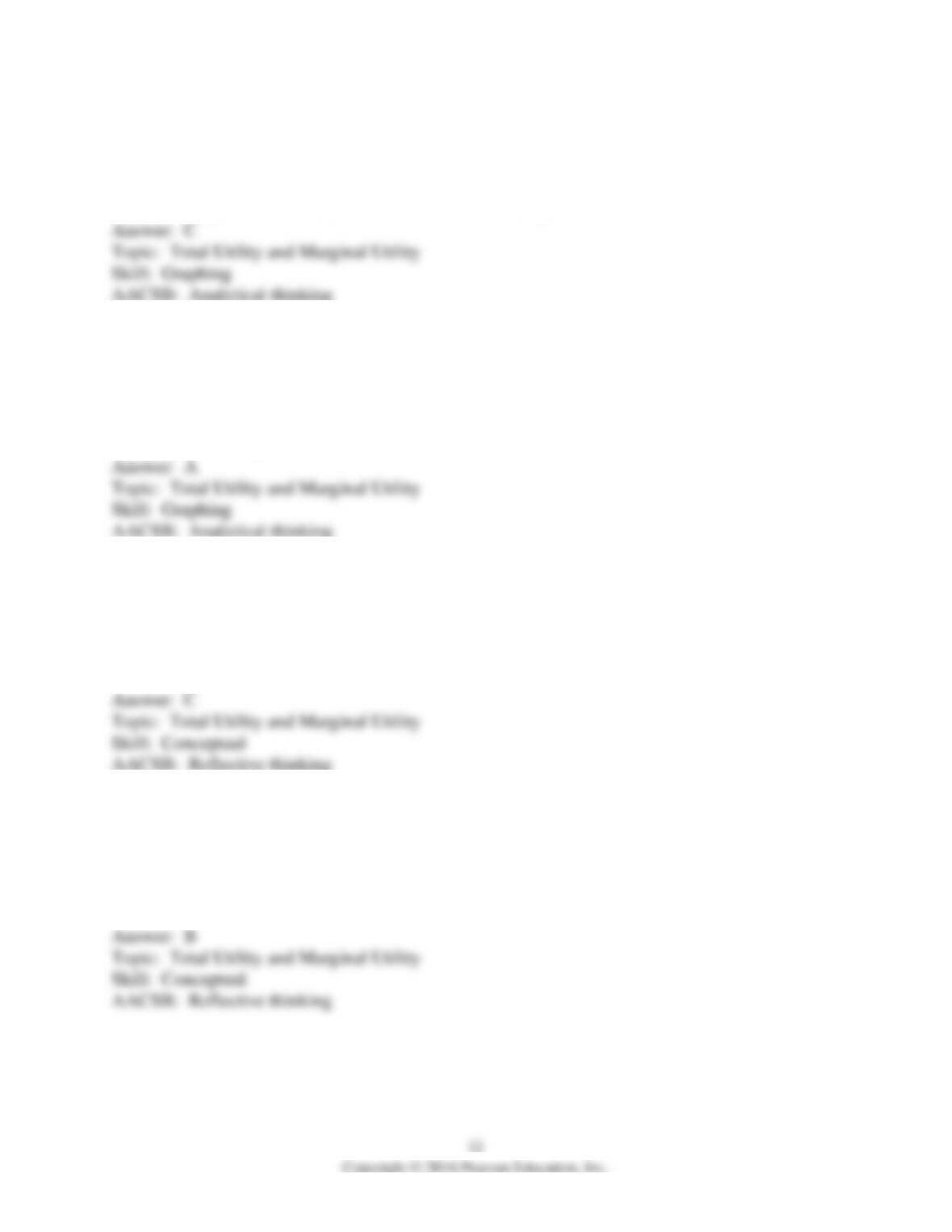
41) In the figure above, the curve that shows the diminishing marginal utility is
A) total utility curve A because it gets steeper as consumption of tomatoes increases.
B) total utility curve A because it is higher than total utility curves B or C.
C) total utility curve C because it gets flatter as consumption of tomatoes increases.
D) total utility curve C because it is lower than total utility curves B and C.
42) In the figure above, the marginal utility of the third crate of tomatoes for the person with
total utility curve C is
A) 13 units of utility.
B) 16 units of utility.
C) 32 units of utility.
D) 45 units of utility.
43) As the quantity of a good consumed increases, its marginal utility ________ and its total
utility ________.
A) increases; increases
B) increases; decreases
C) decreases; increases
D) decreases; decreases
44) As Goldilocks consumes more gummy bears, her total utility ________ and her marginal
utility from gummy bears ________.
A) increases; increases
B) increases; decreases
C) decreases; increases
D) decreases; decreases
45) As Sally increases her consumption of a good, she experiences diminishing marginal utility
if her total utility
A) increases at a constant rate.
B) increases at a decreasing rate.
C) increases at an increasing rate.
D) decreases.
46) The principle of diminishing marginal utility implies that the
A) marginal utility of a product is negative.
B) total utility from a product is also diminishing as more units are consumed.
C) rate of change of total utility is diminishing as more units are consumed.
D) rate of change of marginal utility is very low as more units are consumed.
47) If marginal utility is positive but diminishing, as more units of a good are consumed, then the
total utility from the good must be
A) falling.
B) positive and rising at an increasing rate.
C) positive and rising at a decreasing rate.
D) positive and rising at any rate.
48) As you consume additional hamburgers, the relationship between total and marginal utility is
that
A) both total and marginal utility increase continuously.
B) both total and marginal utility decrease continuously.
C) total utility increases, but marginal utility decreases.
D) total utility decreases, but marginal utility increases.
49) As Shana’s consumption of tacos decreases, her
A) marginal utility from tacos increases.
B) marginal utility from tacos decreases.
C) total utility from tacos increases.
D) both total and marginal utility from tacos decrease.
50) A decrease in consumption will result in
A) both total utility and marginal utility decreasing.
B) total utility increasing, but marginal utility decreasing.
C) total utility decreasing, but marginal utility increasing.
D) both total utility and marginal utility increasing.
51) As consumption increases, total utility increases
A) at an increasing rate.
B) at a decreasing rate.
C) at a constant rate.
D) and marginal utility increases.
52) If marginal utility is positive but diminishing, then total utility must be ________ as
consumption of the good increases.
A) decreasing
B) positive and rising at an increasing rate
C) positive and rising at a decreasing rate
D) positive and rising at any rate
Pizza Pepsi
Slices per
week
Total utility
Quantity per
week
Total utility
0
0
0
0
1
100
1
70
2
150
2
130
3
175
3
180
4
190
4
220
5
195
5
250
53) The table shows Elaine’s utility from pizza and Pepsi. If Elaine consumes 2 slices of pizza
and 3 Pepsis, her marginal utility from the fourth Pepsi is ________ units.
A) 60
B) 54
C) 40
D) 220
Quantity
Total utility
Marginal utility
0
0
1
250
2
180
3
580
4
700
5
100
54) The above table gives some of Tammy’s total and marginal utilities from comedy videos.
Which of the following statements is TRUE?
A) Tammy’s marginal utility from the third comedy video is equal to 580/3.
B) Tammy’s total utility from five comedy videos is 800.
C) Tammy’s marginal utility from the first comedy video is less than her marginal utility from
the third comedy video.
D) None of the above answers are correct.
Box of doughnuts
Homer’s total utility
1
30
2
55
3
75
4
90
5
100
6
103
55) The above table shows Homer’s total utility from boxes of doughnuts. As Homer’s
consumption of doughnuts increases
A) both his total utility and his marginal utility increase.
B) his total utility increases, but his marginal utility decreases.
C) his total utility decreases, but his marginal utility increases.
D) both his total utility and his marginal utility decrease.
56) The above table shows Homer’s utility from boxes of doughnuts. If Homer decreases his
consumption of doughnuts from 4 boxes to 3 boxes, his
A) total utility and marginal utility will both decrease.
B) total utility will decrease, but his marginal utility will increase.
C) total utility will increase, but his marginal utility will decrease.
D) total utility and marginal utility will both increase.
57) The above table shows Homer’s utility from boxes of doughnuts. The marginal utility that
Homer receives from the third box of doughnuts is equal to
A) 75.
B) 25.
C) 20.
D) 3.
58) The above table shows Homer’s utility from boxes of doughnuts. As Homer’s consumption of
doughnuts increases, his
A) marginal utility is positive and increasing.
B) marginal utility is positive but decreasing.
C) marginal utility is negative but increasing.
D) marginal utility is negative and decreasing.
Quantity of
cheeseburgers
Total utility
from
cheeseburgers
1
36
2
66
3
86
4
100
5
110
59) Julie’s total utility from cheeseburgers is given in the table above. What is the marginal
utility of the third cheeseburger?
A) 86
B) 28.7
C) 20
D) 14
Quarts of
ice cream
Total utility
from ice
cream
0
0
1
80
2
150
3
210
4
260
60) From the information in the above table, what is the marginal utility of the third quart of ice
cream?
A) 80
B) 70
C) 60
D) 230
Fritos Fruit drinks
Quantity
Total
utility
Quantity
Total
utility
0
0
0
0
1
40
1
50
2
75
2
95
3
105
3
135
4
130
4
170
5
150
5
200
6
165
6
225
61) The table above shows the total utility from the two goods Freddy likes to consume. The
marginal utility Freddy receives from consuming an extra bag of Fritos
A) depends on the quantity of fruit drinks consumed.
B) decreases as he consumes more bags of Fritos.
C) decreases as he consumes more fruit drinks.
D) equals 75 when he consumes 2 bags of Fritos.
62) The table above shows the total utility from the two goods Freddy likes to consume. Suppose
that Freddy has already eaten 5 bags of Fritos. If he consumes one more bag, his marginal utility
will
A) equal 40.
B) equal 35.
C) equal 15.
D) depend on the price of the extra bag.
63) The table above shows the total utility from the two goods Freddy likes to consume. If
Freddy has consumed 4 fruit drinks and then decides to drink another
A) his total utility will increase.
B) the marginal utility from the 5th drink equals 30.
C) the marginal utility from the 5th drinks equals 50.
D) Both answers A and B are correct.
Quantity of
magazines
Marginal utility
from magazines
Quantity of
gummy bears
Marginal utility
from gummy
bears
0
0
1
100
1
200
2
75
2
180
3
50
3
160
4
25
4
140
5
5
5
120
64) Kelly’s marginal utilities for magazines and packages of gummy bears are listed in the table
above. For Kelly, what is the total utility received from consuming 5 magazines?
A) 5
B) 20
C) 25
D) 255
65) Kelly’s marginal utilities for magazines and packages of gummy bears are listed in the table
above. What is the extra utility received by Kelly when she decides to consume 3 packages of
gummy bears instead of 2 packages?
A) 20
B) 160
C) 180
D) 540
Quantity of
magazines
Total utility
from
magazines
Quantity of
CDs
Total utility
from CDs
0
0
0
0
1
240
1
500
2
400
2
950
3
520
3
1350
4
620
4
1650
5
680
5
1800
6
716
6
1850
7
736
7
1870
8
740
8
1875
66) The table above gives Jane’s total utility from magazines and CDs. What is the marginal
utility of Jane’s sixth magazine?
A) 80 units
B) 60 units
C) 36 units
D) 15 units
67) The table above gives Jane’s total utility from magazines and CDs. What is the marginal
utility of the sixth CD?
A) 150 units
B) 100 units
C) 50 units
D) 5 units