Chapter 07 – Businesses and the Costs of Production
149. The above diagram shows the short-run average total cost curves for five different plant
sizes of a firm. If in the long run the firm should produce output 0x, it should do it with a
plant of size:
150. When diseconomies of scale occur:
151. Which of the following is not a source of economies of scale?
Chapter 07 – Businesses and the Costs of Production
152. When a firm does more of something, it gets better at it. This learning-by-doing is:
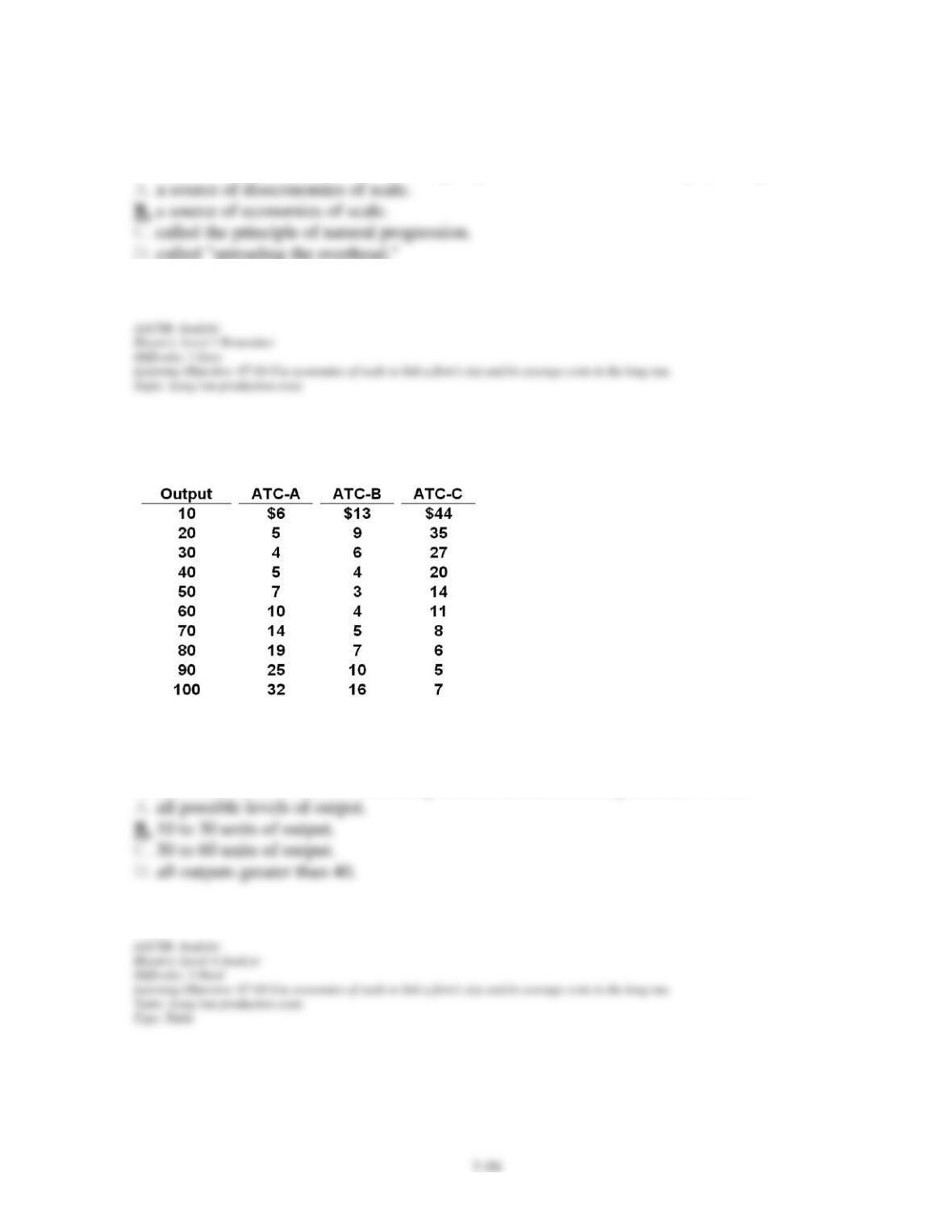
Use the following data to answer the question. The letters A, B, and C designate three
successively larger plant sizes.
153. Refer to the above data. In the long run the firm should use plant size “A” for:
Chapter 07 – Businesses and the Costs of Production
154. Refer to the above data. In the long run the firm should use plant size “C” for:
155. Refer to the above data. Economies of scale are realized over the ___ to ___ levels of
output; diseconomies of scale exist over the ___ to ___ levels of output.
156. Refer to the above data. At what level of output is minimum efficient scale realized?
Chapter 07 – Businesses and the Costs of Production
7-61
157. Economies of scale are indicated by:
158. If a firm doubles its output in the long run and its unit costs of production decline, we
can conclude that:
Chapter 07 – Businesses and the Costs of Production
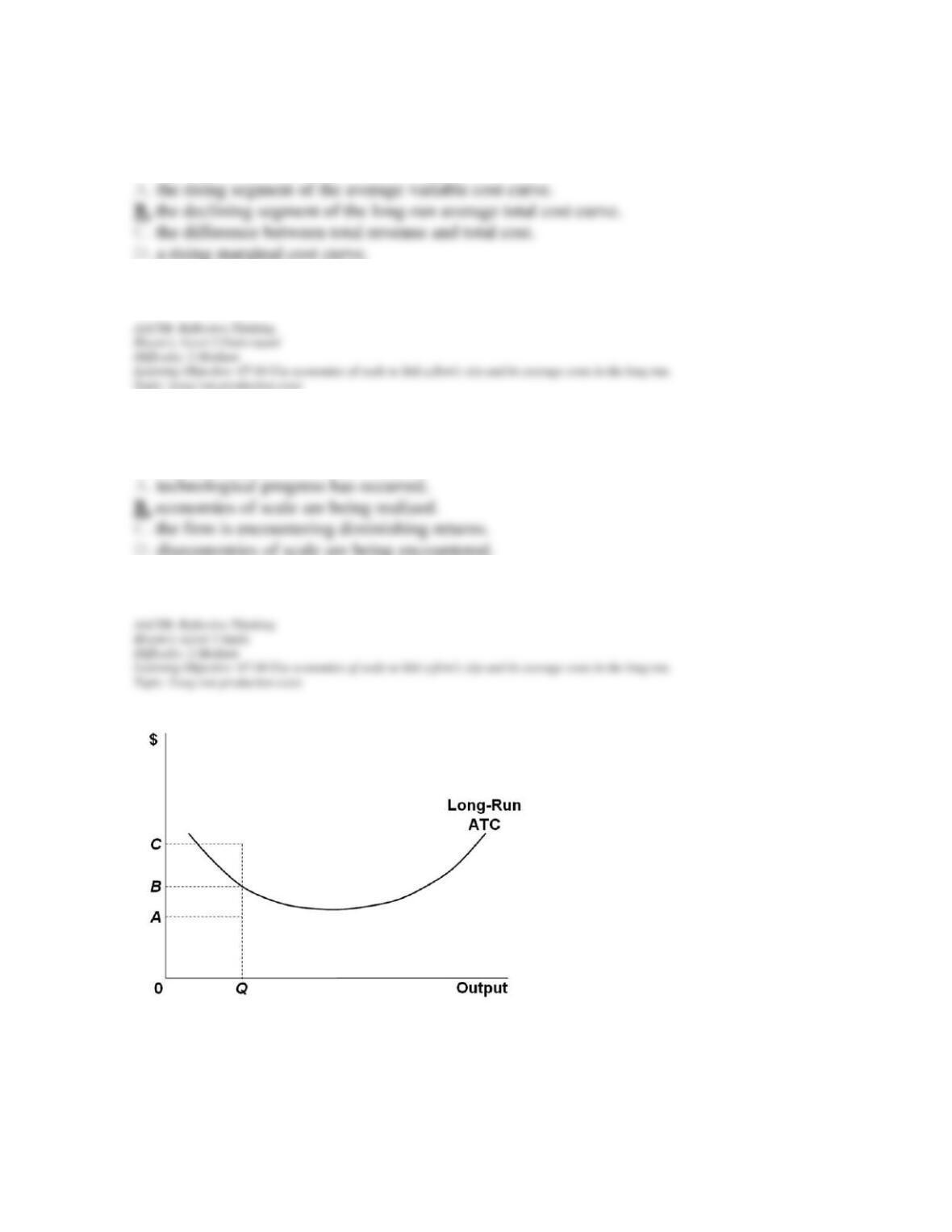
159. Refer to the above diagram. For output level Q, per unit costs of C are:
160. Refer to the above diagram. For output level Q, per unit costs of B are:
161. Refer to the above diagram. The per unit costs at output level Q that are both attainable
and imply the least-cost production for this level of output:
Chapter 07 – Businesses and the Costs of Production
162. The minimum efficient scale of a firm:
163. If an industry’s long-run average total cost curve has an extended range of constant
returns to scale, this implies that:
164. A natural monopoly exists when:
Chapter 07 – Businesses and the Costs of Production
165. Diseconomies of scale arise primarily because:
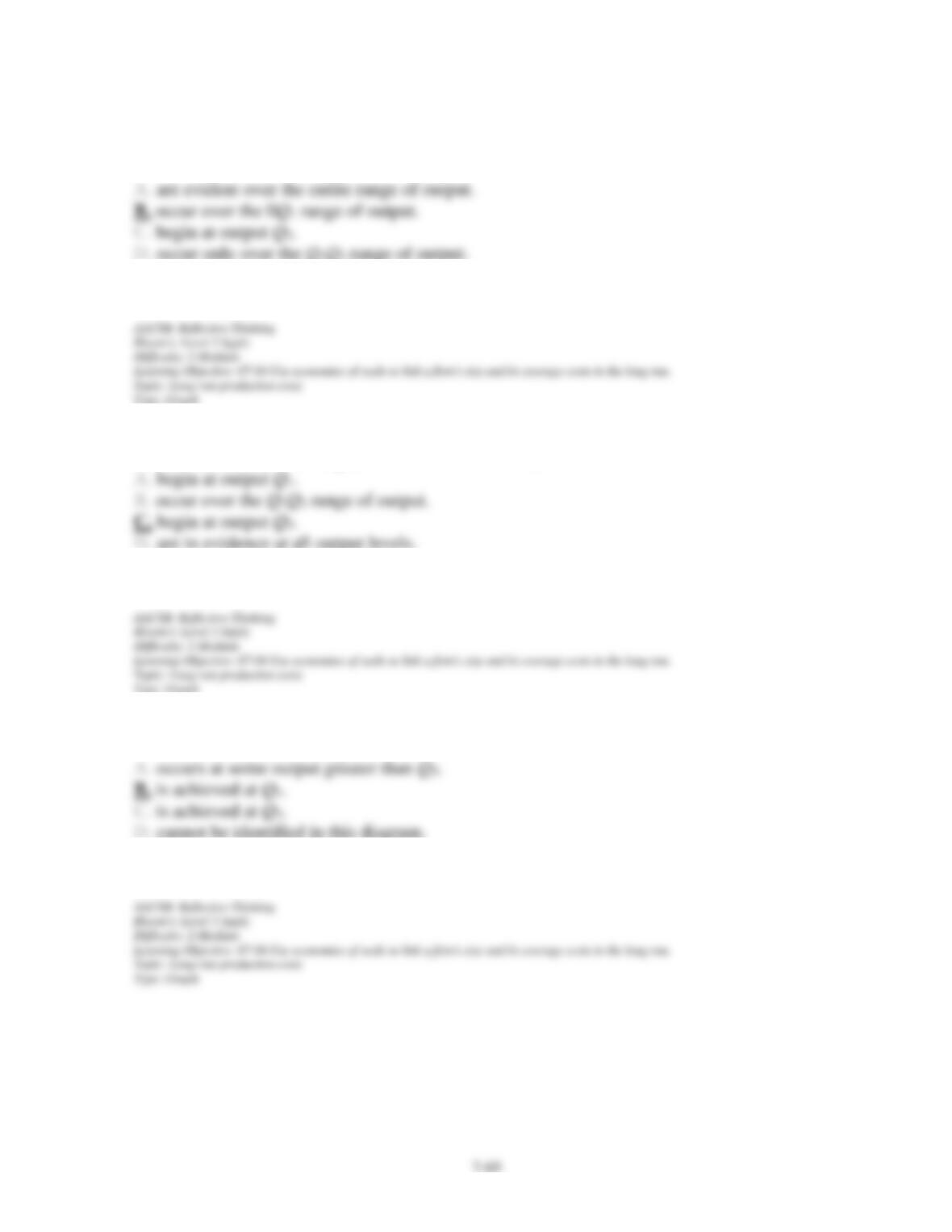
166. In the above diagram it is assumed that:
Chapter 07 – Businesses and the Costs of Production
167. Refer to the above diagram. Economies of scale:
168. Refer to the above diagram. Diseconomies of scale:
169. Refer to the above diagram. Minimum efficient scale:
Chapter 07 – Businesses and the Costs of Production
170. Refer to the above diagram. Constant returns to scale:
171. The long-run average total cost curve:
172. If a firm increases all of its inputs by 10 percent and its output increases by 15 percent,
then:
Chapter 07 – Businesses and the Costs of Production
173. If a firm increases all of its inputs by 10 percent and its output increases by 10 percent,
then:
174. The ABC Corporation decreases all of its inputs by 12 percent and finds that its output
falls by only 8 percent. This means that initially it was producing:
175. Suppose a firm is in a range of production where it is experiencing economies of scale.
Knowing this, we can predict that:
Chapter 07 – Businesses and the Costs of Production
176. Because of higher gasoline prices, firms using gasoline intensively in the production or
distribution of their goods have experienced:
177. Which of the following types of firms are least likely to have their MC, AVC, and ATC
curves affected by fluctuations in gasoline prices?
178. Introduction of the Verson Stamping Machine helped firms in the automobile industry:
Chapter 07 – Businesses and the Costs of Production
179. In which of the following industries are economies of scale exhausted at relatively low
levels of output?
180. Daily newspapers have been rising in price in recent years because:
181. (Consider This) If the law of diminishing returns applies to study time:
Chapter 07 – Businesses and the Costs of Production
182. (Consider This) In order to apply the concept of diminishing returns to study time:
183. (Last Word) A cost that cannot be partly or fully recovered through any subsequent
action is known as a:
184. (Last Word) Which of the following is an example of a sunk cost, as it relates to a firm?
Chapter 07 – Businesses and the Costs of Production
185. (Last Word) Susie purchased a non-refundable ticket to a soccer match for $20. It will
cost her $10 worth of gas and wear and tear to drive to the match, and $5 to park her car. On
the day of the match, Susie’s boss offers her $100 to come to work instead. In considering
what to do, which of the above would be considered a sunk cost?
186. The real opportunity cost of producing product X is the amounts of products Y, Z, and so
forth, that might have been produced if resources had not been used to produce X.
187. The short run is a period of time during which all costs are fixed costs.
Chapter 07 – Businesses and the Costs of Production
188. Variable costs are costs that change directly with output.
189. Diseconomies of scale stem primarily from the difficulties in managing and coordinating
a large-scale business enterprise.
190. At zero units of output a firm’s variable costs are zero.
191. Average fixed costs diminish continuously as output increases.
Chapter 07 – Businesses and the Costs of Production
192. Economic profit is found by subtracting accounting costs from total revenue.
193. A firm’s economic profit is usually higher than its accounting profit.
194. The law of diminishing returns explains why short-run marginal cost curves are
upsloping.
195. The law of diminishing returns explains diseconomies of scale.
Chapter 07 – Businesses and the Costs of Production
196. Minimum efficient scale varies by industry.