Chapter 07 – Businesses and the Costs of Production
1. Economic cost can best be defined as:
2. Which of the following constitutes an implicit cost to the Johnston Manufacturing
Company?
Chapter 07 – Businesses and the Costs of Production
3. Which of the following is most likely to be an implicit cost for Company X?
4. Production costs to an economist:
5. What do wages paid to factory workers, interest paid on a bank loan, forgone interest, and
the purchase of component parts have in common?
Chapter 07 – Businesses and the Costs of Production
6. To the economist, total cost includes:
7. Implicit and explicit costs are different in that:
8. Accounting profits equal total revenue minus:
Chapter 07 – Businesses and the Costs of Production
9. An explicit cost is:
10. Accounting profits are typically:
11. Economic profits are calculated by subtracting:
Chapter 07 – Businesses and the Costs of Production
12. Normal profit is:
13. Which of the following definitions is correct?
14. Suppose that a business incurred implicit costs of $200,000 and explicit costs of $1
million in a specific year. If the firm sold 4,000 units of its output at $300 per unit, its
accounting profits were:
Chapter 07 – Businesses and the Costs of Production
15. Suppose that a business incurred implicit costs of $500,000 and explicit costs of $5
million in a specific year. If the firm sold 100,000 units of its output at $50 per unit, its
accounting:
The following is cost information for the Creamy Crisp Donut Company:
Entrepreneur’s potential earnings as a salaried worker = $50,000
Annual lease on building = $22,000
Annual revenue from operations = $380,000
Payments to workers = $120,000
Utilities (electricity, water, disposal) costs = $8,000
Value of entrepreneur’s talent in the next best entrepreneurial activity = $80,000
Entrepreneur’s forgone interest on personal funds used to finance the business = $6,000
16. Refer to the above data. Creamy Crisp’s explicit costs are:
Chapter 07 – Businesses and the Costs of Production
17. Refer to the above data. Creamy Crisp’s implicit costs, including a normal profit, are:
18. Refer to the above data. Creamy Crisp’s total economic costs are:
19. Refer to the above data. Creamy Crisp’s accounting profit is:
Chapter 07 – Businesses and the Costs of Production
20. Refer to the above data. Creamy Crisp’s economic profit is:
21. Refer to the above data. Creamy Crisp’s total revenues exceed its total costs, including a
22. Refer to the above data. Creamy Crisp:
Chapter 07 – Businesses and the Costs of Production
23. Refer to the above data. If, other things equal, Creamy Crisp’s revenue fell to $286,000:
24. The basic characteristic of the short run is that:
25. Which of the following represents a long-run adjustment?
Chapter 07 – Businesses and the Costs of Production
26. Which of the following is a short-run adjustment?
27. To economists, the main difference between the short run and the long run is that:
28. The amount of calendar time associated with the long run:
Chapter 07 – Businesses and the Costs of Production
29. The basic difference between the short run and the long run is that:
30. The short run is characterized by:
31. The long run is characterized by:
Chapter 07 – Businesses and the Costs of Production
32. Marginal product is:
33. The law of diminishing returns indicates that:
34. Which of the following statements concerning the relationships between total product
(TP), average product (AP), and marginal product (MP) is not correct?
Chapter 07 – Businesses and the Costs of Production
35. Which of the following best expresses the law of diminishing returns?
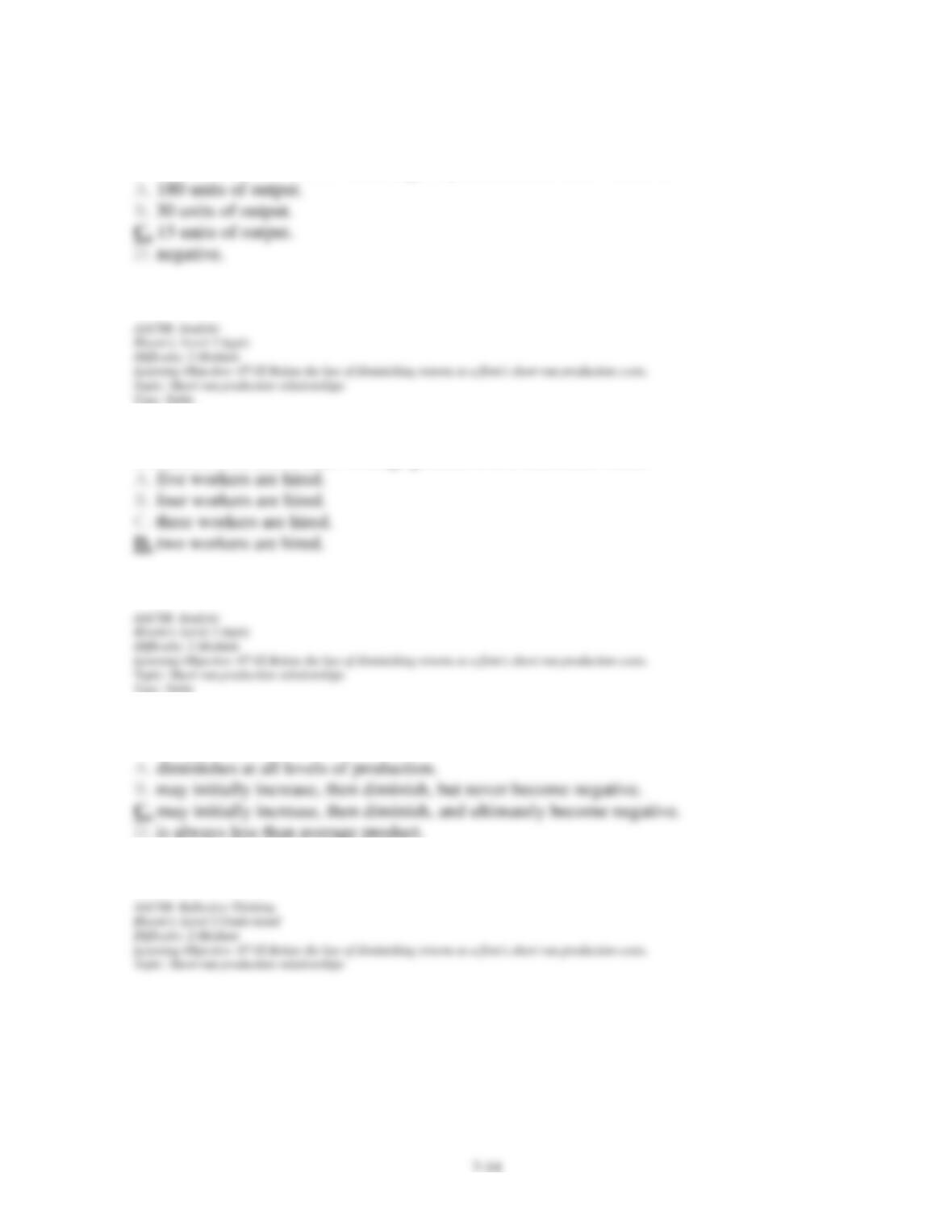
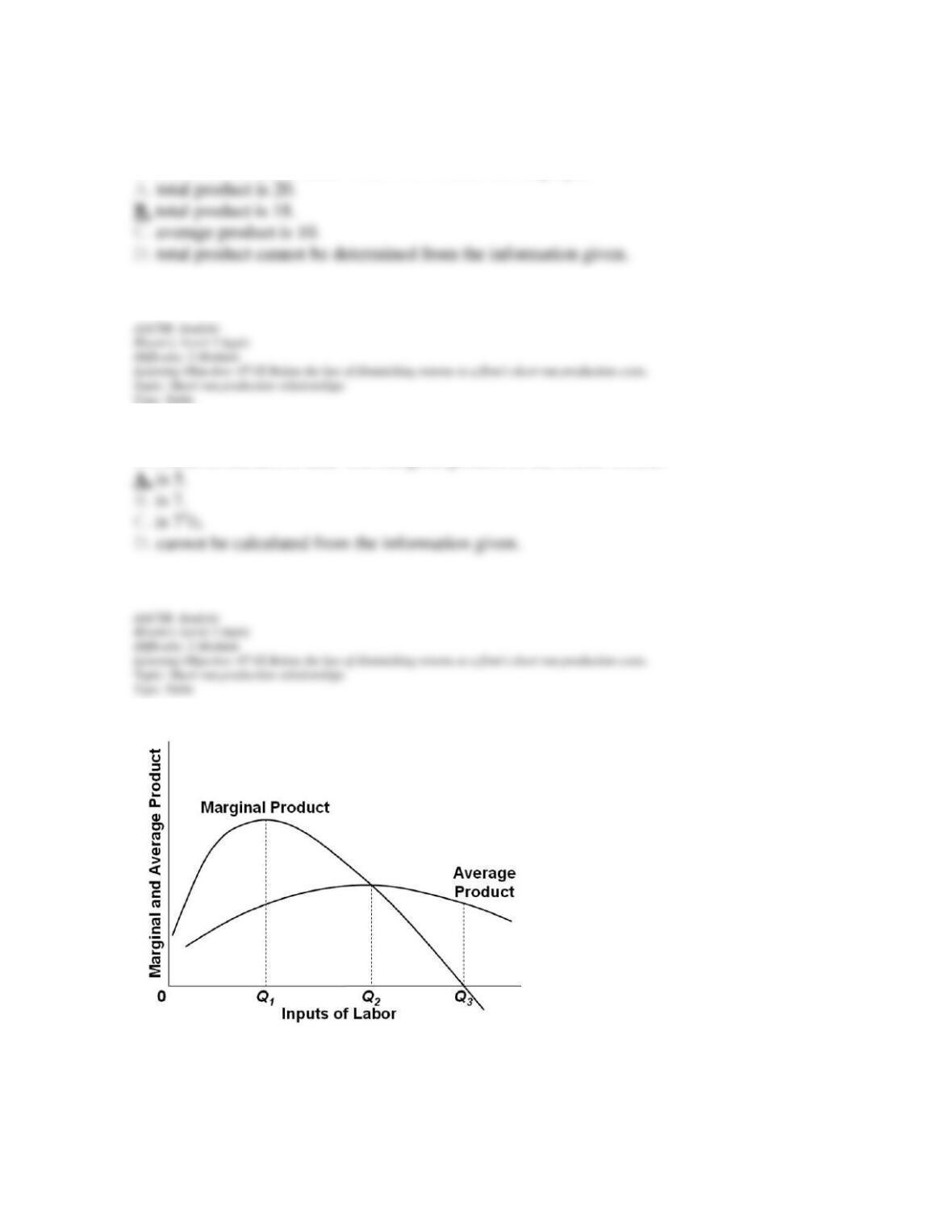
Answer the question on the basis of the following output data for a firm. Assume that the
amounts of all non-labor resources are fixed.
36. Refer to the above data. Diminishing marginal returns become evident with the addition of
Chapter 07 – Businesses and the Costs of Production
37. Refer to the above data. The marginal product of the sixth worker is:
38. Refer to the above data. Average product is at a maximum when:
39. Marginal product:
Chapter 07 – Businesses and the Costs of Production
40. The first, second, and third workers employed by a firm add 24, 18, and 9 units to total
product respectively. Therefore, we can conclude that:
41. If a variable input is added to some fixed input, beyond some point the resulting extra
output will decline. This statement describes:
42. If in the short run a firm’s total product is increasing, then its:
Chapter 07 – Businesses and the Costs of Production
43. The law of diminishing returns results in:
44. The law of diminishing returns describes the:
45. Which of the following is correct?
Chapter 07 – Businesses and the Costs of Production
46. Which of the following is not correct?
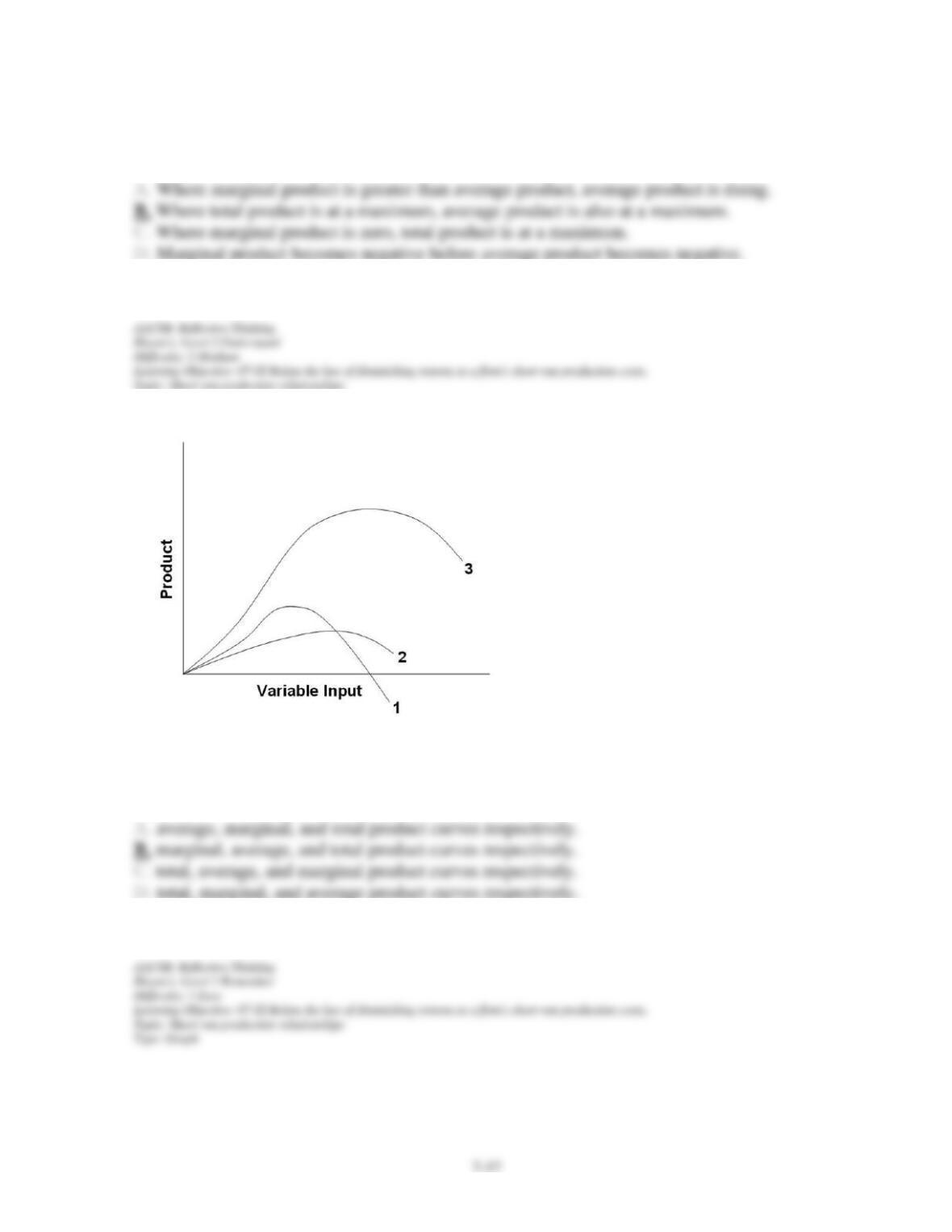
47. In the above diagram curves 1, 2, and 3 represent the:
Chapter 07 – Businesses and the Costs of Production
7-18
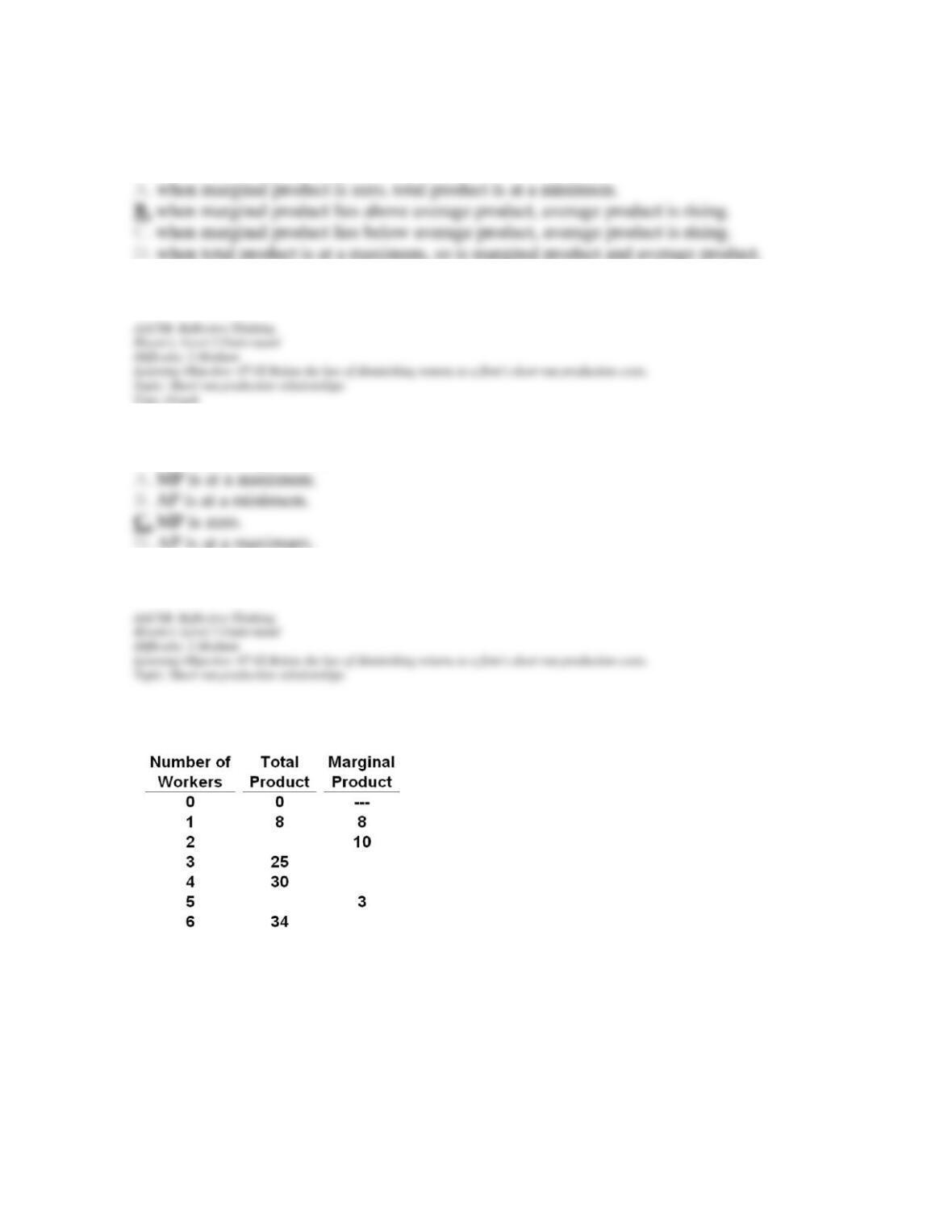
48. The above diagram suggests that:
49. The total output of a firm will be at a maximum where:
Answer the question on the basis of the following information:
Chapter 07 – Businesses and the Costs of Production
7-19
50. Refer to the above data. When two workers are employed:
Chapter 07 – Businesses and the Costs of Production
7-20
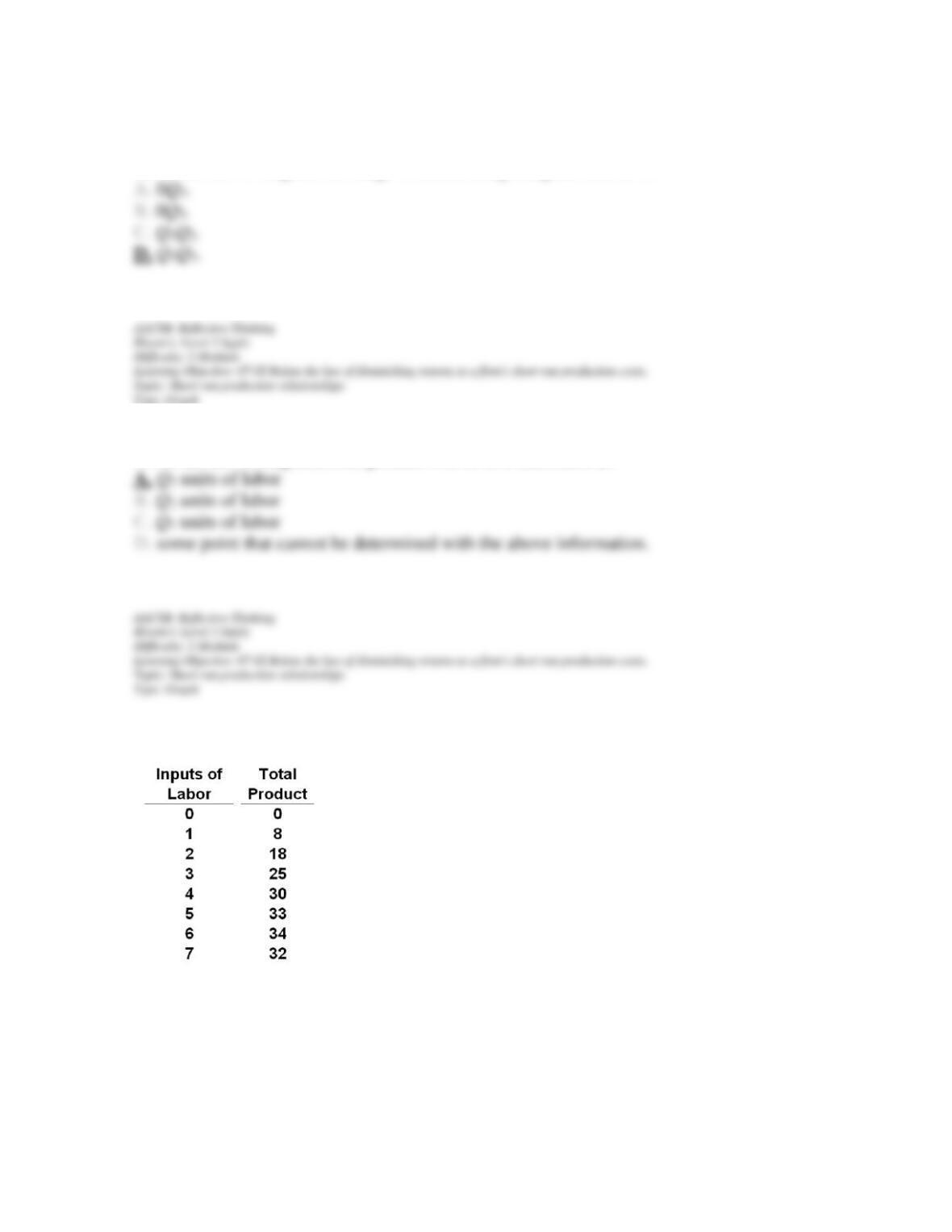
52. In the above diagram the range of diminishing marginal returns is:
53. In the above diagram, total product will be at a maximum at:
Use the following data to answer the question: