Chapter 07 – Businesses and the Costs of Production
1. Jon Brooks quit his job in a bicycle shop, where he earned $15,000 per year, to become a
graduate student in economics. At the university he attended, he spent $2,000 on books,
$1,000 on cough medicine, and earned $12,000 as an economics teaching-assistant. What
were Jon’s economic costs while attending college?
2. Suppose that you could prepare your own tax return in 15 hours, or you could hire a tax
specialist to prepare it for you in 2 hours. You value your time at $11.00 an hour. The tax
specialist will charge you $55 an hour. The opportunity cost of preparing your own tax return
is:
Chapter 07 – Businesses and the Costs of Production
3. Implicit costs are:
4. Cash expenditures a firm makes to pay for resources are called:
5. Which would be an implicit cost for a firm? The cost:
Chapter 07 – Businesses and the Costs of Production
Harvey quit his job at State University where he earned $45,000 a year. He figures his
entrepreneurial talent or foregone entrepreneurial income to be $5,000 a year. To start the
business, he cashed in $100,000 in bonds that earned 10 percent interest annually to buy a
software company, Extreme Gaming. In the first year, the firm sold 11,000 units of software
at $75 for each unit. Of the $75 per unit, $55 goes for the costs of production, packaging,
marketing, employee wages and benefits, and rent on a building.
6. Refer to the above information. The total revenues of Harvey’s firm in the first year were:
7. Refer to the above information. The explicit costs of Harvey’s firm in the first year were:
Chapter 07 – Businesses and the Costs of Production
8. Refer to the above information. The implicit costs of Harvey’s firm in the first year were:
9. Refer to the above information. The normal profits for Harvey in the first year were:
10. Refer to the above information. The economic profits of Harvey’s firm in the first year
were:
Chapter 07 – Businesses and the Costs of Production
11. Economic profits are:
12. If economic profits in an industry are zero and implicit costs are greater than zero, then:
13. If a firm’s revenues just cover all its opportunity costs, then:
Chapter 07 – Businesses and the Costs of Production
14. An industry is expected to expand if firms in the industry are earning positive:
15. Economic profits are equal to:
16. Suppose a firm sells its product at a price lower than the opportunity cost of the inputs
used to produce it. Which of the following statements is definitely true?
Chapter 07 – Businesses and the Costs of Production
17. Normal profits are:
18. Suppose that a firm produces 200,000 units a year and sells them all for $10 each. The
explicit costs of production are $1,500,000 and the implicit costs of production are $300,000.
The firm earns an accounting profit of:
Chapter 07 – Businesses and the Costs of Production
19. The sole proprietor of the Milwaukee Machine Company receives all accounting profits
earned by her firm and a $28,000-a-year salary. She has a standing salary offer of $35,000 a
year working for a large corporation. If she had invested her capital outside her own company,
she estimates that would have returned $22,000 this year. If accounting profits for the year
were $50,000, economic profits were:
20. In the short run, output:
Chapter 07 – Businesses and the Costs of Production
21. The main difference between the short run and the long run is that:
22. Which of the following statements is false?
Chapter 07 – Businesses and the Costs of Production
24. The long run is a period of time, or a time-frame, in which:
25. Which is most likely to be a long-run adjustment for a firm that manufactures cars on an
assembly line basis?
26. Marginal product of labor refers to the:
Chapter 07 – Businesses and the Costs of Production
27. According to the law of diminishing marginal returns:
28. Which of the following statements is true?
29. Diminishing marginal returns occurs as a firm adds more variable inputs to at least one
fixed input because:
Chapter 07 – Businesses and the Costs of Production
30. The law of diminishing returns in a manufacturing plant of a fixed capacity implies that,
eventually, employing one:
31. The law of diminishing returns only applies in cases where:
32. Which statement best illustrates the law of diminishing returns?
Chapter 07 – Businesses and the Costs of Production
33. The total product curve graphically shows the:
34. The marginal product of labor curve graphically shows the change in total product
resulting from a:
35. When a bakery manager reports that at her bakery, productivity of her 15 workers last
month was 1,800 loaves per worker, she is referring to the:
Chapter 07 – Businesses and the Costs of Production
36. When the total product curve is falling, the:
37. The range of diminishing marginal productivity begins when:
38. Over the range of positive, but diminishing, marginal returns for an input, the total product
curve:
Chapter 07 – Businesses and the Costs of Production
39. At the Amarillo Piano Company, the average product of labor stays constant at 5,
regardless of how much labor is employed. This implies that:
40. At what point does marginal product equal average product?
41. At the point where diminishing marginal returns of an input sets in, the:
Chapter 07 – Businesses and the Costs of Production
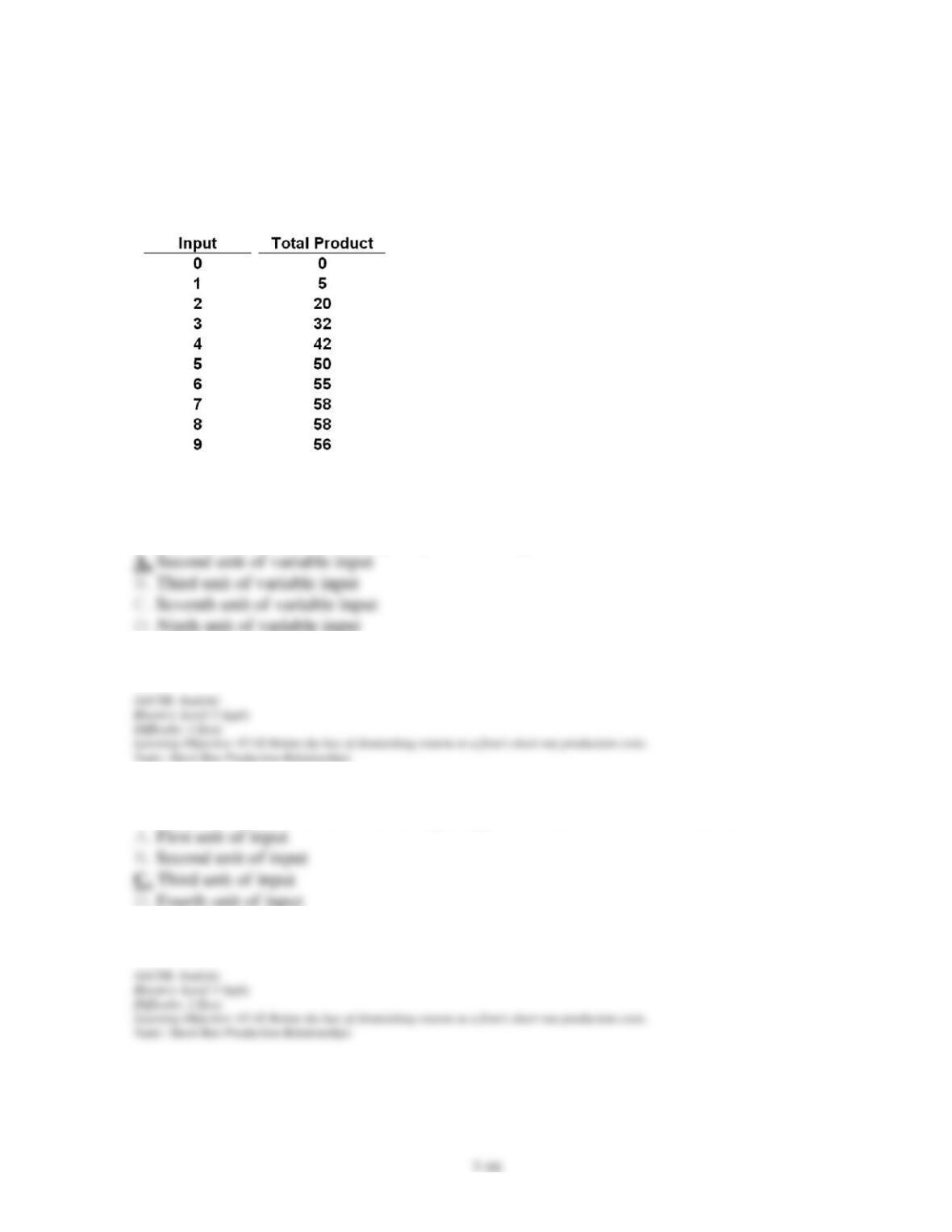
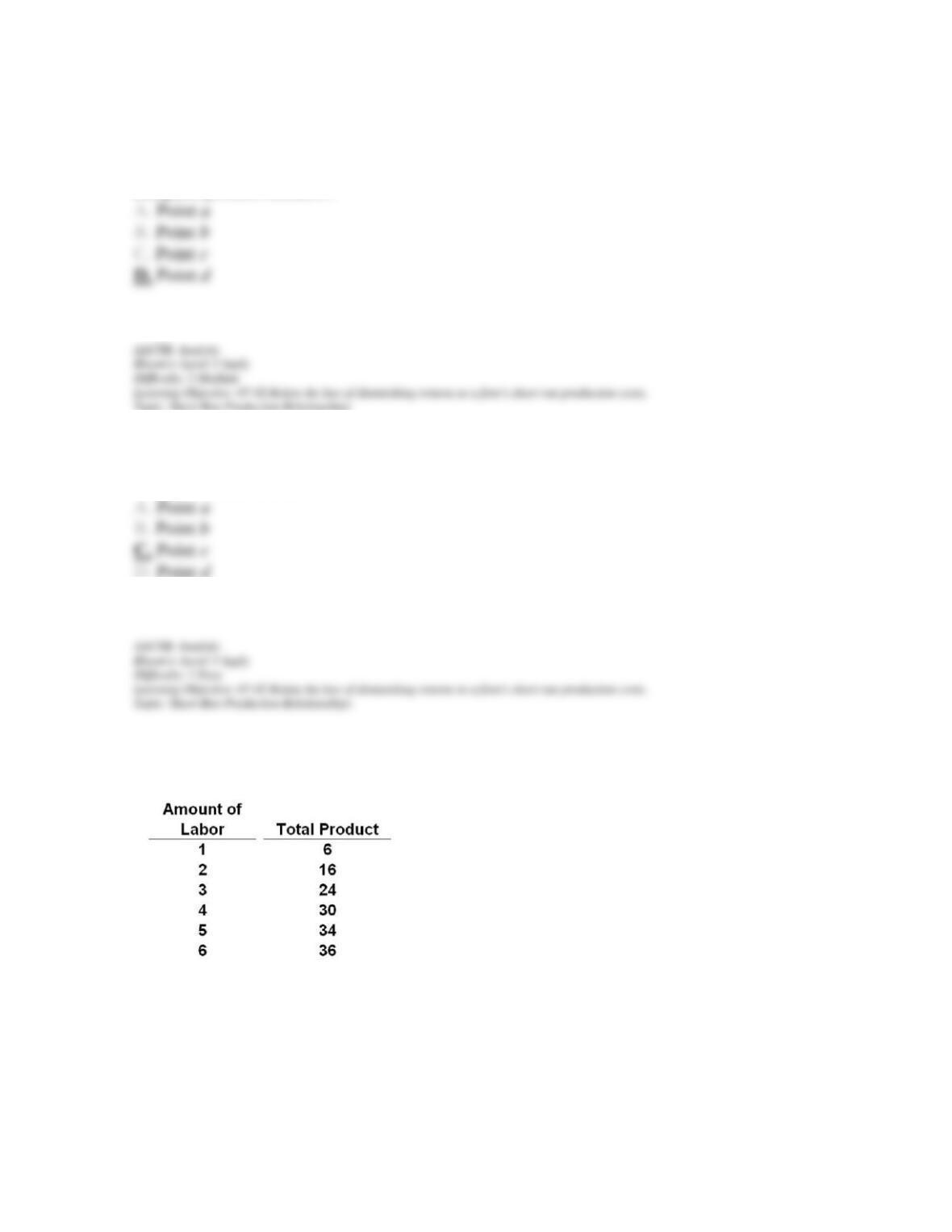
The question is based on the following table that provides information on the production of a
product that requires one variable input.
42. Refer to the above table. Marginal product is largest for the:
43. Refer to the above table. Diminishing marginal returns sets in with the addition of the:
Chapter 07 – Businesses and the Costs of Production
44. Refer to the above table. There are negative marginal returns when the:
45. Refer to the above table. With the addition of the second unit of input, the marginal
product is:
46. Refer to the above table. Marginal product is zero when the total product is:
Chapter 07 – Businesses and the Costs of Production
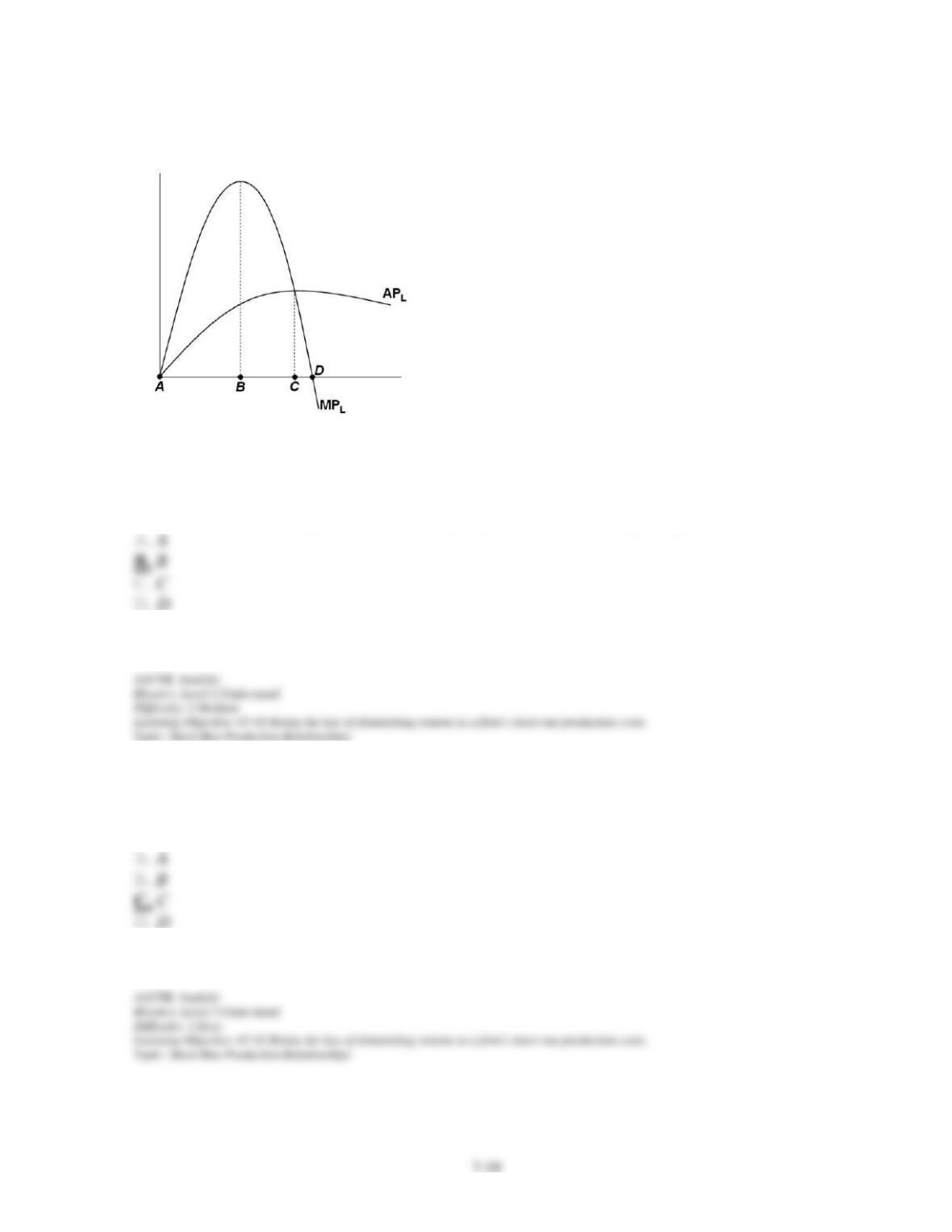
47. Refer to the above graph showing the marginal product (MPL) and the average product of
labor (APL). At which quantity of labor employed does diminishing marginal returns set in?
48. Refer to the above graph showing the marginal product (MPL) and the average product of
labor (APL). At which quantity of labor employed is marginal product equal to average
product?
Chapter 07 – Businesses and the Costs of Production
49. Refer to the above graph showing the marginal product (MPL) and the average product of
labor (APL). At which quantity of labor employed is total product maximized?
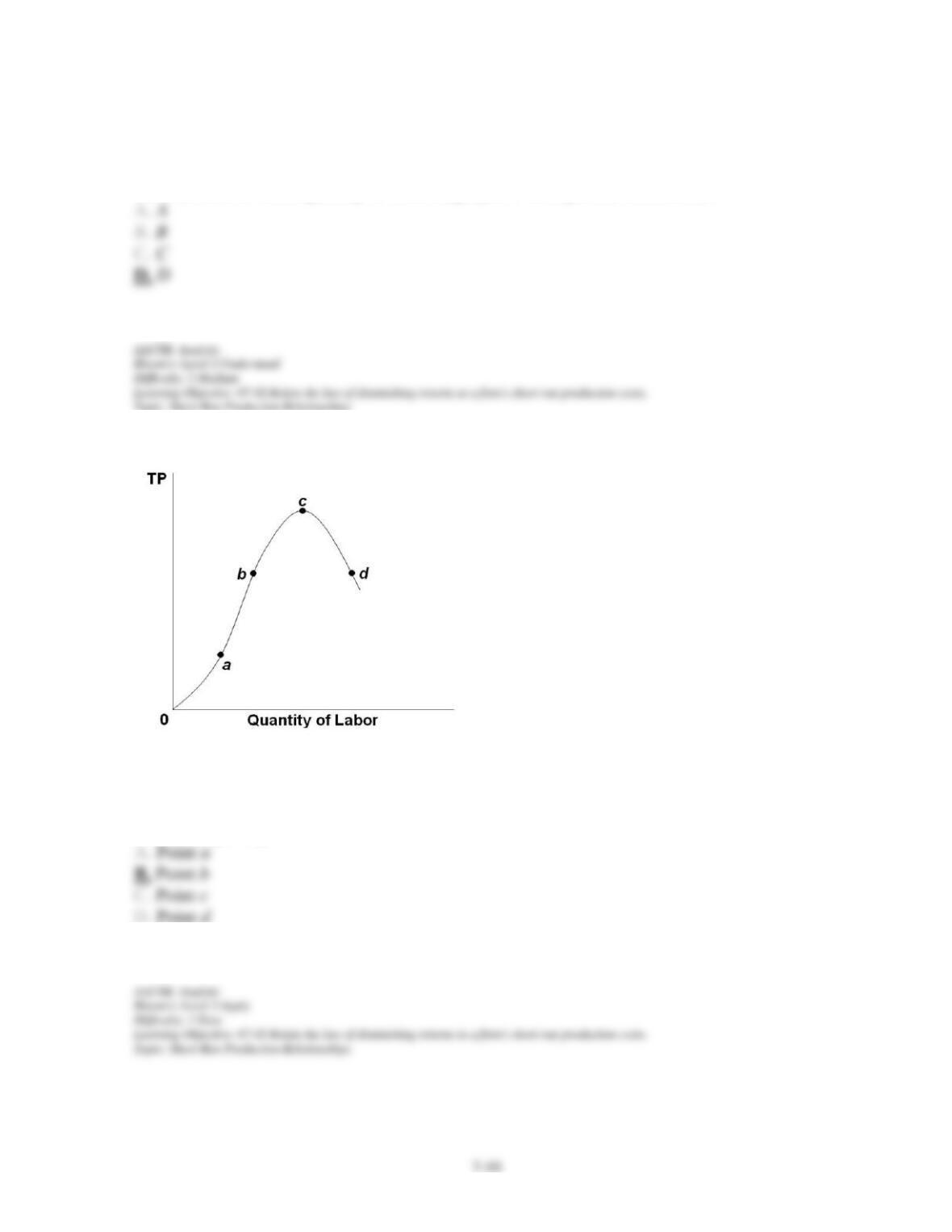
50. Refer to the above graph. It shows the total product (TP) curve. At which point does
diminishing marginal returns set in?
Chapter 07 – Businesses and the Costs of Production
7-20
51. Refer to the above graph. It shows the total product (TP) curve. At which point is
52. Refer to the above graph. It shows the total product (TP) curve. At which point is the
marginal product zero?
Assume that the only variable resource used to produce output is labor.