61. According to the labor statistics of the United States, the _____ reported the highest unemployment rate between 1960
and 2008.
a.
Whites
b.
Asians
c.
African Americans
d.
Hispanics
e.
Latinos
Easy
MACR.BOYE.16.31 – ch. 07, 3
United States – Unemployment
Unemployment
Knowledge
62. Why do the European countries like France, Germany, Italy and Spain have higher unemployment rates than other
industrialized nations?
a.
Low interest rate and low capital formation
b.
Minimum wages are lower in these European countries compared to the other industrialized nations
c.
Trade unions are not so prominent in these European countries
d.
Stringent policies adopted by the governments of these nations against the termination of workers by firms
e.
Nominal wages are more flexible in these nations compared to the other industrialized nations
d
Moderate
MACR.BOYE.16.31 – ch. 07, 3
United States – Unemployment
Global Business Insight – High Unemployment in Europe
Knowledge
63. In the 1990s, the Danish government passed laws tightening eligibility requirements for receiving unemployment
benefits. What happened in Denmark as a result of this policy change?
a.
The size of the labor force declined
b.
The unemployment rate decreased
c.
More teenagers entered the labor force
d.
The wage rate increased
e.
The natural rate of unemployment increased
b
Moderate
MACR.BOYE.16.31 – ch. 07, 3
United States – Unemployment
Knowledge
Revised
64. The inflation rate is a:
a.
percentage decrease in price level.
b.
percentage increase in price level.
c.
sustained increase in relative prices.
d.
sustained decrease in relative prices.
e.
sudden increase in the weighted average of all prices.
65. Which of the following is most likely to occur during recession?
a.
Increase in wage rate
b.
Decrease in potential real GDP
c.
Increase in the market rate of interest
d.
Decrease in the average price level
e.
Decrease in the government transfer payments
MACR.BOYE.16.32 – ch. 07, 4
The table given below reports the consumer price index in a country for four different years.
Table 7.1
Inflation Data
Year
Consumer Price Index
1976
1980
1990
2003
100.00
110.50
128.50
145.00
66. Refer to Table 7.1. By how much did consumer prices rise between 1980 and 2003 (rounded to the first decimal
place)?
a.
34.5 percent
b.
10.5 percent
c.
13.3 percent
d.
31.2 percent
e.
76.2 percent
MACR.BOYE.16.32 – ch. 07, 4
67. Refer to Table 7.1. If a bicycle used to cost $90 in 1990, what did it cost in 2003 based on the inflation rate (rounded
to the first decimal place)?
a.
$115.7
b.
$118.1
c.
$101.6
d.
$130.5
e.
$79.8
Challenging
MACR.BOYE.16.33 – ch. 07, 5
United States – Reflective Thinking
Inflation
Application
68. The purchasing power of one dollar is equal to _____.
a.
real GDP divided by nominal GDP
b.
nominal GDP divided by real GDP
c.
1 minus the average price level
d.
the reciprocal of the average price level
e.
the implicit GDP deflator divided by the CPI
d
Easy
MACR.BOYE.16.33 – ch. 07, 5
Inflation
Knowledge
69. If the average price level in 2002 was 1.25 relative to the base year in 1992, then:
a.
a dollar in 2002 bought just 80 percent of the goods and services that a dollar bought in 1992.
b.
average prices were 80 percent higher in 2002 than in 1992.
c.
a dollar in 2002 bought 25 percent more goods and services than a dollar bought in 1992.
d.
average prices were 125 percent higher in 2000 than in 1992.
e.
purchasing power rose 25 percent between 1992 and 2002.
MACR.BOYE.16.33 – ch. 07, 5
Inflation
MACR.BOYE.16.33 – ch. 07, 5
Inflation
Application
70. Which of the following factors may lead to a decline in the real value of money?
a.
Increase in the rate of interest
b.
Decline in aggregate demand in the economy
c.
Decrease in money supply
d.
Increase in the average price level
e.
Decrease in aggregate output
d
Easy
MACR.BOYE.16.33 – ch. 07, 5
United States – Analytic – BB-Legal
United States – Inflation
Inflation
Knowledge
71. What does it mean if the purchasing power in 1950 was 4.15 relative to the 1982 base year?
a.
It took $4.15 in 1950 to buy what $1 bought in 1982.
b.
The average price level in 1982 was five times as high as in 1950.
c.
$4.15 in 1950 had the same nominal money value as $1 in 1982.
d.
It took $4.15 in 1982 to buy what $1 bought in 1950.
e.
Nominal prices have increased by more than 400 percent between 1950 and 1982, but the real value of money
has not changed.
d
Moderate
MACR.BOYE.16.33 – ch. 07, 5
United States – Inflation
United States – Reflective Thinking
Inflation
Analysis
The table given below lists the average price level in a country for four consecutive years.
Table 7.2
Price Data
Year
Average Price Level
1992
1993
1994
1995
1.000
1.039
1.064
1.093
72. Refer to Table 7.2. What was the purchasing power of the dollar in 1995 relative to the base year 1992?
a.
0.54
b.
0.72
c.
0.91
d.
0.97
e.
1.93
Challenging
Application
73. Refer to Table 7.2. Between 1993 and 1994, the annual inflation rate was _____ percent.
a.
2.4
b.
2.7
c.
3.8
d.
6.0
e.
8.5
Challenging
MACR.BOYE.16.33 – ch. 07, 5
Inflation
Application
74. Refer to the Table 7.2. How many times more goods and services could be purchased with one dollar in 1992 than in
1995?
a.
1.064
b.
1.07
c.
1.093
d.
1.93
e.
1.96
Moderate
MACR.BOYE.16.33 – ch. 07, 5
Inflation
Application
75. During periods of inflation:
a.
everyone’s real income rises.
b.
those people who have fixed incomes benefit.
c.
those people whose nominal income rises faster than the general price level benefit.
d.
those people who enter long-term wage agreements benefit.
e.
those people who hold a lot of cash benefit.
MACR.BOYE.16.33 – ch. 07, 5
Inflation
MACR.BOYE.16.33 – ch. 07, 5
Inflation
Application
76. When inflation is much higher than expected, which of the following is true?
a.
Nominal incomes are lower than expected.
b.
Real interest rates are higher than expected.
c.
Income is redistributed from those whose expenditures are fixed toward those who receive a fixed income.
d.
Nominal interest rates are lower than expected.
e.
Real interest rates are lower than expected.
MACR.BOYE.16.33 – ch. 07, 5
United States – Inflation
77. Unexpected inflation redistributes income:
a.
away from workers with cost-of-living adjustments, benefiting employers.
b.
away from renters, benefiting landlords.
c.
away from poor people, benefiting the rich.
d.
away from people with fixed incomes, benefiting people with fixed costs.
e.
away from debtors, benefiting creditors.
MACR.BOYE.16.33 – ch. 07, 5
78. The cost-of-living adjustments that are included in the wage contracts protect:
a.
businesses from unexpected inflation.
b.
workers from unexpected inflation.
c.
workers from expected inflation.
d.
employers from unexpected inflation.
e.
consumers from expected inflation.
MACR.BOYE.16.33 – ch. 07, 5
United States – Inflation
79. Which of the following is true of expected inflation?
a.
It increases the efficiency of the economy.
b.
It is more of a problem than unexpected inflation.
c.
It results in lower prices over time as people make adjustments.
d.
It is not a major problem if people can make the right interest rate and income level adjustments.
e.
It is necessarily tied to a decline in purchasing power.
80. If the nominal interest rate is less than the rate of inflation, the real interest rate:
a.
will be less than zero.
b.
will be equal to the nominal interest rate.
c.
will equal zero.
d.
will be greater than zero.
e.
will be equal to the rate of inflation.
MACR.BOYE.16.33 – ch. 07, 5
United States – Inflation
81. When the real interest rate is less than zero, then:
a.
a creditor will gain purchasing power.
b.
a creditor will just break even on his or her real loan return.
c.
a creditor will lose purchasing power.
d.
a creditor will benefit from inflation.
e.
a creditor’s purchasing power will not be affected, because the nominal interest rate is greater than zero.
MACR.BOYE.16.33 – ch. 07, 5
82. Other things equal, the equation for the real interest rate indicates that:
a.
as inflation increases, the real interest rate will rise.
b.
as inflation increases, the nominal interest rate will fall.
c.
as inflation decreases, real income will fall.
d.
as inflation decreases, the real interest rate will rise.
e.
as inflation changes, the real interest rate will not change.
MACR.BOYE.16.33 – ch. 07, 5
83. If the nominal interest rate is 6.3 percent and the inflation rate is 7.2 percent, then the real interest rate equals:
a.
– 13.5 percent.
b.
+ 13.5 percent.
c.
– 0.9 percent.
d.
-7.2 percent.
e.
+ 1.1 percent.
MACR.BOYE.16.33 – ch. 07, 5
84. Assume that for a given year, the nominal interest rate is 9 percent while inflation rises to 11 percent indicating a 4
percent higher rate than anticipated. Which group of people is made better off by the inflation?
a.
Those who lend at fixed interest rates
b.
Those who borrow at fixed interest rates
c.
Those who borrow at variable interest rates
d.
Those who receive fixed incomes
e.
Those who save at variable interest rates
MACR.BOYE.16.33 – ch. 07, 5
85. Mortgages with variable interest rates:
a.
increase the risk of expected inflation to creditors.
b.
increase economic efficiency.
c.
are offered at interest rates that can be adjusted to changes in inflation over time.
d.
make borrowers worse off when inflation increases.
e.
shift the risk of unexpected inflation from the borrower to the lender.
MACR.BOYE.16.33 – ch. 07, 5
United States – Inflation
86. Assume you borrow $1,000 on credit cards at an annual interest rate of 10 percent. If the inflation rate is 12 percent
during the year and the debt has to be paid back in 12 months, then:
a.
income will be redistributed from you to the bank.
b.
the real return for the bank will be greater than initially expected.
c.
you will repay the bank with fewer dollars than you borrowed.
d.
the dollars repaid will have less purchasing power than those borrowed.
e.
the bank will obtain the same return on the loan as initially expected.
Challenging
MACR.BOYE.16.33 – ch. 07, 5
United States – Reflective Thinking
Inflation
Application
87. If increases in total spending are not offset by increases in the supply of goods and services, the average price level
will rise. Which of the following factors is responsible for this rise?
a.
Cost-push inflation
b.
Fiscal deficit
c.
Demand-pull inflation
d.
Wage-push inflation
e.
Unemployment
Moderate
MACR.BOYE.16.33 – ch. 07, 5
United States – Inflation
Inflation
Knowledge
88. Which of the following is most likely to result if the Congress passes the living wage law?
a.
Cost-push inflation
b.
Demand-pull inflation
c.
Deflation
d.
Recession
e.
Stagnation
Easy
MACR.BOYE.16.33 – ch. 07, 5
Comprehension
Revised
89. Which of the following could contribute to cost-push inflation?
a.
Greater demand for exports
b.
Lower income taxes
c.
An increase in consumption demand
d.
Higher government spending
e.
Higher wage demands by trade unions
MACR.BOYE.16.33 – ch. 07, 5
United States – Unemployment
90. Demand-pull inflation is caused:
a.
by increases in production costs.
b.
by increases in tax rates by the government.
c.
by trade unions’ pressure for wage hike.
d.
when spending increases in an economy producing at its maximum capacity.
e.
when increases in the supply of goods are exactly offset by increases in spending.
MACR.BOYE.16.33 – ch. 07, 5
United States – Analytic – BB-Legal
The figure given below represents the demand and supply conditions of an economy.
Figure 7.3
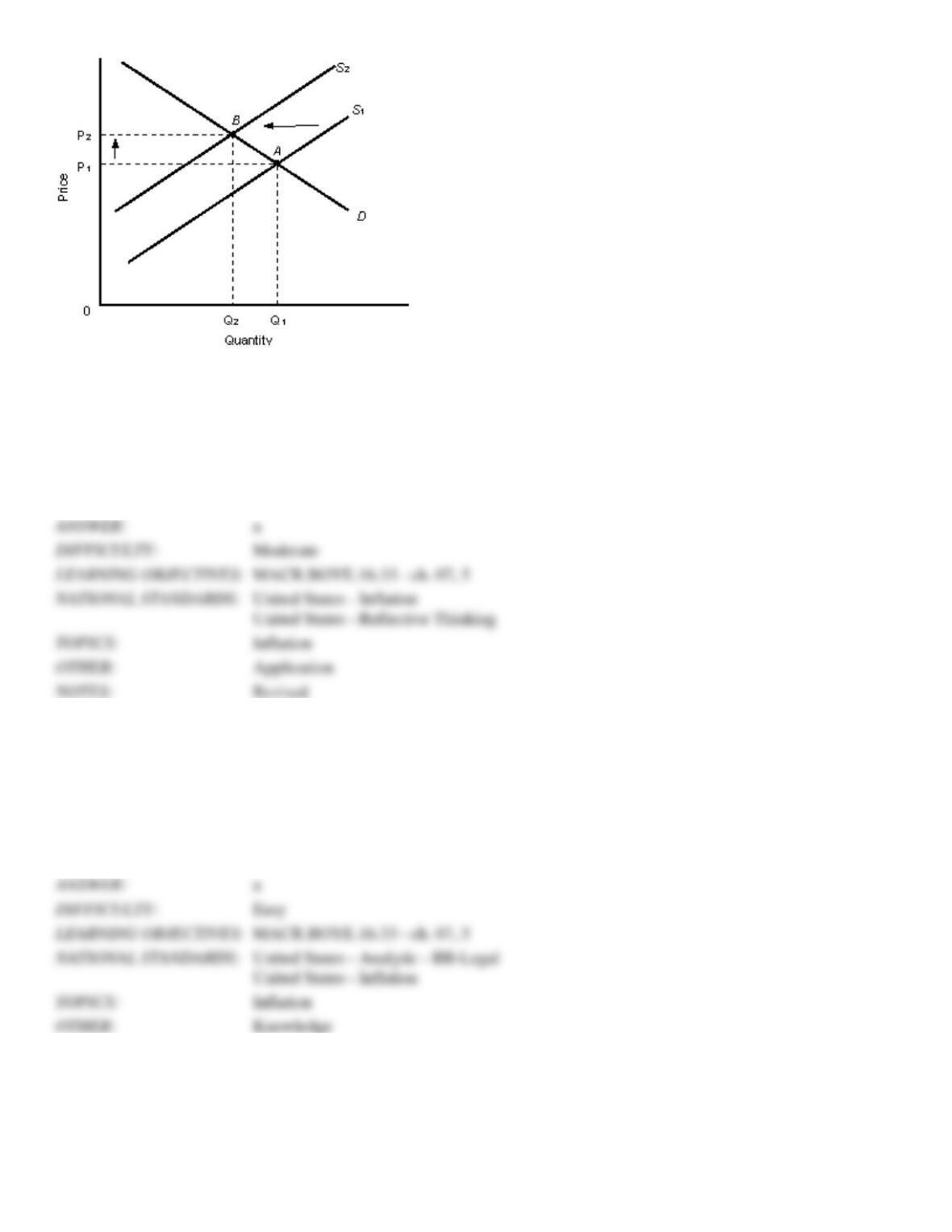
91. Refer to Figure 7.3. Which of the following explains the shift in the supply curve from S1 to S2?
a.
Decreases in oil supplies as experienced in the 1970s
b.
Wage concessions by union members
c.
Businesses reducing their profit margins
d.
Discoveries of natural gas
e.
Increased foreign demand for domestic products
92. Which of the following is true of hyperinflation?
a.
It causes the value of a currency to deteriorate so quickly that people become reluctant to hold that currency.
b.
It is a situation in which people hoard currency expecting its value to increase in recent future.
c.
It is a simultaneous increase in inflation and decrease in the quality of products.
d.
It occurred in the United States in the 1970s.
e.
It is a synonym for cost-push inflation.
MACR.BOYE.16.33 – ch. 07, 5
93. Which of the following led to an introduction of a new currency in Argentina in the mid 1980s?
a.
An economic depression
b.
A misguided political situation
c.
Social instability
MACR.BOYE.16.33 – ch. 07, 5