1. Which of the following refers to business cycles?
a.
Variations in the economy that are all equal in intensity
b.
Seasonal variations in the economy that occur every year
c.
Fluctuations in economic output that show a declining growth pattern over time
d.
Periodic but irregular variations in economic activity
e.
Fluctuations in the profits that businesses in an economy earn over a period of time
2. In the business cycle, a trough marks the end of a(n) _____ and the beginning of a new _____.
a.
contraction; expansion
b.
peak; expansion
c.
expansion; contraction
d.
peak; contraction
e.
expansion; peak
MACR.BOYE.16.29 – ch. 07, 1
United States – Unemployment
Business Cycles
3. The part of a business cycle that follows a peak is the:
a.
trough phase of the cycle.
b.
break-even point of the cycle.
c.
peak period of the cycle.
d.
recessionary phase of the cycle.
e.
expansionary phase of the cycle.
MACR.BOYE.16.29 – ch. 07, 1
Business Cycles
4. Which of the following signals the start of a new expansion?
MACR.BOYE.16.29 – ch. 07, 1
Business Cycles
a.
A boom period
b.
A peak
c.
An inflation
d.
A contraction
e.
A trough
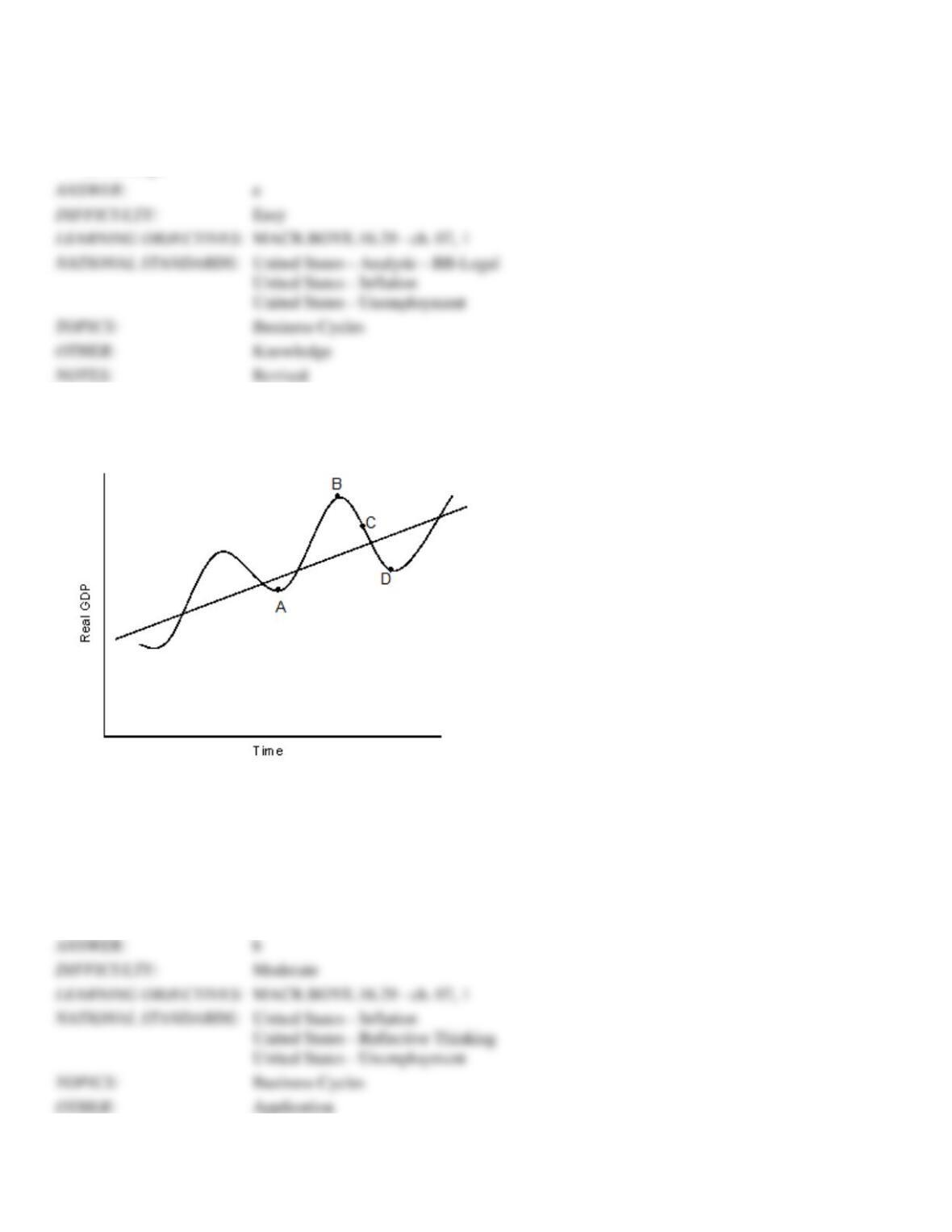
The figure given below represents the business cycle of an economy.
Figure 7.1
5. Refer to Figure 7.1. The movement from point A to point B in the figure is most likely to be associated with _____.
a.
negative inflation.
b.
an increase in the aggregate demand for goods and services.
c.
lagging economic productivity.
d.
an increase in cyclical unemployment.
e.
a downward trend in leading economic indicators.
MACR.BOYE.16.29 – ch. 07, 1
6. Refer to Figure 7.1. At point D, lagging economic indicators should show that:
MACR.BOYE.16.29 – ch. 07, 1
Business Cycles
a.
real GDP is expanding.
b.
real GDP falls to zero.
c.
real GDP is contracting.
d.
real GDP growth is zero.
e.
real GDP growth is positive.
7. Refer to Figure 7.1. The overall upward trend in real GDP reflected by this figure implies that:
a.
the real GDP gap is widening over time.
b.
cyclical unemployment is growing at positive rates.
c.
consumer purchasing power is falling over time.
d.
on average, labor productivity is declining.
e.
expansionary phases outweigh contractionary phases in the economy over time.
MACR.BOYE.16.29 – ch. 07, 1
Business Cycles
8. Which of the following is observed in an economy during the contraction phase of the business cycle?
a.
Nominal GDP begins to rise
b.
Real GDP remains constant
c.
Real GDP falls
d.
Productivity of resources increase
e.
Unemployment falls
MACR.BOYE.16.29 – ch. 07, 1
Business Cycles
MACR.BOYE.16.29 – ch. 07, 1
Business Cycles
9. The long-run growth in the economy depends on all of the following, except:
a.
the growth in productive resources.
b.
the level of technological development in the country.
c.
the increase in the availability of inputs.
d.
the increase in the productivity of inputs.
e.
the number of economic contractions witnessed in a year.
10. Economists call a severe prolonged economic recession a:
a.
slump.
b.
depression.
c.
stagnation.
d.
stagflation.
e.
trend.
b
Easy
MACR.BOYE.16.29 – ch. 07, 1
Business Cycles
Knowledge
11. How is recession defined by the National Bureau of Economic Research [NBER]?
a.
Two consecutive quarters of declining GDP
b.
A significant decline in total output, income, employment, and trade for six months to one year
c.
A dramatic decline in unemployment for less than six months
d.
A sharp increase in money supply and the market rate of interest
e.
A significant decline in stock prices over three consecutive quarters of a business year
b
Easy
MACR.BOYE.16.29 – ch. 07, 1
Business Cycles
Knowledge
12. The official dating of recessions in the United States is the responsibility of the:
a.
Bureau of Labor Statistics (BLS).
Easy
MACR.BOYE.16.29 – ch. 07, 1
Business Cycles
Knowledge
b.
Internal Revenue Service (IRS).
c.
Federal Reserve.
d.
Congress.
e.
National Bureau of Economic Research (NBER).
13. Which of the following monthly data series is closely observed by the Business Cycle Dating Committee of the
NBER?
a.
Real personal income less transfer payments
b.
Wholesale prices of goods
c.
Real GDP
d.
Total unemployment
e.
Real interest rates
MACR.BOYE.16.29 – ch. 07, 1
Business Cycles
Knowledge
14. A leading indicator:
a.
changes in either direction before a recession starts.
b.
usually declines before a recession starts.
c.
generally changes after real GDP changes.
d.
remains unaffected by changes in real GDP.
e.
does not change with business cycles.
MACR.BOYE.16.29 – ch. 07, 1
United States – Unemployment
Business Cycles
Comprehension
15. An increase in stock prices can be considered as an increase in:
a.
a leading indicator.
b.
a coincident indicator.
MACR.BOYE.16.29 – ch. 07, 1
Business Cycles
c.
the consumer price index.
d.
the consumer leverage ratio.
e.
a lagging indicator.
16. Which of the following would be considered a leading indicator?
a.
Prime interest rate
b.
Personal income
c.
Money supply
d.
Inventories to sales ratio
e.
Unemployment duration
MACR.BOYE.16.29 – ch. 07, 1
Business Cycles
17. Which of the following is not a coincident indicator of the business cycle?
a.
Unemployment claims
b.
Payroll employment
c.
Industrial production
d.
Personal income
e.
Manufacturing and trade sales
MACR.BOYE.16.29 – ch. 07, 1
Business Cycles
18. Which of the following will be considered a lagging indicator of the business cycle?
a.
Money supply
b.
New building permits
c.
Unemployment duration
MACR.BOYE.16.29 – ch. 07, 1
Business Cycles
d.
Unemployment claims
e.
New plant and equipment orders
19. Who among the following individuals will not be a part of the U.S. labor force?
a.
An unemployed computer worker who has given up looking for a job
b.
A college graduate seeking job after graduation
c.
An unemployed person who is not working because of a labor dispute
d.
A person who can work only part-time
e.
A person who recently moved to a new city and has not yet found a job
MACR.BOYE.16.30 – ch. 07, 2
20. Unemployment data in the U.S. are published by the:
a.
Bureau of Economic Analysis.
b.
Bureau of Labor Statistics.
c.
Department of Commerce.
d.
Bureau of Federal Intelligence.
e.
Internal Revenue Service.
MACR.BOYE.16.30 – ch. 07, 2
21. To be counted as part of the labor force, a person must:
a.
be less than 65 years old.
b.
have worked at some time in the past.
c.
be employed in some productive activity.
d.
be working or actively looking for work.
e.
be above 16 years of age.
MACR.BOYE.16.29 – ch. 07, 1
United States – Unemployment
Business Cycles
22. The Bureau of Labor Statistics defines a person as unemployed if he or she does not:
a.
work full time.
b.
have a job but is actively seeking one.
c.
earn a wage above the minimum wage rate.
d.
earn enough income to be above the poverty level.
e.
work as much as he or she desires.
MACR.BOYE.16.30 – ch. 07, 2
United States – Unemployment
23. The official unemployment rate is:
a.
the number of unemployed people divided by the number of employed people.
b.
the number of unemployed people divided by the total size of the population.
c.
the number of unemployed people divided by the size of the non-institutionalized population.
d.
the number of unemployed people divided by the size of the labor force.
e.
the number of unemployed people divided by the number of people aged 16 or under.
MACR.BOYE.16.30 – ch. 07, 2
24. Assume that the U.S. labor force consists of 185 million workers and that 17.5 million are officially unemployed.
Calculate the unemployment rate.
a.
11.4 percent
b.
10.0 percent
c.
9.5 percent
d.
7.5 percent
e.
10.8 percent
MACR.BOYE.16.30 – ch. 07, 2
United States – Unemployment
MACR.BOYE.16.30 – ch. 07, 2
25. Which of the following persons would be considered unemployed?
a.
A house wife
b.
A 15-year-old looking for summer employment
c.
A person who worked more than 20 hours in a family-owned business
d.
A recent college graduate looking for her first job
e.
A full-time student
MACR.BOYE.16.30 – ch. 07, 2
United States – Unemployment
26. Suppose Jess resigns from her low paying job. After looking for a new job for two weeks she is highly frustrated and
gives up looking for a better-paying job. According to the U.S. Bureau of Labor Statistics, Jess would:
a.
be considered as a part of the labor force.
b.
be considered employed.
c.
be considered temporarily unemployed.
d.
not be considered as a part of the labor force.
e.
be considered as seasonally unemployed.
MACR.BOYE.16.30 – ch. 07, 2
United States – Unemployment
27. In the official labor statistics, discouraged workers are:
a.
counted as employed.
b.
counted as unemployed.
c.
included in the labor force.
d.
not included in the labor force.
e.
considered to be seasonally unemployed.
MACR.BOYE.16.30 – ch. 07, 2
United States – Unemployment
28. Who among the following individuals is not an underemployed or a discouraged worker?
a.
A person employed part-time but willing to work full-time
b.
A homeless person who has not found work for a year and has given up looking for jobs
c.
A nuclear physicist unable to work because of illness
d.
A gourmet French chef working part-time at Burger King
e.
A 60-year-old professor who has stopped looking for a teaching job because schools consider him too old
Challenging
MACR.BOYE.16.30 – ch. 07, 2
United States – Unemployment
Unemployment
Application
29. Who among the following people will an economist consider underemployed?
a.
Someone who prefers to spend more time on leisure and less time on wage-earning activities
b.
A person who is working part-time at wage-earning activities, but prefers a full-time employment
c.
A rock star who voluntarily chooses to work part-time
d.
Someone who is in prison and is willing to work from his cell
e.
A gardener who hates plants but still does the job because he or she has no other skills
Challenging
MACR.BOYE.16.30 – ch. 07, 2
Application
Revised
Scenario 7.1
Of 1,350 people surveyed, 318 are not working.
The status of those not working is as follows:
122 full-time students
29 discouraged workers
18 in long-term-care facilities
21 seeking employment and aged 16 or older
50 retirees
63 under age 16
15 working in the underground economy and not looking for a “real” job
Eight of those working were under 16 years of age.
30. Refer to Scenario 7.1. According to the data provided, the number of workers officially unemployed is:
a.
122.
b.
36.
c.
40.
d.
21.
Knowledge
e.
55.
31. Refer to Scenario 7.1. According to the data provided, the number of people officially in the labor force is:
a.
1,053.
b.
1,350.
c.
1,032.
d.
1,045.
e.
1,011.
d
Challenging
MACR.BOYE.16.30 – ch. 07, 2
United States – Unemployment
Unemployment
Application
32. Refer to Scenario 7.1. According to the data provided, the official unemployment rate is:
a.
0.02 percent.
b.
2.0 percent.
c.
10 percent.
d.
3.6 percent.
e.
33.7 percent.
b
Challenging
MACR.BOYE.16.30 – ch. 07, 2
Unemployment
Application
33. Refer to Scenario 7.1. If any two individuals who were actively looking for a job, got tired of not finding one and
decided to become full-time students, then:
a.
the official unemployment rate would remain unchanged.
b.
the U.S. Bureau of Labor Statistics would have to be informed immediately.
c.
the official unemployment rate would increase.
d.
the number of people officially in the labor force would remain unchanged.
e.
the official unemployment rate would decrease.
d
Challenging
MACR.BOYE.16.30 – ch. 07, 2
Unemployment
Application
Scenario 7.2
Suppose it has been recently predicted that in the year 2020, the total number of residents in the United States will be
315.5 million, the number of residents under 16 years of age will be 85 million, the number of institutionalized adults will
be 17 million, the number of adults not actively looking for work will be 39 million, and the number of unemployed will
be 21.5 million.
34. Refer to the data in Scenario 7.2. What will be the size of the labor force in the United States in the year 2020?
a.
153 million
b.
294 million
c.
174.5 million
d.
198 million
e.
315.5 million
MACR.BOYE.16.30 – ch. 07, 2
35. Refer to the data in Scenario 7.2. What is the predicted unemployment rate in the United States for the year 2020?
a.
6.8 percent
b.
8.3 percent
c.
11.5 percent
d.
12.3 percent
e.
16.5 percent
MACR.BOYE.16.30 – ch. 07, 2
36. The effect of _____ is to produce an unemployment rate that understates actual unemployment.
a.
the underground economy
b.
discouraged workers and underemployment
c.
the growth in real GDP
d.
institutionalized and retired labor force
e.
seasonally unemployed workers
MACR.BOYE.16.30 – ch. 07, 2
MACR.BOYE.16.30 – ch. 07, 2
37. Because there is no way to account for them, the official unemployment rate does not include discouraged workers.
What would happen to the unemployment rate if, because of a program that gave them new hope, all discouraged workers
suddenly begin reporting themselves as ready to work?
a.
The official unemployment rate would remain unchanged.
b.
The size of the labor force would increase.
c.
The size of the labor force would remain unchanged.
d.
The official unemployment rate would decrease.
e.
The size of the underground economy would shrink.
United States – Unemployment
38. Which of the following is true of seasonal unemployment?
a.
It is not included in calculating the natural rate of unemployment.
b.
It is reflected in the GDP gap.
c.
It is always present, even in a healthy economy.
d.
It causes the natural rate of unemployment to rise.
e.
It inflates potential GDP.
MACR.BOYE.16.30 – ch. 07, 2
United States – Unemployment
39. Which of the following is true about workers who experience structural unemployment?
a.
They quickly accept a much lower salary in a different industry.
b.
They become unemployed due to the business cycle fluctuations.
c.
They sometimes enter the pool of discouraged workers.
d.
They tend to quit their job search very easily.
e.
They usually have the necessary skills to maintain their level of income in another industry.
MACR.BOYE.16.30 – ch. 07, 2
40. Which of the following statements about frictional unemployment is true?
a.
It can be eliminated only in a free society.
b.
It is a long-term unemployment.
c.
It does not exist in developed economies.
d.
It is also called structural unemployment.
e.
It arises when people choose to change jobs.
MACR.BOYE.16.30 – ch. 07, 2
United States – Unemployment
41. During the off season, a fruit picker did not work, so he should be considered:
a.
cyclically unemployed.
b.
frictionally unemployed.
c.
structurally unemployed.
d.
seasonally unemployed.
e.
naturally unemployed.
MACR.BOYE.16.30 – ch. 07, 2
United States – Reflective Thinking
42. Which of the following is the closest example of structural unemployment?
a.
An accountant quitting her job to become an investment banker
b.
An auto worker being fired for poor job performance
c.
Workers in a firm manufacturing films for roll film cameras losing jobs due to the popularity of digital
cameras
d.
A consultant being laid off because poor economic conditions have depressed the market for consultants
e.
A college graduate seeking his/her first job in the IT industry
MACR.BOYE.16.30 – ch. 07, 2
United States – Reflective Thinking
43. Technological advancements cause structural unemployment. However, they help in:
a.
lowering the rate of interest in the economy.
b.
increasing the price level in the economy and hence make business more profitable for the firms.
c.
improving living standards by giving consumers a greater variety of goods at lower costs.
d.
raising government’s tax revenue.
e.
raising the aggregate income in the economy.
MACR.BOYE.16.30 – ch. 07, 2
United States – Unemployment
44. Structural unemployment will decline if:
a.
more seasonal work becomes available.
b.
the government increases taxes to support more welfare programs.
c.
consumer spending on new technology decreases.
d.
computerized job-search systems are improved.
e.
retrained workers can move to areas where new jobs are available.
MACR.BOYE.16.30 – ch. 07, 2
United States – Unemployment
45. A recent economics graduate is looking for a position as an industrial economist. During the period this individual
starts looking for a job and ultimately finds one, he may be classified as:
a.
seasonally unemployed.
b.
frictionally unemployed.
c.
cyclically unemployed.
d.
structurally unemployed.
e.
occasionally unemployed.
MACR.BOYE.16.30 – ch. 07, 2
46. A worker who loses his or her job as a consequence of a decline in aggregate demand in the economy is experiencing:
a.
disguised unemployment.
b.
underemployment.
c.
cyclical unemployment.
d.
frictional unemployment.
e.
seasonal unemployment.
47. Which of the following is an example of cyclical unemployment?
a.
A recent college graduate still looking for her first job
b.
A car salesman who loses his job because of a recession
c.
A ski instructor who is out of work during the summer
d.
An economics journalist who just quit her writing job in order to begin a new career as a college professor
next month
e.
A worker displaced from his factory job because of greater mechanization in the workplace
Moderate
MACR.BOYE.16.30 – ch. 07, 2
Unemployment
Application
48. At potential real GDP:
a.
there is zero unemployment.
b.
there is no seasonal unemployment.
c.
there is no frictional unemployment.
d.
unemployment is at its natural rate.
e.
cyclical unemployment equals approximately 5 percent.
d
MACR.BOYE.16.31 – ch. 07, 3
United States – Analytic – BB-Legal
United States – Unemployment
Unemployment
49. The natural rate of unemployment is the unemployment rate that would exist in the absence of _____.
a.
structural unemployment
b.
educated unemployment
c.
cyclical unemployment
Moderate
MACR.BOYE.16.30 – ch. 07, 2
United States – Reflective Thinking
United States – Unemployment
Unemployment
Application
d.
frictional unemployment
e.
underemployment
50. Which of the following would tend to increase the natural unemployment rate?
a.
The creation of national unemployment offices to increase the information about job openings
b.
Recessionary downturns in the economy that result in massive layoffs of auto workers
c.
Sociological changes that encourage people to seek employment
d.
The creation of government subsidies for workers who relocate into areas where new jobs can be found
e.
Less government money made available as unemployment compensation
MACR.BOYE.16.31 – ch. 07, 3
United States – Unemployment
Unemployment
51. Which of the following statements about the GDP gap is not true?
a.
It widens during recessions and narrows down during expansions.
b.
When an economy’s GDP gap equals zero, it operates on its production possibilities curve.
c.
It is a measure of output lost as a result of unemployment.
d.
There are more goods and services available in an economy as its GDP gap widens.
e.
It is equal to potential real GDP minus actual real GDP.
Moderate
MACR.BOYE.16.31 – ch. 07, 3
United States – Unemployment
Knowledge
Easy
MACR.BOYE.16.31 – ch. 07, 3
United States – Unemployment
Knowledge
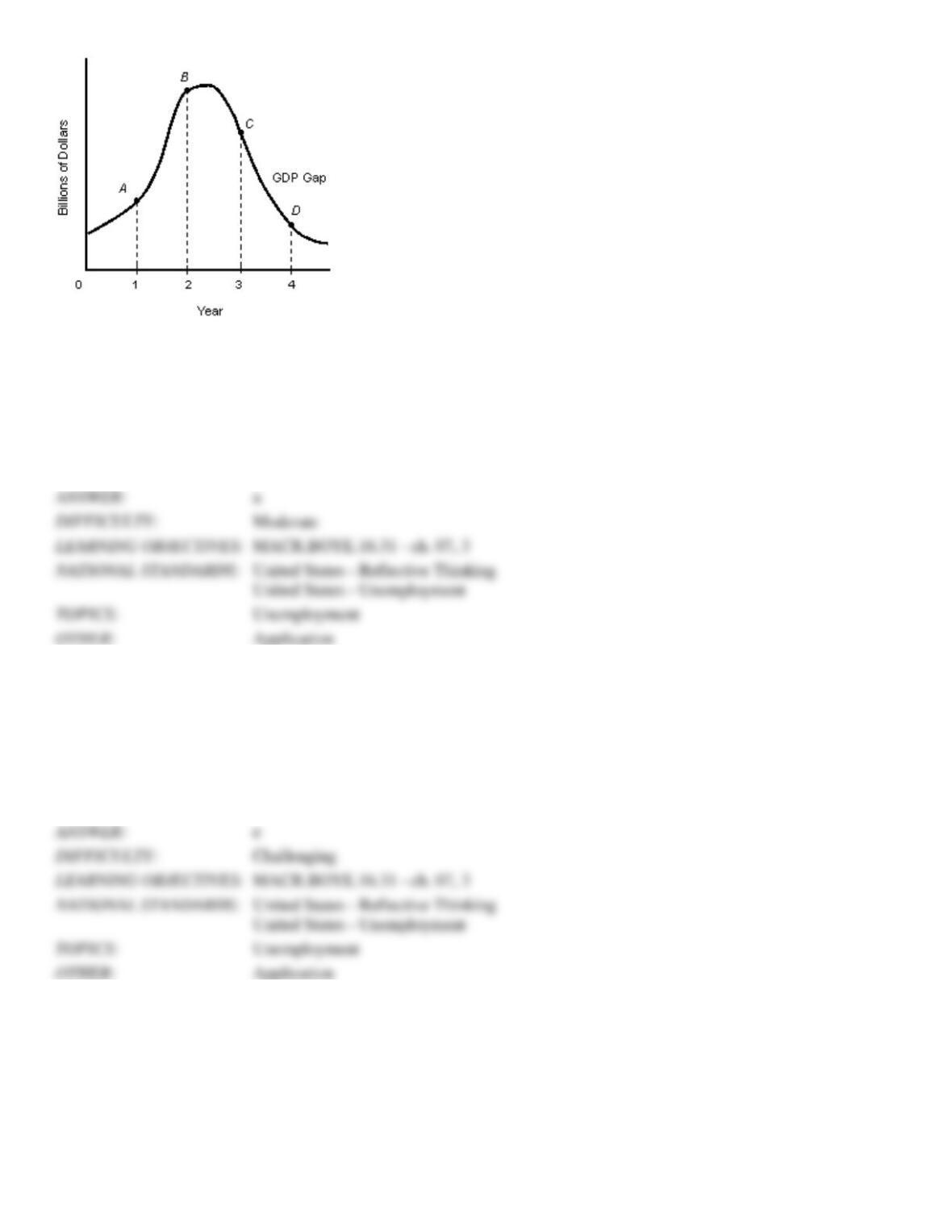
52. Refer to Figure 7.2. The difference between potential and actual GDP consistently widens between points:
a.
A and B.
b.
B and D.
c.
A and D.
d.
B and C.
e.
C and D.
53. Refer to Figure 7.2. Which time period is most likely to be associated with an economic expansion?
a.
Years 1 to 2
b.
Years 1 to 3
c.
Year 4 only
d.
Years 1 to 4
e.
Years 3 to 4
MACR.BOYE.16.31 – ch. 07, 3
United States – Unemployment
54. When the U.S. economy is at its full-employment level, the unemployment rate is not equal to zero because:
a.
cyclical unemployment is always present in a modern economy.
b.
of the statistical discrepancy.
c.
voluntary unemployment is always positive.
d.
frictional and structural unemployment are always present in a modern economy.
e.
there are always people who are too lazy to work.
MACR.BOYE.16.31 – ch. 07, 3
55. What is another name for the natural unemployment rate?
a.
Non-deteriorating low-inflationary unemployment (NDLIU)
b.
Natural rate of no-inflation unemployment (NRNIU)
c.
Non-accelerating-inflation rate of unemployment (NAIRU)
d.
Non-inflationary rate of low unemployment (NIRLU)
e.
Natural unaffected rate of inflationary unemployment (NURIU)
Easy
MACR.BOYE.16.31 – ch. 07, 3
Unemployment
Knowledge
56. Some economists say that “full employment” exists in an economy when:
a.
cyclical unemployment is 2 percent.
b.
cyclical unemployment is 4 to 6 percent.
c.
frictional unemployment is zero.
d.
the unemployment rate is 4 to 7 percent.
e.
the natural unemployment rate is zero.
d
Easy
MACR.BOYE.16.31 – ch. 07, 3
United States – Unemployment
Unemployment
Knowledge
57. If an economy operates on its production possibilities frontier, the natural unemployment rate must be:
a.
zero.
b.
positive.
c.
negative.
d.
at 1 percent.
e.
at 5 percent.
b
Easy
MACR.BOYE.16.31 – ch. 07, 3
d
Moderate
MACR.BOYE.16.31 – ch. 07, 3
United States – Unemployment
Unemployment
Knowledge
58. Unemployment will decrease over time if:
a.
actual GDP increases faster than potential GDP.
b.
actual GDP increases at the same rate as potential GDP.
c.
acutal GDP remains the same but potential GDP increases.
d.
actual GDP increases at a less than proportionate rate than potential GDP.
e.
actual GDP decreases but potential GDP increases.
Challenging
MACR.BOYE.16.31 – ch. 07, 3
United States – Unemployment
Unemployment
Application
Revised
59. Which of the following statements regarding the unemployment rates in the U.S. between 1971 and 2002 is true?
a.
The unemployment among the whites were much lower compared to the non-whites.
b.
The unemployment rate for all workers reached a low of 2.9 percent in 1982.
c.
The unemployment rate of both male and female workers have consistently increased from 1971 to 1998.
d.
The whites had much higher unemployment rates than the nonwhites.
e.
Teenagers reported the lowest unemployment rates in the country.
Challenging
MACR.BOYE.16.31 – ch. 07, 3
United States – Unemployment
Unemployment
Knowledge
60. According to general trends in the incidence of unemployment across different demographic groups in the United
States, which of the following groups have the lowest unemployment rates in the country?
a.
Asians
b.
Hispanics
c.
Whites
d.
Nonwhites
e.
Latinos
Moderate
MACR.BOYE.16.31 – ch. 07, 3
United States – Unemployment
United States – Unemployment
Unemployment
Knowledge