International Economics, 9e (Husted/Melvin)
Chapter 7 Nontariff Barriers and Arguments for Protection
7.1 Multiple-Choice Questions
1) Quotas are government imposed limits on the ________ of goods traded between countries.
A) prices
B) quantity
C) value
D) Either B or C
2) ________ are quotas that lead to a complete elimination of trade.
A) Embargoes
B) Voluntary export restraints
C) Nontariff barriers
D) Orderly marketing agreements
3) Like tariffs, quotas tend to lead to
A) higher prices and reduced imports.
B) increased government revenue.
C) increased consumer surplus.
D) All of the above.
4) The welfare effects of a quota depend, to considerable extent, upon
A) who has the quota license.
B) the size of the quota.
C) elasticities of domestic demand and supply.
D) all of the above.
5) ________ are profits that accrue to whomever has the right to import the quota restricted
good.
A) Quota licenses
B) Quota rents
C) Quota prices
D) None of the above.
6) Tariffs and quotas tend to be similar in their domestic welfare effects
A) if quota licenses are given to foreigners.
B) if quota licenses are auctioned.
C) if quota licenses are given to domestic firms.
D) Both B and C.
7) Governments around the world tend to auction quota licenses
A) never.
B) seldom.
C) often.
D) always.
8) A(n) ________ is an example of a quota where foreigners hold quota licenses.
A) voluntary export restraint
B) embargo
C) auction quota
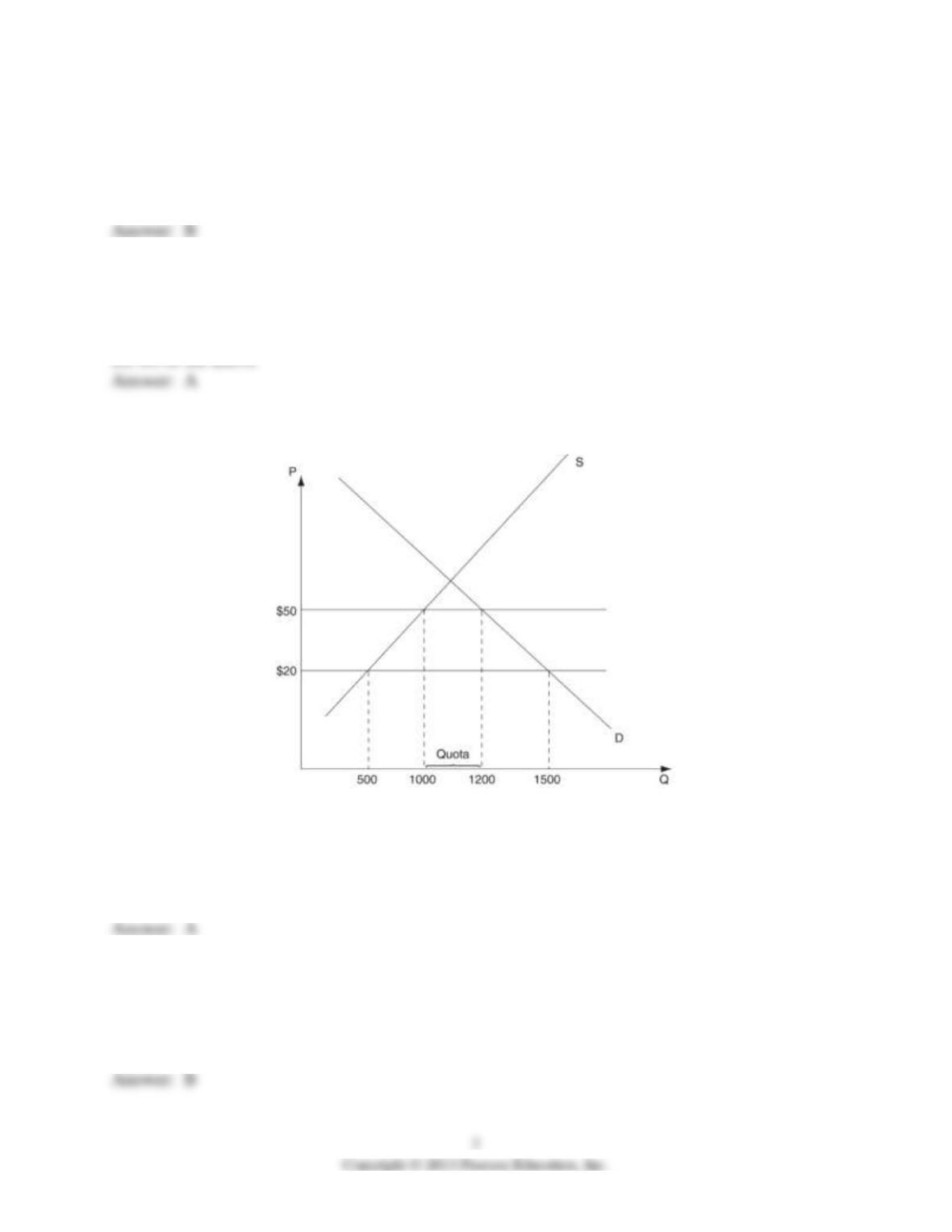
Answer the question(s) below based on the following diagram.
9) Refer to the figure above. The quota shown in the diagram equals
A) 200 units.
B) 500 units.
C) 1000 units.
D) 1200 units.
10) Refer to the figure above. The quota restricts trade by the same amount as a tariff of
A) $20.
B) $30.
C) $50.
D) Cannot answer without more information.
11) Refer to the figure above. Quota rents equal
A) $2000.
B) $5000.
C) $6000.
D) $10000.
12) Refer to the figure above. If the government was to auction quota licenses competitively, it
could earn up to
A) $2000.
B) $5000.
C) $6000.
D) $10000.
13) Refer to the figure above. The quota generates deadweight costs of
A) $10,000.
B) $12,000.
C) $30,000.
D) $50,000.
14) Refer to the figure above. If this were a voluntary restraint agreement, the welfare costs to
the importing country would be
A) $14,000.
B) $18,000.
C) $38,000.
D) $60,000.
15) Which of the following is true (assume the small country case)?
A) With a quota, an increase in demand leads to a higher price and more imports.
B) With a tariff, an increase in demand leads to a higher price and more imports.
C) With either a tariff or a quota, an increase in demand leads to a higher price and more
imports.
D) None of the above are true.
16) Which of the following is false?
A) Tariffs and quotas are identical in their effects, if the protected industry is a monopoly.
B) Quotas tend to breed graft.
C) Welfare effects of quotas depend, in part, on who gets the quota rents.
D) Quotas tend to be administrated in an arbitrary fashion.
17) Export subsidies lead to
A) greater production of exportables and higher internal prices for these goods.
B) greater production of exportables and lower internal prices for these goods.
C) greater production of importables and higher internal prices for these goods.
D) None of the above.
18) Countries like the United States use ________ to offset foreign export subsidies.
A) quotas
B) the escape clause
C) countervailing duties
D) government procurement
19) Which of the following are used as nontariff barriers?
A) health and safety standards
B) government procurement policies
C) domestic content laws
D) All of the above
20) Which of the following is a valid argument for protection?
A) national defense
B) fair trade
C) creation of employment
D) All of the above
21) Which of the following is an invalid argument for protection?
A) redistribution of income
B) infant industry protection
C) preservation of the home market
D) All of the above
22) ________ countries tend to depend on tariffs for a relatively large part of their government
revenue.
A) Developed
B) Developing
C) All
23) Tariffs can be used to redistribute income from
A) abundant factors to scarce factors.
B) consumers to domestic producers.
C) from one country to another.
D) All of the above.
24) In the case of national defense protection, ________ is a better policy than protection.
A) a production subsidy combined with free trade
B) an income tax
C) direct government provision of infrastructure
D) None of the above is better
25) A production subsidy combined with free trade
A) has the same deadweight costs as a tariff.
B) has only consumption deadweight costs.
C) has only production deadweight costs.
D) None of the above.
26) The United States bans most imports from all of the following countries except
A) China.
B) Cuba.
C) North Korea.
D) Iran.
27) Quotas that entirely eliminate trade in a certain product or a number of products are known
as
A) export tariffs.
B) deadweight.
C) ultimate tariffs.
D) embargoes.
28) The argument that developing countries with lax environmental standards will attract foreign
manufacturers who want to escape stricter standards in their own countries is known as
A) the pollution havens hypothesis.
B) the escape clause hypothesis.
C) the earth destruction hypothesis.
D) the environmentally destructive hypothesis.
29) The argument that developing countries should nurture their domestic industries by
protecting them from foreign competition is known as
A) preservation of the home market.
B) the escape clause hypothesis.
C) the earth destruction hypothesis.
D) institutional fair trade policy.
30) The argument that developing countries should nurture their infant domestic industries by
protecting them from foreign competition is known as
A) the infant industry argument.
B) the escape clause hypothesis.
C) preservation of the home market.
D) institutional fair trade policy.
7.2 True or False Questions
1) Higher protection raises the overall level of employment.
2) Tariffs and quotas are essentially identical in their effects.
3) While tariff levels have been falling over the past several decades, nontariff barriers have been
used increasingly.
4) The welfare effects of quotas depend, to some extent, on who has the right to import the quota
restricted goods.
5) The most commonly expressed arguments for protection tend to be largely invalid.
6) A less costly alternative to protection of national defense industries would be a production
subsidy.
7) Quotas redistribute income from consumers to domestic producers.
8) Export subsidies lead to lower prices of exportables for both domestic residents and
foreigners.
9) Voluntary export restraints and quotas are essentially identical in their welfare effects.
10) Strategic trade policy considerations imply that free trade policies should never be pursued.
11) Most tariffs around the world are collected on an ad valorem basis.
12) If the pollution havens hypothesis is true, we should expect world pollution to decline as a
result of international trade and globalization.
13) The argument that developing countries with lax environmental standards will attract foreign
manufacturers who want to escape stricter standards in their own countries is known as the
pollution havens hypothesis.
7.3 Essay Questions
1) Explain why each of the following is not a valid argument for protection.
(a) patriotism
(b) fair play (e.g. level international playing fields)
(c) preservation of jobs
2) Are tariffs and quotas equivalent in their economic effects? Demonstrate.
3) Write an essay on the national defense argument for tariffs. Include in your discussion points
in favor of this idea as well as problems with its implementation. Is protection the best policy to
achieve the stated ends? Explain.
8
4) Why do countries impose protection even if it lowers economic welfare? Explain fully.
5) Describe aspects of customs valuation practices that are controversial in the world of
international trade, such as how countries establish import tariffs. Also, how does the WTO
protect against potentially abusive practices when determining appropriate tariffs.