61) The definition of the adult population is those who are 16 years and older and who are
A) employed or unemployed.
B) in the labor force.
C) in the labor force or not in the labor force.
D) not in the labor force.
62) A person who has taken medical leave is
A) in the labor force.
B) not in the labor force.
C) unemployed.
D) a job leaver.
63) By the legal definition of unemployment, a person who has quit his job to take care of his
children full time is
A) unemployed.
B) employed.
C) in the labor force.
D) not in the labor force.
64) The labor force is defined as
A) the number of people over 16 years of age.
B) the number of people who are working.
C) the sum of the employed and the unemployed.
D) the number of people in blue-collar jobs.
65) Unemployment is a ________ concept, measuring the ________.
A) flow; number of people who are first entering the labor force
B) flow; number of people who lost their jobs within the last week
C) stock; number of people who are not working
D) stock; number of people at a point in time who are not working but who are looking for work
66) Unemployment is a
A) flow concept.
B) stock concept.
C) both a flow and a stock concept.
D) neither a stock nor a flow concept.
67) Suppose that last week 100,000 people lost their jobs or quit. We can say that
A) the number of unemployed increased by 100,000 people.
B) the number of unemployed increased by less than 100,000 people because we should not
count those who quit their jobs.
C) the 100,000 people represent a flow known as job departures.
D) the 100,000 people represent a stock known as the new unemployed.
68) Distinguishing between stock measures and flow measures of the labor force, the stock
measures are
A) the labor force only.
B) the number of people who lost their jobs and the number of people who found jobs only.
C) the total number of people who are unemployed only.
D) the total number in the labor force and the total number of people who are unemployed only.
69) Distinguishing between stock measures and flow measures, the flow measures are
A) the labor force only.
B) the number of people who lost their jobs and the number of people who found jobs only.
C) the total number of people who are unemployed only.
D) the total number in the labor force and the total number of people who are unemployed only.
70) Suppose there are 100 million in the labor force, and 6 million unemployed people. During
the next month, 200,000 people lose their jobs and 300,000 find jobs. The new total of employed
is ________ and the new unemployment rate is ________.
A) 100.1 million; 5.8 percent
B) 100 million; 6.1 percent
C) 94.1 million; 5.9 percent
D) 93.9 million; 6.1 percent
71) Suppose the population of El Campo is 120,000. Of the population 16 years and older,
50,000 are employed, 10,000 have never worked and are not looking for work, 5,000 are not
working and are looking for work, and 15,000 are retired and not looking for work. The labor
force equals
A) 50,000.
B) 55,000.
C) 65,000.
D) 80,000.
72) Suppose the population of El Campo is 120,000. Of the population 16 years and older,
50,000 are employed, 10,000 have never worked and are not looking for work, 5,000 are not
working and are looking for work, and 15,000 are retired and not looking for work. The number
unemployed equals
A) 5,000.
B) 10,000.
C) 15,000.
D) 20,000.
73) The population of a small town is 5,000. There are 4,000 people in the labor force, and 3,500
people are employed. The unemployment rate equals
A) 5 percent.
B) 10 percent.
C) 12.5 percent.
D) 35 percent
74) In a small country, the adult population is 10,000. In that country, 7,000 people are in the
labor force and 6,300 people are employed. The unemployment rate equals
A) 0.63 percent.
B) 7 percent.
C) 10 percent.
D) an undetermined amount given the lack of information.
75) In a small country, the adult population equals 10,000. In that country, 8,000 people are in
the labor force and 200 people are unemployed. The unemployment rate equals
A) 2.5 percent.
B) 2 percent.
C) 4 percent.
D) an undetermined amount given the lack of information.
76) A job loser is an individual
A) in the labor force whose employment was involuntarily terminated.
B) who used to work full time but left the labor force and has now reentered it looking for a job.
C) in the labor force who quits voluntarily.
D) who has never held a full-time job lasting two weeks or longer but is now seeking
employment.
77) A reentrant is an individual
A) in the labor force whose employment was involuntarily terminated.
B) who used to work full time but left the labor force and has now reentered it looking for a job.
C) in the labor force who quits voluntarily.
D) who has never held a full-time job lasting two weeks or longer but is now seeking
employment.
78) A job leaver is an individual
A) in the labor force whose employment was involuntarily terminated.
B) who used to work full time but left the labor force and has now reentered it looking for a job.
C) in the labor force who quits voluntarily.
D) who has never held a full-time job lasting two weeks or longer but is now seeking
employment.
79) An individual in the labor force whose employment was involuntarily terminated is
A) a job leaver.
B) a job loser.
C) a job reentrant.
D) part of the PPI.
80) All of the following are considered to be unemployed EXCEPT
A) job leavers.
B) discouraged workers.
C) job reentrants.
D) new job entrants.
81) New entrants to the labor force usually account for around ________ percent of the
unemployed.
A) 10
B) 20
C) 25
D) 30
82) A new entrant is an individual
A) in the labor force whose employment was involuntarily terminated.
B) who used to work full time but left the labor force and has now reentered it looking for a job.
C) in the labor force who quits voluntarily.
D) who has never held a full-time job lasting two weeks or longer but is now seeking
employment.
83) The unemployment rate can increase when
A) the number of job finders increases.
B) the size of the military increases.
C) the proportion of 18-22 year olds that go to college increases.
D) the number of unemployed workers increases.
84) The duration of unemployment tends to rise when
A) people leave their jobs rather than lose their jobs.
B) the number of entrants exceeds the number of reentrants.
C) business activity starts back up after a long period of decline.
D) business activity goes into a downturn.
85) Discouraged workers
A) are considered part of the unemployed because they are not working.
B) are considered part of the unemployed because they are still in the labor force.
C) are not considered part of the unemployed because they quit their jobs voluntarily.
D) are not considered part of the unemployed because they are not actively seeking work.
86) A discouraged worker is someone who
A) has been fired.
B) is unemployed.
C) is not in the labor force.
D) is employed.
87) One criticism of the unemployment rate is that it
A) does not include the number of discouraged workers as unemployed.
B) does not include people who are not working and are not looking for work.
C) counts a new entrant that is actively seeking work as unemployed.
D) is a stock measure.
88) The unemployment rate will decrease when
A) the duration of unemployment increases.
B) the average workweek falls from 40 to 39 hours.
C) the age of the labor force increases.
D) people get discouraged and quit looking for work.
89) The percentage of the noninstitutionalized working-age individuals who are employed or
seeking work is known as
A) the labor force.
B) the labor force participation rate.
C) discouraged worker.
D) the stock of employed and unemployed workers.
90) An increase in the labor force participation rate
A) implies that the unemployment rate must fall.
B) implies that the unemployment rate must rise.
C) means there are more discouraged workers.
D) is consistent with either a rise or a fall in the unemployment rate.
91) The labor force participation rate is the
A) proportion of the noninstitutionalized adult population in the labor force.
B) proportion of the labor force that is employed.
C) proportion of the labor force that is unemployed.
D) proportion of the noninstitutionalized adult population that is employed.
92) The major change in American labor markets this century is
A) the steady rise of the unemployment rate.
B) the steady rise of the employment rate.
C) the increase in the female labor-force participation rate.
D) the increase in the labor-force participation rate.
93) Which of the following would NOT be a factor that has contributed to the rising female labor
force participation rate?
A) greater access to education
B) greater access to training
C) increasing family size
D) reduction of barriers to competing with men for jobs
94) In a small country, the adult population equals 500. There are 400 people in the labor force
and 300 people are employed. The labor force participation rate equals
A) 75 percent.
B) 80 percent.
C) 60 percent.
D) an undetermined amount given the lack of information.
95) In a country, the adult population equals 100,000. There are 50,000 people unemployed and
40,000 people are employed. The labor force participation rate equals
A) 90 percent.
B) 50 percent.
C) 40 percent.
D) an undetermined amount given the lack of information.
96) In a small country, there are 5,000 people in the labor force and 4,000 people are employed.
The labor force participation rate equals
A) 40 percent.
B) 90 percent.
C) 80 percent.
D) an undetermined amount given the lack of information.
97) To be counted in the labor force
A) a person has to be working at least 40 hours per week.
B) a person has to be at least 16 or older, have a job, or if unemployed has to be actively seeking
employment.
C) a person, irrespective of his or her age, has to be working or, if out of work, actively seeking
employment.
D) a person has to be over 16 years of age, irrespective of whether she or he is actively seeking
work.
98) To be counted as unemployed in the United States a person has to be
A) at least 16 and out of work.
B) at least 16, out of work, and actively seeking employment.
C) at least 16 and less than 65 and actively seeking employment.
D) out of work and actively seeking employment.
99) All of the following are examples of a flow EXCEPT
A) a new entrant into the labor force.
B) an individual who voluntarily leaves the labor force.
C) a person who is fired from a job.
D) the current unemployment rate.
100) A person who is currently not working and has stopped looking for a job because he or she
is convinced there is no job available is classified as a
A) discouraged worker.
B) disgruntled worker.
C) depressed worker.
D) dissatisfied worker.
101) The labor force participation rate is
A) the percentage of the population who are in the labor force.
B) the percentage of the non-institutionalized working age population who is in the labor force.
C) the percentage of the non-institutionalized population who is in the labor force.
D) the percentage of the entire population who is in the labor force.
102) Since 1950, the labor force participation rate in the United States
A) of men and women both increased.
B) of men increased and women decreased.
C) of men and women both decreased.
D) of men decreased and for women increased.
103) Which one of the following statements is TRUE?
A) The existence of unemployment places the economy at a point inside its production
possibilities curve.
B) The unemployment rate is the percentage of the population not working.
C) To be counted as part of the labor force, an individual must be working more than 40 hours a
week.
D) The sum of wages lost by all unemployed workers gives an accurate, comprehensive estimate
of the total cost of unemployment.
104) During the Great Depression
A) the unemployment rate was not unusually high, but wage levels were low.
B) unemployment statistics were not collected.
C) the U.S. unemployment rate reached its historical highest.
D) most people who couldn’t find work left the labor force, so the official unemployment rate
remained low.
105) Which one of the following individuals is NOT counted as unemployed?
A) a recent college graduate currently without any employment and looking for her first full-time
job
B) a 35-year-old woman fired from her prior work because of poor performance and looking for
another job
C) a 50-year-old woman laid off from her former job because of a downturn in the company’s
sales and looking for another job
D) a 22-year-old aspiring actress currently without any show business employment, but working
temporarily as a waitress while she auditions for acting jobs
106) The average duration of unemployment across the labor force is about
A) 25 weeks.
B) 15 weeks.
C) 8 weeks.
D) 4 weeks.
107) What is the definition of a discouraged worker?
A) a member of the labor force who is working but is discouraged about his prospects for
advancement within the company
B) a member of the labor force who is working but is discouraged about the performance of his
company within the industry
C) a person who has dropped out of the labor force because he is discouraged about his prospects
for employment
D) an employed member of the labor force who is discouraged about his pay
108) Which one of the following accurately describes the trends in U.S. labor force participation
over the past 50 years?
A) The labor force participation rate of men has climbed from about 75 percent to 90 percent.
B) The labor force participation rate of women has climbed from below 40 percent to about 60
percent.
C) The labor force participation rates for both men and women have declined.
D) The overall labor force participation rate has held steady at about 85 percent.
109) Is it possible for the unemployment rate to rise at the same time that the number of people
working increases?
A) no
B) yes, if the new workers are employed less than full time
C) yes, if labor force growth outpaces growth in the number of people working
D) yes, if established workers keep their jobs but no longer have the option of working overtime
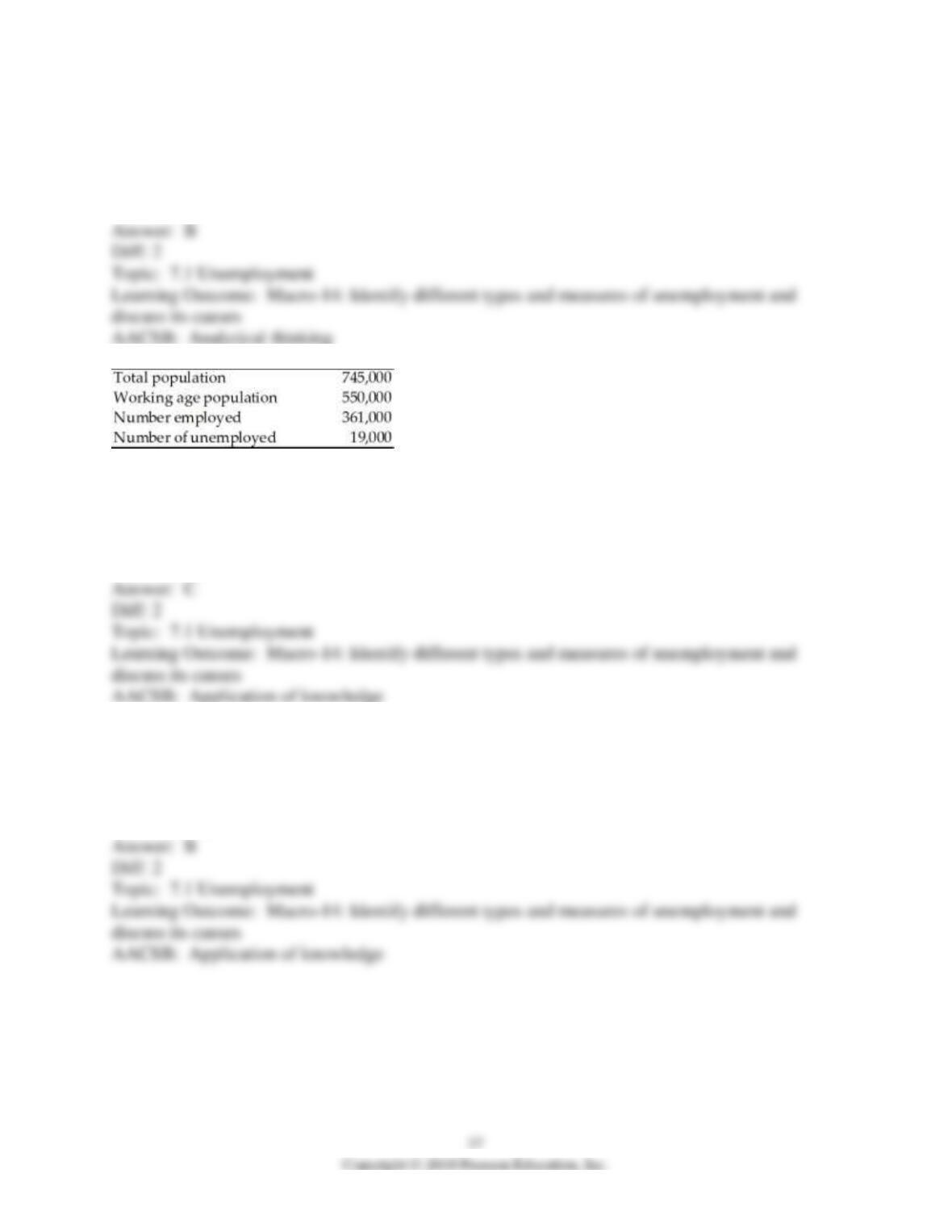
110) The labor force in the United States includes
A) discouraged workers.
B) those over the age of 16 who are employed or are seeking employment.
C) those between ages 12 and 16 who are actually working.
D) all of the above.
111) Using the above table, the employment rate is
A) 65.6 percent.
B) 48.5 percent.
C) 95.0 percent.
D) 69.1 percent.
112) Using the above table, the unemployment rate X is
A) 2.6 percent.
B) 5.0 percent.
C) 3.5 percent.
D) 2.1 percent.
113) Using the above table, the labor force is
A) 380,000.
B) 911,000.
C) 930,000.
D) 569,000.
114) Using the above table, the labor force participation rate is
A) 65.6 percent.
B) 73.8 percent.
C) 81.8 percent.
D) 69.1 percent.
115) Unemployment statistics are often criticized for
A) understating the number of people out of work, because discouraged workers are excluded in
the statistics.
B) overstating the number of people out of work, because retirees are included in the statistics.
C) understating the number people out of work, because full-time college students are excluded.
D) overstating the number of people out of work, because the unemployment statistics include all
low-income workers.
116) If Tim works at home taking care of the household
A) he is part of the labor force.
B) he is not part of the labor force.
C) he is considered to be employed.
D) he is considered to be unemployed.
117) Which of the following would be considered a member of the labor force?
A) an engineer who has been laid off a year ago and since then has not looked for work
B) an inmate in a state prison making license plates
C) a person in a mental institution
D) a computer programmer looking for work
118) Which of the following people would be considered unemployed assuming that they are
actively seeking employment?
A) those who were fired from their job
B) those who resigned from their job
C) new entrants into the job market
D) All of the above are correct.
119) The highest measured rate of unemployment in the United States occurred during
A) the post-WWII years.
B) the Panic of 1893.
C) the Carter administration.
D) the Great Depression.
120) Which of the following groups would NOT be considered as part of the civilian labor force?
A) full-time students who are not working or looking for work
B) those already employed
C) those who are unemployed
D) all individuals only working part-time
121) Assuming there are 190 million people employed in the United States and 10 million people
unemployed, the unemployment rate would therefore equal
A) 1.9 percent.
B) 5 percent.
C) 10 percent.
D) an undetermined amount given the lack of information.