93. Compared to the long run, consumers typically ____ to price changes in the short run.
a.
are very responsive
b.
are more demand sensitive
c.
are less demand sensitive
d.
do not respond at all
e.
overreact
94. Demand will be more elastic when
a.
the time the consumer has to adjust to price changes is short.
b.
the price of the good is low.
c.
the number of good substitutes is large.
d.
the consumption of the good is essential.
95. The demand for a product is likely to be more elastic when
a.
the share of the total budget spent on the product is small.
b.
more complementary products are available.
c.
the consumer has a short time to adjust to price changes.
d.
more good substitutes for the product are available.
96. The price elasticity of demand for a product tends to be large (more elastic) when
a.
people spend a large share of their income on the product.
b.
the population in the market area is small.
c.
few good substitutes for the product are available.
d.
many complementary products are available.
97. Other things constant, the price elasticity of demand for a product will tend to be smaller (more
inelastic) if
a.
people spend a large share of their income on the product.
b.
people spend an insignificant share of their income on the product.
c.
the population in the market area is large.
d.
there are many good substitutes for the product.
98. If you compared the short-run demand and long-run demand for education at your college, you would
almost certainly find that
a.
the long-run demand curve was steeper than the short-run demand curve.
b.
a tuition increase would reduce enrollment more in the long run than in the short run.
c.
a reduction in tuition would increase enrollment in the short run but not in the long run.
d.
the short-run and long-run demand curves were identical.
99. If the demand for a good is elastic, then total revenue
a.
increases as price increases.
b.
remains constant as quantity demanded increases.
c.
increases as price decreases.
d.
decreases as quantity demanded increases.
e.
decreases as price decreases.
100. If the price of Pepsi-Cola increases from 50 cents to 60 cents per can and the quantity demanded
decreases from 100 cans to 50 cans, then the Pepsi-Cola Company could increase its total revenue by
a.
lowering price.
b.
decreasing quantity supplied.
c.
leaving price the same.
d.
raising price.
e.
decreasing supply.
101. Which of the following describes a situation in which demand must be elastic?
a.
The price of pens rises by 10 cents, and quantity of pens demanded falls by 50.
b.
The price of pens rises by 10 cents, and total revenue rises.
c.
A 20 percent increase in the price of pens leads to a 20 percent decrease in the quantity of
pens demanded.
d.
Total revenue does not change when the price of pens rises.
e.
Total revenue decreases when the price of pens rises.
102. Which of the following describes a situation in which demand must be inelastic?
a.
The price of pens rises by 10 cents, and quantity of pens demanded falls by 50.
b.
The price of pens rises by 10 cents, and total revenue rises.
c.
A 20 percent increase in the price of pens leads to a 20 percent decrease in the quantity of
pens demanded.
d.
Total revenue does not change when the price of pens rises.
e.
Total revenue decreases when the price of pens rises.
103. Which of the following describes a situation in which demand must be inelastic?
a.
Total revenue decreases by 10 percent when the price of jeans rises by 10 percent.
b.
Total revenue decreases by less than 10 percent when the price of jeans rises by 10
percent.
c.
Total revenue increases by more than 10 percent when the price of jeans rises by 10
percent.
d.
Total revenue decreases by $10 when the price of jeans rises by $10.
e.
Total revenue decreases by more than $10 when the price of jeans rises by $10.
104. Which of the following describes a situation in which demand must be elastic?
a.
Total revenue increases by 15 percent when the price of corndogs rises by 15 percent.
b.
Total revenue increases by less than 15 percent when the price of corndogs rises by 15
percent.
c.
Total revenue decreases by more than 15 percent when the price of corndogs rises by 15
percent.
d.
Total revenue increases by $15 when the price of corndogs rises by $15.
e.
Total revenue increases by more than $15 when the price of corndogs rises by $15.
105. If the price of apples increases, total expenditures on apples will decline if
a.
the demand for apples is inelastic.
b.
the demand for apples is elastic.
c.
the quantity of apples purchased is unresponsive to changes in price.
d.
there are few good substitutes for apples.
106. If a Pizza Hut restaurant near campus reduces its pizza prices by 15 percent, and as a result, its total
revenue from pizza sales increases, this indicates that the price elasticity of demand was
a.
elastic.
b.
of unitary elasticity.
c.
inelastic.
d.
equal to 0.15.
107. A 20 percent increase in the price of sugar reduces sugar consumption by about 10 percent. Such a
price increase causes households to
a.
spend less on sugar.
b.
spend more on sugar.
c.
spend the same amount on sugar as before.
d.
consume more goods like coffee and tea, which are sugar complements.
108. Suppose a city that operates local electric and natural gas companies wants to raise revenues by
increasing its rates for electricity and natural gas. The price rise will increase city revenues if the
elasticity of demand for electricity and natural gas is
a.
inelastic.
b.
elastic.
c.
negative.
d.
equal to −1.
109. Tele-Com, Inc., a large cable TV company, tested the effect of a price reduction for the Disney
Channel. It lowered prices from $10.75 to $7.95 and found that the number of customers more than
doubled. This means the
a.
demand curve for the Disney Channel shifted to the right.
b.
supply curve of the Disney Channel shifted to the left.
c.
demand for the Disney Channel is elastic in this price range.
d.
demand for the Disney Channel is inelastic in this price range.
110. A recent study on enrollment at a liberal arts college concluded that demand elasticity is 0.91. The
administration is considering a tuition increase to help balance the budget. The revenue-maximizing
decision is to
a.
decrease tuition, which should boost enrollment enough to balance the budget.
b.
decrease tuition, which would bring in more revenue.
c.
leave tuition as is-an increase would not help balance the budget.
d.
increase tuition, which would generate more revenue.
111. The price of an airline ticket rises as the amount of time between purchase and flight departure gets
smaller. The airlines base the policy on the assumption that
a.
consumers are not aware of airline prices.
b.
consumer demand is unrelated to prices.
c.
consumer demand becomes more elastic as departure time approaches.
d.
consumer demand becomes more inelastic as departure time approaches.
112. New York City increased regulated taxi fares by 17.5 percent and expected taxi revenue to increase by
the same amount. The taxi commission believed taxi demand was
a.
unit elastic.
b.
somewhat elastic.
c.
perfectly elastic.
d.
perfectly inelastic.
e.
somewhat inelastic
113. In which of the following cases will the total spending on a good decrease?
a.
Demand is inelastic, and price increases.
b.
Demand is elastic, and price increases.
c.
Demand is elastic, and price decreases.
d.
Demand is of unit elasticity, and price decreases.
114. When demand is price inelastic,
a.
price and total revenue move in the same direction.
b.
price and total revenue move in the opposite direction.
c.
total revenue increases whether price goes up or down.
d.
total revenue decreases whether price goes up or down.
115. Suppose Microsoft announces it is cutting the prices of some of its software titles (mainly games) by
25 percent. Assuming that Microsoft is seeking to increase revenues, it must believe that the elasticity
of demand for these products is
a.
elastic.
b.
inelastic.
c.
of unitary elasticity.
d.
perfectly inelastic.
116. If a 10 percent rise in airfares leads to a 5 percent increase in total expenditures on air travel, the price
elasticity of demand for air travel in this range must be
a.
2.
b.
elastic.
c.
0.5.
d.
inelastic.
117. If a 30 percent decline in the price of gasoline leads to a 15 percent rise in expenditures on gasoline,
the price elasticity of demand for gasoline in this range must be
a.
2.
b.
elastic.
c.
0.5.
d.
inelastic.
118. If the board of regents of a major state university system plans to raise tuition in order to increase
revenues, the regents must believe student demand is
a.
elastic.
b.
inelastic.
c.
of unitary elasticity.
d.
perfectly elastic.
119. If demand is inelastic, an increase in the price of a good will cause total expenditures on the good to
a.
fall.
b.
remain constant since the decrease in quantity sold is exactly offset by the price increase.
c.
rise.
d.
rise if it is a normal good and fall if it is an inferior good.
120. An increase in the price of computer diskettes leads to an increase in total expenditures on the
diskettes. Which of the following is true for this price change?
a.
Computer diskettes are an inferior good.
b.
The demand for computer diskettes is perfectly elastic.
c.
The demand for computer diskettes is inelastic.
d.
The demand for computer diskettes is elastic.
121. If the price of apples increases, total expenditures on apples will decline if
a.
there are few substitutes for apples.
b.
the supply of apples is inelastic.
c.
the demand for apples is elastic.
d.
apples are a normal good.
122. Suppose the athletic department wanted to increase revenues by decreasing ticket prices to football
games. This would make sense only if the price elasticity of demand for football games was (in
absolute value)
a.
greater than 1.
b.
equal to 1.
c.
less than 1.
d.
perfectly inelastic.
123. Elaine, a small grocer, is planning to cut certain prices to increase her sales revenues. What will be the
likely result of a price decrease for matches, a good for which the demand is inelastic, and a price
decrease for fresh green tomatoes, an item for which consumer demand is elastic?
a.
The total revenue derived from both will go up.
b.
The total revenue derived from matches will increase, but total revenue derived from
tomatoes will decline.
c.
The total revenue derived from matches will decline, but total revenues derived from
tomatoes will increase.
d.
The total revenues derived from both will decline.
124. If Francis experiences a decrease in his income, we would expect that Francis’s demand for
a.
each good he purchases will remain unchanged.
b.
normal goods will decrease.
c.
most goods will increase.
d.
inferior goods will decrease.
125. You and your college roommate eat three packages of Ramen noodles each week. After graduation last
month, both of you were hired at several times your college income. You still enjoy Ramen noodles
very much and buy even more, but your roommate plans to buy fewer Ramen noodles in favor of
foods she prefers more. When looking at income elasticity of demand for Ramen noodles,
a.
yours would be negative and your roommate’s would be positive.
b.
yours would be positive and your roommate’s would be negative.
c.
yours would be zero and your roommate’s would approach infinity.
d.
yours would approach infinity and your roommate’s would be zero.
126. Muriel’s income elasticity of demand for football tickets is 1.5. All else equal, this means that if her
income increases by 20 percent, she will buy
a.
150 percent more football tickets.
b.
50 percent more football tickets.
c.
30 percent more football tickets.
d.
20 percent more football tickets.
127. The number of CDs purchased increased by 5 percent when consumer income increased by 10 percent.
Assuming other factors are held constant, CDs would be classified as
a.
inferior goods.
b.
normal goods.
c.
elastic goods.
d.
inelastic goods.
128. If bus travel is an inferior good, then its income elasticity of demand will be
a.
strictly greater than one.
b.
positive.
c.
equal to zero.
d.
negative.
129. A good is classified as inferior if
a.
consumers buy less when the price rises.
b.
consumers buy less when income rises.
c.
consumers buy less when the price falls.
d.
consumers buy more when income rises.
130. Suppose the value of income elasticity of demand for a private college education is equal to 1.5. This
means that
a.
every $1 increase in income provides an incentive for a $1.50 increase in expenditures on
private college education.
b.
every $1.50 increase in income provides an incentive for a $1 increase in expenditures on
private college education.
c.
a 10 percent increase in income causes a 15 percent increase in the quantity of private
college education purchased.
d.
a 15 percent increase in income causes a 10 percent increase in the quantity of private
college education purchased.
e.
a 10 percent decrease in private college tuition will have a large enough income effect to
increase spending on private college education by 15 percent.
131. Sarah recently got a 10 percent raise. She now purchases 30 percent more in groceries on a weekly
basis. Sarah’s income elasticity for groceries is
a.
0.33.
b.
0.5.
c.
1.
d.
3.
132. Sally recently got a 15 percent raise. She now purchases 7.5 percent more steak dinners. Sally‘s income
elasticity for steak dinners is
a.
0.5.
b.
0.75.
c.
1.5
d.
2.
133. If a 10 percent increase in income induced a group of consumers to reduce their yearly purchases of
potatoes by 5 percent, for these consumers,
a.
the income elasticity of potatoes equals approximately 1.05.
b.
the income elasticity of potatoes is 0.5.
c.
potatoes are a luxury good.
d.
potatoes are an inferior good.
134. An inferior good is a good whose quantity demanded
a.
rises when its price falls.
b.
falls when the price of a related good falls.
c.
falls when the consumer’s total utility rises.
d.
rises when the consumer’s income falls.
135. The difference between normal and inferior goods is that
a.
an increase in price will shift the demand curve for a normal good rightward and the
demand curve for an inferior good leftward.
b.
if the price of a normal good increases, individuals who buy it are poorer; for inferior
goods, the opposite is true.
c.
an inferior good is something that will not be demanded until quantities of the normal
good have been exhausted.
d.
an increase in income will shift the demand curve for a normal good rightward and the
demand curve for an inferior good leftward.
136. If people buy less chewing gum at every price when their incomes fall, then
a.
chewing gum is a normal good.
b.
the demand for chewing gum is positively sloped.
c.
demand for chewing gum has increased.
d.
the price of chewing gum has increased.
e.
there has been a decrease in population that changed demand.
137. A normal good is defined by economists to be a good
a.
with a negatively-sloped demand curve.
b.
that is purchased by at least 75 percent of the population.
c.
that is bought by consumers with normal tastes.
d.
whose demand increases when incomes increase.
e.
whose demand decreases when incomes increase.
138. Assuming that bus travel is an inferior good, a decrease in consumer income, other things being equal,
will cause
a.
a downward movement along the demand curve for bus travel.
b.
no change in the demand curve for bus travel.
c.
an upward movement along the demand curve for air travel.
d.
a rightward shift in the demand curve for bus travel.
139. Assuming that bus travel is an inferior good, an increase in consumer income, other things being equal,
will cause
a.
an upward movement along the demand curve for bus travel.
b.
a downward movement along the demand curve for bus travel.
c.
a rightward shift in the demand curve for bus travel.
d.
a leftward shift in the demand curve for bus travel.
140. If the income elasticity of a good is positive, we can conclude that the good is
a.
an inferior good.
b.
a normal good.
c.
a luxury good.
d.
a necessity.
141. If the demand for a product increases as the result of a decline in income, it can be concluded that the
a.
product is an inferior good.
b.
demand for the product is inelastic.
c.
price elasticity of demand for the product equals unity.
d.
demand for the product is elastic.
142. If the income elasticity of demand for a good is negative, this implies that
a.
only the poor will buy the good.
b.
as incomes fall, less will be spent on the good.
c.
as incomes rise, the demand for the good will fall.
d.
the good does not obey the law of demand.
143. If rice is an inferior good,
a.
the income elasticity of demand for rice will be positive.
b.
an increase in income will cause the demand curve for rice to shift to the left.
c.
an increase in income will cause consumers to buy more rice at the current market price.
d.
a reduction in income would not affect the demand for rice, but it would increase the
quantity demanded.
144. A good with a high income elasticity is generally considered to be
a.
an inferior good.
b.
a luxury good.
c.
a necessity.
d.
inexpensive, relative to other goods.
145. Goods that consumers regard as luxuries generally have
a.
an income elasticity equal to 1.
b.
an income elasticity less than 1.
c.
an income elasticity greater than 1.
d.
a negative income elasticity.
146. The price elasticity of supply
a.
will be positive when supply is elastic and negative when it is inelastic.
b.
will be negative when supply is elastic and positive when it is inelastic.
c.
will always be positive.
d.
will be positive when demand for the good is inelastic.
e.
will be positive when demand for the good is elastic.
147. When economists say the price elasticity of supply is elastic, they mean that
a.
suppliers are willing to produce much larger amounts of their good.
b.
suppliers are willing to produce only a small amount more of their good.
c.
consumers are willing to purchase much larger quantities of the good.
d.
the change in quantity supplied is relatively small compared to the change in price.
148. As the period for firms to expand output is lengthened, the elasticity of the market supply curve will
a.
approach zero.
b.
increase.
c.
decrease.
d.
remain the same since time does not affect the elasticity of market supply.
149. All things equal, the price elasticity of supply
a.
will be greater in the short run than in the long run.
b.
will be greater in the long run than in the short run.
c.
is the same for the short run and the long run.
d.
approaches zero in the long run.
150. All things equal, the price elasticity of supply
a.
will be smaller in the short run than in the long run.
b.
will be smaller in the long run than in the short run.
c.
is the same for the short run and the long run.
d.
approaches zero in the long run.
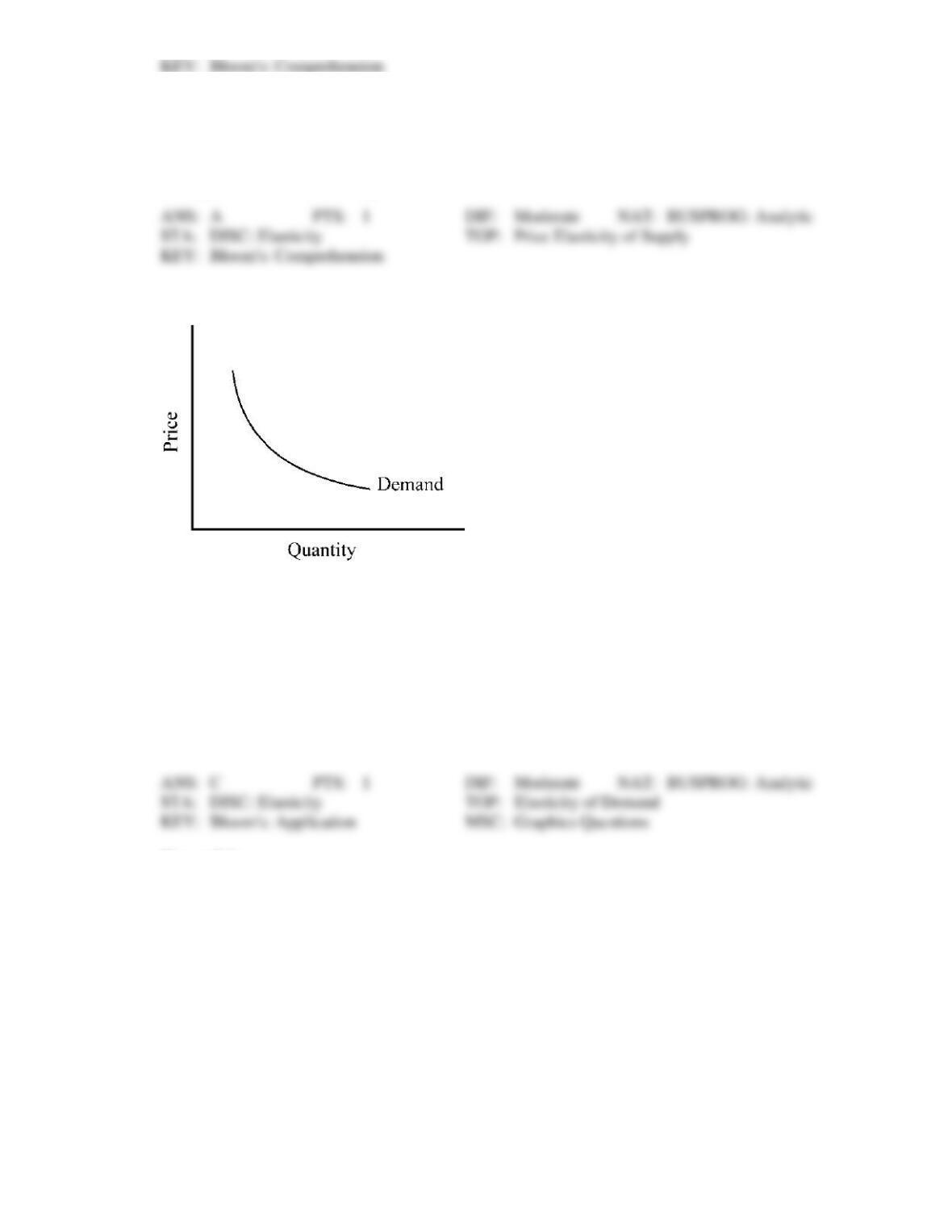
Figure 7-1
151. Figure 7-1 depicts a demand curve with a price elasticity that is
a.
perfectly elastic, implying that consumers will purchase as much as can be supplied at the
market price.
b.
relatively inelastic, implying that a percent increase in price results in a smaller percent
reduction in sales.
c.
unitary, implying that a percent change in price leads to an equal percent change in
quantity demanded.
d.
perfectly inelastic, implying that the same amount will be purchased regardless of the
price of the good.
Figure 7-2
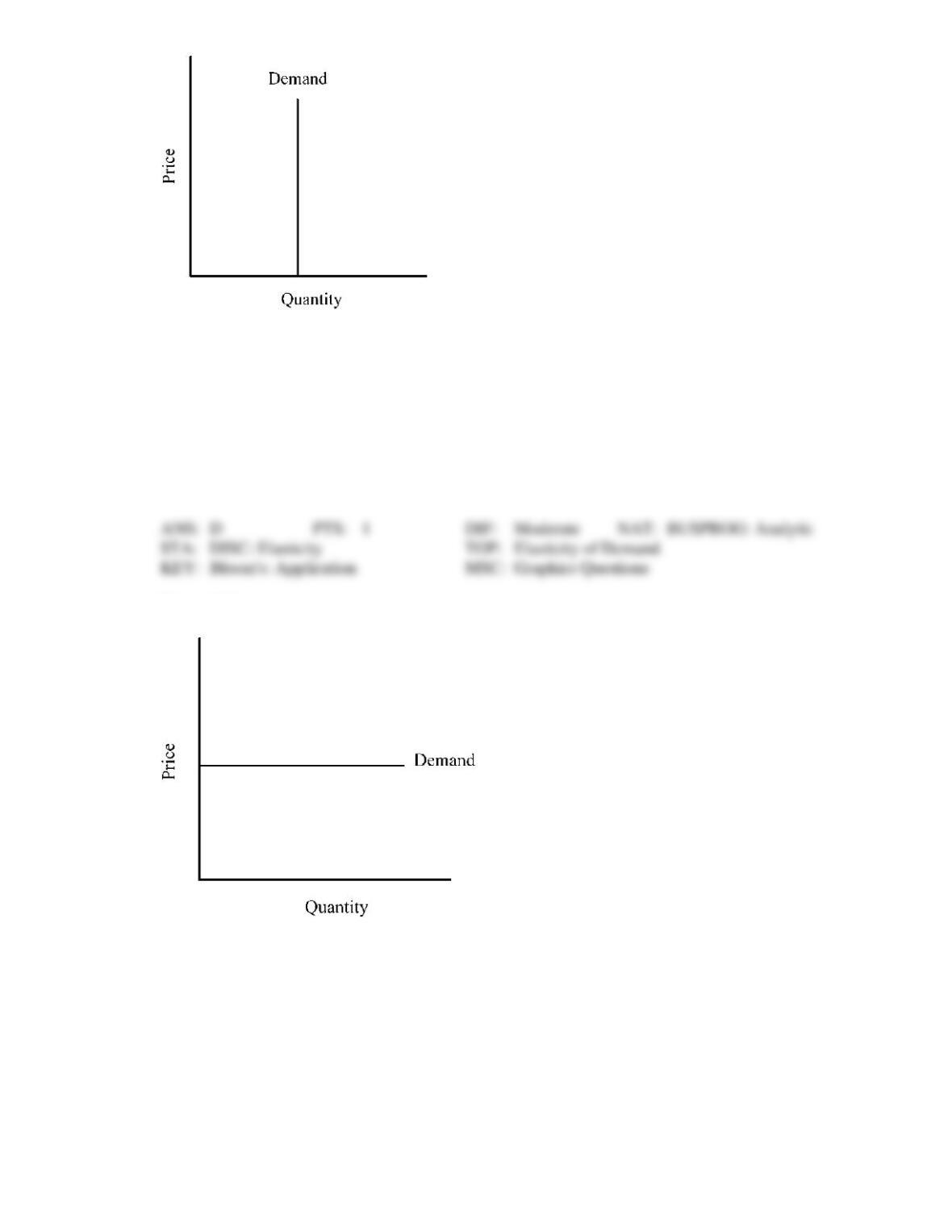
152. Figure 7-2 depicts a demand curve with a price elasticity that is
a.
perfectly elastic, implying that as much as can be supplied will be purchased at the market
price.
b.
relatively inelastic, implying that a percent increase in price results in a smaller percent
reduction in sales.
c.
unitary, implying that a percent change in price leads to an equal percent change in
quantity demanded.
d.
perfectly inelastic, implying that the same amount will be purchased regardless of the
price of the good.
Figure 7-3
153. Figure 7-3 depicts a demand curve with a price elasticity that is
a.
perfectly elastic, implying that consumers will purchase as much as can be supplied at the
market price.
b.
relatively inelastic, implying that a percent increase in price results in a smaller percent
reduction in sales.
c.
unitary, implying that a percent change in price leads to an equal percent change in
quantity demanded.
d.
perfectly inelastic, implying that the same amount will be purchased regardless of the
price of the good.
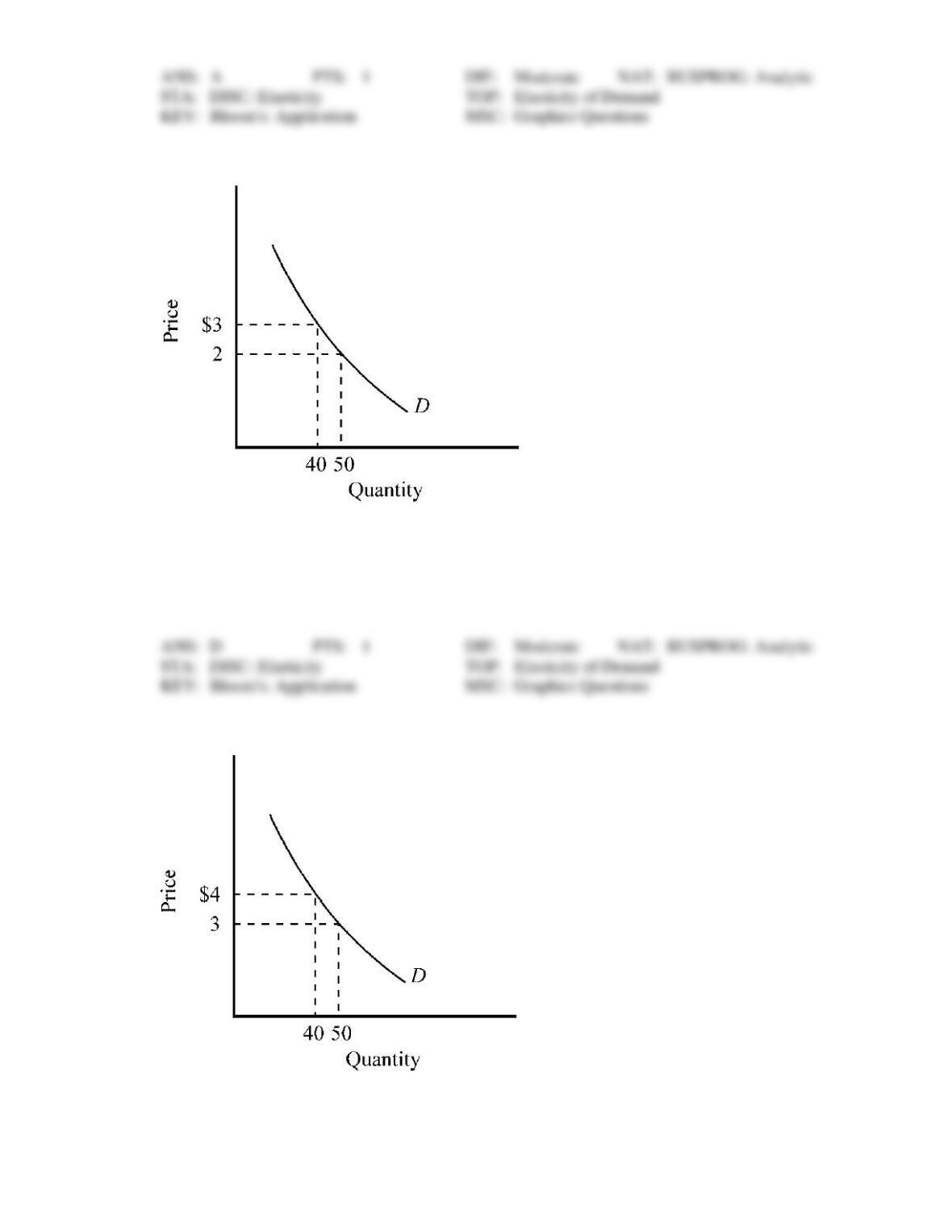
Figure 7-4
154. Which of the following is true for the demand curve depicted in Figure 7–4?
a.
An increase in price from $2 to $3 will reduce total expenditures on the product.
b.
In the $2 to $3 range, the price elasticity of the demand curve is approximately unitary.
c.
At a price of $2, the price elasticity of the demand curve equals approximately −2.5.
d.
In the $2 to $3 range, the demand curve is inelastic.
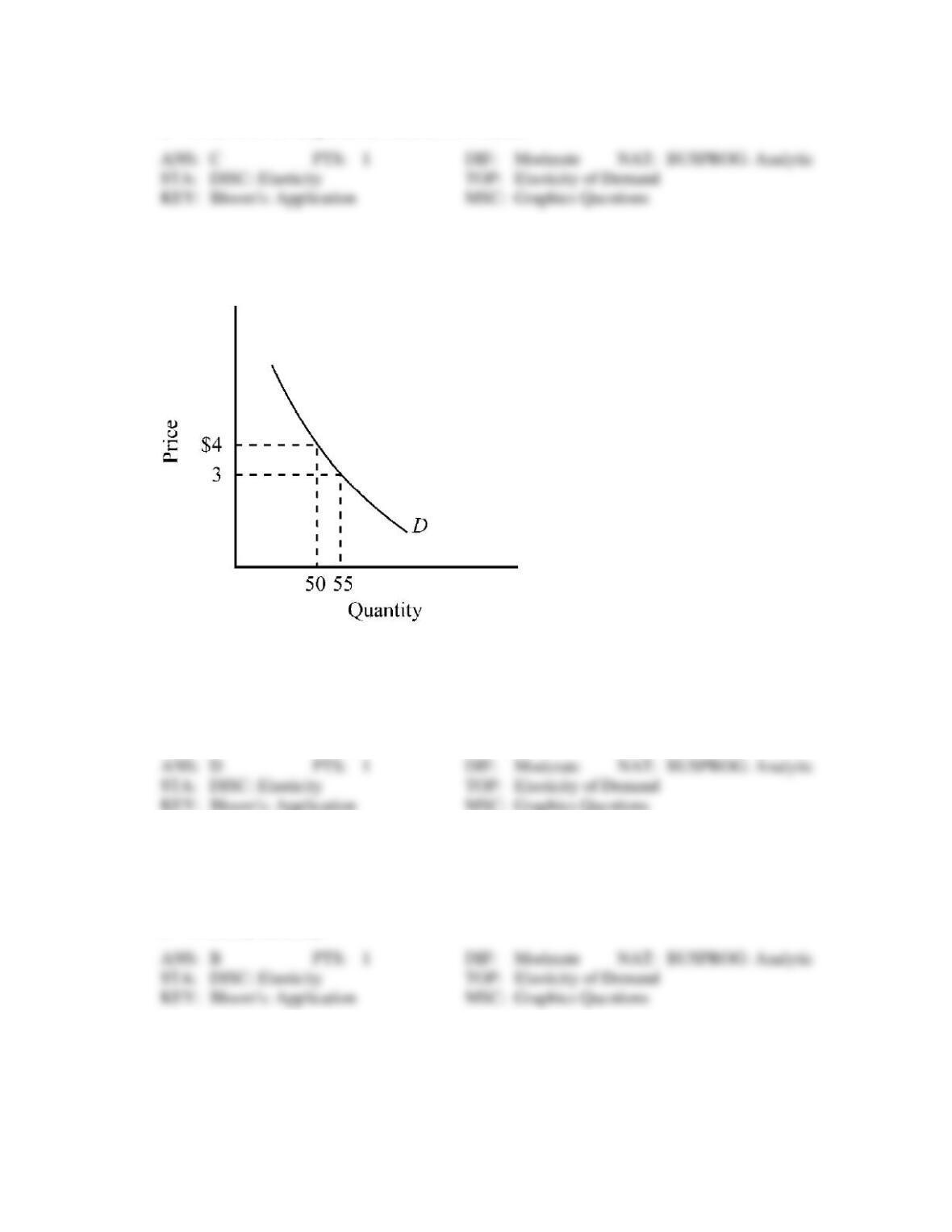
Figure 7-5
155. Which of the following is true for the demand curve depicted in Figure 7–5?
a.
In the $3 to $4 range, the price elasticity of the demand curve equals 1.
b.
At a price of $3, the price elasticity of the demand curve equals approximately −3.3.
c.
In the $3 to $4 range, the demand curve is inelastic.
d.
In the $3 to $4 range, the demand curve is elastic.
Use the figure below to answer the following question(s).
Figure 7-6
156. Between $3 and $4, the price elasticity of the demand curve depicted in Figure 7-6 is
a.
relatively inelastic.
b.
approximately equal to −0.33.
c.
approximately equal to −3.
d.
both a and b.
157. In the price range between $3 and $4, the price elasticity of the demand curve depicted in Figure 7-6 is
a.
highly elastic.
b.
approximately equal to −0.33.
c.
approximately equal to −3.
d.
of unitary elasticity.
Figure 7-7
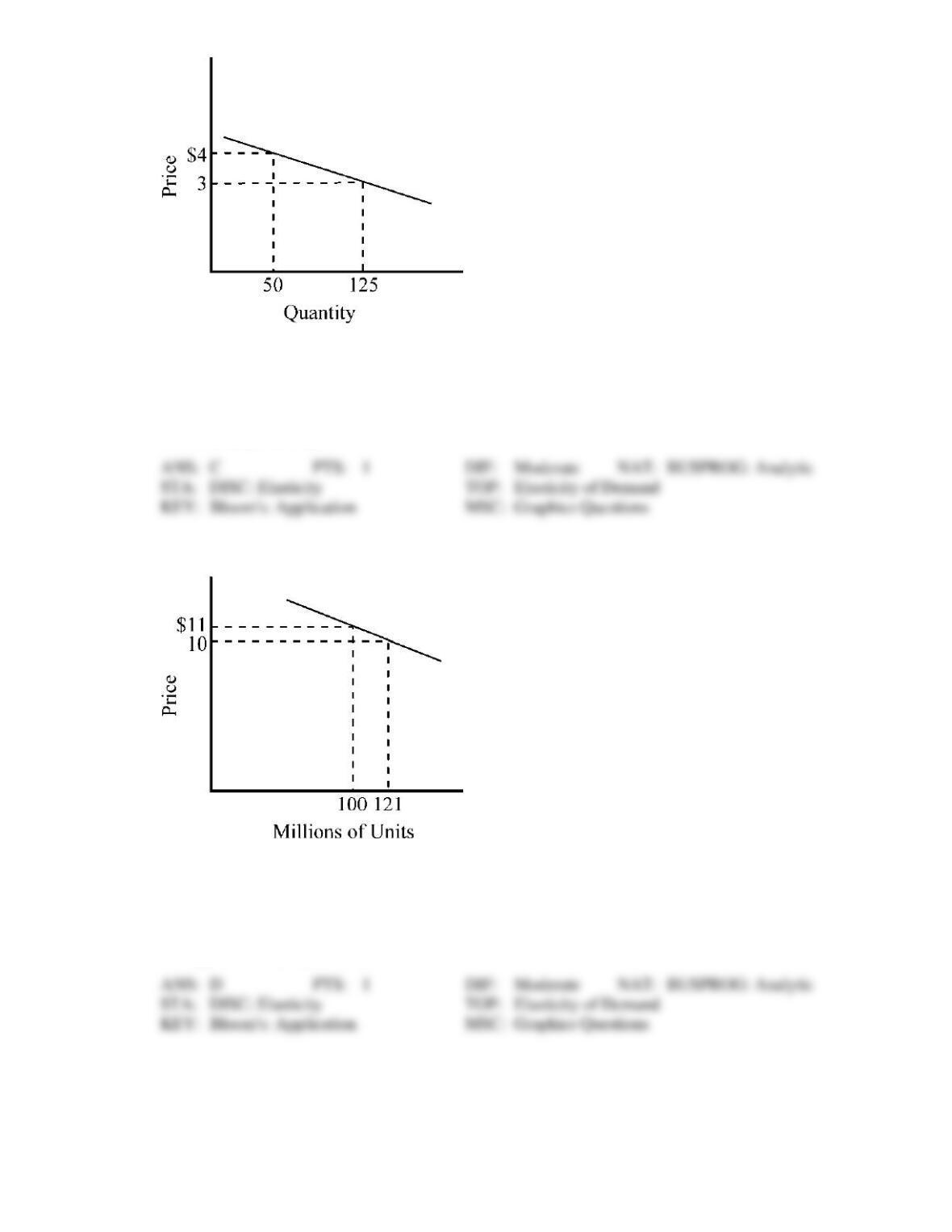
158. In the price range between $3 and $4, the price elasticity of the demand curve depicted in Figure 7-7 is
a.
highly elastic.
b.
approximately equal to −0.33.
c.
approximately equal to −3.
d.
of unitary elasticity.
Figure 7-8
159. For a price increase from $10 to $11, the price elasticity of the demand curve depicted in Figure 7-8 is
a.
highly inelastic.
b.
relatively inelastic.
c.
approximately equal to −1.
d.
approximately equal to −2.
Figure 7-9
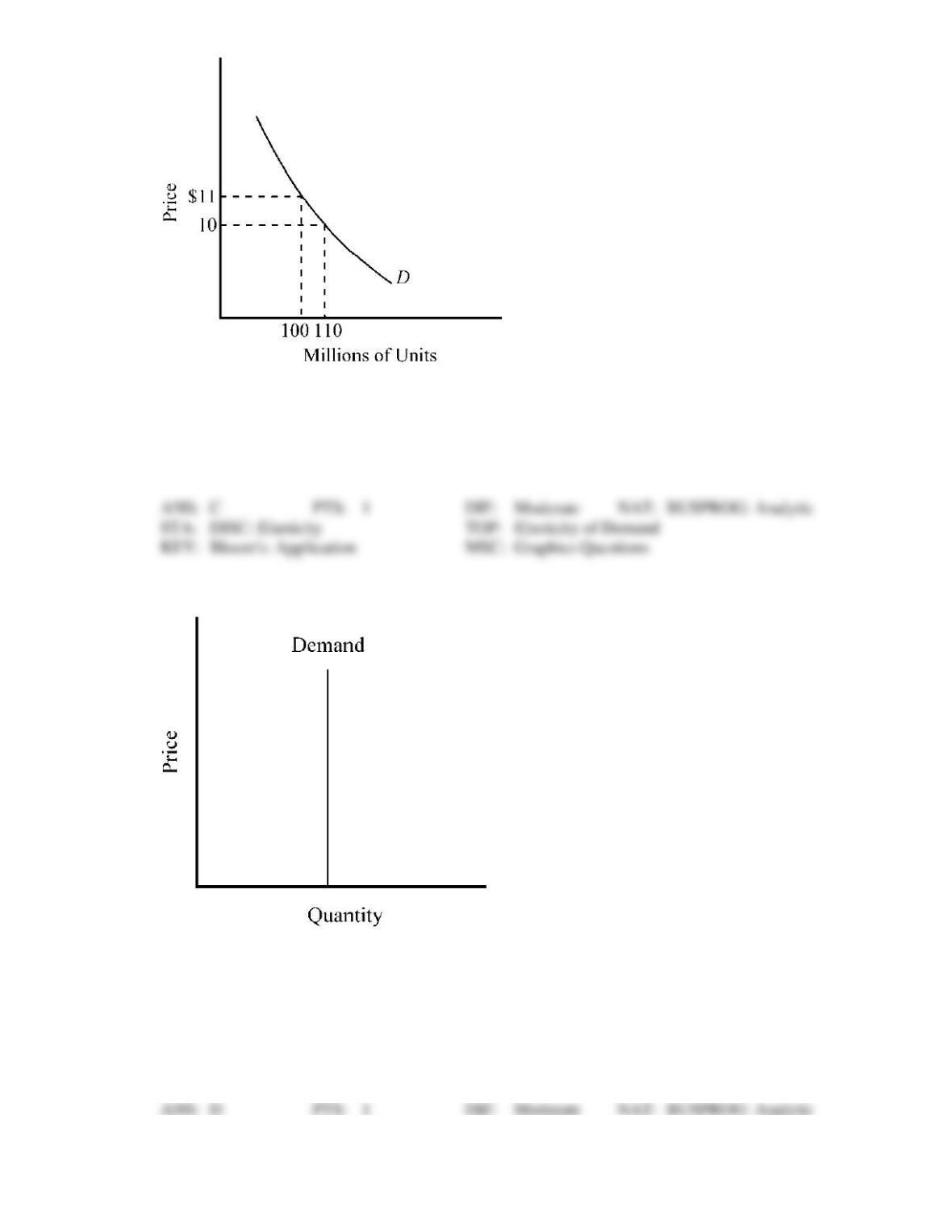
160. At a price of $10, the price elasticity of the demand curve depicted in Figure 7-9 is
a.
positive.
b.
approximately equal to −0.1.
c.
approximately equal to −1.
d.
approximately equal to −2.
Figure 7-10
161. Figure 7-10 depicts a demand curve with a price elasticity that is
a.
unitary, implying that a percent change in price leads to an equal percent change in
quantity demanded.
b.
perfectly inelastic, implying that the same amount will be purchased regardless of the
price of the good.
c.
equal to zero.
d.
both b and c.