C.
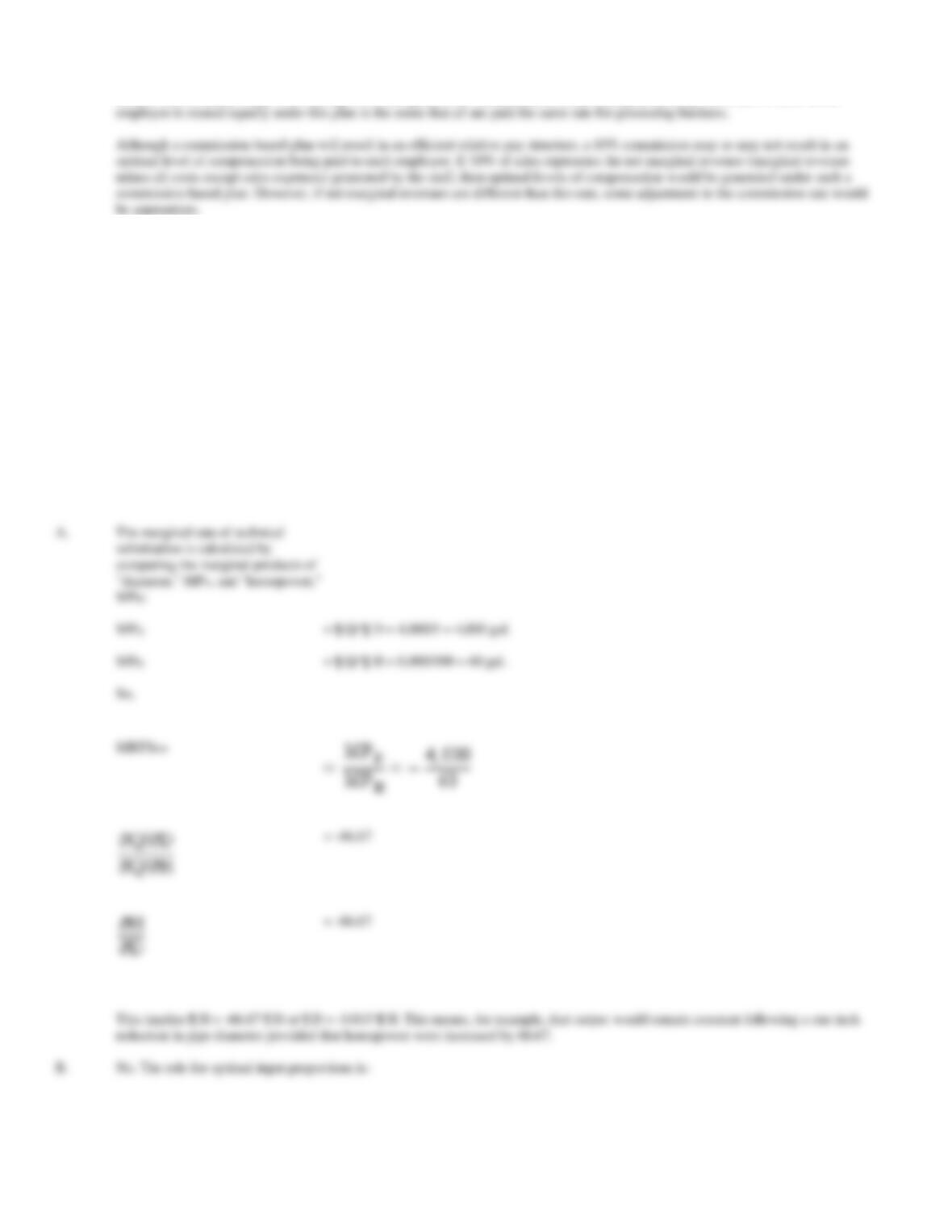
The commission-based compensation plan will result in more efficient compensation for sales personnel. Under this plan, Brisco, Van
Buren’s staff attorney salary costs average 10%, irrespective of which member of the staff generates a given dollar of sales. Each
38. Optimal Input Mix. Hydraulics Ltd. has designed a pipeline that provides a throughput of 70,000 gallons
of water per 24-hour period. If the diameter of the pipeline were increased by 1 inch, throughput would increase
by 4,000 gallons per day. Alternatively, throughput could be increased by 6,000 gallons per day using the
original pipe diameter with pumps that had 100 more horsepower.
A.
Estimate the marginal rate of technical substitution between pump horsepower and pipe diameter.
B.
Assuming the cost of additional pump size is $600 per horsepower and the cost of larger diameter pipe is $200,000 per inch, does the
original design exhibit the property required for optimal input combinations? If so, why? If not, why not?
commission-based plan. However, if net marginal revenues are different than this rate, some adjustment in the commission rate would
be appropriate.
39. Optimal Input Mix. Electron Specialties, Inc. has designed an electric feeder cable that provides a
throughput of 2,000 ampere hours (aH) per 24-hour period. If the diameter of the cable were increased by 1/2
inch, throughput would increase by 500 aH per day. Alternatively, throughput could be increased by 1,000 aH
per day using the original cable diameter with an additional 100 mf of capacitance electronics designed by the
firm.
A.
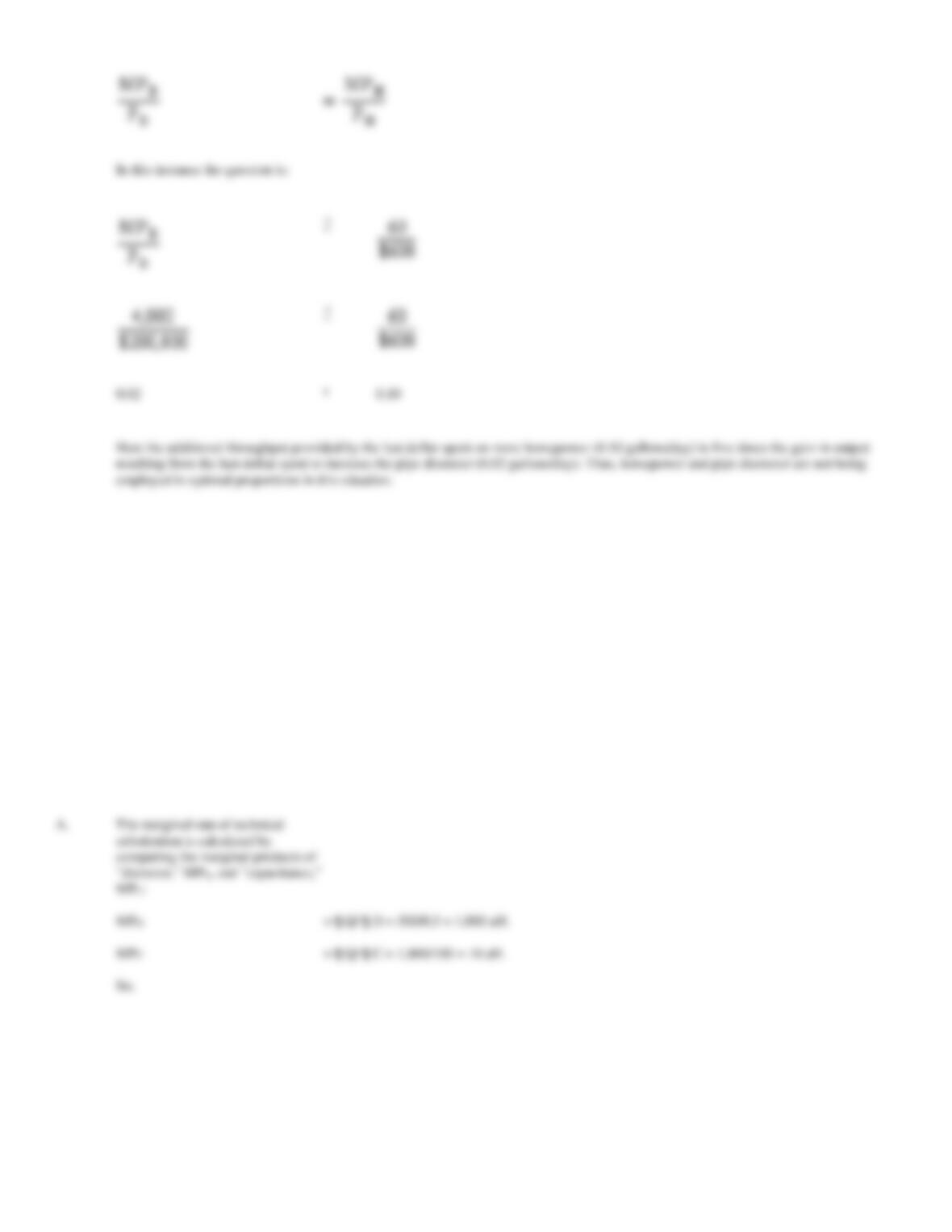
Estimate the marginal rate of technical substitution between capacitance electronics and cable diameter.
B.
Assuming the cost of additional capacitance electronics is $50 per mf and the cost of larger diameter cable is $20,000 per 1/2 inch, does
the original design exhibit the property required for optimal input combinations? If so, why? If not, why not?
So,
In this instance the question is:
0.02
¹
0.10
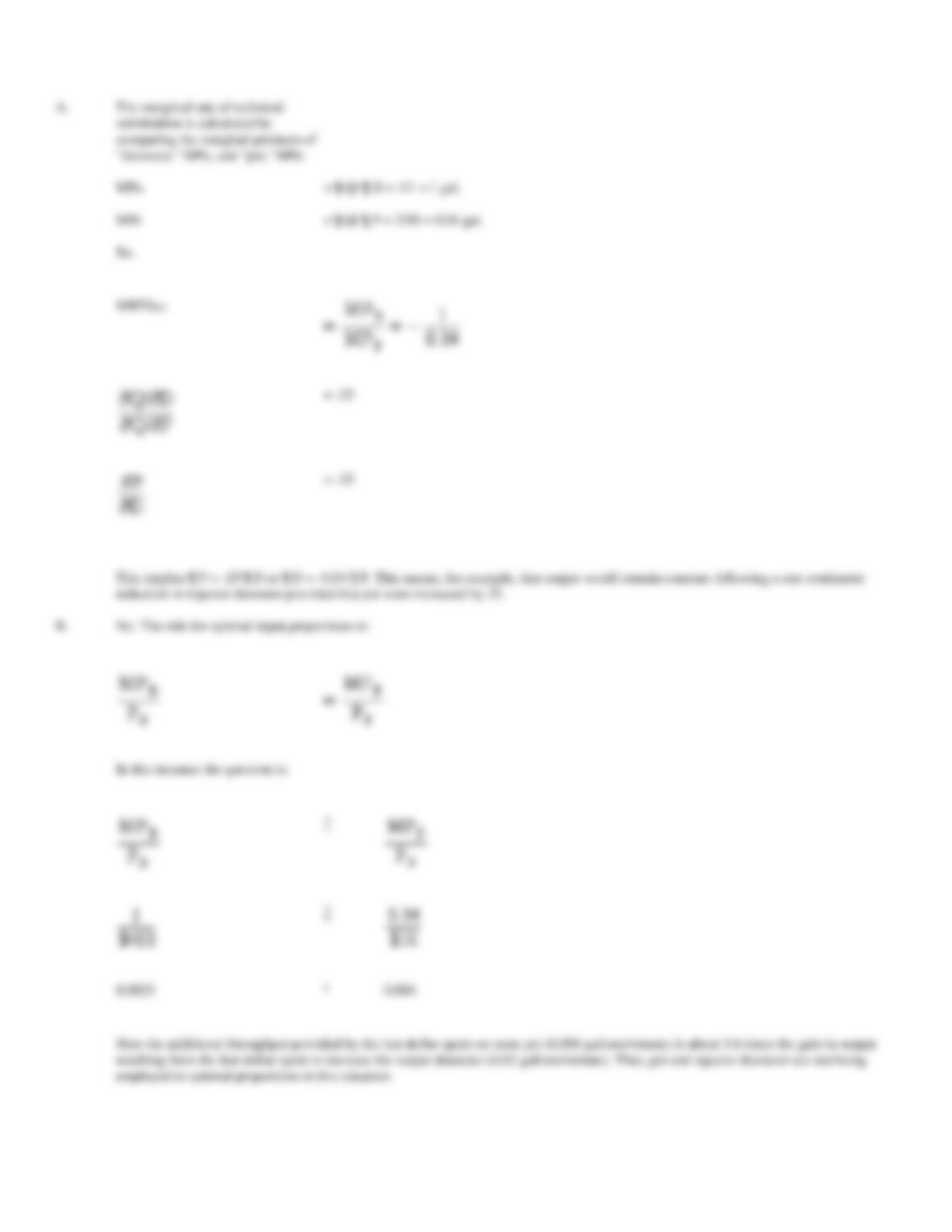
40. Optimal Input Mix. Boch, Ltd., has designed a fuel injector for oil fired generators that provides a
throughput of 3 gallons of oil per minute. If the diameter of the industrial injector nozzle were increased by 1
centimeter, throughput would increase 1 gallon per minute. Alternatively, throughput could be increased by 2
gallons per minute using the original injector diameter with fuel pumps that had 50 more pounds of pressure
(psi).
A.
Estimate the marginal rate of technical substitution between pump psi and injector diameter.
B.
Assuming the cost of additional fuel pump size is $10 per psi (due to changing of the pump and fuel supply peripheral), and the cost of
larger diameter fuel injector is $400 per centimeter (due to machining of combustion units), does the original design exhibit the property
required for optimal input combinations? If so, why? If not, why not?
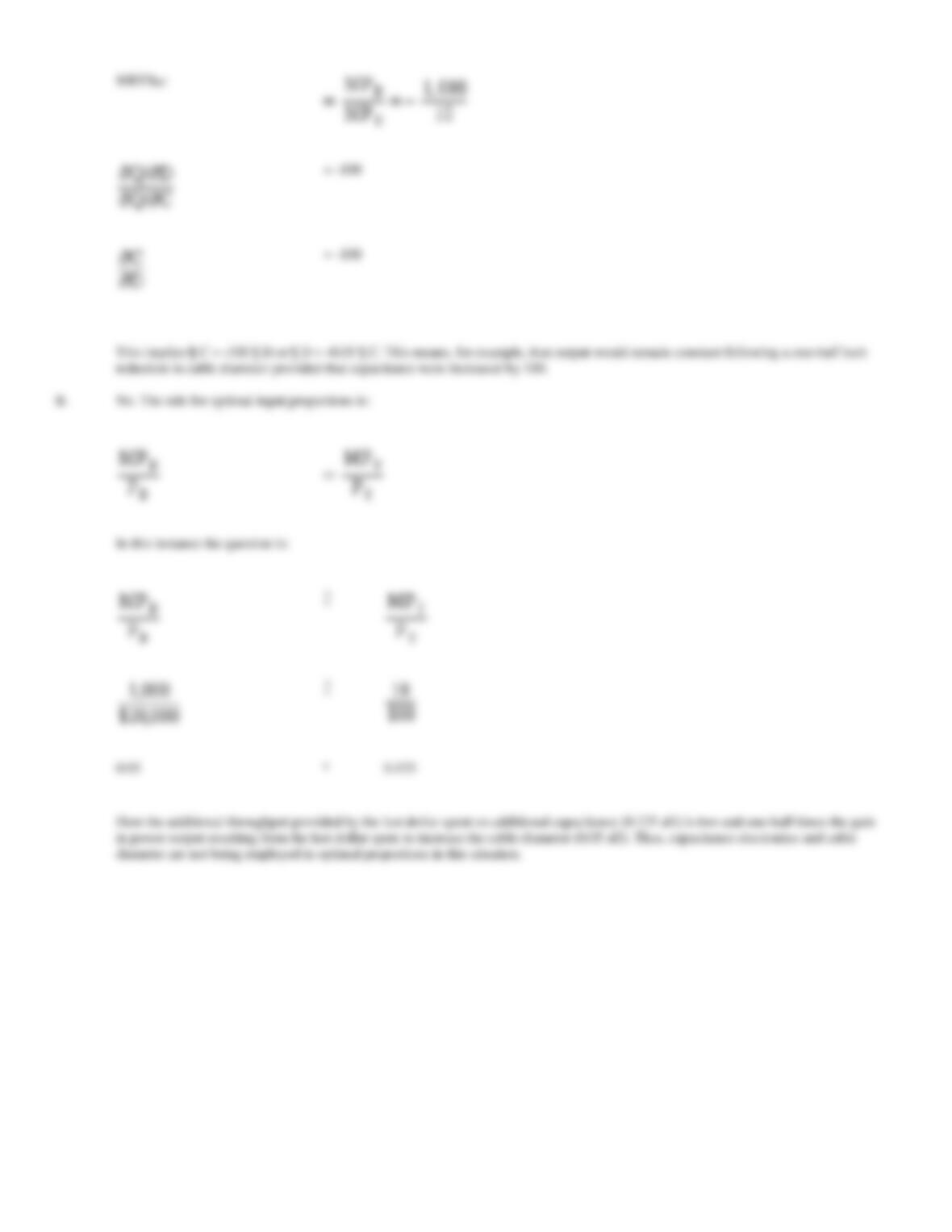
No. The rule for optimal input proportions is:
0.05
¹
0.125
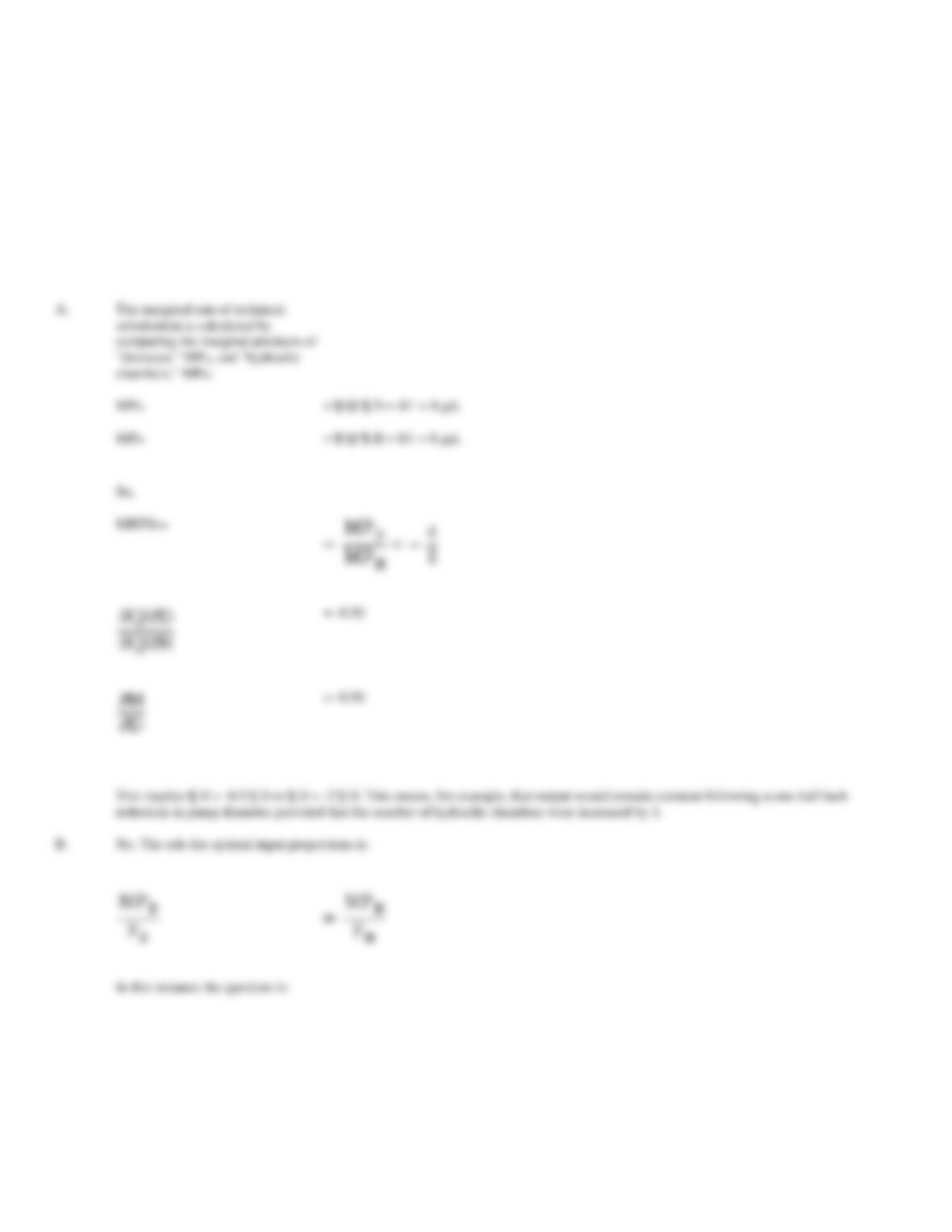
41. Optimal Input Mix. Third World Solutions, Inc., has designed a manual water pump that attains a flow rate
of 5 gallons per minute using 1 manpower. If the diameter of the pump were increased by 1 inch, throughput
would increase 4 gallons per minute. Alternatively, throughput could be increased by an additional 8 gallons per
minute using the original pump diameter with one hydraulic chamber.
A.
Estimate the marginal rate of technical substitution between hydraulic chambers and pump diameter.
B.
Assuming the cost of additional hydraulic chamber size is $5 per chamber and the cost of a larger pump diameter is $2.50 per inch, does
the original design exhibit the property required for optimal input combinations? If so, why? If not, why not?
So,
No. The rule for optimal input proportions is:
In this instance the question is:
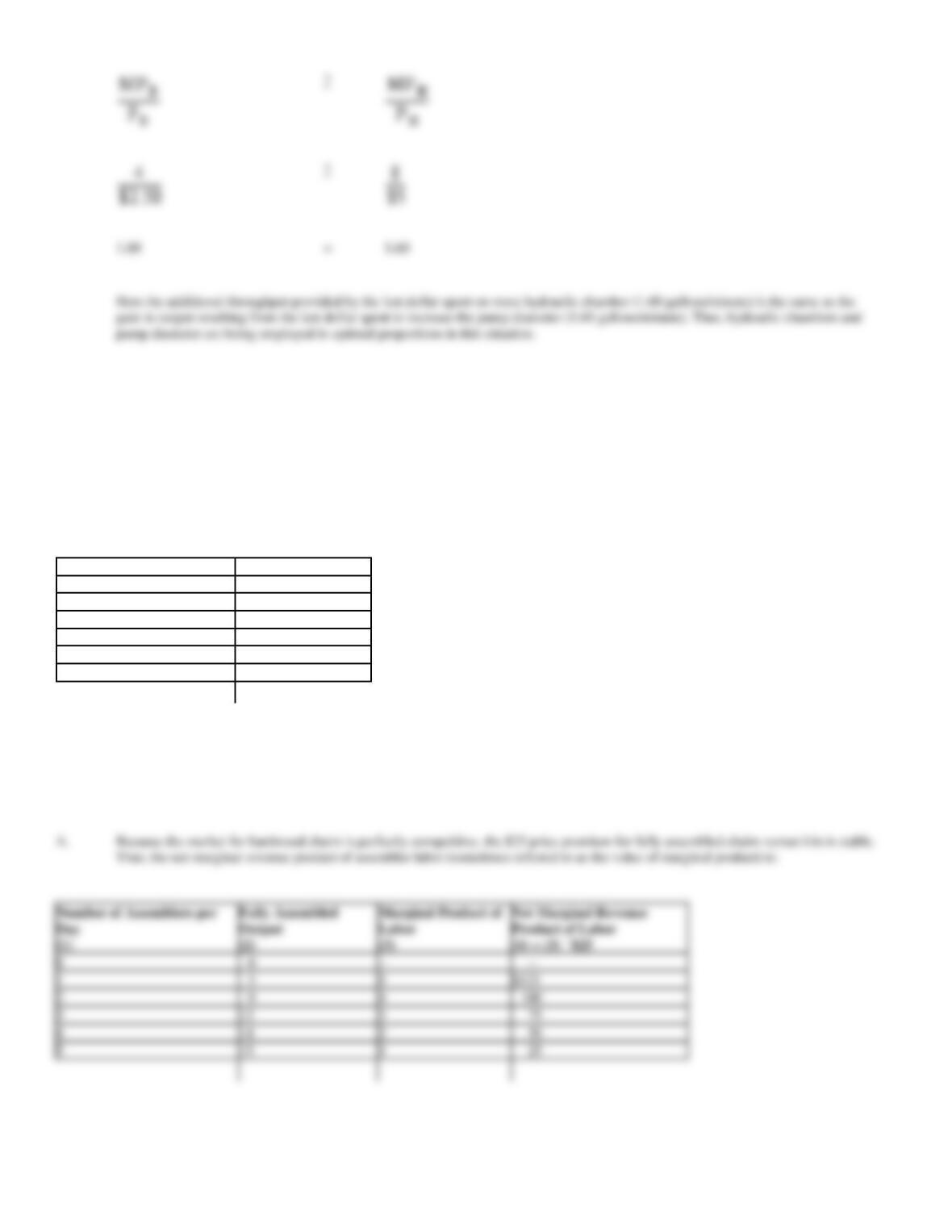
42. Optimal Input Level. U-Do-It Furniture, Inc., sells hardwood chairs, in both kits and fully assembled
forms. Customers who assemble their own chairs benefit from the lower kit price of $35 per chair.
“Full-service” customers enjoy the luxury of an assembled chair, but pay a higher price of $60 per chair. Both
kit and fully assembled chair prices are stable. The company has observed the following relation between the
number of assembly workers employed per day and assembled chair output:
Number of Workers per day
Finished Chairs
0
0
1
5
2
9
3
12
4
14
5
15
A.
Construct a table showing the net marginal revenue product derived from assembly worker employment.
B.
How many assemblers would U-Do-It Furniture employ at a daily wage rate of $75?
C.
What is the highest daily wage rate U-Do-It Furniture would pay to hire four assemblers per day?
0
0
—
1
5
5
$125
2
9
4
100
3
12
3
75
4
14
2
50
5
15
1
25
1.60
=
1.60
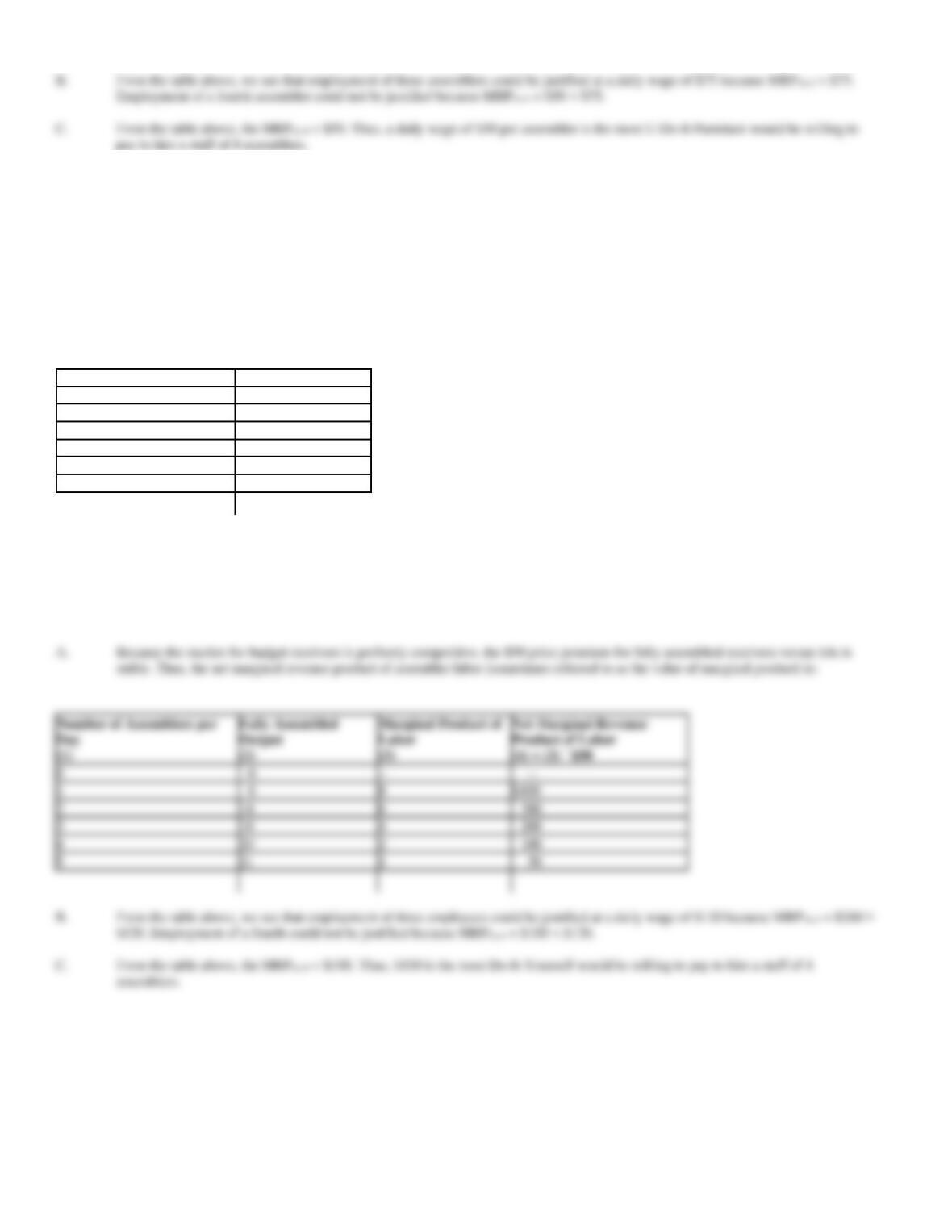
43. Optimal Input Level. Do-It-Yourself, Inc., sells budget-priced stereo receivers, in both kit and
fully-assembled forms. Customers who assemble their own receivers benefit from the lower kit price of $100
per receiver. “Full-service” customers enjoy the luxury of an assembled receiver, but pay a higher price of $150
per receiver. Both kit and fully assembled receiver prices are stable. The company has observed the following
relation between the numbers of assembly workers employed per day and assembled receiver output:
Number of Workers per day
Finished Receivers
0
0
1
8
2
14
3
18
4
20
5
21
A.
Construct a table showing the net marginal revenue product derived from assembly worker employment.
B.
How many assemblers would Do-It-Yourself employ at a daily wage rate of $120?
C.
What is the highest daily wage rate Do-It-Yourself would pay to hire four assemblers per day?
0
0
—
1
8
8
$400
2
14
6
300
3
18
4
200
4
20
2
100
5
21
1
50
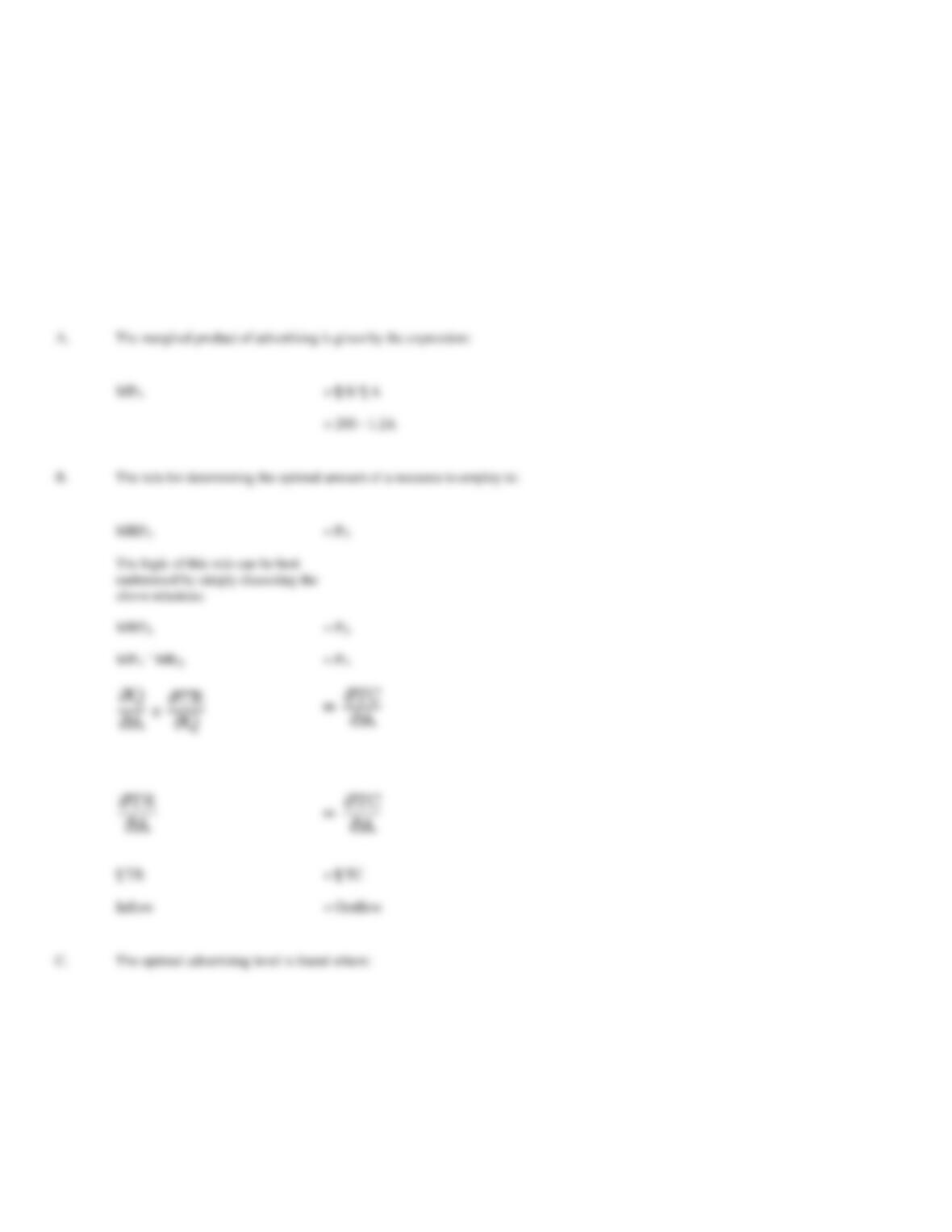
44. Optimal Input Level. Just Bikes, Inc., sells tricycles, in partially-assembled and fully assembled forms.
Parents who assemble their own tricycles benefit from the lower price of $40 per tricycle. “Full-service”
customers enjoy the luxury of an assembled tricycle, but pay a higher price of $60 per tricycle. Both partially
and fully assembled tricycle prices are stable. The company has observed the following relation between the
number of assembly workers employed per day and assembled tricycle output:
Number of Workers per day
Finished Tricycles
0
0
1
8
2
14
3
18
4
21
5
23
A.
Construct a table showing the net marginal revenue product derived from assembly worker employment.
B.
How many assemblers would Just Bikes employ at a daily wage rate of $100?
C.
What is the highest daily wage rate Just Bikes would pay to hire three assemblers per day?
45. Nonprice Competition. Tickets, Inc., uses mall intercept promotion services to promote concerts and
sporting events. The St. Louis firm uses a team of ten students to hand-deliver flyers at shopping malls and
other high traffic centers, where every hour increment of flyer advertising costs $130. Over the past year, the
following relation between advertising and ticket sales per event has been observed:
Sales (units) = 7,000 + 200A – 0.6A2
and
¶ Sales/ ¶ A = 200 – 1.2A
0
0
—
1
8
8
$160
2
8
6
120
3
14
4
80
4
20
3
60
5
23
2
40
Here A represents one hour of flyer distribution, and sales are measured in numbers of tickets. Niki Martin, manager for the St. Louis firm, has been
asked to recommend an appropriate level of advertising. In thinking about this problem, Martin noted its resemblance to the optimal resource
employment problem she had studied in a managerial economics course that was part of her MBA program. The advertising-sales relation could be
thought of as a production function with advertising as an input and sales as the output. The problem is to determine the profit-maximizing level of
employment for the input, advertising, in this “production” system. Martin recognized that to solve the problem she needed a measure of output
value. After consultation with associates, she determined that the value of output is $2 per ticket, the net marginal revenue earned (price minus all
marginal costs except flyer advertising).
A.
Continuing with Martin’s production analogy, what is the “marginal product” of advertising?
B.
What is the rule for determining the optimal amount of a resource to employ in a production system? Explain the logic underlying this
rule.
C.
Using the rule for optimal resource employment, determine the profit-maximizing number of flyer distribution hours.
A.
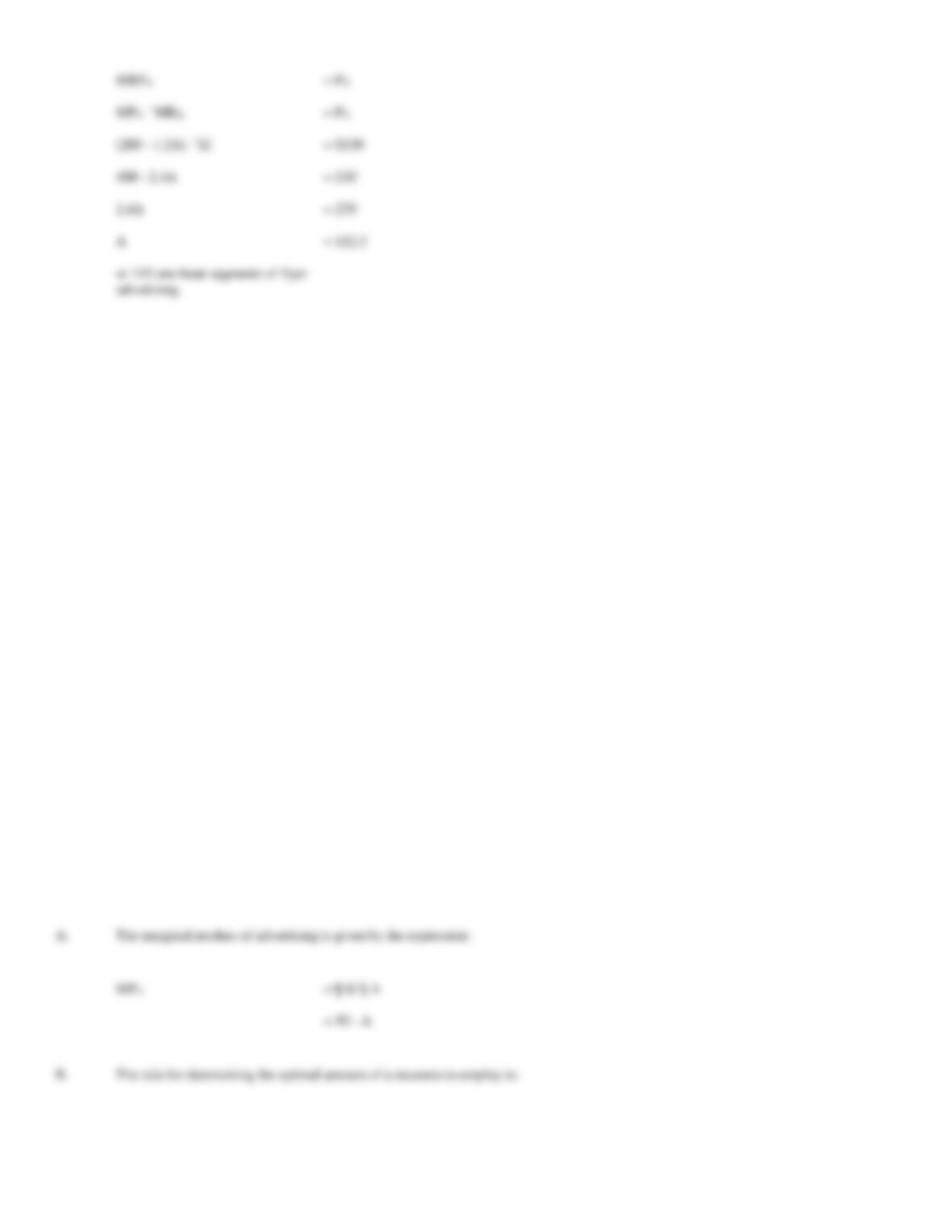
The marginal product of advertising is given by the expression:
= 200 – 1.2A
B.
The rule for determining the optimal amount of a resource to employ is:
= PA
= PA
¶ TR
Inflow
= Outflow
C.
The optimal advertising level is found where:
46. Nonprice Competition. Top Gun Marketing, Inc., offers overhead banner fly-by promotion services using
their Cessna aircraft and banner creation facilities. The Padres Island firm specializes in restaurant promotion
via fly-bys at outdoor events and other high traffic centers, where each 10 minute increment of advertising costs
$300. Over the past year, the following relation between fly-by advertising and incremental restaurant guests
per month has been observed:
Sales (units) = 5,200 + 50A – 0.5A2
and
¶ Sales/ ¶ A = 50 – A
Here A represents a 10-minute fly-by advertisement, and sales are measured in numbers of restaurant guests.
Pete Mitchel, manager for the Padres Island firm, has been asked to recommend an appropriate level of advertising. In thinking about this problem,
Mitchel noted its resemblance to the optimal resource employment problem he had studied in a managerial economics course that was part of his
MBA program. The advertising-sales relation could be thought of as a production function with advertising as an input and sales as the output. The
problem is to determine the profit-maximizing level of employment for the input, advertising, in this “production” system. Mitchel recognized that to
solve the problem he needed a measure of output value. After consultation with the restaurant, he determined that the value of output is $10 per guest,
the net marginal revenue earned by the client (price minus all marginal costs except fly-by advertising).
A.
Continuing with Mitchel’s production analogy, what is the “marginal product” of advertising?
B.
What is the rule for determining the optimal amount of a resource to employ in a production system? Explain the logic underlying this
rule.
C.
Using the rule for optimal resource employment, determine the profit-maximizing number of 10-minute ads.
The marginal product of advertising is given by the expression:
= 50 – A
B.
The rule for determining the optimal amount of a resource to employ is:
= PA
= PA
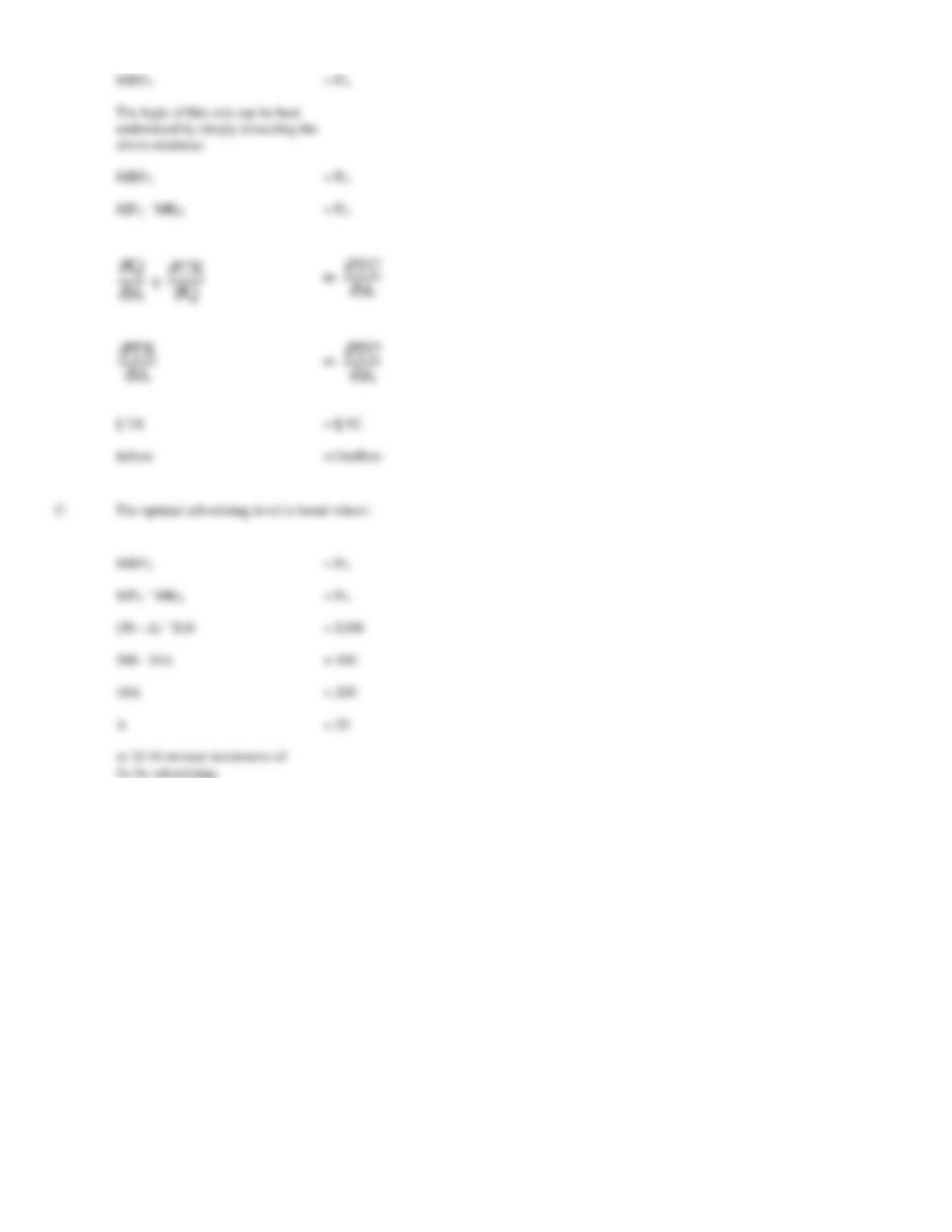
(200 – 1.2A) ´ $2
= $130
400 – 2.4A
= 130
2.4A
= 270
A
= 112.5
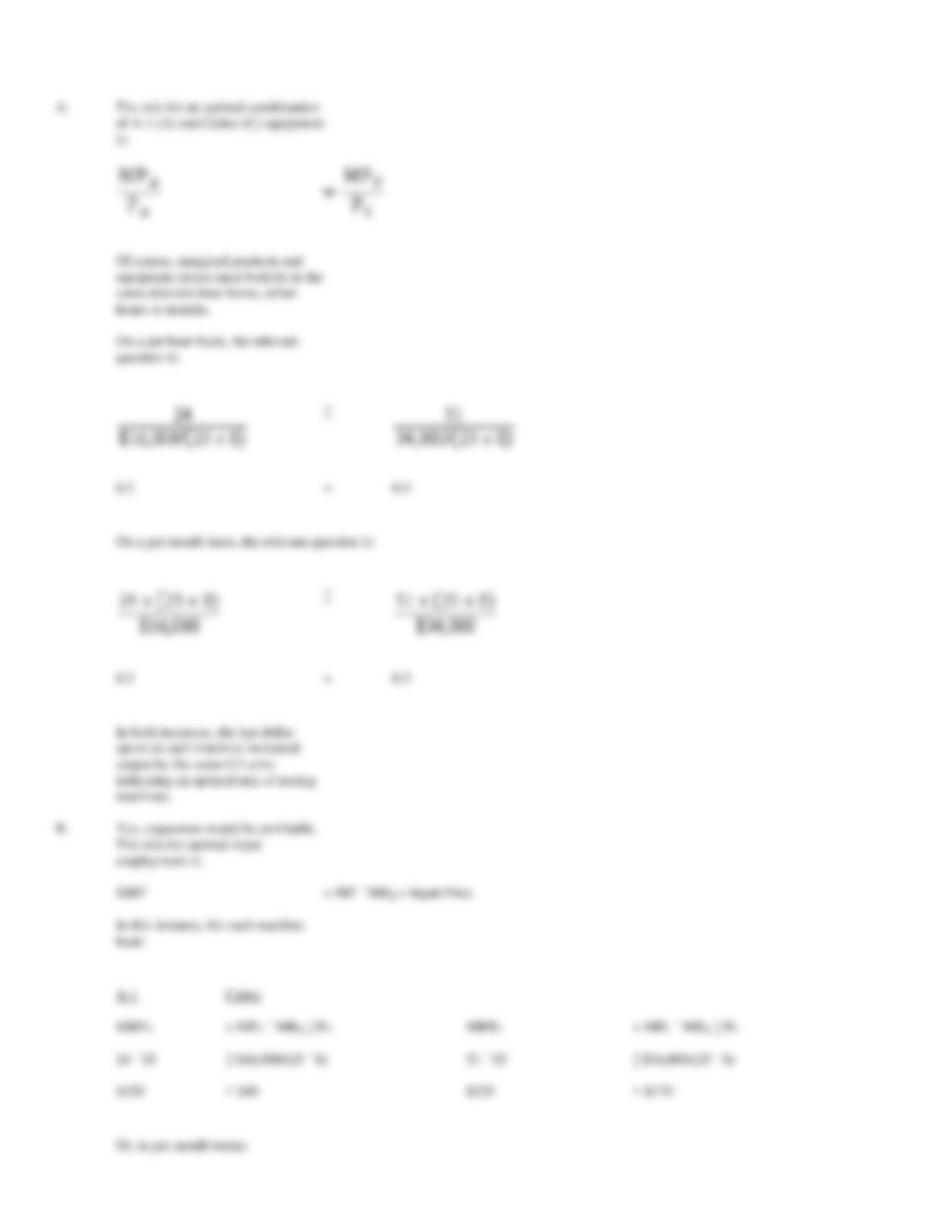
47. Optimal Input Level. Laboratory Testing, Inc., provides routine drug tests for employers in the Los
Angeles metropolitan area. Tests are supervised by skilled technicians using equipment produced by two
leading competitors in the medical equipment industry. Records for the current year show an average of 24 tests
per hour performed on the A-1, and 51 tests per hour on a new machine, the Caltec. The A-1 is leased for
$16,000 per month, and the Caltec is leased at a rate of $34,000 per month. On average, each machine is
operated 25 eight-hour days per month. Labor and all other costs are fixed.
A.
Does company usage reflect an optimal mix of testing equipment?
B.
At a price of $5 per test should the company lease more machines?
= PA
= PA
= PA
¶ TR
C.
The optimal advertising level is found where:
= PA
= PA
(50 – A) ´ $10
= $300
500 – 10A
= 300
= 200
A
= 20
48. Optimal Input Level. Smokey’s Garage, Inc., provides routine auto diagnostics for customers in the
Atlanta, Georgia, metropolitan area. Tests are supervised by skilled mechanics using equipment produced by
two leading competitors in the auto test equipment industry. Records for the current year show an average of 4
tests per hour performed on the Sunny Tune System (STS), and 6 tests per hour on a new machine, the Car Care
Tower (CCT). The STS is leased for $8,000 per month, and the CCT is leased at a rate of $12,000 per month.
On average, each machine is operated 25 eight-hour days per month. Labor and all other costs are fixed.
A.
Does company usage reflect an optimal mix of testing equipment?
B.
At a price of $15 per test should the company lease more machines?
Of course, marginal products and equipment prices must both be in the same relevant time frame, either hours or months.
On a per hour basis, the relevant question is:
0.1
=
0.1
? PA
? PC
? $16,000
? $34,000
$24,000
> $16,000
$51,000
> $34,000
In both cases, we see that each machine returns more than its marginal cost (price), and expansion would be profitable.
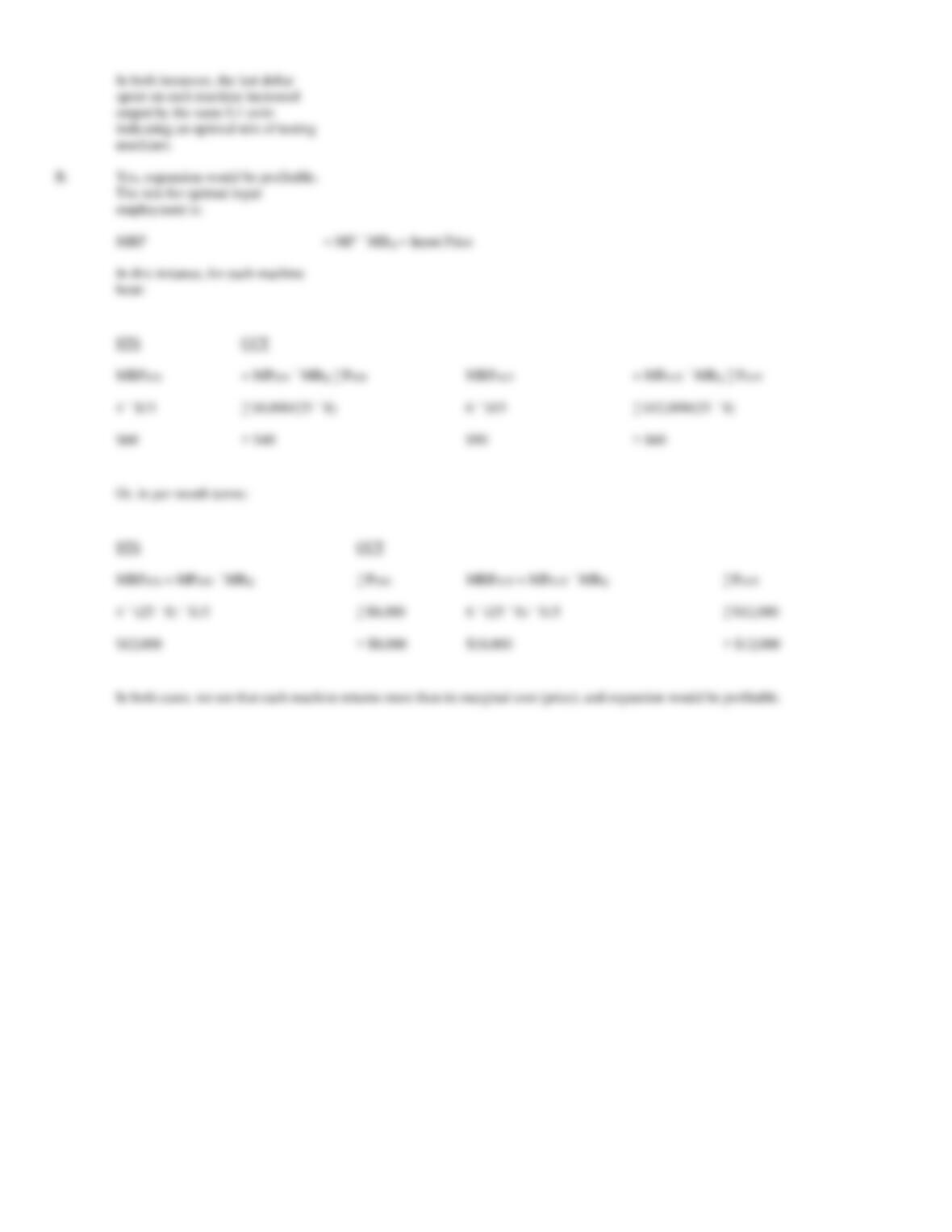
49. Optimal Input Level. Communications Consultant Services, Inc., advises small to medium-sized
businesses on telephone equipment and network configurations. The primary resources CCS employs are skilled
network consultants and computers. Currently, CCS employs 16 consultants at a cost of $70 per hour (wage
plus fringes and variable overhead), and purchases 160 hours of computer time each week at a time-sharing cost
of $280 per hour. Each consultant works a 40-hour week. This level of employment allows CCS to complete
213 communications analyses per week for which the firm receives $300 each.
A.
Assuming that both returns to factors and returns to scale are constant, what are the marginal products for: (1) communication
consultants and, (2) computer time (up to the full capacity level)?
B.
Is CCS employing labor and computers in an optimal ratio, assuming that substitution of the resources is possible? Explain.
C.
Determine the marginal revenue products for consultants and for the computer services employed by CCS. (Assume constant returns to
factors in part A.)
D.
Is CCS employing an optimal (profit-maximizing) quantity of labor and computer time? Explain.
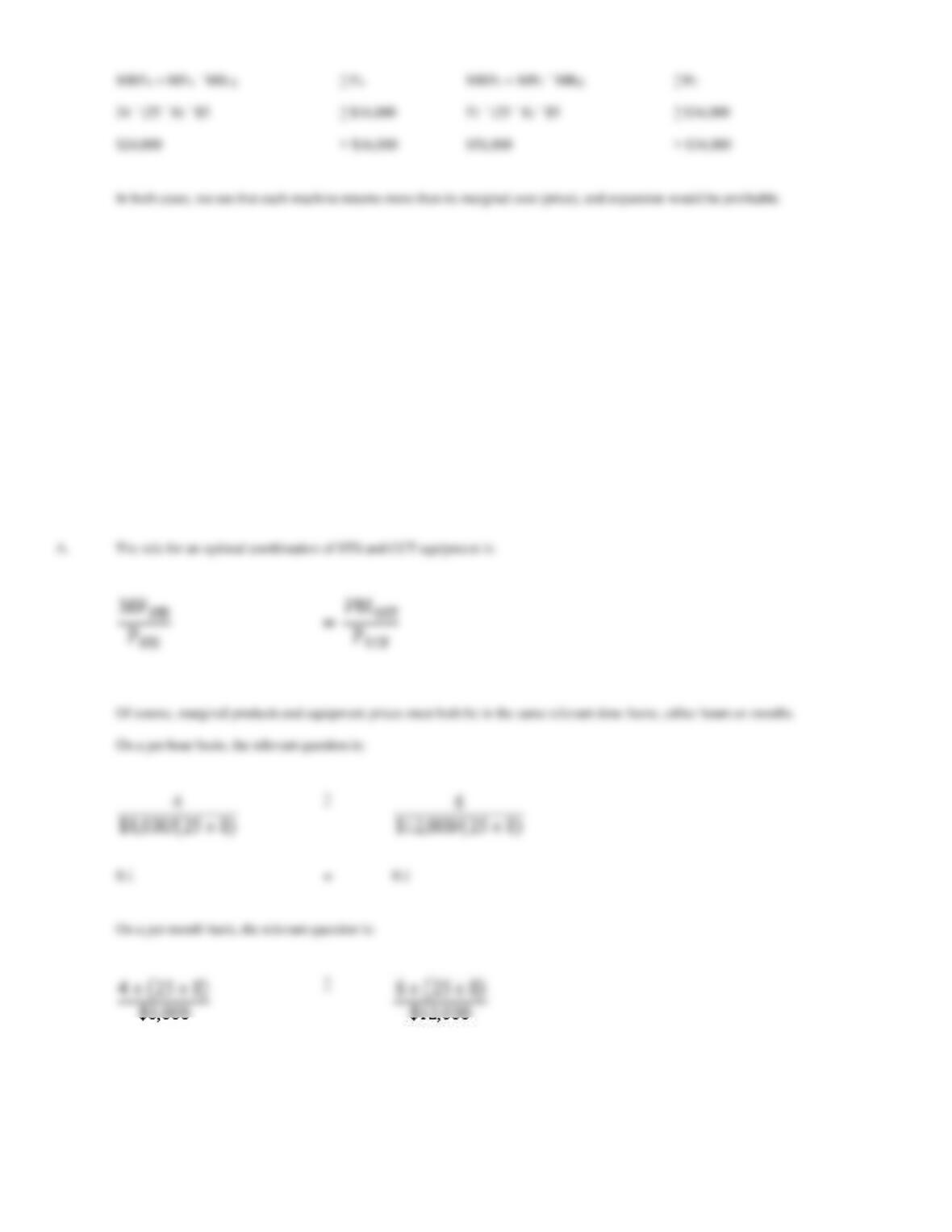
machines.
employment is:
MRP
= MP ´ MRQ = Input Price
In this instance, for each machine
STS
CCT
? $8,000/(25 ´ 8)
? $12,000/(25 ´ 8)
Or, in per month terms:
? PSTS
? PCCT
? $8,000
? $12,000
In both cases, we see that each machine returns more than its marginal cost (price), and expansion would be profitable.
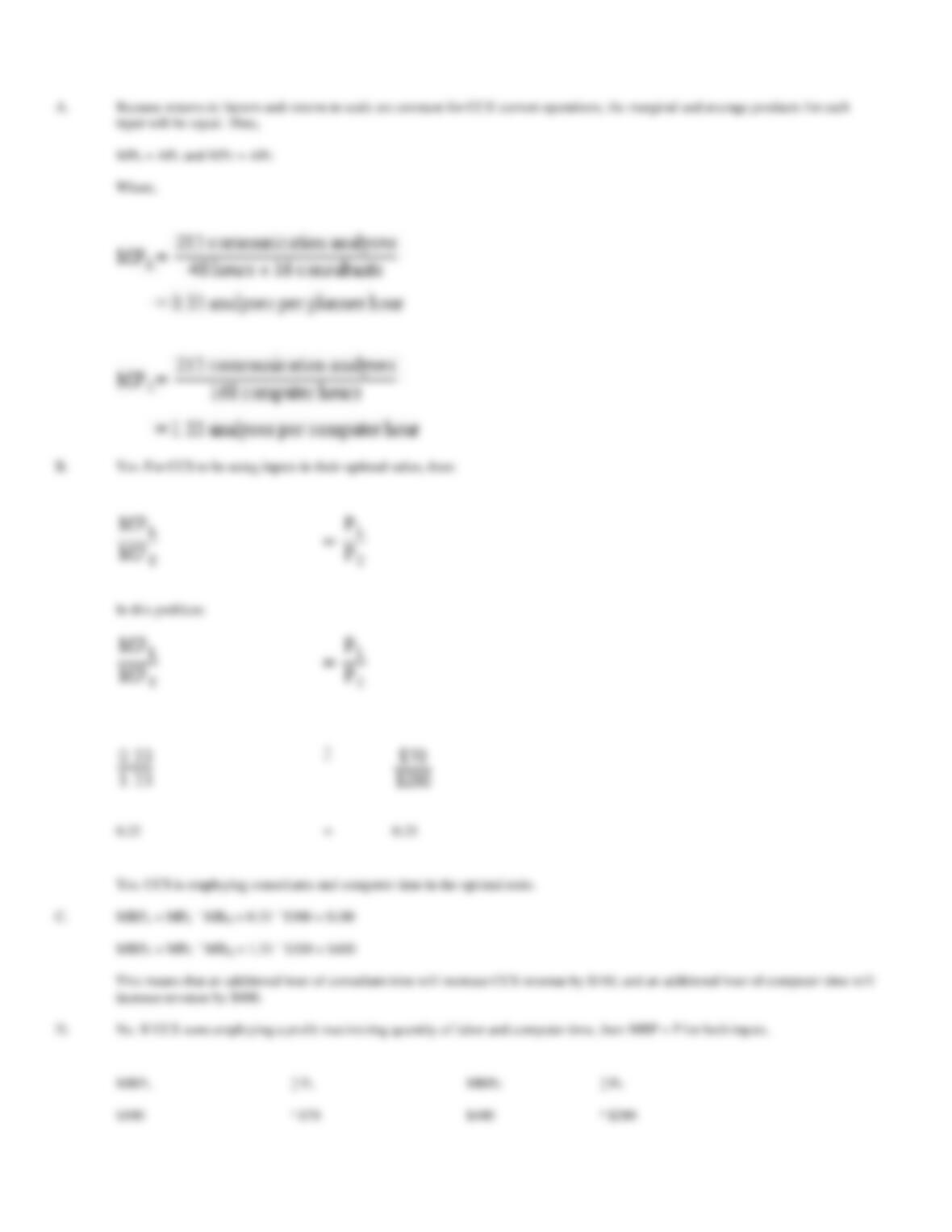
50. Optimal Input Level. Sunshine Pest Control, Inc., provides exterminator services to residences in the
Miami area. The primary resources SPC employs are skilled exterminators and large dome/air pumps used to
cover the homes, pump in insecticide, and minimize leakage to the environment. Currently, SPC employs 10
exterminators at a cost of $15 per hour, employs 2,000 hours of pump time each week at a cost of $3 per hour.
Each exterminator works a 40-hour week. This level of employment allows SPC to complete 100 treatments per
week for which the firm receives $100 each.
A.
Assuming that both returns to factors and returns to scale are constant, what are the marginal products for (1) exterminators and (2)
gallons of chemicals?
B.
Is SPC employing labor and domes in an optimal ratio, assuming that substitution of the resources is possible? Explain.
C.
Determine the marginal revenue products for exterminators and for the domes/pumps employed by SPC. (Assume constant returns to
factors in part A.)
D.
Is SPC employing an optimal (profit-maximizing) quantity of labor and computer time? Explain.
Where,
B.
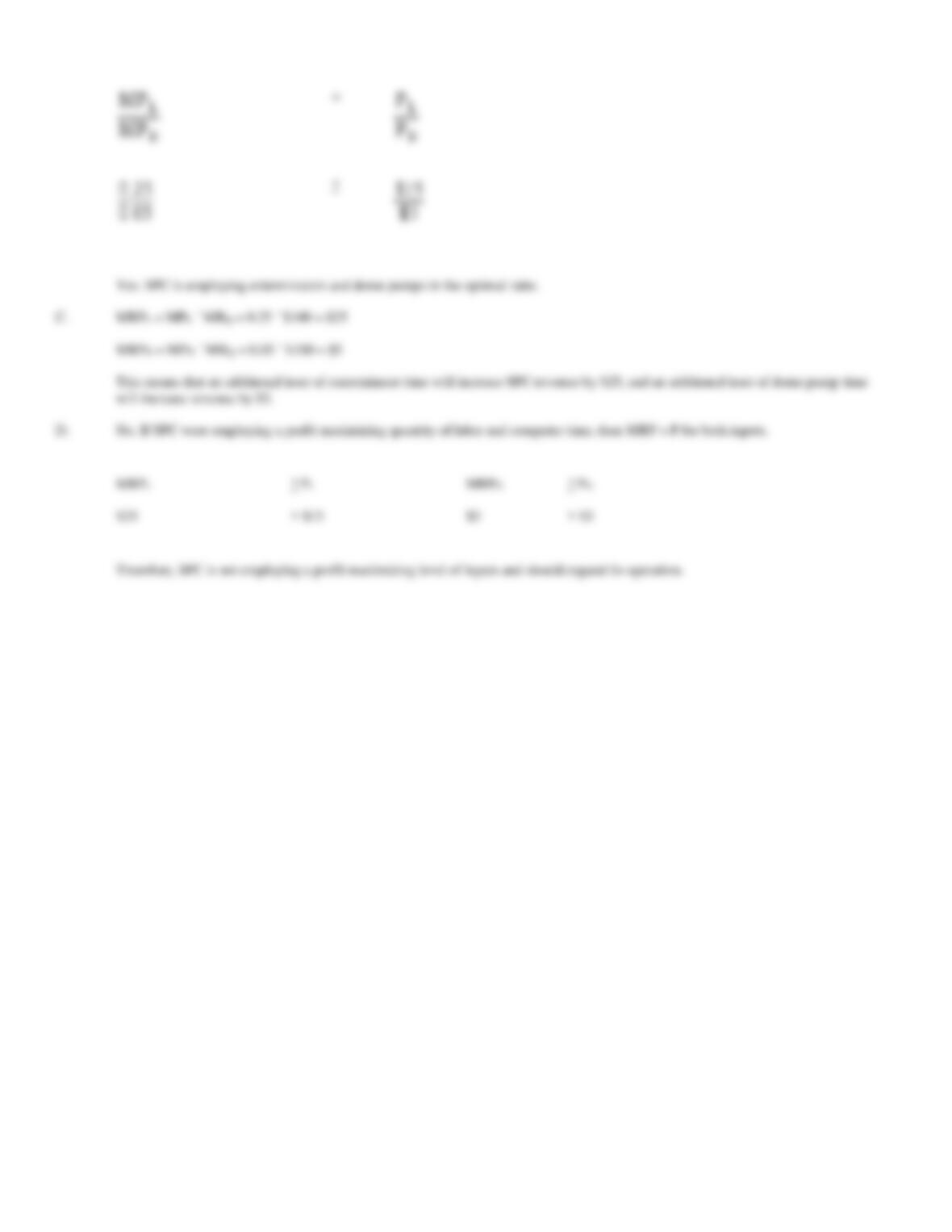
Yes. For SPC to be using inputs in their optimal ratios, then:
In this problem:
Therefore, CCS is not employing a profit maximizing level of inputs and should expand its operation.