53
6) The University of Central Florida (UCF) wanted “to create a town center where students can
live, eat, study and revel in college traditions like football.” In addition, the university needed
funding to build dorms that would house 2000 students. UCF was able to secure financing by
promising to pay a lender a specific amount of money on specific dates. This transaction takes
place in the ________ market for ________ capital.
www.sptimes.com 10/14/2007
A) loan; physical
B) bond; financial
C) stock; financial
D) loan; financial
7) A share of Apple stock has a price of $430 and gives $43 of Apple profit to its owner. The
interest rate on this share is
A) 10 percent.
B) $430.
C) 15.4 percent
D) $43.
8) In 2007, the interest rate banks in France charge each other for loans was 4.86 percent. The
inflation rate in France in 2007 was 2.8 percent. The real interest rate in France is
A) 7.62 percent
B) 2.06 percent.
C) 0.58 percent.

9) In January 2013, you can put your savings in a Bank of America account and be paid 2
percent per year. During 2013, suppose the inflation rate is 3.4 percent. In 2013 you earned a real
interest rate of
A) 0.59 percent.
B) 6.8 percent.
C) 1.4 percent.
D) -1.4 percent.
10) The table below shows data for the United States.
Nominal
Interest Rate
Inflation Rate
2013
5.25
4
2014
5
2
2015
4.5
4.3
Between 2013 and 2014, the real interest rate ________ and caused a ________ the demand for
loanable funds curve.
A) increased; rightward shift
B) decreased; leftward
C) increased; movement upward along
D) decreased; downward along
11) The table below shows data for the U.S.
Nominal
Interest Rate
Inflation Rate
2013
5.25
4
2014
5
2
2015
4.5
4.3
Between 2014 and 2015 the real interest rate ________ and caused a ________ the demand for
loanable funds curve.
A) increased; rightward shift
B) decreased; movement down along
C) increased; movement up along
D) decreased; leftward shift
12) In 2008, the financial and housing crisis caused firms to decrease their profit expectations.
As a result, there was a ________ in the ________ for loanable funds curve.
A) leftward shift; demand
B) movement upward along; demand
C) leftward shift; supply
D) movement downward along; supply
13) In 2010, the United States and foreign economies start to recover from the recession. U.S.
firms increase their profit expectations. As a result, the demand for loanable funds curve shifts
________ and the real interest rate ________.
A) leftward; decreases
B) rightward; decreases
C) leftward; increases
D) rightward; increases
14) In 2008, the many people became unable to make payments on their mortgages and instead
defaulted on them. As a result, the ________ of loanable funds curve shifts ________ and real
interest rate ________.
A) supply; leftward; increases
B) demand; leftward; increases.
C) supply; rightward; falls.
D) demand; rightward; decreases.
15) During the financial crisis in 2007 and 2008, financial institutions believed that default risks
were higher. As a result, there was ________ in the supply of loanable funds and a ________ in
the real interest rate.
A) a decrease; fall
B) an increase; rise
C) an increase; fall
D) a decrease; rise
16) In 2007, Singapore’s government ran a budget surplus of $4.5 billion. The budget surplus
________ loanable funds and ________ the real interest rate.
A) increased the supply of; lowered
B) decreased the demand for; lowered
C) increased the supply of; raised
D) increased the demand for; raised
17) In 2008, Germany had a budget deficit of 37 billion euros. This will budget deficit ________
the supply of loanable funds and ________ the real interest rate.
A) increased; lowered
B) decreased; raised
C) decreased; lowered
D) increased; raised
18) In 2008, Germany had a budget deficit of 37 billion euros. This deficit resulted in
A) a rightward shift of the supply of loanable funds curve.
B) a leftward shift of the demand for loanable funds curve.
C) a crowding out effect in which investment decreases.
D) the Ricardo-Barro effect and an increase in the interest rate.
19) In 2008, Australia had a government budget surplus of $21.7 billion. This budget surplus
shifts the demand for loanable funds curve ________
A) leftward and lowers the real interest rate.
B) leftward and creates a crowding-out effect.
C) rightward and creates a crowding-out effect.
D) rightward and creates a Ricardo-Barro effect.
5 Essay Questions
1) Begin with the formula showing how households can divide their income. Then use this
formula and the expenditure approach to GDP to show how investment is financed from three
sources.
2) What is the approximate relationship among the real interest rate, the inflation rate, and the
nominal interest rate?
3) What is the influence of the expected profit and the real interest rate on the amount of
investment firms make?
4) “An increase in the real interest rate increases the quantity of investment.” Is the previous
statement correct or incorrect?
5) Explain the relationship between the real interest rate and the demand for loanable funds.
Compare that relationship to the relationship between expected profit and the demand for
loanable funds.
6) How does an increase in the expected profit affect investment demand and the demand for
loanable funds curve?
7) What are the factors that change investment demand and shift the demand for loanable funds
curve?
8) How does the real interest affect households’ decisions about saving?
9) How does expected future income affect saving supply?
10) What is the relationship between the real interest rate, the supply of loanable funds and the
demand for loanable funds?
11) Does a change in the real interest rate shift the supply of loanable funds curve? Explain your
answer.
12) What are the factors that change the supply of saving and shift the supply of loanable funds
curve?
13) Explain how each of the following events affect the supply of loanable funds curve:
a) The economy is in a recession so people’s disposable income is lower.
b) The stock market is booming so the people’s wealth is higher.
c) Fewer college graduates are finding jobs so expected future income is lower.
d) The real interest rate increases.
14) “When there is a shortage of loanable funds, the real interest rate will increase.” Explain
whether the previous statement is correct or not.
15) In the loanable funds market, what variable changes to eliminate a shortage of loanable funds
and how is the shortage eliminated?
6 Numeric and Graphing Questions
Real interest
rate
(percent per
year)
Loanable
funds
demanded
(trillions of
2009 dollars)
Loanable
funds
supplied
(trillions of
2009 dollars)
10
0.7
1.5
8
0.9
1.3
6
1.1
1.1
4
1.4
0.9
2
1.7
0.7
1) The table above shows the loanable funds supply and demand schedules.
a) What is the equilibrium real interest rate and the equilibrium quantity of loanable funds?
b) If the real interest rate is 4 percent, is there a shortage or surplus? What will happen in the
market?
7 True or False
1) Expected profit and the real interest rate affect investment decisions.
2) The nominal interest rate is approximately equal to the real interest rate minus the inflation
rate.
3) There is a positive relationship between the demand for loanable funds and the real interest
rate.
4) The real interest rate has a positive relationship with the supply of loanable funds.
5) If Ann’s disposable income increases, her saving decreases.
6) As the purchasing power of wealth increases, saving decreases.
7) The supply of loanable funds curve shifts leftward if the real interest rate rises.
8 Extended Problems
Real interest rate
(percent per year)
Supply of
loanable funds
(2009 dollars)
Demand for
loanable funds
(2009 dollars)
5
2,000
5,000
7
3,000
4,000
9
4,000
3,000
11
5,000
2,000
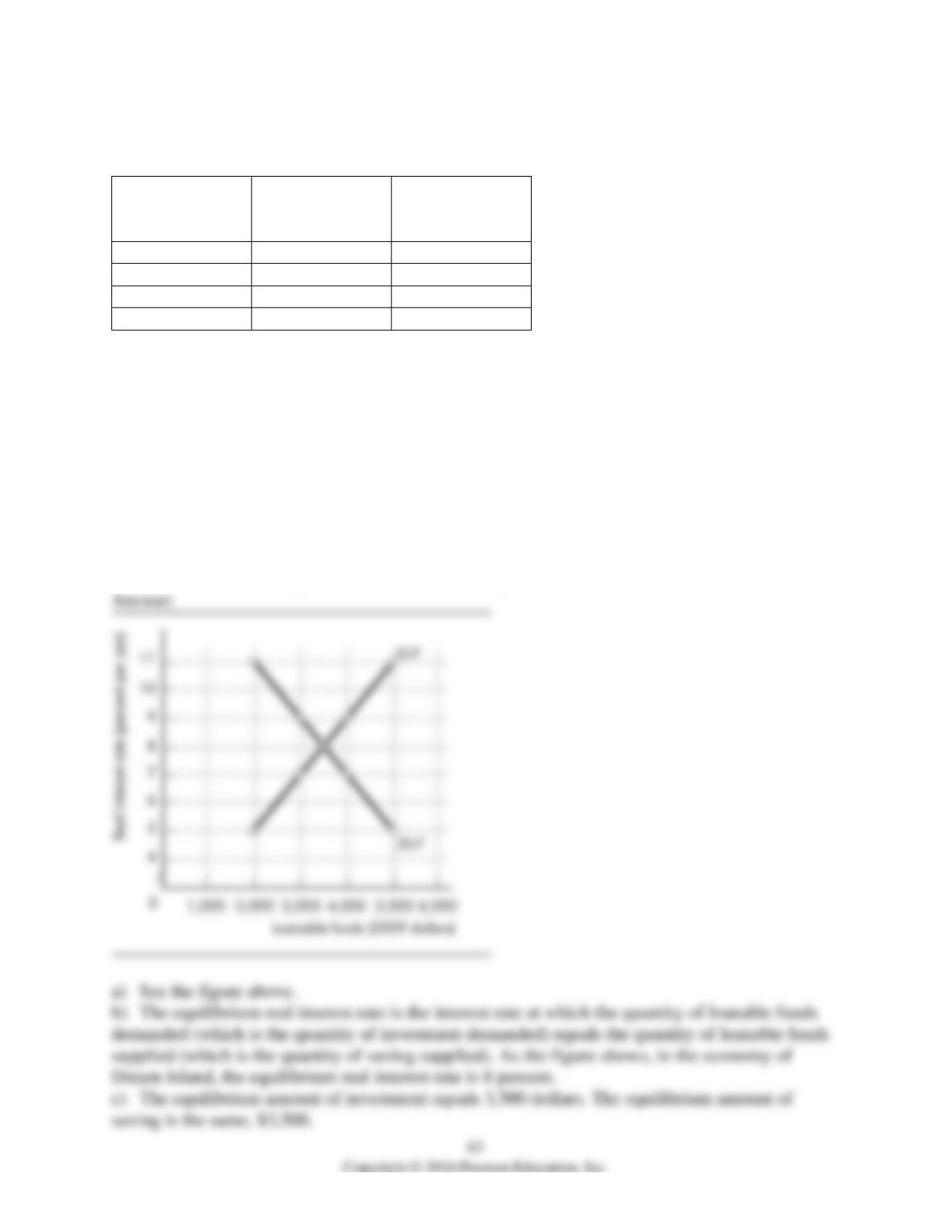
1) The economy of Dream Island, which is isolated from the rest of the world, has the supply of
loanable funds schedule and the demand for loanable funds schedule shown in the table above.
As it happens, all of the supply of loanable funds is from households’ saving and the entre
demand for loanable funds is from firms’ investment demand.
a) Draw the demand and supply curves.
b) What is the equilibrium real interest rate?
c) What is equilibrium investment? Equilibrium saving?
d) Describe the situation in Dream Island’s loanable funds market when the real interest rate is
10 percent. Is there a shortage of loanable funds? A surplus of loanable funds?
e) Describe the situation in Dream Island’s capital market when the real interest rate is 6
percent. Is there a shortage of loanable funds? A surplus of loanable funds?