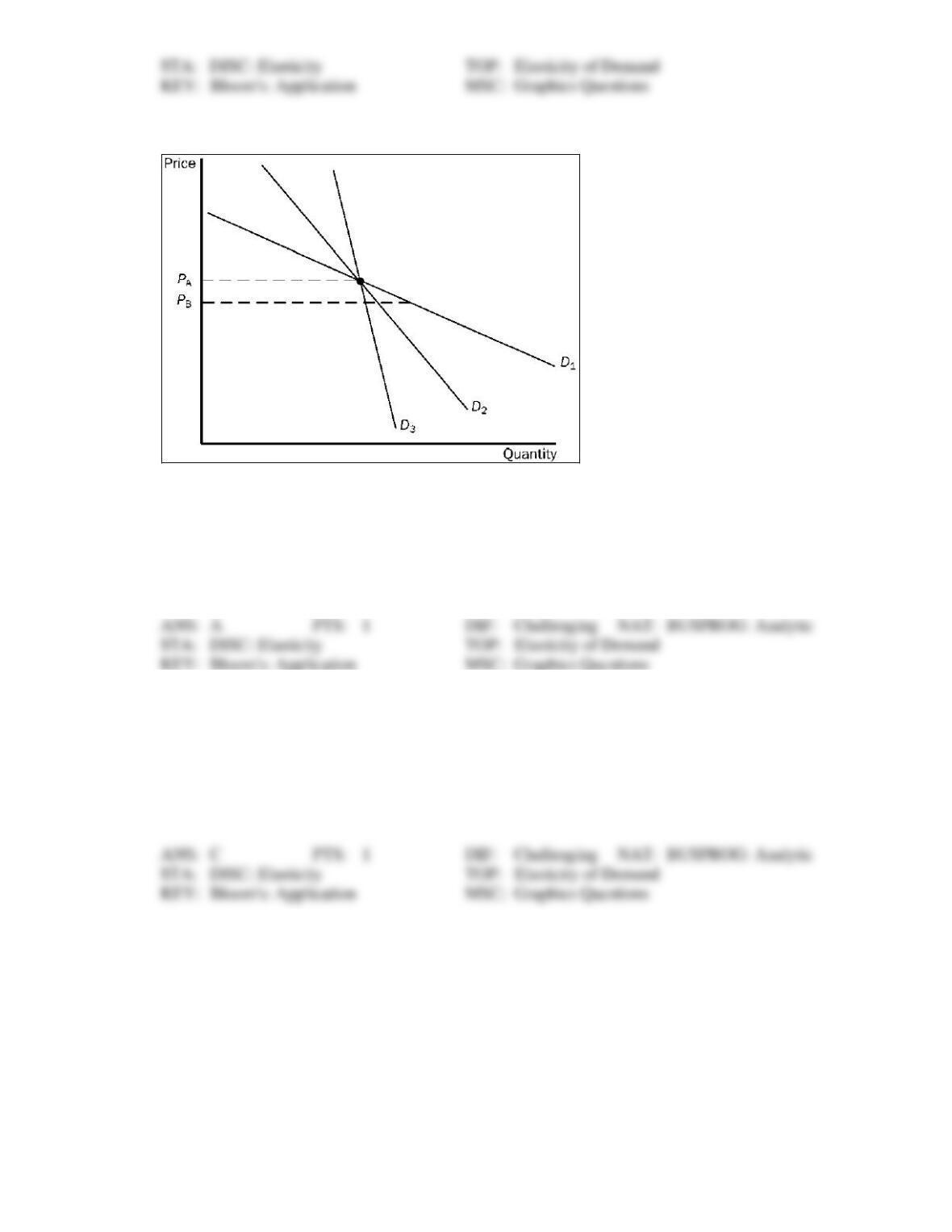
Figure 7-11
162. Refer to Figure 7-11. As price falls from PA to PB, which demand curve represents the most elastic
demand?
a.
D1
b.
D2
c.
D3
d.
All of the above are equally elastic.
163. Refer to Figure 7-11. As price falls from PA to PB, we could use the three demand curves to calculate
three different values of the price elasticity of demand. Which of the three demand curves would
produce the smallest elasticity?
a.
D1
b.
D2
c.
D3
d.
All of the above are equally elastic.
Figure 7-12
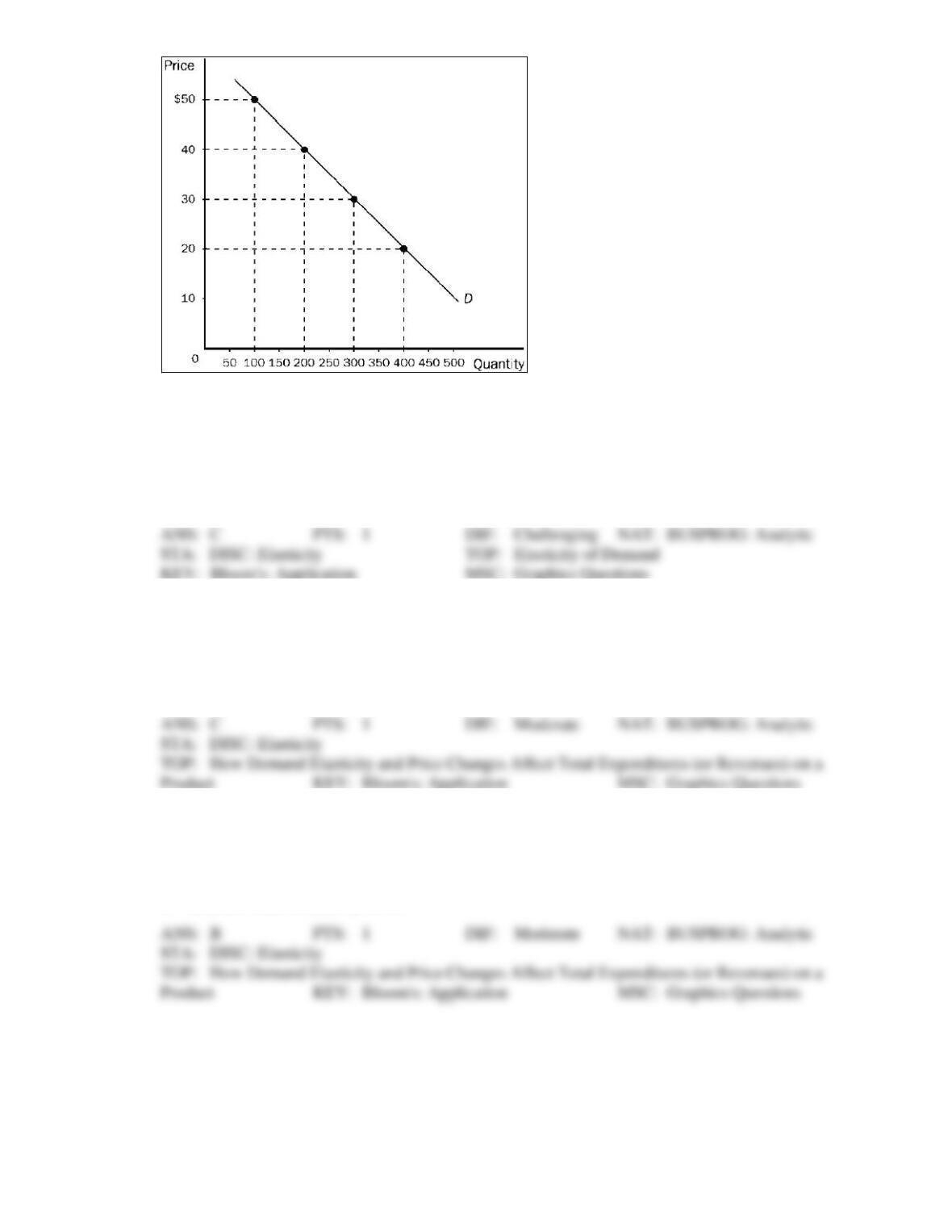
164. Refer to Figure 7-12. When price falls from $50 to $40, it can be inferred that demand between those
two prices is
a.
inelastic, since total revenue decreases from $8,000 to $5,000.
b.
inelastic, since total revenue increases from $5,000 to $8,000.
c.
elastic, since total revenue increases from $5,000 to $8,000.
d.
unit elastic, since total revenue increases from $5,000 to $8,000.
165. Refer to Figure 7-12. An increase in price from $20 to $30 would
a.
increase total revenue by $2,000.
b.
decrease total revenue by $2,000.
c.
increase total revenue by $1,000.
d.
decrease total revenue by $1,000.
166. Refer to Figure 7-12. An increase in price from $30 to $35 would
a.
increase total revenue by $250
b.
decrease total revenue by $250.
c.
increase total revenue by $500.
d.
decrease total revenue by $500.
Figure 7-13
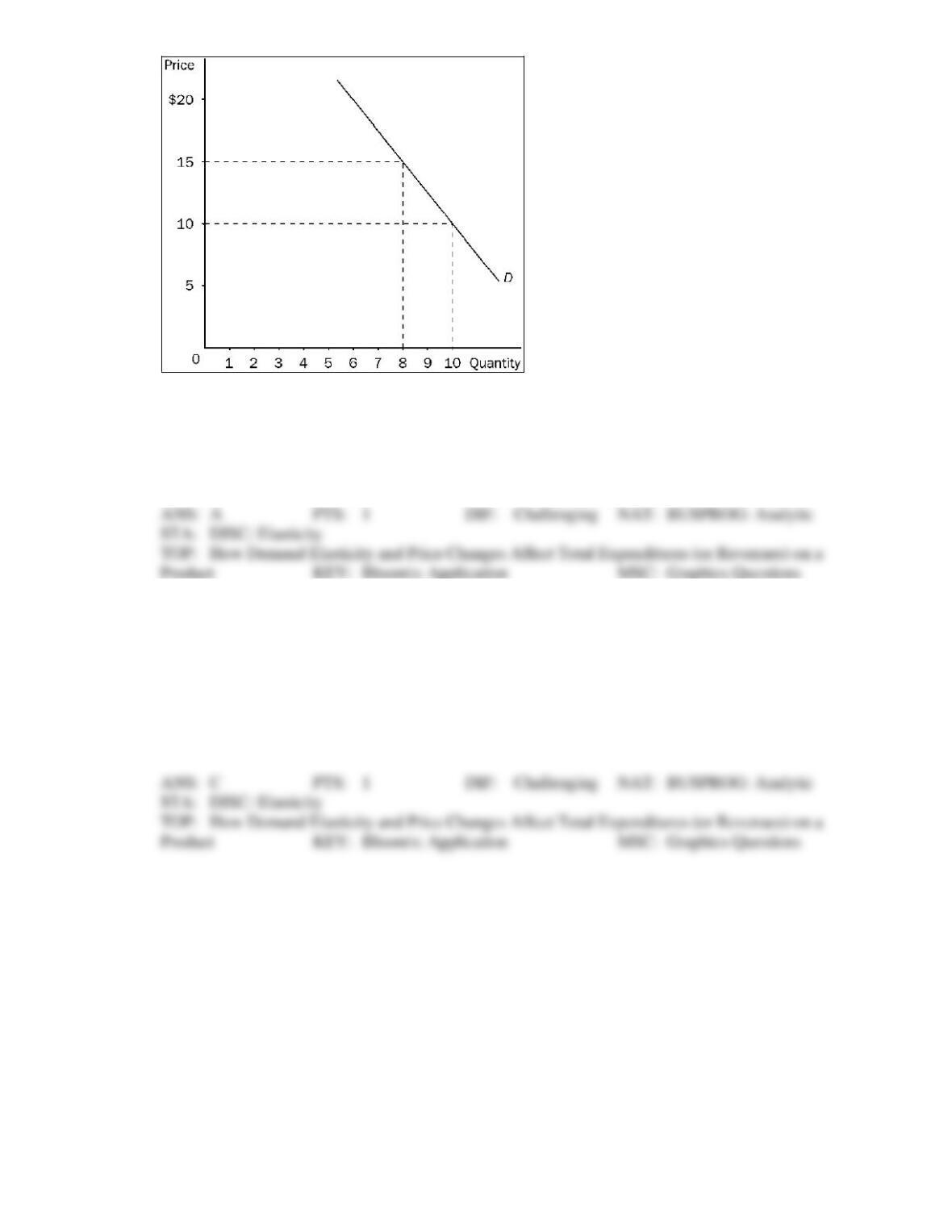
167. Refer to Figure 7-13. If price increases from $10 to $15, total revenue will
a.
increase by $20, so demand must be inelastic in this price range.
b.
increase by $5, so demand must be inelastic in this price range.
c.
decrease by $20, so demand must be elastic in this price range.
d.
decrease by $10, so demand must be elastic in this price range.
168. Refer to Figure 7-13. A decrease in price from $15 to $10 leads to
a.
a decrease in total revenue of $10, so the price elasticity of demand is greater than 1 in this
price range.
b.
a decrease in total revenue of $10, so the price elasticity of demand is less than 1 in this
price range.
c.
a decrease in total revenue of $20, so the price elasticity of demand is less than 1 in this
price range.
d.
a decrease in total revenue of $20, so demand is elastic in this price range.
Figure 7-14
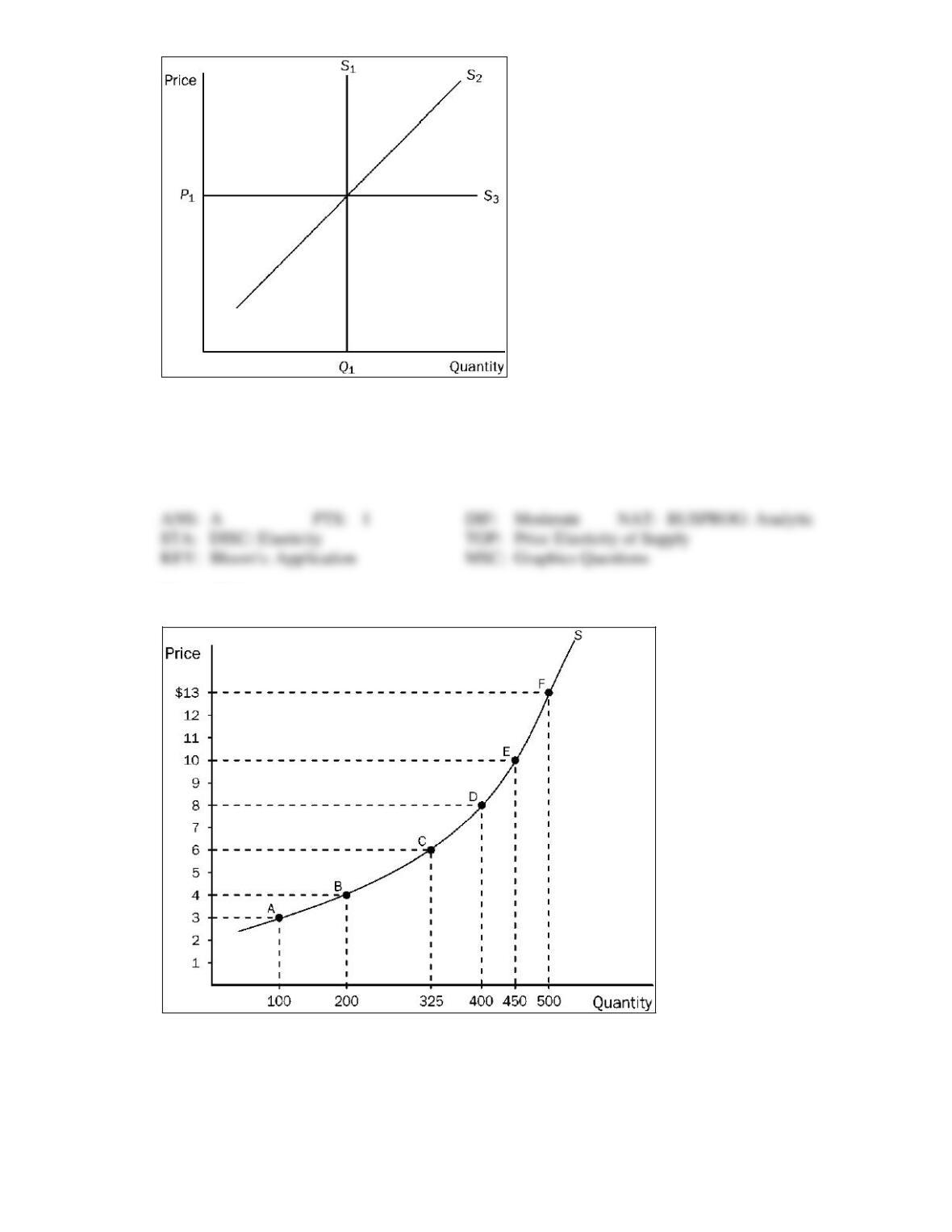
169. Refer to Figure 7-14. Which supply curve represents perfectly inelastic supply?
a.
S1
b.
S2
c.
S3
d.
It is impossible to tell without more information.
Figure 7-15
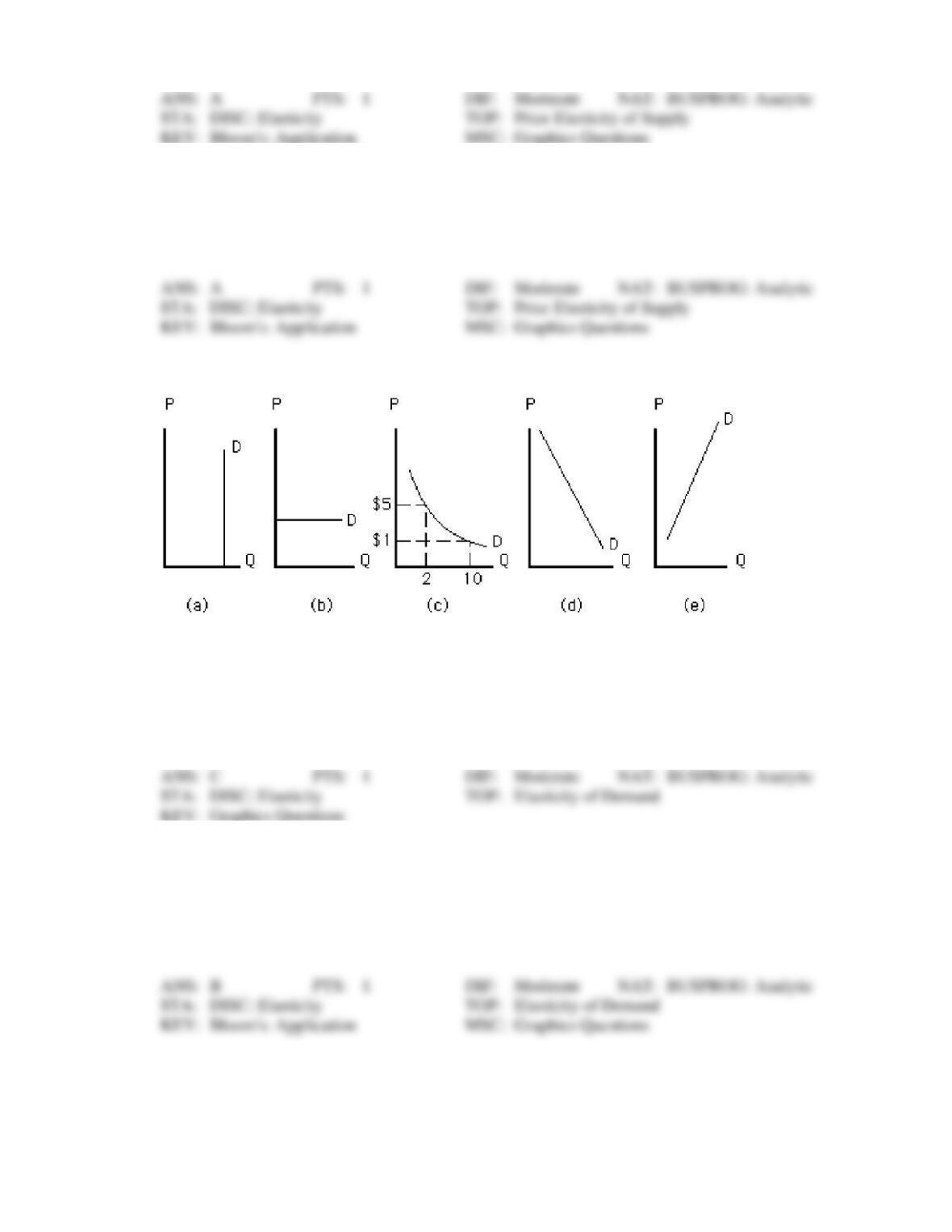
170. Refer to Figure 7-15. Along which of these segments of the supply curve is supply least elastic?
a.
between E and F
b.
between C and D
c.
between A and C
d.
between A and B
171. Refer to Figure 7-15. Along which of these segments of the supply curve is supply most elastic?
a.
between A and B
b.
between C and D
c.
between D and F
d.
between E and F
Figure 7-16
172. Which of the demand curves in Figure 7-16 is unit elastic?
a.
the curve in graph a
b.
the curve in graph b
c.
the curve in graph c
d.
the curve in graph d
e.
the curve in graph e
173. Which demand curve in Figure 7-16 is perfectly elastic?
a.
the curve in graph a
b.
the curve in graph b
c.
the curve in graph c
d.
the curve in graph d
e.
the curve in graph e
Figure 7-17
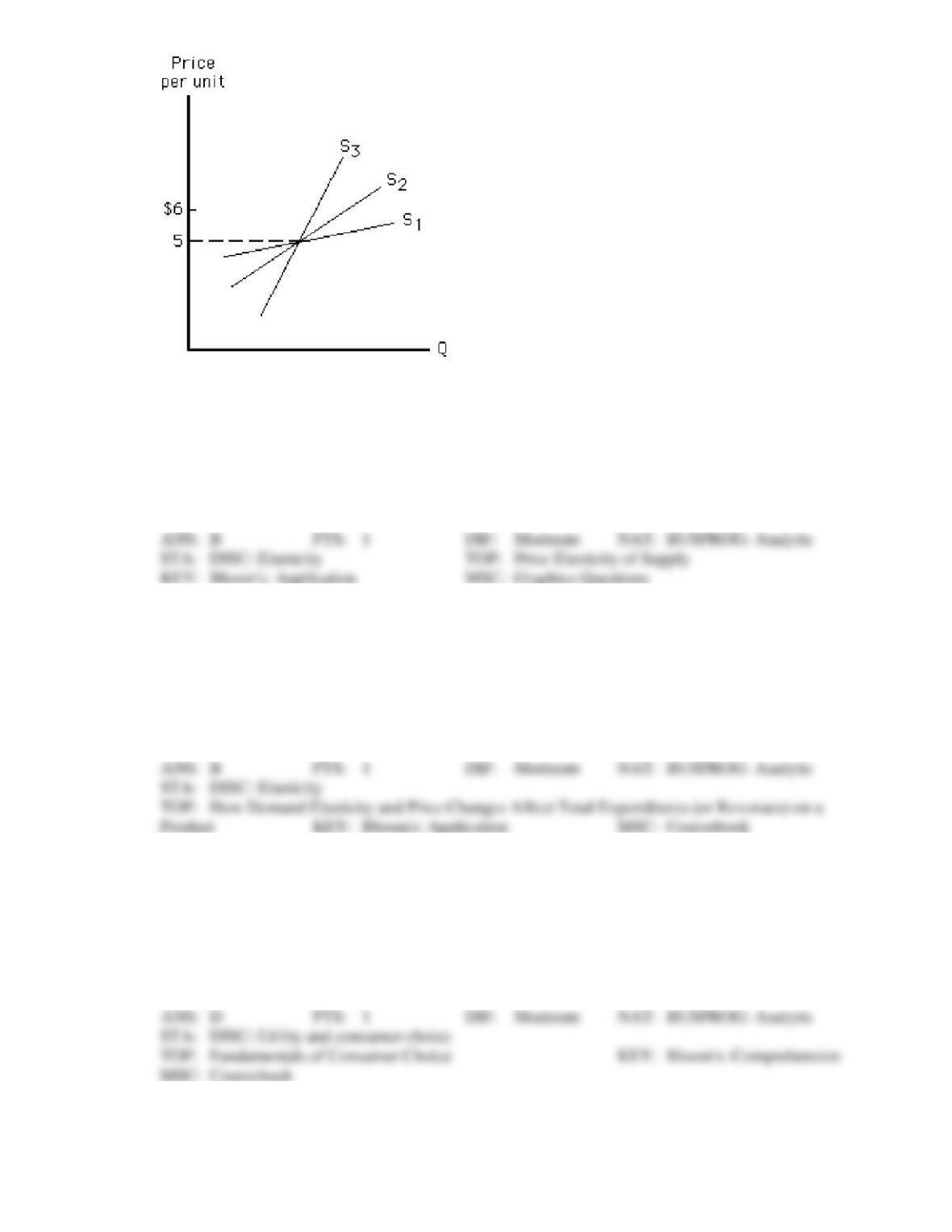
174. Consider Figure 7-17. Between the prices of $5 and $6, which supply curve is most elastic and which
is least elastic?
a.
S1 is most elastic; S2 is least elastic.
b.
S1 is most elastic; S3 is least elastic.
c.
S3 is most elastic; S1 is least elastic.
d.
S3 is most elastic; S2 is least elastic.
e.
S2 is most elastic; S3 is least elastic.
175. A 15 percent increase in the price of beef reduces the quantity of beef consumed by 30 percent. Thus,
the demand for beef is ____, and total consumer expenditure (or total firm revenue) will ____ as a
result of the price increase. (Fill in the blanks.)
a.
elastic; increase
b.
elastic; decrease
c.
inelastic; increase
d.
inelastic; decrease
176. Which of the following is true about marginal benefit?
a.
A consumer’s marginal benefit is equal to the height of her demand curve.
b.
Consumers will continue to purchase up until the point where marginal benefit equals
price.
c.
Marginal benefit declines as consumption increases because of the law of diminishing
marginal utility.
d.
All of the above are true.
177. Jane received a 10 percent increase in her salary and purchased 20 percent more jewelry. For Jane,
jewelry
a.
has an income elasticity of two.
b.
is a normal good.
c.
is a luxury good.
d.
is all of the above.
178. An inferior good is distinguished by a
a.
negative price elasticity of demand.
b.
positive price elasticity of demand.
c.
positive income elasticity of demand.
d.
negative income elasticity of demand.
179. If Joe’s income increased and as a result he purchased more wine and less fast food,
a.
wine is a normal good and fast food an inferior good for Joe.
b.
wine is an inferior good and fast food a normal good for Joe.
c.
both wine and fast food are inferior goods for Joe.
d.
both wine and fast food are normal goods for Joe.
180. “After eating nothing but fast-food hamburgers on spring break, I was anxious to return home and eat
something different.” This statement most clearly reflects the law of
a.
the budget constraint.
b.
consumer irrationality.
c.
greater demand elasticity with time.
d.
diminishing marginal utility.
181. If the price elasticity of demand for grapes was 2.5,
a.
the demand for grapes would be considered inelastic.
b.
an increase in the price of grapes would decrease total consumer spending on grapes.
c.
consumer purchases are less sensitive to a change in the price of grapes than to a change in
the price of bananas, which have a price elasticity of 1.6.
d.
the income elasticity for grapes must also be 2.5.
182. If a 50 percent increase in the price of hula hoops led to a 10 percent reduction in the quantity of hula
hoops purchased, the price elasticity of demand is
a.
5 and the demand for hula hoops is elastic.
b.
0.2 and the demand for hula hoops is elastic.
c.
5 and the demand for hula hoops is inelastic.
d.
0.2 and the demand for hula hoops is inelastic.
183. “Because of the unseasonably cold weather, Florida orange growers expect (1) fewer bushels of
oranges to be harvested, (2) a higher market price for oranges, and (3) larger total revenues from this
year’s crop.” This statement would most likely be correct if the
a.
demand for Florida oranges was elastic.
b.
demand for Florida oranges was unitary elastic.
c.
demand for Florida oranges was inelastic.
d.
income elasticity of Florida oranges was negative.
184. Which of the following statements is true regarding the price elasticity of supply?
a.
The price elasticity of supply is always negative.
b.
The price elasticity of supply is always positive.
c.
The price elasticity of supply will be greater when suppliers have a shorter time to respond
to a price change.
d.
None of the above statements are true.
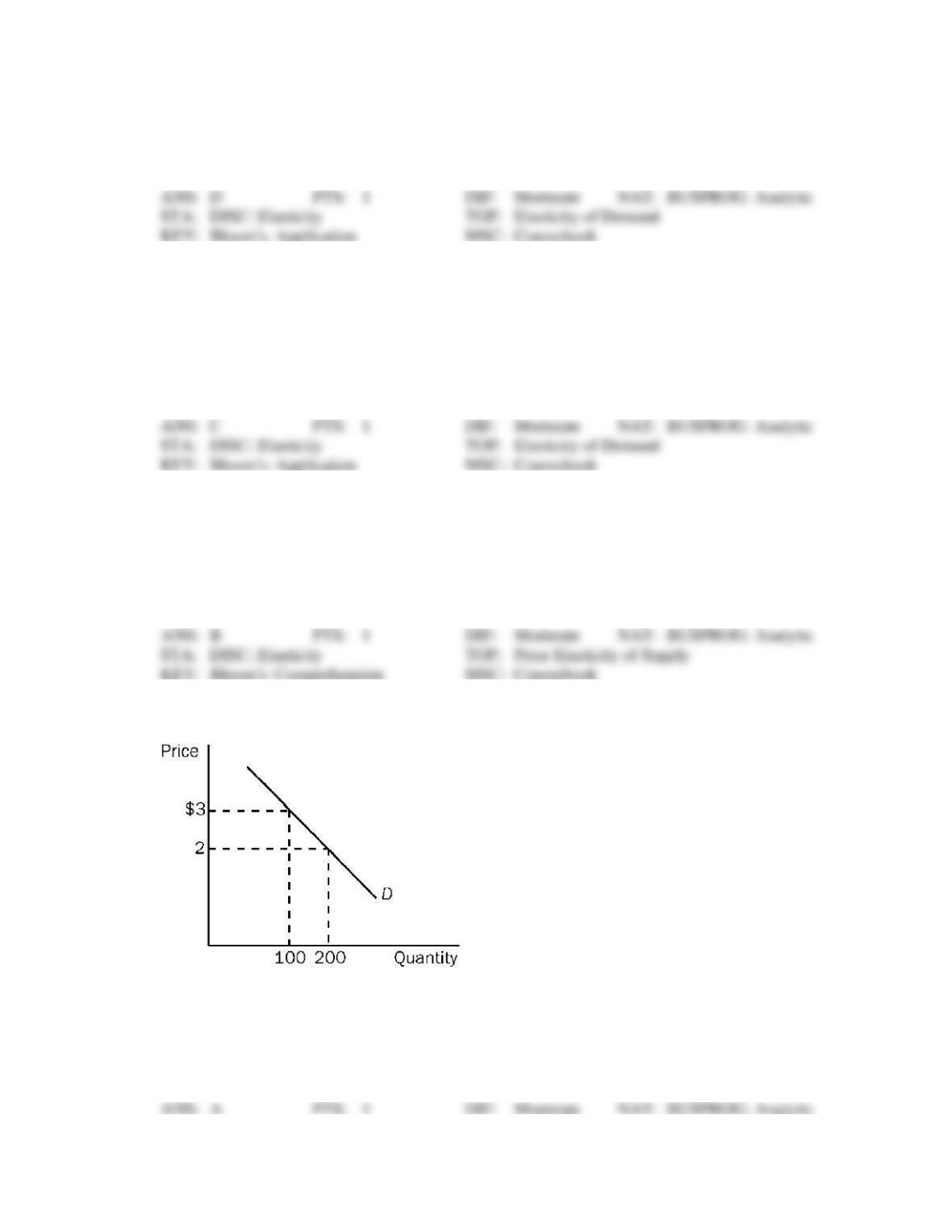
185. Use the diagram below to answer this question.
For this demand curve, the price elasticity of demand is
a.
more elastic at $3 than at $2.
b.
more elastic at $2 than at $3.
c.
identical at $2 to that at $3.
d.
equal to 1.0 over the range from $3 to $2.
186. A car wash currently sells 30 car washes a day at a price of $5. Total daily revenue is now $150. If
they lower their price to $3,
a.
total revenue will fall if the number of washes sold only rises to 40.
b.
total revenue will remain unchanged if the number of washes sold rises to 50.
c.
total revenue will increase if the number of washes sold rises to 60.
d.
all of the above are true.
187. Coach Ballford: “To increase our revenue from football games, we need to lower ticket prices.”
University President Smith: “Coach, that would be counterproductive; a reduction in ticket prices
would reduce our revenue, not increase it.” Which of the following best explains this disagreement?
a.
The coach thinks that demand is elastic, whereas the university president thinks that
demand is inelastic.
b.
The coach thinks that demand is inelastic, whereas the university president thinks that
demand is elastic.
c.
The coach believes that lower ticket prices will increase attendance, but the university
president must not believe attendance will increase when prices are lowered.
d.
Although both the coach and the president believe demand is of unitary elasticity, they
disagree about how much attendance will rise.
188. All else equal, if a firm raises its price by 20 percent and the firm’s total revenue falls by 20 percent,
a.
demand must be elastic.
b.
demand must be inelastic.
c.
demand must be unit elastic.
d.
the price elasticity of demand must be equal to 1.
189. Which of the following is not a fundamental that underlies consumer behavior?
a.
Goods can be substituted for one another.
b.
Consumers make decisions purposefully based upon past experience and knowledge.
c.
The law of diminishing marginal utility applies to all goods.
d.
Consumers always make choices with perfect information.
190. Terri currently consumes 10 hamburgers and 2 shirts per month. At her current rates of consumption,
her marginal utility of hamburgers is 10 and her marginal utility of shirts is 50. If the price of
hamburgers is $2 each, while the price of a shirt is $25, Terri
a.
is maximizing her utility.
b.
could improve her total utility by buying fewer hamburgers and more shirts.
c.
could improve her total utility by buying fewer shirts and more hamburgers.
d.
could improve her total utility by spending less on both goods.
191. If taking an airplane from Pittsburgh to Miami cost $600 and takes 5 hours, while taking a bus would
cost $150 and takes 50 hours, the minimum value of your time that would make it worthwhile to fly
would be
a.
$1 per hour.
b.
$3 per hour.
c.
$10 per hour.
d.
$12 per hour.
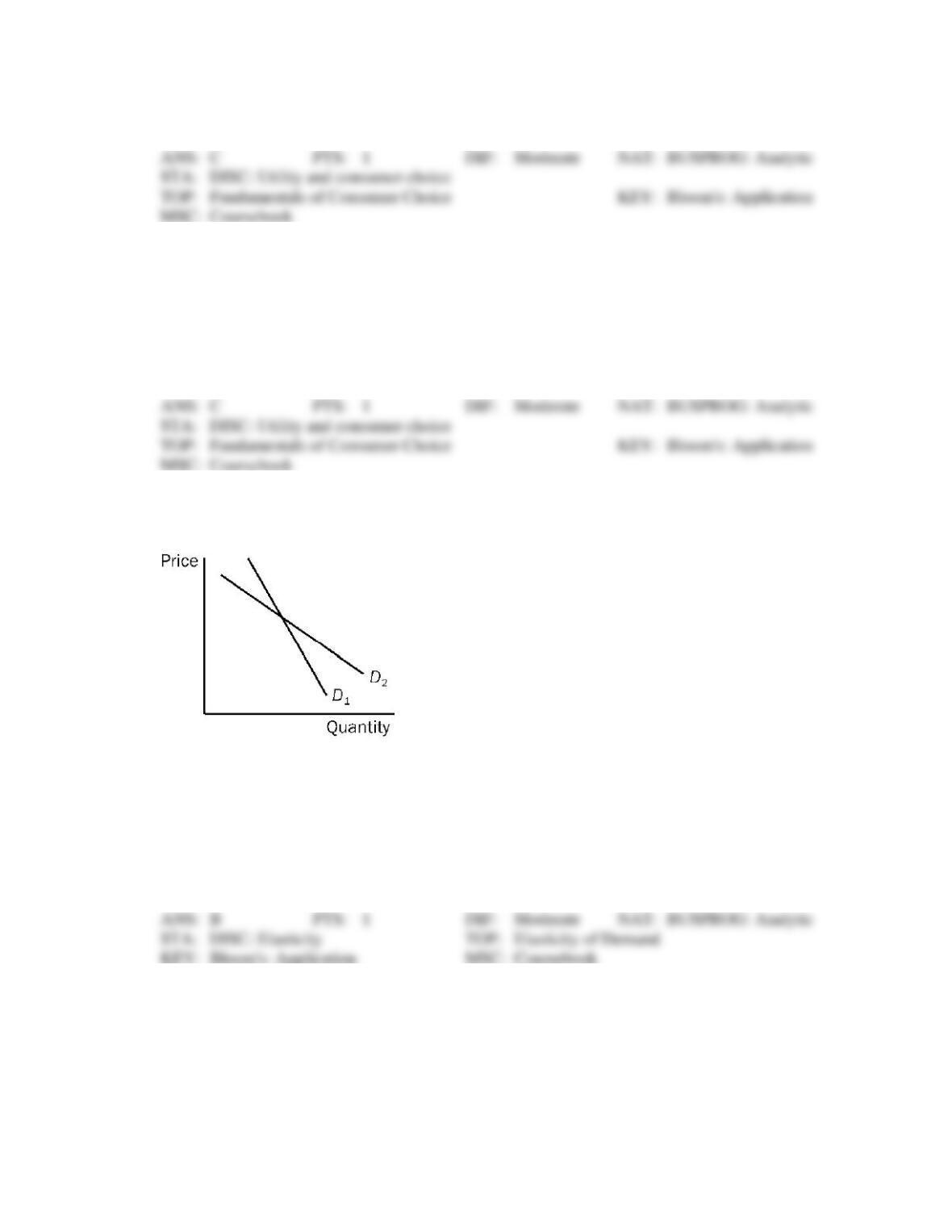
192. The exhibit illustrates two possible demand curves for a product, D1 and D2. Which of the following is
true regarding these demand curves?
a.
Demand curve D1 represents a demand curve that is relatively more elastic than demand
curve D2.
b.
Demand curve D1 represents a demand curve that is relatively more inelastic than demand
curve D2.
c.
Demand curve D1 represents a demand curve that shows consumer purchases being more
responsive to a change in the price of the good than demand curve D2.
d.
Both are examples of unitary elastic demand curves.
193. Making drugs, such as cocaine, illegal results in a higher price than would be present if the drugs were
legal. All else constant, the higher price results in drug users spending
a.
more on drugs if the demand for drugs is inelastic.
b.
more on drugs if the demand for drugs is elastic.
c.
less on drugs if the demand for drugs is inelastic.
d.
more on drugs if the demand for drugs is unitary elastic.
194. If the price of steak rises from $6 to $10 per pound, and the quantity purchased falls from 90 to 70
pounds, the price elasticity of demand (in absolute value) is
a.
0.2.
b.
0.5.
c.
1.0.
d.
2.0.
195. When the price elasticity of demand is greater than one, it means that demand is
a.
inelastic and the percent change in quantity is greater than the percent change in price.
b.
inelastic and the percent change in quantity is less than the percent change in price.
c.
elastic and the percent change in quantity is greater than the percent change in price.
d.
elastic and the percent change in quantity is less than the percent change in price.
196. If Russell values a ticket to a rock concert at $100 and is able to purchase it for only $40, he has
received ____ in consumer surplus on his purchase. (Fill in the blank.)
a.
$40
b.
$60
c.
$100
d.
$140
197. The market demand for a good is
a.
the horizontal sum of all individual demand curves for the good.
b.
generally upward sloping, unlike individual demand curves.
c.
usually a vertical line at a quantity of one hundred.
d.
the average amount purchased by each individual in the market.
198. Bob goes out to dinner three times per week, usually either to the local steak house or a Chinese
restaurant in town. If the steak house were to raise its prices, Bob would probably (1) be less inclined
to eat at the steak house and more inclined to eat at the Chinese restaurant when he did go out and (2)
eat out fewer times per week because at the higher prices he cannot afford to eat out as much.
a.
Part 1 is an example of the substitution effect, part 2 of the income effect.
b.
Part 1 is an example of the income effect, part 2 of the substitution effect.
c.
Part 1 is an example of the law of diminishing marginal utility, part 2 of the substitution
effect.
d.
Part 1 is an example of the proportions hypothesis, part 2 of the income effect.
199. The price elasticity of demand for automobiles measures the responsiveness of
a.
consumer purchases to a change in the price of automobiles.
b.
consumer purchases to a change in the quality of automobiles.
c.
supplier production levels to a change in the price of automobiles.
d.
consumer purchases of automobiles to a change in their income.
200. Which of the following is true regarding the price elasticity of demand?
a.
Demand is generally more elastic in the long run than in the short run.
b.
Along a single demand curve, demand elasticity decreases as you move down the curve (to
lower prices).
c.
A demand curve that is flatter (has a less steep slope) is relatively more elastic than a
demand curve that has a steeper slope.
d.
All of the above are true.
201. If the price of apples rises from $.50 to $1.50 and quantity demanded falls from 1,000 to 900, we can
conclude that the price elasticity for apples is
a.
−20.
b.
inelastic.
c.
elastic.
d.
unitary.
202. If the quantity demanded of a product rose from 900 to 1,200 when the price of the product fell from
$11 to $9, the price elasticity of demand coefficient is equal to
a.
−0.20.
b.
−0.70.
c.
−1.00.
d.
−1.42.
203. Cary increases the price of her cakes from $8 to $10 per cake, but her cash receipts decrease by 2
percent. The price elasticity of demand (in the $8 to $10 range) is
a.
elastic.
b.
inelastic.
c.
0.02.
d.
0.25.
204. Rebel Records announces it is cutting the prices of its bluegrass album titles by 25 percent. If Rebel is
seeking to increase revenues, it must believe that the elasticity of demand for bluegrass albums is
a.
elastic.
b.
inelastic.
c.
of unitary elasticity.
d.
perfectly inelastic.
205. Since the income elasticity for food is estimated to be 0.51, it appears that the proportion of income
spent by poor people on food is ____ the proportion spent by those with higher incomes.
a.
greater than
b.
less than
c.
about the same as
d.
about half as great as
206. “I’m tired of eating cold pizza for breakfast. Today I’m going to the make some oatmeal instead.” This
statement most clearly reflects the
a.
law of increasing returns to scale.
b.
second law of demand.
c.
law of diminishing marginal utility.
d.
law of comparative advantage.
207. After downing three glasses of lemonade on a hot summer afternoon, Todd says, “You would have to
pay me to drink another glass!” This statement best illustrates
a.
the law of demand.
b.
the substitutability among goods.
c.
the law of diminishing marginal utility.
d.
that chocolate candy bars are an inferior good.
208. A 10 percent increase in the price of sugar reduces sugar consumption by about 5 percent. The increase
causes households to
a.
spend more on sugar.
b.
spend less on sugar.
c.
spend the same on sugar.
d.
consume more goods like coffee and tea that are complements of sugar.
209. If Mr. Smith thinks the last dollar spent on shirts yields more satisfaction than the last dollar spent on
cola, and Smith is a utility-maximizing consumer, he should
a.
decrease his spending on cola.
b.
decrease his spending on cola and decrease his spending on shirts.
c.
decrease his spending on shirts.
d.
increase his spending on cola and decrease his spending on shirts.
210. If the income elasticity of a good is negative, we can conclude that the good is
a.
an inferior good.
b.
a normal good.
c.
a luxury good.
d.
a necessity.
211. If the demand for a product increases as the result of an increase in income, it can be concluded that
the
a.
product is an inferior good.
b.
demand for the product is inelastic.
c.
price elasticity of demand for the product equals unity.
d.
product is a normal good.
212. Which one of the following goods would likely have the most inelastic demand?
a.
Kellogg’s corn flakes
b.
salt
c.
a new Toyota automobile
d.
fresh green beans
213. A perfectly inelastic demand curve indicates that
a.
a producer can sell as many units as desired at the market price but no units above the
market price.
b.
for a given percent change in price, the quantity demanded rises by the same percentage.
c.
price has no effect on the quantity demanded.
d.
the percent change in price is less than the percent change in quantity demanded.
214. If people spend 30 percent less on movie tickets when movie prices decline 15 percent, the price
elasticity of demand for movie tickets at these prices must be
a.
−3.0.
b.
elastic
c.
−0.5.
d.
inelastic.
215. When the price of a product increases, the passage of time usually causes the price elasticity of
demand for the product to become
a.
less elastic.
b.
more elastic.
c.
smaller and smaller in an absolute value.
d.
approximately equal to zero in the long run because of scarcity.
ESSAY
216. Mark complains: “I can’t believe they raised the price of comic books, and because of this, I’m going to
reduce my demand for comic books.” Is Mark stating the concept of demand correctly?
217. Sally is on her college golf team and only uses Titleist golf balls. She states: “I don‘t care what the
price is, I will only buy Titleists.” Is this a believable assertion?
ANS:
218. John is a well-known consultant who makes $150 an hour and has all the work he can handle. He has a
big job in Washington D.C., ten hours away. He can drive at a cost of $80 round trip or take a
one-hour flight for $300. Which is he likely to do? Are there circumstances that may lead him to
choose otherwise?
219. Fred, a poor college student, states: “I eat tuna sandwiches five times a week. When I graduate and get
a real job, I will never purchase tuna again.” Is Fred planning on breaking the law of demand?
220. In the mythical nation of Oz, gasoline used to sell for $1 a gallon, and the natives purchased 100,000
gallons a week. Four years ago, the price rose to $3 a gallon, and the natives reduced their quantity
demanded to 90,000 gallons a week. Calculate the price elasticity for this change. Today, gas again
sells for $1 a gallon in Oz, but the natives are only buying 70,000 gallons a week. What gives?
221. Jack, a music major, is perusing Jill’s notes for her economics class, where she has written that “total
revenues will rise with price rises only if demand is elastic.” Jack tells Jill this is nonsense because
firms can always increase their revenues by raising price. How should Jill respond?
222. A question on an economics exam asks: What happens in the market for margarine when income
rises? Allison, an excellent student, shows the demand for margarine decreasing. Is she necessarily
wrong? Why or why not?
223. A local restaurant offers an “all you can eat” ribs special. If a person pays $11.95, she can eat as many
servings as she desires at no additional cost. Can you infer anything about her marginal utility from
observing her eating behavior?