51) In 2014, some European countries were dealing with a recession. Workers who were laid off
in those countries due to the economic downturn would be
A) frictionally unemployed.
B) structurally unemployed.
C) cyclically unemployed.
D) seasonally unemployed.
52) Annie had a job as a human resource manager of a restaurant chain that went out of business
due to a downturn in the economy. This is an example of
A) cyclical unemployment.
B) structural unemployment.
C) seasonal unemployment.
D) technological unemployment.
53) The unemployment rate reported by the Bureau of Labor Statistics includes all of the
following type of unemployment with the exception of
A) frictional unemployment.
B) structural unemployment.
C) hidden unemployment.
D) cyclical unemployment.
54) A person who is unemployed because of a mismatch between the person’s skills and current
employment requirements is experiencing
A) frictional unemployment.
B) structural unemployment.
C) cyclical unemployment.
D) seasonal unemployment.
55) The estimate of the current natural rate of unemployment rate in the United States is
approximately
A) 0 percent.
B) 0.5 percent.
C) 10 percent.
D) none of the above.
56) Which of the following best describes an economy with full employment?
A) “Everyone who is looking for a job will have one.”
B) “No person is unemployed for whatever reason.”
C) “Full employment occurs only when the economy has a zero percent unemployment rate.”
D) “The level of unemployment that corresponds to the normal friction in the labor market.”
57) Full employment does NOT necessarily mean that every adult has a job because
A) students and homemakers are always looking for work.
B) there are always some discouraged workers.
C) policy makers never want to achieve full employment.
D) there are transaction costs in finding a job in the labor market.
58) The natural rate of unemployment does NOT include which of the following?
A) cyclical unemployment
B) frictional unemployment
C) seasonal unemployment
D) all of the above
59) An unemployment rate of zero cannot be expected since
A) there are some people who do not want to work.
B) there will always be discouraged workers.
C) some portion of the labor force will always be between jobs.
D) aggregate demand can never create enough job vacancies.
60) Which of the following statements about full employment is correct?
I. Full employment means that the unemployment rate is less than 1/2 of 1 percent.
II. Full employment means that the transaction costs associated with getting a job are zero.
A) I only
B) II only
C) Both I and II
D) Neither I nor II
61) Full employment means that
A) everyone who wants a job has a job, although it may not be the job they really want.
B) everyone who wants a job has a job, and they have the job they most prefer.
C) taking seasonal fluctuations into account, only frictional and structural unemployment exist.
D) the sum of structural and cyclical unemployment is greater than frictional unemployment.
62) Full employment is defined by the Council of Economic Advisers as
A) a zero percent unemployment rate.
B) every adult who wants to work has a job.
C) the unemployment rate associated with zero inflation.
D) the unemployment rate associated with the normal frictions in the labor market.
63) The natural rate of unemployment when seasonally adjusted includes
A) frictional and structural unemployment but not cyclical.
B) frictional and cyclical unemployment but not structural.
C) frictional unemployment only.
D) cyclical and structural unemployment but not frictional.
64) In conditions of full employment
A) no one in or out of the labor force is unemployed.
B) the only unemployment results from a normal frictions and structural mismatches in the labor
market.
C) the only unemployment results from cyclical swings in economic activity.
D) no one in the labor force is unemployed.
65) Full employment is NOT zero unemployment because
A) there are statistical errors when determining the unemployment rate that cannot be overcome.
B) there is “normal” friction in the economy made up of those workers who are between jobs and
those new entrants to the labor force.
C) there are undocumented workers in the economy who are not counted by the Bureau of Labor
Statistics.
D) government workers are not counted in the labor force.
66) Currently, economists estimate that the natural rate of unemployment in the United States is
about
A) 10 percent.
B) 2 percent.
C) 5 percent.
D) 0 percent.
67) Full employment is
A) zero unemployment.
B) when the unemployment level is reduced to the goal set by Congress.
C) the unemployment level when the normal friction in the economy is taken in account.
D) when all adults looking for work can find full time occupation.
68) The natural rate of unemployment is the rate of unemployment that
A) all workers and employers have fully adjusted to any changes in the economy.
B) occurs when all workers find work in the economy.
C) is an unrealistic goal set by policymakers.
D) occurs when employers find more than one job applicant for each job available.
69) Full employment in the United States today
A) means a 100% employment rate.
B) means 0% unemployment for 6 months.
C) means about a 95% employment rate.
D) means that the cyclical unemployment rate is about 5%.
70) The level of unemployment that is equal to the frictional and structural rate in the long run is
sometimes referred to as
A) cyclical employment.
B) the natural rate of unemployment.
C) the total rate of unemployment.
D) the zero unemployment rate.
71) When Joe, who is among the highest-paid workers in a field in which there are numerous job
openings across the nation, recently became unemployed, his opportunity cost of job search is
A) average, so the length of his period of unemployment is likely to be long.
B) relatively high, so the length of his period of unemployment is likely to be short.
C) relatively low, so the length of his period of unemployment is likely to be long.
D) relatively high, so the length of his period of unemployment is likely to be long.
72) Which one of these factors plays a role in determining the extent and duration of frictional
unemployment?
A) the ease with which job seekers can obtain information about job openings
B) the degree to which the overall level of business activity fluctuates up and down
C) the extent to which government legislation requires firms to provide health insurance for
employees
D) the education and skill levels of labor force participants
73) Describe the major types of unemployment.
74) What is meant by full employment? Why isn’t the full employment rate zero? What causes
frictional unemployment?
7.3 Inflation and Deflation
1) A major element of the concepts of inflation and deflation is
A) the idea that price changes are measured daily.
B) their dependence on average rather than individual prices.
C) the requirement that ALL prices must be moving in the same direction.
D) each household’s willingness to report what they pay for goods and services each month.
2) A sustained decrease in the average of all prices of goods and services in the economy is
known as
A) inflation.
B) disinflation.
C) deflation.
D) hyperinflation.
3) The statistical measure of a weighted average of prices of goods and services that firms
produce and sell is known as
A) the inflation rate.
B) the consumer price index (CPI).
C) the producer price index (PPI).
D) the Gross Domestic Product (GDP) deflator.
4) Inflation is best described as a situation in which
A) relative prices are changing.
B) some prices are rising faster than others.
C) relative prices are changing, but the purchasing power of the dollar is unchanged.
D) the average of all prices are on a sustained rise over a period of time.
5) Deflation is defined as a situation in which
A) the rate of inflation is below 2 percent.
B) the average of all prices of goods and services in an economy is falling.
C) the value of the dollar is rising relative to other currencies.
D) the Gross Domestic Product’s growth rate is less for a given quarter than it was for the prior
quarter.
6) Inflation is best defined as
A) a sustained increase in the price of ALL goods and services in an economy.
B) a relative price increase.
C) a sustained increase in the average of all prices of goods and services in an economy.
D) a sustained increase in the price of a single good or service.
7) Deflation refers to a situation in which
A) the inflation rate decreases.
B) the average of all prices is falling.
C) there is a recession and inflation.
D) prices are not changing.
8) The rate of inflation and the purchasing power of money are
A) positively related.
B) totally unrelated.
C) inversely related.
D) randomly related.
9) The faster the drop in the purchasing power of money, the faster the
A) drop in the inflation rate.
B) drop in the deflation rate.
C) increase in the deflation rate.
D) increase in the inflation rate.
10) The value of your money income, in terms of buying goods and services, is referred to as
your money’s
A) staying power.
B) rigidity factor.
C) purchasing power.
D) transaction cost.
11) By definition, the purchasing power of money always drops when
A) inflation occurs.
B) deflation occurs.
C) the economy is experiencing full employment.
D) there is a presidential election year.
12) The nominal value of a good is
A) the good’s value expressed in purchasing power terms.
B) the good’s anticipated value one year from now.
C) the price of the good in today’s dollars, minus an anticipated inflation premium.
D) the price of the good in today’s dollars.
13) The formula for computing a basic price index is
A) (cost of market basket today/cost of market basket in base year) × 100.
B) (cost of market basket in base year/100) × cost of market basket today.
C) (cost of market basket in base year/cost of market basket today) × 100.
D) (100/cost of market basket in base year) + cost of market basket today.
14) If the current price of a market basket of goods is $850 and the base year price for the same
market basket is $500, what is the value of the price index?
A) 140
B) 170
C) 120
D) 100
15) Assume that the current price of a market basket of goods is $2,500 and the base year price
of the same market basket is $2,000. The current price index is
A) 2500.
B) 250.
C) 200.
D) 125.
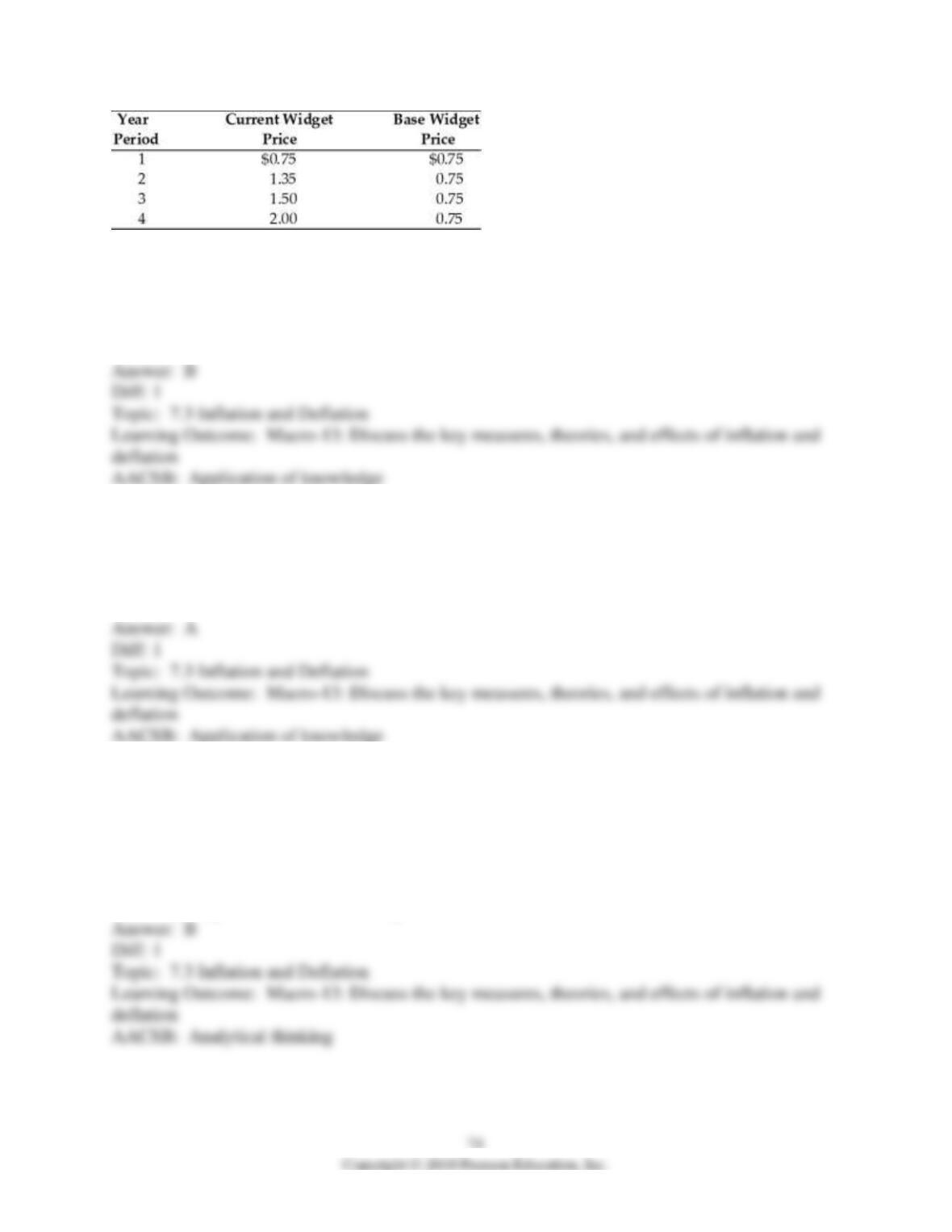
16) According to the above table, in Year 3, the price index for widgets is
A) 100.
B) 200.
C) 75.
D) 150.
17) According to the above table, in the base period (Year 1), the price index is
A) 100.
B) 200.
C) 75.
D) 150.
18) The Consumer Price Index measures
A) the average of raw material prices paid by producing firms.
B) the level of prices with respect to goods and services purchased by a typical consumer in
urban areas.
C) the average of the prices of all goods produced in a country and goods imported from other
countries.
D) hourly wage rates of manufacturing workers.
19) Which of the following price indexes is designed to measure changes in the prices of goods
and services purchased by a typical individual?
A) Producer Price Index
B) Gross Domestic Product (GDP) Deflator
C) Index of Leading Economic Indicators
D) Consumer Price Index
20) A price index shows
A) the current cost of a basket of goods.
B) the relative price of necessities.
C) the price of goods in the future.
D) the cost of today’s goods expressed in terms of the cost of goods in a base year.
21) Assume that there was a 5 percent increase in the price of all goods in 2015; if the base year
is 2014, then the price index in 2015 will be
A) 95.
B) 105.
C) 110.
D) 1100.
22) The statistical measure of the weighted average of prices of goods purchased by a typical
individual is called the
A) Producer Price Index.
B) Gross Domestic Product (GDP) deflator.
C) Consumer Price Index.
D) Personal Consumption Expenditure Index.
23) The broadest indication of economy-wide inflation is captured by the
A) Consumer Price Index.
B) Gross Domestic Product (GDP) deflator.
C) Producer Price Index.
D) Personal Consumption Expenditure Index.
24) Which of the following measures gives the earliest warning of increasing inflation?
A) the Consumer Price Index
B) the Producer Price Index
C) the Personal Consumption Expenditure Index
D) All of these should signal the same short-run inflation.
25) Last year the price of a dozen eggs was $1, and this year the price is $1.30. Which of the
following does NOT express this price change accurately?
A) The price increased 30 percent.
B) The price increased by 30 cents.
C) If last year was the base year, the index number for this year would be 130.
D) If this year is the base year, the index number for last year would be 130.
26) Last year you purchased 20 CDs at $12 a piece, 10 shirts at $15 each, and 5 sweaters at $30
each (total spending equals $540). This year you buy 18 CDs at $15 each, 10 shirts at $16 each,
and 6 sweaters at $36 each (total spending equals $640). If last year’s index was 100, this year’s
index
A) is 119.6.
B) is 118.5.
C) is 83.6.
D) is 30.
27) In computing a price index,
A) the most recent year is always set equal to 100.
B) both the quantities in the market basket and the prices change from year to year.
C) the quantities in the market basket stay the same while the prices differ.
D) the base year must be one for which the inflation rate was zero.
28) The price index that measures the changes in prices of ALL goods and services produced by
the economy is the
A) CPI.
B) PPI.
C) Gross Domestic Product (GDP) deflator.
D) Personal Consumption Expenditure Index.
29) The consumer price index (CPI) is a measure of inflation for
A) farmers.
B) an elderly couple recently retired to Yuma, Arizona.
C) Apple Computer.
D) a typical consumer of the market basket used to calculate the index.
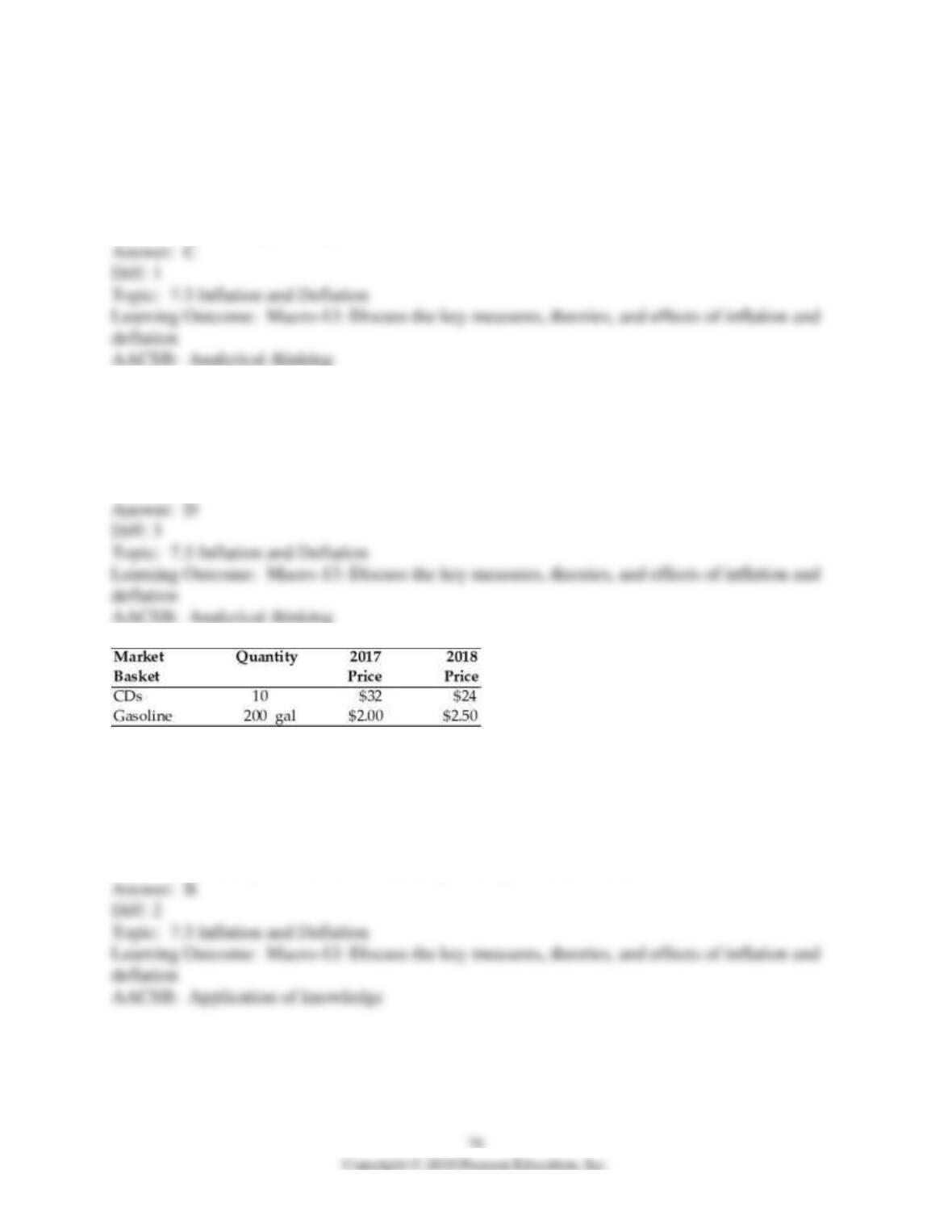
30) If 2017 is the base year, what is the price index for a market basket of goods for 2018 in the
above table?
A) 97.3
B) 102.8
C) 128.0
D) Zero, since the price of CDs fell and the price of gasoline increased
31) Which of the following is a measure of general inflation that is NOT based on a fixed market
basket of goods and services?
A) consumer price index
B) producer price index
C) personal consumption expenditure index
D) medical price index
32) The relationship between the producer price index (PPI) and the consumer price index (CPI)
is such that, in the short run
A) the CPI usually increases before the PPI.
B) the CPI and the PPI usually move simultaneously.
C) the PPI usually increases before the CPI.
D) the CPI and the PPI usually move in opposite directions.
33) If the Bureau of Labor Statistics changed the way it calculates the consumer price index
(CPI) so as to take into account product quality changes and the changing mix of products and
services purchased by the average family, the result would most likely
A) show a higher rate of inflation.
B) show a lower rate of inflation.
C) cause an increase in Social Security payments.
D) cause higher wage increases for union employees with contracts that specify automatic wage
boosts when the CPI rises.
34) Inflation refers to the situation when
A) the prices of necessities increase.
B) the average of all prices is increasing.
C) all prices rise by the same rate.
D) the rate at which prices are rising is rising.
35) Deflation is the situation when
A) the rate at which prices increase falls.
B) the average of all prices is declining.
C) the real rate of interest is negative.
D) some prices are increasing and some are declining.
36) Which of the following statements is NOT true about inflation?
A) Inflation is a sustained increase in the average prices of goods in the economy.
B) During an inflationary period, the prices of some goods will increase while the price of some
goods will decrease.
C) When there is inflation, the purchasing power of a dollar decreases.
D) During an inflationary period, the prices of all goods will increase.