115) Technological progress that increases the expected profit shifts the demand for loanable
funds curve
A) leftward and reduces the real interest rate.
B) rightward and increases the real interest rate.
C) rightward and reduces the real interest rate.
D) leftward and increases the real interest rate.
116) Suppose that expected profit decreases. This change means
A) the demand curve for loanable funds shifts leftward and the real interest rate falls.
B) the supply curve for loanable funds shifts rightward and the nominal interest rate rises.
C) there is a movement down along the demand curve for loanable funds.
D) the real interest rate rises as saving increases.
117) If disposable income increases, people will decide to ________ saving, the supply of
loanable funds will ________ and the real interest rate will ________.
A) increase; decrease; rise
B) decrease; decrease; rise
C) increase; increase; fall
D) decrease; increase; fall
118) Suppose the real interest rate rises and the quantity of loanable funds decreases. These
changes could have been the result of
A) firms expecting higher future profits.
B) an increase in disposable income.
C) an increase in household wealth.
D) a decrease in the default risk.
119) Suppose the real interest rate rises and the quantity of loanable funds increases. These
changes could have been the result of
A) firms expecting higher future profits.
B) firms expecting lower future profits.
C) households expecting higher future income.
D) in increase in the default risk.
120) The U.S. personal savings rate for the first quarter of 2012 dropped to its lowest level since
the start of the recession. Americans stashed away 3.6 percent of personal income in the first
quarter, down from 4.2 percent in the fourth quarter and a near-term peak of 6.2 percent in the
second quarter of 2009. Which of the following could explain this drop in savings?
A) a decrease in wealth from a fall in stock prices
B) a rise in the real interest rate
C) an increase in disposable income as the job market recovers
D) a rise in consumer confidence that their incomes will be higher in the future
121) Suppose the market for loanable funds is in equilibrium. If disposable income increases, the
equilibrium real interest rate ________ and the quantity of loanable funds ________.
A) falls; increases
B) falls; decreases
C) rises; decreases
D) rises; increases
122) According to the Bureau of Economic Analysis, household disposable income fell by 0.3
percent of August, 2012. If all else remains the same, what is the likely impact of this fall on the
real interest rate?
A) The real interest rate will rise.
B) The real interest rate will fall.
C) A change in household disposable income will have no impact on the real interest rate.
D) The impact on the real interest rate is ambiguous.
123) Suppose the market for loanable funds is in equilibrium. If the expected profit falls, the
equilibrium real interest rate ________ and the quantity of loanable funds ________.
A) falls; decreases
B) falls; increases
C) rises; increases
D) rises; decreases
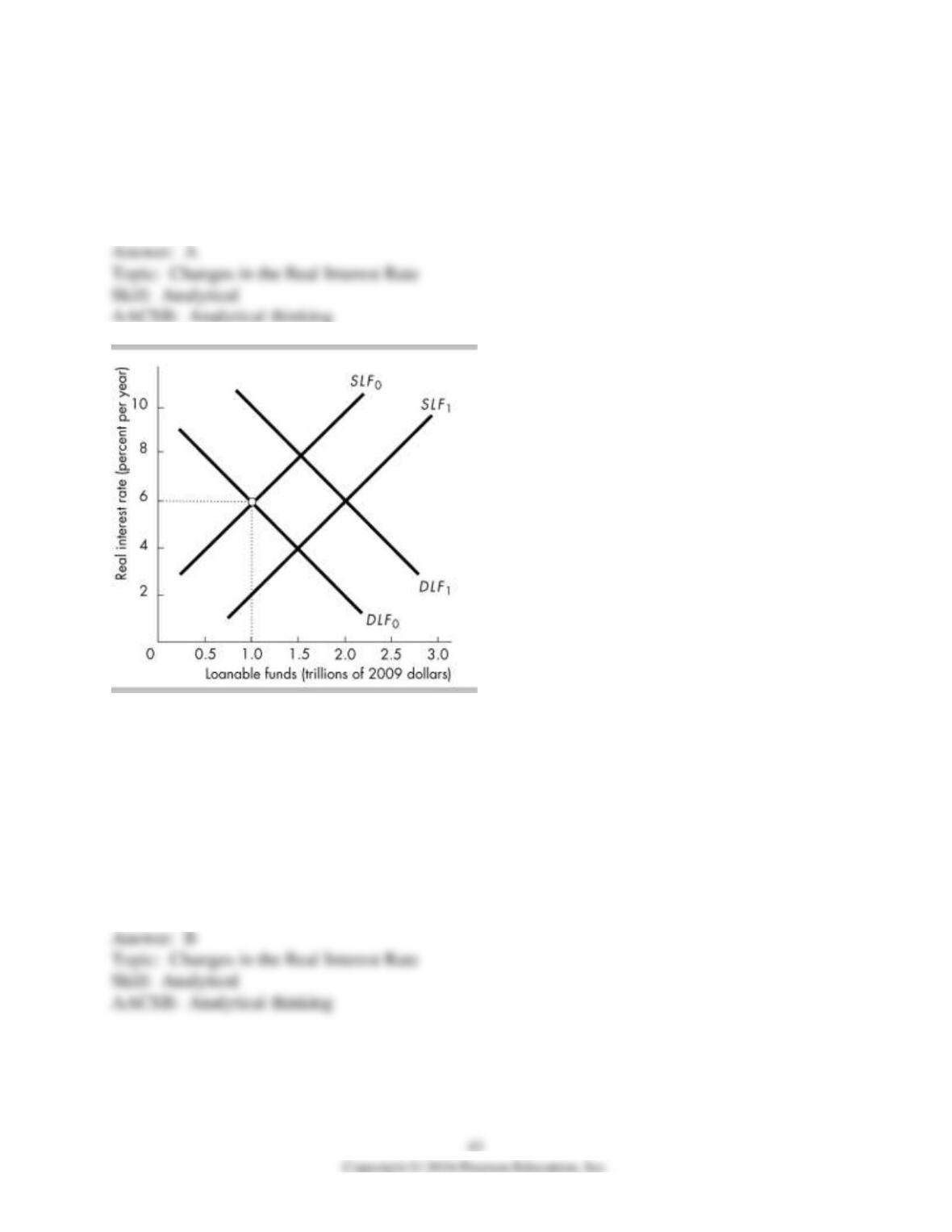
124) In the above figure, the initial supply of loanable funds curve is SLF0 and the initial
demand for loanable funds curve is DLF0. An economic expansion that raises disposable income
and the expected profit would
A) only shift the supply of loanable funds curve rightward to a curve such as SLF1.
B) shift the supply of loanable funds curve rightward to a curve such as SLF1, and shift the
demand for loanable funds curve rightward to a curve such as DLF1.
C) only shift the demand for loanable funds curve rightward to a curve such as DLF1.
D) have no effect on either the demand for loanable funds curve or the supply of loanable funds
curve.
125) In the above figure, the initial supply of loanable funds curve is SLF0 and the initial
demand for loanable funds curve is DLF0. An increase in the expected profit would
A) only shift the supply of loanable funds curve rightward to a curve such as SLF1.
B) shift the supply of loanable funds curve rightward to a curve such as SLF1, and shift the
demand for loanable funds curve rightward to a curve such as DLF1.
C) only shift the demand for loanable funds curve rightward to a curve such as DLF1.
D) have no effect on either the demand for loanable funds curve or the supply of loanable funds
curve.
126) In the above figure, the initial supply of loanable funds curve is SLF0 and the demand for
loanable funds investment curve is DLF0. An increase in the real interest rate to 7 percent could
be caused by
A) an increase in investment demand.
B) a decrease in the expected profit.
C) an increase in people’s disposable incomes.
D) an expansion that increased both saving and investment by the same amount.
127) A fall in the real interest rate
A) results in a movement along the demand for loanable funds curve.
B) shifts the demand for loanable funds curve rightward.
C) shifts the demand for loanable funds curve leftward.
D) has no effect on the demand for loanable funds curve
128) A decrease in disposable income shifts the ________.
A) demand for loanable funds curve rightward
B) demand for loanable funds curve leftward
C) supply of loanable funds curve leftward
D) supply of loanable funds curve rightward
3 Government in the Loanable Funds Market
1) If net taxes exceed government expenditures, the government sector has a budget ________
and government saving is ________.
A) surplus; positive
B) surplus; negative
C) deficit; positive
D) deficit; negative
2) When a government has a budget surplus, the surplus
A) helps finance investment.
B) crowds-out private saving.
C) must be subtracted from private saving to get total saving.
D) increases the world real interest rate.
3) If the government’s budget deficit increases and the Ricardo-Barro effect does not apply
A) the real interest rate rises.
B) investment increases.
C) investment decreases.
D) Both answers A and C are correct.
4) The idea that a government budget deficit decreases investment is called
A) government dissaving.
B) the crowding-out effect.
C) the Ricardo-Barro effect.
D) the capital investment effect.
5) The term “crowding out” relates to the decrease in
A) consumption expenditure from an increase in investment.
B) the real interest rate from a government budget deficit.
C) private investment from a government budget deficit.
D) saving from an increase in disposable income.
6) The crowding-out effect refers to
A) government spending crowding out private spending.
B) private saving crowding out government saving.
C) government investment crowding out private investment.
D) private investment crowding out government saving.
7) If the government has a budget deficit, crowding out might occur. Crowding out leads to all of
the following EXCEPT
A) a higher real interest rate.
B) a decreased quantity of investment.
C) a smaller capital stock in the future.
D) decreased private saving.
8) If the government begins to run a larger budget deficits, then assuming there is no Ricardo-
Barro effect, the demand for loanable funds ________ and the real interest rate ________.
A) decreases; falls
B) decreases; rises
C) increases; rises
D) increases; falls
9) In the absence of a Ricardo-Barro effect, a government budget deficit ________ the demand
for loanable funds and ________ investment.
A) increases; increases
B) increases; decreases
C) decreases; increases
D) decreases; decreases
10) In the absence of the Ricardo-Barro effect, an increase in the government deficit results in a
________ real interest rate and a ________ equilibrium quantity of investment.
A) higher; higher
B) higher; lower
C) lower; higher
D) lower; lower
11) In the absence of a Ricardo-Barro effect, a government budget deficit ________ the demand
for loanable funds, ________ the real interest rate, and ________ investment.
A) increases; increases; crowds out
B) increases; decreases; increases
C) decreases; increases; increases
D) decreases; increases; crowds out
12) If China’s government runs a budget surplus and there is no Ricardo-Barro effect, there will
be ________ in the supply of loanable funds, private saving ________ and investment
________.
A) an increase; decreases; increases
B) a decrease; increases; increases
C) an increase; increases; increases
D) a decrease; decrease; increases
13) France’s government is running a budget deficit. With no Ricardo-Barro effect, which of the
following events will occur?
I. The supply curve of loanable funds will shift leftward.
II. A higher real interest rate crowds out investment.
III. Saving increases.
A) I and II
B) II and III
C) I only
D) III only
14) The tendency for private saving to increase in response to growing government deficits is
known as the
A) crowding out effect.
B) money illusion effect.
C) Keynes effect.
D) Ricardo-Barro effect.
15) According to the Ricardo-Barro effect
A) government deficits raise the real interest rate.
B) taxpayers fail to foresee that government deficits imply higher future taxes.
C) households increase their personal saving when governments run budget deficits.
D) government budget deficits increase households’ expected future disposable income.
16) The Ricardo-Barro effect of a government budget deficit refers to
A) a change in private savings supply.
B) a large crowding out effect from a government budget deficit.
C) a large crowding out effect from a government budget surplus.
D) the international impact of government deficits.
17) The Ricardo-Barro effect holds that
A) equal increases in taxes and government expenditures have no effect on equilibrium real
GDP.
B) government budget deficits have no effect on the real interest rate.
C) a government budget deficit crowds out private investment.
D) a government budget deficit induces a decrease in saving that magnifies the crowding out
effect.
18) The Ricardo-Barro effect says that
A) government budget deficits have no crowding out effect because taxpayers increase their
savings to match the quantity of loanable funds demanded by the government.
B) government budget deficits crowd out private investment and thereby lower the real interest
rate.
C) government budget deficits resulting from an increase in government expenditure have no
effect on investment but government deficits resulting from a decrease in taxes crowd out
investment.
D) government budget deficits cause households to save more in anticipation of higher taxes,
which causes higher real interest rates.
19) According to the Ricardo-Barro effect, government deficits
A) lead to a rise in the equilibrium real interest rate, crowding out investment.
B) lead to simultaneous increases in private saving and no effect on the equilibrium real interest
rate and investment.
C) lead to simultaneous decreases in private saving and decreases in the equilibrium real interest
rate and investment.
D) lead to a fall in the equilibrium real interest rate and a rise in investment.
20) According to the Ricardo-Barro effect
A) the government budget has no effect on the real interest rate.
B) a government budget deficit crowds out private investment.
C) financing government spending with taxes has a smaller effect on private investment than
financing through government borrowing.
D) None of the above answers are correct.
21) The Ricardo-Barro effect asserts that
A) government saving affects private saving.
B) government budget deficits crowd out private borrowing.
C) government expenditure affects private expenditure.
D) taxation raises interest rates.
22) If the Ricardo-Barro effect occurs, an ________ in saving finances the government budget
deficit and the real interest rate ________.
A) increase; remains the same
B) decrease; increases
C) increase; falls
D) decrease; remains the same
23) If the Ricardo-Barro effect is present, a government budget deficit raises the equilibrium real
interest rate by ________ and decreases the equilibrium quantity of investment by ________
than if the Ricardo-Barro effect is absent.
A) more; more
B) more; less
C) less; more
D) less; less
24) A decrease in the government budget deficit decreases the ________ loanable funds and an
increase in the government budget surplus increases the ________ loanable funds.
A) demand for; demand for
B) demand for; supply of
C) supply of; demand for
D) supply of; supply of
1) In November 2008, automobile executives from Ford, GM and Chrysler testified to Congress
that their firms needed a $25 billion bailout to prevent bankruptcies. The executives stated that
part of the cash would be used to re-design production lines. The $25 billion is ________ and the
re-designed production lines are ________.
A) financial capital; physical capital
B) gross investment; physical capital
C) physical capital; financial capital
D) net investment; gross investment
2) In 2007, France’s GDP totaled $1.9 trillion and in 2006 GDP was $1.8 trillion. The total
amount spent on new capital in 2007 was $357 billion and in 2006 was $335 billion. To calculate
the amount of net investment in France for these years, you need to know ________.
A) saving
B) depreciation
C) the amount of financial capital available.
D) the aggregate production function.
3) In 2007, France’s GDP totaled $1.9 trillion and in 2006 GDP was $1.8 trillion. The total
amount spent on new capital in 2007 was $357 billion and in 2006 was $335 billion. Suppose
that depreciation is 12 percent of GDP. ________ investment in 2006 was ________ billion.
A) Gross; $357
B) Gross; $216
C) Gross; $335
D) Net; $216
4) In 2007, France’s GDP totaled $1.9 trillion and in 2006 GDP was $1.8 trillion. The total
amount spent on new capital in 2007 was $357 billion and in 2006 was $335 billion. Suppose
that depreciation is 12 percent of GDP. ________ investment in 2007 was ________ billion.
A) Gross; $216
B) Gross; $129
C) Net; $228
D) Net; $129
5) In November 2008, Grand Canyon Education chose to finance expansion by offering
ownership in its firm. These owners of Grand Canyon Education the are entitled to a share of the
firm’s profits. This financing is an example of ________.
A) a mortgage
B) a bond
C) issuing stock.
D) gross investment