8) Refer to Table 7-6. Which country has a comparative advantage in producing belts?
A) Estonia
B) Morocco
C) both countries
D) neither country
9) Refer to Table 7-6. Prior to trade, what was the opportunity cost to produce 1 belt in Estonia?
A) 1/3 of a sword
B) 3/5 of a sword
C) 1.67 swords
D) 5 swords
10) Refer to Table 7-6. Prior to trade, what was the opportunity cost to produce 1 belt in Morocco?
A) 1/2 of a sword
B) 1 sword
C) 1.5 swords
D) 2 swords
11) Refer to Table 7-6. Prior to trade, what was the opportunity cost to produce 1 sword in Estonia?
A) 1/3 of a belt
B) 3/5 of a belt
C) 1.67 belts
D) 3 belts
12) Refer to Table 7-6. Prior to trade, what was the opportunity cost to produce 1 sword in Morocco?
A) 1/2 of a belt
B) 1 belt
C) 1.5 belts
D) 2 belts
13) Refer to Table 7-6. With trade, what is the total gain in belt production?
A) 20
B) 40
C) 60
D) 120
14) Refer to Table 7-6. With trade, what is the total gain in sword production?
A) 40
B) 60
C) 100
D) 200
15) Refer to Table 7-6. All of the following are terms of trade that could possibly benefit both countries
except
A) 1 belt : 1.25 swords.
B) 1 belt : 1.33 swords.
C) 1 belt : 1.75 swords.
D) 1 belt : 2.25 swords.
16) Refer to Table 7-6. All of the following are terms of trade that could possibly benefit both countries
except
A) 2/3 of a belt : 1 sword.
B) 4/5 of a belt : 1 sword.
C) 7/10 of a belt : 1 sword.
D) 1/4 of a belt : 1 sword.
17) Refer to Table 7-6. If the actual terms of trade are 1 belt for 1.5 swords and 50 belts are traded, how
many belts will Estonia consume?
A) 50
B) 70
C) 90
D) 120
18) Refer to Table 7-6. If the actual terms of trade are 1 belt for 1.5 swords and 50 belts are traded, how
many belts will Morocco consume?
A) 60
B) 70
C) 90
D) 120
19) Refer to Table 7-6. If the actual terms of trade are 1 belt for 1.5 swords and 50 belts are traded, how
many swords will Estonia consume?
A) 75
B) 100
C) 125
D) 200
20) Refer to Table 7-6. If the actual terms of trade are 1 belt for 1.5 swords and 50 belts are traded, how
many swords will Morocco consume?
A) 60
B) 75
C) 135
D) 200
21) Refer to Table 7-6. If the actual terms of trade are 1 belt for 1.5 swords and 50 belts are traded, how
many belts will Estonia gain compared to the “without trade” numbers?
A) 0
B) 10
C) 40
D) 50
22) Refer to Table 7-6. If the actual terms of trade are 1 belt for 1.5 swords and 50 belts are traded, how
many belts will Morocco gain compared to the “without trade” numbers?
A) 0
B) 10
C) 50
D) 60
23) Refer to Table 7-6. If the actual terms of trade are 1 belt for 1.5 swords and 50 belts are traded, how
many swords will Estonia gain compared to the “without trade” numbers?
A) 25
B) 75
C) 100
D) 125
24) Refer to Table 7-6. If the actual terms of trade are 1 belt for 1.5 swords and 50 belts are traded, how
many swords will Morocco gain compared to the “without trade” numbers?
A) 0
B) 15
C) 60
D) 75
25) The first example of comparative advantage appeared in a book that was published in 1817. This
example showed that mutually beneficial trade between two countries (England and Portugal) was
possible. The example assumed that two goods (wine and cloth) could be produced by both countries.
Which of the following describes the conclusion of this example?
A) Portugal had a comparative advantage in wine and England had a comparative advantage in cloth.
B) Portugal had a comparative advantage in both wine and cloth, but its advantage in cloth was greater.
C) England had a comparative advantage in both wine and cloth, but its advantage in cloth was greater.
D) England had an absolute advantage in both wine and cloth, but a comparative advantage in wine.
26) Examples of comparative advantage show how trade between two countries can make each better
off. Compared to their pre-trade positions, trade makes both countries better off because in each
country
A) total employment is greater.
B) total consumption of goods is greater.
C) wages are higher.
D) total welfare is greater.
27) In the real world we don’t observe countries completely specializing in the production of goods for
which they have a comparative advantage. All of the following are reasons for this except
A) not all goods and services are traded internationally.
B) some countries have more resources than other countries.
C) tastes for many traded goods are different in many countries because of globalization.
D) production of most goods involves increasing opportunity costs.
28) Automobiles and many other products are differentiated. As a result,
A) different countries may each have a comparative advantage in producing different types of
automobiles.
B) consumers of automobiles have difficulty deciding what type of imported automobile to buy.
C) the quality of imported automobiles is less than it could be.
D) we see countries specializing completely in the production of automobiles.
29) A consequence of increasing marginal costs of producing laptop computers in the United States is
A) the United States will import laptop computers from countries that don’t experience increasing
marginal costs.
B) the United States will stop short of complete specialization in the production of laptop computers.
C) the United States will not export laptop computers.
D) the United States will likely impose trade restrictions on imported laptop computers.
30) Textbook examples of trade between two nations are simplified in order to show how two nations
both benefit from trade. These examples are misleading because
A) in the real world, rich countries can take advantage of poor countries.
B) they do not account for the reduction in wages that occurs in both countries as a result of trade.
C) some individuals in both countries may be made worse off because of trade.
D) trade restrictions are likely to be imposed as trade grows over time.
31) Which of the following statements is false?
A) Not all individuals in both countries are made better off as a result of international trade.
B) Within each country, some individuals are made better off as a result of international trade, but one
of the countries will be worse off overall.
C) Although some individuals may not be made better off as a result of international trade, both
countries may be made better off overall.
D) Each country as a whole is made better off as a result of international trade, but individuals within
each country may be made worse off.
32) All of the following are sources of comparative advantage except
A) climate and natural resources.
B) relative abundance of labor and capital.
C) a strong foreign currency exchange rate.
D) technology.
33) The United States has developed a comparative advantage in digital computers, airliners, and many
prescription drugs. The source of its comparative advantage in these products is
A) a favorable climate.
B) technology.
C) abundant supplies of natural resources.
D) a strong central government.
34) Pakistan has developed a comparative advantage in the production of clothing. The source of its
comparative advantage in this product is
A) a favorable climate.
B) technology.
C) abundant supplies of natural resources.
D) a large supply of unskilled workers.
35) China has developed a comparative advantage in the production of children’s toys. The source of
this comparative advantage is
A) superior process technology.
B) a large supply of unskilled workers and relatively little capital.
C) investment in capital used to produce toys.
D) a large supply of natural resources.
36) Costa Rica is a leading exporter of bananas. What explains the comparative advantage of this
country in banana production?
A) climate and soil conditions in Costa Rica which are well-suited for banana production
B) investment by multinational firms such as Chiquita Brands International and the Dole Food
Company
C) a large supply of unskilled labor
D) positive externalities
37) In the past two decades the United States lost its comparative advantage in automobiles to Japan.
What factor was most responsible for the development of Japan’s comparative advantage in
automobiles?
A) Japanese firms excelled in process technology.
B) Japan has abundant supplies of labor.
C) Japanese firms benefited from external economies.
D) Japan has abundant supplies of natural resources needed to produce automobiles.
38) One reason a country does not specialize completely in production is that production of most goods
involves increasing opportunity costs.
39) One of the main sources of comparative advantage is natural resources.
40) Autarky is a situation where one country does not trade with other countries.
41) The ratio at which a country can trade its exports for imports from other countries is called
comparative advantage.
42) What are terms of trade?
43) How does the U.S. federal government assist workers who have lost their jobs due to international
trade?
44) Examples of comparative advantage often begin with two countries that each produce the same two
goods. Each country is then shown to have a comparative advantage in producing the good it can
produce at a lower opportunity cost, and specializes in the production of the good for which it has a
comparative advantage. How do these examples prove that both nations are made better off as a result
of trade than they would be without trade?

32
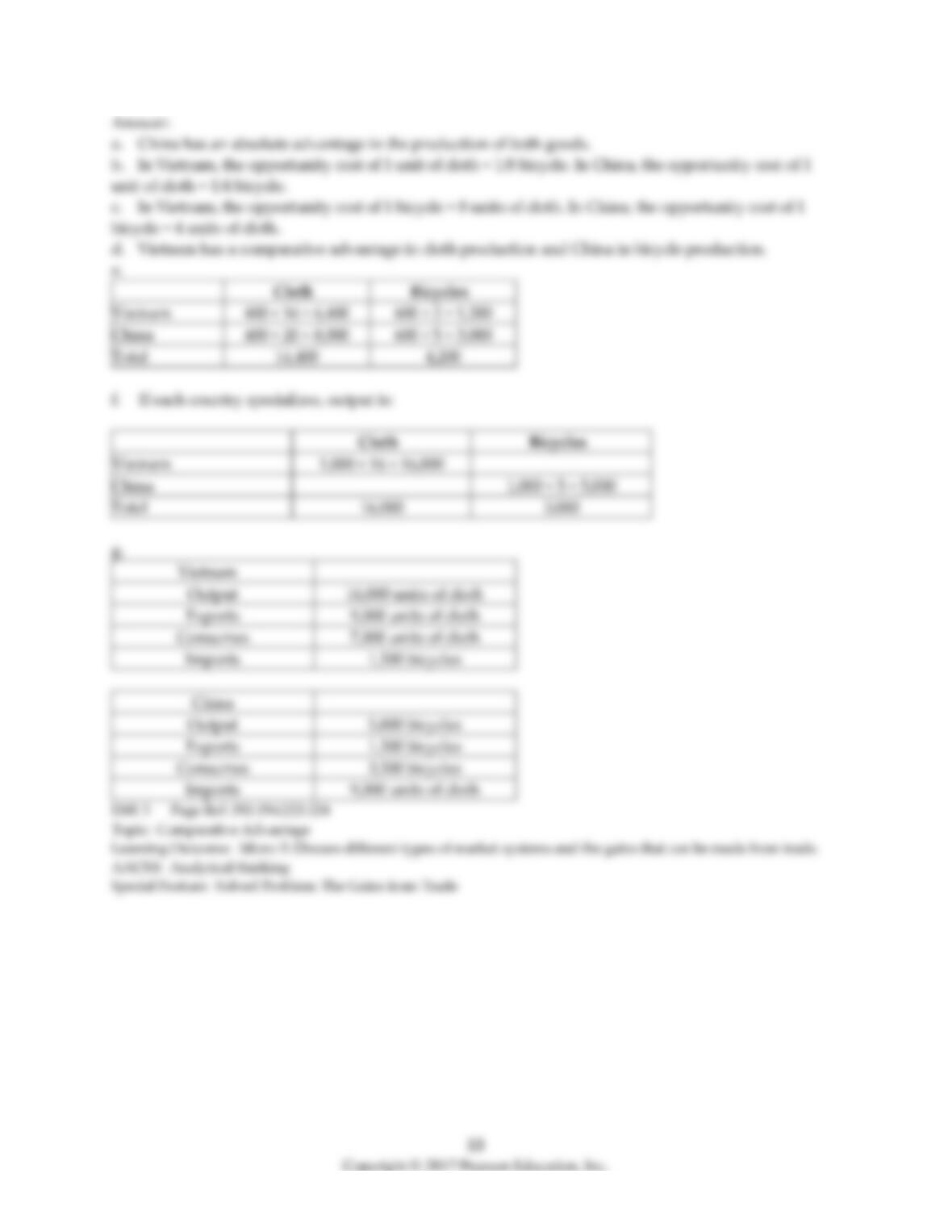
45) Suppose in Vietnam a worker can produce either 16 units of cloth or 2 bicycles while in China a
worker can produce either 20 units of cloth or 5 bicycles.
a. Which country has an absolute advantage in cloth production? In bicycle production?
b. What is the opportunity cost of 1 unit of cloth in Vietnam? In China?
c. What is the opportunity cost of 1 bicycle in Vietnam? In China?
d. Which country has a comparative advantage in cloth production? In bicycle production?
e. Suppose each country has 1,000 workers. Currently, each country devotes 40 percent of its labor
force to cloth production and 60 percent to bicycle production. What is the output of cloth and bicycles
for each country and what is the total output of cloth and bicycles between the two countries?
f. Suppose each country specializes in the production of the good in which it has a comparative
advantage. What is the total output of cloth and bicycles in the two countries?
g. Provide a numerical example to show how Vietnam and China can both gain from trade. Assume
that the terms of trade are established at 6 units of cloth for 1 bicycle.
7.4 Government Policies That Restrict International Trade
1) Free trade refers to trade between countries
A) that is without shipping costs.
B) that is licensed by both governments.
C) that is without restrictions.
D) of products which are free to low-income consumers.
Figure 7-1
Figure 7-1 shows the U.S. demand and supply for leather footwear.
2) Refer to Figure 7-1. Under autarky, the equilibrium price is
A) $0.
B) $24.
C) $30.
D) $54.
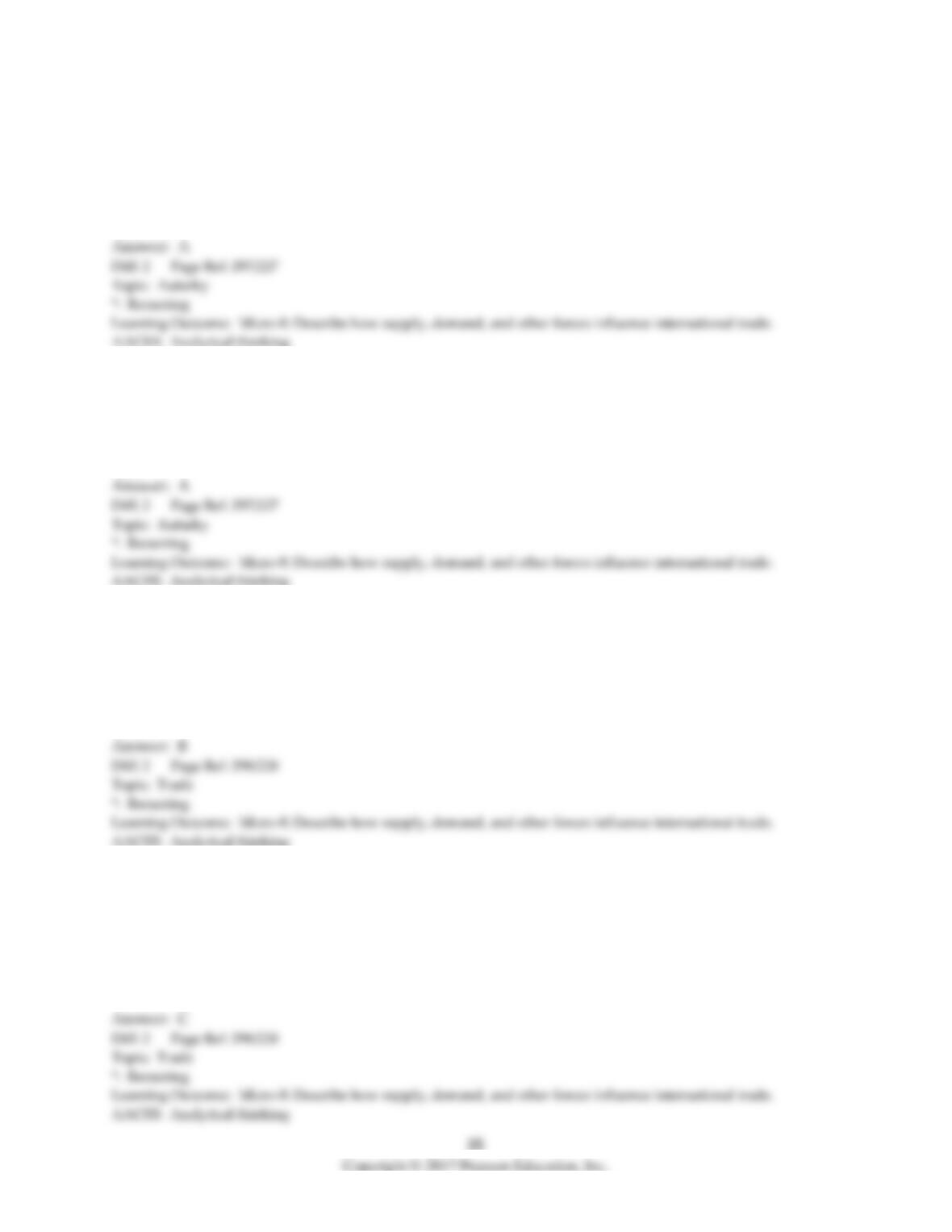
3) Refer to Figure 7-1. Under autarky, the consumer surplus is area
A) R.
B) S.
C) R + S + V.
D) S + V.
4) Refer to Figure 7-1. Under autarky, the producer surplus is area
A) S + V.
B) T + W + X.
C) V.
D) S + T + V + W + X.
5) Refer to Figure 7-1. Suppose the government allows imports of leather footwear into the United
States. What will the market price be?
A) > $24
B) $24
C) $30
D) $54
6) Refer to Figure 7-1. Suppose the government allows imports of leather footwear into the United
States. What will be the quantity demanded?
A) Q0
B) Q1
C) Q2
D) Q2 – Q0
7) Refer to Figure 7-1. Suppose the government allows imports of leather footwear into the United
States. What will be the domestic quantity supplied?
A) Q0
B) Q1
C) Q2
D) Q2 – Q0
8) Refer to Figure 7-1. Suppose the government allows imports of leather footwear into the United
States. What will be the quantity of imports?
A) Q0
B) Q1
C) Q2
D) Q2 – Q0
9) Refer to Figure 7-1. Suppose the government allows imports of leather footwear into the United
States. The market price falls to $24. What area represents consumer surplus?
A) R + S
B) R + S + T + U
C) V + W + X + Y
D) R + S + V
10) Refer to Figure 7-1. Suppose the government allows imports of leather footwear into the United
States. The market price falls to $24. What area represents domestic producer surplus?
A) T + U
B) V
C) V + W + X + Y
D) W + X + Y
11) Which of the following is an example of a trade restriction?
A) Japan places a tax on all Korean automobiles.
B) Domestic wine is more expensive than wine imported from Chile.
C) The United States, Canada, and Mexico sign the NAFTA agreement.
D) Consumers prefer German beer to domestic beer.
12) International trade
A) harms consumers but helps exporting firms.
B) helps consumers but harms exporting firms and their workers.
C) helps consumers but hurts firms that are less efficient than their foreign competitors.
D) helps consumers and firms that compete with their foreign competitors.
13) A quota is
A) a limit placed on the quantity of goods that can be imported into a country.
B) a tax imposed by a government on goods imported into a country.
C) a subsidy granted to importers of a vital input.
D) a health and safety restriction imposed on an imported product.
38
14) A tax imposed by a government on imports of a good into a country is called a
A) tariff.
B) quota.
C) value added tax.
D) sales tax.
15) Which of the following is the best example of a quota?
A) a subsidy from the U.S. government to domestic manufacturers of residential air conditioners to
enable them to compete more effectively with foreign producers
B) a limit on the quantity of residential air conditioners that can be imported from a foreign country
C) a $150 fee imposed on all imported residential air conditioners
D) a tax placed on all residential air conditioners sold in the domestic market to help offset the impact of
emissions on the environment
16) Which of the following is the best example of a tariff?
A) a subsidy from the U.S. government to domestic manufacturers of residential air conditioners to
enable them to compete more effectively with foreign producers
B) a limit on the quantity of residential air conditioners that can be imported from a foreign country
C) a $150 fee imposed on all imported residential air conditioners
D) a tax placed on all residential air conditioners sold in the domestic market to help offset the impact of
emissions on the environment
39
17) A tariff
A) makes domestic consumers better off.
B) makes both domestic producers and consumers better off.
C) makes everyone worse off.
D) makes domestic producers better off.
18) A quota
A) makes domestic consumers worse off.
B) makes both domestic producers and consumers better off.
C) makes everyone worse off.
D) makes domestic producers worse off.
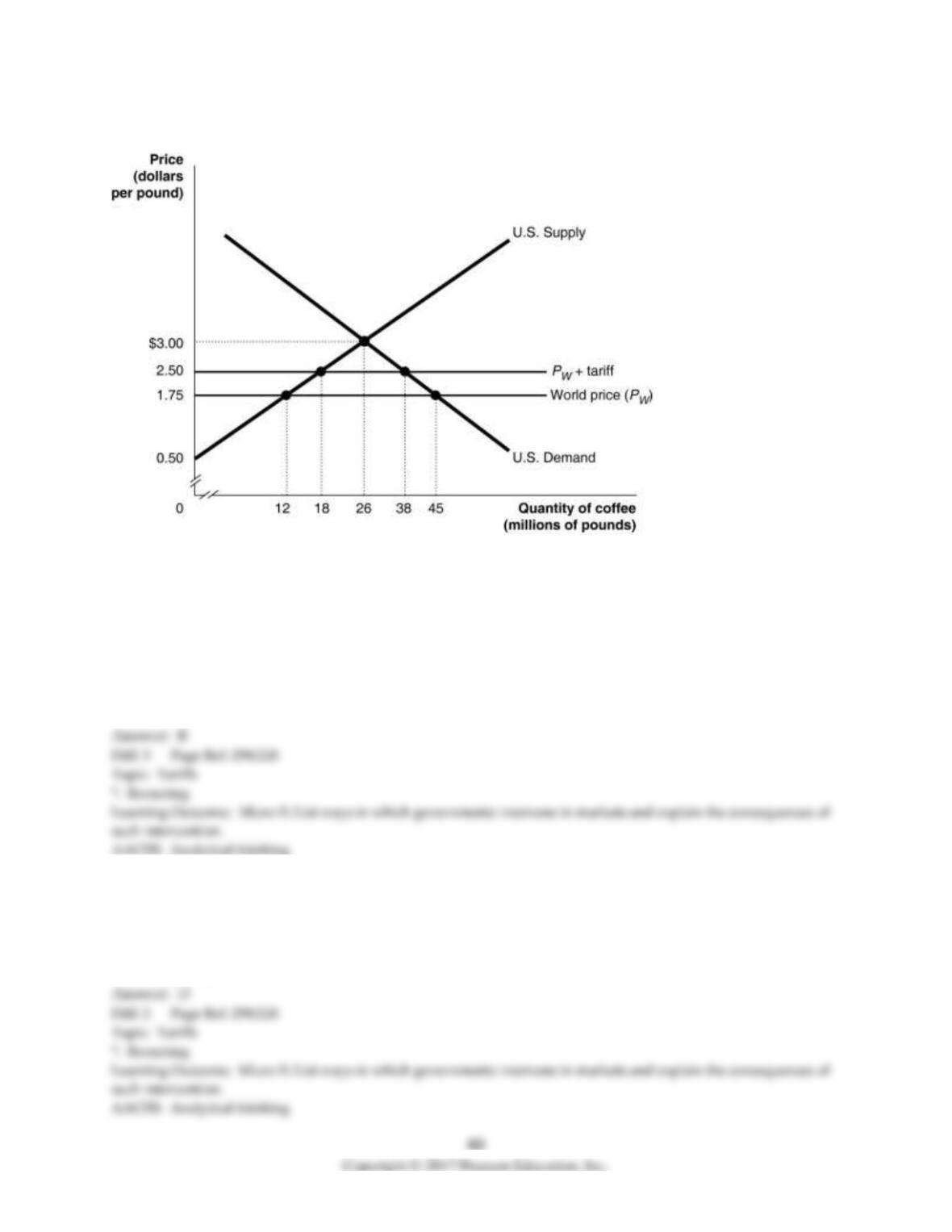
Figure 7-2
Suppose the U.S. government imposes a $0.75 per pound tariff on coffee imports. Figure 7-2 shows the
impact of this tariff.
19) Refer to Figure 7-2. The tariff revenue collected by the government equals
A) $10 million.
B) $15 million.
C) $19.875 million.
D) $35 million.
20) Refer to Figure 7-2. Without the tariff in place, the United States consumes
A) 12 million pounds of coffee.
B) 26 million pounds of coffee.
C) 33 million pounds of coffee.
D) 45 million pounds of coffee.