49) The real interest rate is
A) the nominal interest rate plus the anticipated inflation rate.
B) the nominal interest rate minus the anticipated inflation rate.
C) the nominal interest rate plus a COLA.
D) the nominal interest rate plus the GDP deflator.
50) If the nominal interest rate is 4 percent and the anticipated inflation rate is 6 percent, then
A) the real interest rate is -10 percent.
B) the real interest rate is 10 percent.
C) the real interest rate is -2 percent.
D) the real interest rate is 2 percent.
51) During an unanticipated inflation
A) creditors are helped and debtors are hurt.
B) creditors are hurt and debtors are helped.
C) both creditors and debtors are hurt.
D) both creditors and debtors are helped.
52) An automatic increase in a wage rate found in some contracts is known as a
A) change of labor agreement.
B) cost of labor arrangement.
C) cost of living adjustment.
D) charge for living amendment.
53) How is inflation related to interest rates?
54) What are the costs to society of inflation? Who is harmed by inflation and who benefits?
7.5 Changing Inflation and Unemployment: Business Fluctuations
1) The term “business fluctuations” refers to
A) changes in overall business activity, as evidenced by changes in national income,
employment, and the price level.
B) changes in the general price level from inflation to deflation, or vice versa.
C) changes in the full employment level of economic activity.
D) changes in the value of the dollar.
2) In sequential order, the four phases of the business cycle are
A) trough, peak, expansion, contraction.
B) peak, contraction, trough, expansion.
C) expansion, contraction, peak, trough.
D) contraction, trough, peak, expansion.
3) The peak phase of the business cycle represents
A) a temporary maximum output level of Gross Domestic Product (GDP).
B) an increase in foreign investment.
C) a labor surplus.
D) falling prices.
4) When economy-wide business activities are increasing, they are referred to as
A) contractions.
B) expansions.
C) anti-cycles.
D) corrections.
5) A recession may be defined as
A) a period during which the rate of growth of business activity is consistently less than its long-
term trend.
B) an increase in real economic output from one period to the next.
C) no change in real economic output over a period of time.
D) no change in the dollar (money) value of economic output over a period of time.
6) All of the following are signals of a recession EXCEPT
A) a cyclical reduction in employment of labor.
B) a slight reduction in a currently high rate of growth in economic activity.
C) increasing unemployment.
D) a falling level of economic activity.
7) An economy recovering from a recession moves
A) up from its trough to a period of expansion.
B) up from its peak to a period of expansion.
C) down from its trough to a period of depression.
D) down from its peak to a period of expansion.
8) During a recession
A) incomes rise and employment decreases.
B) incomes fall and unemployment increases.
C) incomes fall and unemployment falls.
D) incomes rise and unemployment increases.
9) When economy-wide business fluctuations are negative, they are referred to as
A) contractions/recessions.
B) booms.
C) expansions.
D) peaks.
10) Contractions are characterized by
A) increases in the rate of growth of economic activity.
B) an upward movement toward a peak in economic activity.
C) a downward movement toward a trough in economic activity.
D) a long period in which no cycles are observed in economic activity.
11) The business cycle phase that must come before the peak is a(n)
A) trough.
B) expansion.
C) recession.
D) contraction.
12) When, over a sustained period of time, the growth of aggregate business activity falls below
what is considered the normal growth rate, the economy necessarily experiences
A) inflation.
B) deflation.
C) an expansion.
D) a recession.
13) A period of time in which the overall business activity is rising at a rapid rate is known as
A) inflation.
B) hyperinflation.
C) an expansion.
D) a contraction.
14) The official dating of recessions is done by
A) the President.
B) the Congress.
C) the National Bureau of Economic Research.
D) the Council of Economic Advisors.
15) An extremely severe recession is known as a
A) trough.
B) peak.
C) contraction.
D) depression.
16) A period of time in which the overall pace of business activity is falling is known as
A) inflation.
B) deflation.
C) an expansion.
D) a contraction.
17) A period in which the level of business is consistently less than its long-term trend is known
as
A) depression.
B) recession.
C) business cycle.
D) growth trend.
18) A period of time in which the overall pace of business activity is rising is known as
A) inflation.
B) deflation.
C) an expansion.
D) a contraction.
19) The official dating of recessions is done by
A) the Council of Economic Advisors.
B) the National Bureau of Economic Research.
C) the Government Accounting Office.
D) the Secretary of the Treasury.
20) The long-run trend in business activity is
A) downward.
B) constant.
C) upward.
D) such that it cannot be described as a trend.
21) Business fluctuations
A) influence unemployment but not inflation.
B) influence inflation but not unemployment.
C) can influence inflation and unemployment.
D) have no influence on inflation and unemployment.
125
22) Which of the following would be considered an external shock?
A) a decline in tax revenues during a recession
B) a recession
C) a depression
D) a war
23) Which of the following is a TRUE statement?
A) All recessions are due to external shocks.
B) Ultimately, no recession has been due to an external shock.
C) There have been recessions that cannot be explained by external shocks.
D) All recessions and all expansions are due to external shocks.
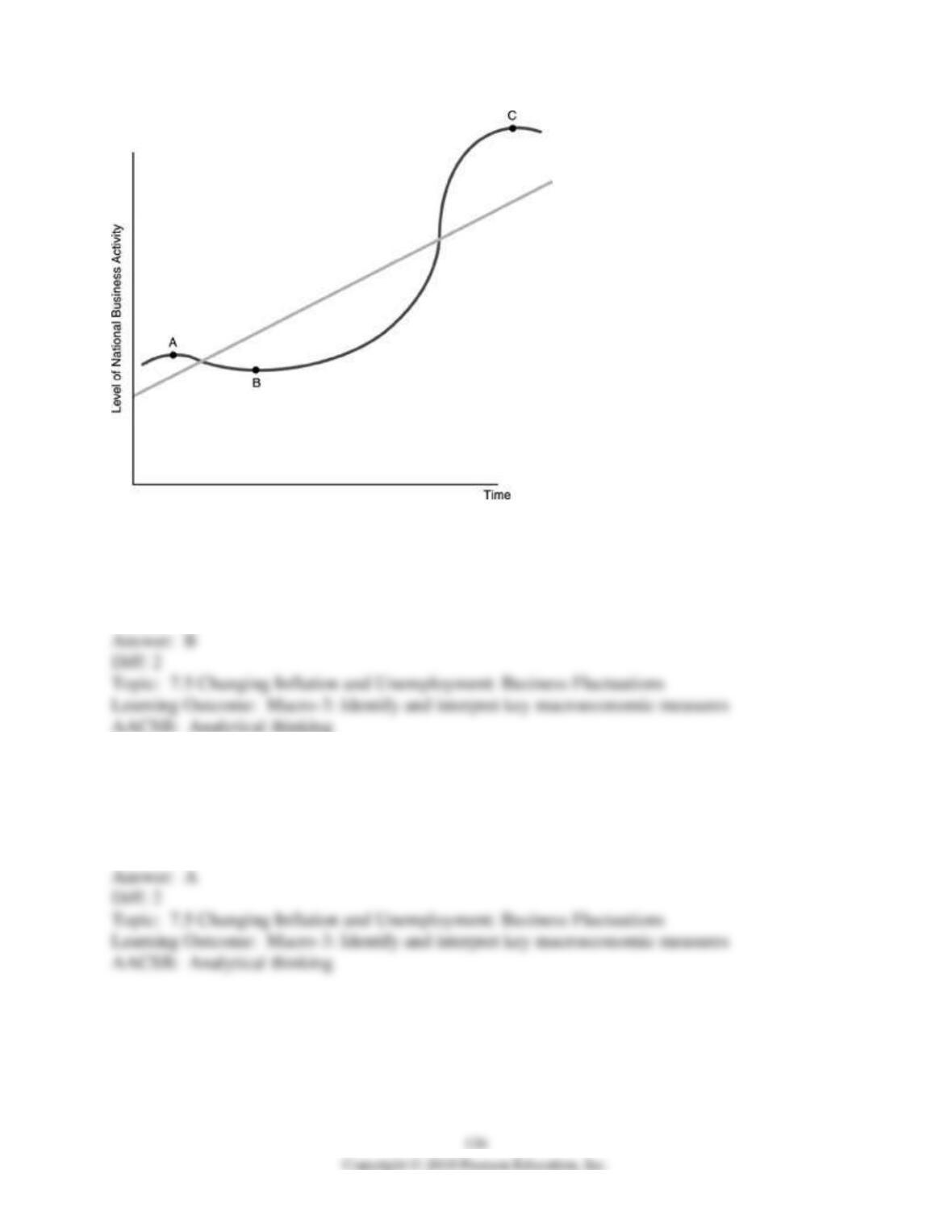
24) Refer to the above figure. Point B is known as
A) a peak.
B) a recession.
C) an expansion.
D) a contraction.
25) Refer to the above figure. Point C is known as
A) a peak.
B) a trough.
C) an expansion.
D) a contraction.
26) Refer to the above figure. The points between A and B are known as
A) a peak.
B) a trough.
C) an expansion.
D) a contraction.
27) Refer to the above figure. The points between B and C are known as
A) a peak.
B) a trough.
C) an expansion.
D) a contraction.
28) Refer to the above figure. A recession is best described as
A) the upward linear line.
B) the period between Point B and Point C.
C) the period between Point A and Point B.
D) none of the above.
29) Refer to the above figure. At Point B, the actual unemployment rate
A) will decrease over time.
B) is negative.
C) tends to be higher than the natural unemployment rate.
D) tends to be lower than the natural unemployment rate.
30) Ups and downs in business activity are referred to as
A) ebb and flow.
B) contractions.
C) variability.
D) business fluctuations.
31) Business fluctuations in the United States are
A) smooth and steady.
B) predictable.
C) controllable.
D) irregular and unpredictable.
32) Examples of external shocks are all of the following EXCEPT
A) war.
B) drought.
C) oil shock.
D) U. S. federal tax policies.
33) When the economy is experiencing a contraction, there is an increase in
A) frictional unemployment.
B) structural unemployment.
C) seasonal unemployment.
D) cyclical unemployment.
34) The trough of a contraction is
A) the point in time at which the level of national business activity reaches a minimum before
expanding again.
B) the point in time at which the level of national business activity reaches a maximum before
contracting again.
C) the rate at which the level of business activity is declining.
D) an external shock that causes economic activity to decline.
35) How has the pattern of fluctuations in overall U.S. business activity changed since World
War II?
A) It has become less volatile.
B) Expansions have been eliminated.
C) Contractions have been eliminated.
D) Recessions have been eliminated.
36) Changes in business activity are
A) referred to as business fluctuations.
B) referred to as the ebb and flow of business.
C) always undesirable.
D) caused by the changing seasons every year.
37) A decline in business activity is called
A) a recession.
B) a trough.
C) an expansion.
D) a peak.
38) Which of the following would be a leading indicator?
A) the number of unemployment claims
B) the real interest rate
C) personal income in the United States
D) an increase in stock prices
39) Which of the following statements is correct?
A) The depth and the length of all business cycles are identical.
B) The depth and the length of all business cycles are different.
C) Business cycles are caused by seasonal unemployment changes.
D) Business cycles are caused by unanticipated inflation.
40) A severe and prolonged recession is called
A) a slump.
B) a stagnation.
C) a trough.
D) a depression.
41) Historically speaking, business fluctuations in an economy were more commonly referred to
as
A) inflationary pressures.
B) economic growth.
C) bulls and bears.
D) business cycles.
42) According to business activity charts for the last 100 years, the point of the highest business
activity in the United States occurred
A) during the 1920s bull market boom.
B) during World War II.
C) during the Vietnam War.
D) during the Clinton administration.
43) A business fluctuation when the pace of economic activity is slowing down is called
A) a reduction.
B) a contraction.
C) a depression.
D) a slowdown.
44) Typically during a recession
A) incomes fall, and unemployment falls.
B) incomes and unemployment rise.
C) incomes fall, and unemployment rises.
D) incomes increase, and unemployment falls.
45) Changes in leading indicators signal
A) the changes in the frictional and seasonal unemployment rate.
B) the changes that will occur in the economy.
C) the changes in the frictional unemployment rate and the changes in the inflation rate.
D) the changes in the market basket.
46) The National Bureau of Economic Research is
A) funded by Congress and evaluates the budget appropriations.
B) funded by the Federal Reserve Banks and analyzes the banking system.
C) a nonprofit organization and evaluates the business cycles.
D) a nonprofit organization and evaluates the U.S. monetary policy.
47) The period between the trough and the peak of a business fluctuation is called
A) the growth phase.
B) the spreading out.
C) the development.
D) the expansion.
48) Refer the above figure. Stage “1” of the economy is called
A) the top.
B) the peak.
C) the trend.
D) the climax.
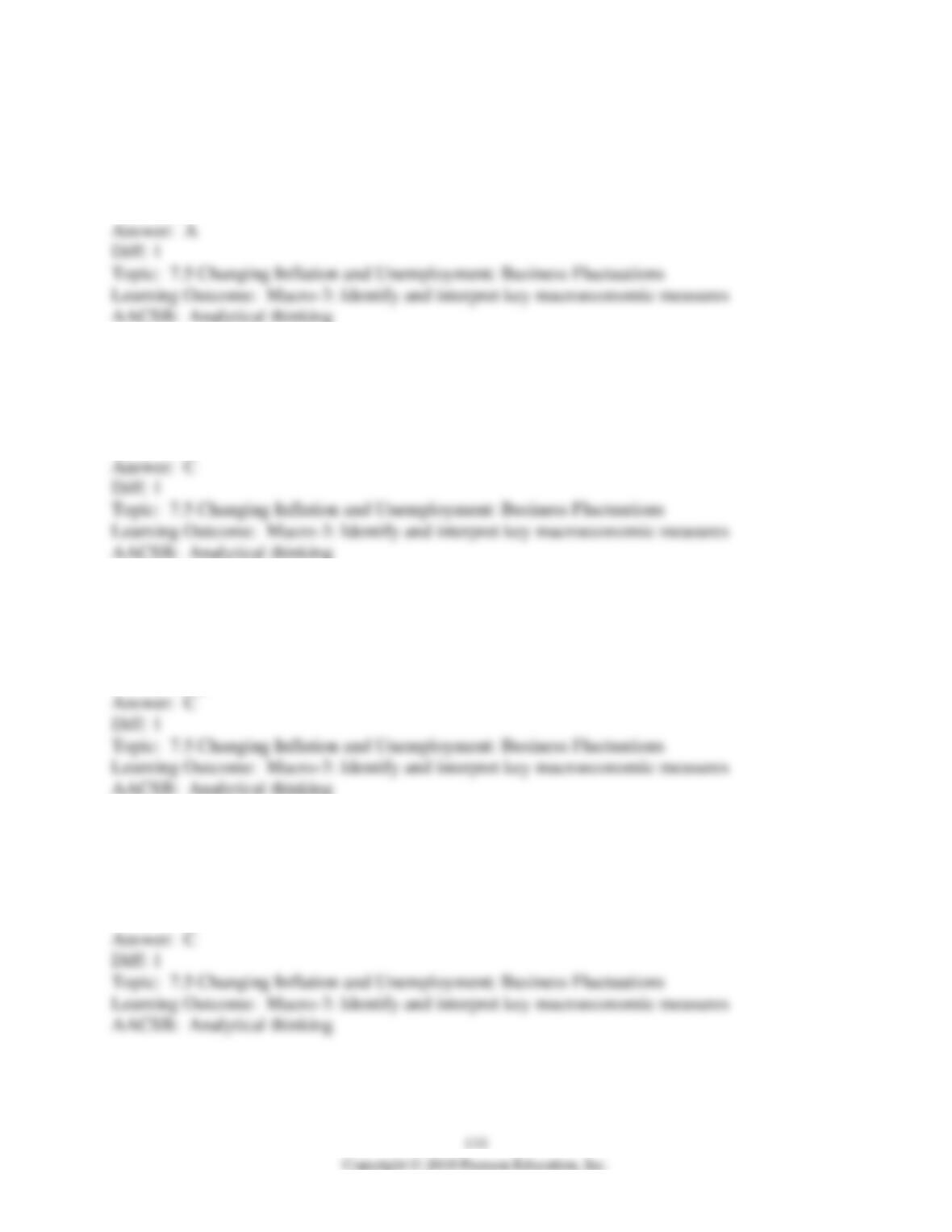
49) Refer the above figure. Stage “2” of the economy is called
A) a contraction.
B) a peak.
C) a trough.
D) an expansion.
50) Refer to the above figure. Stage “3” of the economy is called
A) a development.
B) a pit.
C) a trough.
D) a hole.
51) Refer the above figure. Stage “4” of the economy is called
A) a maturity.
B) a spreading out.
C) an expansion.
D) a development.
52) A business fluctuation when the pace of business activity is speeding up is known as
A) a contraction.
B) a trough.
C) an expansion.
D) a recession.
134
53) A huge snow storm that disrupted U.S. economic activity is known as
A) an external shock.
B) an expansion.
C) a demand shock.
D) an internal shock.
54) What is the business cycle? How “cyclical” is it? What causes the business cycle?