Macroeconomics: Policy and Practice, 2e (Mishkin)
Chapter 7 Drivers of Growth: Technology, Policy, and Institutions
7.1 Technology as a Production Input
1) The Solow model is used to explain ________.
A) why some economies experience higher rates of growth than others
B) the relationship between price and quantity demanded
C) the relationship between the rate of inflation and the rate of unemployment
D) the notion of opportunity cost
2) Another term for an economic variable whose value is given is ________.
A) endogenous
B) exogenous
C) autonomous
D) ornamental
3) Physical objects are rival in the sense that ________.
A) they are necessarily in opposition to one another
B) they are nontrivial
C) when they are used in one activity, they cannot be used in another
D) some countries possess natural resources, e.g. oil, while some do not
4) Which of the following is nonrival in character?
A) labor
B) capital
C) a desk
D) technology
5) The ability of an owner of a piece of property to deny its use to others is labeled ________.
A) excludability
B) rivalry
C) non-rivalry
D) lugubrious
6) Capital and labor are distinct from technology since ________.
A) technology is exogenous
B) technology is rival in its use
C) capital and labor are physical things
D) technology is a physical thing
7) The nonrivalrous character of technological ideas suggests that ________.
A) patent law protection is ultimately inefficient
B) technological change follows a logarithmic pattern
C) technology developed in one industry, e.g. the vodka industry, cannot be used in another
industry, e.g. the automobile industry
D) ideas can be used over and over again
8) Which of the following is most easily excludable?
A) ideas
B) capital
C) technology
D) a set of designs or instructions
9) Because original ideas are likely to become known and used by others, without the inventor’s
knowledge or consent, ________.
A) technology is the key driver of economic growth
B) new ideas contribute little to economic growth
C) we refer to ideas as rival
D) technology is inherently exogenous
3
7.2 Policies to Promote Productivity
1) Investments in public infrastructure ________.
A) are not subject to diminishing returns
B) are a misallocation of national savings
C) typically decline during periods of rapid economic growth
D) may boost productivity and income
2) Which of the following groups receives the highest wages?
A) high school drop-outs
B) college drop-outs
C) individuals who complete a bachelor’s degree program
D) individuals with advanced degrees
3) Building infrastructure is left to the government since ________.
A) the cost of such projects would not be economical for any individual firm
B) borrowing costs make such projects prohibitively expensive
C) inflation tends to erode the real value of debt
D) a natural monopoly would result if this activity were undertaken by an individual private firm
4) The U.S. interstate system was begun under ________.
A) President Franklin Delano Roosevelt in 1933 as part of the New Deal
B) President Herbert Hoover in 1923
C) President Dwight D. Eisenhower in 1956
D) President George W. Bush in 2002 after the 9/11 attacks
5) The Interstate Highway system in the U.S. has boosted economic productivity mainly through
________.
A) the positive impact on tourism
B) reduction in transportation costs
C) increased competition among fast food restaurants
D) increased speed of military deployments
4
6) The knowledge and skills that workers have built up through education and training programs
is known as ________.
A) the college premium
B) human capital
C) productivity
D) financial torsion
7) A key difference between human capital and technology is that ________.
A) human capital is excludable
B) human capital is nonrival
C) scarce resources are used in the production of human capital
D) technology is an input in the production of new technology
8) For the period 1915 to 2005, educational improvements in the U.S. labor force contributed
what percentage of real per-capita GDP growth?
A) 0.01
B) 15
C) 317
D) 34
9) U.S. educational achievements ________.
A) began to stagnate in the 1970s
B) have always fallen behind our European and Asian counterparts
C) have not had a measurable effect on U.S. growth rates
D) have not been duplicated outside the U.S.
10) Education achievements ________.
A) are a sufficient condition for economic development to occur
B) are a guarantee of making a poor country wealthy
C) cannot raise human capital
D) are both rival and nonrival in character
5
11) Government spending on child development promotes economic productivity by ________.
A) encouraging research and development
B) increasing national savings
C) increasing human capital
D) building infrastructure
12) Government spending on public health promotes economic productivity by ________.
A) encouraging research and development
B) increasing national savings
C) increasing human capital
D) building infrastructure
13) Private businesses tend to spend too little on research and development, because ________.
A) investments to increase the capital stock are a better way to boost productivity
B) governments tend to spend too much on research and development
C) patent laws make it difficult to reap the benefits of such spending
D) technology is often nonexcludable
14) The three ways government can encourage research and development are ________.
A) patents, foreign aid and direct government spending
B) foreign aid, direct government spending and tax incentives
C) direct government spending, tax incentives and patents
D) tax incentives, patents and foreign aid
15) Intellectual property rights provided by patent systems typically ________.
A) provide tax incentives to encourage research and development
B) allow for the depreciation of capital
C) compensate the government for building infrastructure
D) last about twenty years
6
16) Entities that buy up patents then try to extract large payments from companies that use
similar technologies are known as ________.
A) Solow pirates
B) tertiary leeches
C) Great Googly Mooglies
D) patent trolls
17) Patent trolls ________.
A) are paid by innovative firms to the federal government
B) buy up patents then attempt to extract large payments from firms using similar technology
C) develop new machines and machine processes in small-scale firms, rather than large
corporations
D) can evolve into natural monopolies
18) The Coca-Cola Company has chosen to keep its soda formula a secret, ________.
A) because soda is a non-rival good
B) to preserve its patent rights
C) because the soda formula is a rival good
D) to reap the benefits of excludability
19) According to the Solow model, which type of government spending is more likely to raise
the long-term growth rate of output per person, spending on infrastructure or spending on
research and development?
7
20) Use the distinction between rival and nonrival to explain the college premium.
21) Imagine that encryption and related technologies become so advanced that the knowledge
produced by research and development are as excludable as any other good, while technology
remains nonrival. In a world in which technology is both nonrival and excludable, do the
government policies of government spending on R&D, tax incentives for R&D, and patents
continue to make sense?
8
7.3 Institutions and Property Rights
1) The legal system in which the law is continually reinterpreted by judges is labeled ________.
A) a Napoleonic system of law
B) a tropicalismo system
C) a common law system
D) a constitutional system
2) According to Nobel Prize winner Douglass North, the most important factor in limiting
economic growth in developing countries today is ________.
A) the relatively low level of saving
B) the relatively high rate of inflation
C) the inability to develop effective low-cost contract enforcement
D) the inadequate state of the health care system
3) The legal system based on common law derives from the experience of which country?
A) France
B) England
C) Germany
D) Rome
4) English common law is particularly effective because ________.
A) it was derived from the Napoleonic codes of the period of industrialization
B) it is the only system that provides protection for personal property rights
C) it is able to evolve over time
D) of the diverse character of the British Empire
5) The elements of an effective legal system include ________.
A) strict limits on the ability of judges to interpret law
B) a temperate climate
C) a large body of legislators
D) an adequate supply of lawyers
9
6) The Doing Business reports provide information on ________.
A) the size of a country’s national debt
B) the rate of inflation
C) the independence of individual central banks
D) how easy it is to conduct business in different parts of the world
7) The Doing Business reports are considered by many economists to have contributed to
economic growth and poverty reduction. The effectiveness of the reports may be attributed to
________.
A) their encouragement to governments to reduce impediments to business
B) their encouragement to businesses to migrate to business-friendly locations
C) their deepening of economists’ understanding of economic growth
D) their exposing of corrupt officials and practices
8) Governments that steal from their own citizens are known as ________.
A) pure democracies
B) kleptocracies
C) Mugabes
D) antediluvians
9) Which of the following is poorest country?
A) Canada
B) Mexico
C) Haiti
D) New Orleans
10) The amount of foreign aid provided by the United States ________.
A) constitutes a major proportion of federal government outlays
B) is the highest in percentage terms for any developed market economy
C) averages about 2.7 percent of U.S. income per year
D) is a very small percentage of gross national income
10
11) Extreme global poverty is defined as ________.
A) income of less than one dollar a day
B) foreign debt in excess of 100% of GDP
C) one percent of U.S. income
D) one-fourth of U.S. income
12) Mobutu Sese Seko was President of ________.
A) Canada
B) Zaire
C) Cote d’Ivoire
D) Tajikistan
13) The impact of foreign aid on developing countries has been reduced by ________.
A) the low rate of saving in these countries
B) the Marshall Plan
C) the misuse of foreign aid funds by corrupt governments
D) the low rate of consumption in these countries
14) An example of foreign aid that has improved economic conditions is ________.
A) funding of public health programs
B) funding of the U.S. Interstate Highway System
C) programs to reduce foreign debt
D) the Napoleonic code
15) How does the centrality of institutions and property rights in economic growth help to
explain the predominance of rich countries in temperate climates and of poor countries in the
tropics?
7.4 Endogenous Growth Theory
1) The goal of endogenous growth theory is to explain ________.
A) supply and demand in individual markets
B) the causes of technological advance
C) the business cycle
D) the relationship between economic growth and the rates of inflation and unemployment
2) The Romer model is distinct from the Solow model in that the former assumes that ________.
A) technology is fixed
B) an increase in price affects quantity demanded, rather than demand
C) some labor is devoted to producing new technology
D) output per worker is fixed
3) The key endogenous variable in endogenous growth theory is ________.
A) the level of technology
B) the productivity of research and development
C) the growth rate of output
D) the level of per capita income
4) The quote, “If I have seen farther than others, it is because I have stood on the shoulders of
giants” is attributed to ________.
A) Albert Einstein
B) Paul Romer
C) Friedrich Nietszche
D) Sir Isaac Newton
5) A change in which of the following can change the long-run growth rate of the economy in the
Romer model?
A) investments in public infrastructure
B) the national saving rate
C) the fraction of the population engaged in and the productiveness of research and development
D) government spending and tax rates
6) A likely way to increase the productivity of workers engaged in research and development is
to ________.
A) increase the size of the labor force
B) increase the number of workers engaged in research and development
C) invest more in the education of scientists
D) increase the national saving rate
7) The key assumption of the Romer model that allows an explanation of sustained growth in
output per person is ________.
A) technology is nonrivalrous
B) the total amount of labor is fixed
C) some labor is devoted to producing new technology
D) the saving rate is fixed
8) Growth of output per person at a constant rate is referred to as ________.
A) a balanced growth path
B) a steady state
C) a ratio scale
D) an amplification effect
9) The result that the growth rate of output per worker is equal to 1.43 × is ________.
A) true of the Solow model only
B) true of both the Solow model and the Romer model
C) true of the Romer model only
D) true under the common-law legal system only
10) If the level of technology rises from 8 to 8.2 in one period, the growth rate of technology is
________.
A) 2.5 percent
B) 20 percent
C) two percent
D) 0.2 percent
13
11) Output per person is 170 in an economy in which 15 percent of the population are engaged in
research and development, where their productivity is 0.002, and the total population size is 100
million. If this economy is on a balanced growth path, then output per person in the next period
will be ________.
A) 175.1
B) 195.5
C) 176.2
D) 177.3
12) An economy with population 500 million has a research and development productivity of
0.0005, and its output per person has risen from one period to the next along its balanced growth
path from 350 to 362.5. The fraction of this economy’s population engaged in research and
development is ________.
A) 14%
B) 2.5%
C) 3.6%
D) 10 %
13) In a logarithmic scale ________.
A) the ratio of capital to labor is constant
B) the vertical axis lies along the horizontal axis
C) equal distances reflect the same percentage change
D) values along the vertical axis correspond to the square root of values along the horizontal axis
14) Because old ideas are an input in the production of new ideas, nothing prevents the growth
rate of output per person from rising without limit. Comment.
15) An economy has 20 million workers in research and development, where their productivity is
0.004, and the level of technology is 6.75. The depreciation rate is 0.15, and the saving rate is
0.2. The per worker production function is y = A (1–α), and there are 180 million production
16) The growth accounting equation is = + (0.3) + (0.7) . An economy with an initial
workforce of 50 million allocates 20 percent of them to research and development, where their
productivity is 0.003. If the labor input in this economy is growing at one percent, and the
growth rates of capital and output are equal, what is that common growth rate? Is this a realistic
scenario?
7.5 Factors That Affect Endogenous Growth
1) In the Romer model. as more labor is devoted to research and development ________.
A) there is an immediate decrease in output per capita
B) there is an immediate increase in output per capita
C) output per capita is unaffected, but the savings rate begins to rise
D) output per capita is unaffected, but the savings rate begins to fall
2) In the Romer model, as more labor is devoted to research and development there is ________.
A) an immediate increase in output per capita and a permanent increase in output per capita
B) an immediate decrease in output per capita and a permanent increase in output per capita
C) an immediate increase in output per capita and a permanent decrease in output per capita
D) an immediate decrease in output per capita and a permanent decrease in output per capita
3) The Romer model suggests that there is a trade-off between ________.
A) the use of resources in research and development and the productiveness of R&D
B) the rate of saving and the long-run growth of output
C) per capita output in the short-run and long-run
D) the size of the total population and the saving rate
4) Spending on education is likely to raise output per person by ________.
A) increasing the productiveness of R&D
B) by increasing the population
C) increasing the fraction of the population engaged in productive activities
D) increasing the saving rate
5) Endogenous growth theory supports the conclusion that ________.
A) government spending cannot influence the level of research and development
B) increased government spending on research and development is counterproductive
C) per capita income growth is a function of real factors, such as the supply of money
D) increased government spending on research and development is useful
6) One difference between a policy of direct spending by the government on research and
development and an alternative policy of tax incentives to encourage private spending on R&D is
________.
A) the former improves the productivity of R&D, while the latter raises its level
B) the former requires a decrease in national saving, while the latter causes an increase
C) the former raises the level of R&D spending, while the latter also improves its productivity
D) the former requires an increase in national saving, while the latter causes a decrease
7) According to the Romer model, tax incentives to support research and development will lead
to ________.
A) higher tax rates in the future
B) an increase in the general level of prices
C) a decrease in the general level of prices
D) increased per capita income
16
Assume that the growth rate of the capital stock in each period is determined by the level of
output in the previous period.
8) An economy of 80 million people has ten percent of them engaged in research and
development, where their productivity is 0.0035. The economy is on a balanced growth path,
when suddenly 2.88 million people move from goods production into R&D, raising the fraction
there to 13.6 percent. In the one period that begins with this labor reallocation, the growth rate of
output is ________. [Refer to the instruction above.]
A) 2.8%
B) 0.0%
C) 3.8%
D) 2.2%
9) An economy of 82 million people has twenty percent of them engaged in research and
development, where their productivity is 0.003. The economy is on a balanced growth path,
when suddenly the productiveness of R&D rises to 0.004. For the one period that begins with
this productivity increase, the growth rate of output is ________. [Refer to the instruction
above.]
A) 8.7%
B) 9.4%
C) 6.6%
D) 7%
10) An economy of 25 million people has twenty percent of them engaged in research and
development, where their productivity is 0.0056. The economy is on a balanced growth path,
when suddenly a wave of immigration raises the population to 27 million. Assume that the new
workers are immediately “on the job,” and that the fraction engaged in R&D remains twenty
percent. For the one period that begins with this population increase, the growth rate of output
per person is ________. [Refer to the instruction above.]
A) 4.3%
B) 1.8%
C) 3%
D) 8%
11) According to the Romer model, an increase in population will cause ________.
A) an immediate increase in output per capita and a permanent increase in output per capita
B) an immediate decrease in output per capita and a permanent increase in output per capita
C) an immediate increase in output per capita and a permanent decrease in output per capita
D) an immediate and permanent decrease in output per capita
12) The Solow model is distinct from the Romer model in that an increase in population tends to
cause ________.
A) a permanent decrease in the standard of living in the Romer model
B) an increase in spillover effects in the Solow model, but not in the Romer model
C) a permanent increase in the standard of living in the Solow model
D) a permanent increase in the standard of living in the Romer model
13) Technological spillover ________.
A) is made possible by the nonrivalry of ideas
B) generates an increase in both capital and labor
C) is caused by population growth
D) is caused by population decline
14) The observation that countries with high rates of population growth don’t have higher per
capita income ________.
A) suggests that the Solow model is unrealistic
B) implies that technology doesn’t work as well in countries where the population is growing
rapidly
C) is not supported by most empirical studies
D) is consistent with the Romer model as applied to the world as a whole
15) When technology improves in a country with a fast-growing population ________.
A) output rises, but output per person does not
B) output rises in that country, while output per person rises in other countries
C) output per person rises in that country and around the world
D) output per person rises temporarily, then declines
16) The current world population is more than ________.
A) 6 million
B) 6 billion
C) 6 trillion
D) 6 gazillion
17) The Romer and Solow models reach the same conclusion with respect to ________.
A) output growth in the long-run
B) the impact of changing population
C) the effect of an increase in the saving rate
D) the general level of prices
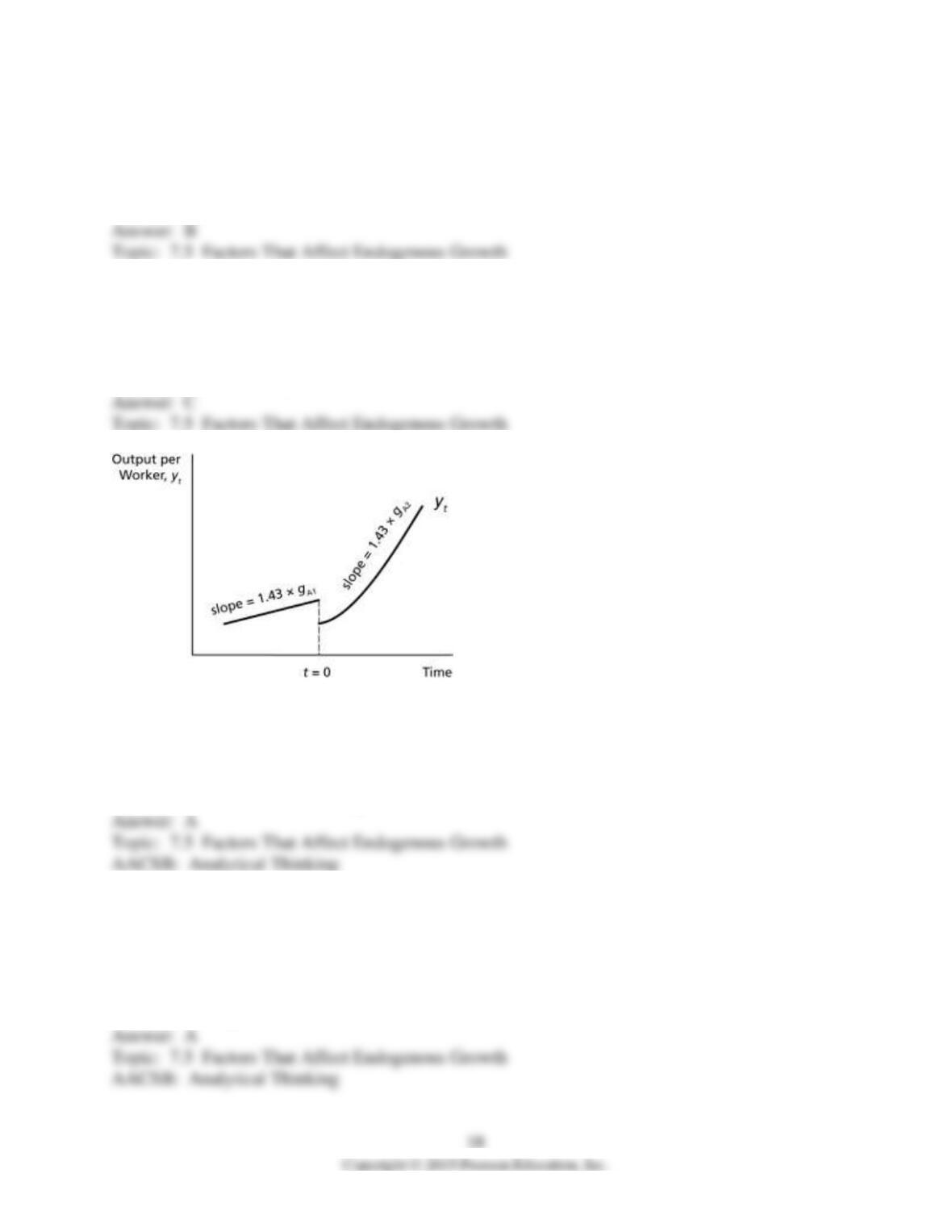
18) The graph above might represent the ________.
A) response to an increase in the fraction of the population engaged in research and development
B) response to a rise in the productiveness of research and development
C) response to an increase in the total population
D) response to a rise in the saving rate
19) On the graph above, for a while after t = 0, the growth rate of output per worker is ________
the growth rate prior to time zero, and ________.
A) below; rising
B) below; falling
C) above; constant
D) above; falling
20) On the graph above, for a while after t = 0, the growth rate of technology is ________ the
growth rate prior to time zero, and ________.
A) below; falling
B) below; rising
C) above; constant
D) above; falling
21) On the graph above, the constant value 1.43 is ________.
A) the productivity of labor devoted to research and development
B) the logarithmic scale
C) the amplification effect of improving technology
D) the initial level of technology
22) How might technological spillover explain why countries with high rates of population
growth don’t have higher per-capita income?
23) Suppose a wave of immigration increases the number of workers in research and
development without altering the labor input in production. Describe the impact on the level and
growth rate of output per worker, immediately, and as time passes.
20
24) Technology grows at a rate of three percent in an economy in which ten percent of the
workforce is engaged in research and development, where their productivity is 0.003. The
economy is on a balanced growth path, and the workforce is growing at two percent. Calculate
the growth rates of output, capital, and output per worker now, and five years from now.