37) The purchasing power of money increases when
A) the inflation rate increases.
B) there is inflation.
C) there is deflation.
D) there are more dollars in the economy.
38) The value of money for buying goods and services is known as
A) inflation.
B) nomination.
C) nominal income.
D) purchasing power.
39) Which of the following statements is TRUE if your money income stays the same but the
price of one good that you are buying goes up?
A) Your effective purchasing power falls.
B) Your nominal income has been decreased.
C) You will have to reduce the quantities you purchase of all goods.
D) Your real income has increased.
40) The greater the inflation rate, the
A) faster the decrease in the purchasing power of money.
B) slower the decrease in the purchasing power of money.
C) better it is to hold money as cash.
D) better it is to put money into savings accounts.
41) An increase in the price of electricity, ceteris paribus, indicates that
A) the purchasing power of money is decreasing.
B) the purchasing power of money is increasing.
C) electricity is relatively more scarce than it was before.
D) inflation is increasing.
42) The value of an item expressed in purchasing power that varies with the overall price level is
known as
A) inflation.
B) deflation.
C) the nominal value.
D) the real value.
43) The value of an item expressed in today’s dollars is known as
A) inflation.
B) deflation.
C) the nominal value.
D) the real value.
44) Robert received a $100 gift certificate to a bookstore a year ago. The economy has been in an
inflationary period for the last year. This gift certificate is
A) expressed in real terms and is worth more.
B) expressed in nominal terms and is worth less.
C) not expressed in either real or nominal terms since it is not money.
D) adjusted in terms of the CPI.
45) A price index is the
A) cost of a market basket of goods today.
B) cost of a market basket of goods and services a year ago expressed as a percentage of the cost
of the same market basket today.
C) cost of a market basket of goods and services today expressed as a percentage of the cost of
the same market basket during a base year.
D) year that is chosen as the point of reference for comparison of prices in other years.
46) In the base year the price index
A) will be between 1 and 100.
B) will always equal 100.
C) equals 100 times the cost of the market basket in the base year.
D) will equal the year.
47) The year that is chosen as the point of reference for comparison of prices in other years is
known as the
A) base year.
B) price index.
C) purchasing power.
D) consumer price index.
48) Last year a pair of jeans had a price of $20 and this year the price is $25. Which of the
following expresses this price change accurately?
A) If this year is the base year, the index number for last year would be 120.
B) If last year is the base year, the index number for this year would be 120.
C) If this year is the base year, the index number for last year would be 80.
D) If last year is the base year, the index number for this year would be 80.
49) Last year you purchased 20 shirts at $15 apiece, 30 CDs at $12 each, and 5 sweaters at $25
apiece. This year you buy 20 shirts at $20 apiece, 30 CDs at $12 apiece, and 5 sweaters at $20
apiece. If last year’s index was 100, this year’s index is
A) 91.3.
B) 102.0.
C) 109.5.
D) 9.5.
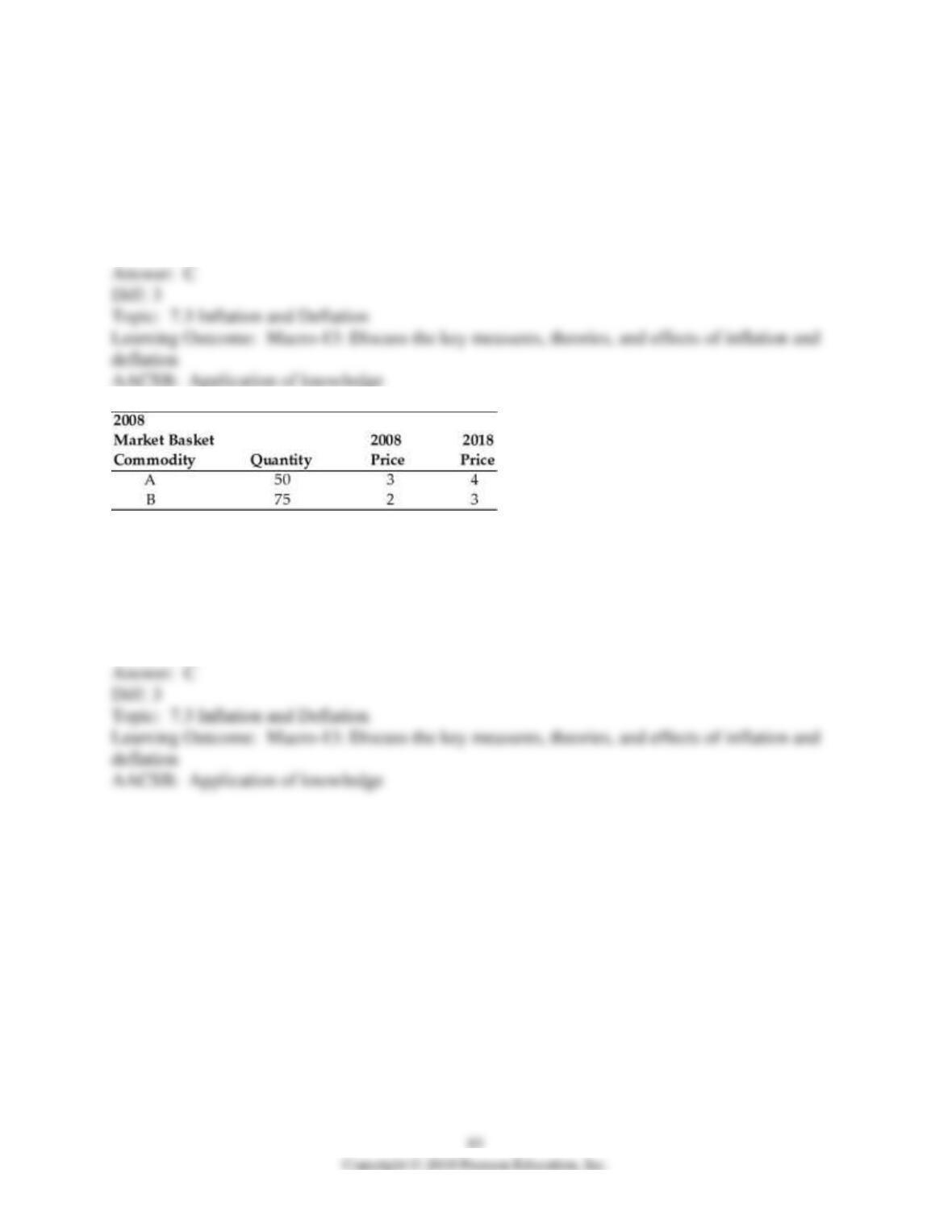
50) Refer to the above table. You are given information on Collin’s consumption for 2008 and
2018. Using 2008 as the base year, compute the price index for 2018. The index equals
A) 1.5.
B) 70.588.
C) 141.667.
D) 107.143.
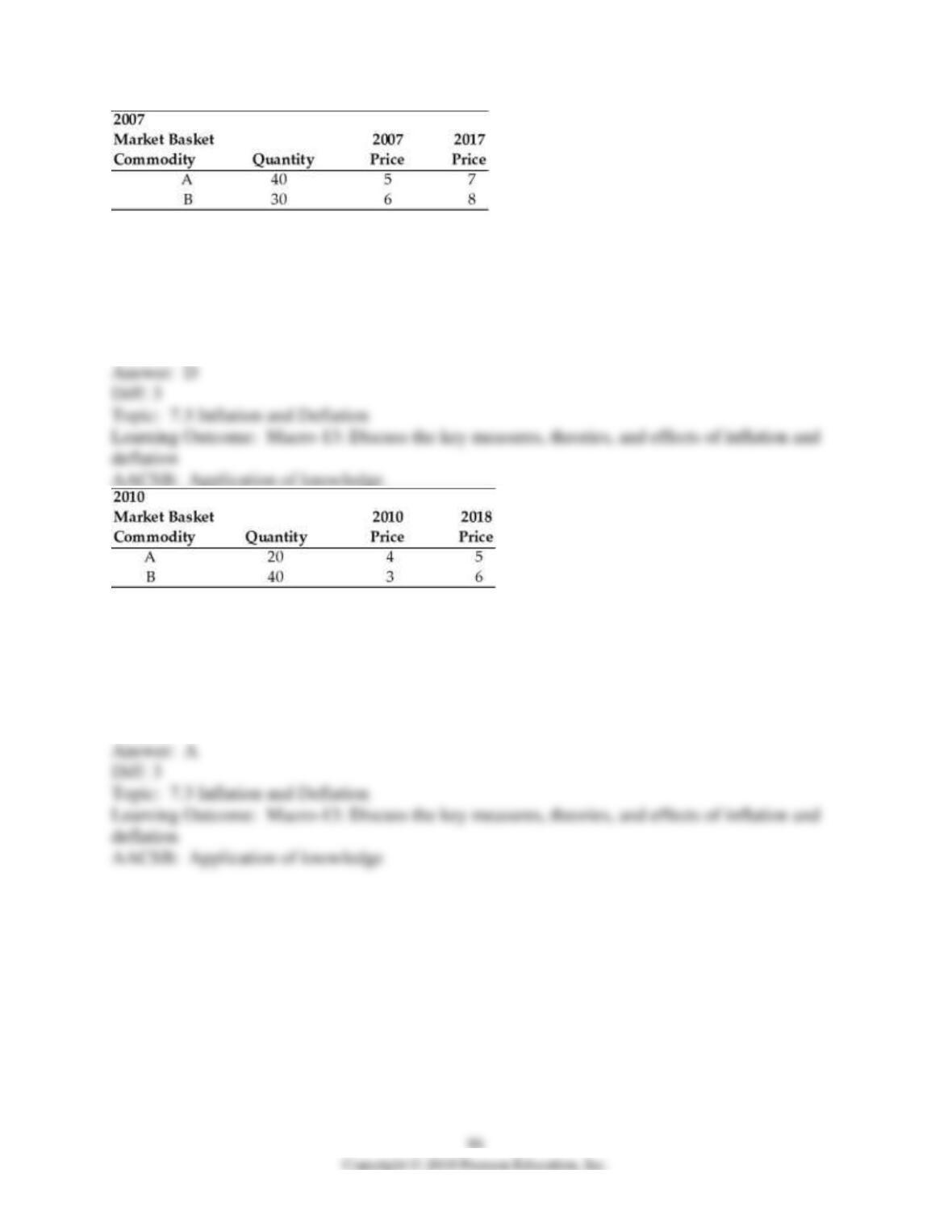
51) Refer to the above table. You are given information on Collin’s consumption for 2007 and
2017. Using 2007 as the base year compute the price index for 2017. The index equals
A) 0.75.
B) 73.007.
C) 87.50.
D) 136.842.
52) Refer to the above table. You are given information on Jasmin’s consumption for 2010 and
2018. Using 2010 as the base year compute the price index for 2018. The index equals
A) 170.
B) 58.823.
C) 0.5823.
D) 0.17.
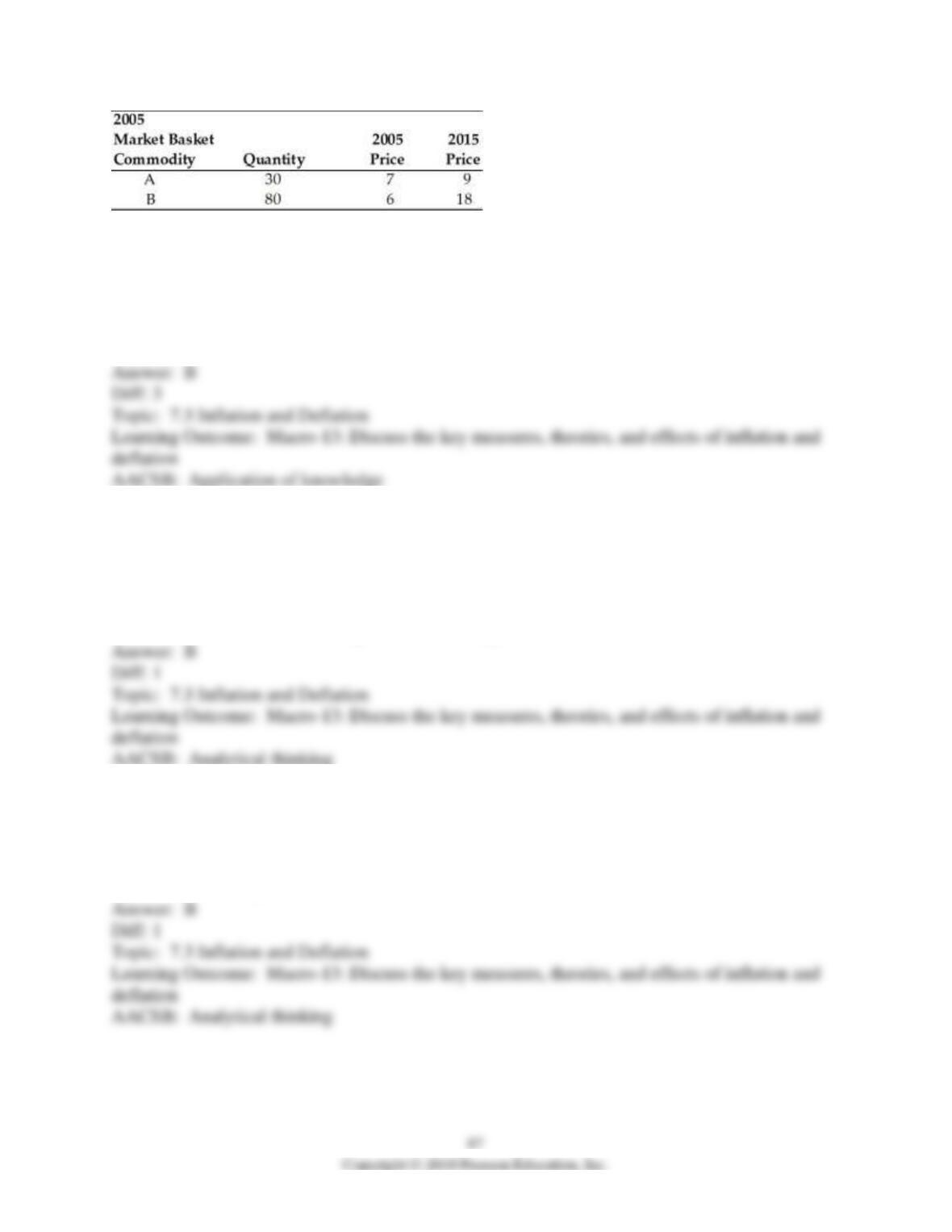
53) Refer to the above table. You are given information on Jasmin’s consumption for 2005 and
2015. Using 2005 as the base year compute the price index for 2015. The index equals
A) 40.35.
B) 247.826.
C) 0.4035.
D) 0.2478.
54) If all prices in the economy go up from one year to the next, the CPI index, using the
previous year as the base would
A) be less than 100.
B) be greater than 100.
C) not be influenced since quantities have remained unchanged.
D) not be determined since enough information is given.
55) When computing a price index, the base year is
A) the earliest year for which data are available.
B) the year that is chosen as the point of reference for comparison of prices with other years.
C) the most recent year for which data are available.
D) the most recent year in which the inflation rate was close to zero.
56) The GDP deflator is
A) an index that utilizes a consumer’s market basket of goods in calculating the inflation rate.
B) the most general indicator of inflation since it measures changes in the prices of all goods and
services in the economy.
C) an index used to calculate inflation at the wholesale level.
D) the least used index because it is so costly to calculate.
57) The Consumer Price Index (CPI) is a
A) statistical measure of a weighted average of prices of a specific set of goods and services
purchased by consumers in urban areas.
B) statistical measure of a weighted average of prices of commodities that firms produce and
sell.
C) price index measuring the changes in prices of all new goods and services produced in the
economy.
D) statistical measure of average prices using annually updated weights based on surveys of
consumer spending.
58) The Producer Price Index (PPI) is a
A) statistical measure of a weighted average of prices of a specific set of goods and services
purchased by wage earners in urban areas.
B) statistical measure of a weighted average of prices of commodities that firms produce and
sell.
C) price index measuring the changes in prices of all new goods and services produced in the
economy.
D) price index that tracks the price levee of commodities that firms purchase from other firms.
59) The Personal Consumption Expenditure Index (PCE) is a
A) statistical measure of a weighted average of prices of a specific set of goods and services
purchased by wage earners in urban areas.
B) statistical measure of a weighted average of prices of commodities that firms produce and
sell.
C) price index measuring the changes in prices of all new goods and services produced in the
economy.
D) statistical measure of average prices using annually updated weights based on surveys of
consumer spending.
60) The GDP deflator is a
A) statistical measure of a weighted average of prices of a specific set of goods and services
purchased by wage earners in urban areas.
B) statistical measure of a weighted average of prices of commodities that firms produce and
sell.
C) price index measuring the changes in prices of all new goods and services produced in the
economy.
D) price index that tracks the price level of commodities that firms purchase from other firms.
61) Suppose medical care makes up 5 percent of the CPI index, and that prices rise in the
medical care area faster than in the rest of the economy. An elderly couple spends 15 percent of
their income on medical care. For this couple, the CPI
A) understates the inflation rate because of the importance of medical care for this family.
B) overstates the inflation rate because this family is not typical of the country as a whole.
C) understates the inflation rate because the CPI always understates inflation.
D) is a good measure of inflation since the bias inherent in the CPI is offset by the increased
emphasis on health care for this family.
62) For the CPI. the value of the index in the base year
A) always equals 100.
B) depends upon price and quantity that are constantly changing.
C) is always greater than 100.
D) depends upon what prices did the year before.
63) The index that is NOT based on a fixed market basket of goods and services is the
A) CPI.
B) PPI.
C) Wholesale Price Index.
D) GDP Price Deflator.
64) The indices that are based on a fixed market basket of goods and services are
A) CPI and GDP deflator.
B) PPI and GDP deflator.
C) CPI and PPI.
D) CPI, PPI and GDP deflator.
65) The CPI tends to overstate the true inflation rate because
A) we cannot know what the true inflation rate is.
B) it fails to consider the effects of new products in the marketplace.
C) the market basket actually selected is inappropriate.
D) the market basket fails to weigh housing costs sufficiently.
66) Which of the following is NOT a criticism of the CPI?
A) The CPI does not account for the way consumer substitute less expensive items for higher
priced items.
B) The CPI ignores changes in consumption patterns that occur between years in which it revises
the index.
C) The CPI ignores successful new products until long after they have been introduced.
D) The CPI ignores the changes of prices of goods that firms produce and sell to each other.
67) Throughout U.S. history, inflation has been highest
A) right after a recession.
B) right before a recession.
C) during periods of war.
D) during Republican administrations.
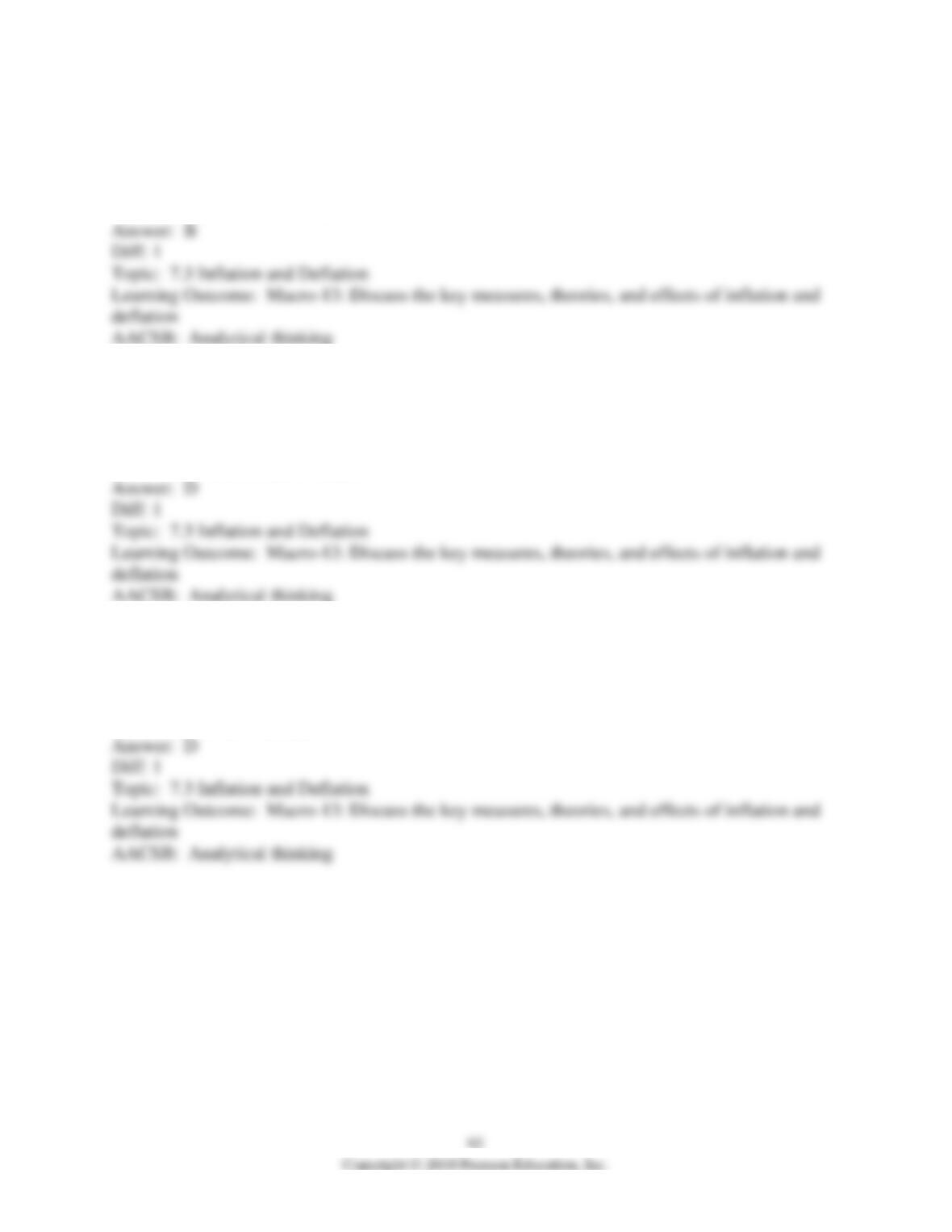
68) Using the above table, the following is the output of a two-product economy. The price index
in this economy in Year 2, assuming Year 1 is the base year, is
A) 113.0.
B) 88.5.
C) 107.1.
D) 106.7.
69) Inflation can be defined as
A) an increase in the purchasing power of money.
B) a decrease in the purchasing power of money.
C) no change in the purchasing power of money.
D) an increase in real income.
70) Which of the following is NOT a measure of the general level of prices?
A) Consumer Price Index
B) Producer Price Index
C) GDP Deflator
D) Personal Sales Deflator Index
71) An increase in inflation will cause a reduction in which of the following?
A) the nominal value of money
B) the Producer Price Index
C) the GDP deflator
D) the real value of money
72) Which one of the following is TRUE?
A) Inflation increases the real value of money.
B) In the base year, the value of a price index is 100.
C) The consumer price index measures changes in the average income of consumers.
D) The market basket defined for the consumer price index contains more items than does the
market basket defined for the GDP deflator.
73) Economists agree that the structure of the Consumer Price Index has some problems that
limit its usefulness as a reliable measure of inflation. What is one of these drawbacks?
A) It is based on the faulty assumption that each consumer buys only one unit of each item.
B) It is based on the faulty assumption that consumption choices are not influenced by income
levels.
C) It ignores changes in consumption patterns brought about by changes in the relative prices of
consumer goods.
D) It is based on a market basket of mail-order items and does not include the goods that
consumers typically purchase.
74) Which government agency compiles the consumer price index?
A) the Congressional Budget Office
B) the Government Accounting Office
C) the Bureau of Labor Statistics
D) It is not compiled by a government agency, but rather by an independent research institution
called the Conference Board.
75) Which is the broadest price index reported in the United States?
A) the CPI-U
B) the GDP deflator
C) the consumer price index
D) the producer price index
76) The GDP deflator is NOT a fixed-quantity price index, but the CPI is. What is the
significance of this fact?
A) The GDP deflator does not include enough items in its market basket.
B) A base year cannot be defined for the GDP deflator.
C) The GDP deflator reflects not only changes in prices, but also changes in consumption
patterns as consumers substitute between goods.
D) The GDP deflator overstates the true rate of inflation, whereas the CPI understates it.
77) How has the pattern of movements in the U.S. price level changed since World War II?
A) Periods of inflation have largely been eliminated.
B) Periods of deflation have largely been eliminated.
C) The annual rate of inflation has never risen above 3 percent.
D) The price level has become more volatile.
78) The price index for any designated base year must always equal
A) the CPI for that year.
B) 0.
C) 100.
D) one divided by the nominal price change for the year.
79) The government agency which has been given the task of calculating the Consumer Price
Index (CPI) is
A) the Bureau of Economic Research.
B) the Department of State.
C) the Council of Economic Advisors.
D) the Bureau of Labor Statistics.
80) The purchasing power of the dollar
A) increases as the price of basic goods and services increases.
B) is the amount of goods and services that can be purchased with the dollar.
C) has been rising in the United States since 1945.
D) has remained unchanged in the last 20 years.
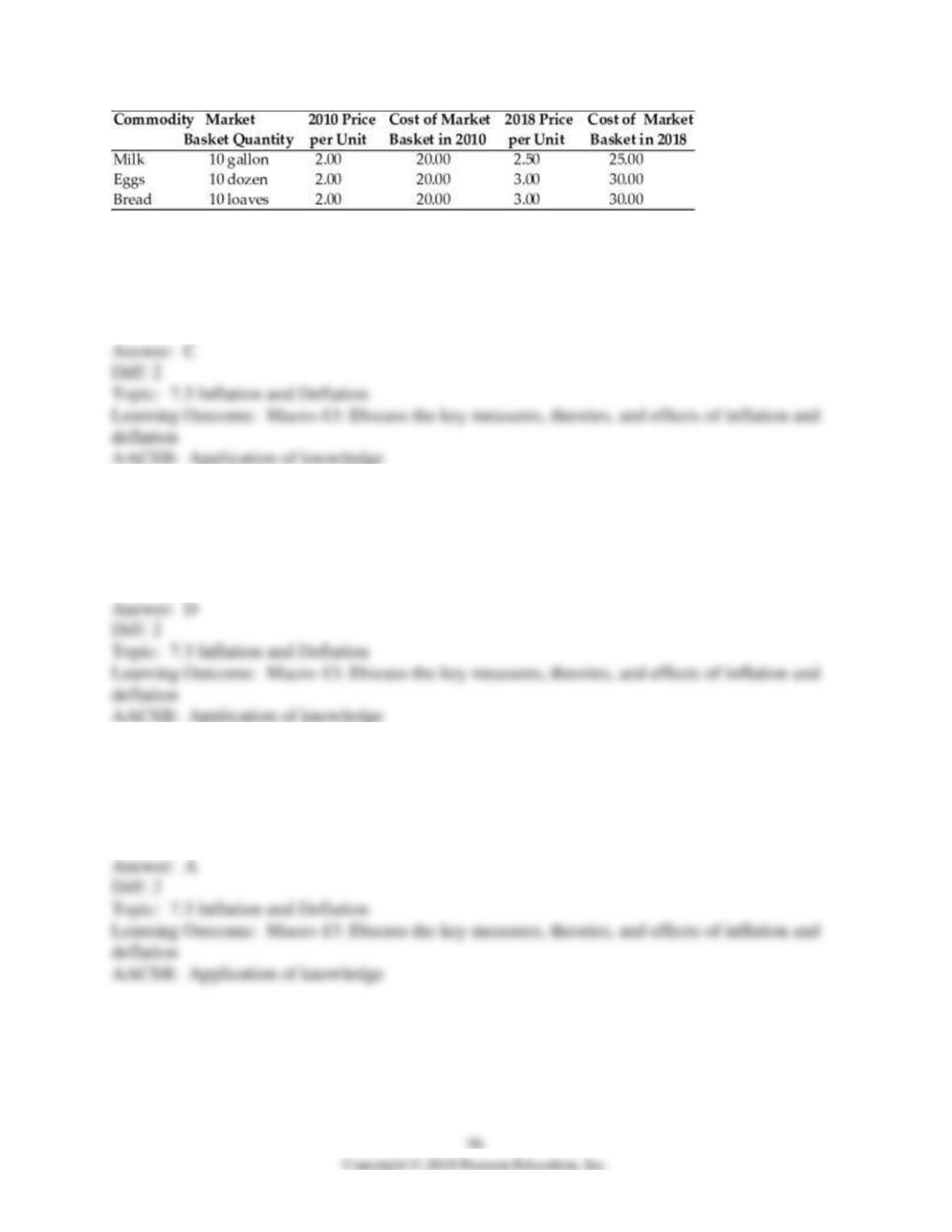
81) In the table shown above, the total cost of the market basket in 2010 was
A) $6.00.
B) $8.50.
C) $60.00.
D) $85.00.
82) In the table shown above, the total cost of the market basket in 2018 was
A) $6.00.
B) $8.50.
C) $60.00.
D) $85.00.
83) If 2010 is the base year in the table shown above, what is the price index for the year 2010?
A) 100.0
B) 121.3
C) 147.1
D) 141.7
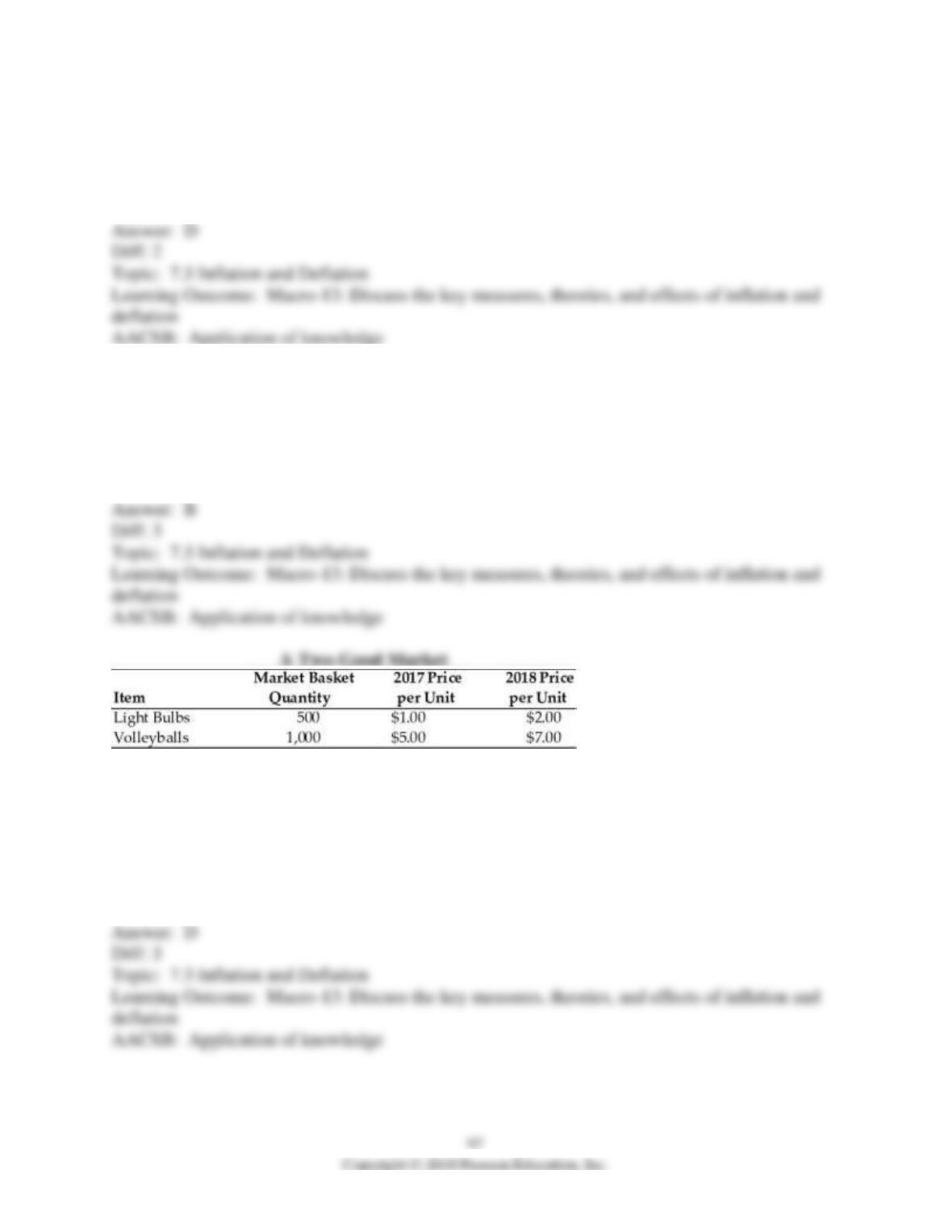
84) If 2010 is the base year in the table shown above, what is the price index for the year 2018?
A) 100.0
B) 114.7
C) 147.1
D) 141.7
85) Considering the data in the table shown above and 2010 as the base year, what is the
inflation rate between years 2010 and 2018?
A) 0.0 percent
B) 41.7 percent
C) 17.1 percent
D) 3.4 percent
86) In the table shown above, assuming that the market basket cost of light bulbs and volleyballs
in the base year was $4500, what would the price index for this two-good market equal in the
year 2017?
A) 104.86
B) 100.00
C) 112.52
D) 122.22
87) Considering the data from the table shown above, assuming that the market basket cost of
light bulbs and volleyballs in the base year was $4500, what would be the price index for the
year 2018?
A) 177.78
B) 156.30
C) 100.00
D) 92.70
88) In the United States, most often the ________ changes first, and the ________ follows.
A) CPI; PPI
B) GDP deflator; CPI
C) PPI; CPI
D) PCE; CPI
89) The term “market basket” means a
A) collection of goods that can fit into an average shopping cart.
B) collection of goods that changes every year and is defined by Congress.
C) collection of goods that is used by a typical family.
D) collection of goods that is purchased during a holiday season.
90) The market basket cost $300 in 2015, while it cost $250 in the base year. Therefore, the price
index for 2015 is
A) 83.
B) 120.
C) 80.
D) cannot be calculated because the inflation rate is not given.
91) You receive a five percent raise in your hourly wage. The inflation rate is four percent. Your
purchasing power has
A) increased.
B) decreased.
C) stayed the same.
D) is indeterminate.
92) You receive a 5 percent raise in your salary. The inflation rate is 6 percent. The purchasing
power of your salary has
A) increased by 1 percent.
B) decreased by 1 percent.
C) increased by 11 percent.
D) decreased by 11 percent.
93) In 2018, the price for a market basket of consumer goods is $1,300. In the base year, the cost
of the identical market basket was $1,000. The price index in this case is
A) 13.0.
B) 130.0.
C) 200.0.
D) 160.0.
94) In 2018, the price for a market basket of consumer goods is $800. In the base year, the cost
of the identical market basket was $1,000. The price index in this case is
A) 80.0.
B) 130.0.
C) 800.0.
D) 180.0.
95) According to your text, during the 2000s, the inflation rate was in which range of
percentages?
A) 0-5%
B) 5-10%
C) 10-15%
D) 15-20%