
Barro
Chapter 7
TRUE/FALSE
1. If the value of initial assets increases, then a household will change consumption or present value of
asset at the end of period 2 due to an income effect.
2. $100 a year from now is equal in worth to $100 today.
3. A discount factor is used to deflate nominal consumption to real consumption.
4. If wages rises by $10 per worker just this period, we would expect to see consumption rise by much
less than $10 this period.
5. The aggregate household budget constraint is consumption plus net investment is real GDP less
depreciation.
6. In the multiyear household budget constraint, wage incomes from each year are added together without
further adjustments.
7. In the multiyear household budget constraint, initial asset values are excluded.
8. An increase in the interest rate leads to an income effect and an intertemporal-substitution effect on
consumption which offset each other.
9. An increase in the interest rate leads to an income effect which increases consumption and saving in
year 1.
10. An increase in the interest rate leads to an intertemporal substitution effect which decreases
consumption and increases saving in year 1.
66
MULTIPLE CHOICE
1. Real profit is zero when:
a.
the interest rate is zero.
c.
the labor and capital markets clear.
b.
the depreciation rate is high.
d.
the labor and capital markets do not clear.
2. When the labor and capital markets clear:
a.
depreciation is zero.
c.
a dollar today is worth more than a dollar
in the future.
b.
real profit is zero.
d.
all of the above.
3. Real household saving is:
a.
B + K
c.
( B/P) + K
b.
B + ( K/P)
d.
( B/P) + ( K/P)
4. Real income is:
a.
wL + i(B+K)
c.
(w/P)L + i((B/P)+(K/P))
b.
(w/P)L + i((B/P)+ K)
d.
(w/P)L + i(B+ K)
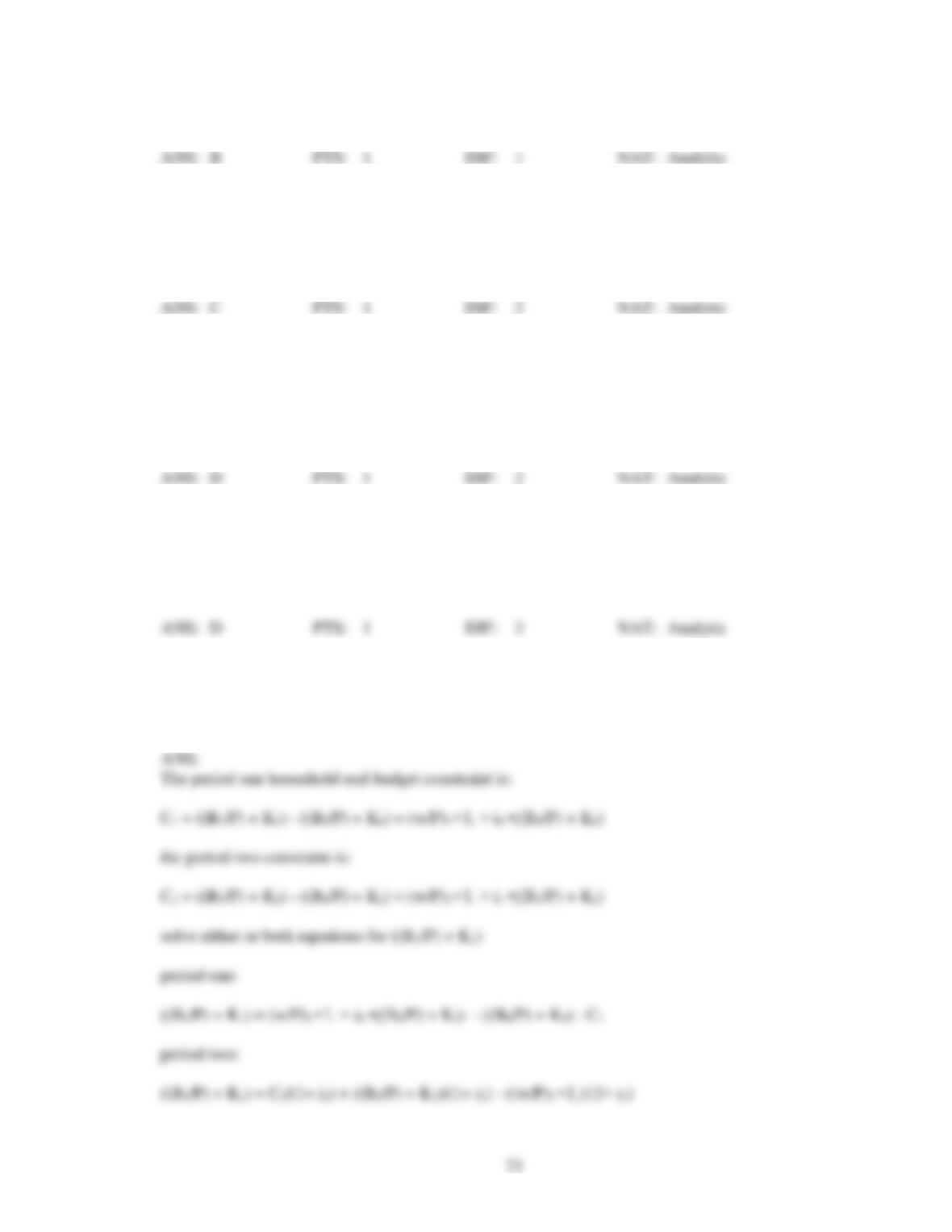
Figure 7.1
F
G
H
I
Real C
Real S
5. In Figure 7.1 if the household opts to consume all its income it will be at point:
a.
F
c.
H
b.
G
d.
I
6. In Figure 7.1 if the household decides to save all of its income, it would be at point:
a.
F
c.
H
b.
G
d.
I

67
7. In Figure 7.1 if the household moves from point G to point H on its budget, it would be:
a.
saving and consuming more.
c.
saving more and consuming less.
b.
saving less and consuming more.
d.
saving and consuming less.
8. In Figure 7.1 if the household moves from point I to point H on its budget, it would be:
a.
saving and consuming more.
c.
saving more and consuming less.
b.
saving less and consuming more.
d.
saving and consuming less.
9. In Figure 7.1 if the household moves from point F to point H on its budget, it would be:
a.
saving and consuming more.
c.
saving more and consuming less.
b.
saving less and consuming more.
d.
saving and consuming less.
10. In Figure 7.1 if the household moves from point H to point G on its budget, it would be:
a.
saving and consuming more.
c.
saving more and consuming less.
b.
saving less and consuming more.
d.
saving and consuming less.
11. In Figure 7.1 if the household moves from point H to point G on its budget, it would be:
a.
gaining one unit of saving and one unit of
consumption.
c.
gaining one unit of saving for giving up
five units of consumption.
b.
giving up one unit of saving for one unit
of consumption.
d.
giving up one unit of saving and five units
of consumption.
12. Real saving in year one is:
a.
real bonds plus capital in year 1 minus real
bonds and capital in year 0.
c.
bonds plus capital in period 1.
b.
bonds plus capital plus money period 1.
d.
interest times the sum of bonds plus
capital in period 1.
13. The household’s year one budget constraint is:
a.
real assets at the end of year zero plus real
income in year one less consumption in
year one equals real assets at the end of
year one.
c.
real assets at the end of year zero plus real
income in year one plus consumption in
year one equals real assets at the end of
year one.
b.
real income in year one less real assets at
the end of year zero less consumption in
year one equals real assets at the end of
year one.
d.
real income in year one plus consumption
in year one less real assets at the end of
year zero equals real assets at the end of
year one.
14. In the one period budget constraint sources of funds include:
a.
labor income.
c.
income from bonds.
b.
income from capital.
d.
all of the above.

15. In the one period budget constraint sources of funds include:
a.
labor income.
c.
capital gains.
b.
interests bearing money.
d.
all of the above.
16. In the one period budget constraint sources of funds include:
a.
capital gains.
c.
income from rising prices.
b.
income from capital.
d.
all of the above.
17. In the one period budget constraint sources of funds include:
a.
capital gains.
c.
income from bonds.
b.
inflation.
d.
all of the above.
18. In the one period budget constraint the uses of funds include:
a.
purchases of consumption goods.
c.
purchases of bonds.
b.
purchases of capital goods.
d.
all of the above.
19. In the one period budget constraint the uses of funds include:
a.
purchases of consumption goods.
c.
payment profits.
b.
payment of wages.
d.
all of the above.
20. In the one period budget constraint the uses of funds include:
a.
payment of transfers.
c.
payment of wages.
b.
purchases of capital goods.
d.
all of the above.
21. In the one period budget constraint the uses of funds include:
a.
payment of transfers.
c.
purchases of bonds.
b.
payment of wages.
d.
all of the above.
22. The measure used to reduce future consumption to today’s values is called:
a.
an implicit deflator.
c.
an escalator.
b.
a discount factor.
d.
a future value.
23. When a discount factor is multiplied times a future period variable it creates a:
a.
future value.
c.
a real variable.
b.
a present value.
d.
a nominal variable.

69
24. A dollar today is worth more than a dollar a year from now as long as:
a.
the interest rate is negative.
c.
the depreciation rate is negative.
b.
the interest rate is positive.
d.
the depreciation rate is positive.
25. An income effect is the response of households to changes in the present value of:
a.
relative prices.
c.
uses of funds.
b.
sources of funds.
d.
assets at the end of year two.
26. If the interest rate is greater than zero, then the concept of present value is that a dollar today:
a.
is worth more than a dollar a year from
now.
c.
will be worthless a year from now.
b.
is worth less than a dollar a year from
now.
d.
is worth the same as a year from now.
27. If the present value of assets at the end of year two is constant, an increase in the present value of
sources of funds must cause:
a.
consumption in periods one and two to
rise.
c.
consumption to rise in period one and fall
in period two.
b.
consumption in periods one and two to
fall.
d.
consumption to fall in period one and rise
in period two.
28. The present value of sources of funds is:
a.
the value of intial assets plus the present
value of wage income plus the present
value of assets at the end of year two.
c.
the present value of wage income plus the
present value of assets at the end of year
two.
b.
the value of initial assets plus the present
value of assets at the end of year two.
d.
the value of intial assets plus the present
value of wage income.
29. An increase in the interest rate:
a.
makes consumption in period two
relatively more expensive compared to
consumption in period one.
c.
makes consumption in period two
relatively cheaper compared consumption
in period one.
b.
does not change relative cost of
consuming in either period.
d.
discourages savings in each period.
30. If a household consumes one less unit in period 1, they can consume:
a.
on more unit in period two.
c.
one less unit in period two.
b.
(1 + i) more units in period two.
d.
no more in period two.
31. Utility in economics is:
a.
a product with a derived demand like
electricity.
c.
satisfaction or happiness.

70
b.
usefulness.
d.
all of the above.
32. Utility in economics:
a.
used to mean happiness.
c.
is what a person gets from a good.
b.
used to mean satisfaction.
d.
all of the above.
33. An increase in the interest rate can cause an income effect by:
a.
making future consumption cheaper.
c.
making present consumption cheaper.
b.
changing real income in year two.
d.
all of the above.
34. An increase in the interest rate:
a.
makes future consumption cheaper.
c.
makes present consumption more
expensive.
b.
increases future income.
d.
all of the above.
35. An increase in the interest rate:
a.
makes future consumption cheaper.
c.
makes present consumption cheaper.
b.
decreases future income.
d.
all of the above.
36. An increase in the interest rate:
a.
makes future consumption more
expensive.
c.
makes present consumption more
expensive.
b.
decreases future income.
d.
all of the above.
37. An increase in the interest rate:
a.
makes future consumption more
expensive.
c.
makes present consumption cheaper.
b.
increases future income.
d.
all of the above.
38. An intertemporal substitution effect is caused by a change in:
a.
a price from one period to another.
c.
income.
b.
wealth.
d.
all of the above.
39. The marginal propensity to save out of a temporary change in income is approximately:
a.
1
c.
0
b.
0.5
d.
none of the above.
40. The marginal propensity to save out of a permanent change in income is approximately:
a.
1
c.
0

b.
0.5
d.
none of the above.
41. The marginal propensity to consume out of a permanent change in income is approximately:
a.
1
c.
0
b.
0.5
d.
none of the above.
42. The marginal propensity to consume out of a temporary change in income is approximately:
a.
1
c.
0
b.
0.5
d.
none of the above.
43. If a worker receives a one time bonus we would expect them to:
a.
save most of it.
c.
consume most of it.
b.
refuse it.
d.
consume half and save half of it.
44. If a worker receives a bonus every Christmas, we would expect them to:
a.
save most of it.
c.
consume most of it.
b.
reject it.
d.
consume half of it and save half of it.
45. If a person wins $500 in a scratch-off lottery game, we would expect them to:
a.
save most of it.
c.
consume most of it.
b.
refuse it.
d.
consume half and save half of it.
46. If a worker gets a promotion that doubles their salary, with the increase in salary we would expect
them to:
a.
save most of it.
c.
consume most of it.
b.
reject it.
d.
consume half of it and save half of it.
47. If the household budget constraint is aggregated over all household, it shows that:
a.
consumption plus net investment equal net
national product.
c.
C + K = Y – K
b.
consumption plus net investment equals
real GDP less depreciation.
d.
all of the above.
48. If the household budget constraint is aggregated over all household, it shows that:
a.
consumption plus net investment equal net
national product.
c.
C – K = Y + K.
b.
consumption less net investment equals
real GDP less depreciation.
d.
all of the above.

72
49. If the household budget constraint is aggregated over all household, it shows that:
a.
consumption less net investment equal net
national product.
c.
C – K = Y + K
b.
consumption plus net investment equals
real GDP less depreciation.
d.
all of the above.
50. If the household budget constraint is aggregated over all household, it shows that:
a.
profit is zero.
c.
C + K = Y – K
b.
PC+ B+P• K = + wL + i(B + PK),
d.
all of the above.
51. In the multi-year budget constraint the present value of consumption equals the value of initial assets
plus the:
a.
present value of savings.
c.
present value of wage incomes.
b.
present value of final assets.
d.
the present value of time.
52. In the two-year household budget constraint, each unit of initial assets is adjusted by
a.
multiplying by (1 + io).
c.
dividing by (1 + io).
b.
multiplying by (1 + i1).
d.
dividing by (1 + i1).
53. In the two-year household budget constraint, each unit of labor in year 2 is adjusted by
a.
multiplying by (1 + io).
c.
dividing by (1 + io).
b.
dividing by (1 + i1).
d.
multiplying by (1 + i1).
54. In the two-year household budget constraint, each unit of conumption in year 2 is adjusted by
a.
multiplying by (1 + io).
c.
dividing by (1 + i1).
b.
multiplying by (1 + i1).
d.
dividing by (1 + i0).
55. For a household budget over two years, suppose the dollar wage rate in year 1 and year 2 equals $12,
the price level in year 1 and year 2 equals 2, and the nominal interest rate in year 1 and year 2 equals 3
percent. The total present value of wage income over two years is
a.
24
c.
12
b.
12.18
d.
5.83
56. For a household budget over two years, suppose the dollar wage rate in year 1 and year 2 equals $8,
the price level in year 1 and year 2 equals 2, and the nominal interest rate in year 1 and year 2 equals 3
percent. The present value of wage income in year two only is
a.
3.88
c.
4.12
b.
4
d.
5.83
57. Suppose that the present value of a household’s wage income rises. The effect on consumption most
likely is
a.
zero.
c.
more consumption in year 2 only.
b.
more consumption in both year 1 and 2.
d.
more consumption in year 1 only.
58. An increase in the interest rate in year 1 leads to
a.
an intertemporal substition effect which
lowers C1 and lowers C2.
c.
an intertemporal substition effect which
lowers C1 and raises C2.
b.
an interpersonal effect which lowers C1
and lowers C2.
d.
an interpersonal effect which lowers C1
and lowers C2.
59. An increase in the interest rate in year 1 leads to
a.
an intertemporal substition effect which
raises consumption and saving in year 1.
c.
an intertemporal substition effect which
lowers consumption and raises saving in
year 1.
b.
an income effect which lowers
consumption and saving in year 1.
d.
an income effect which raises
consumption and lowers saving in year 1.
60. For a 2-year household budget constraint, an increase in the interest rate in year 1 leads to which
combined effect on consumption?
a.
An increase in consumption in year 1.
c.
A decrease in consumption in year 1.
b.
A decrease in consumption in year 1 and
an increase in year 2.
d.
An ambiguous effect.
SHORT ANSWER
1. Derive the household’s two period real budget constraint.
2. What is an intertemporal substitution effect and what can cause one?
3. What is an income effect and what can cause one?
4. What are the effects of an increase in the interest rate on the choice of consumption over time?
5. Show the relationship between the household budget constraint and net national product.
75
6. Does an increase in permanent income affect household consumption differently than an increase in
temporary income?
7. What is the marginal propensity to consume? When would you predict its value to be close to zero?
ANS: