51) A paper company dumps nondegradable waste into a river that flows by the firm’s plant. The firm
estimates its production function to be:
Q = 6KP,
where Q = annual paper production measured in pounds, K = machine hours of capital, and P = gallons of
polluted water dumped into the river per year. The firm currently faces no environmental regulation in
dumping waste into the river. Without regulation, it costs the firm $7.50 per gallon dumped. The firm
estimates a $30 per hour rental rate on capital. The firm produces 600 million pounds of paper per year.
For this problem, consider the long-run production of output.
a. Determine the firm’s optimal ratio of wastewater to capital.
b. Given the firm’s output of 600 million lbs, how much capital and wastewater should the firm employ?
c. How much will it cost the firm to produce the 600 million lbs of paper?
d. The state environmental protection agency plans to impose a $7.50 fee for each gallon that is dumped
(this is in addition to the current cost of $7.50). Assuming that the firm intends to maintain its same
output level, how much capital and wastewater should the firm employ?
e. How much will the firm pay in fees? What happens to the firm’s cost as a result of the fee?
52) Determine the output expansion path (equation) for a cobb–douglas production function f(L,K) =
10LaK1-a. How does the shape of the output expansion path change as “a” changes?
7.4 Lower Costs in the Long Run
1) Long-run average cost is never greater than short-run average cost because in the long run
A) capital costs equal zero.
B) the firm can move to the lowest possible isocost curve.
C) wages always increase over time.
D) wages always decrease over time.
2) Which of the following statements best explains why long-run average cost is never greater than short-
run average cost?
A) In the long run, tangency of the isocost and isoquant is attainable. This is not necessarily true in the
short run.
B) In the long run, diseconomies of scale might not occur, but in the short run diminishing marginal
returns do.
C) In the long run, the cost of capital declines because the firm is able to pay down some of its debts.
D) In the long run, the average cost curve need not be U–shaped, but in the short run it is.
3) In the short run, the expansion path is
A) horizontal.
B) vertical.
C) diagonal.
D) indeterminate.
4) In the long run, the expansion path is
A) horizontal.
B) vertical.
C) diagonal.
D) Not enough information.
5) Learning by doing will result in
A) an upward-sloping long-run average cost curve.
B) a larger long-run marginal cost than long-run average cost.
C) a rotation in the isocost curves.
D) lower long-run costs than short-run costs.
6) After 2 years of operation, the workers in XYZ Co. become more adept because of their repeating work.
As a result, the average cost of production is lowered due to
A) economies of scale.
B) increasing returns to scale.
C) increasing marginal returns.
D) learning by doing.
For the following, please answer “True” or “False” and explain why.
7) Short-run average cost exceeds long-run average cost only when there are economies of scale.
8) Short-run costs are never equal or lower than long-run cost.
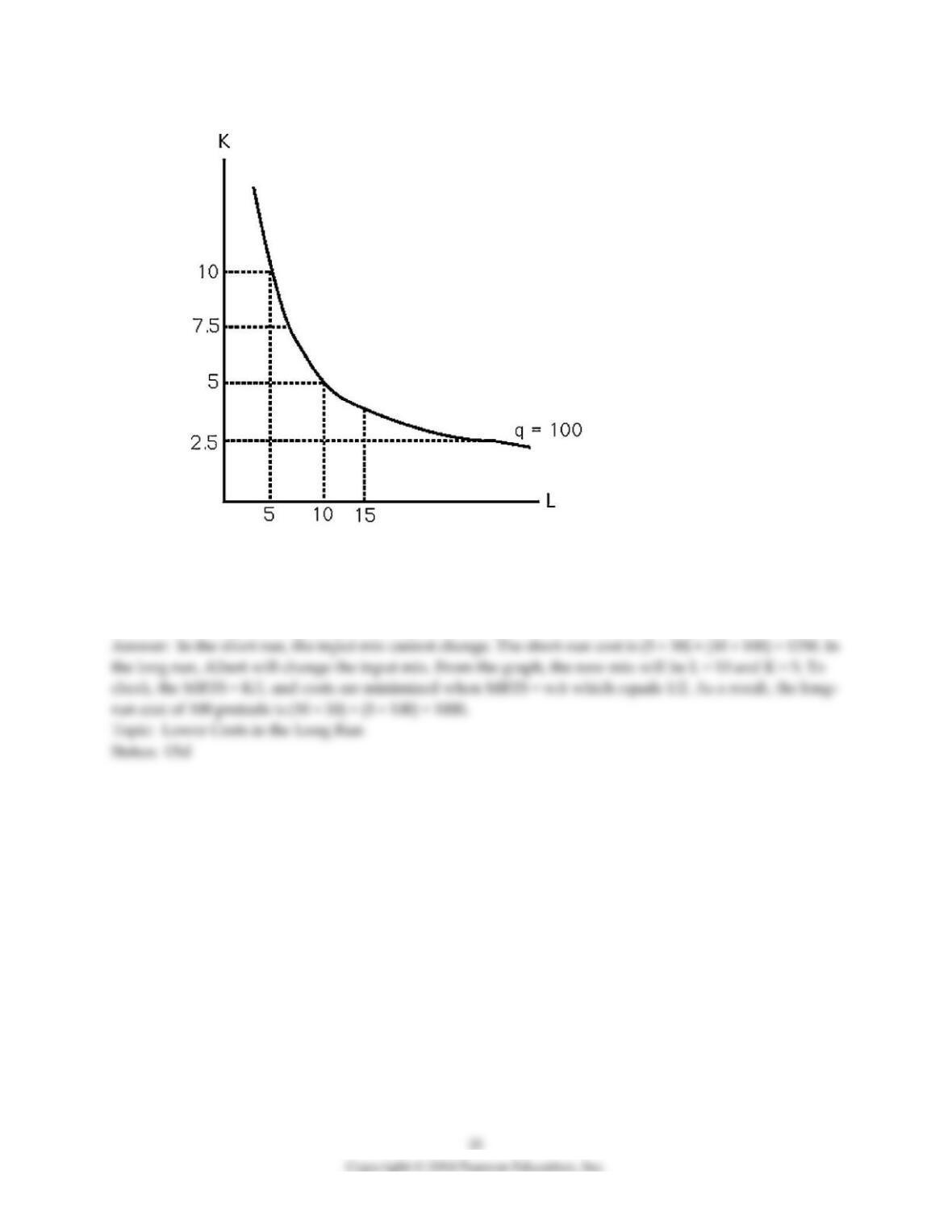
9) At Albert’s Pretzel Company, MPL = 1/L, and MPK = 1/K. The isoquant for 100 pounds of pretzels daily
is shown in the above figure. Albert minimizes the cost of producing 100 pounds of pretzels daily by
hiring five units of labor and 10 units of capital when w = 50 and r = 25. When r rises to 100, what is the
minimum cost of producing 100 pounds of pretzels daily in the short run? in the long run?
10) Carmela‘s pasta factory employs workers and pasta machines according to the following production
function
f(L,K) = L.5K.5
The hourly cost of capital is $10 and the hourly cost of workers is $40.
a. Write out the Lagrangian for the cost-minimization problem.
b. Derive the optimal capital to labor ratio. Describe the long-run output expansion path.
c. Suppose Carmela wishes to produce 1000 units of pasta. How much labor and capital should she
employ? How much will it cost to produce?
d. An order arrives doubling the amount of pasta Carmela needs to produce. Assuming she is unable to
purchase more capital, how much will it cost to meet the new production level?
e. In the long-run, Carmela will be able to employ more capital as well as labor. If Carmela continues to
produce 2000 units of output, how much will it cost in the long run?
f. In words, explain why the cost in the long run is different than in the short run.
11) Consider a firm with two technologies to choose between when producing output. The cost function
when using technology 1 is given by:
c1(q) = 3600 + 65q + 36q2
The cost function when using technology 2 is given by:
c2(q) = 900 + 900q +q2
Assume that the firm can only implement one of the two technologies at a time.
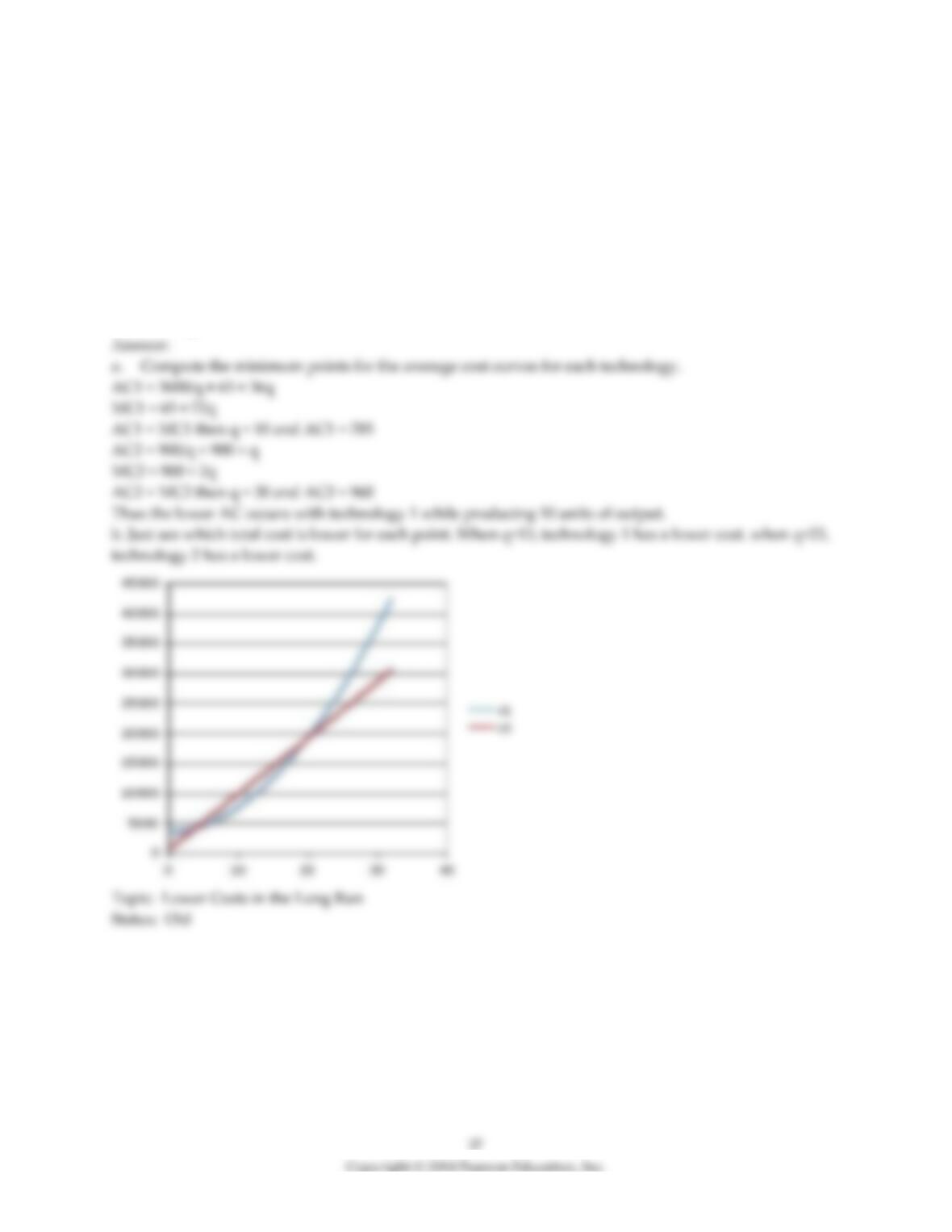
a. If the firm wishes to produce output at the lowest per-unit cost, which technology should it choose
and how much output should it produce?
b. Which technology should the firm choose if it wishes to produce 15 units of output? What about 25
units of output?
12) A firm produces output according to the following function:
q = f (L, K) = L1/2 K1/3
The cost of labor is $9 per hour and the rental cost of capital is $4 per hour.
a. With the given prices, use the Lagrangian method to compute the optimal (cost–minimizing) capital
to labor ratio (K/L) for the firm.
b. Suppose the firm wishes to produce 72 units of output. How much capital and how much labor does
the firm employ?
c. What is the total cost of producing 72 units of output?
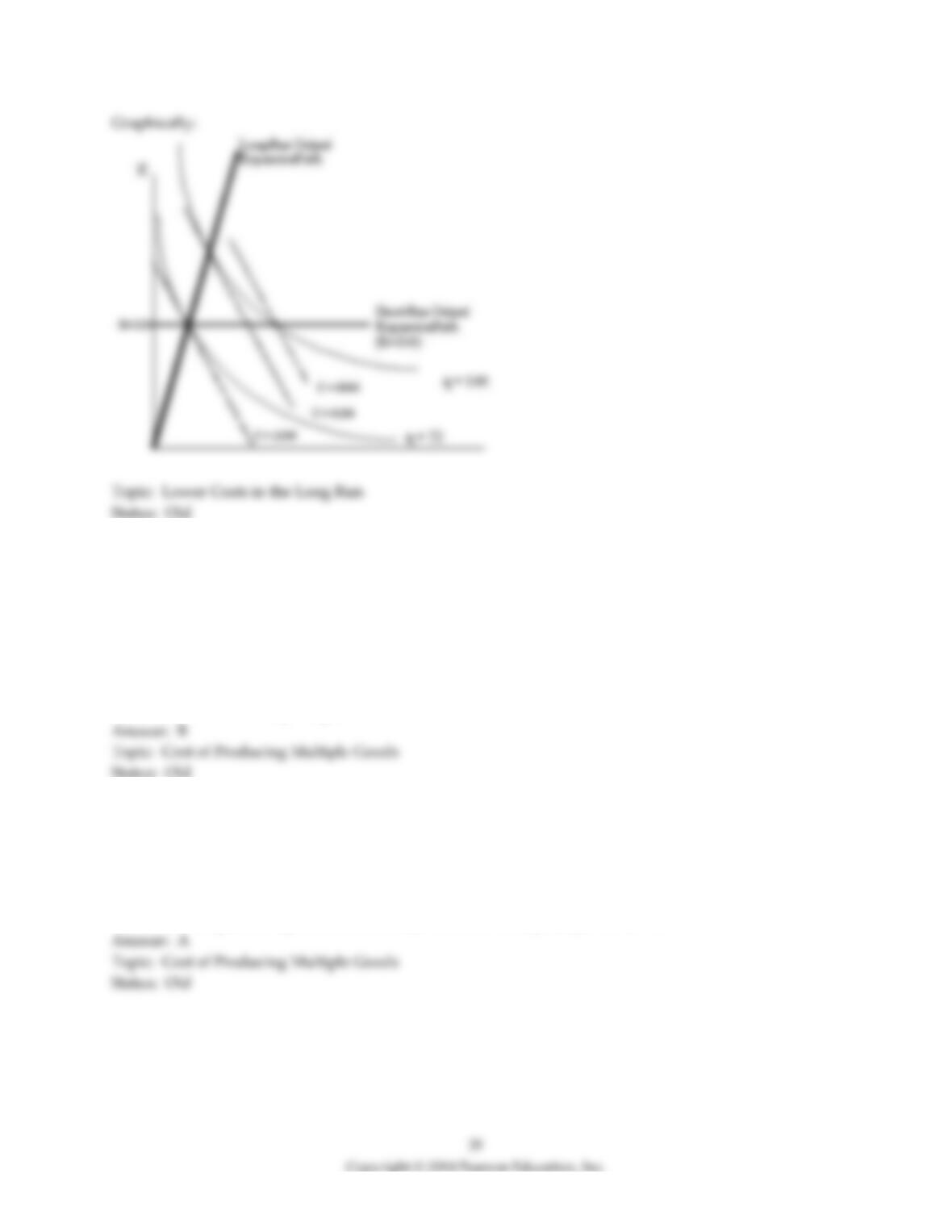
d. Suppose that the firm suddenly decides to double the quantity of output but only has a day to
complete the order. Therefore, in that time, the amount of capital is fixed but labor hours are not. How
much will it cost to produce 144 units of output? How much would it cost if the firm could also vary
capital? Compute as well as providing a graph (isocost/isoquant) illustrating the optimal bundles.
7.5 Cost of Producing Multiple Goods
1) Many universities have either a top football program OR a top basketball program. Very few have
both. These results suggest the presence of
A) economies of scope.
B) diseconomies of scope.
C) returns to scale.
D) the law of diminishing marginal returns.
2) Economies of scope exist between book publishing and magazine publishing if
A) the cost of publishing a magazine is lower for book publishers than for other firms.
B) the cost of publishing a magazine is lower for firms that publish many magazines than for firms that
publish only one magazine.
C) the cost of publishing a book falls over time as the publisher acquires more experience.
D) the cost of a publishing a book is not subject to diminishing marginal returns.
3) Suppose the cost of producing two goods, x and y, can be represented as C = ax + by + cxy. If the
measure of economies of scope, SC, is zero, then which of the following must be true?
A) a = b
B) a + b = -c
C) c = 0
D) a = –b
4) Suppose the cost of producing two goods, x and y, can be represented as C = ax + by + cxy. If there are
economies of scope, then which of the following must be true?
A) c > 0
B) a + b = -c
C) c = 0
D) c < 0
5) Suppose the cost of producing two goods, x and y, can be represented as C = ax + by + cxy. If there are
diseconomies of scope, then which of the following must be true?
A) a = b
B) a + b = -c
C) c > 0
D) c < 0
6) A production possibilities frontier that is a downward–sloping straight line implies
A) economies of scale.
B) diseconomies of scale.
C) economies of scope.
D) no economies of scope.
7) A production possibilities frontier that is a bowed-inward line implies
A) economies of scale.
B) diseconomies of scope.
C) economies of scope.
D) no economies of scope.
For the following, please answer “True” or “False” and explain why.
8) If a pharmaceutical firm is researching ways to improve its heartburn medicine and discovers a
technique that will improve its allergy medicine, one could conclude that economies of scope exist in that
industry.
9) Explain why in the case of economies of scope the production possibility frontier is bowed outward.