35) A tariff hurts
A) the government by decreasing its revenue.
B) domestic producers who can’t compete with cheaper imports.
C) consumers who pay more for the imported good.
D) All of the above answers are correct.
36) A reason tariffs and quotas are imposed is that
A) their costs are spread among many people and their benefits are concentrated.
B) their costs are concentrated and their benefits are spread among many people.
C) they create net benefits in the long run.
D) they reduce import dependence.
37) One reason that international trade is restricted is that
A) the individual gain to parties who benefit from the protection is much larger than the
individual loss to parties who lose.
B) the government completely pays the losers from international trade for their losses.
C) protectionism benefits consumers.
D) the government cannot measure the cost of protectionism.
38) Usually the removal of trade barriers affecting a particular good benefits ________ people
domestically, each of whom gains a ________.
A) a few; little
B) a few; lot
C) many; little
D) many; lot
39) Usually the imposition of trade barriers affecting a particular good benefits ________ people
domestically, each of whom gains a ________.
A) a few; little
B) a few; lot
C) many; little
D) many; lot
40) The gains from free trade are enjoyed by a ________ number of people and the costs of free
trade are imposed by ________ number of people.
A) small; large
B) large; small
C) small; small
D) large; large
41) Trade barriers are politically popular because
A) they are a way to avoid trade wars and still protect domestic producers.
B) people recognize their use as a negotiating tool in international relations.
C) their benefits are widespread, while their costs are highly concentrated.
D) their benefits are concentrated, while their costs are widespread.
42) Which of the following reasons explains why rich countries persistently restrict textile
imports from poor countries?
A) The trade restrictions make textile consumers better off.
B) The trade restrictions make workers in poor countries better off.
C) The trade restrictions benefit an organized visible special interest in rich countries.
D) Rich countries have a strong need for the revenue from these trade restrictions.
43) When NAFTA was approved, Congress attempted to soften the losses suffered by some
industries by
A) creating new jobs to hire workers who lost their jobs because of NAFTA.
B) setting aside funds to support and retrain workers who lost their jobs because of NAFTA.
C) reducing tariffs.
D) imposing quotas.
44) Which of the following is a reason why only limited attempts are made to compensate those
who lose from free international trade?
A) Free trade advocates consistently lobby to eliminate compensation.
B) It would be difficult to determine the extent to which someone’s sufferings were because of
free trade and not due to reasons under their own control.
C) No one loses in the from free trade in the long run.
D) None of the above answers are correct.
45) Selling a product in a foreign nation at a price less than its cost of production is called
A) infant-industry exploitation.
B) absolute advantage.
C) dumping.
D) net exporting.
46) The (false) idea that an industry should be protected because of learning-by-doing until it is
large enough to compete successfully in world markets is the ________ argument for protection.
A) cheap foreign labor
B) infant industry
C) dumping
D) comparative advantage
47) When a rich nation buys a product made in a poor nation, in the poor nation the demand for
labor ________ and the wage rate ________.
A) increases; rises
B) increases; falls
C) decreases; rises
D) decreases; falls
48) Which of the following is a valid reason for protecting an industry?
A) The industry is unable to compete with low-wage foreign competitors.
B) Protection penalizes lax environmental standards.
C) Protection keeps richer nations from exploiting the workers of poorer countries.
D) None of the above reasons is a valid reason for protection.
49) Which of the statements about the gains from international trade is CORRECT?
A) Everyone gains from international trade.
B) Some people gain from international trade and some lose, though overall the gains exceed the
losses.
C) Some people gain from international trade and some lose; overall the gains exceed the losses.
D) Everyone loses from international trade.
5 News Based Questions
1) Between August 2007 and July 2008, Brazil exported more than 3.5 billion pounds of coffee
to the rest of the world. These exports mean that
A) Brazil has comparative advantage in coffee production.
B) the rest of the world has comparative advantage in coffee production.
C) the rest of the world has absolute advantage in coffee production.
D) Brazil has absolute advantage in coffee production.
2) Between August 2007 and July 2008, Brazil exported more than 3.5 billion pounds of coffee
to the rest of the world. This fact means that
A) Brazilian coffee workers “gain” from this trade.
B) Brazilian producers “lose” from this trade.
C) Brazilian consumers “gain” from this trade.
D) Brazilian car manufacturers “lose” from this trade.
3) Between August 2007 and July 2008, Brazil exported more than 3.5 billion pounds of coffee
to the rest of the world. Suppose the Brazilian government subsidizes the export of coffee by
$0.42 per pound. Which of the following would be an outcome of this subsidy?
A) Brazilian producers experience an increase in producer surplus.
B) Brazilian consumers experience an increase in consumer surplus.
C) Producers from the rest of the world experience a gain in producer surplus.
D) Brazilian coffee exports would decrease.
4) During 2005-2006 Europe imported more than $70 million worth of U.S. long-grain rice. Who
gains from this trade?
A) European rice consumers gain from trade.
B) There is no gain from trade.
C) European rice producers gain from trade.
D) American rice consumers gain from trade.
5) During 2005-2006 Europe imported more than $70 million worth of U.S. long-grain rice. In
2006, the European Union threatened to restrict imports of long-grain rice because traces of
genetically modified rice were found mixed in to commercial supplies. What would NOT be an
effect in the European rice market if U.S. imports were banned?
A) There would be an increase in long-grain rice consumption.
B) There would be an increase European in rice production.
C) The price of long-grain rice would increase.
D) The quantity of long-grain rice imports would decrease.
6) In 2006, the European Union (EU) threatened to ban imports of long-grain rice because traces
of genetically modified rice were found mixed in to commercial supplies. Instead of a ban,
suppose the EU placed a tariff on the import of long-grain rice. Which of the following would be
an outcome of this tariff?
A) The EU would gain tariff revenue.
B) Deadweight loss would decrease.
C) European rice producers would decrease production.
D) The price of long-grain rice in the EU would not change.
7) In 2007, European Union (EU) negotiators have offered to cut tariffs for Latin American
bananas to avoid “banana wars”. What are the effects of a cut in tariffs?
A) The quantity of bananas imported into the EU will increase.
B) The price of bananas for consumers will increase.
C) The quantity of bananas produced in the EU (such as in France and Spain) will increase.
D) Europe will start to export bananas.
8) In 2006, the European Union tariff on imported bananas from Latin America was €176 a ton.
Suppose 2.5 million tons of bananas were imported in 2006 but then the tariff decreased to €152
a ton in 2007 and as a result, 3 million tons were imported in 2007. What is the change in tariff
revenue between 2006 and 2007?
A) €1,000,000
B) €440,000,000
C) €445,000,000
D) – €1,000,000
9) In 2006, the European Union tariff on imported bananas from Latin America was €176 a ton.
Suppose 2.5 million tons of bananas were imported in 2006 but then the tariff decreased to €152
a ton in 2007 and as a result, 3 million tons were imported in 2007. What is the tariff revenue in
2007?
A) €445,000,000
B) €528,000,000
C) €440,000,000
D) €375,000,000
10) During the first 6 months of 2008, the United States imported more than 1.6 billion pounds
of coffee. Suppose the United States is considering placing trade restrictions on the importation
of coffee. What would be a potential consequence of such a trade restriction?
A) The U.S. price of coffee would increase.
B) U.S. consumers would drink more coffee.
C) The quantity of coffee imported into the United States would increase.
D) U.S. consumer surplus from coffee would increase.
11) During the first 6 months of 2008, the United States imported from Africa, Asia, and Latin
America more than 1.6 billion pounds of coffee and did not export any coffee. Based on this, we
know definitively that
A) Africa, Asia, and Latin America have comparative advantage in coffee production.
B) the United States has absolute advantage in coffee production.
C) Africa, Asia, and Latin America have absolute advantage in coffee production.
D) the United States has comparative advantage in coffee production.
12) During the first 6 months of 2008, the United States imported from Africa, Asia, and Latin
America more than 1.6 billion pounds of coffee and did not export any coffee. How is the gain
from imports distributed between consumers and domestic producers?
A) U.S. producer surplus shrinks.
B) U.S. consumer surplus increases.
C) Total U.S. surplus increases.
D) All the above answers are correct.
13) Currently Belize, a country in Central America, has a small coffee industry but does not
export any coffee. Suppose the government of Belize, in order to protect the new coffee industry
to enable it to grow into a mature industry that can compete in world markets, places a tariff on
the importation of coffee. What is the argument that has been used to support the tariff on
coffee?
A) the infant-industry argument
B) the dumping argument
C) protection of Belize coffee workers
D) to prevent rich countries from exploiting developing countries
14) Belize, a country in Central America, has a small coffee industry. Suppose Belize does not
have free trade but it has comparative advantage in coffee production. If Belize allowed
international trade, what would be the gains from trade?
A) Belize coffee producers would gain from trade.
B) Belize coffee consumers would gain from trade.
C) Belize would gain tariff revenue from trade.
D) All of these answers are gains from trade.
15) During the first 6 months of 2008, the European Union (EU) initiated an anti-dumping case
against China for imports of taper candles. What is dumping?
A) when China sells its candles to the EU at a lower price than China’s cost of production
B) when China does not pay the tariff on the candles
C) when China sells its candles to the EU at a lower price than other producers
D) when China tries to sell more candles to the EU than is allowed by the import quota
16) The U.S.—Colombia Trade Promotion Agreement was signed on November 22, 2006, in
Washington, D.C. This comprehensive trade agreement eliminated tariffs and other barriers to
goods and services. Colombia will immediately eliminate tariffs on wheat, barley, peanuts, and
many other products in which Columbia does not have a comparative advantage. This policy
means that the price of peanuts in Columbia will become
A) equal to the free trade price.
B) lower than the free trade price.
C) higher than the price when a tariff was in place.
D) higher than the free trade price.
17) In 2008, Agriculture Secretary Ed Schafer announced that Chile’s Livestock and Agricultural
Service approved the U.S. inspection, control and certification systems for poultry, allowing
these products to enter the Chilean market. The effect of this change in Chilean policy in the
Chilean poultry market is to
A) increase Chilean consumer surplus.
B) increase Chilean producer surplus.
C) decrease Chilean total surplus.
D) have no effect in the Chilean poultry market.
18) In 2008, Agriculture Secretary Ed Schafer announced that Chile’s Livestock and Agricultural
Service approved the U.S. inspection, control and certification systems for poultry, allowing
these products to enter the Chilean market. What is NOT an effect of this change in Chilean
policy on the Chilean poultry market?
A) Chile’s tariff revenue will increase.
B) The quantity of poultry consumed in Chile will increase.
C) The quantity of Chilean imports will increase.
D) The price for poultry in Chile will decrease.
6 Essay Questions
1) Define comparative advantage and discuss its role in international trade.
2) “When countries specialize in producing the good in which they have a comparative
advantage and then trade with each other, only the country with the absolute advantage gains.” Is
the previous statement correct or incorrect? Briefly explain your answer.
3) Give a brief description of the history of tariffs in the United States.
4) How does a tariff affect the domestic price of the import, the domestic consumption, the
domestic production, and the quantity imported?
5) How does an import quota affect the domestic price of the import, the domestic consumption,
the domestic production, and the quantity imported?
6) Currently, the United States has an import quota on the amount of sugar that is allowed to be
imported into the United States. What would happen to the price of sugar in the United States if
the import quota was removed? What would happen to U.S. consumption and U.S. production of
sugar?
7) How does a tariff affect the government’s revenue? How does an import quota affect the
government’s revenue?
8) Discuss reasons why we see trade restrictions. Are any of these reasons valid?
9) Two arguments used to promote trade barriers are the infant-industry argument, and the
dumping argument. Explain each of these arguments and evaluate whether each one has any
flaws.
10) Because wage rates are so low in Africa, why don’t Microsoft, Cisco and other major
corporations close down their American operations and move to Africa?
11) Some people assert that protection from foreign competition prevents rich countries from
exploiting developing countries. What is this argument in more detail and what is its flaw?
12) Explain how governments restrict international trade and who benefits as well as who loses
from the restrictions.
13) What is “rent seeking?” How does it apply to restricting imports?
14) Economics demonstrates that opening up unrestricted free international trade is beneficial to
all nations. However, are there any losers from such a policy change?
15) How does the United States attempt to compensate losers from lower trade restrictions?
7 Numeric and Graphing Questions
Price
(dollars per
pound)
Quantity supplied
(thousands of
pounds per year)
Quantity
demanded
(thousands of
pounds per year)
21
120
60
18
100
100
15
80
140
12
60
180
9
40
220
1) The United States imports cheese from a variety of countries. The table above gives the
domestic supply of, and demand for, cheese in the United States. The world price of cheese is
$12 per pound, and trade is unrestricted.
a) How many pounds of cheese are consumed in the United States?
b) How many pounds of cheese are produced in the United States?
c) How many pounds of cheese are imported into the United States?
If a $3 per pound tariff is imposed,
d) How many pounds of cheese are consumed in the United States?
e) How many pounds of cheese are produced in the United States?
f) How many pounds of cheese are imported into the United States?
g) How much will the U.S. government collect in tariff revenue?
h) Who benefits from the tariff? Who loses?
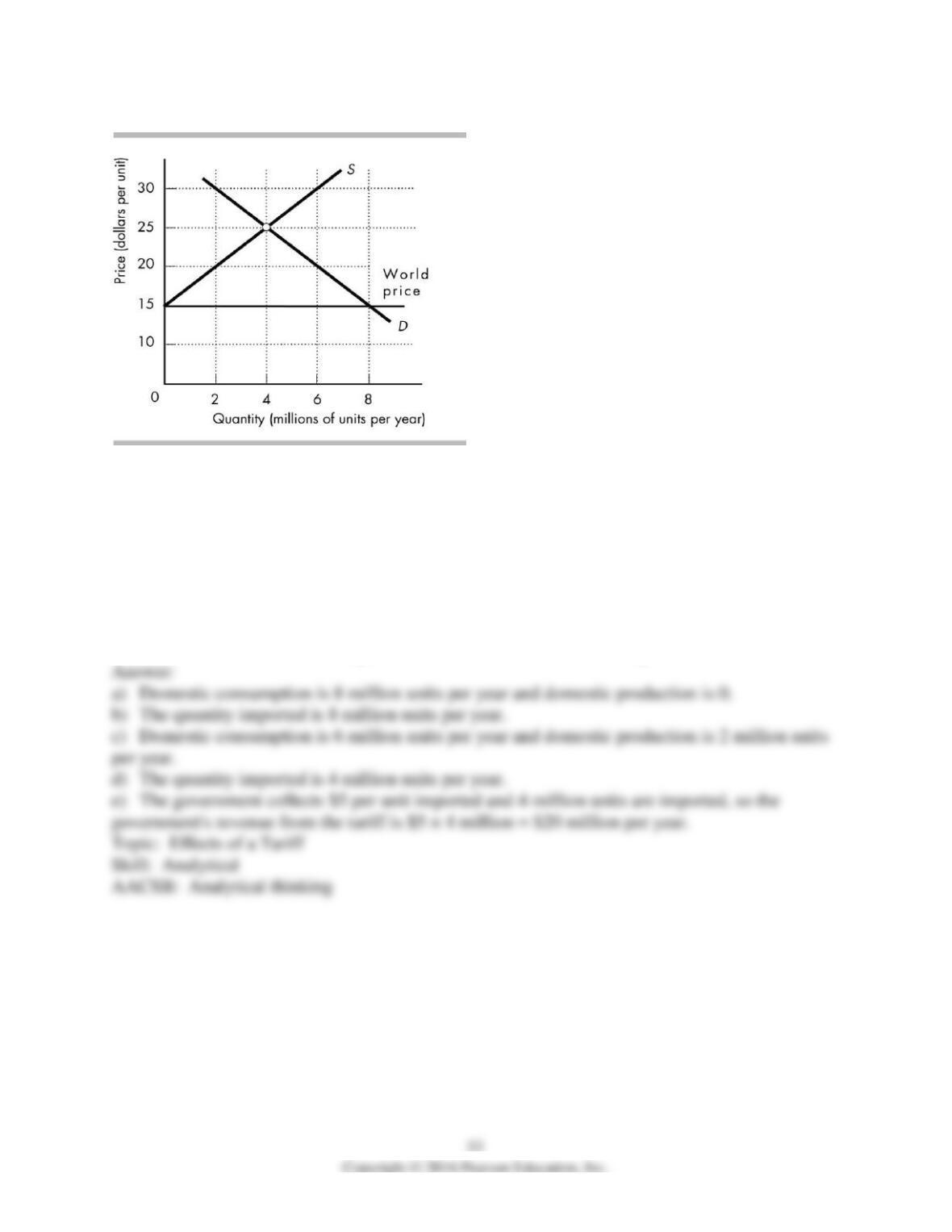
2) The above figure shows the domestic supply of and domestic demand for an imported good.
The world price is $15 per unit.
a) At the world price of $15 per unit, what is the domestic consumption and domestic
production?
b) At the world price of $15 per unit, what is the quantity imported?
c) If the government imposes a tariff of $5 per unit, what is the domestic consumption and
domestic production?
d) With the $5 per unit tariff, what is the quantity imported?
e) How much revenue does the government collect with a tariff of $5 per unit?
3) Suppose that elimination of tariffs on agricultural products means that 1,000 farm workers
lose jobs that pay an average of $20,000 per year. At the same time, because of the importation
of relatively cheaper foreign vegetables, 150 million consumers save $2 per year on their grocery
bills.
a) What is the total income lost by farm workers because of the free trade?
b) What is the total dollar amount saved by all consumers combined?
c) Which is greater, the lost income or the consumer savings? Do the benefits of free trade out-
weigh the costs in this simple example?
d) Which group is most likely to become politically involved over the issue of removing the
tariffs, the farm workers or the consumers? Why?
8 True or False
1) Over the past 80 years, the United States has reduced its average tariff rate so today it is less
than 5 percent.
2) As a result of an increase in tariffs, imports decrease and government revenue increases.
3) Tariffs and import quotas both decrease the amount of a good consumed and raise the price
paid by domestic residents for the good.
4) Import quotas are less damaging to an economy than are tariffs.
5) Dumping occurs when a foreign firm sells its exports at a lower price than it costs to produce
them.
6) Most economists would agree that “saving jobs” is a valid reason for restricting trade.
7) The infant-industry argument is the only perfectly valid argument for protection.
8) Hiring foreign labor and producing in other countries is an example of offshoring.
9) Trade war occurs when, after a tariff is imposed, other countries retaliate with their own tariff.
10) The Smoot-Hawley tariff triggered a trade war during the Great Depression of the 1930s.