90. Driving in the city is an example of a good that is
a. excludable. d. nonrival.
b. excludable and rival. e. excludable and nonrival.
c. nonexcludable and rival.
91. Visiting the public beach during summer is an example of an activity that is
a. excludable. d. nonrival.
b. excludable and rival. e. excludable and nonrival.
c. nonexcludable and rival.
92. Which good is nonrival?
a. sharing a pizza with one’s family d. listening to public radio
b. swimming in a public pool e. visiting the post office
c. driving in a city
93. Consider the production of a private good, such as a car, and a common-resource good, such as
fish. What do the markets for these two goods have in common?
a. The quantity of output produced is inefficiently low.
b. The quantity of output produced is inefficiently high.
c. Both create a positive externality.
d. Both markets are likely to arrive at the social optimum without government intervention.
e. The price of both goods is inefficiently high.
94. What does it mean for a good to be excludable?
a. The good must be paid for before it is used.
b. The good can only be enjoyed by one person at a time.
c. The good is subject to the free-rider problem.
d. The good comes with a natural incentive to protect it.
e. The good does not fall within the scope of the Coase theorem.
95. A pizza can be divided among two or more people. Why is it nonetheless a rival good?
a. One and only one person conducts the transaction to buy the pizza.
b. One is allowed a limited number of toppings unless one pays extra.
c. A pizzeria has limited seating capacity.
d. In most towns, more than one pizzeria competes for customers’ business.
e. Any slice consumed by one person cannot also be consumed by another.
96. A good that is rival and excludable is defined as a ________ good.
a. private d. club
b. public e. government
c. common-resource
97. Which of the following characteristics best defines a private good?
a. rival and excludable
b. rival and nonexcludable
c. nonrival and nonexcludable
d. nonrival and excludable
e. a good that is never produced by the government
98. Which of the following characteristics best defines a public good?
a. rival and excludable
b. rival and nonexcludable
c. nonrival and nonexcludable
d. nonrival and excludable
e. a good that is never produced by the government
99. A good that is nonrival and nonexcludable is defined as a ________ good.
a. private d. club
b. public e. government
c. common-resource
100. What type of good is often provided by the government because it is hard to get people to
voluntarily contribute their fair share of the expense?
a. private d. public
b. club e. government
c. common-resource
101. ________ goods can be jointly consumed by more than one person, and nonpayers are difficult to
exclude.
a. Private d. Public
b. Club e. Government
c. Common-resource
102. The market works efficiently in the absence of externalities if the good is
a. rival and excludable.
b. nonrival and nonexcludable.
c. rival and nonexcludable.
d. nonrival and excludable.
e. rival and either excludable or nonexcludable.
103. A major reason why public goods are NOT supplied by the market is the
a. free-rider problem.
b. existence of negative externalities.
c. fact that no one is willing to pay for them.
d. fact that public goods are rival.
e. fact that no firm would be able to earn a profit by producing them.
104. Which of the factors listed contributes to making street performances a public good?
a. Music and live theater are art, not science.
b. Performances do not follow a set schedule.
c. Not everyone enjoys street theater.
d. No qualifications are required to perform.
e. Any passerby can enjoy the show.
105. Which of the following is NOT a public good?
a. entertainment television d. open source software
b. interstate highways e. national defense
c. public-health research
106. Which of the following is NOT a club good?
a. satellite TV d. education
b. a timeshare condo e. toll roads
c. a subscribers-only website
107. Which of the following is a common-resource good?
a. baseball tickets
b. GPS service
c. pay-per-view television
d. free public parking spaces
e. paramedic emergency medical service
108. The city decides to offer a subsidy to each homeowner’s association that plants more flowers in
their common areas. In the market for flowers, this will cause the
a. supply curve to shift to the left.
b. supply curve to shift to the right.
c. demand curve to shift to the left.
d. demand curve to shift to the right.
e. the supply curve to shift to the left and the demand curve to shift to the right.
109. Which of the following characteristics best defines a club good?
a. rival and excludable
b. rival and nonexcludable
c. nonrival and nonexcludable
d. nonrival and excludable
e. a good that is never produced by the government
110. A good that is nonrival and excludable is defined as a ________ good.
a. private d. club
b. public e. government
c. common-resource
111. Club goods are
a. nonrival, like public goods, and excludable, like private goods.
b. nonrival, like private goods, and excludable, like common-resource goods.
c. nonrival, like common-resource goods, and excludable, like public goods.
d. rival, like private goods, and nonexcludable, like public goods.
e. rival, like common-resource goods, and nonexcludable, like private goods.
112. Club goods tend to be offered at ________ market price and at ________ quantity compared to
what society desires.
a. a lower; a lower d. a lower; a higher
b. a higher; a higher e. the same; a lower
c. a higher; a lower
113. Which of the following characteristics best defines a common-resource good?
a. rival and excludable
b. rival and nonexcludable
c. nonrival and nonexcludable
d. nonrival and excludable
e. a good that is never produced by the government
114. A good that is rival and nonexcludable is defined as a ________ good.
a. private d. club
b. public e. government
c. common-resource
115. Common resources are
a. overused. d. always owned by the government.
b. underused. e. never owned by anyone.
c. optimally used.
116. Common-resource goods are
a. nonrival, like public goods, and excludable, like private goods.
b. nonrival, like private goods, and excludable, like club goods.
c. nonrival, like club goods, and excludable, like public goods.
d. rival, like private goods, and nonexcludable, like public goods.
e. rival, like club goods, and nonexcludable, like private goods.
117. The market overproduces common-resource goods because private decision makers consider
________ costs but society experiences ________ costs.
a. only internal; only external d. only external; internal and external
b. only internal; internal and external e. internal and external; only external
c. only external; only internal
118. Common-resource goods tend to be offered at ________ market price and at ________ quantity
than what society desires.
a. a lower; a lower d. a lower; a higher
b. a higher; a higher e. the same; the same
c. a higher; a lower
119. Which of the following is the best example of a common-resource good?
a. a fireworks display d. fish in a lake
b. a lighthouse e. the production of gasoline
c. cable television
120. The air is a ________ good.
a. private d. common-resource
b. public e. government
c. club
121. The challenge of cost-benefit analysis and the tragedy of the commons are two problems
associated with which type of good?
a. excludable d. nonrival
b. rival e. private
c. nonexcludable
122. What is the purpose of a cost-benefit analysis of a public good?
a. to document why the private sector is not supplying the good
b. to lay down rules about who will be allowed to consume the good
c. to establish whether the good is excludable
d. to decide how much of the good the government should supply
e. to determine how much consumers should pay for the good
123. How, in practice, is cost-benefit analysis of public goods, such as city-funded fireworks displays,
usually carried out?
a. through surveys of people attending fireworks displays
b. through surveys of people who live near fireworks displays
c. through public elections of local officials
d. through debates at community forums
e. through the passage of municipal regulations
124. To maximize social welfare, the optimal quantity of a public good to provide should be determined
through the use of
a. private markets. d. cost-benefit analysis.
b. the judicial system. e. the political process.
c. public survey.
125. Copyright laws exist to
a. eliminate negative externalities. d. solve the tragedy of the commons.
b. eliminate public goods. e. protect consumers.
c. limit free-riding.
126. The ability to download music and movies from the Internet without paying is
a. an example of a negative externality.
b. an example of a club good.
c. an illegal form of free-riding.
d. an illustration of the tragedy of the commons.
e. something that anyone who pays taxes should be allowed to do.
127. The music you buy on the Internet is
a. a club good. d. a public good.
b. a private good. e. rival and excludable.
c. a common-resource good.
128. It is best to reduce the level of pollution
a. until all negative externalities are internalized.
b. to zero.
c. as long as the benefit exceeds the cost of doing so.
d. only in nonessential industries.
e. until all external costs have been eliminated.
129. The quantity produced of a common-resource good is likely to deviate from the socially optimal
quantity because
a. common-resource goods are nonrival.
b. common-resource goods cannot be traded.
c. there is an incentive to overproduce the good.
d. of the free-rider problem.
e. positive externalities are likely to exist.
130. The tragedy of the commons occurs for goods that are
a. rival and excludable. d. nonrival and excludable.
b. rival and nonexcludable. e. never produced by the government.
c. nonrival and nonexcludable.
131. The tragedy of the commons occurs because the good being produced is
a. nonrival. d. nonrival and nonexcludable.
b. rival and excludable. e. excludable.
c. rival and nonexcludable.
132. The tragedy of the commons
a. gives rise to a negative externality.
b. gives rise to a positive externality.
c. occurs when club goods are produced.
d. occurs when public goods are provided.
e. leads to underutilized resources.
133. A carbon tax would be an efficient method of addressing the problem of global warming because
a. carbon taxes are an external cost.
b. it forces firms to internalize the external cost of emissions.
c. it eliminates the positive externalities associated with global warming.
d. firms are likely to prefer the carbon tax over the cap-and-trade policy.
e. it is less likely than the cap-and-trade policy to result in rising prices.
134. Which rule would NOT protect fish populations?
a. limiting the length of the fishing season
b. limiting the number of fish that can be caught
c. not allowing female fish to be caught
d. not allowing young fish to be caught
e. catching any fish except males
135. Global warming is an example of
a. the tragedy of the commons. d. a positive externality.
b. a public good. e. a problem that has an easy solution.
c. the club-good problem.
136. How many fishermen will choose to operate their boats?
a. one d. four
b. two e. five
c. three
137. What is the optimal number of boats that should operate?
a. one d. four
b. two e. five
c. three
138. If four boats operate, then each boat will make a profit of
a. $775.00. d. $675.00.
b. $500.00. e. $68.75.
c. $275.00.
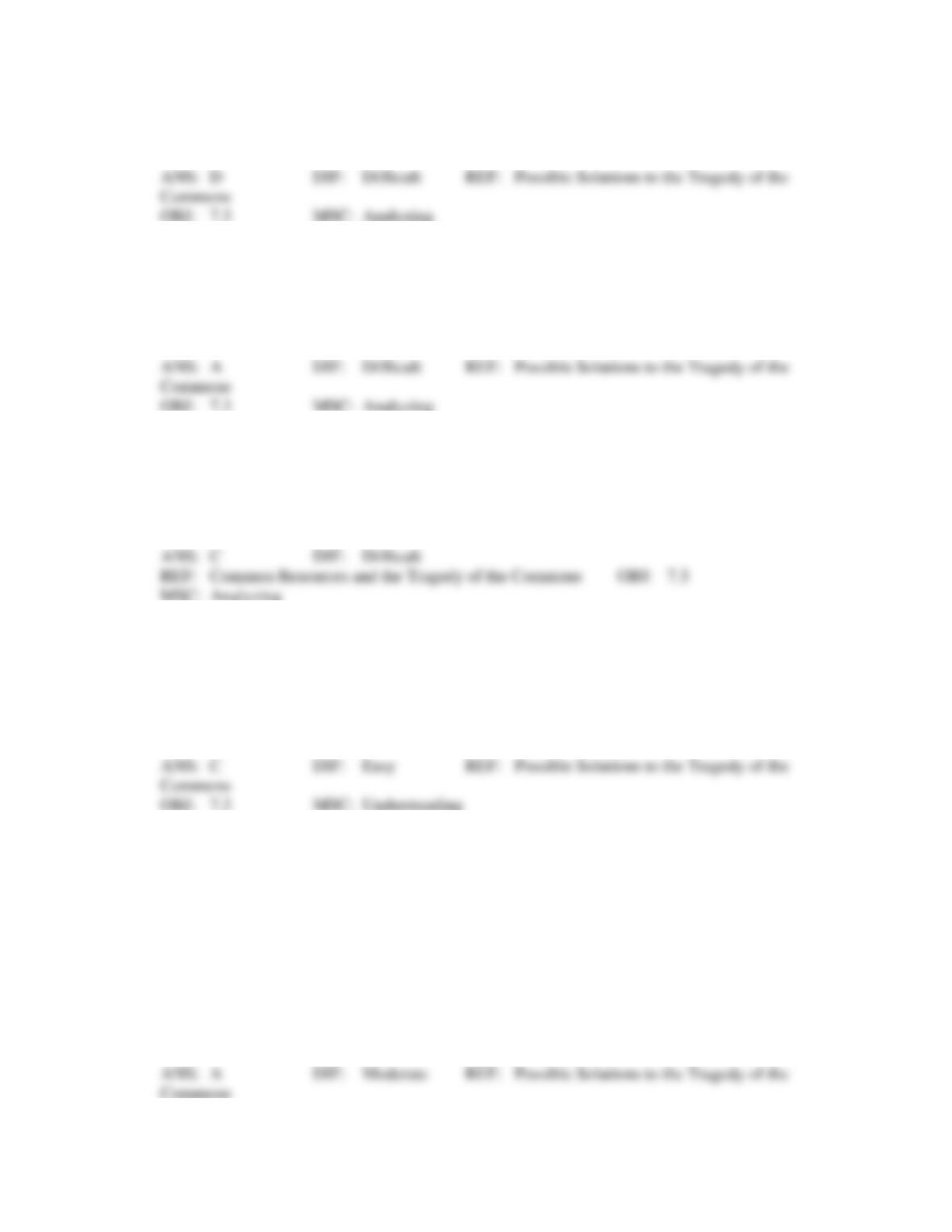
139. If the government sets a quota of 300 pounds of fish caught per day, then fish will sell for
________ per pound.
a. $20 d. $50
b. $30 e. $70
c. $40
140. If the government sets a quota of 300 pounds of fish caught per day, then fish will sell for
________ more per pound than the cost of catching the fish.
a. $20 d. $40
b. $10 e. $50
c. $30
141. If the government sets a quota of 300 pounds of fish caught per day and issues a license that
entitles the holder to catch 20 pounds of fish per day, then the value of the license is
a. $20. d. $500.
b. $50. e. $200.
c. $400.
142. A cap-and-trade policy is most often used to solve problems associated with
a. making free-riders pay for the goods they are consuming.
b. the production of public goods.
c. the production of goods that generate a negative externality.
d. the production of goods that generate a positive externality.
e. the production of club goods.
143. Which of the following is the best definition of a cap-and-trade policy for pollution?
a. The government sets a cap on emissions. Firms are given permits by the government to emit
pollutants and have the right to trade the permits with each other.
b. Emissions of a pollutant are capped by the government at the current level, and the good being
produced can still be traded in the market.
c. Production of the good is capped by the government at the current level, but the good can still
be traded in the market.
d. The number of firms producing a good is capped by the government at the current level, but
the good can still be traded in the market.
e. Consumption of the good being produced is capped by the government at the current level, but
the good can still be traded in the market.
144. A policy option for reducing emissions is cap and trade. Which of the following is true?
a. The policy will result in lower prices for consumers.
b. The policy will result in lower costs for firms.
c. The policy will increase total emissions.
d. The policy will discourage the development of greener technologies.
e. The policy will not raise large amounts of revenue for the government.
145. To reduce the level of pollution emitted by firms in an industry, the government could use a
cap-and-trade policy or a carbon tax (where the government taxes carbon producers based on the
amount of carbon produced). Which of the following is true?
a. The price of the good sold will rise with the carbon tax policy, but not with the cap-and-trade
policy.
b. The quantity of the good sold will fall with the carbon tax policy, but not with the
cap-and-trade policy.
c. The price of the good sold will rise under either policy, but there will be no change in the level
of production.
d. The quantity of the good sold will fall under either policy, but there will be no change in the
price of the good.
e. The price of the good sold will rise under either policy, and there will be a reduction in the
level of production.
146. A cap-and-trade policy is an efficient method of reducing pollution because
a. all firms will be forced to reduce pollution.
b. only high-cost firms will be forced to reduce pollution.
c. only low-cost firms will be forced to reduce pollution.
d. those who can reduce pollution relatively more cheaply will have an incentive to buy permits.
e. those who can reduce pollution relatively more cheaply will have an incentive to sell permits.
147. If the government implements a cap-and-trade system to reduce pollution in a particular industry,
then the
a. supply curve shifts to the left.
b. supply curve shifts to the right.
c. demand curve shifts to the left.
d. demand curve shifts to the right.
e. supply curve and the demand curve shift to the left.
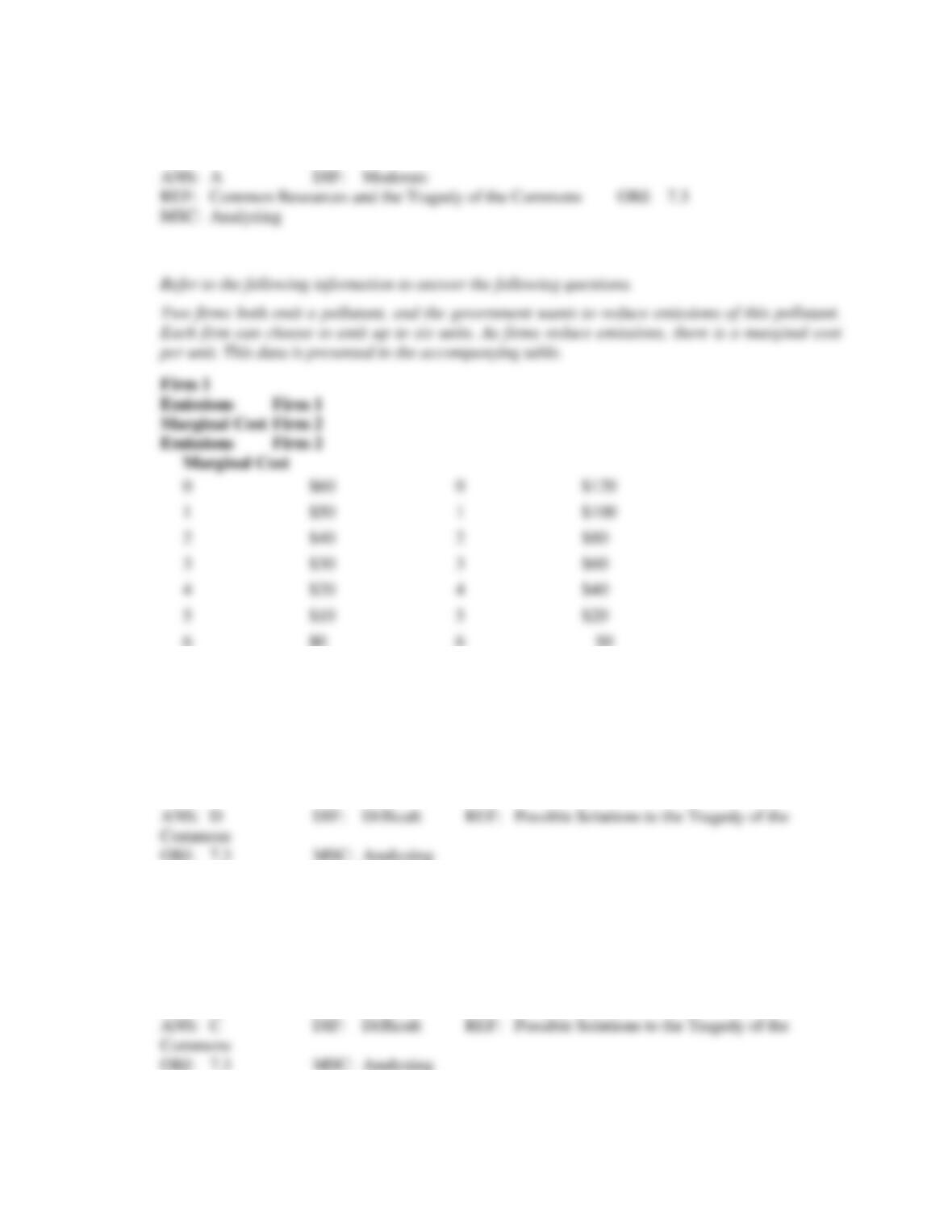
148. If emissions of this pollutant are not regulated, then the total emissions from the two firms equal
_______ units.
a. 12 d. 10
b. 6 e. 9
c. 0
149. The government allocates three allowances to each firm, where each allowance allows one unit to
be emitted. If both firms now emit three units each, the total cost of reducing emissions for Firm 1
is ________ and the total cost of reducing emissions for Firm 2 is ________.
a. $30; $60 d. $60; $120
b. $180; $360 e. $30; $60
c. $120; $240
150. The government allocates three allowances to each firm, where each allowance allows one unit to
be emitted. The optimal outcome in this case is for ________ to sell one permit to the other firm,
and a price that will be agreeable to both is ________.
a. Firm 1; $10 d. Firm 2; $100
b. Firm 1; $90 e. Firm 2; $40
c. Firm 1; $50
SHORT ANSWER
1. Explain the difference between an internal cost and an external cost. Give an example of each for a
car.
2. A city is considering expanding a frequently traveled road from two lanes to four lanes. This road
passes through the center of the city. What negative externalities and positive externalities might
the expansion create, once it is finished?
3. Explain how the following two activities could create both a negative externality and a positive
externality:
1. a bee farm
2. a fireworks display
4. Is it possible to have a positive externality associated with the production and supply of a good
rather than with demand and consumption? Why or why not?
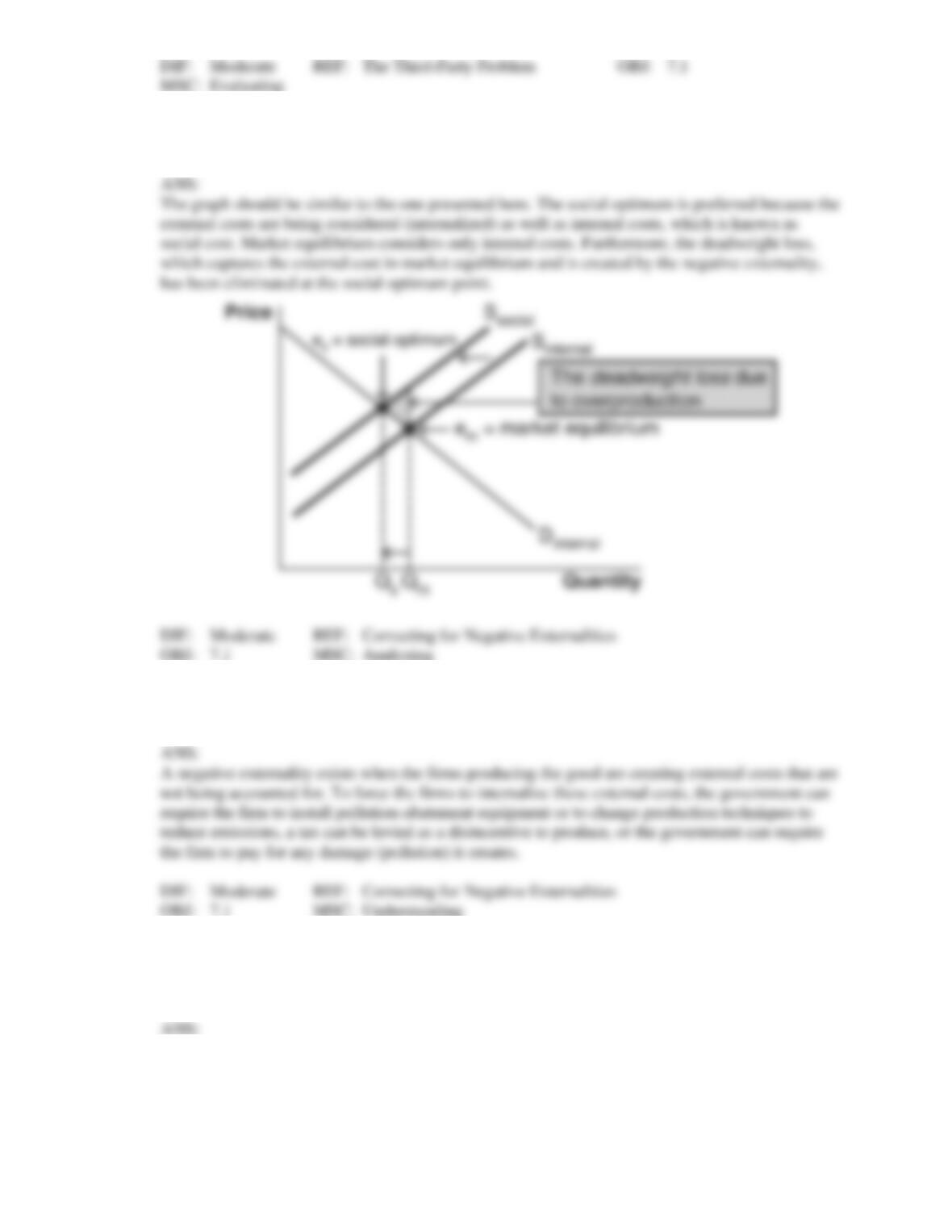
5. Draw a graph to illustrate the market equilibrium and the social optimum in the case where there is
a negative externality. Explain why the social optimum is preferred to the market equilibrium.
6. When a negative externality exists, as in the case of pollution, the government may be able to
restore the social optimum using three different solutions. Name them.
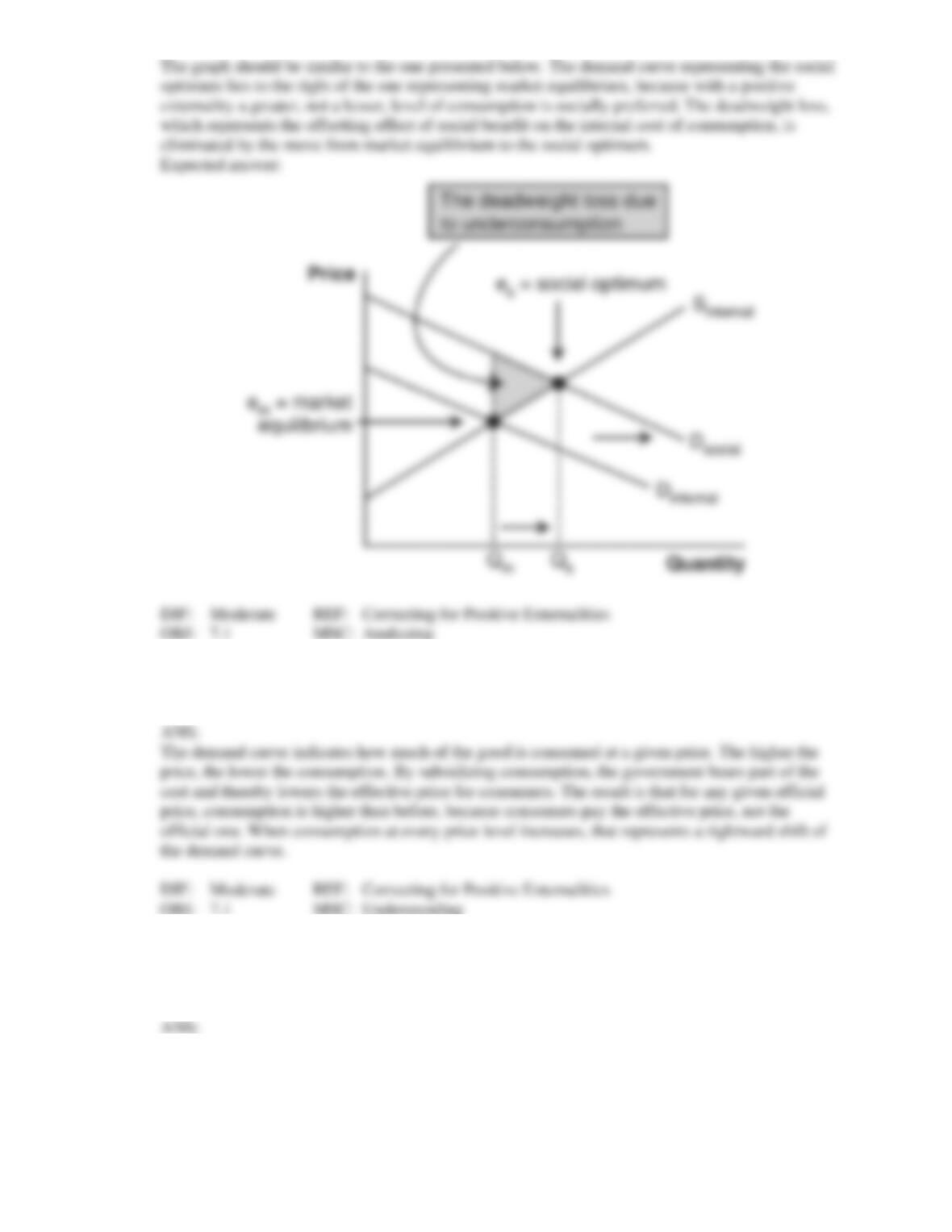
7. Draw a graph to illustrate the market equilibrium and the social optimum in the case
where there is a positive externality due to underconsumption. Explain the relative
positions of the two demand curves.
8. How does a government subsidy for the consumption of a good shift the demand curve for that
good?
9. Vaccines provide a direct benefit to the consumers being vaccinated, namely immunity from
disease. Given this clear incentive to vaccinate, why do governments perceive a need to take steps
to promote vaccinations?
10. “A government that wants to correct for a positive internality must find a way to subsidize the
production or consumption that moves equilibrium to the social optimum.” Is this statement true or
false? Explain.
11. What three incentives commonly exist for people to get vaccinated against disease? Name them
and explain how each incentive works.
12. Give an example of an externality that does not warrant government intervention, and explain why
not.
13. Use the concept of a positive externality to explain why it makes sense for government and private
industry to subsidize young adults’ college educations.
14. What are the negative and positive externalities associated with owning a dog, and what, if
anything, does the government do to internalize them?
15. Identify and briefly explain the four incentives that arise when there are well-defined property
rights for a homeowner.
16. Are city parks considered public goods? Why or why not?
17. Group work in a classroom setting creates a free-rider problem. Explain how this is so, and what
instructors can do to solve the problem.
18. Explain why satellite TV service is a club good.
19. In what ways can the problem of Internet piracy of songs and movies be seen as an example of the
tragedy of the commons? In what ways is Internet piracy different?
20. How does the political system provide indirect cost-benefit analysis for public goods?
21. Explain how person-to-person digital file sharing of songs and movies can lead, over time, to
undersupply of these goods.
22. Ocean beaches are provided by Mother Nature free of charge. Nonetheless, they present an
opportunity for cost-benefit analysis regarding a public good. How?
23. Explain why the actual social benefit of a public good is hard to measure.
24. What two incentives are associated with common property that can be used to explain the tragedy
of the commons?
25. Explain why cap and trade is an efficient policy approach to reducing emissions.