24) The long run average cost curve may initially slope downward due to
A) decreasing average fixed costs.
B) increasing marginal returns.
C) economies of scale.
D) All of the above.
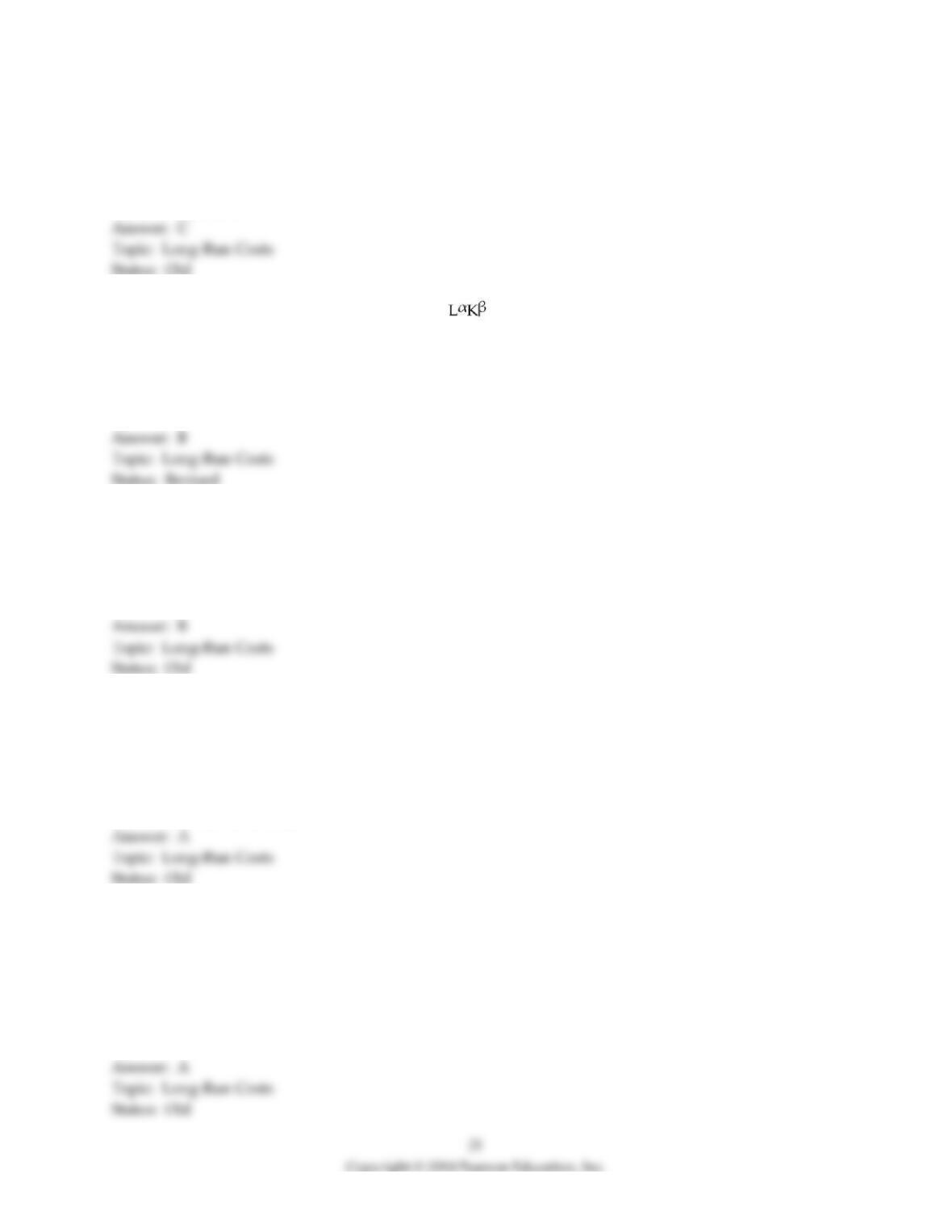
25) If a production function is represented as q = , the long-run average cost curve will be horizontal
as long as
A) α + β = 0.
B) α + β = 1.
C) q > 0.
D) L = K.
26) If there are diseconomies of scale within a given range of output, which of following is(are) TRUE?
A) The short-run average cost curve must be upward sloping within that range of output.
B) The long-run average cost curve must be upward sloping within that range of output.
C) Long-run average cost must equal short-run average cost.
D) All of the above.
27) The total cost of producing one unit is $50. The total cost of producing two units is $75. At a
production level of two units, the cost function exhibits
A) economies of scale.
B) rising average costs.
C) increasing marginal costs.
D) constant returns to scale.
28) Suppose a firm acts to minimize the cost of producing 500 units of output and determines this cost to
be $25,000. Then, if the firm acts to maximize output for a total cost of $25,000, the maximum output
attainable is
A) 500.
B) less than 500.
C) more than 500.
D) unknown.
For the following, please answer “True” or “False” and explain why.
29) If increasing returns to scale are present, the long-run average cost increases as more output is
produced.
30) Economies of scale and Increasing Returns to Scale are the same thing looked at from either the
production or cost perspective.
31) “If the wage rate paid to one form of labor is twice the cost of another form of labor, the first type of
labor must be twice as productive.” Comment.
32) Explain the difference between fixed costs in the short run and fixed costs in the long run.
33) What are the functions for MC and AC if TC = 100q + 100q2? Are the returns to scale increasing,
decreasing, or constant?
34) Explain how a firm can have constant returns to scale in production and economies of scale in cost.
35) Explain why the long-run total cost curve, not the short-run total cost curve, shows the lowest cost of
producing any level of output. Is there an exception?
36) A firm observes that in order to minimize the average cost, it must produce 25,000 units of output.
Suppose the government imposes a specific tax on the output of the firm. Will the output level required
to minimize the average cost increase, decrease, stay the same or is it uncertain? Can you tell how much
the minimum average cost will change by? Explain.
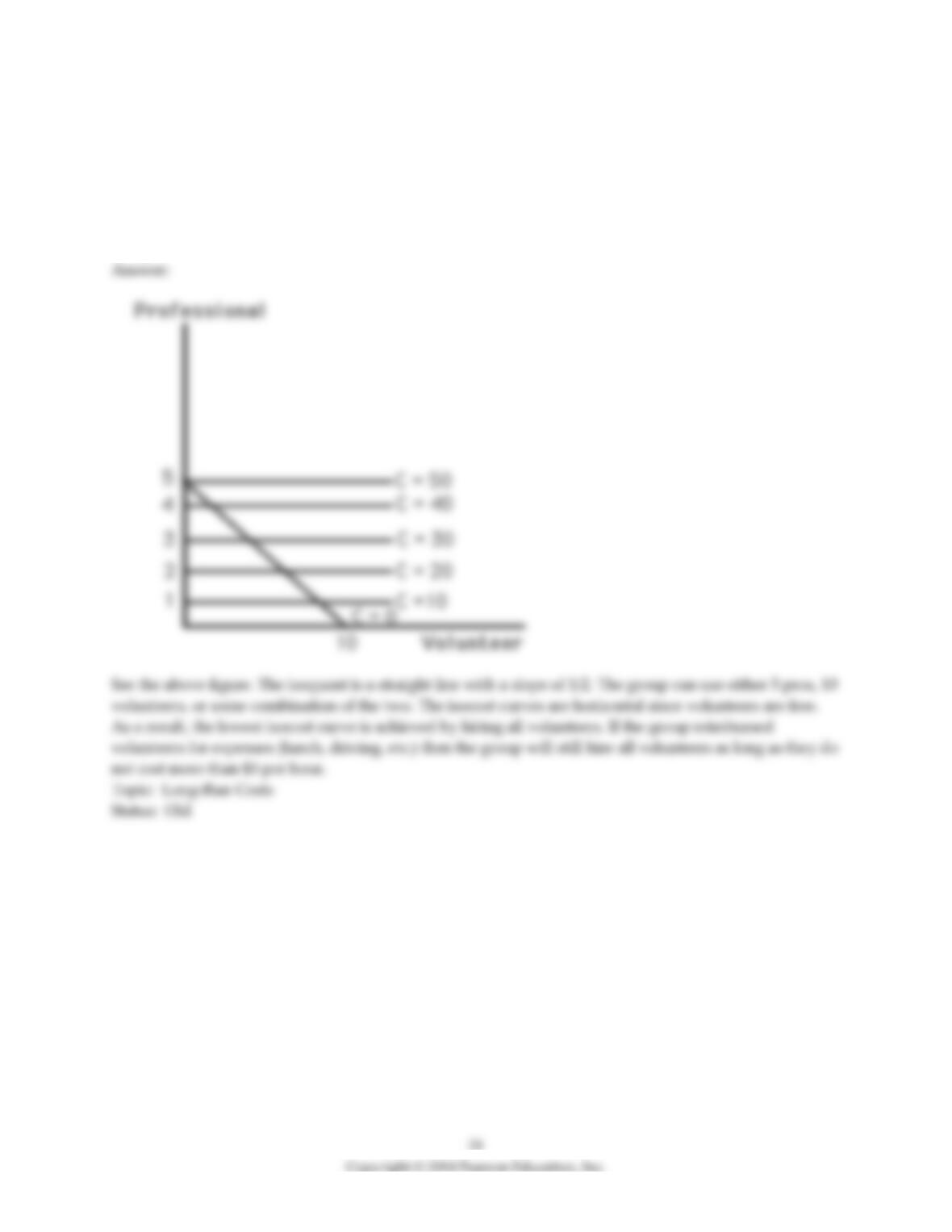
37) A local non-profit group prints a weekly newsletter. Professional typists earn $10 per hour and can
type 2 pages per hour. Unpaid volunteers can type only 1 page per hour. Measuring hours of professional
typist services on the vertical axis and hours of unpaid volunteer typist services on the horizontal axis,
draw the relevant isoquant and isocost curves if the newsletter is 10 pages long. What input mix is chosen
by the non-profit group if they wish to minimize the cost of the newsletter? If the group will reimburse
volunteers for expenses (lunch, driving), how much must the reimbursement be for your answer to
change?
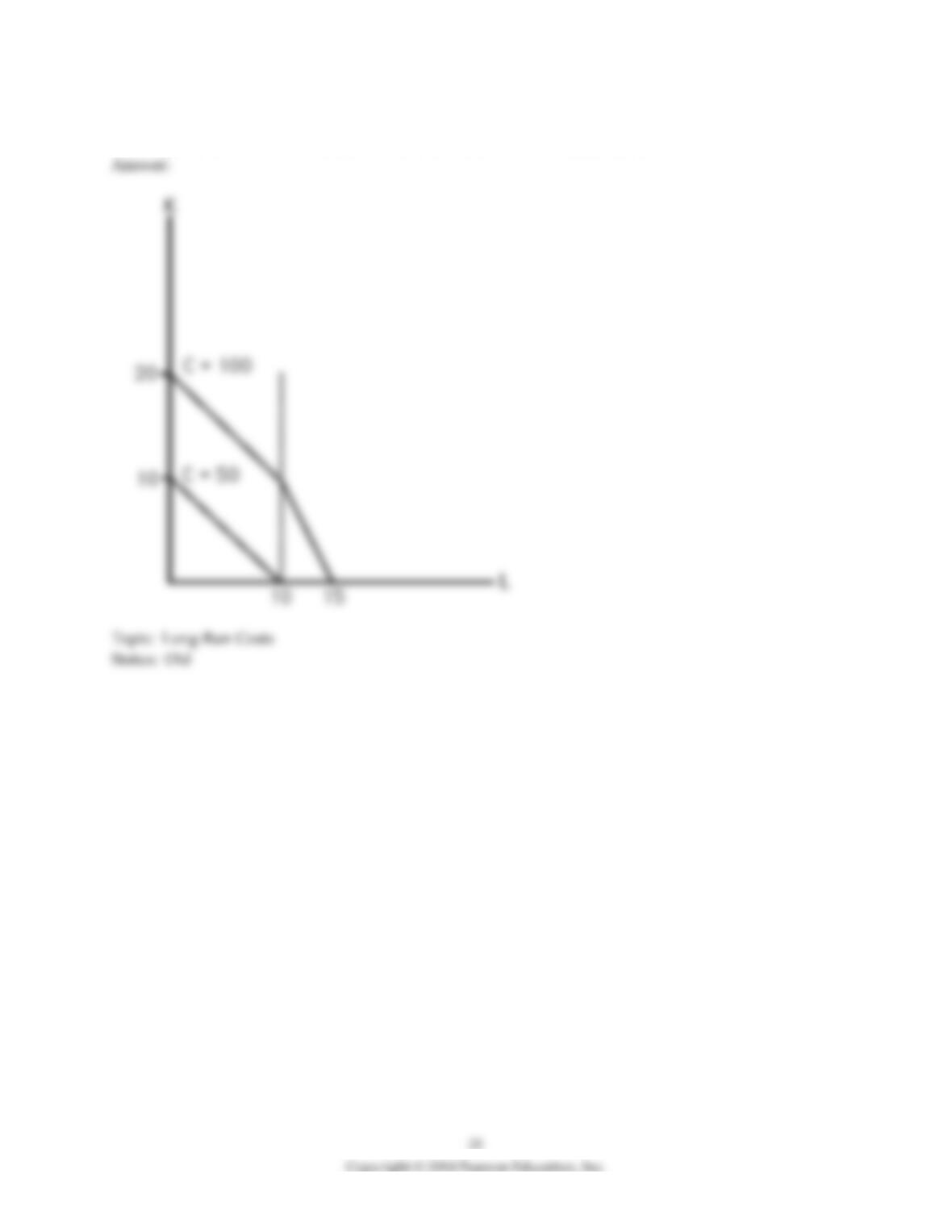
38) A firm pays $5 for each unit of capital. Labor costs $5 per hour for the first 10 hours and $10 per hour
for every hour thereafter. Draw the isocost curves for total costs of $50 and $100.
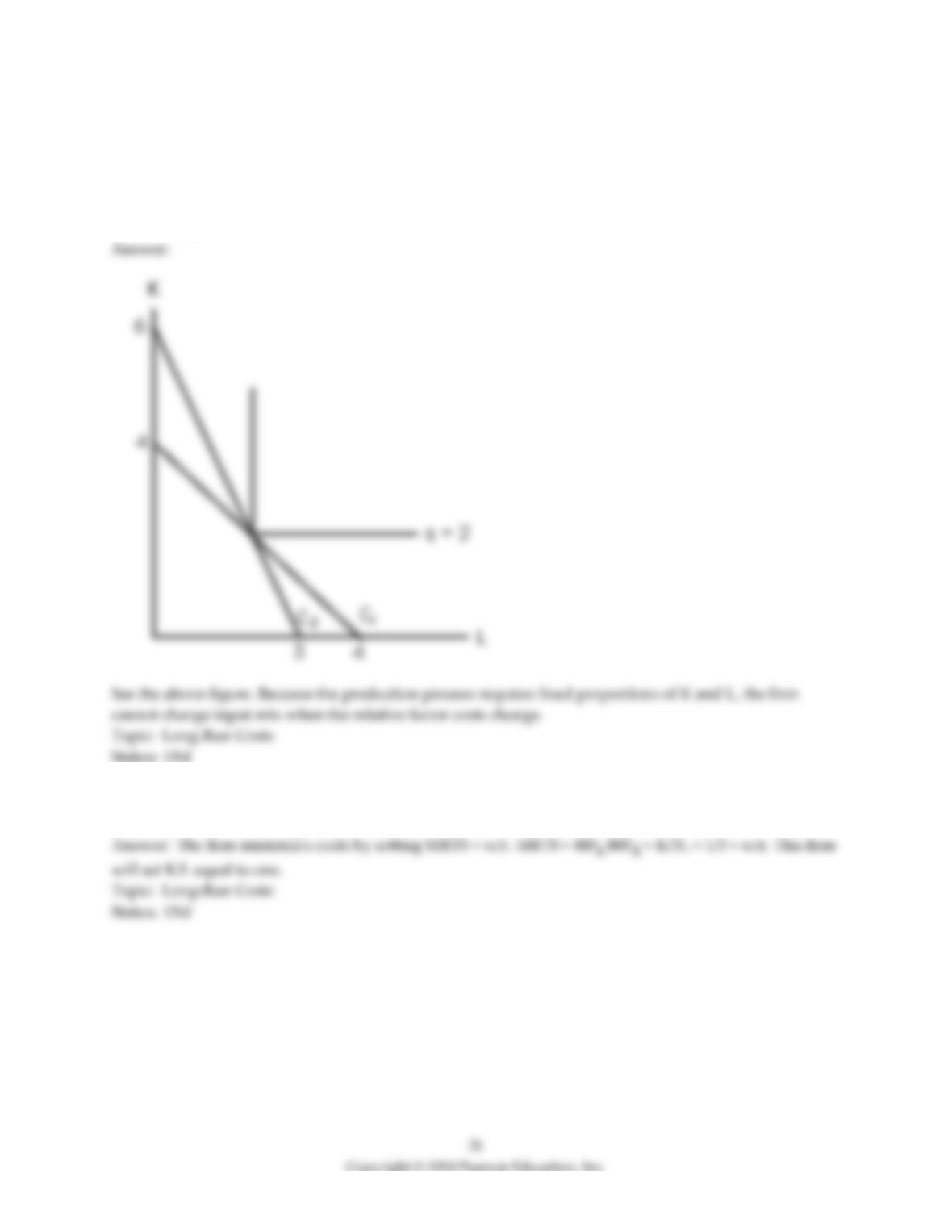
39) To dig a trench, each worker needs a shovel. Workers can use only one shovel at a time. Workers
without shovels do nothing, and shovels cannot operate on their own. Graphically determine the number
of shovels and workers used by a firm to dig two trenches when:
a. w = 10 and r = 10
b. w = 10 and r = 5
40) Suppose the production function is q = 12 L0.25 K0.75. Determine the long-run capital–to-labor ratio
(K/L) if the cost a unit of capital (r) is three times the cost of a unit of labor (w).
27
41) Suppose capital and labor are perfect substitutes resulting in a production function of q = K + L. That
is, the isoquants are straight lines with a slope of -1. Derive the long-run total cost function TC = C(q)
when the wage rate is w and the rental rate on capital is r.
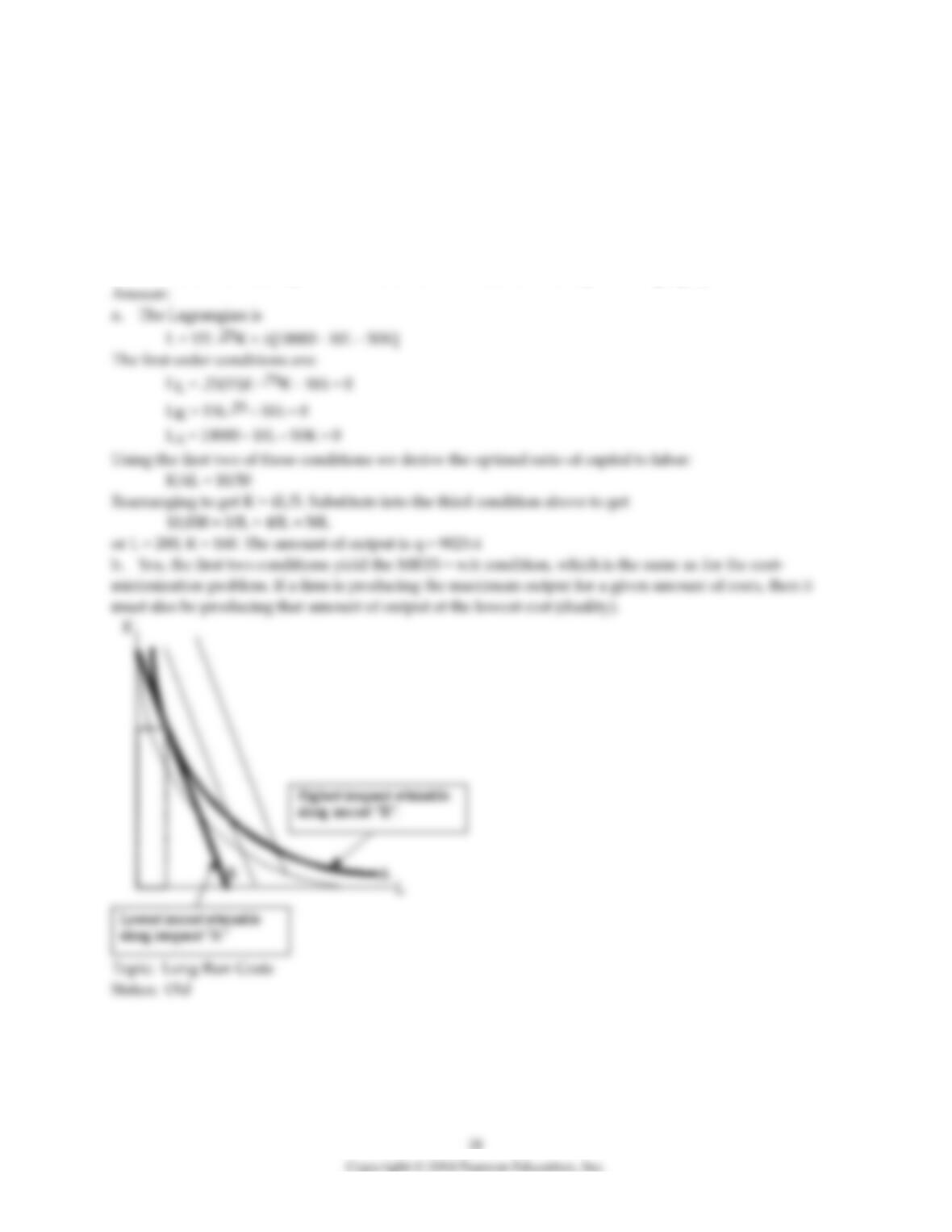
42) Sam and Erica are starting a new restaurant in Portland, Oregon. While Sam plans to do the cooking
himself, he will need to employ workers and machinery to produce food. He estimates his production
function as:
q = 15L.25K
Sam is able to accumulate $10,000 to finance the business. Workers cost $10 and capital costs $50.
a. If Sam wishes to produce the most output with the finances available, how much labor and capital
should Sam employ? Use a Lagrangian to solve this problem.
b. Does this bundle of capital and labor also minimize the costs? Explain using a graph.
43) This question has you determine the effect of a tax on labor on the long-run cost function. Consider a
firm with the production function f(L,K) = LK. The wage rate and rental rate on capital are w and r,
respectively.
a. Using the Lagrangian, derive the long-run cost function for this firm.
b. Suppose the government taxes labor at by an amount t per unit of labor. Rewrite the long-run cost
function including the tax. Hint: the effective wage rate is now w + t.
c. Compute the marginal effect of the tax on the long-run cost function. To do so, compute the partial
derivative of the cost function with respect to t. Does an increase in the tax increase the cost linearly?
44) Joey notices that by employing an additional hairdresser, he will be able to increase the number of
haircuts in his salon by 15 haircuts per day. The daily salary he will need to pay the hairdresser is $200.
How much is the cost for an additional haircut? Describe the general relationship between the marginal
product and marginal cost curves.
45) Explain why in the long run a firm that is cost minimizing will choose K and L where:
w/MPL = r/MPK
What does this tell you about the marginal cost of increasing output through hiring labor and the
marginal cost of increasing output through adding capital?
46) What is the last dollar rule for cost-minimization? Provide a brief explanation (in words) as well as the
corresponding mathematical equality. If the firm is producing at a point where the isocost line is steeper
than the isoquant, what does the last dollar rule imply (i.e., where is the last dollar most productive, L or
K) and how should the firm alter its capital and labor in the long run?
47) Sam’s company produces output with labor and capital. At the current quantities of labor and capital,
the following information is obtained: the output produced by spending one more dollar on labor
exceeds the output produced by spending one more dollar on capital. In the long run, is Sam minimizing
costs? If not, explain how capital and labor should change (holding output constant) and how this relates
to the MRTS = w/r condition.
48) A firm currently employs five units of capital. When the firm adds a sixth unit of capital, it is able to
reach a lower average cost for a greater quantity of output. What does this tell you about the shape of the
long-run average cost curve and are economies of scale occurring? Explain briefly. Does this necessarily
imply increasing or decreasing returns to scale in production or is it ambiguous? Explain briefly.
49) To dig a trench, each worker needs a shovel. Workers can only use one shovel at a time. Workers
without shovels do nothing, and shovels cannot operate on their own. What kind of production
technology is this? Graphically (with isocost and isoquant lines) determine the optimal number of shovels
and workers used by a firm to dig two trenches when w = r = 10. What will be the (long-run) total cost of
the two trenches? What will happen if the rental rate drops to $5 while the wage remains at $10? Add the
relevant lines to your graph and compute the new optimal quantity of inputs and total cost.
50) Suppose Ralph hires workers at his supermarket at a wage of $12/hour. Ralph currently has 10
checkstands (i.e., capital) with a rental rate of $10/hour. Production of customers served (i.e., output) is
determined by the hourly production function
f(L,K) = 0.5L3/4K2
For the questions that follow, the number of checkstands is fixed. Show your work clearly.
a. If Ralph wants to serve 400 customers per hour, how many workers must he employ? How much will
it cost to serve 400 customers per hour?
b. Derive Ralph’s short-run cost function with the 10 checkstands.
c. Derive the equations for the MC, AC, AVC, and AFC.