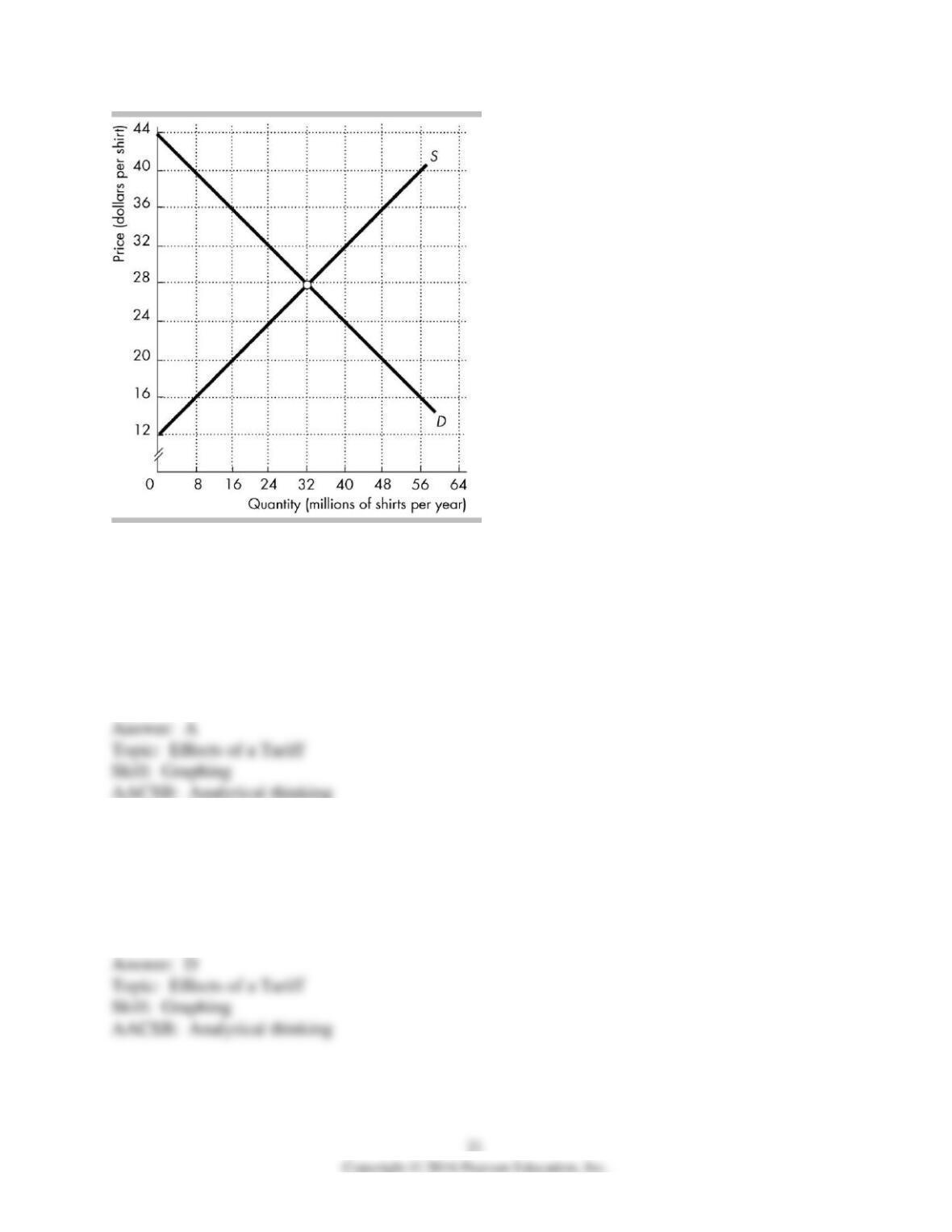
The figure shows the market for shirts in the United States, where D is the U.S demand curve
and S is the U.S. supply curve. The world price is $20 per shirt. The United States imposes a
tariff on imported shirts, $4 per shirt.
29) In the figure above, with the tariff American consumers ________ million shirts per year.
A) 40
B) 48
C) 32
D) 16
30) In the figure above, with the tariff the United States imports ________ million shirts per
year.
A) 24
B) 8
C) 32
D) 16
31) In the figure above, the tariff ________ U.S. imports of shirts by ________ million shirts per
year.
A) decreases; 16
B) decreases; 8
C) increases; 8
D) increases; 4
32) In the figure above, the tariff ________ the domestic production of shirts in the United States
by ________ per year.
A) increases; 8 million
B) decreases; 16 million
C) increases; 4 million
D) decreases; 8 million
33) In the figure above, the U.S. government’s revenue from the tariff is ________.
A) $64 million
B) $32 million
C) $128 million
D) $48 million
34) In the figure above, U.S. consumers’ ________ from the tariff is ________.
A) loss; $176 million
B) gain; $64 million
C) loss; $80 million
D) gain; $128 million
35) In the figure above, U.S. producers’ ________ from the tariff is ________.
A) loss; $32 million
B) loss; $64 million
C) gain; $80 million
D) gain; $128 million
36) In the figure above, the deadweight loss from the tariff is ________.
A) $32 million
B) $80 million
C) $16 million
D) zero
37) During the Great Depression in the 1930s, the average tariff level in the United States peaked
at about
A) zero.
B) 6 percent.
C) 20 percent.
D) 100 percent.
38) Average tariff levels in the United States in the last decade are
A) about equal to the average since 1930.
B) above the average since 1930.
C) positive, but below the average since 1930.
D) zero, as there are no longer any tariffs in the United States.
39) The Smoot-Hawley Act was enacted in
A) 1980.
B) 2000.
C) 1930.
D) 2010.
40) The Smoot-Hawley Act introduced
A) opportunities for expanding U.S. foreign trade.
B) the highest tariffs set by the United States in the last 90 years.
C) a framework promoting international free trade.
D) revenue tariffs as a major source of U.S. government revenues.
41) The average tariff rate imposed by the United States on imported goods
A) has generally increased over the past 60 years.
B) has generally decreased over the past 60 years.
C) peaked in 1990.
D) peaked in 1980.
42) The current U.S. average tariff rate is
A) less than 5 percent.
B) greater than 10 percent.
C) approximately 20 percent.
D) over 50 percent.
43) An import quota is
A) a tariff that is a fixed percentage of the price of a good.
B) a tariff that is a fixed dollar amount per unit of a good.
C) an agreed upon price for a good to be imported at a specified future date.
D) a restriction that specifies the maximum amount of a good that may be imported.
44) Import quotas
A) are the same as tariffs.
B) set the maximum quantity of a good that can be imported.
C) are not used by the United States.
D) set the minimum percentage of the value of a product that must consist of imported
components.
45) An import quota is a
A) tariff imposed on goods that are dumped in the country.
B) law that prevents ecologically damaging goods from being imported into a country.
C) market-imposed balancing factor that keeps prices of imports and exports in equilibrium.
D) government-imposed restriction on the quantity of a specific good that can be imported.
46) An import quota specifies the
A) price that can be charged for any imported good.
B) amount of taxes that must be paid on any imported good.
C) maximum amount of a good that may be imported during a specified period.
D) minimum amount of a good that may be imported during a specified period.
47) An import quota protects domestic producers by
A) setting a limit on the amount of imports.
B) placing a prohibitive tax on imports.
C) encouraging competition among domestic producers.
D) increasing the total supply of the product.
48) An import quota on sugar
A) increases the imports of sugar and lowers its price.
B) increases the imports of sugar and raises its price.
C) increases the demand for sugar and raises its price.
D) decreases the imports of sugar and raises its price.
49) An import quota restricts ________ and is designed to protect domestic ________.
A) exports; consumers
B) exports; producers
C) imports; consumers
D) imports; producers
50) Import quotas ________ the price of imported goods and ________ the quantity consumed in
the nation imposing the quota.
A) raise; increase
B) raise; decrease
C) lower; increase
D) lower; decrease
51) If a government imposes a quota on imports of a popular doll, the price of the doll in the
country will ________ and the quantity purchased in the country will ________.
A) rise; increase
B) rise; decrease
C) fall; increase
D) fall; decrease
52) A key difference between tariffs and quotas is that
A) consumers are hurt with quotas but not with tariffs.
B) consumers are hurt with tariffs but not with quotas.
C) the government receives revenue with tariffs, but the importer receives added profit with
quotas.
D) the government receives revenue with quotas, but the importer receives added profit with
tariffs.
53) A difference between a quota and a tariff is that
A) a tariff generates a higher price than does a quota.
B) a tariff generates a greater reduction in exports than does a quota.
C) a quota increases profits of domestic producers more than does a tariff.
D) the government collects revenue from a tariff but does not collect revenue from a quota.
54) Quotas and tariffs both
A) decrease deadweight loss.
B) restrict foreign trade.
C) cause a loss of revenue to domestic producers.
D) lower prices on imported goods.
55) Voluntary export restraints (VERs)
A) do not protect domestic producers.
B) raise revenue for the governments involved.
C) raise the prices paid by domestic consumers.
D) Both answers B and C are correct.
56) A tariff is
A) a government imposed limit on the amount of a good that can be exported from a nation.
B) a government imposed barrier that sets a fixed limit on the amount of a good that can be
imported into a nation.
C) a tax on a good imported into a nation.
D) an agreement between governments to limit exports from a nation.
57) When the United States imposes a tariff on a good, the amount of the ________ in U.S.
consumer surplus is ________ the amount of the ________ in U.S. producer surplus.
A) increase; smaller than; increase
B) decrease; larger than; decrease
C) decrease; larger than; increase
D) decrease; equal to; increase
58) Who benefits from a tariff on a good?
A) domestic consumers of the good
B) foreign governments
C) domestic producers of the good
D) foreign producers of the good
59) When the United States imposes an import quota on a good, the amount of the ________ in
U.S. consumer surplus is ________ the amount of the ________ in U.S. producer surplus.
A) increase; smaller than; increase
B) decrease; larger than; decrease
C) decrease; larger than; increase
D) decrease; equal to; increase
60) Who benefits from an import quota on a good?
A) domestic consumers of the good
B) foreign governments
C) domestic producers of the good
D) foreign producers of the good
61) Tariffs ________ consumer surplus and import quotas ________ consumer surplus.
A) decrease; decrease
B) increase; increase
C) decrease; increase
D) increase; decrease
62) Tariffs ________ the domestic price of the good and import quotas ________ the domestic
price of the good.
A) lower; lower
B) lower; raise
C) raise; lower
D) raise; raise
63) Tariffs ________ a deadweight loss and import quotas ________ a deadweight loss.
A) create; create
B) do not create; create
C) create; do not create
D) do not create; do not create
64) When does the domestic government gain the MOST revenue?
A) when it imposes a tariff
B) when it imposes an import quota
C) when it negotiates a voluntary export restraint
D) The amount of revenue it gains is the same with a tariff and a voluntary export restraint.
4 The Case Against Protection
1) Most economists agree that valid reasons for protecting trade include which of the following?
I. The economies of scale argument
II. The saving jobs argument
III. The protection of high wages argument
A) I only
B) I and II
C) I and III
D) None of the reasons are valid.
2) Almost all economists support protectionist policies because protection
A) saves jobs.
B) prevents rich countries from exploiting poorer countries.
C) is a good way for governments in developed nations to raise revenue.
D) Economists would not support any of the above reasons.
3) Which of the following are reasons economists consider valid for trade protection?
I. Protection penalizes countries that have weak environmental standards.
II. Protection limits dumping of low-wage jobs into the domestic economy.
III. Protection prevents low-wage jobs in foreign countries from lowering wages in the United
States.
A) I and II
B) II and III
C) I, II, and III
D) none of the above
4) The most efficient way to encourage the growth of an infant industry is through
A) a voluntary export restraint.
B) a tariff.
C) a subsidy.
D) an import quota.
5) The infant industry argument is based on the idea of
A) learning-by-doing.
B) absolute productivity advantage.
C) global monopoly.
D) countervailing duties.
6) Which of the following statements is TRUE?
A) The infant-industry argument is valid only if the benefits of learning-by-doing in the infant
industry spill over to other parts of the economy.
B) A subsidy to an infant industry is a more efficient way to protect it from foreign competition
than a tariff on the competing foreign goods.
C) Both statements are true.
D) Neither of the statements is true.
7) An assumption behind the infant-industry argument for tariff protection is that
A) foreign competitors are selling output below average cost.
B) the domestic industry will be facing an upward adjustment in its average cost.
C) the domestic industry will eventually gain a comparative advantage in producing the good.
D) the market needs additional competition to satisfy consumer demand.
8) Dumping occurs when a foreign firm ________.
A) pollutes international waters
B) disposes of waste materials in other countries
C) sells inferior output to foreigners
D) sells its exports at a lower price than its cost of production
9) ________ occurs when a foreign firm sells its exports at a lower price than it costs to produce
the goods.
A) Dumping
B) Comparative advantage
C) Learning-by-doing
D) A tariff
10) When a foreign firm sells its exports at a lower price than its cost of production, the firm is
A) imposing an economies of scale cost.
B) dumping.
C) avoiding a tariff.
D) competing in an infant industry.
11) Which of the following statements is TRUE?
A) Dumping is illegal under the rules of the WTO.
B) Dumping occurs when a foreign firm sells its exports at a higher price than its cost of
production.
C) Both statements are true.
D) Neither of the statements is true.
12) Suppose that the country of Pacifica sold its cars in Atlantica for less than it costs to produce
the cars. Pacifica could be accused of
A) avoiding import quotas.
B) increasing its gains from trade.
C) dumping.
D) engaging in learning-by-doing.
13) When a firms “dumps” some of its products in another country, it
A) creates an environmental hazard in the receiving country.
B) sells its goods abroad at a price lower than it costs to produce the goods.
C) increases the total level of employment in the receiving country.
D) is specializing according to comparative advantage.
14) Japan was accused of dumping in the steel industry within the United States when it
A) negotiated an illegal agreement to raise prices with U.S. steel industries.
B) prohibited imports of U.S. steel into Japan.
C) sold steel in the United States at a price below its cost of production.
D) negotiated an illegal trade deal with Canada.
15) Some observers opposing free trade argue that when we buy shoes from Brazil, U.S. workers
lose their jobs. The fact of the matter is that
A) no U.S. worker has actually lost a job because of free trade.
B) most jobs lost because of free trade pay less than the poverty level.
C) free trade creates jobs in export industries.
D) the jobs lost are really in Brazil.
16) Using calculations of the cost to Americans per job saved in protected industries, it can be
concluded that
A) import quotas are an efficient way to redistribute income.
B) each job saved is worth more than the cost imposed on consumers per job saved.
C) each job saved is worth less than the cost imposed on consumers per job saved.
D) tariffs are an efficient way to redistribute income to disadvantaged groups.
17) It is possible for the United States to compete against cheap foreign labor because expensive
domestic workers
A) pay U.S. taxes.
B) receive subsidies.
C) are more productive.
D) belong to unions.
18) Which of the following is an effective counter argument to the claim that protectionism saves
domestic jobs?
A) Protectionism eliminates domestic jobs in export industries.
B) Imports create jobs in this country for people selling and servicing imported items.
C) The cost of saving domestic jobs through protectionism may be high.
D) all of the above
19) The reason that average labor costs are higher in the United States than in Haiti is that
A) workers are more productive in the United States.
B) U.S. workers have a comparative advantage.
C) Haitian workers have a comparative advantage.
D) Haitian workers do not have union representation.
20) Which of the following are TRUE regarding the argument that trade barriers protect U.S.
workers from cheap foreign labor?
I. Low-wage foreigners are just as productive as U.S. workers.
II. U.S. workers have a comparative advantage in low-wage jobs.
A) I only
B) II only
C) I and II
D) Neither I nor II is correct.
21) The activities in which U.S. workers are relatively more productive
A) pay higher wages.
B) are those in which the United States has a comparative advantage.
C) are at risk of disappearing from the United States when NAFTA is completed.
D) Both answers A and B are correct.
22) The argument that protection ________.
A) penalizes poor environmental standards is true
B) allows us to compete with cheap foreign wages is true
C) is necessary for infant industries is true
D) saves jobs is flawed
23) In poorer countries, free trade ________ the demand for labor in these countries and
________ the wages paid in these countries.
A) decreases; lowers
B) decreases; raises
C) increases; lowers
D) increases; raises
24) Which of the following statements is TRUE?
A) International trade raises wages in developing countries.
B) International trade with rich industrial countries forces people in the developing countries to
work for lower wages.
C) International trade leads to job losses in both import competing industries and exporting
industries.
D) Unlike other types of international trade, offshoring does not bring any gains from trade.
25) Which of the following is an explanation for the existence of trade restrictions?
A) Tariffs generate revenue for the government.
B) rent seeking
C) inefficient quotas
D) Both answers A and B are key explanations.
26) International trade is restricted because
A) there is an uneven distribution of benefits and costs of free trade.
B) free trade creates an inefficient use of resources.
C) free trade leads to higher costs.
D) free trade stifles diversity and stability.
27) In developing countries, there is more reliance on ________ as opposed to ________ for
government revenue.
A) tariffs; tax collection
B) quotas; tariffs
C) tax collection; tariffs
D) tariffs; quotas
28) Which of the following is a TRUE statement?
A) Everyone benefits from free trade.
B) Only exporters benefit from trade.
C) All producers benefit from trade and but not all consumers benefit.
D) Free trade harms domestic producers of goods that face import competition.
29) Suppose that the country of Pacifica imposes a quota on bananas. The reason that the
government imposed this trade restriction could be
A) that the government of Pacifica needs to increase its revenue.
B) lobbying from banana farmers in Pacifica.
C) comparative advantage.
D) Both answers A and B are correct.
30) Of the groups listed below, which is most likely to lobby for protection?
A) workers in importing industries
B) workers in exporting industries
C) consumers of imported goods
D) producers in exporting industries
31) Rent seeking is one reason why countries choose to
A) restrict trade.
B) export and import the same goods.
C) work for freer trade.
D) follow the theory of comparative advantage.
32) When a group lobbies for the prevention of free trade, the most likely reason is
A) rent seeking.
B) tariff revenue.
C) defense against expensive domestic labor.
D) preservation of the environment.
33) When considering rent seeking, which of the following is TRUE?
A) The anti-free trade group generally will lobby more than the pro-free trade group.
B) The pro-free trade group generally will lobby more than the anti-free trade group.
C) Usually only the anti-free trade group is concerned about what is best for society at large.
D) Only the pro-free trade group is concerned about the government’s revenue from tariffs.
34) A tariff will benefit
A) domestic producers by maintaining a higher than free-trade price.
B) foreign producers by allowing them to sell at a higher price in markets with tariffs.
C) consumers who are able to better afford domestically produced goods.
D) All of the above answers are correct.