Chapter 7: Bonds and Their Valuation
66.
Which of the following statements is CORRECT?
a.
The total return on a bond during a given year is based only on the coupon interest payments received.
b.
All else equal, a bond that has a coupon rate of 10% will sell at a discount if the required return for bonds of
similar risk is 8%.
c.
The price of a discount bond will increase over time, assuming that the bond’s yield to maturity remains
constant.
d.
For a given firm, its debentures are likely to have a lower yield to maturity than its mortgage bonds.
e.
When large firms are in financial distress, they are almost always liquidated, whereas smaller firms are
generally reorganized.
67.
Which of the following statements is CORRECT?
a.
A bond is likely to be called if its coupon rate is below its YTM.
b.
A bond is likely to be called if its market price is below its par value.
c.
Even if a bond’s YTC exceeds its YTM, an investor with an investment horizon longer than the bond’s
maturity would be worse off if the bond were called.
d.
A bond is likely to be called if its market price is equal to its par value.
e.
A bond is likely to be called if it sells at a discount below par.
68.
Which of the following statements is CORRECT?
a.
Assume that two bonds have equal maturities and are of equal risk, but one bond sells at par while the other
sells at a premium above par. The premium bond must have a lower current yield and a higher capital gains
yield than the par bond.
b.
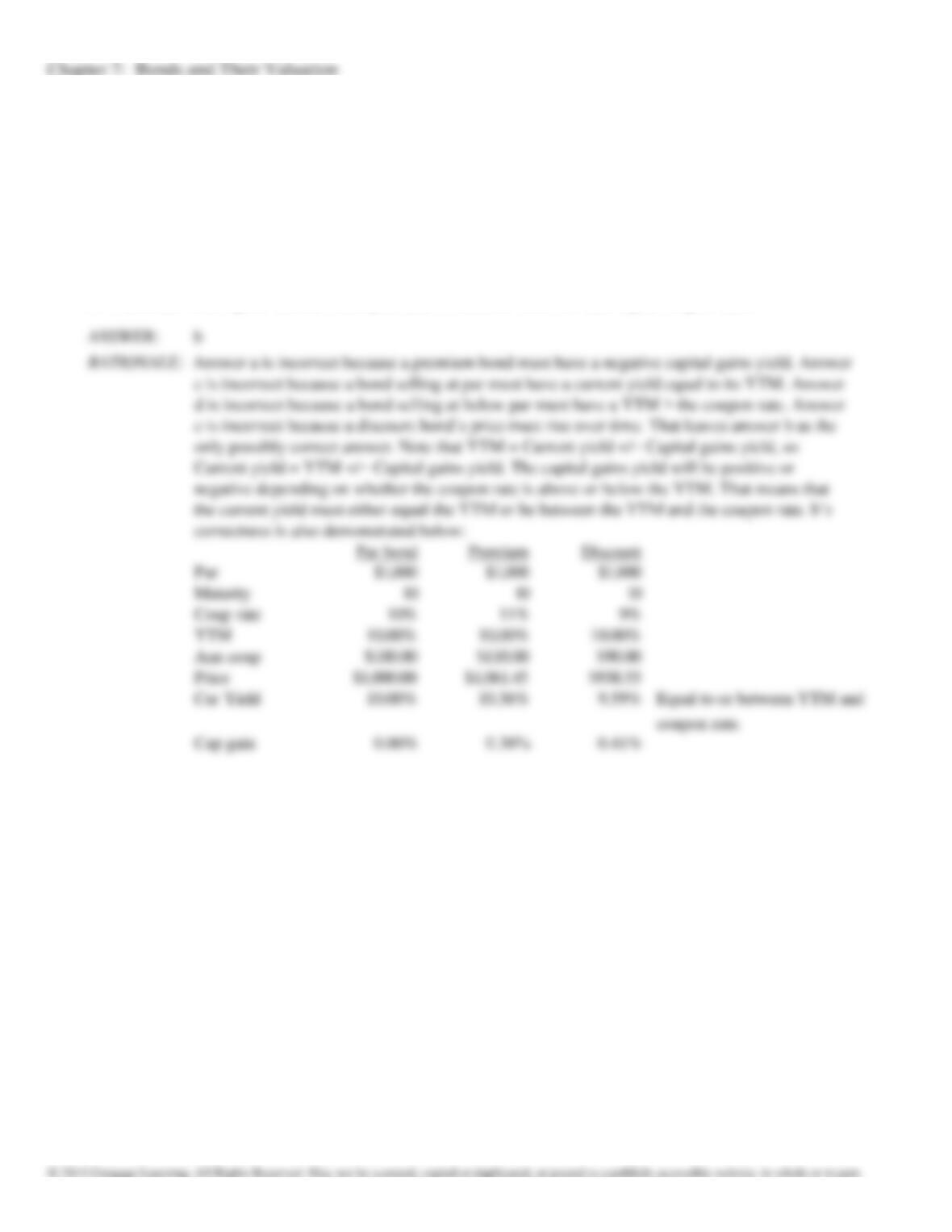
A bond’s current yield must always be either equal to its yield to maturity or between its yield to maturity
and
its coupon rate.
c.
If a bond sells at par, then its current yield will be less than its yield to maturity.
d.
If a bond sells for less than par, then its yield to maturity is less than its coupon rate.
e.
A discount bond’s price declines each year until it matures, when its value equals its par value.
69.
Assume that a noncallable 10-year T-bond has a 12% annual coupon, while a 15-year noncallable T-bond has
an 8%
annual coupon. Assume also that the yield curve is flat, and all Treasury securities have a 10% yield to
maturity.
Which of the following statements is CORRECT?
a.
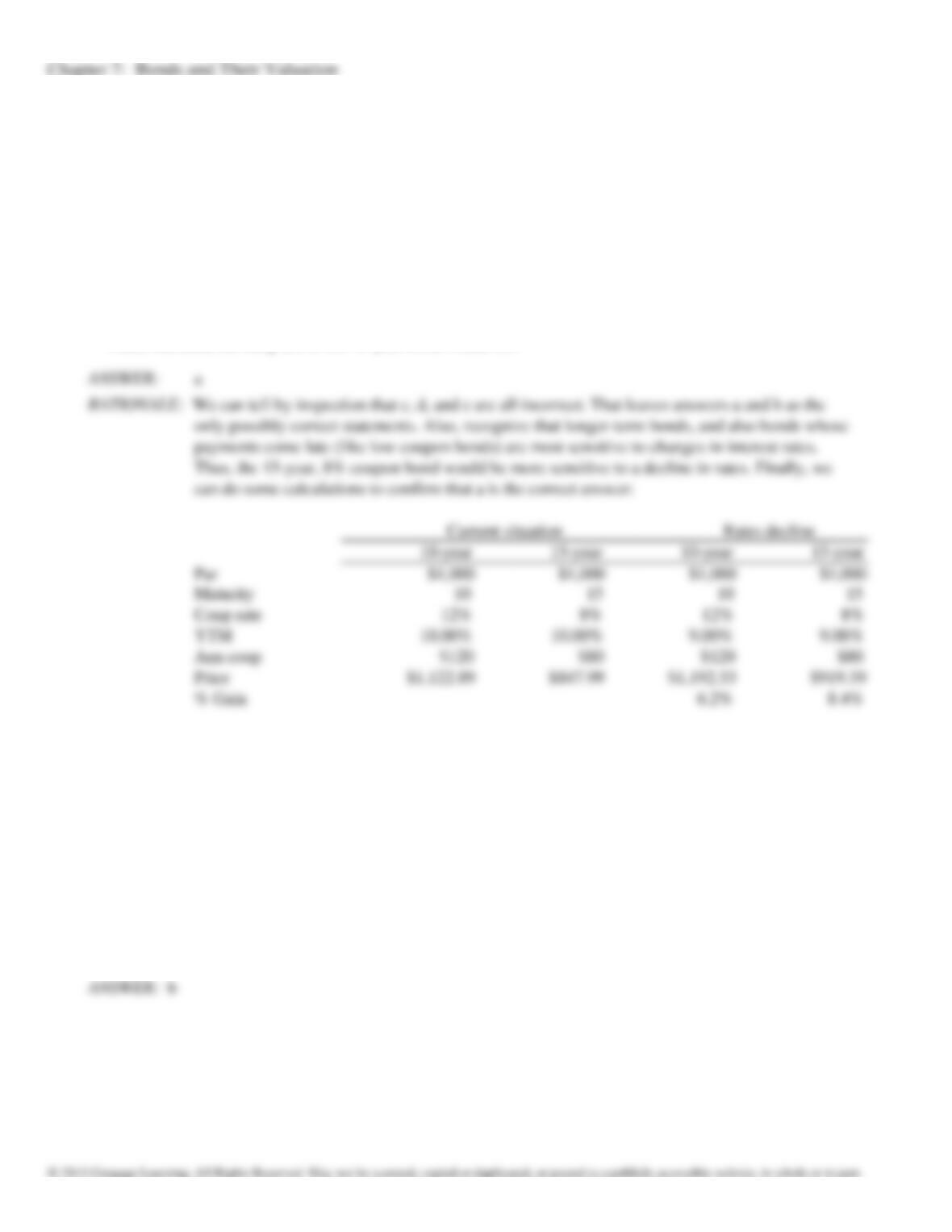
If interest rates decline, the prices of both bonds would increase, but the 15-year bond would have a larger
percentage increase in price.
b.
If interest rates decline, the prices of both bonds would increase, but the 10-year bond would have a larger
percentage increase in price.
c.
The 10-year bond would sell at a discount, while the 15-year bond would sell at a premium.
d.
The 10-year bond would sell at a premium, while the 15-year bond would sell at par.
e.
If the yield to maturity on both bonds remains at 10% over the next year, the price of the 10-year bond
would
increase, but the price of the 15-year bond would fall.
70.
Which of the following statements is CORRECT?
a.
A zero coupon bond of any maturity will have more price risk than any coupon bond, even a perpetuity.
b.
If their maturities and other characteristics were the same, a 5% coupon bond would have more price risk
than a 10% coupon bond.
c.
A 10-year coupon bond would have more reinvestment risk than a 5-year coupon bond, but all 10-year
coupon
bonds have the same amount of reinvestment risk.
d.
A 10-year coupon bond would have more price risk than a 5-year coupon bond, but all 10-year coupon
bonds
have the same amount of price risk.
e.
If their maturities and other characteristics were the same, a 5% coupon bond would have less price risk than
a 10% coupon bond.
71.
Listed below are some provisions that are often contained in bond indentures. Which of these provisions,
viewed
alone, would tend to reduce the yield to maturity that investors would otherwise require on a newly
issued bond?
1.
Fixed assets are used as security for a bond.
2.
A given bond is subordinated to other classes of debt.
3.
The bond can be converted into the firm’s common stock.
4.
The bond has a sinking fund.
5.
The bond has a call provision.
6.
The indenture contains covenants that restrict the use of additional debt.
a. 1, 3, 4, 6
b. 1, 4, 6
c. 1, 2, 3, 4, 6
d. 1, 2, 3, 4, 5, 6
e. 1, 3, 4, 5, 6
72.
Suppose a new company decides to raise a total of $200 million, with $100 million as common equity and
$100 million
as long-term debt. The debt can be mortgage bonds or debentures, but by an iron-clad provision
in its charter, the
company can never raise any additional debt beyond the original $100 million. Given these
conditions, which of the
following statements is CORRECT?
a.
The higher the percentage of debt represented by mortgage bonds, the riskier both types of bonds will be
and,
consequently, the higher the firm’s total dollar interest charges will be.
b.
If the debt were raised by issuing $50 million of debentures and $50 million of first mortgage bonds, we
could
be certain that the firm’s total interest expense would be lower than if the debt were raised by issuing
$100
million of debentures.
c.
In this situation, we cannot tell for sure how, or even whether, the firm’s total interest expense on the $100
million of debt would be affected by the mix of debentures versus first mortgage bonds. The interest rate on
each type of bond would increase as the percentage of mortgage bonds used was increased, but the average
cost might well be such that the firm’s total interest charges would not be affected materially by the mix
between the two.
d.
The higher the percentage of debentures, the greater the risk borne by each debenture, and thus the higher
the
required rate of return on the debentures.
e.
If the debt were raised by issuing $50 million of debentures and $50 million of first mortgage bonds, we
could
be certain that the firm’s total interest expense would be lower than if the debt were raised by issuing
$100
million of first mortgage bonds.
73.
A company is planning to raise $1,000,000 to finance a new plant. Which of the following statements is
CORRECT?
a.
The company would be especially eager to have a call provision included in the indenture if its management
thinks that interest rates are almost certain to rise in the foreseeable future.
b.
If debt is used to raise the million dollars, but $500,000 is raised as first mortgage bonds on the new plant
and
$500,000 as debentures, the interest rate on the first mortgage bonds would be lower than it would be if the
entire $1 million were raised by selling first mortgage bonds.
c.
If two classes of debt are used (with one senior and the other subordinated to all other debt), the
subordinated
debt will carry a lower interest rate.
d.
If debt is used to raise the million dollars, the cost of the debt would be lower if the debt were in the form of
a
fixed-rate bond rather than a floating-rate bond.
e.
If debt is used to raise the million dollars, the cost of the debt would be higher if the debt were in the form of
a
mortgage bond rather than an unsecured term loan.
74.
Assuming all else is constant, which of the following statements is CORRECT?
a.
Other things held constant, a 20-year zero coupon bond has more reinvestment risk than a 20-year coupon
bond.
b.
Other things held constant, for any given maturity, a 1.0 percentage point decrease in the market interest rate
would cause a smaller dollar capital gain than the capital loss stemming from a 1.0 percentage point increase
in the interest rate.
c.
From a corporate borrower’s point of view, interest paid on bonds is not tax-deductible.
d.
Other things held constant, price sensitivity as measured by the percentage change in price due to a given
change in the required rate of return decreases as a bond’s maturity increases.
e.
For a bond of any maturity, a 1.0 percentage point increase in the market interest rate (rd) causes a larger
dollar capital loss than the capital gain stemming from a 1.0 percentage point decrease in the interest rate.
75.
Morin Company’s bonds mature in 8 years, have a par value of $1,000, and make an annual coupon interest
payment
of $65. The market requires an interest rate of 8.2% on these bonds. What is the bond’s price?
a.
$903.04
b.
$925.62
c.
$948.76
d.
$972.48
e.
$996.79
76.
Ryngaert Inc. recently issued noncallable bonds that mature in 15 years. They have a par value of $1,000 and
an
annual coupon of 5.7%. If the current market interest rate is 7.0%, at what price should the bonds sell?
a.
$817.12
b.
$838.07
c.
$859.56
d.
$881.60
e.
$903.64
77.
Adams Enterprises’ noncallable bonds currently sell for $1,120. They have a 15-year maturity, an annual
coupon of $85, and a par value of $1,000. What is their yield to maturity?
a.
5.84%
b.
6.15%
c.
6.47%
d.
6.81%
e.
7.17%
78.
Dyl Inc.’s bonds currently sell for $1,040 and have a par value of $1,000. They pay a $65 annual coupon and
have a
15-year maturity, but they can be called in 5 years at $1,100. What is their yield to maturity (YTM)?
a.
5.78%
b.
6.09%
c.
6.39%
d.
6.71%
e.
7.05%
79.
Radoski Corporation’s bonds make an annual coupon interest payment of 7.35%. The bonds have a par value
of $1,000, a current price of $1,130, and mature in 12 years. What is the yield to maturity on these bonds?
a.
5.52%
b.
5.82%
c.
6.11%
d.
6.41%
e.
6.73%
80.
Sadik Inc.’s bonds currently sell for $1,180 and have a par value of $1,000. They pay a $105 annual coupon
and have
a 15-year maturity, but they can be called in 5 years at $1,100. What is their yield to call (YTC)?
a. 6.63%
b. 6.98%
c. 7.35%
d. 7.74%
e. 8.12%
81.
Malko Enterprises’ bonds currently sell for $1,050. They have a 6-year maturity, an annual coupon of $75, and
a par
value of $1,000. What is their current yield?
a. 7.14%
b. 7.50%
c. 7.88%
d. 8.27%
e. 8.68%
82.
Assume that you are considering the purchase of a 20-year, noncallable bond with an annual coupon rate of
9.5%.
The bond has a face value of $1,000, and it makes semiannual interest payments. If you require an 8.4%
nominal
yield to maturity on this investment, what is the maximum price you should be willing to pay for the
bond?
a.
$1,105.69
b.
$1,133.34
c.
$1,161.67
d.
$1,190.71
e.
$1,220.48
83.
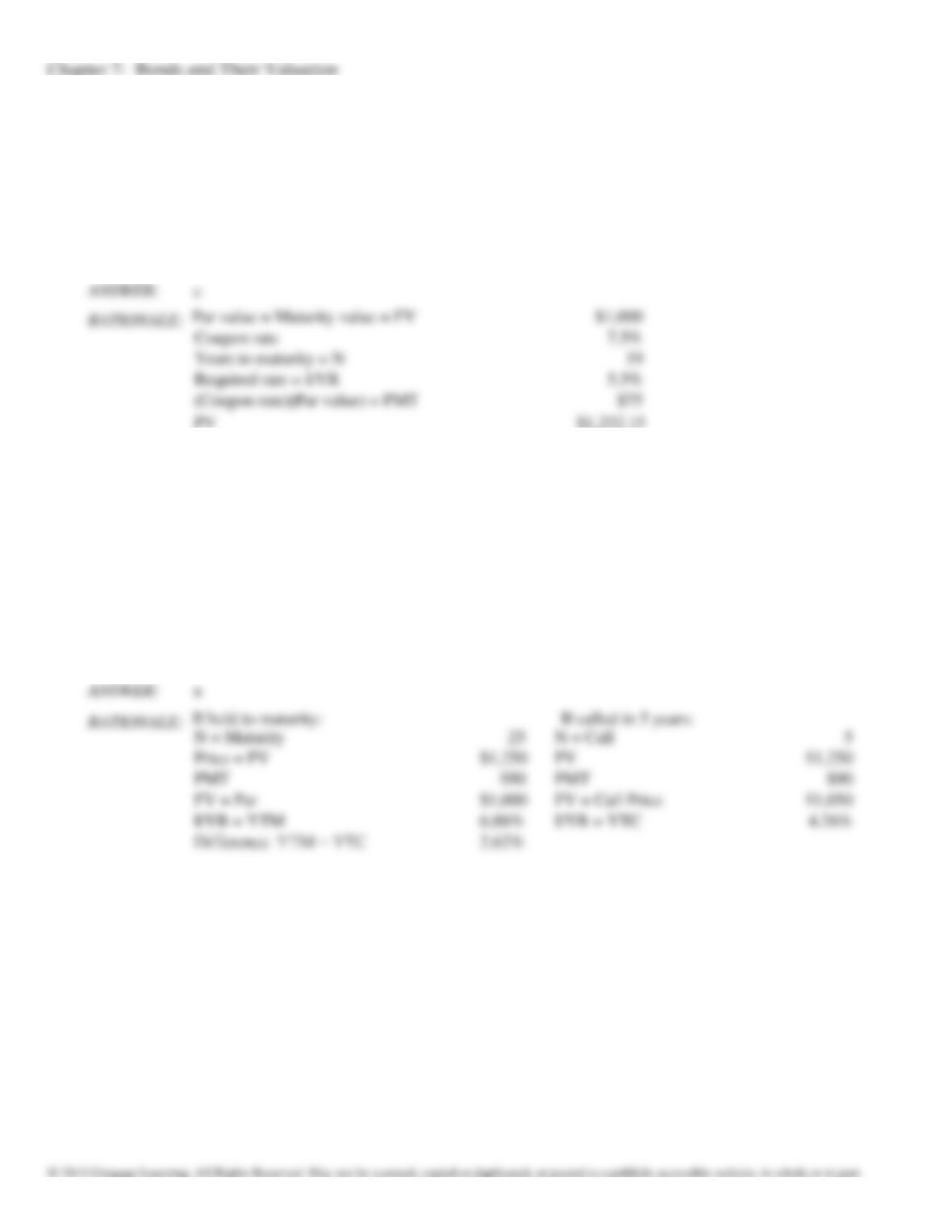
Grossnickle Corporation issued 20-year, noncallable, 7.5% annual coupon bonds at their par value of $1,000
one year
ago. Today, the market interest rate on these bonds is 5.5%. What is the current price of the bonds,
given that they
now have 19 years to maturity?
a.
$1,113.48
b.
$1,142.03
c.
$1,171.32
d.
$1,201.35
e.
$1,232.15
84.
McCue Inc.’s bonds currently sell for $1,250. They pay a $90 annual coupon, have a 25-year maturity, and a
$1,000
par value, but they can be called in 5 years at $1,050. Assume that no costs other than the call premium
would be
incurred to call and refund the bonds, and also assume that the yield curve is horizontal, with rates
expected to
remain at current levels on into the future. What is the difference between this bond’s YTM and its
YTC? (Subtract
the YTC from the YTM; it is possible to get a negative answer.)
a.
2.62%
b.
2.88%
c.
3.17%
d.
3.48%
e.
3.83%
85.
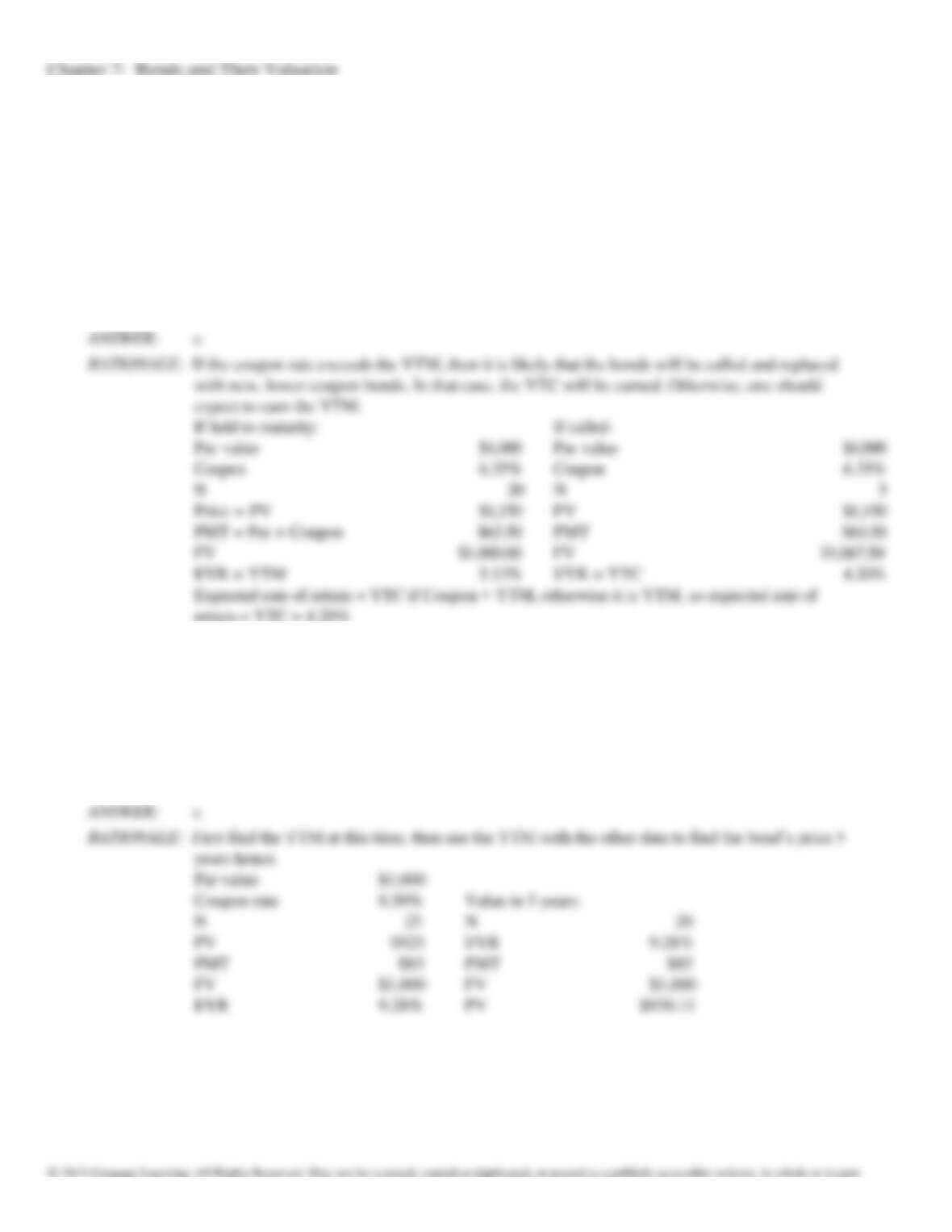
Taussig Corp.’s bonds currently sell for $1,150. They have a 6.35% annual coupon rate and a 20-year maturity,
but
they can be called in 5 years at $1,067.50. Assume that no costs other than the call premium would be
incurred to
call and refund the bonds, and also assume that the yield curve is horizontal, with rates expected to
remain at current
levels on into the future. Under these conditions, what rate of return should an investor expect
to earn if he or she
purchases these bonds?
a.
3.42%
b.
3.60%
c.
3.79%
d.
3.99%
e.
4.20%
86.
A 25-year, $1,000 par value bond has an 8.5% annual payment coupon. The bond currently sells for $925. If
the
yield to maturity remains at its current rate, what will the price be 5 years from now?
a.
$884.19
b.
$906.86
c.
$930.11
d.
$953.36
e.
$977.20
87.
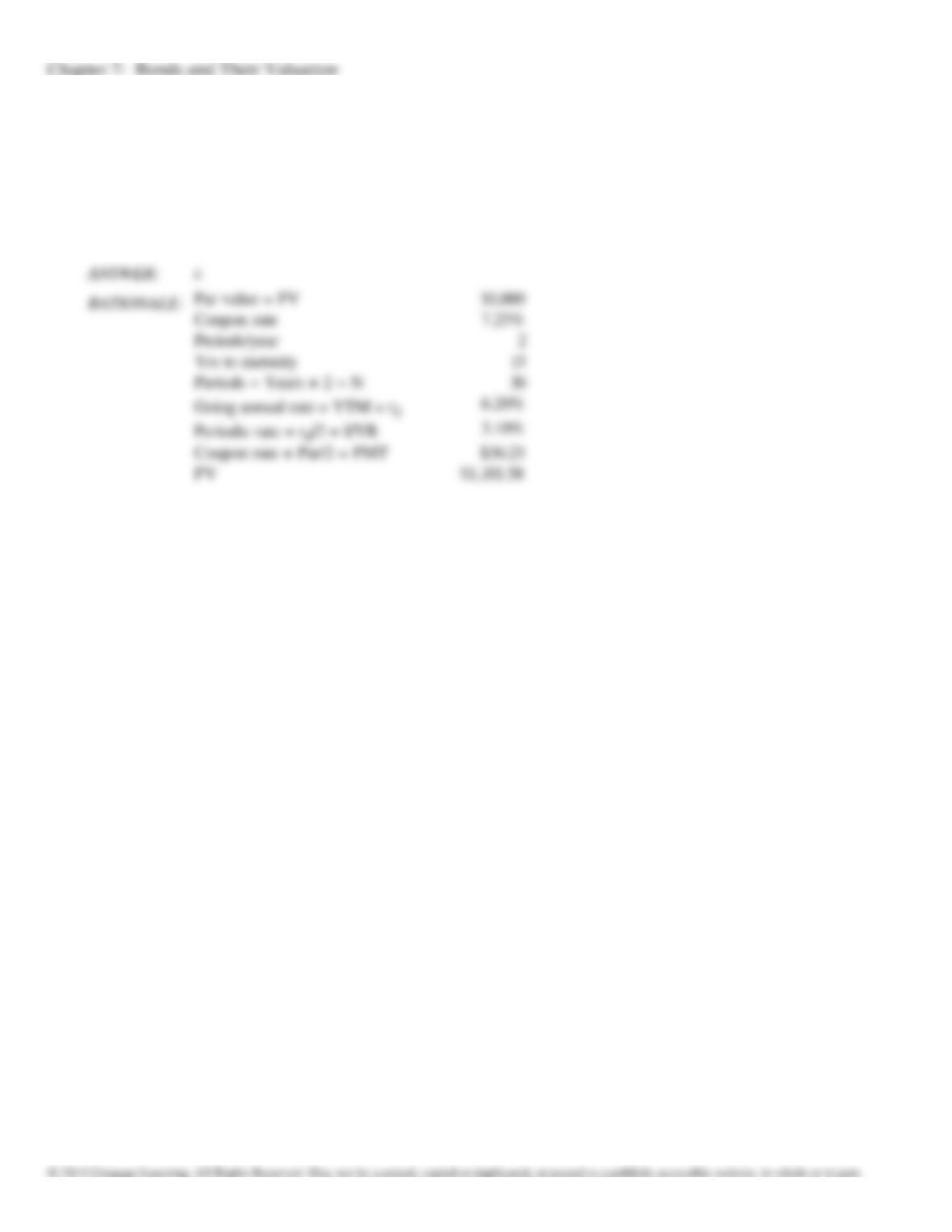
Moerdyk Corporation’s bonds have a 15-year maturity, a 7.25% semiannual coupon, and a par value of $1,000.
The
going interest rate (rd) is 6.20%, based on semiannual compounding. What is the bond’s price?
a.
$1,047.19
b.
$1,074.05
c.
$1,101.58
d.
$1,129.12
e.
$1,157.35
88.
In order to accurately assess the capital structure of a firm, it is necessary to convert its balance sheet figures
from
historical book values to market values. KJM Corporation’s balance sheet (book values) as of today is as
follows:
Long-term debt (bonds, at par)
$23,500,000
Preferred stock
2,000,000
Common stock ($10 par)
10,000,000
Retained earnings
4,000,000
Total debt and equity
$39,500,000
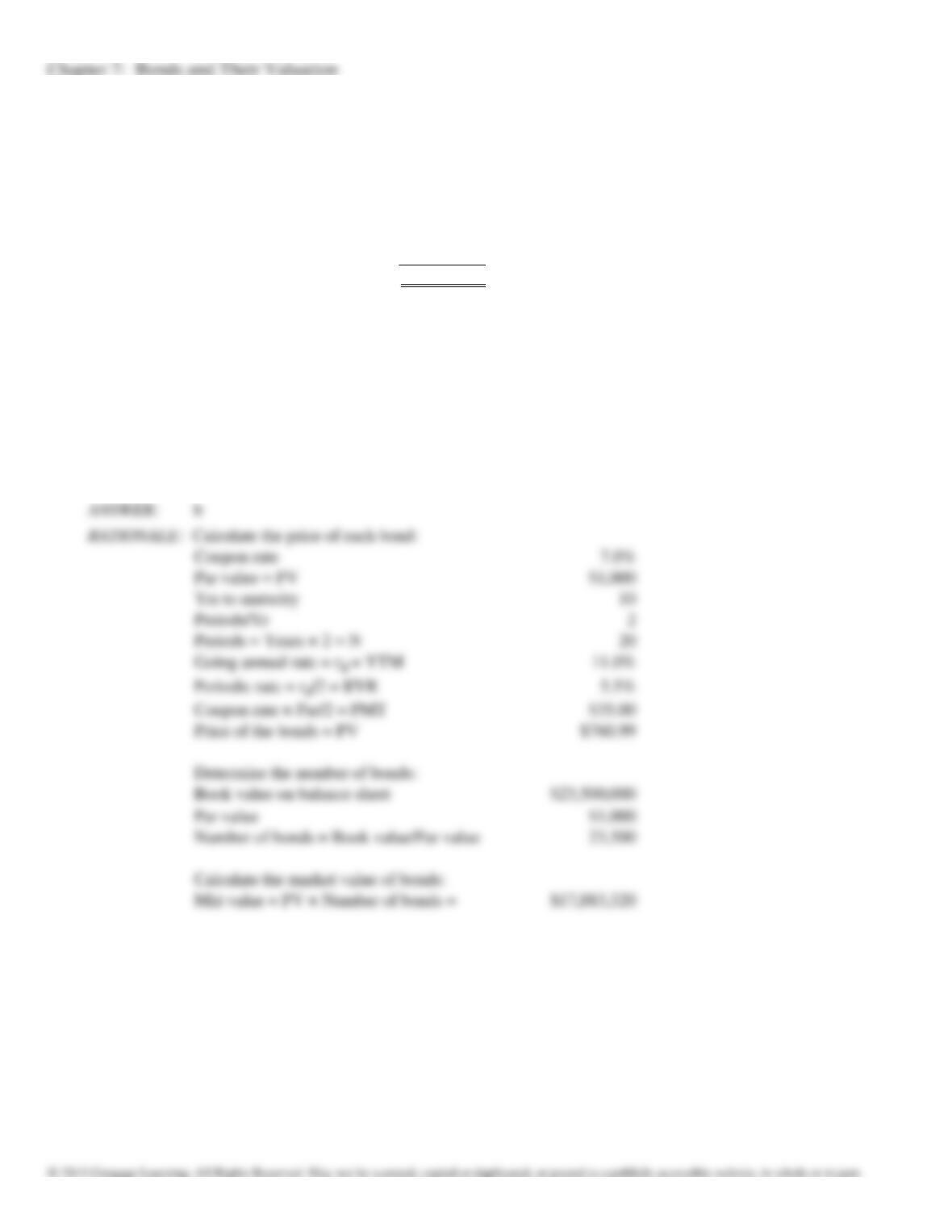
The bonds have a 7.0% coupon rate, payable semiannually, and a par value of $1,000. They mature exactly 10
years
from today. The yield to maturity is 11%, so the bonds now sell below par. What is the current market
value of the
firm’s debt?
a.
$17,436,237
b.
$17,883,320
c.
$18,330,403
d.
$ 7,706,000
e.
$ 7,898,650
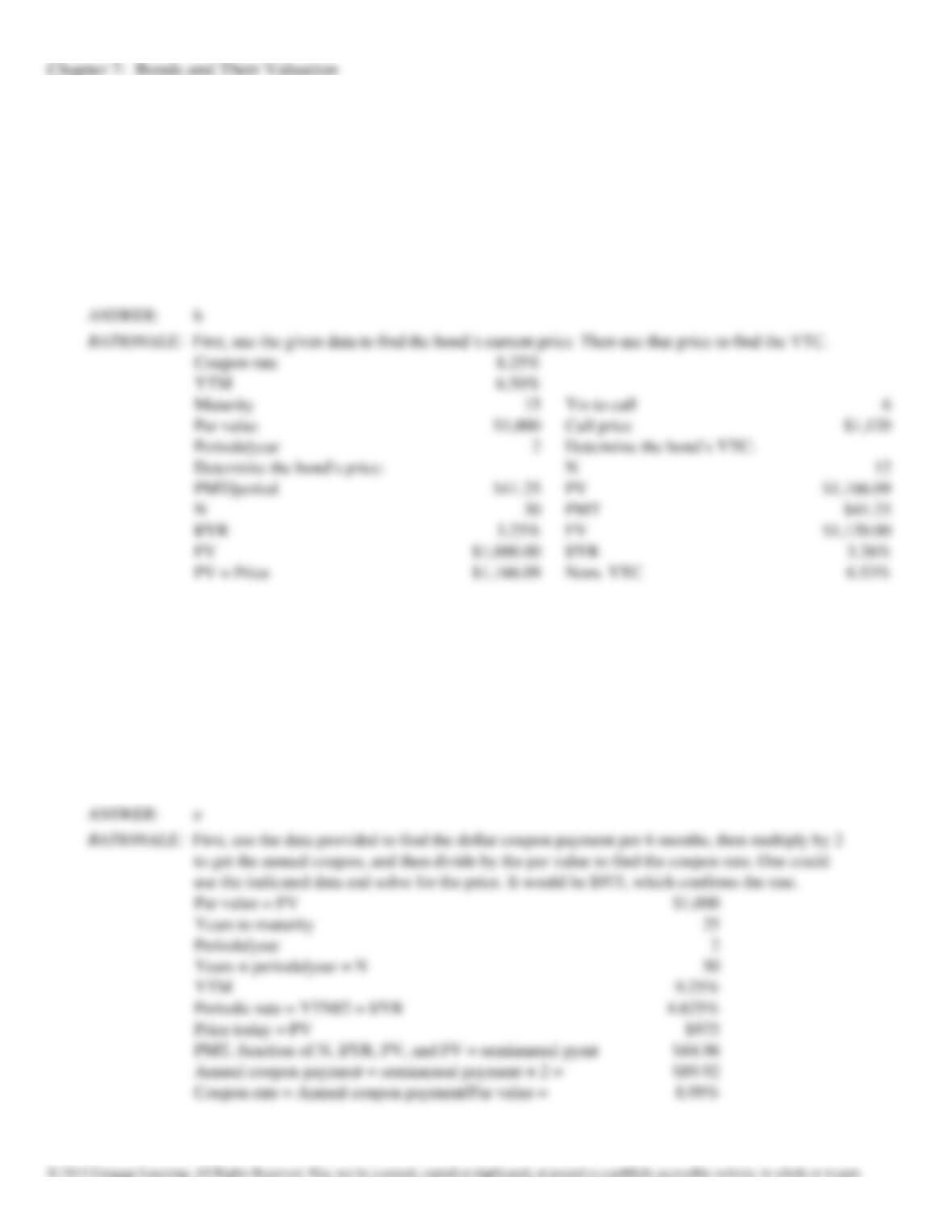
89.
Keenan Industries has a bond outstanding with 15 years to maturity, an 8.25% nominal coupon, semiannual
payments, and a $1,000 par value. The bond has a 6.50% nominal yield to maturity, but it can be called in 6
years at
a price of $1,120. What is the bond’s nominal yield to call?
a. 6.20%
b. 6.53%
c. 6.85%
d. 7.20%
e. 7.55%
90.
O’Brien Ltd.’s outstanding bonds have a $1,000 par value, and they mature in 25 years. Their nominal yield to
maturity is 9.25%, they pay interest semiannually, and they sell at a price of $975. What is the bond’s nominal
coupon
interest rate?
a. 7.32%
b. 7.71%
c. 8.12%
d. 8.54%
e. 8.99%
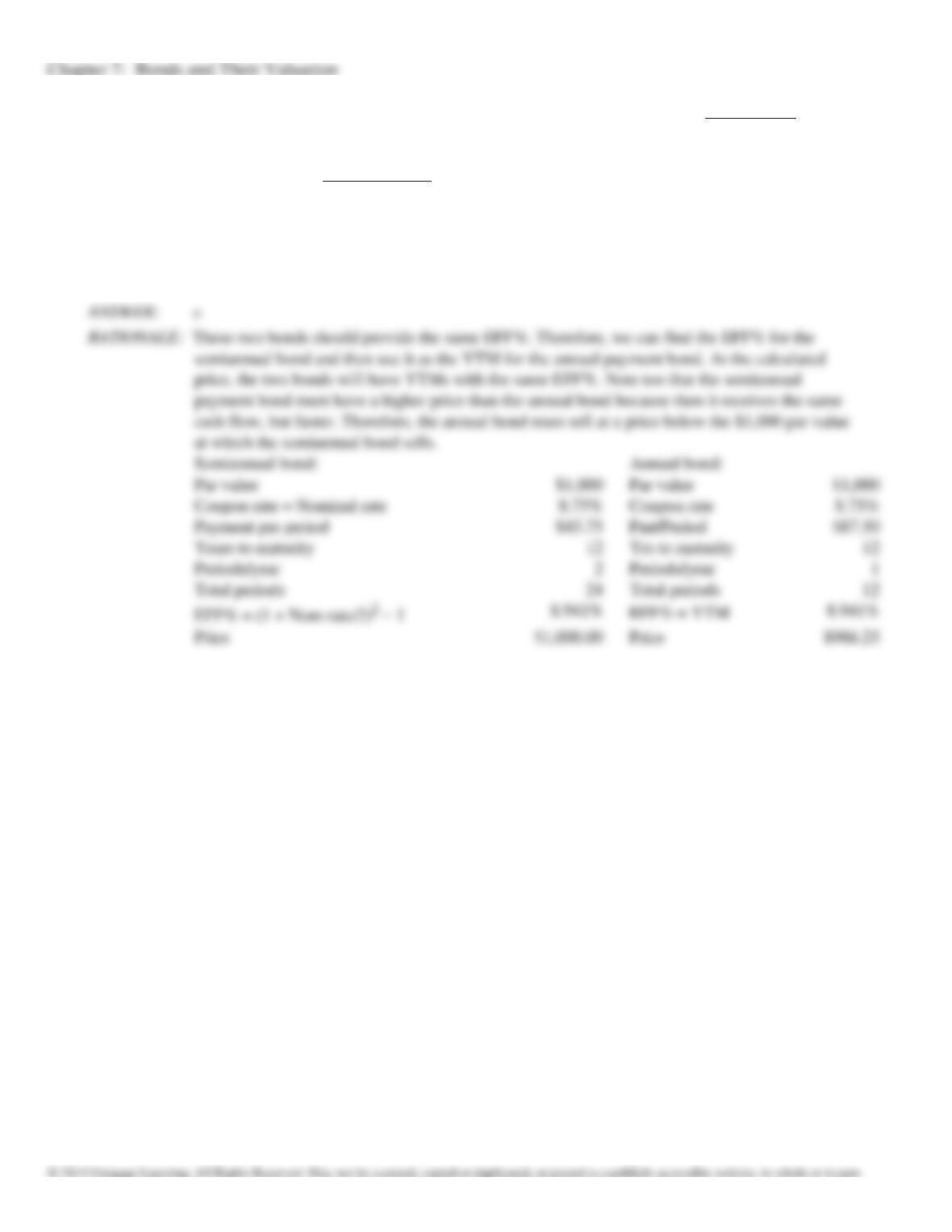
91.
Kebt Corporation’s Class Semi bonds have a 12-year maturity and an 8.75% coupon paid semiannually
(4.375%
each 6 months), and those bonds sell at their $1,000 par value. The firm’s Class Ann bonds have the
same risk,
maturity, nominal interest rate, and par value, but these bonds pay interest annually. Neither bond is
callable. At what
price should the annual payment bond sell?
a.
$ 937.56
b.
$ 961.60
c.
$ 986.25
d.
$1,010.91
e.
$1,036.18
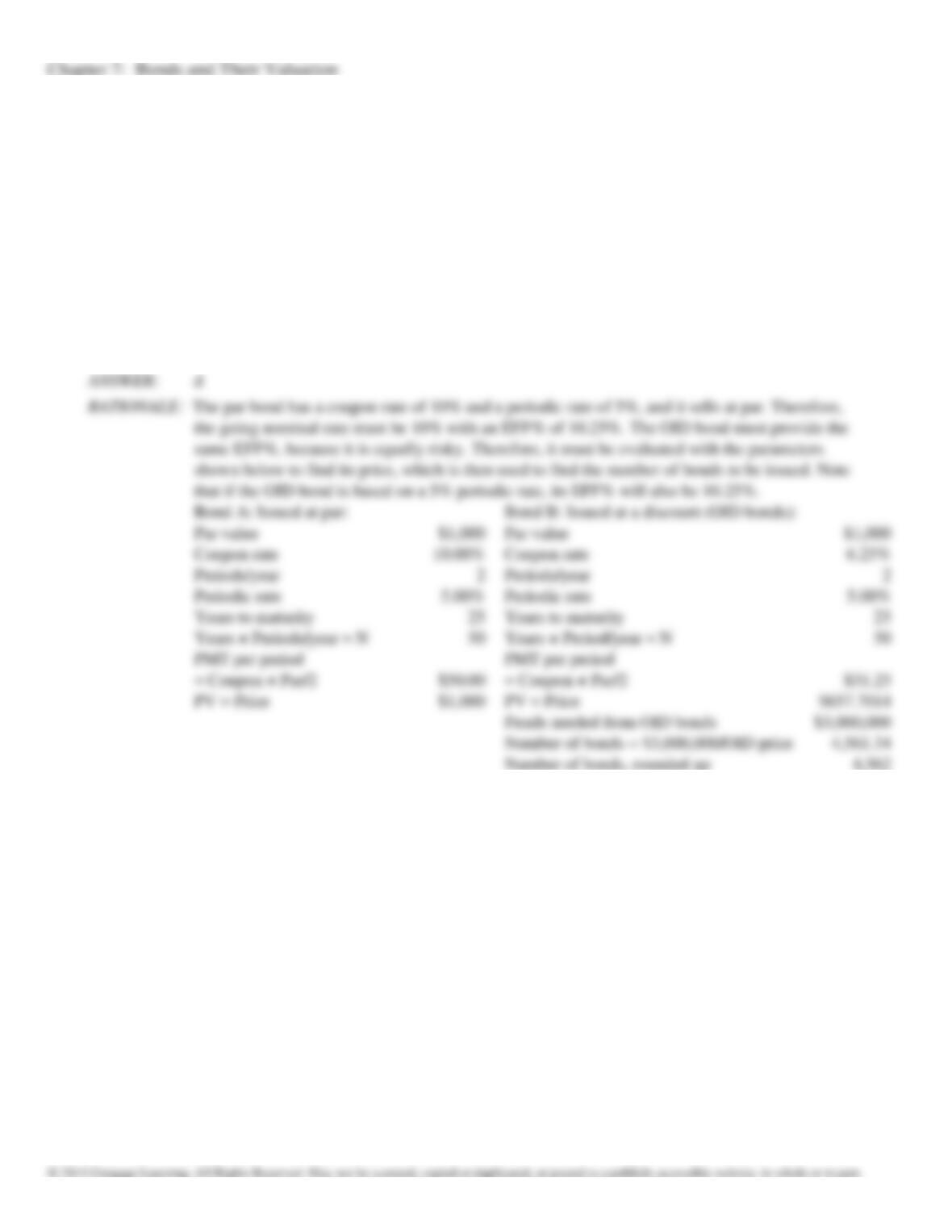
92.
Moon Software Inc. is planning to issue two types of 25-year, noncallable bonds to raise a total of $6 million,
$3
million from each type of bond. First, 3,000 bonds with a 10% semiannual coupon will be sold at their
$1,000 par
value to raise $3,000,000. These are called “par” bonds. Second, Original Issue Discount (OID)
bonds, also with a
25-year maturity and a $1,000 par value, will be sold, but these bonds will have a
semiannual coupon of only 6.25%.
The OID bonds must be offered at below par in order to provide investors
with the same effective yield as the par
bonds. How many OID bonds must the firm issue to raise $3,000,000?
Disregard flotation costs, and round your final
answer up to a whole number of bonds.
a.
4,228
b.
4,337
c.
4,448
d.
4,562
e.
4,676