Chapter 07 Test Bank KEY
1. Utility is:
2. Which of the following statements is true about individuals and utility?
3. Individuals will make choices to maximize their:
4. Utility measurements are:
5. Utility is:
6. Revealed preference is:
7. According to revealed preference a consumer that chooses to smoke cigarettes:
8. One baseline assumption that economists make about consumer behavior is that:
9. After browsing several pairs of shoes, Bob buys a pair of Nike running shoes. Economists would say
that:
10. Utility is:
11. Billy is deciding whether to watch TV at home or go spend time with his friends. If Billy decides to stay
home, we can conclude that:
12. Utility is:
13. A utility function is:
14. A bundle:
15. When economists observe someone make a choice, they assume the individual chooses:
7-4
16. Barbie is deciding whether to play soccer or go swimming over the next hour. She decides to swim.
Economists would conclude that Barbie:
17. After browsing his cabinets to see what meals he can make, Ken is deciding whether to make nachos
or spaghetti for dinner. If Ken makes spaghetti, we can conclude:
18. Bart is seen standing in front of the cooler that contains containers of iced tea and lemonade.
Moments later, we see Bart drinking iced tea, and we conclude Bart is getting more utility from that drink
than lemonade. We drew that conclusion based on what economic concept?
19. Corey has a blue sweater and a denim jacket. On some days he chooses to wear the sweater but on
others he chooses to wear the jacket. Economists would most likely conclude that:
20. Bobby makes a New Year’s resolution to lose weight. On January 3rd, he decides to go to Ben amp;
Jerry’s for ice cream instead of going to the gym. Using the concept of revealed preference, economists
would most likely conclude that Bobby:
21. Alison is deciding how to spend the next hour. We ask her to rate the utility she would get from an
hour of each activity. She would get utility of 4 from an hour of reading, utility of 2 from an hour of playing
video games, and utility of 6 from jogging. Based on this information, economists could predict that Alison
will:
22. Ben is asked to rate the utility he would get from reading different types of publications for the next
hour. If he read a graphic novel he would get utility of 5. If he read a biography, he would get utility of 4,
and if he read his economics textbook, he would get utility of 9. An economist would predict that Ben will
spend his next hour reading:
23. The concept of marginal utility:
24. The concept of diminishing marginal utility:
25. Sadie has just eaten a donut and says it gave her a utility of 6. If she chooses to eat another donut:
26. Nona has just gone on a bike ride for an hour and says it gave her a utility of 7. If she chooses to
continue to ride her bike for another hour:
27. Grace has just eaten a slice of pizza and says it gave her a utility of 8. If she chooses to eat a second
slice:
28. Howard has just smoked a cigarette. If he chooses to smoke a second one:
29. Elijah has just eaten his second popsicle. Using the concept of marginal utility, we can say:
30. Katie just finished a bottle of Coke. Using the concept of marginal utility, we can say:
31. Claire has just eaten her second bowl of cereal. We can say:
32. Linus has just watched two hours of TV. We can say:
33. If successive units of a good are consumed, the marginal utility gained typically:
34. If Bella eats one piece of pie, she gains a utility of 10. If she continues, a second piece yields a
marginal utility of 8, a third will yield a marginal utility of 2, and a fourth piece of pie will yield a marginal
utility of 2. We can say:
7-8
35. If Bob has one piece of gum in his mouth, he gains a utility of 12. If he adds a second piece to the
first, it yields a marginal utility of 6; adding a third will bring marginal utility of 1. Adding a fourth piece will
make Bob choke, yielding a marginal utility of 4. We can say:
36. Thinking about the total utility gained from the consumption of a typical good, we can say in general
that:
37. The marginal utility gained from the consumption of successive units of a typical good:
38. Johnny spends his day doing a variety of activities; he spends the morning exercising and doing yard
work, reads in the afternoon, and hosts a dinner party in the evening. Economists would say his choice to
do a variety of activities instead of spending all of his time on one activity illustrates the concept of:
39. After watching a movie, Alan chooses not to watch a second and goes for a walk instead. Economists
could explain his choices using the concept of:
40. Jeff and Roel like to eat pizza twice a week, burritos once a week, and steak four days a week. This
variety of dinner choices illustrates the concept of:
41. Dave and Buster play two games of tennis, and then decide to go have lunch. Using the concept of
utility to explain their choices, we can conclude that:
42. Courtney goes for an hour bike ride which yields a marginal utility of 8. She stops and gets an ice
cream cone, and then rides her bike for another hour. We can say:
43. Zachary spends his day studying for a total of four hours and exercising for one hour. Using the
concept of utility to explain his choices, we can say
7-10
44. When someone is served pizza and soda for dinner, it is typical behavior to eat some pizza, then
drink some soda, then eat more pizza, and so on, until the person stops consuming both. How can this
behavior be explained using economic concepts?
45. You decide to forgo a third slice of pizza and have a scoop of ice cream instead. This is an example
of the economic concept of:
46. This table shows the different combinations of goods that Jack can consume, given that his income to
spend on these two items is $10.
Bundle
Number of
popsicles
Utility from
popsicles
Number of ice
cream cones
Utility from
ice cream cones
A
10
700
0
0
B
8
720
1
500
C
6
650
2
700
D
4
550
3
750
E
2
400
4
760
F
0
0
5
760
Considering the information in the table shown, the bundle of goods that will derive the highest total utility
for Jack is:
7-11
47. This table shows the different combinations of goods that Jack can consume, given that his income to
spend on these two items is $10.
Bundle
Number of
popsicles
Utility from
popsicles
Number of ice
cream cones
Utility from
ice cream cones
A
10
700
0
0
B
8
720
1
500
C
6
650
2
700
D
4
550
3
750
E
2
400
4
760
F
0
0
5
760
Considering the information in the table shown, if we assume Jack is a rational utility maximizer, then we
can predict he will buy which bundle with his $10?
48. This table shows the different combinations of goods that Jack can consume, given that his income to
spend on these two items is $10.
Bundle
Number of
popsicles
Utility from
popsicles
Number of ice
cream cones
Utility from
ice cream cones
A
10
700
0
0
B
8
720
1
500
C
6
650
2
700
D
4
550
3
750
E
2
400
4
760
F
0
0
5
760
Considering the information in the table shown, if Jack consumes 2 popsicles and 2 ice cream cones:
49. This table shows the different combinations of goods that Jack can consume, given that his income to
spend on these two items is $10.
Bundle
Number of
popsicles
Utility from
popsicles
Number of ice
cream cones
Utility from
ice cream cones
A
10
700
0
0
B
8
720
1
500
C
6
650
2
700
D
4
550
3
750
E
2
400
4
760
F
0
0
5
760
Considering the information in the table shown, if Jack consumes 3 popsicles and 1 ice cream cone, then:
7-13
50. This table shows the different combinations of goods that Jack can consume, given that his income to
spend on these two items is $10.
Bundle
Number of
popsicles
Utility from
popsicles
Number of ice
cream cones
Utility from
ice cream cones
A
10
700
0
0
B
8
720
1
500
C
6
650
2
700
D
4
550
3
750
E
2
400
4
760
F
0
0
5
760
Considering the information in the table shown, if Jack decides to consume bundle D, we can conclude
that Jack:
51. This table shows the different combinations of goods that Jack can consume, given that his income to
spend on these two items is $10.
Bundle
Number of
popsicles
Utility from
popsicles
Number of ice
cream cones
Utility from
ice cream cones
A
10
700
0
0
B
8
720
1
500
C
6
650
2
700
D
4
550
3
750
E
2
400
4
760
F
0
0
5
760
Considering the information in the table shown, Jack’s total utility from consuming bundle D would be:
52. This table shows the different combinations of goods that Jack can consume, given that his income to
spend on these two items is $10.
Bundle
Number of
popsicles
Utility from
popsicles
Number of ice
cream cones
Utility from
ice cream cones
A
10
700
0
0
B
8
720
1
500
C
6
650
2
700
D
4
550
3
750
E
2
400
4
760
F
0
0
5
760
Considering the information in the table shown, the price of ice cream is:
53. A budget constraint is:
54. A budget constraint:
55. A budget constraint:
56. A budget constraint:
7-16
57.
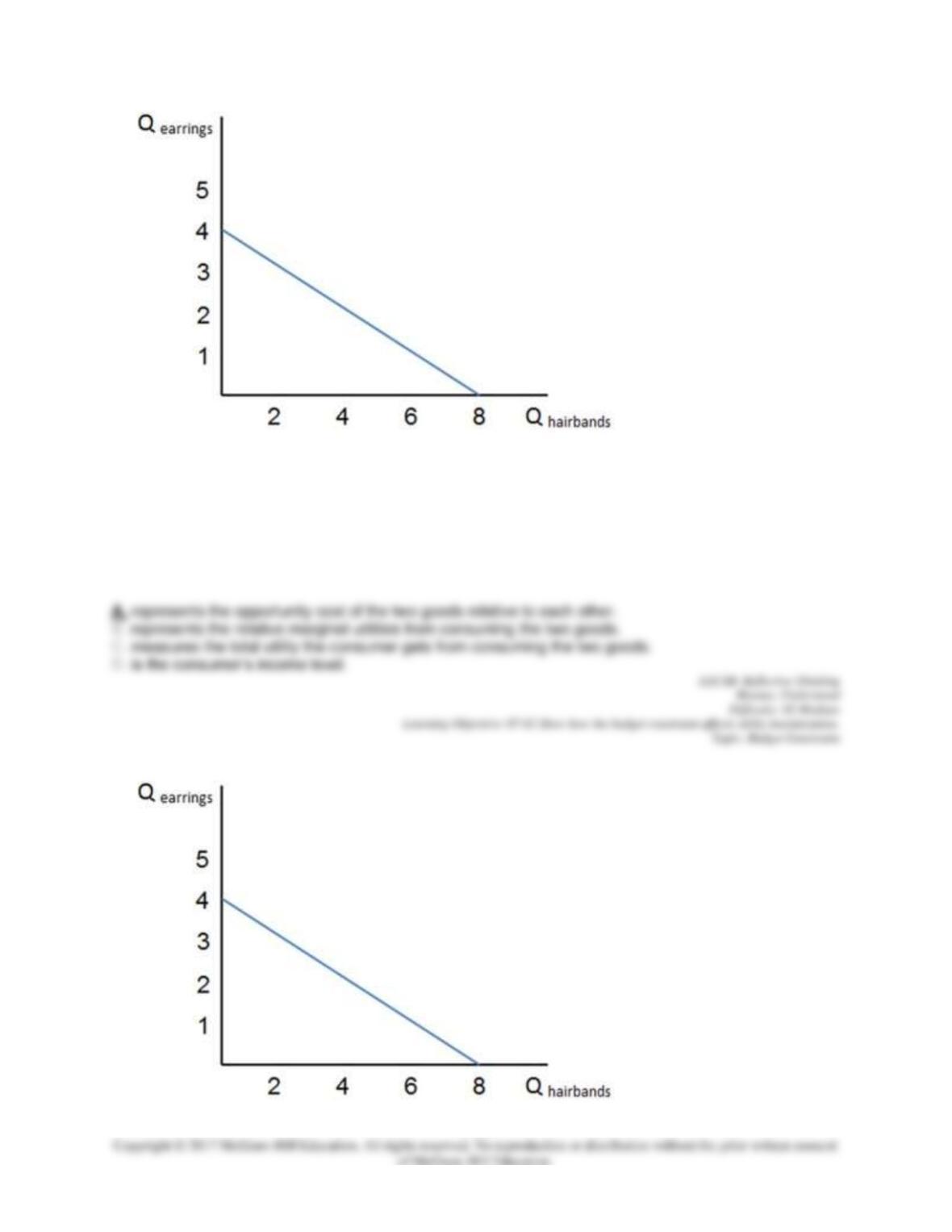
The slope of the budget line in the graph shown:
58.
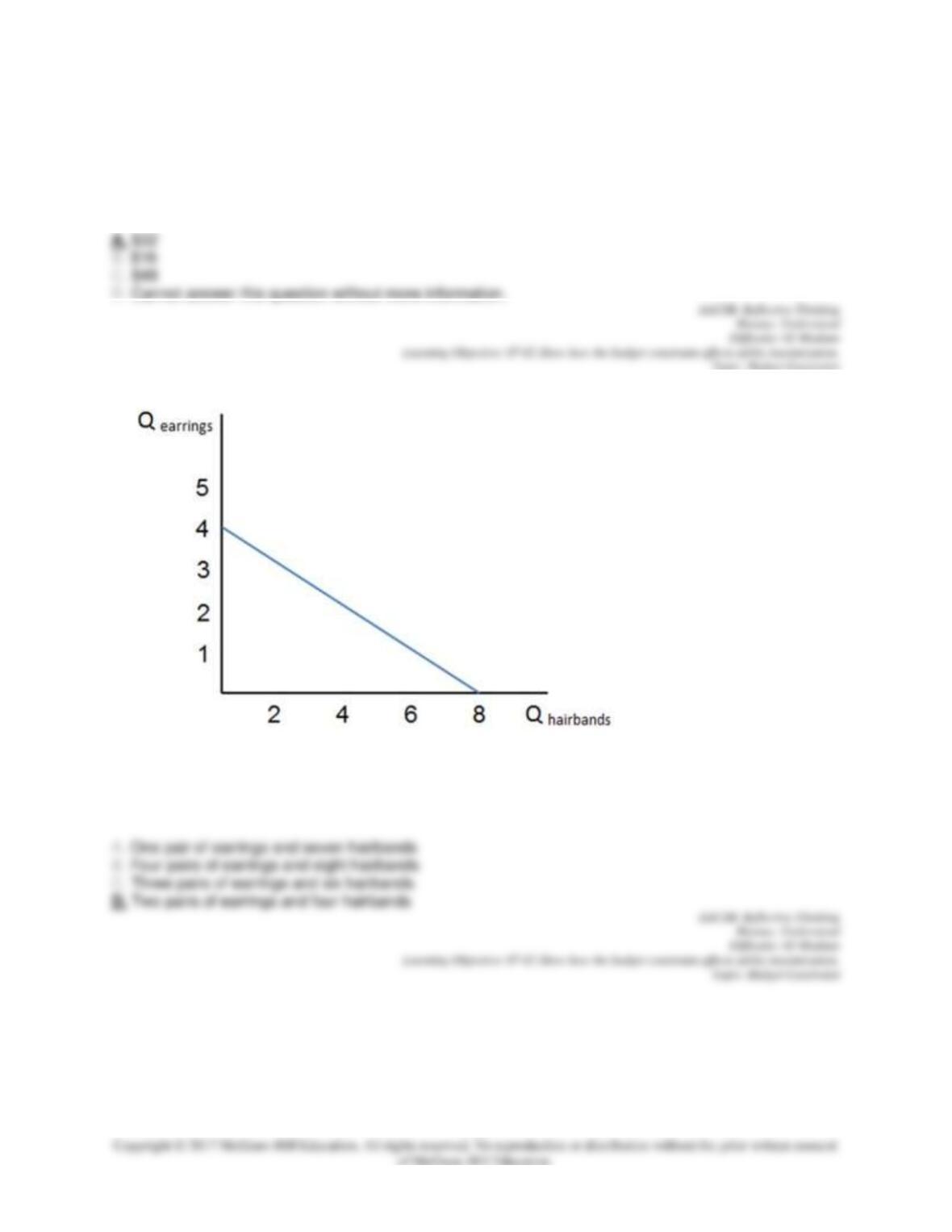
7-17
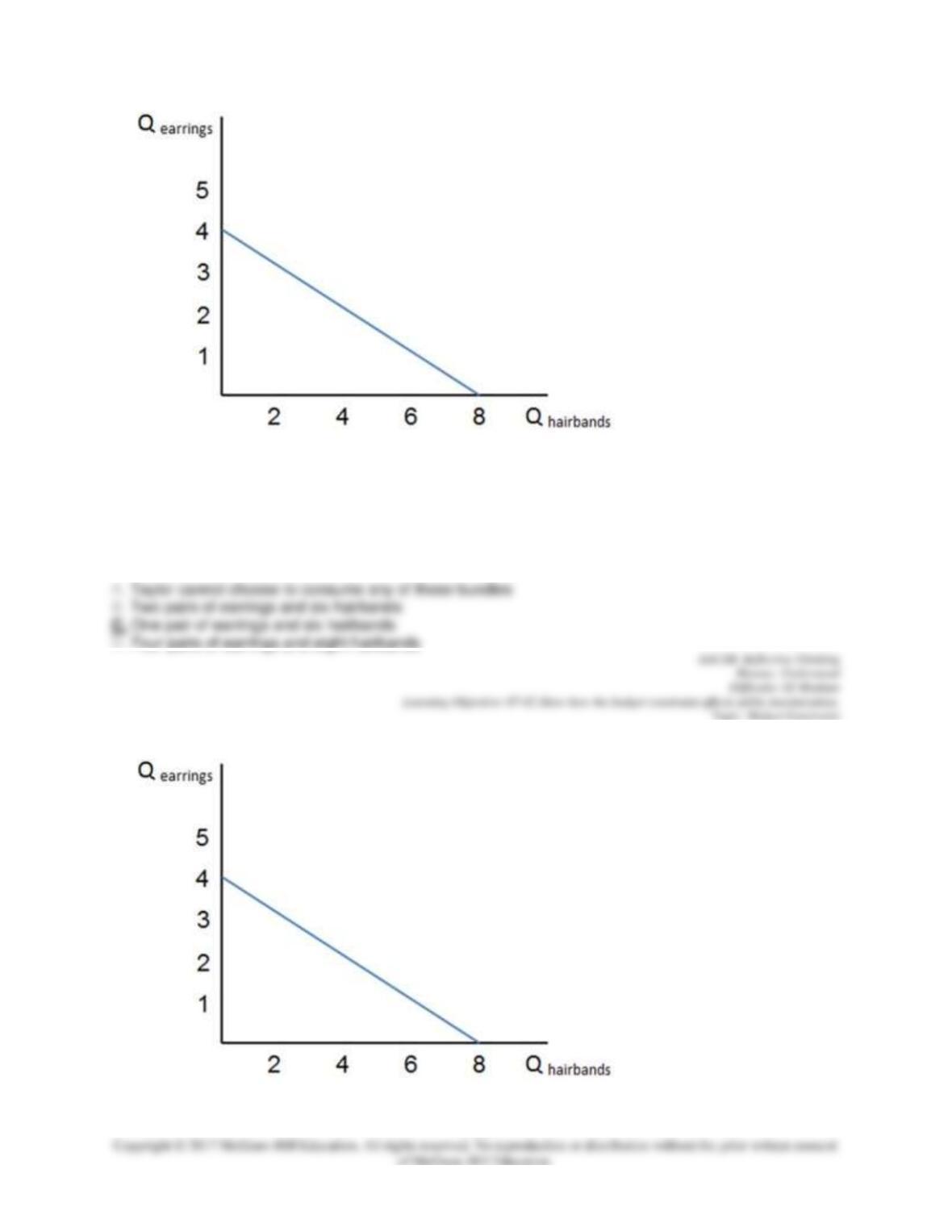
If the graph shown represents Stella’s budget constraint, and hairbands cost $4, what must Stella’s
income to spend on these two items be?
59.
If the graph shown represents Stella’s budget constraint, and she has income of $48 to spend on these
two items, Stella could choose which consumption bundle?
7-18
60.
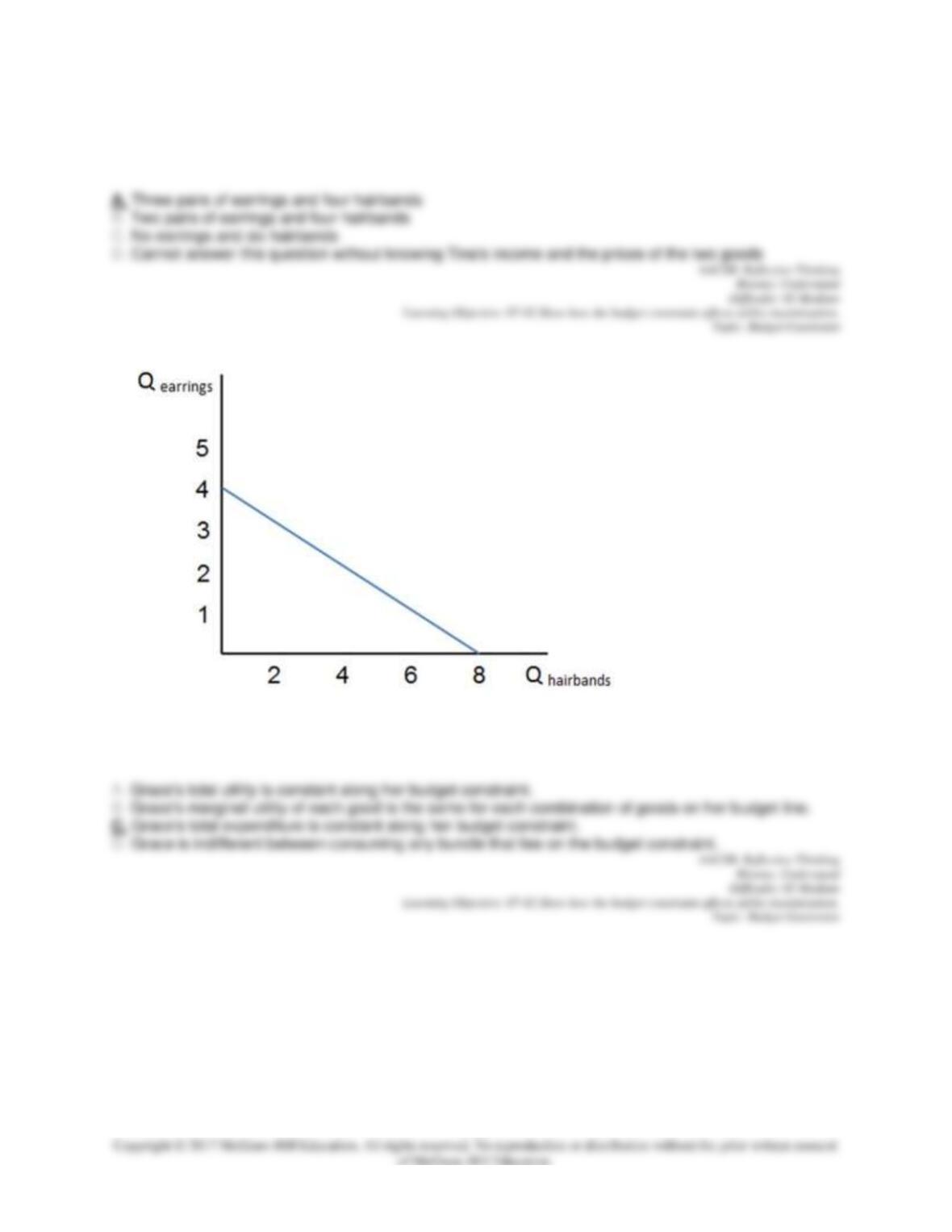
If the graph shown represents Taylor’s budget constraint, which of the following consumption bundles
could Taylor choose?
61.
7-19
If the graph shown represents Tina’s budget constraint, which of the following consumption bundles can
Tina not afford?
62.
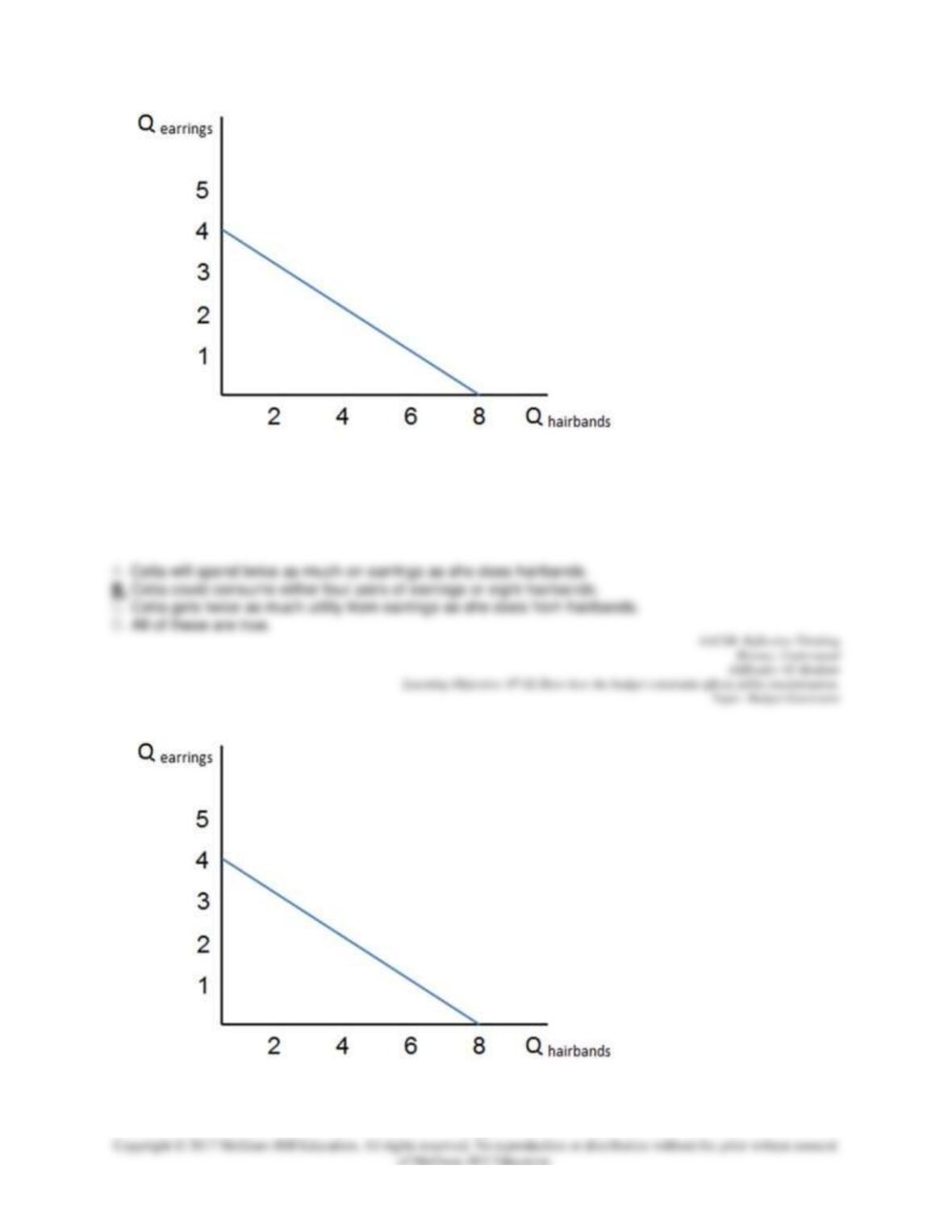
Assume the graph shown represents Grace’s budget constraint. Which of the following is true?
7-20
63.
If the graph shown represents Celia’s budget constraint, which of the following must be true?
64.
If the graph shown represents Suzi’s budget constraint, what can be said about hairbands?