Chapter 7
Interest Rates and Present Value
Multiple Choice
1. The percentage of a balance that a borrower must pay a lender is called the
A) inflation rate.
B) usury rate.
C) interest rate.
D) monetary index.
2. In a market for money, it is typically the case that we use the ________ in a supply and
demand model.
A) inflation rate
B) interest rate
C) wage rate
D) monetary index
3. In a supply and demand model for the market for money, we typically use the _____ to look
at savers’ behavior.
A) the demand curve
B) the supply curve
C) the production possibilities frontier
D) the surplus curve
4. In a supply and demand model for the market for money, we typically use the _____ to look
at borrowers’ behavior.
A) the demand curve
B) the supply curve
C) the production possibilities frontier
D) the surplus curve
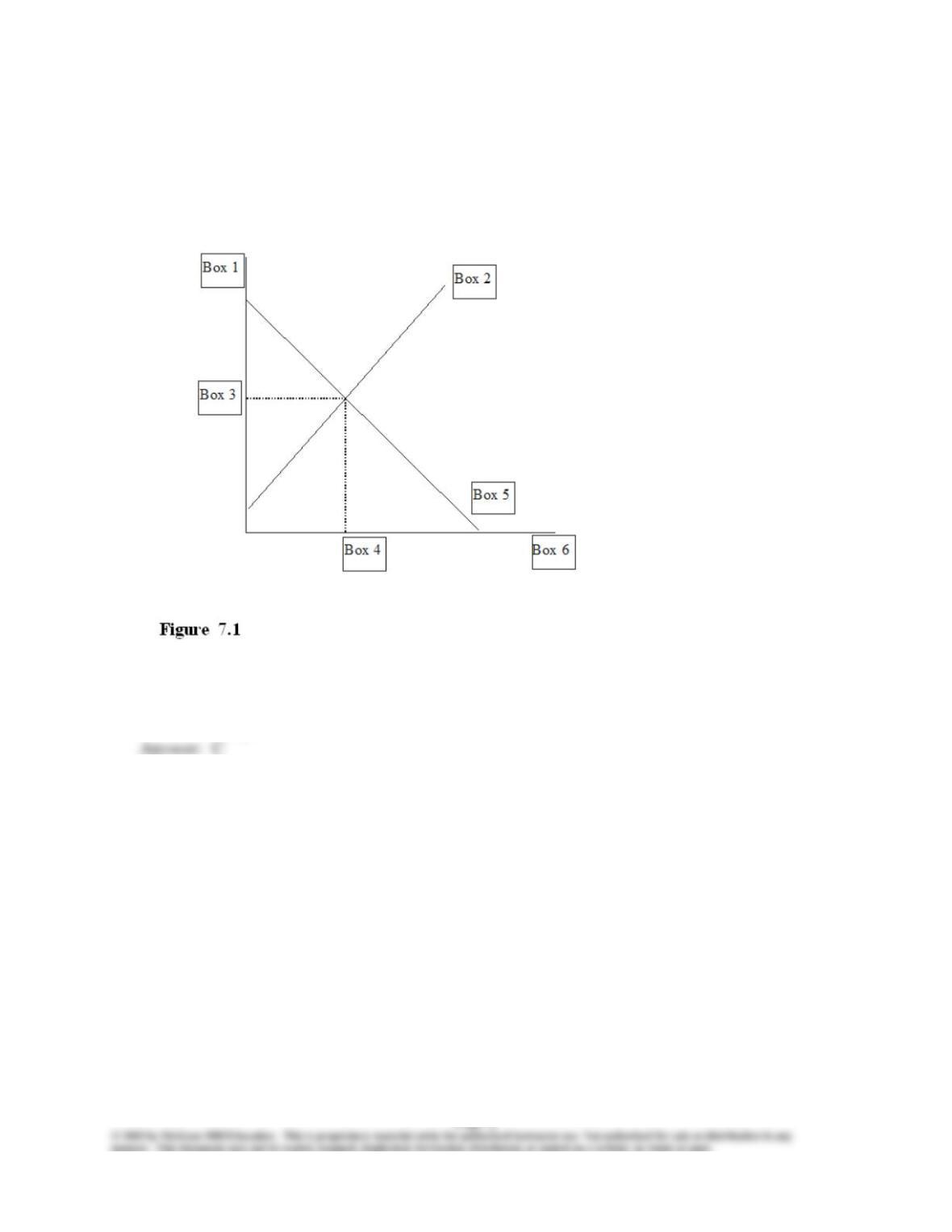
5. Assuming that Figure 7.1 is a market for money that can be borrowed or saved, Box 1 is
A) “$” for the amount borrowed/saved.
B) “$*” for the equilibrium amount borrowed/saved.
C) “r” for interest rate.
D) “r*” for equilibrium interest rate.
6. Assuming that Figure 7.1 is a market for money that can be borrowed or saved, Box 3 is
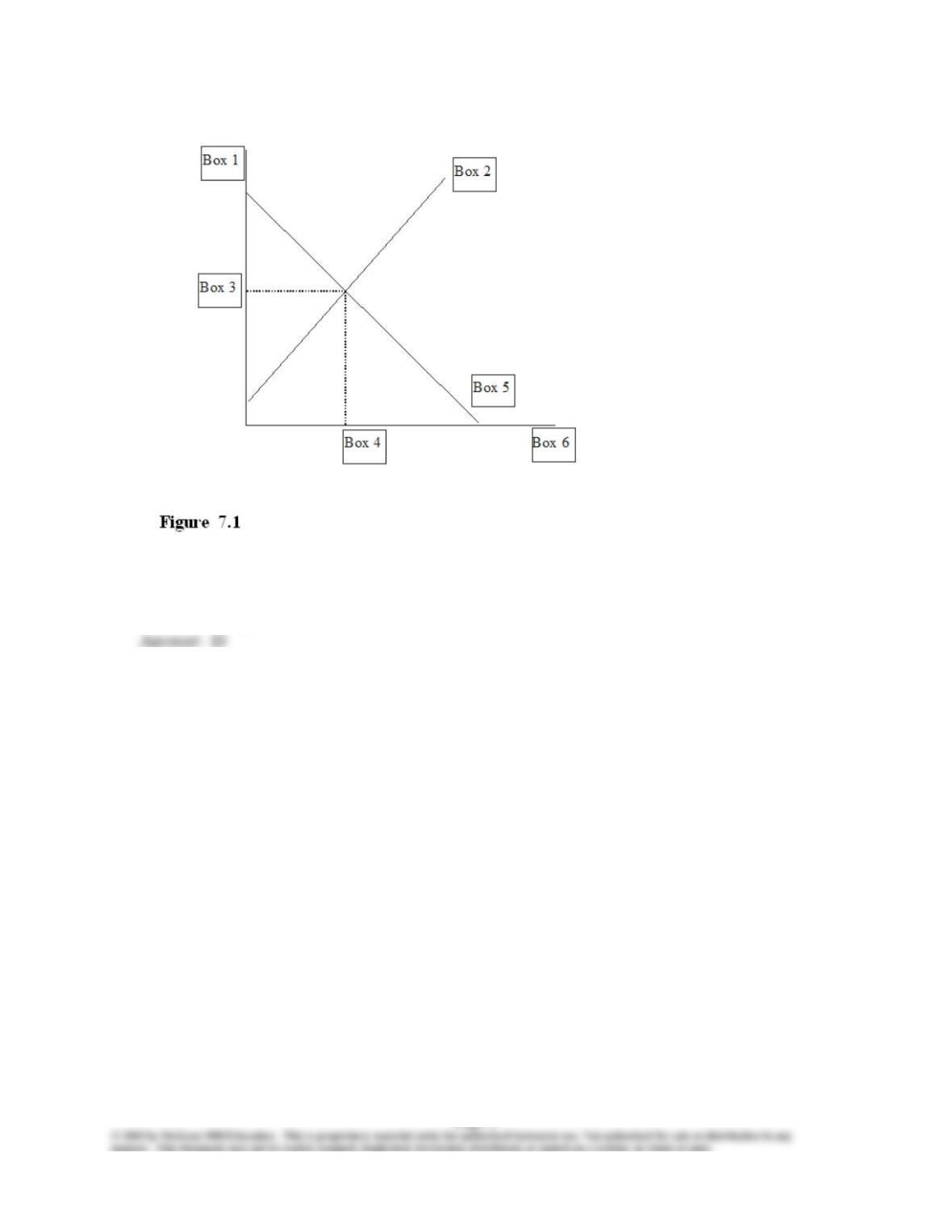
A) “$” for the amount borrowed/saved.
B) “$*” for the equilibrium amount borrowed/saved.
C) “r” for interest rate.
D) “r*” for equilibrium interest rate.
7. Assuming that Figure 7.1 is a market for money that can be borrowed or saved, Box 4 is
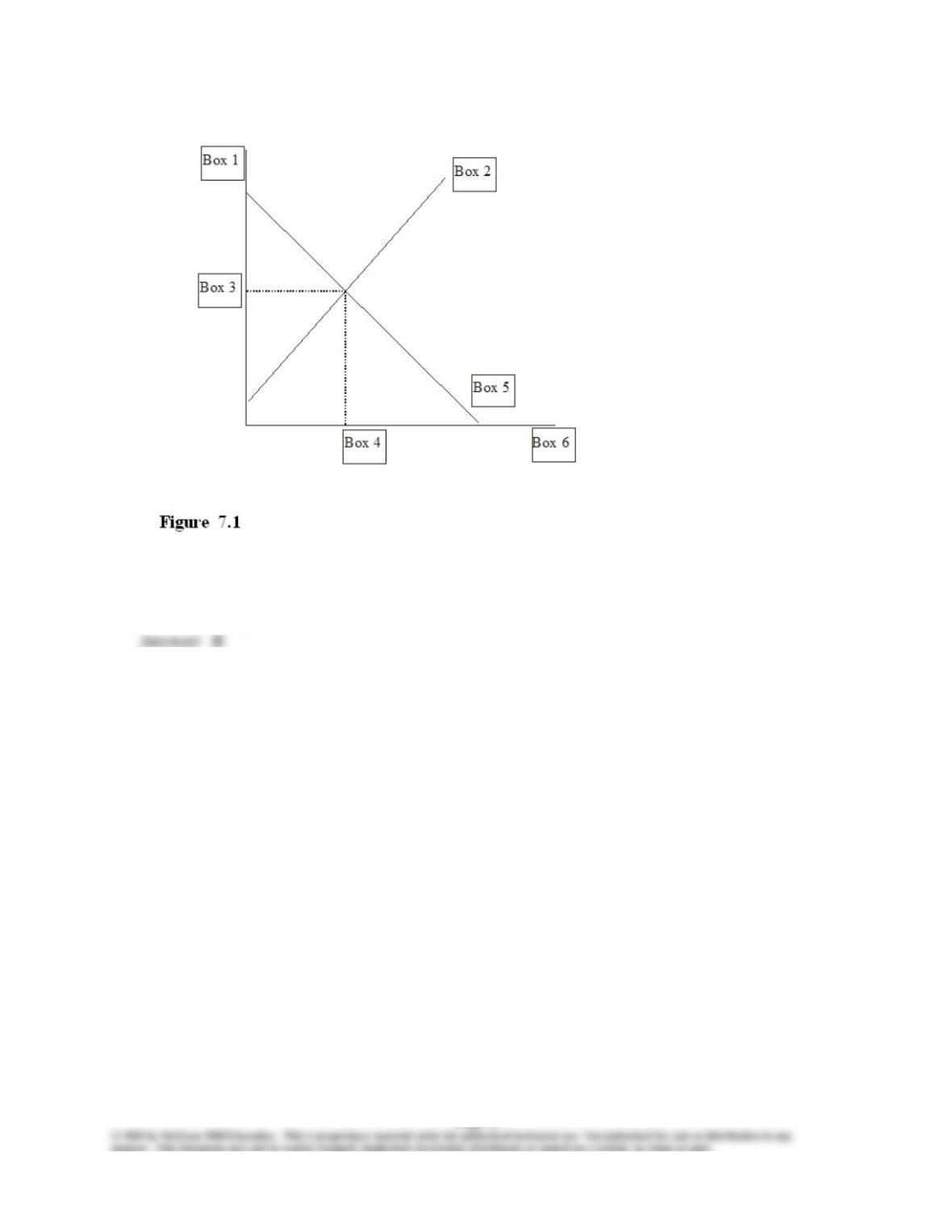
A) “$” for the amount borrowed/saved.
B) “$*” for the equilibrium amount borrowed/saved.
C) “r” for interest rate.
D) “r*” for equilibrium interest rate.
8. Assuming that Figure 7.1 is a market for money that can be borrowed or saved, Box 6 is
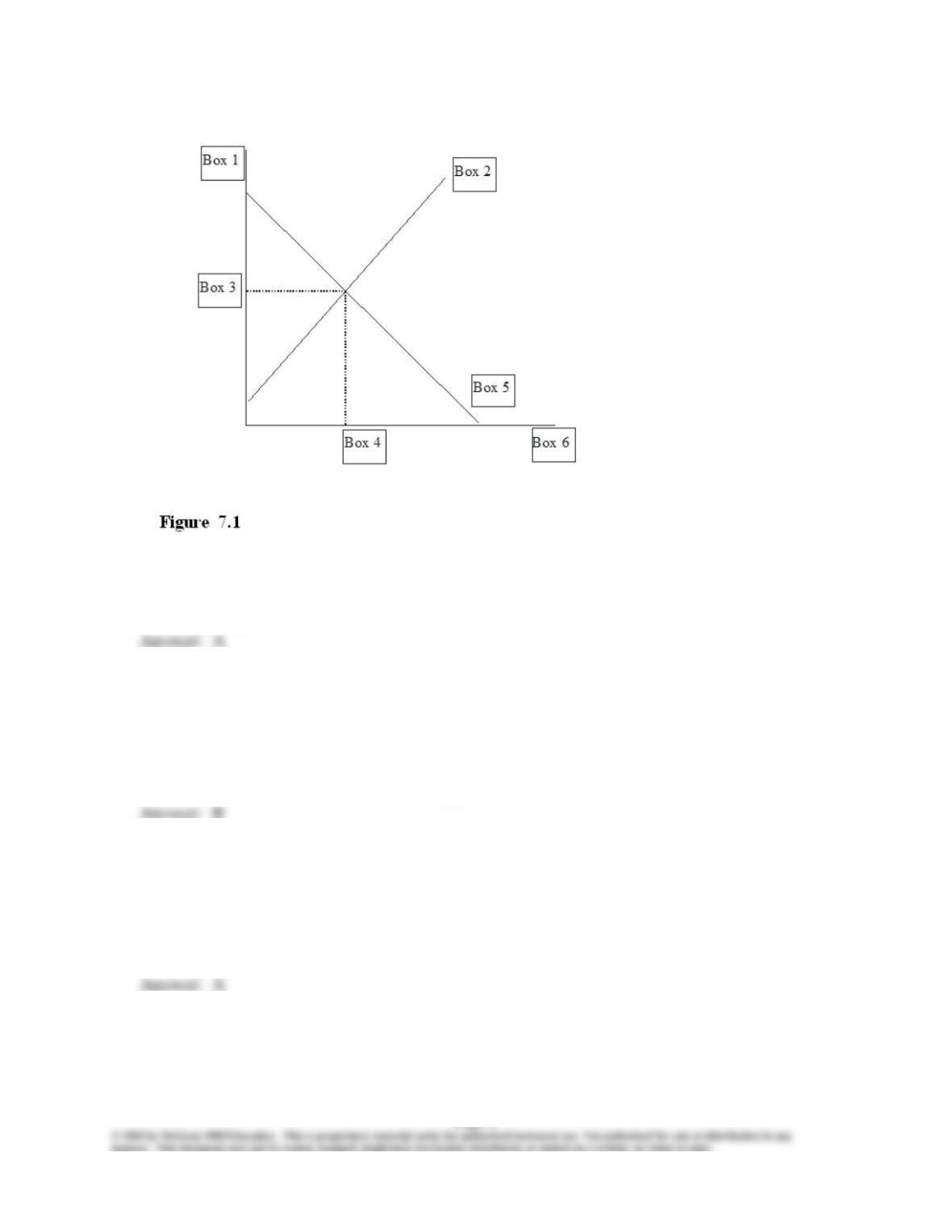
A) “$” for the amount borrowed/saved.
B) “$*” for the equilibrium amount borrowed/saved.
C) “r” for interest rate.
D) “r*” for equilibrium interest rate.
9. In a market for money
A) borrowers are the suppliers and lenders are the consumers.
B) borrowers are the consumers and lenders are the suppliers.
C) both borrowers and lenders are the consumers.
D) both borrowers and lenders are the suppliers.
10. In the market for money the price is
A) the interest rate.
B) the wage rate.
C) the exchange rate.
D) the premium.
11. An increase in the interest rate will
A) increase the demand for money alone.
B) decrease the demand for money and increase the supply of money.

C) increase the demand for money and decrease the supply of money.
D) change neither the demand nor the supply of money; rather it will only affect the quantity
demanded and quantity supplied.
12. A decrease in the interest rate will
A) increase the demand for money alone.
B) decrease the demand for money and increase the supply of money.
C) increase the demand for money and decrease the supply of money.
D) change neither the demand nor the supply of money; rather it will only affect the quantity
demanded and quantity supplied.
13. The demand for money is likely downward sloping because
A) interest sensitive consumption and business investment are both negatively impacted by
increases in the interest rate.
B) interest sensitive consumption and business investment are both positively impacted by
increases in the interest rate.
C) the marginal revenue product of labor is decreasing.
D) the government can always borrow what it wants.
14. The notion of interest sensitive consumption would be most readily observed when people
buy
A) cars.
B) food.
C) insurance.
D) higher education.
15. The notion of interest sensitive consumption would be most readily observed when people
buy
A) furniture.
B) food.
C) insurance.
D) health care.
16. Interest sensitive consumption is negatively impacted by interest rates because when you
A) pay cash for something, the price you really pay depends on the interest rate.
B) buy something on installments (like a car) your payments are positively related to the
interest rate so a higher interest rate would mean a higher payment, and therefore, less
interest sensitive consumption.
C) buy something on installments (like a car) your payments are negatively related to the
interest rate so a higher interest rate would mean a higher payment, and therefore, less
interest sensitive consumption.
D) buy something you really need, the price you really pay depends on the interest rate.
17. The notion of business investment being related to interest rates is shown when interest rates
are
A) higher, more projects (where businesses borrow capital to start new lines of business) are
profitable.
B) higher, fewer projects (where businesses borrow capital to start new lines of business) are
profitable.
C) higher, people are less likely to buy expensive goods on installments.
D) higher, people are more likely to buy expensive goods on installments.
18. If an investment (where the costs are incurred before then profits) makes sense when the
interest rate on the borrowed money to pay for it is 10%
A) an increase in the interest rate will cause the investment to lose money.
B) an increase in the interest rate will cause the investment to be less profitable, but it still
may make money.
C) a decrease in the interest rate will cause the investment to lose money.
D) a decrease in the interest rate will cause the investment to be less profitable, but it still
may make money.
19. If an investment (where the costs are incurred before then profits) makes sense when the
interest rate on the borrowed money to pay for it is 10%
A) an increase in the interest rate will cause the investment to lose money.
B) an increase in the interest rate will cause the investment to be more profitable.
C) a decrease in the interest rate will cause the investment to make even more money.
D) a decrease in the interest rate will cause the investment to be less profitable, but it still
may make money.
20. A higher interest rate
A) increases the motivation to delay consumption and, therefore, save.
B) increases the motivation to delay consumption and, therefore, borrow.
C) decreases the motivation to delay consumption and, therefore, save.
D) decreases the motivation to delay consumption and, therefore, borrow.
21. An increase in the confidence that car-buying consumers have in their future income will
A) increase the demand for borrowable money.
B) decrease the demand for borrowable money.
C) increase the supply of borrowable money.
D) decrease the supply of borrowable money.
22. A decrease in the confidence that car-buying consumers have in their future income will
A) increase the demand for borrowable money.
B) decrease the demand for borrowable money.
C) increase the supply of borrowable money.
D) decrease the supply of borrowable money.
23. An increase in the confidence that equipment-buying firms have in their future profitability
will
A) increase the demand for borrowable money.
B) decrease the demand for borrowable money.
C) increase the supply of borrowable money.
D) decrease the supply of borrowable money.
24. An increase in the confidence that equipment-buying firms have in their future profitability
will
A) increase the demand for borrowable money.

B) decrease the demand for borrowable money.
C) increase the supply of borrowable money.
D) decrease the supply of borrowable money.
25. If people (who used to neither borrow nor save) are now saving for their retirement then this
will cause the
A) supply for loanable funds to increase.
B) demand for loanable funds to increase.
C) supply for loanable funds to decrease.
D) demand for loanable funds to decrease.
26. If people (who used to neither borrow nor save) are now saving for their retirement then this
will cause the equilibrium interest rate
A) to rise.
B) to fall.
C) to fluctuate wildly.
D) to remain constant.
27. Suppose there is a decrease in the confidence that workers have in their future employment
and income. This will cause
A) an decrease in borrowing which will decrease interest rates.
B) an decrease in saving which will decrease interest rates.
C) an decrease in borrowing which will increase interest rates.
D) an decrease in saving which will increase interest rates.
28. Suppose there is an increase in the confidence that workers have in their future employment
and income. This will cause
A) an increase in borrowing which will decrease interest rates.
B) an increase in saving which will decrease interest rates.
C) an increase in borrowing which will increase interest rates.
D) an increase in saving which will increase interest rates.
29. If people (who used to neither borrow nor save) are now borrowing to put their kids through
college then this will cause the
A) supply for loanable funds to increase.
B) demand for loanable funds to increase.
C) supply for loanable funds to decrease.
D) demand for loanable funds to decrease.
30. If people (who used to neither borrow nor save) are now borrowing to put their kids through
college then this will cause the equilibrium interest rate
A) to rise.
B) to fall.
C) to fluctuate wildly.
D) to remain constant.
31. In the market for loanable dollars, an increase in the profitability of investments overall will
be revealed in
A) an increase in the supply of loanable dollars.
B) an increase in the demand for loanable dollars.
C) a decrease in the supply of loanable dollars.
D) a decrease in the demand for loanable dollars.
32. The difference between nominal and real interest rates is that
A) real interest rates are almost always greater than nominal interest rates.
B) real interest rates are what you get after having adjusted nominal rates for inflation.
C) nominal interest rates are what lenders receive and real interest rates are what borrowers
pay.
D) nominal interest rates are what borrowers pay and real interest rates are what lenders
receive.
33. When evaluating whether or not to make an investment one should focus on the _____
because doing so takes into account anticipated inflation.
A) nominal interest rate
B) exchange rate
C) real interest rate
D) junk bond rate
34. If the inflation rate is 3% and the real interest rate is 4%, then the nominal interest rate is
around

A) 1%.
B) 3%.
C) 7%.
D) 12%.
35. If the inflation rate is 2% and the real interest rate is 1%, then the nominal interest rate is
around
A) -1%.
B) 1%.
C) 2%.
D) 3%.
36. If the inflation rate is 5% and the real interest rate is 4%, then the nominal interest rate is
around
A) -1%.
B) 1%.
C) 9%.
D) 20%.
37. If the inflation rate is 6% and the real interest rate is 4%, then the nominal interest rate is
around
A) 2%.
B) -2%.
C) 6%.
D) 10%.
38. If the inflation rate is 3% and the nominal interest rate is 4%, then the real interest rate is
around
A) 1%.
B) 3%.
C) 7%.
D) 12%.
39. If the inflation rate is 2% and the nominal interest rate is 1%, then the real interest rate is
around
A) -1%.

B) 1%.
C) 2%.
D) 3%.
40. If the inflation rate is 5% and the nominal interest rate is 4%, then the real interest rate is
around
A) -1%.
B) 1%.
C) 9%.
D) 20%.
41. When evaluating a business decision, an economist will often resort to the use of present
value because
A) the profits may not be large enough to warrant the time and attention of the investor.
B) the investment occurs in one time period and the profits in another.
C) the investment is often in one currency and the profits in another.
D) the investment is often under one set of managers and the profits under another.
42. To determine whether an investment makes sense a business will compute the net present
value and if the result is
A) negative they will make the investment.
B) positive they will make the investment.
C) positive they will not make the investment unless the interest rate rises.
D) positive they will not make the investment regardless of the change in interest rates.
43. If a business makes the determination that an investment makes sense at the current interest
rate but before they can act the interest rates rises
A) they will have to recalculate whether it still makes sense.
B) it will only make the situation better so they will clearly make the investment.
C) it will cause them to not make the investment regardless of the increase.
D) they will go ahead with the investment because interest rates have nothing to do with
whether an investment makes sense.
44. If a business makes the determination that an investment makes sense at the current interest
rate but before they can act the interest rates fall
A) they will have to recalculate whether it still makes sense.
B) it will only make the situation better so they will clearly make the investment.
C) it will cause them to not make the investment regardless of the decrease.
D) they will go ahead with the investment because interest rates have nothing to do with
whether an investment makes sense.
45. If the interest rate is positive, the present value of a stream of payments is
A) greater than the sum of the actual payments over time.
B) less than the sum of the actual payments over time.
C) equal to the sum of the actual payments over time.
D) unrelated to the stream of actual payments over time.
46. If the interest rate is positive, the present value of $1000 to be received in ten years is
A) less than $1000.
B) greater than $1000.
C) equal to $1000.
D) either greater than $1000 or less than $1000, depending upon the interest rate
47. Suppose your grandmother told you (today) that she had set aside an amount of money in a
savings account bearing 3% interest that was sufficient to give you a $5,000 graduation
present in exactly four years. How much would she have had to set aside?
A) $5000.
B) $5000 x (1.03)4.
C) $5000 / (1.03)4.
D) $5000 / (1+.034).
48. Using an interest rate of 5%, which figure has the largest present value
A) $5000.
B) $5050 to be received two years from now.
C) $5075 to be received three years from now.
D) $5500 to be received ten years from now.
49. Using an interest rate of 5%, which figure has the smallest present value