CHAPTER 7: Market Inefficiencies: Externalities and Public Goods
MULTIPLE CHOICE
1. The costs or benefits of a market activity that affect a third party are called
a. externalities. d. internal costs.
b. public goods. e. common-resource goods.
c. club goods.
2. The costs of a market activity paid for by an individual engaged in the market activity are
________ costs.
a. external d. social
b. internal e. common
c. free-rider
3. An internal cost is best defined as the cost of an activity paid for by
a. the individual who is engaged in the activity.
b. the government.
c. a third party.
d. a free-rider.
e. the individual and the third party.
4. The personal decisions of consumers and firms are based on ________ cost(s).
a. external d. third-party
b. social e. public-good
c. internal
5. The amount an individual pays for gasoline for his or her car is an example of a(n) ________ cost.
a. internal d. third-party
b. social e. public-good
c. external
6. The amount an individual pays for insurance on his or her car is an example of a(n) ________ cost.
a. internal d. third-party
b. social e. public-good
c. external
7. Suzanne drives to work each day. The best example of an internal cost is the
a. amount of pollution emitted by Suzanne’s car.
b. congestion created by Suzanne’s car being on the road.
c. amount the government paid to build the road.
d. amount Suzanne pays to maintain her car.
e. amount of money Suzanne saves each day by avoiding the toll roads.
8. The costs of a market activity paid for by an individual NOT engaged in the market activity are
________ costs.
a. external d. social
b. internal e. common
c. free-rider
9. An external cost is best defined as the cost of an activity paid for by
a. the individual who is engaged in the activity.
b. the government.
c. a third party.
d. a free-rider.
e. the individual and the third party.
10. For a market to work efficiently
a. the external costs must be paid.
b. all external costs must be eliminated.
c. all internal costs must be eliminated.
d. the social costs must be equal to the internal costs.
e. all pollution must be eliminated.
11. External costs are the result of the actions of
a. firms.
b. consumers.
c. firms and consumers.
d. the government.
e. firms, consumers, and the government.
12. The pollution emitted by a car is an example of a(n) ________ cost.
a. internal d. production
b. social e. public-good
c. external
13. The external cost is equal to ________ per unit.
a. $60 d. $50
b. $70 e. $30
c. $20
14. The market equilibrium occurs where price is ________ and quantity is ________.
a. $70; 200 d. $80; 300
b. $50; 200 e. $60; 100
c. $60; 300
15. The social optimum occurs where price is ________ and quantity is ________.
a. $70; 200 d. $80; 300
b. $50; 200 e. $60; 100
c. $60; 300
16. Which of the following is true?
a. social costs = internal costs − external costs
b. social costs = internal costs + external costs
c. internal costs = social costs + external costs
d. external costs = social costs + internal costs
e. internal costs − social costs = external costs
17. The cost of an activity paid for by the individual and the third party is defined as a(n) ________
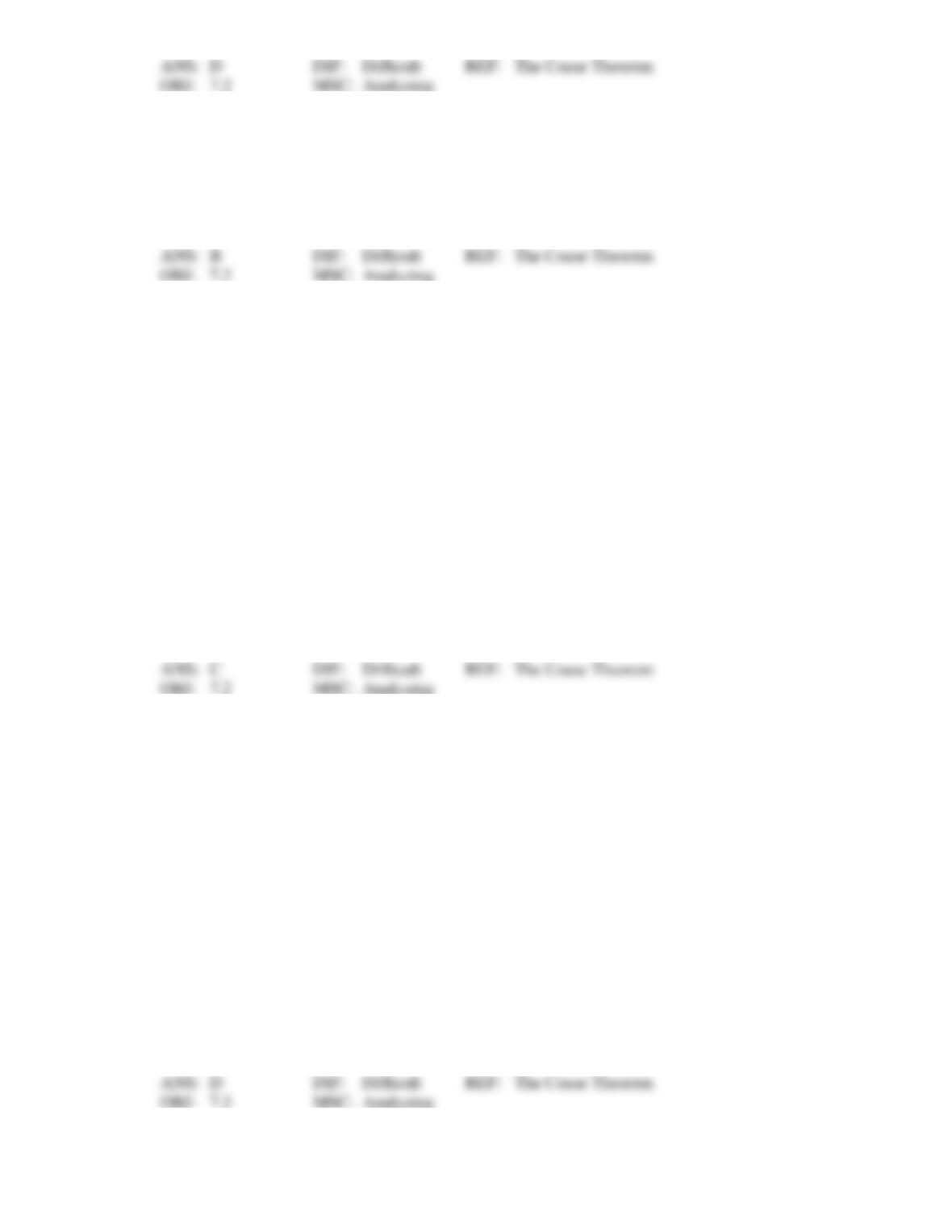
cost.
a. internal d. third-party
b. social e. public-good
c. external
18. Lila shares a house with two other people. She is a concert pianist and often practices at home. One
roommate enjoys listening to her practice, but the other does not. For the roommate who enjoys
listening to Lila play, this is an example of ________; for the other roommate, it is an example of
________.
a. the tragedy of the commons; the third-party problem
b. a positive externality; a negative externality
c. a positive externality; the free-rider problem
d. the free-rider problem; the tragedy of the commons
e. a negative externality; the tragedy of the commons
19. Negative externalities have ________ for third parties.
a. internal costs d. external benefits
b. internal benefits e. social costs
c. external costs
20. A negative externality exists whenever
a. there are no internal costs.
b. production of a good creates an external cost.
c. production of a good creates an external benefit.
d. production of a good has no social cost.
e. production of a good has no social benefit.
21. Consider a market with a negative externality. The market will tend to ________ the good because
the market participants tend to ignore the ________ of their decision.
a. overproduce; external benefit d. underproduce; external cost
b. underproduce; external benefit e. overproduce; internal benefit
c. overproduce; external cost
22. Which of the following is true of a negative externality?
a. Some costs are borne by a third party.
b. The government can use subsidies to encourage firms to internalize the externality.
c. The government must take over the production of this good so that the externality can be
internalized.
d. Some benefits accrue to a third party.
e. Its existence always requires corrective measures by the government.
23. Consider a market where production of the good is creating a negative externality. In the market
equilibrium, there is a deadweight loss because the
a. internal cost of production is less than the social cost.
b. internal cost of production is not equal to the internal benefit.
c. internal benefit is not equal to the external benefit.
d. social cost is greater than the internal benefit.
e. internal benefit is less than the internal cost.
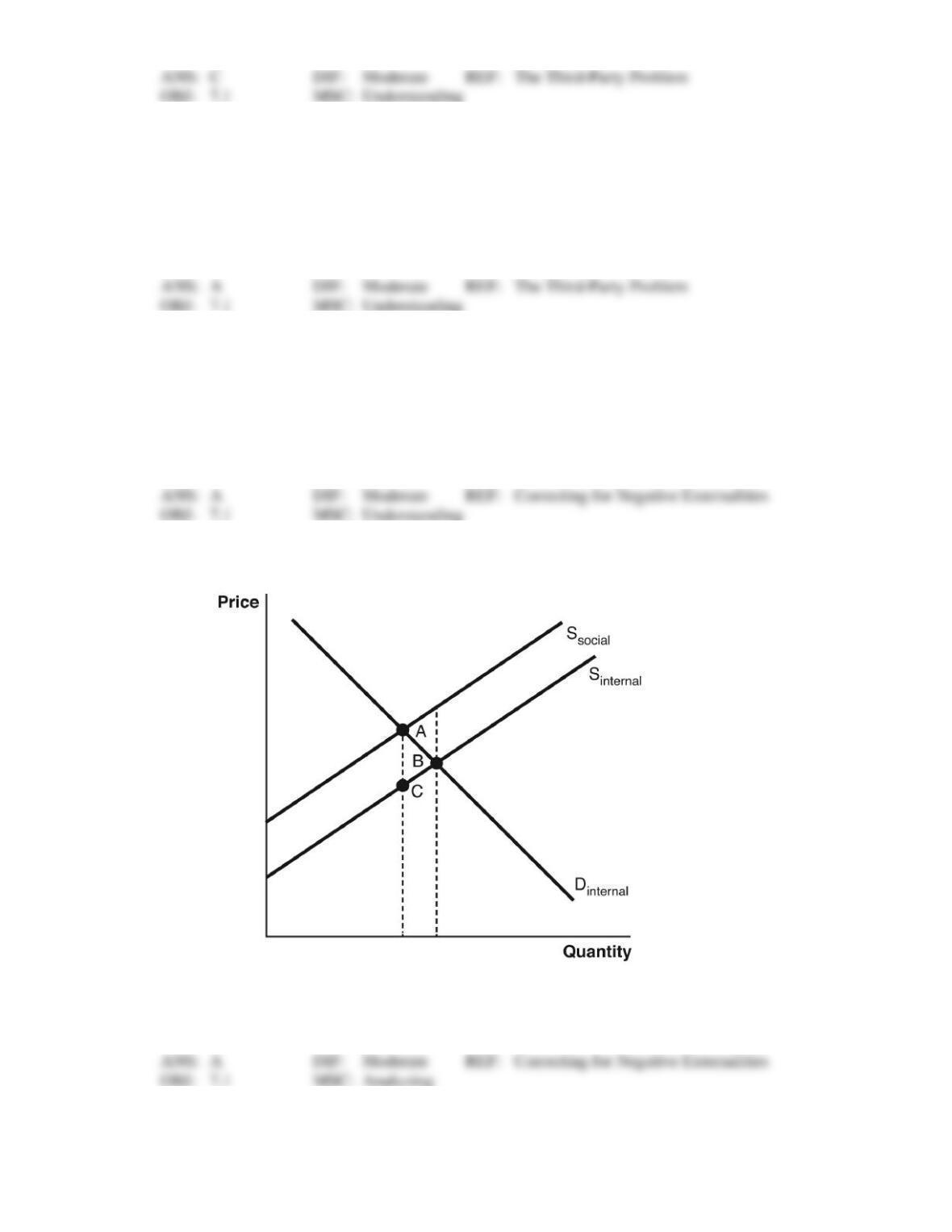
24. Refer to the accompanying figure. Which area represents the deadweight loss associated with
producing at the market equilibrium instead of the social optimum?
a. A d. C
b. B e. A + B + C
c. A + B
25. The third-party problem
a. occurs when a market activity leads to a negative externality.
b. occurs when a market activity leads to a positive externality.
c. occurs when a market activity leads to a negative or a positive externality.
d. is the same as the free-rider problem.
e. is associated with the production of private goods but not public goods.
26. Elijah’s neighbor likes to mow his grass each Saturday at 7 A.M. and the noise invariably wakes
Elijah up. This is an example of
a. the third-party problem. d. the free-rider problem.
b. the tragedy of the commons. e. a positive externality.
c. an internal cost.
27. Siri’s neighbor is an avid gardener who changes his flower displays four times per year and who
was given the “best yard on the block” award last year. While Siri personally enjoys these
changing flower displays, some of her neighbors have said they do not like some of the flowers her
neighbor chooses to plant. For Siri, this is an example of
a. a positive externality. d. internalizing the external cost.
b. the tragedy of the commons. e. a negative externality.
c. an internal cost.
28. Jack’s roommate is studying to be a drummer in a rock band. She practices in Jack’s apartment
every evening for three hours and the noise makes it difficult for Jack to concentrate. This is an
example of
a. the third-party problem. d. the free-rider problem.
b. the tragedy of the commons. e. a positive externality.
c. an internal cost.
29. When pollution (a negative externality) is created by firms, which of the following is NOT a valid
way for the government to restore the social optimum?
a. require firms to install pollution-abatement equipment
b. require firms to change production techniques to reduce emissions
c. levy a tax on the production of the good
d. require firms to pay for the environmental damage they create
e. offer a subsidy to firms to reduce their production costs
30. Consider a market where production of a good generates a negative externality. In the market
equilibrium,
a. too much of the good is being produced.
b. too little of the good is being produced.
c. there is no deadweight loss.
d. the external costs have been internalized.
e. firms are not maximizing profit.
31. Consider the market for refined oil. In the market equilibrium,
a. the internal supply equals the internal demand.
b. the internal supply equals the social supply.
c. the social supply equals the internal demand.
d. there is too little of the good being produced.
e. there is no deadweight loss.
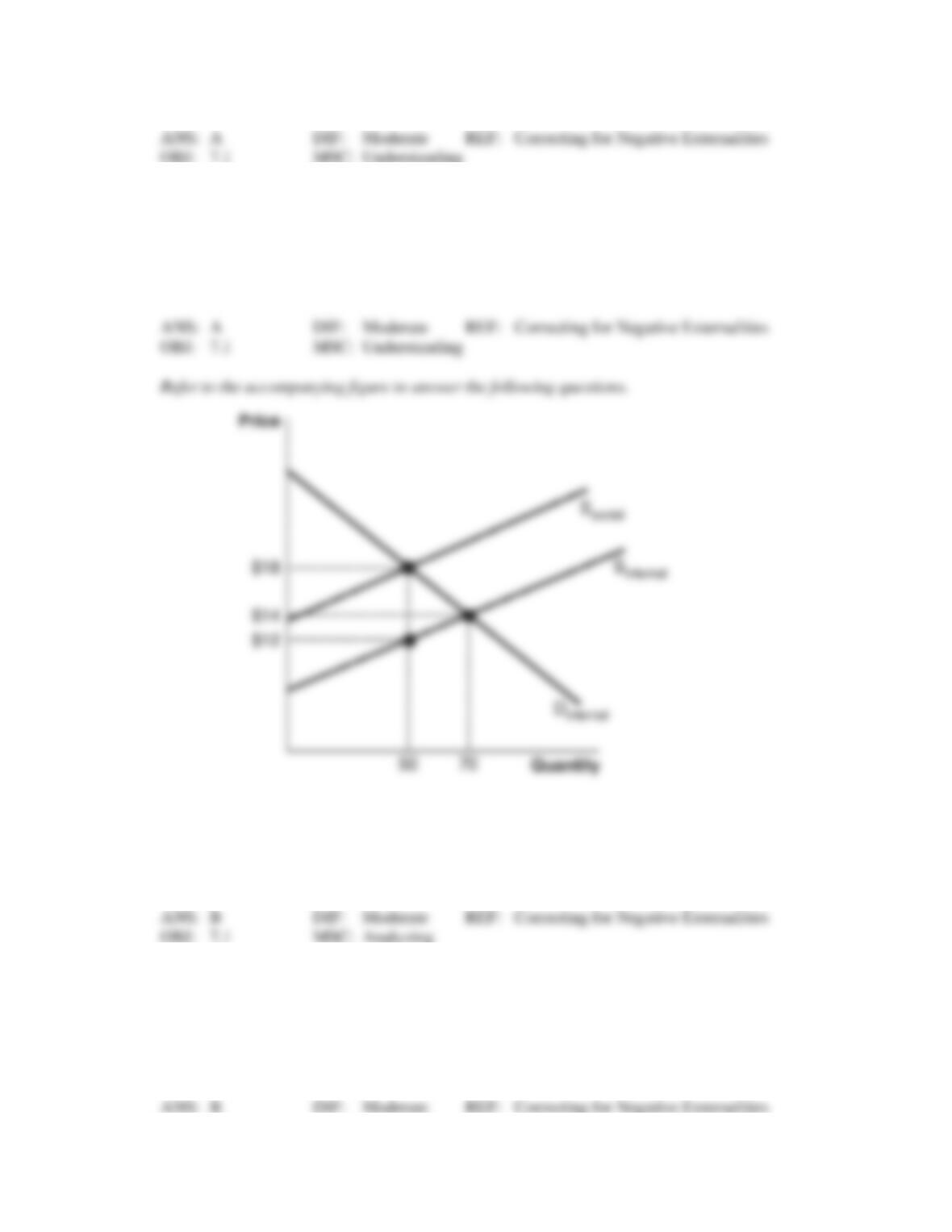
32. At the market equilibrium, price is equal to ________ units of the good are produced.
a. $18 and 70 d. $14 and 50
b. $14 and 70 e. $18 and 50
c. $12 and 50
33. The figure best illustrates what type of market?
a. The good produced creates a positive externality.
b. The good produced creates a negative externality.
c. The good produced is a club good.
d. The good produced is a public good.
e. Firms in this industry have been given a subsidy to encourage more production.
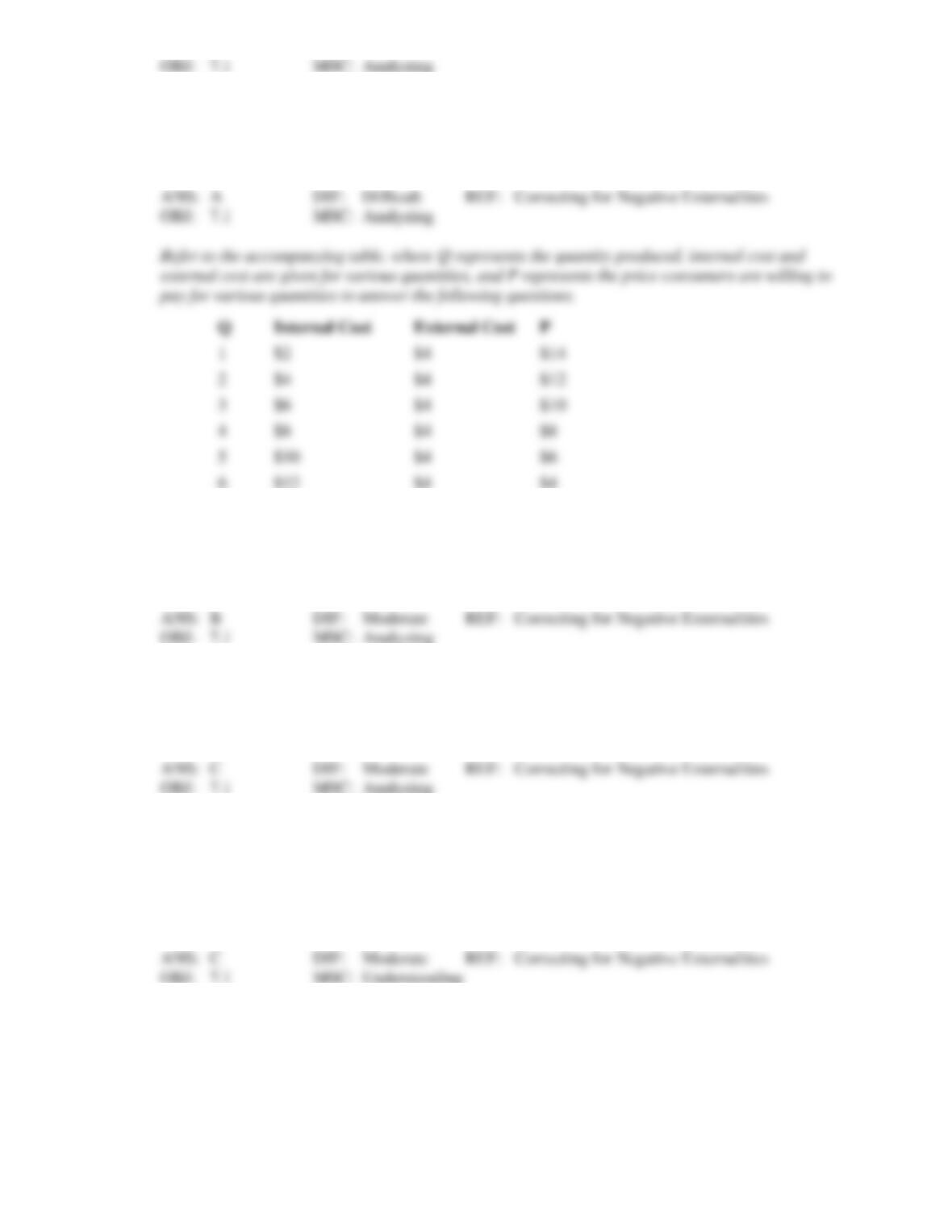
34. To achieve the social optimum, the government could set a tax equal to ________ per unit sold.
a. $6 d. $3
b. $4 e. $5
c. $2
35. The market equilibrium occurs where price is __________ and quantity is _________.
a. $4; 2 d. $10; 5
b. $8; 4 e. $12; 6
c. $10; 3
36. The social optimum occurs where price is ________ and quantity is ________.
a. $4; 6 d. $10; 5
b. $8; 4 e. $12; 6
c. $10; 3
37. Which of the following is a benefit of internalizing a negative externality?
a. All pollution is eliminated.
b. More output is produced.
c. The deadweight loss is eliminated.
d. The good is sold for a lower price.
e. Output increases and prices are lower.
38. Which of the following is a cost of internalizing a negative externality?
a. Less output is produced.
b. The deadweight loss is larger.
c. The level of pollution rises.
d. Taxes must increase to cover the external cost.
e. The government must pay firms to encourage them to change production techniques.
39. If government regulation forces firms in an industry to internalize the externality, then the
a. supply curve shifts to the left.
b. supply curve shifts to the right.
c. demand curve shifts to the left.
d. demand curve shifts to the right.
e. supply curve and the demand curve shift to the left.
40. If government regulation forces firms in an industry to internalize the externality, then we can
expect the equilibrium price of the good to ________ and the equilibrium quantity to ________.
a. increase; increase d. decrease; increase
b. increase; decrease e. increase; remain unchanged
c. decrease; decrease
41. The government has identified a situation where the production of a good is creating a negative
externality. The government should enact legislation to require firms to internalize the externality
a. in all such cases.
b. if the benefits of doing so outweigh the costs.
c. as long as it will not increase the price of the good being produced.
d. as long as it will not create unemployment in this industry.
e. as long as there are positive health benefits associated with this policy.
42. When a negative externality is not internalized, then the equilibrium price of the good produced is
too ________ and the equilibrium quantity produced is too ________.
a. high; high d. high; low
b. low; low e. expensive; inefficient
c. low; high
43. A government decision to impose a tax on the sale of plastic disposable water bottles is an example
of
a. a positive externality. d. an external cost.
b. internalizing the externality. e. the Coase theorem.
c. the third-party problem.
44. If the government imposes a tax on each aluminum can sold, payable by consumers when they
purchase the item, then, in the market for goods sold in aluminum cans, the
a. supply curve shifts to the left.
b. supply curve shifts to the right.
c. demand curve shifts to the left.
d. demand curve shifts to the right.
e. supply curve and the demand curve shift to the left.
45. The government identifies a situation where production of a good is generating a negative
externality. A reasonable option for the government to consider is to
a. impose a tax on the sale of this good.
b. pass a law preventing the production of this good.
c. subsidize the cost of producing the good.
d. pass a law preventing the consumption of this good.
e. ration the good.
46. If the government decides to adopt a carbon tax, the price of goods whose production generates
carbon emissions will ________ and the quantity produced will ________.
a. increase; increase d. decrease; increase
b. increase; decrease e. decrease; decrease
c. increase; remain unchanged
47. The government imposes a tax on each plastic bag sold such that the producer of the plastic bags
must pay the tax to the government. In the market for plastic bags, the
a. supply curve shifts to the left.
b. supply curve shifts to the right.
c. demand curve shifts to the left.
d. demand curve shifts to the right.
e. the supply curve and the demand curve shift to the left.
48. Congestion charges effectively decrease the number of cars on the road. This is an example of
a. the law of supply. d. the common-resource problem.
b. the public-good problem. e. internalizing the externality.
c. the free-rider problem.
49. Congestion charges cause the price of driving to ________. Therefore, the number of cars on the
road will ________.
a. rise; rise d. fall; rise
b. rise; fall e. remain unchanged; remain unchanged
c. fall; fall
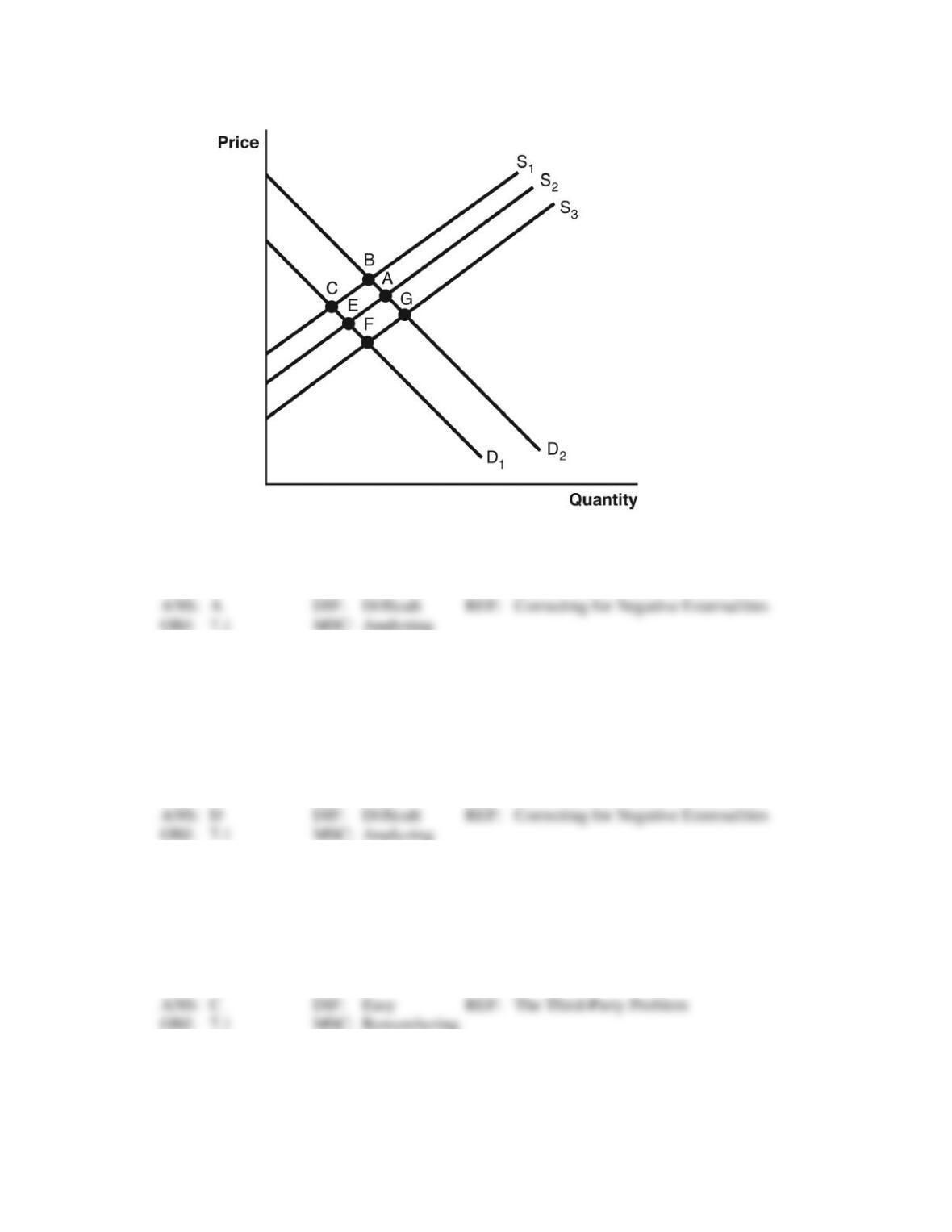
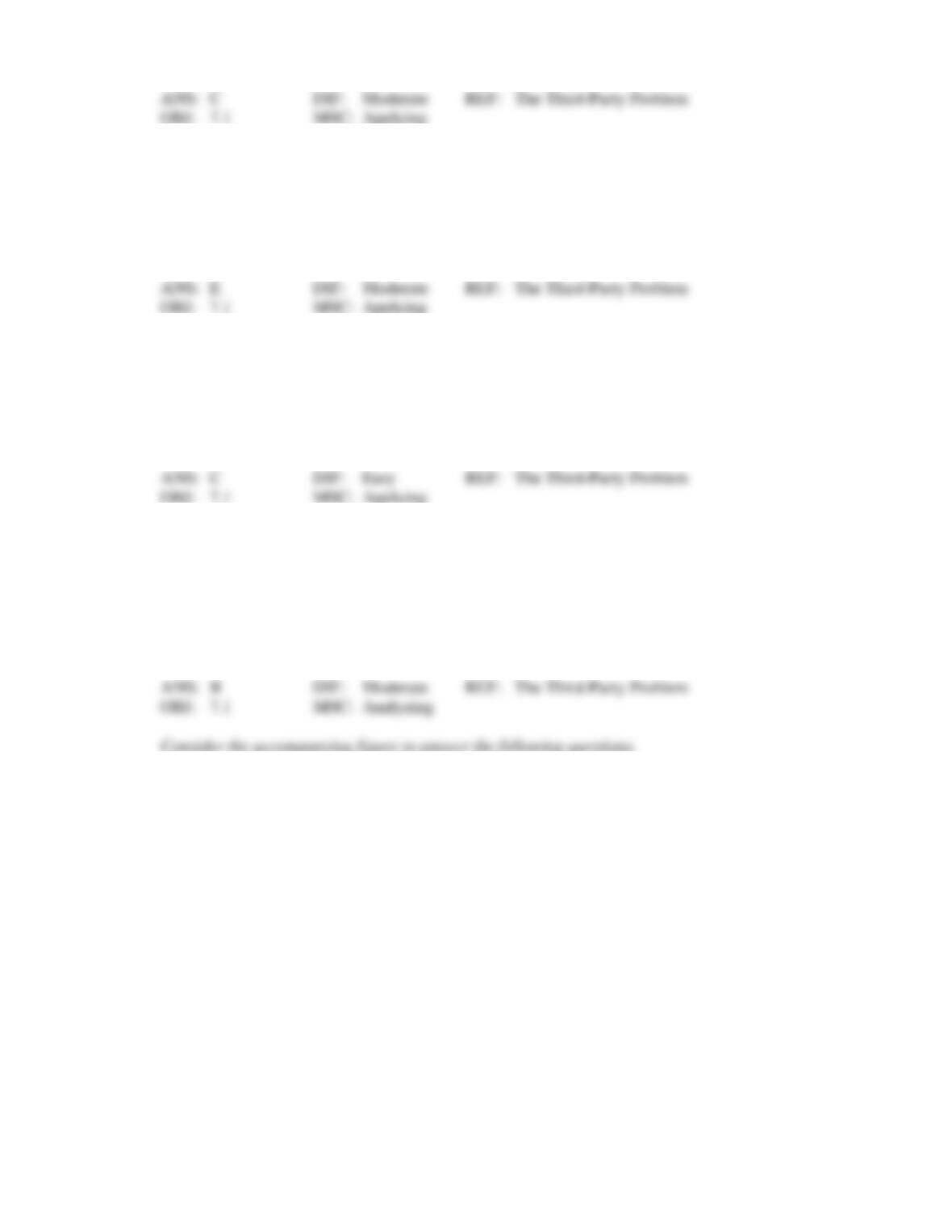
50. Refer to the accompanying figure. The market for dry-cleaning services is currently in equilibrium
at point A, and the government decides to tax the stores that offer dry-cleaning services in order to
improve the air quality. The new equilibrium will be at point
a. B. d. F.
b. C. e. G.
c. E.
51. The government imposes a tax on the sale of a good whose production is creating a negative
externality. The value of the tax is $4 per unit sold. In the new equilibrium, we would expect
a. the same amount to be sold and the price to be $4 higher.
b. the same amount to be sold and the price to increase by less than $4.
c. less to be sold and the price to increase by $4.
d. less to be sold and the price to increase by less than $4.
e. less to be sold and the price to increase by more than $4.
52. A positive externality exists whenever
a. there are no internal costs.
b. production of a good creates an external cost.
c. production of a good creates an external benefit.
d. production of a good has no social cost.
e. production of a good has no social benefit.
53. When production of a good creates an external benefit
a. there is a negative externality.
b. too much of the good is being produced.
c. there is a positive externality.
d. it results in the tragedy of the commons.
e. a club good is being produced.
54. Positive externalities have ________ for third parties.
a. internal costs d. external benefits
b. internal benefits e. social costs
c. external costs
55. Consider a market with a positive externality. The market will tend to ________ the good because
the market participants tend to ignore the ________ of their decision.
a. overproduce; external benefit d. underproduce; external cost
b. underproduce; internal benefit e. underproduce; external benefit
c. overproduce; external cost
56. Which of the following is true of a positive externality?
a. Some costs are borne by a third party.
b. The government can use taxes to move the market to the social optimum.
c. There are no internal benefits.
d. Some benefits accrue to a third party.
e. Its existence always requires corrective measures by the government.
57. Positive externalities exist because ________ benefits are ________ than ________ benefits.
a. internal; less; external d. internal; greater; social
b. internal; greater; external e. internal; less; social
c. external; greater; social
58. Which activity is most likely to create a positive externality?
a. A person drives downtown each day.
b. An oil refinery operates for 16 hours each day.
c. A new airport is built in a big city.
d. A person receives a flu shot.
e. The government offers reduced-cost financing toward the purchase of a new car.
59. When people elect to spend more years in school, this results in a ________ externality because
there are ________ associated with this decision.
a. negative; internal costs d. positive; external costs
b. negative; external costs e. positive; internal benefits
c. positive; external benefits
60. Christopher’s roommate is studying to be a chef and likes to try new recipes. He leaves his
delicious creations in the refrigerator for anyone who wants to eat them. The food he leaves is
always gone within a day. This is an example of
a. the third-party problem. d. the free-rider problem.
b. the tragedy of the commons. e. a positive externality.
c. an internal cost.
61. Which of the following is an example of a positive externality?
a. Drag racing on urban streets puts pedestrians at risk.
b. Drinking a glass or two of wine makes one feel pleasantly drowsy.
c. Working out at a fitness club makes one more cheerful around others.
d. Failure to save for retirement now means a lower quality of life later on.
e. Rooting for a particular team increases one’s enjoyment of sporting events.
62. Standing in line at a small-town grocery store gives people a chance to socialize. Is this a positive
externality associated with the act of shopping? Why or why not?
a. Yes, because chatting with others is not inherently part of buying groceries.
b. No, because the benefit is to the shoppers, not to third parties.
c. Yes, because in large cities such socializing would not occur.
d. No, because people can easily socialize elsewhere, as well.
e. Yes, because not every shopper is in a mood to talk.
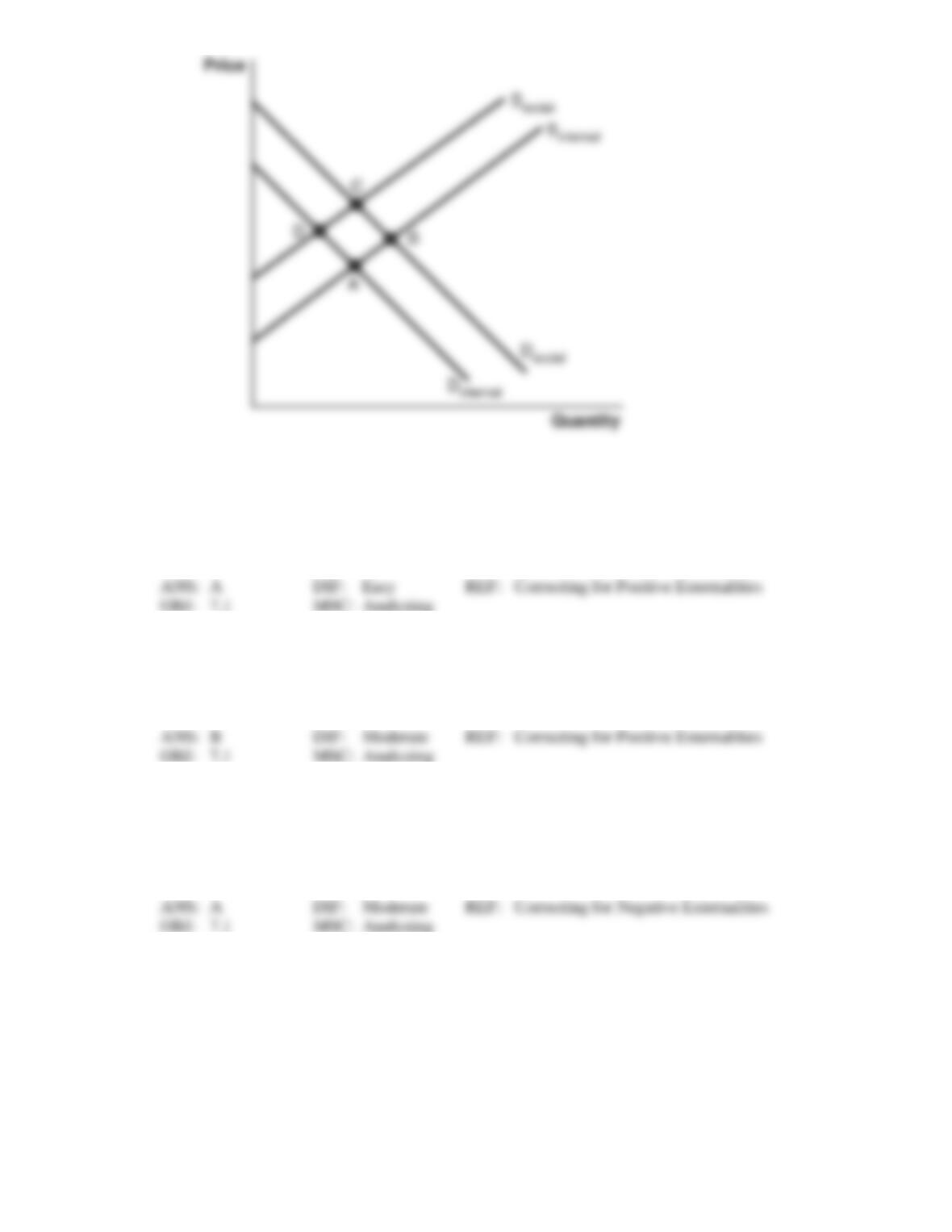
63. A positive externality exists and the government does not intervene. Which point best identifies the
market equilibrium?
a. A d. D
b. B e. either C or D
c. C
64. When a positive externality exists, which point best identifies the social optimum?
a. A d. D
b. B e. either A or D
c. C
65. When a negative externality exists and the government does not intervene, which point best
identifies the market equilibrium?
a. A d. D
b. B e. either C or D
c. C
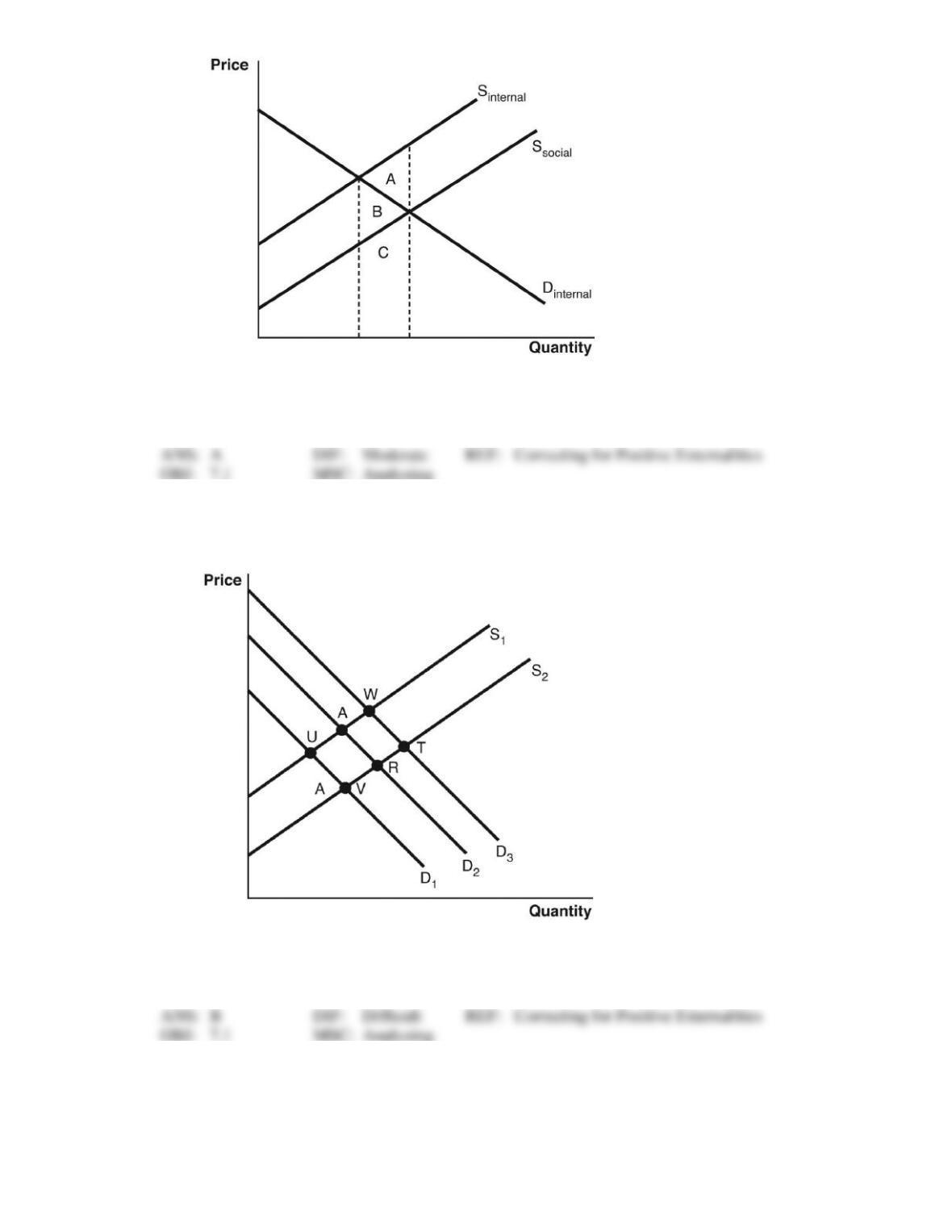
66. Refer to the accompanying figure. Which area represents the deadweight loss associated with
producing at the market equilibrium instead of the social optimum?
a. A d. C
b. B e. A + B + C
c. A + B
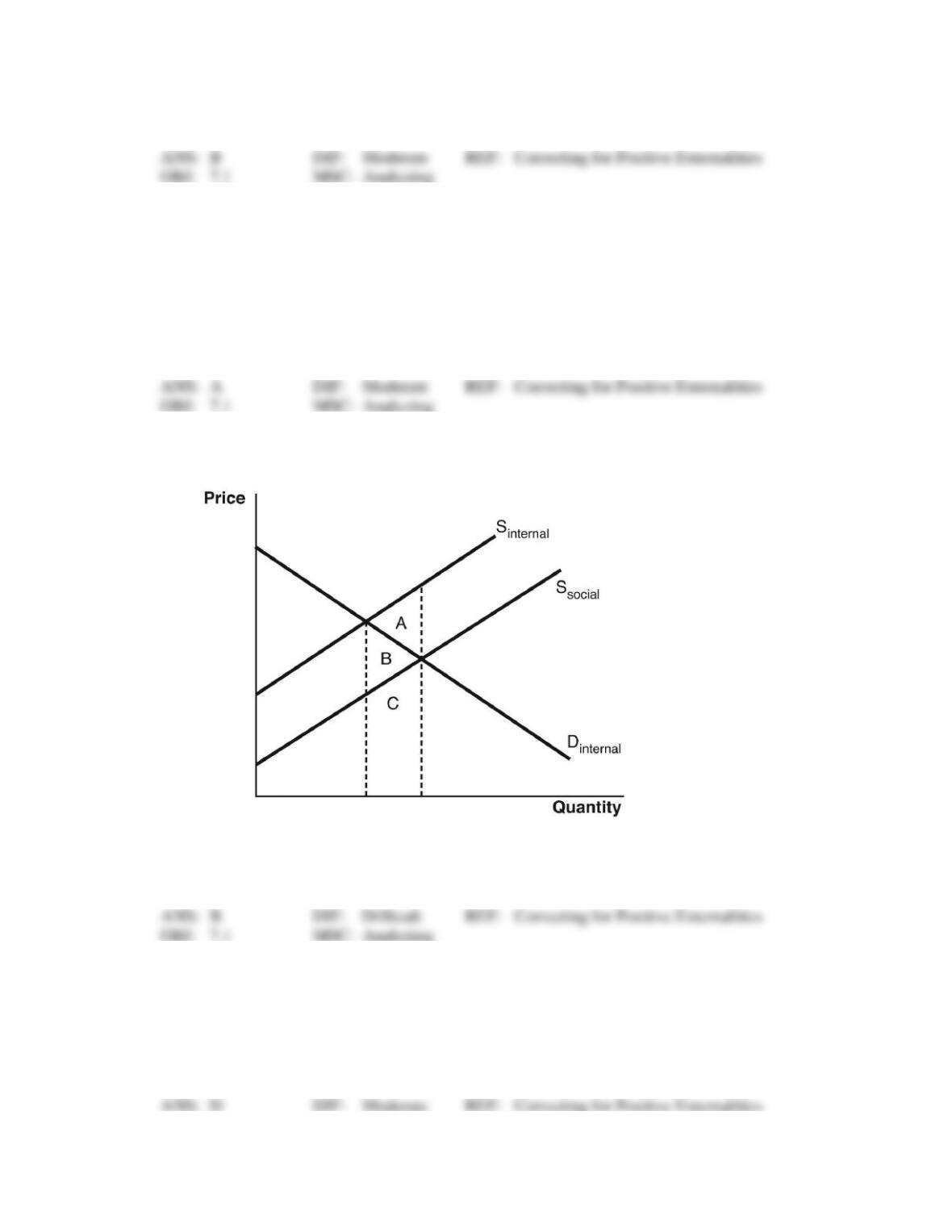
67. Refer to the accompanying figure. The market for college degrees is currently in equilibrium at
point A, and the government decides to subsidize the cost of a college education by offering grants
to students. The new socially optimal equilibrium will be at point
a. R. d. U.
b. W. e. V.
c. T.
68. Which of the following supply and demand situations definitely involves a positive externality?
a. An Sinternal or Dinternal curve lies to the right of the corresponding Ssocial or Dsocial curve.
b. An Sinternal or Dinternal curve lies to the left of the corresponding Ssocial or Dsocial curve.
c. An Sinternal curve lies to the left or right of the corresponding Ssocial curve.
d. A Dinternal curve lies to the left or right of the corresponding Dsocial curve.
e. The externality has not been internalized through government intervention.
69. Which of the following correctly describes the deadweight loss associated with any positive
externality?
a. the cost borne by third parties if the externality is not internalized
b. the benefit to third parties of keeping the externality in place
c. the cost to consumers of government actions to internalize the externality
d. the cost to producers of government actions to internalize the externality
e. the combined cost, to consumers and producers, of government actions to internalize the
externality
70. Refer to the accompanying figure. Which area represents the deadweight loss associated with
producing at the market equilibrium instead of the social optimum?
a. A d. A + B
b. B e. B + C
c. C
71. What makes an externality positive rather than negative?
a. The deadweight loss is greater than zero, not less.
b. The socially optimal quantity exchanged is less, not greater, than at market equilibrium.
c. The externality affects the demand curve rather than the supply curve.
d. The externality benefits third parties rather than harming them.
e. The externality becomes internalized without government action.
72. Which of the following is true?
a. social benefits = internal benefits − external benefits
b. social benefits = internal benefits + external benefits
c. internal benefits = social benefits + external benefits
d. external benefits = social benefits + internal benefits
e. internal benefits − social benefits = external benefits
73. External benefits arise from the actions of
a. firms.
b. consumers.
c. firms and consumers.
d. the government.
e. firms, consumers, and the government.
74. Clean air becomes polluted because
a. it is a private good.
b. no one owns the air.
c. it is a club good.
d. the air is owned by private corporations.
e. the air is owned by the government.
75. Externalities are minimized if
a. private property rights are well established.
b. the government owns all of the productive resources.
c. there are no private goods.
d. there are no public goods.
e. there are no free-riders.
76. Externalities exist because
a. owners of private property have an incentive to maintain their property.
b. owners of private property have little incentive to protect their property.
c. owners of private property are not able to trade with others.
d. property rights are not clearly defined.
e. there is too much private ownership of property.
77. A major reason why the market equilibrium for a manufactured good may not be efficient is
a. there is too much government regulation.
b. property rights are not well defined.
c. there is likely to be a positive externality associated with production.
d. the industry is likely to be a monopoly.
e. the industry is producing too little output.
78. Which good has well-defined property rights?
a. wild animals d. the air
b. the ocean e. a street performance
c. a country club golf course
79. The Coase theorem suggests that private parties
a. will never be able to negotiate to correct a negative externality.
b. can always negotiate to correct a negative externality.
c. can negotiate to correct a negative externality if there are no barriers to negotiation.
d. can negotiate to correct a negative externality if the government passes a law allowing them to
do so.
e. can never negotiate to correct a negative externality if there are more than two parties
involved.
80. According to the Coase theorem, negative externalities can be internalized if
a. property rights are assigned to either party.
b. property rights are assigned to the party who is being damaged.
c. property rights are assigned to the party who is doing the damage.
d. the party causing the damage is forced out of business.
e. the government takes action to solve the problem.
81. If property rights over the river are assigned to Smith, then
a. Smith will force Jones to close the factory.
b. Smith will pay Jones up to $75 per day to install the filter.
c. Smith will pay Jones up to $125 to install the filter.
d. Jones will install a filter and pay Smith at least $75 per day.
e. Jones will install a filter.
82. If property rights over the river are assigned to Jones, then
a. Jones will force Smith to close his resort.
b. Smith will pay Jones up to $75 per day to install the filter.
c. Smith will pay Jones up to $125 to install the filter.
d. Jones will install a filter and pay Smith at least $75 per day.
e. Jones will not install a filter.
83. A cattle rancher and a wheat farmer own adjacent properties that may or may not be separated by a
fence. The accompanying table identifies the annual profit received by each party per year in the
event there is, or there is not, a fence. If there is no fence, one can be installed and maintained at an
annual cost of $25,000.
Fence No Fence
Cattle Rancher $40,000 $10,000
Wheat Farmer $50,000 $20,000
If legal rights are assigned to the wheat farmer so that the cattle rancher is liable for any damage
caused by his cattle to the wheat crop, then the
a. rancher will choose to close his ranch.
b. farmer will not allow the rancher to stay in business.
c. rancher will pay to build the fence.
d. rancher will choose to compensate the farmer for damages.
e. rancher will be indifferent toward neither building the fence nor compensating the farmer for
damages.
84. A cattle rancher and a wheat farmer own adjacent properties that may or may not be separated by a
fence. The accompanying table identifies the annual profit received by each party per year in the
event there is, or there is not, a fence. If there is no fence, one can be installed and maintained at an
annual cost of $25,000.
Fence No Fence
Cattle Rancher $40,000 $50,000
Wheat Farmer $50,000 $40,000
If legal rights are assigned to the wheat farmer so that the cattle rancher is liable for any damage
caused by his cattle to the wheat crop, then the
a. rancher will choose to close his ranch.
b. farmer will not allow the rancher to stay in business.
c. rancher will pay to build the fence.
d. rancher will choose to compensate the farmer for damages.
e. rancher will be indifferent toward neither building the fence nor compensating the farmer for
damages.
85. A cattle rancher and a wheat farmer own adjacent properties that may or may not be separated by a
fence. The accompanying table identifies the annual profit received by each party per year in the
event there is, or there is not, a fence. If there is no fence, one can be installed and maintained at an
annual cost of $25,000.
Fence No Fence
Cattle Rancher $40,000 $45,000
Wheat Farmer $50,000 $20,000
If legal rights are assigned to the wheat farmer so that the cattle rancher is liable for any damage
caused by his cattle to the wheat crop, then the
a. rancher will choose to close his ranch.
b. farmer will not allow the rancher to stay in business.
c. rancher will pay to build the fence.
d. rancher will choose to compensate the farmer for damages.
e. rancher is indifferent toward building the fence or compensating the farmer for damages.
86. A free-rider problem exists when
a. people receive a benefit for which they do not need to pay.
b. firms impose a cost on third parties.
c. negative externalities exist.
d. a private good is produced.
e. any market is in equilibrium.
87. Which goods are sold in markets?
a. private goods
b. private goods and club goods
c. private goods, club goods, and common-resource goods
d. all types of goods
e. public goods
88. Which good is excludable?
a. apples on a tree in a public park d. a walk in a public park
b. a fireworks display e. education at a community college
c. swimming in the ocean
89. Museum visits in a particular city are free. This good is
a. excludable. d. nonrival.
b. rival. e. excludable and nonrival.
c. excludable and rival.