Microeconomics: Theory and Applications with Calculus, 3e (Perloff)
Chapter 7 Costs
7.1 Measuring Costs
1) Economic costs of an input include
A) only implicit costs.
B) only explicit costs.
C) both implicit and explicit costs.
D) whatever management wishes to report to the shareholders.
2) The cost of waiting two months for health care to address a debilitating problem in Canada is most
accurately described as
A) an explicit cost.
B) an accounting cost.
C) no real cost.
D) an opportunity cost.
3) Applications to MBA programs rose during the economic downturn in 2008. This is best explained by:
A) The opportunity cost of attending an MBA dropped for most applicants due to poor job prospects.
B) More teachers were available to teach MBA classes due to the lower opportunity cost of teaching.
C) The explicit costs of attending an MBA program fell in 2008.
D) The implicit costs of attending an MBA program rose in 2008.
4) Sarah earns $40,000 per year working for a large corporation. She is thinking of quitting this job to
work full time in her own business. She will invest her savings of $50,000 (which currently has an annual
10% rate of return) into the business. Her annual opportunity cost of this new business is
A) $0.
B) $40,000.
C) $45,000.
D) $90,000.
5) The Nifty Gum Co. has purchased a large parcel of land for $1 million. The company recently
discovered that the land is contaminated and is worthless to all possible buyers. The opportunity cost of
the land is
A) $0.
B) $1 million.
C) some amount greater than $0 but less than $1 million.
D) equal to the cost of the factory that was planned to be built there.
6) Johnny has worked as a CPA for five years and wants to open his own public accounting practice. The
cost of his college degree in accounting represents
A) the opportunity cost of this endeavor.
B) a sunk cost.
C) an expense.
D) a variable cost.
7) Economists proclaim that competitive firms make zero economic profit in the long run. This shows
how
A) detached economists are from the real world.
B) unrealistic economic theory is.
C) firms cover all their cost, both monetary and non-monetary.
D) firms cover only monetary cost when economic profits are zero.
8) If a firm buys a building so as to have office space for its workers, the monthly opportunity cost of the
building is best measured as
A) the monthly mortgage payment the firm must pay.
B) the price the firm paid divided by twelve.
C) zero.
D) the rent the firm could earn if it rented the building to another firm.
9) A firm built an inventory of 16-bit chips for $50,000 last year. However, the introduction of 32-bit chips
lowers the market price for 16-bit chips and the inventory can only be sold for $40,000 now. What is the
opportunity cost of the inventory of 16-bit chips?
A) $50,000
B) $40,000
C) $10,000
D) $90,000
10) A firm built an inventory of 16–bit chips for $50,000 last year. However, the introduction of 32-bit
chips lowers the market price for 16-bit chips and the inventory can only be sold for $40,000 now. What is
the sunk cost?
A) $50,000
B) $40,000
C) $10,000
D) $90,000
11) Consider the following two situations.
(i) You purchase a $10 movie ticket in advance over the Internet, but when arriving at the theater, you
realize that you lost the ticket. The only way to see the movie is to purchase a new ticket.
(ii) On the way to seeing a movie, you drop a $10 bill. You still can afford the movie, but you have lost
the $10.
How should you, rational person, respond to the two situations?
A) You should still see the movie in both situations.
B) You should respond the same way to each situation, whether it is to see the movie or not.
C) In the first situation, you should skip the movie; in the second, you should still see the movie.
D) In each situation, you should not see the movie.
For the following, please answer “True” or “False” and explain why.
12) When buying a piece of equipment, it is always best for the firm to pay cash instead of borrowing the
funds since this renders the equipment less costly.
13) Four years after graduating from college you must decide if you want to go on as an accountant (your
college major) or if you want to make a career change and become a singer. The cost of your education
will matter for your decision.
14) An accountant may amortize the expense of a durable good by dividing the total amount spent on the
good by the number of years the good is expected to last. An economist may amortize the expense of a
durable and never fully account for the total expense.
15) Your company makes copper pipes. Over the years, you have collected a large inventory of raw
copper. The production process involves melting the copper and shaping it into pipes. You also have a
large stockpile of pennies. Suppose the price of copper rises so much that the copper in the penny
becomes worth more than one cent. Should you melt down your pennies?
16) Simon is given a free ticket to see Coldplay Saturday night. He already has a ticket to see Sting in
concert that night. The Sting ticket cost Simon $50 though he would have paid as much as $80 to go to the
show. Simon knows that he can easily sell the Sting ticket on Craigslist for $60. What is his opportunity
cost of seeing Coldplay?
17) You have two career options. You can work for someone else for $50,000 a year, or, you can run your
own business, with an annual revenue of $100,000, and explicit costs of $40,000 annually. Explain which
career option a profit-maximizer would select and why.
7.2 Short-Run Costs
1) A firm’s marginal cost can always be thought of as the change in total cost if
A) the firm produces one more unit of output.
B) the firm buys one more unit of capital.
C) the firm’s average cost increases by $1.
D) the firm moves to the next highest isoquant.
2) Fixed costs are
A) a production expense that does not vary with output.
B) a production expense that changes with the quantity of output produced.
C) equal to total cost divided by the units of output produced.
D) the amount by which a firm’s cost changes if the firm produces one more unit of output.
3) Variable costs are
A) a production expense that does not vary with output.
B) a production expense that changes with the quantity of output produced.
C) equal to total cost divided by the units of output produced.
D) the amount by which a firm’s cost changes if the firm produces one more unit of output.
4) Which of the following statements is NOT true?
A) AC = AFC + AVC
B) C = F + VC
C) AVC = wage/MPL
D) AFC = AC – AVC
6
5) Joey’s Lawncutting Service rents office space from Joey’s dad for $300 per month. Joey’s dad is thinking
of increasing the rent to $400 per month. As a result Joey’s marginal cost of cutting grass will
A) increase by $100 divided by the amount of grass cut.
B) increase by $100.
C) decrease by $100.
D) not change.
6) Suppose a firm can only vary the quantity of labor hired in the short run. An increase in the cost of
capital will
A) increase the firm’s marginal cost.
B) decrease the firm’s marginal cost.
C) have no effect on the firm’s marginal cost.
D) More information is needed to answer the question.
7) Suppose the total cost of producing T-shirts can be represented as TC = 50 + 2q. The marginal cost of
the 5th T-shirt is
A) 2.
B) 10.
C) 12.
D) 60.
8) Suppose the total cost of producing T-shirts can be represented as TC = 50 + 2q. The average cost of the
5th T-shirt is
A) 2.
B) 12.
C) 52.
D) 60.
9) Suppose the total cost of producing T-shirts can be represented as TC = 50 + 2q. Which of the following
statements is TRUE at all levels of production?
A) MC = AVC
B) MC = AC
C) MC > AFC
D) All of the above.
10) Suppose the short-run production function is q = 10 ∗ L. If the wage rate is $10 per unit of labor, then
AVC equals
A) q.
B) q/10.
C) 10/q.
D) 1.
11) Suppose the short-run production function is q = 10 ∗ L. If the wage rate is $10 per unit of labor, then
MC equals
A) q.
B) q/10.
C) 10/q.
D) 1.
12) If average cost is decreasing,
A) marginal cost equals average cost.
B) marginal cost exceeds average cost.
C) marginal cost is less than average cost.
D) Not enough information is provided.
13) If average cost is positive,
A) marginal cost equals average cost.
B) marginal cost exceeds average cost.
C) marginal cost is less average cost.
D) Not enough information is provided.
14) Suppose the short-run production function is q = L0.5. If the marginal cost of producing the tenth unit
is $5, what is the wage per unit of labor?
A) $1
B) 5¢
C) 25¢
D) It cannot be determined without more information.
15) Suppose the short-run production function is q = 10 ∗ L. If the wage rate is $10 per unit of labor, then
AFC equals
A) 0.
B) 1.
C) 10/q.
D) It cannot be determined from the information provided.
16) When a firm produces one unit, the variable cost is $3. When the firm produces two units, the variable
cost is $6. What is the marginal cost associated with two units of production?
A) $2
B) 5¢
C) $6
D) $3
17) When a firm produces 1000 widgets with total cost of $2000 and fixed cost of $1000, what is the
average variable cost?
A) $2
B) $1
C) $0.5
D) $0.2
18) If the total cost of production for 1000 widgets is $2000 and marginal cost is constant at $1, what is the
average cost if 2000 widgets are produced?
A) $2
B) $1.5
C) $1
D) $0.5
19) If the total cost of production for 1000 widgets is $2000 and marginal cost is constant at $1, what is the
average fixed cost for the 1000 widgets?
A) $2
B) $1.5
C) $1
D) $0.5
20) When diminishing marginal returns set in,
A) average product is increasing.
B) average variable cost is decreasing.
C) average cost is decreasing.
D) None of above.
21) In the short run, the point at which diminishing marginal returns to labor begin is the point at which
the marginal cost curve
A) peaks.
B) bottoms out.
C) is upward sloping.
D) is downward sloping.
22) In the short run, the point at which average cost is minimized, the line from the origin to the point on
the
A) total cost curve is tangent to the curve.
B) total cost curve has the largest slope.
C) total variable cost curve has the largest slope.
D) total variable cost curve has the smallest slope.
23) If the marginal cost of producing a good is increasing as a firm produces more of the good, then
which of the following must be TRUE?
A) AFC is rising.
B) AVC is rising.
C) MC > AVC.
D) MPL is falling.
24) If the average cost of producing a good is increasing as a firm produces more of the good, then which
of the following must be TRUE?
A) AFC is falling.
B) AVC is rising.
C) MC > AVC.
D) All of the above.
25) If a particular production process is subject to diminishing marginal returns to labor at every level of
output, then at every level of output
A) AC is upward sloping.
B) MC exceeds AVC.
C) AFC is constant.
D) All of the above.
26) Marginal cost is equal to
A) the increase in total cost from increasing the amount of labor by one unit.
B) the increase in variable cost from increasing the amount of labor by one unit.
C) Both A and B.
D) Neither A nor B.
27) Suppose each worker must use only one shovel to dig a trench, and shovels are useless by themselves.
In the short run, an increase in the price of shovels will result in
A) fewer shovels being purchased.
B) more workers being hired.
C) a decrease in the firm’s output.
D) no change in the firm‘s output.
28) Which of the following will cause the marginal cost curve of making cigarettes to shift?
A) a $5 million penalty charged to each cigarette maker
B) a $1 per pack tax on cigarettes
C) a $1 million advertising campaign by the American Cancer Society
D) All of the above
29) Which of the following will cause the average cost curve of making cigarettes to shift?
A) a $5 million penalty charged to each cigarette maker
B) a $1 per pack tax on cigarettes
C) a $1 an hour wage increase paid to all cigarette production workers
D) All of the above
30) Which of the following will cause the average fixed cost curve of making cigarettes to shift?
A) a $5 million penalty charged to each cigarette maker
B) a $1 per pack tax on cigarettes
C) a $3 per hour wage increase
D) an increase in the demand for cigarettes
31) A specific tax of $1 per unit of output will affect a firm’s
A) average total cost, average variable cost, average fixed cost, and marginal cost.
B) average total cost, average variable cost, and average fixed cost.
C) average total cost, average variable cost, and marginal cost.
D) marginal cost only.
For the following, please answer “True” or “False” and explain why.
32) The “Law of Diminishing Marginal Returns” could also be termed the “Law of Increasing Marginal
Costs.”
33) The marginal cost curve intersects the average fixed cost curve at its minimum.
34) A consumer purchases a book by driving across town to a bookstore, standing in line for five minutes
to pay the cashier, and then pays $5. The same book is purchased by another consumer who spends two
minutes placing the order over the Internet for $10. The book necessarily cost the first consumer less.
35) After employing her last laborer, Rachel notices that her Average Product has decreased. True or
False: Her marginal cost is greater than her average variable cost.
36) Explain why the marginal cost curve intersects a U-shaped average cost curve at its minimum point.
13
37) Consider a general cost function C(q), with Average Cost=C(q)/q. Prove using calculus that the
quantity which minimizes the Average Cost function is also at the point where the Marginal Cost equals
the Average Cost. To do this, first derive the necessary condition for the AC to be at a minimum.
38) Suppose firm has a constant marginal product of labor – one additional worker adds four units of
output given any initial quantity of workers. What do the average variable and marginal costs look like
for this firm? Provide a graph of the MC and AVC.
39) Ed’s construction company has the following short-run cost function: q3 – 10q2 + 36q.
a. What level of output will minimize the average cost? What is the AC at this point?
b. Does the production process indicate diminishing returns? How can you tell?
40) Evren wants to go into the donut business. For $500 per month he can rent a bakery complete with all
the equipment he needs to make a dozen different kinds of donuts (K = l, r = 500). He must pay unionized
donut bakers a monthly salary of $400 each. He projects his monthly production function to be
Q = 5KL
where Q is tons of donuts.
a. With the current level of capital, what is the marginal product of labor? Is the marginal product
diminishing? Explain.
b. If Evren wishes to make 25 tons of donuts, how many bakers are required given the current level of
capital? How much will it cost to produce this (total cost)?
c. Derive Evren’s short-run cost function with K=1.
d. Derive the marginal cost curve from your answer to c. and show the relationship between the
marginal cost and marginal product of labor.
41) Consider a general Cobb-Douglas production function
q = ALaKb
where A, a and b are positive constants.
Using this production function, derive the short-run cost function for a fixed capital stock, K0, wage rate
w, and capital rental rate r.
42) Alison lives in a small town where she plans to hire workers to help her make candy. Her production
function for candy is
q = 4LK.5
She begins producing with K=4. The cost of capital is $50/unit. The wage depends on the amount of
workers she employs. Specifically, w(L) = 10 + 2L.
a. Does Alison’s production function exhibit diminishing marginal return to labor? Explain.
b. Derive Alison’s short-run cost function.
c. What is the shape of Alison’s Marginal Cost.
d. Does the relationship w/MP = MC hold? Show this explicitly.
7.3 Long-Run Costs
1) In the long run, fixed costs are
A) sunk.
B) avoidable.
C) larger than in the short run.
D) not included in production decisions.
2) The slope of the isocost line tells the firm how much
A) capital must be reduced to keep total cost constant when hiring one more unit of labor.
B) capital must be increased to keep total cost constant when hiring one more unit of labor.
C) more expensive a unit of capital costs relative a unit of labor.
D) the isocost curve will shift outward if the firm wishes to produce more.
3) Which of the following does NOT represent a possible shape of the long–run average cost curve?
A) downward-sloping
B) upward sloping
C) U-shaped
D) vertical
4) The slope of the isoquant tells the firm how much
A) output increases when labor increases by one unit.
B) output increases when capital and labor are doubled.
C) capital must decrease to keep output constant when labor increases by one unit.
D) a unit of capital costs relative to the cost of labor.
5) If an isocost line crosses the isoquant twice, a cost minimizing firm will
A) use a different isocost line to select the bundle of inputs.
B) use the input bundle associated with the intersection on the higher point of the isoquant.
C) use the input bundle associated with the intersection on the lower point of the isoquant.
D) Both B and C.
6) When the isocost line is tangent to the isoquant, then
A) MRTS = w/r.
B) the firm is producing that level of output at minimum cost.
C) the last dollar spent on capital yields as much extra output as the last dollar spent on labor.
D) All of the above.
7) A firm can minimize cost by
A) picking the bundle of inputs where the lowest isocost line touches the isoquant.
B) picking the bundle of inputs where the isoquant is tangent to the isocost line.
C) picking the bundle of inputs where the last dollar spent on one input gives as much extra output as the
last dollar spent on any other input.
D) All of the above.
8) When the isocost line is tangent to the isoquant, then
A) MPL = MPK.
B) the firm is producing that level of output at minimum cost.
C) the firm has achieved the right economies of scale.
D) All of the above.
9) If the wage increases the isocost line will
A) stay the same.
B) shift outward in parallel fashion.
C) rotate inward around the point where only capital is employed in production.
D) shift inward in parallel fashion.
10) If the isoquants are straight lines or L-shaped, then a cost-minimizing firm will
A) not be able to minimize costs.
B) find the lowest isocost line touching the relevant isoquant.
C) find the highest isocost line touching the relevant isoquant.
D) choose not to produce any output.
11) If the marginal rate of technical substitution for a cost minimizing firm is 10, and the wage rate for
labor is $5, what is the rental rate for capital in dollars?
A) .5
B) 1
C) 2
D) 10
12) Suppose MPL = 0.5 ∗ (q/L) and MPK = 0.5 ∗ (q/K). In the long run, the firm will hire equal amounts of
capital and labor
A) all of the time.
B) only when w = r.
C) only when w = 0.5 ∗ r.
D) at no point in time.
13) Suppose that each worker must use only one shovel to dig a trench, and shovels are useless by
themselves. In the long run, an increase in the price of shovels will result in
A) fewer shovels being purchased to produce the same number of trenches.
B) more workers being hired to produce the same number of trenches.
C) the firm wishing to produce more trenches.
D) no change in the firm‘s input mix.
14) Suppose that each worker must use only one shovel to dig a trench, and shovels are useless by
themselves. In the long run, the firm will experience
A) increasing returns to scale.
B) constant returns to scale.
C) decreasing returns to scale.
D) The returns to scale cannot be determined from the information provided.
15) Suppose that each worker must use only one shovel to dig a trench, and shovels are useless by
themselves. In the long run, the firm’s cost function is
A) TC = (w/r) ∗ q.
B) TC = (w + r)/q.
C) TC = (w + r).
D) TC = (w + r) ∗ q.
16) At the XYZ Co., a unit of capital costs three times as much as a unit of labor. If the isoquants are
convex, and the firm does not change its input mix in the long run, we can conclude that
A) MPK = 3 ∗ MPL.
B) the firm will not hire any capital.
C) the firm will hire 3 times as much labor as capital.
D) the firm will hire 3 times as much capital as labor.
17) At the XYZ Co., a unit of capital costs three times as much as a unit of labor. If MPK = 10, MPL = 5,
then this firm
A) is minimizing its cost at current output level.
B) should use more capital and less labor to raise output at current cost.
C) should use less capital and more labor to raise output at current cost.
D) None of above.
18) The production of cigarettes is highly automated; however, a worker is required to monitor each
machine. Machines and workers do not interact with one another. Given this information, there are most
likely
A) economies of scale.
B) economies of scope.
C) constant returns to scale.
D) increasing returns to scale.
19) Suppose that capital and labor must be kept in a fixed proportion to produce a particular good. For
example, digging a trench requires one worker who has one shovel. What does this imply about returns
to scale?
A) There are constant returns to scale.
B) There are increasing returns to scale.
C) There are decreasing returns to scale.
D) Nothing.
20) A change in relative factor prices will always result in
A) a change in the slope of the isoquants.
B) a tangency between the new isocost line and a new isoquant.
C) a rotation of the isocost lines.
D) All of the above.
21) Assuming that w and r are both positive, if the long–run expansion path is horizontal, then
A) MPK = 0.
B) MRTS is a function of capital only.
C) w = r.
D) All of the above.
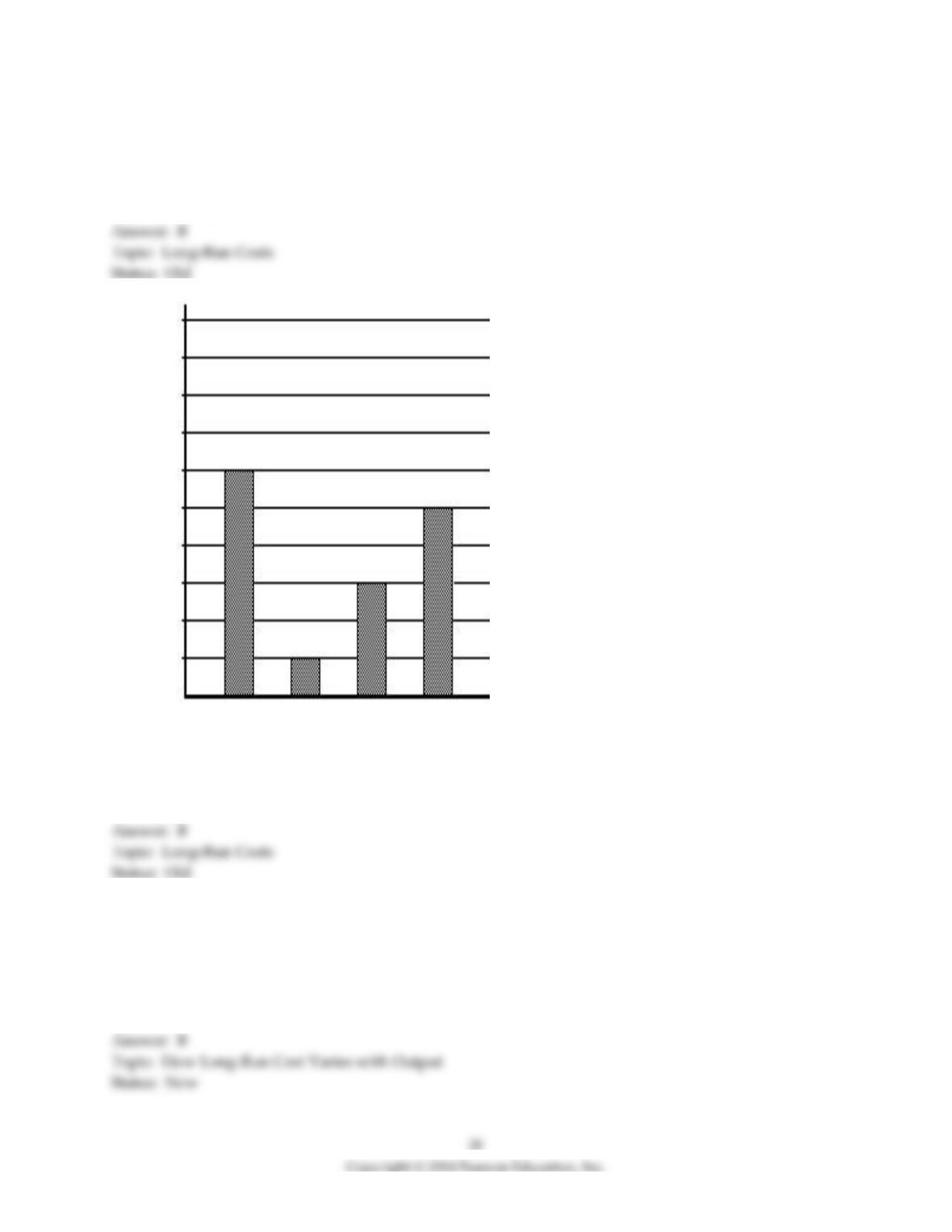
22) The above figure shows the long-run expansion path. The long-run average cost curve will be
A) horizontal.
B) downward sloping.
C) upward sloping.
D) vertical.
23) The above figure shows the long-run expansion path. With an increase in the wage rate, the long run
expansion path will
A) remain unchanged.
B) shift up.
C) shift down.
D) become flatter.