Chapter 06 – Consumer Behavior (+ Appendix)
6-21
51. Mr. Samuelson’s current rates of purchase are such that the marginal utility of slacks is 18
and the marginal utility of ties for him is 5. If slacks and ties are priced at $12 and $2
respectively, it can be concluded that Mr. Samuelson:
52. The goal of a rational consumer is to maximize:
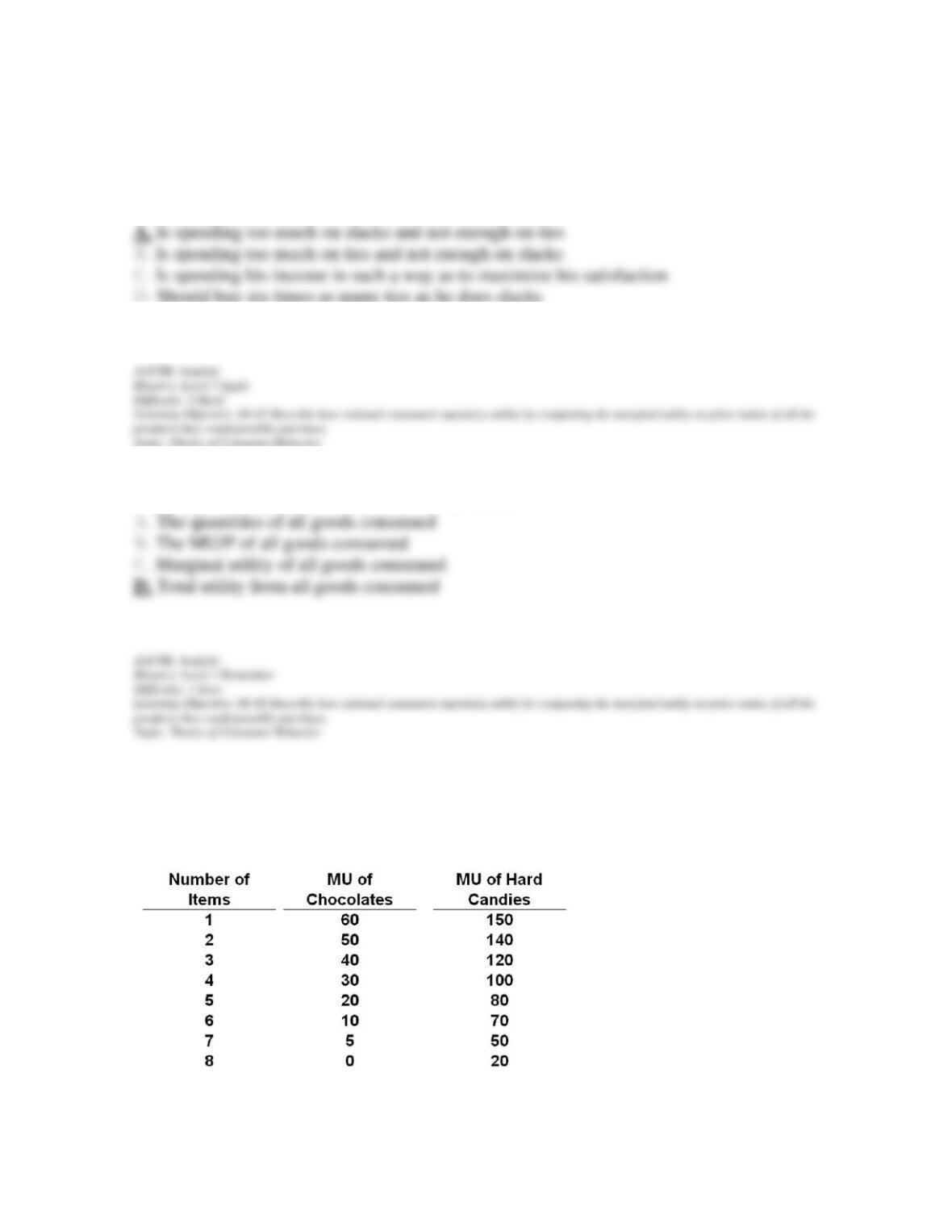
A child is given $1 of pocket money to be spent on either hard candies or chocolates.
Chocolates cost 10 cents and hard candies 20 cents each. The marginal utilities derived from
each product are as follows:
Chapter 06 – Consumer Behavior (+ Appendix)
6-22
53. Refer to the above table. Which combination should be bought with the $1 to maximize
total utility?
54. Refer to the above table. What will total utility be when the consumer purchases the
utility-maximizing combination of products?
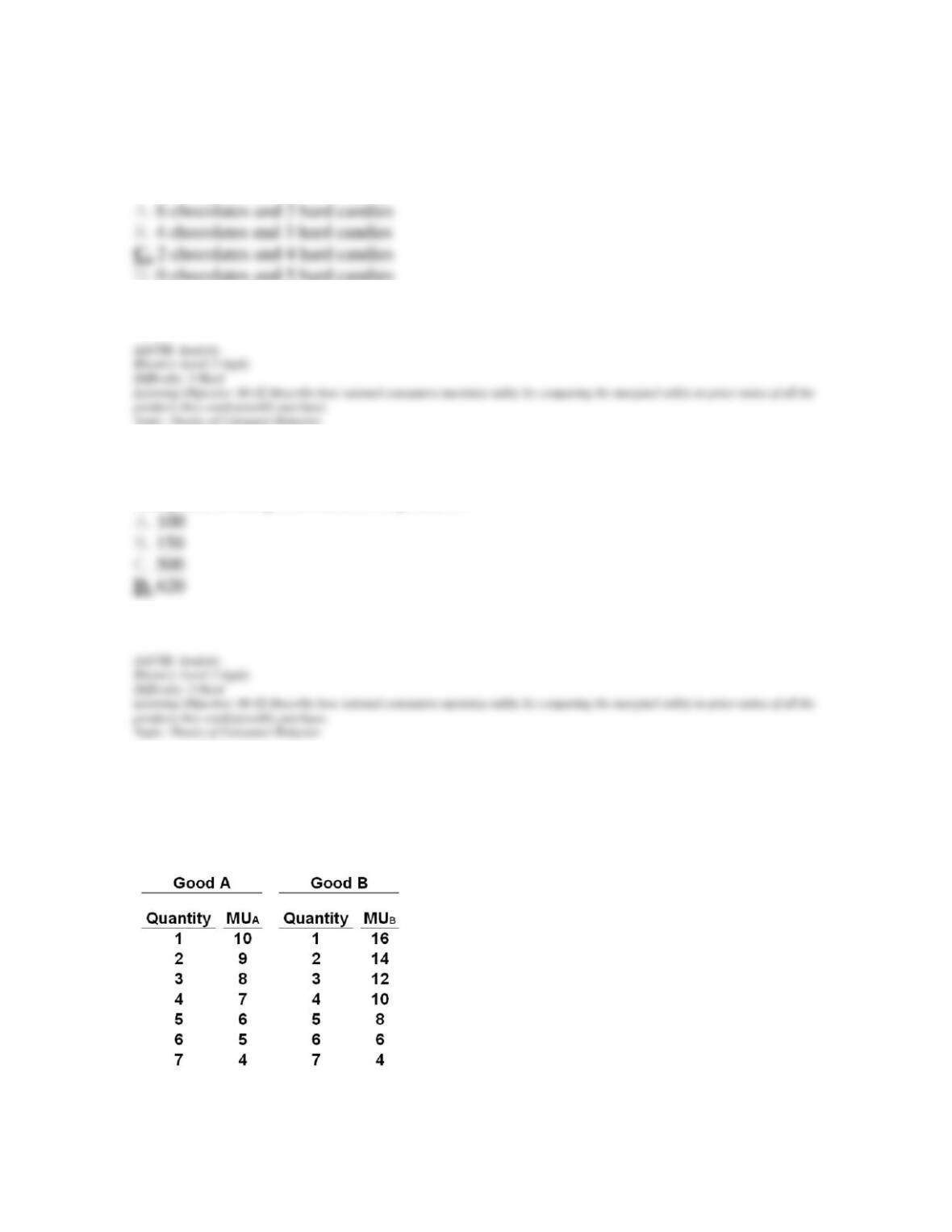
The table below shows the marginal-utility schedules for goods A and B for a hypothetical
consumer. The price of good A is $1 and the price of good B is $2. The income of the
consumer is $8.
Chapter 06 – Consumer Behavior (+ Appendix)
55. Refer to the above table. To maximize utility, the consumer will buy:
56. Refer to the above table. If the price of B falls to $1, while the price of A and the
consumer’s income stay the same, what would be the utility-maximizing combination of
goods A and B?
57. Refer to the above table. If the price of A decreases, while the price of B and the
consumer’s income stay the same, we would expect:
Chapter 06 – Consumer Behavior (+ Appendix)
58. A downsloping demand curve can be derived for a normal product by increasing its price
in the consumer-behavior model and noting:
59. When the price of a product falls for a normal good, the:
60. When the price of a product rises for an inferior good, the:
Chapter 06 – Consumer Behavior (+ Appendix)
61. The reason the substitution effect works to encourage a consumer to buy less of a product
when its price increases is:
62. Assume that Tonya consumes only two products, pizza and potato chips, out of a given
budget. Both are normal goods for Tonya. If the price of pizza decreases, then Tonya’s
consumption of pizza will:
Chapter 06 – Consumer Behavior (+ Appendix)
6-26
64. An increase in the price of product X causes a decrease in the quantity demanded for
product X. One basic explanation for this is:
65. A downsloping demand curve can be derived for a normal product by increasing its price
in the consumer-behavior model and noting:
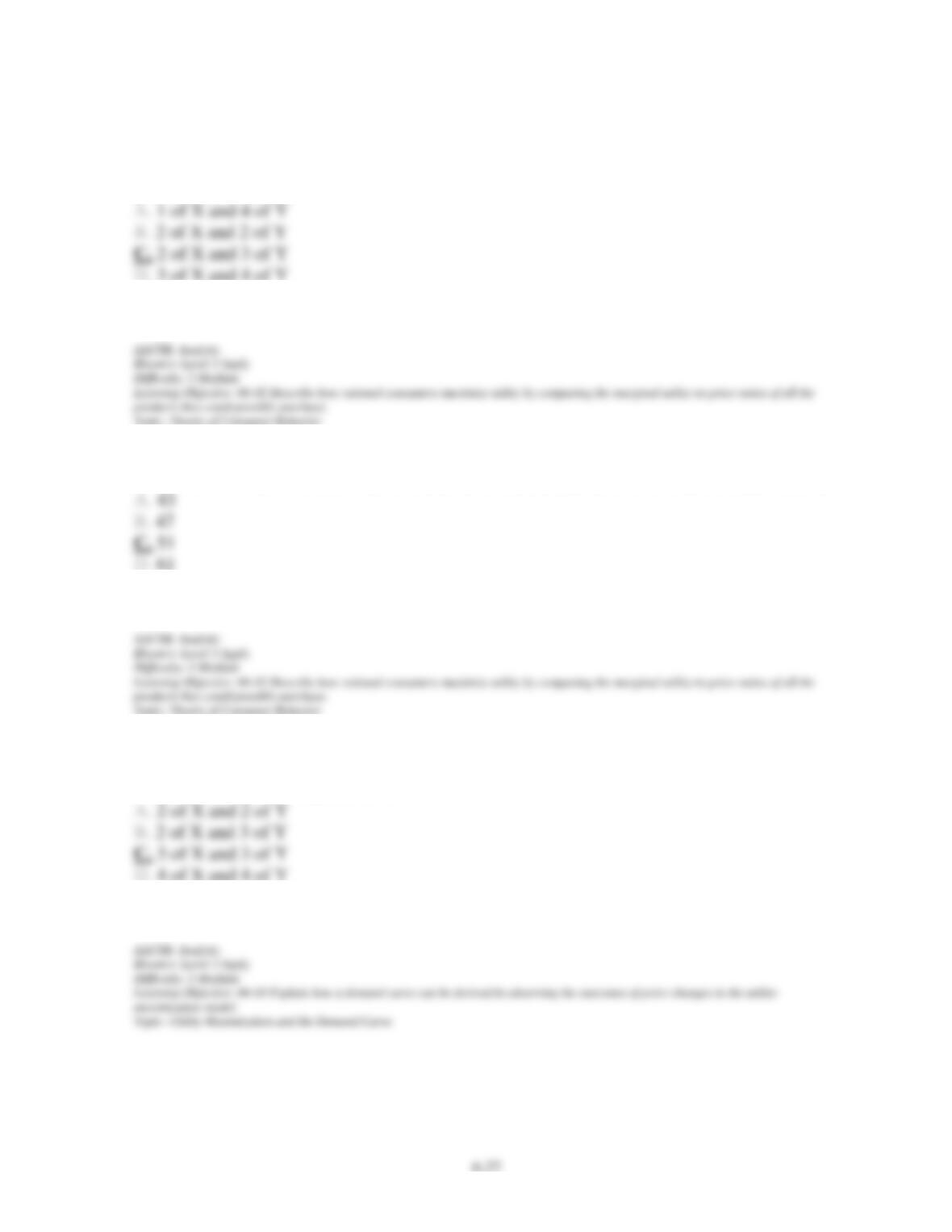
The table below shows the total utility data for products X and Y. Assume that the prices of
X and Y are $3 and $4, respectively, and that consumer income is $18.
Chapter 06 – Consumer Behavior (+ Appendix)
66. Refer to the above table. How many units of the two products will the consumer buy, to
get maximum utility?
67. Refer to the above table. What is the level of total utility for the consumer in equilibrium?
68. Refer to the above table. If the price of X decreases to $2, then the utility-maximizing
combination of the two products is:
Chapter 06 – Consumer Behavior (+ Appendix)
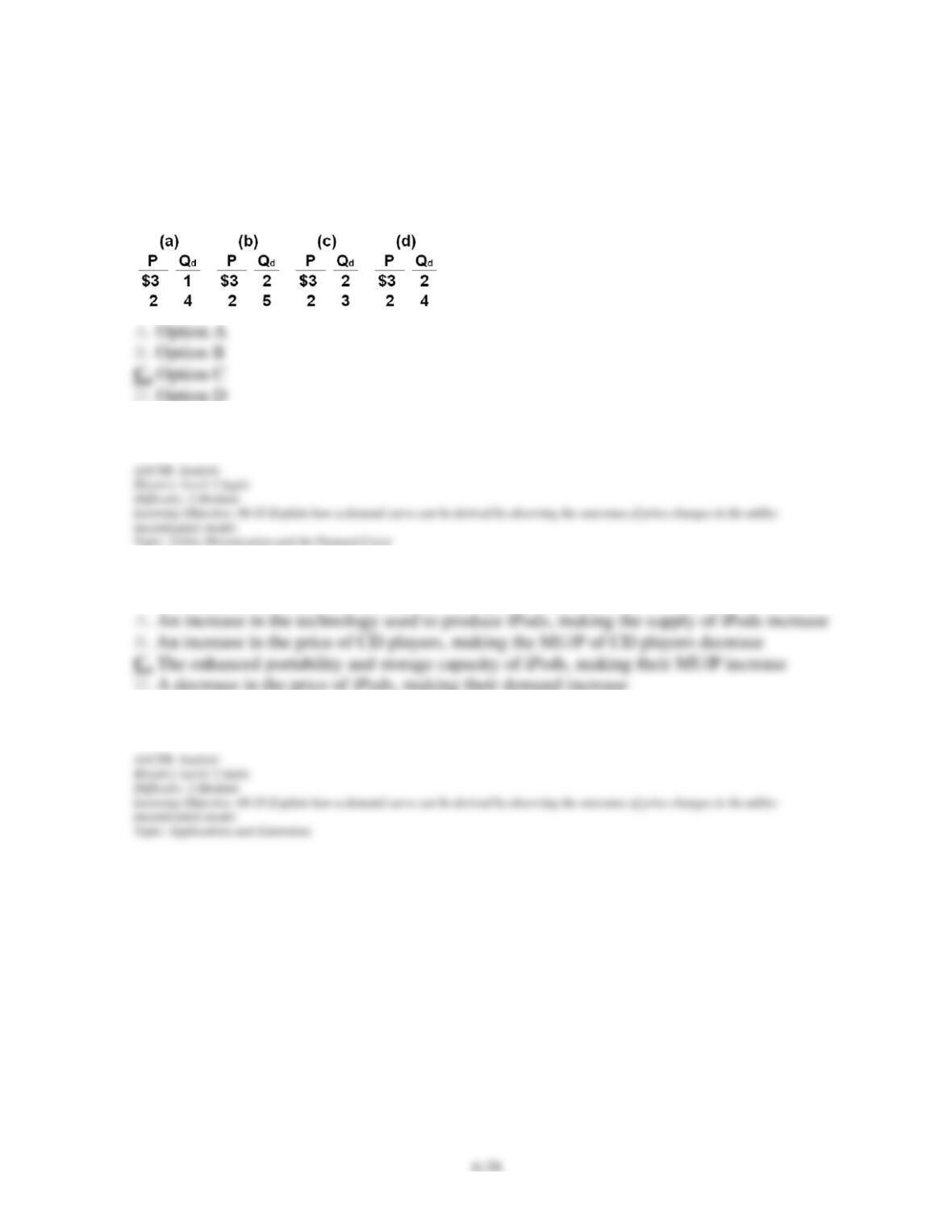
69. Refer to the above table. Which of the following price-quantity schedules would represent
the demand for X in the $2 and $3 price-range?
70. The increase in demand for iPods can be explained by:
Chapter 06 – Consumer Behavior (+ Appendix)
71. Understanding the water and diamond paradox is valuable because it explains why:
72. The price of diamonds is substantially greater than the price of water because:
73. The fact that an ounce of gold is priced higher than an ounce of chocolate suggests that:
Chapter 06 – Consumer Behavior (+ Appendix)
74. A consumer has two basic choices: rent a DVD movie for $4.00 and spend 2 hours
watching it, or spend $13 for a miniature golf game that takes 1 hour. If the marginal utilities
of the movie and the miniature golf game are equal, and the consumer values time at $12 an
hour, the rational consumer will most likely:
75. Assume a round of golf requires four hours of leisure time, and attending a concert
requires two hours. If the price of a round of golf is $40 and the price of a concert is $80,
ceteris paribus, Joe will play:
Chapter 06 – Consumer Behavior (+ Appendix)
76. The marginal utility of leisure time appears to:
77. You can drive from Kansas City to St. Louis in five hours. You can fly between both
cities in two hours. The price of an airline ticket is $150. The cost of driving between the
cities is $50. About what hourly wage would make the “full” cost of driving equal the “full”
cost of flying, where “full” cost includes the value of time?
78. An increase in the productivity of labor over time will:
Chapter 06 – Consumer Behavior (+ Appendix)
79. A consumer has two basic choices in making a trip: rent a car for $30.00 a day and spend
two days of travel to the destination, or spend $400 for an airplane ticket and fly to the
destination in two hours. The marginal utilities of the car rental and the airline ticket are the
same. The consumer values time at $5 an hour. The rational consumer will most likely:
80. The financing of health care through insurance has:
81. Health insurance often pays 80 percent of health care cost. This situation will encourage
the rational consumer to:
Chapter 06 – Consumer Behavior (+ Appendix)
82. If you purchase a gift worth $25 for your sister, but your sister would only pay $10 for the
gift, then the:
83. From the viewpoint of potential criminals, the probability of being fined or imprisoned:
84. The following are major observations made by behavioral economists regarding human
behavior, except:
Chapter 06 – Consumer Behavior (+ Appendix)
85. The following statements about behavioral economics are true, except:
86. Which of the following facts is not a basis for prospect theory in behavioral economics?
87. Prospect theory in behavioral economics predicts that as the price of flour increases,
bakeries will:
Chapter 06 – Consumer Behavior (+ Appendix)
88. Which of the following questions best illustrates the “framing effects” studied by
behavioral economists?
89. The “anchoring” phenomenon observed by behavioral economists refers to the fact that
people’s estimates of the value of things are affected by:
90. One implication of the phenomenon described by economist Richard Easterlin as the
“hedonic treadmill” is that:
Chapter 06 – Consumer Behavior (+ Appendix)
91. Marginal utility is the accumulation of the total utility from successive units of a good or
service consumed.
92. The law of diminishing marginal utility suggests that the total utility a consumer derives
from a product will increase slower and slower as consumption of the product increases.
93. If total utility increases as consumption of a good increases, then marginal utility must be
increasing also.
Chapter 06 – Consumer Behavior (+ Appendix)
94. The law of diminishing marginal utility implies that in order to induce a buyer to buy
more of a product, the seller must lower its price.
95. If the price of chicken = 5 while the price of pork = 9, and the MU of chicken = 6 while
the MU of pork = 12, then the consumer should buy more chicken and less pork in order to
increase his total utility.
96. If the price of a good increases, it will tend to make the MU-to-P ratio for the good rise
and the good becomes more attractive to the buyer.
Chapter 06 – Consumer Behavior (+ Appendix)
97. The income effect of a price-increase for a normal good causes an increase in the
consumption of the good.
98. An increase in the real income of a consumer will result from an increase in the price of a
product that the consumer is buying.
99. The income and substitution effects will both induce the consumer to buy more of a
normal good when its price decreases.
100. Someone paying $800 to fly from one city to another instead of paying only $100 for a
bus trip between the two cities is making an irrational choice and is thus not maximizing his
utility.
Chapter 06 – Consumer Behavior (+ Appendix)
101. One reason for the increased health-care spending in our economy is that insurance
companies pay the most of the cost of health care.
102. Noncash gifts usually have higher utilities than cash gifts.
103. The findings of behavioral economists confirm the assumption that consumers always
behave rationally based on clear and objective comparisons of MU/P ratios of various items.
104. Behavioral economics is still in the early stages of development and thus is not yet
capable of being used as a basis for policy-making.
Chapter 06 – Consumer Behavior (+ Appendix)
105. A graph that shows the maximum combinations of two goods which a consumer can
purchase with a given money income is:
106. The ratio of the prices of two products that a consumer would buy with a given fixed
income is equivalent to the:
107. A decrease in the prices of two products that a consumer buys out of a constant budget
would cause the consumer’s: