Chapter 06 – Consumer Behavior (+ Appendix)
1. The satisfaction or pleasure one gets from consuming a good or service is:
2. The utility of a specific product:
Chapter 06 – Consumer Behavior (+ Appendix)
3. Total utility is best defined by which of the following?
4. Which of the following statements is correct?
5. Which of the following defines marginal utility?
Chapter 06 – Consumer Behavior (+ Appendix)
6. Which best expresses the law of diminishing marginal utility?
7. After eating four slices of pizza, you are offered a fifth slice. You turn down the slice. Your
refusal indicates that the:
8. When diminishing marginal utility starts happening as a person consumes more and more
of a given good:
Chapter 06 – Consumer Behavior (+ Appendix)
9. Which situation is consistent with the law of diminishing marginal utility?
10. Which statement is correct?
11. Children who dislike Brussels sprouts exemplify the notion that the marginal utility of
Brussels sprouts is:
Chapter 06 – Consumer Behavior (+ Appendix)
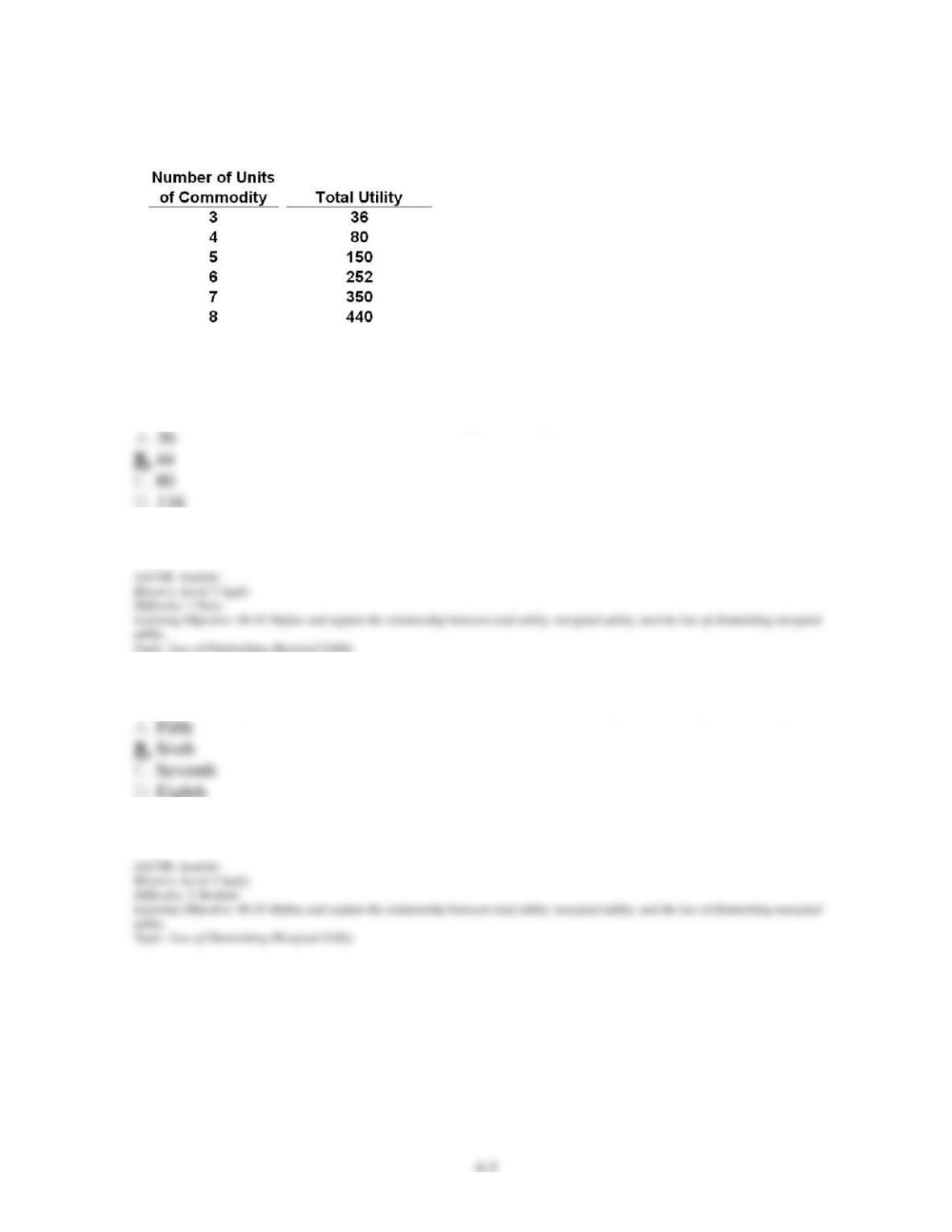
12. Refer to the above table. What is the marginal utility of the fourth unit?
13. Refer to the above table. The addition of which unit has the greatest marginal utility?
Chapter 06 – Consumer Behavior (+ Appendix)
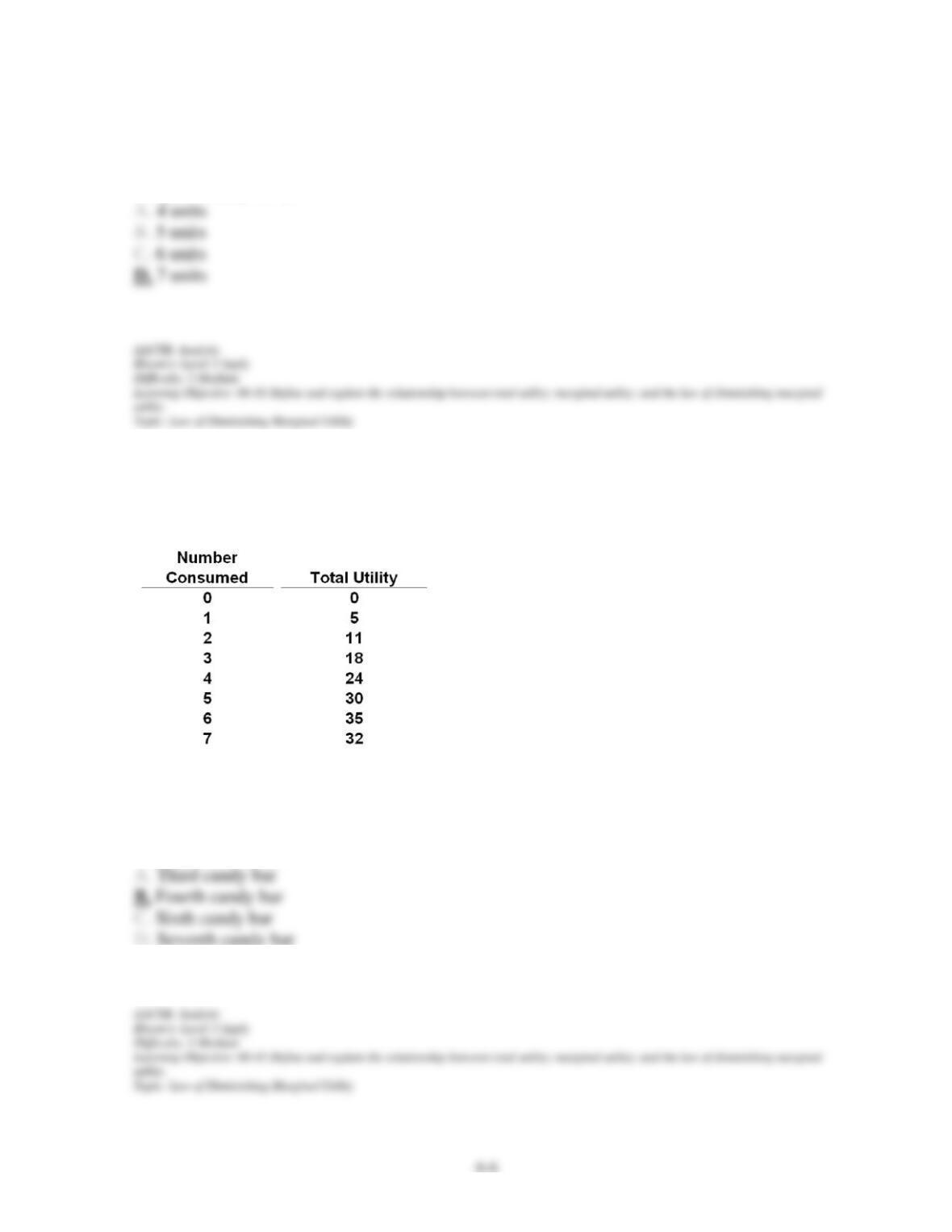
14. Refer to the above table. At what consumption level for this product does diminishing
marginal utility set in?
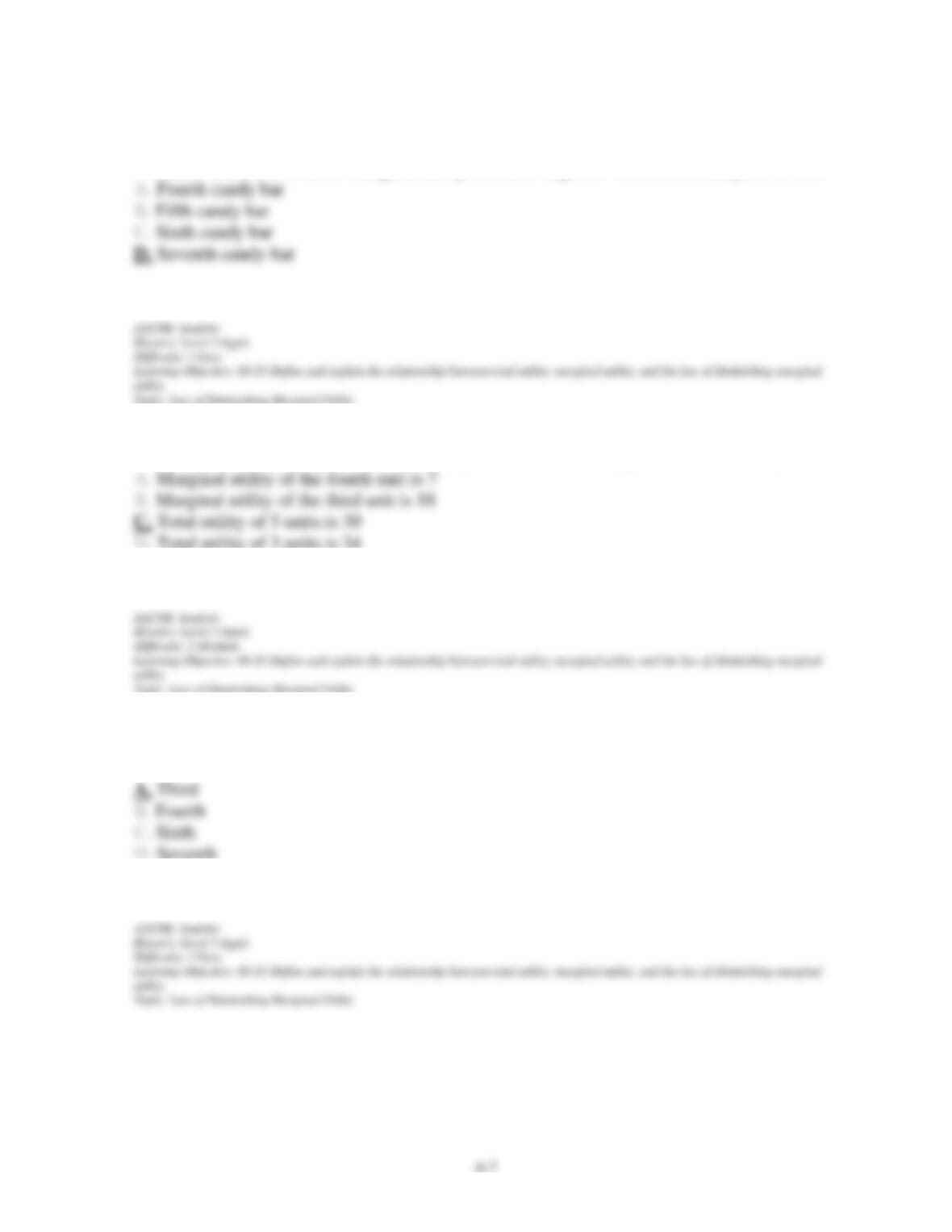
The table below shows the hypothetical utility schedule for a consumer of chocolate candy
bars.
15. Refer to the above table. This consumer begins to experience diminishing marginal utility
when consuming the:
Chapter 06 – Consumer Behavior (+ Appendix)
16. Refer to the above table. Marginal utility becomes negative with the consumption of the:
17. Refer to the above table. Based on the data in the above table you can conclude that the:
18. Refer to the above table. The consumption of which bar yields the greatest marginal
utility?
Chapter 06 – Consumer Behavior (+ Appendix)
19. If total utility is increasing, then marginal utility:
20. If a product has a diminishing but positive marginal utility, then:
21. Suppose that football tickets at your university are given away for free, and that there are
still empty seats for all games. Ignoring all other costs of going to the game, you should attend
until your:
Chapter 06 – Consumer Behavior (+ Appendix)
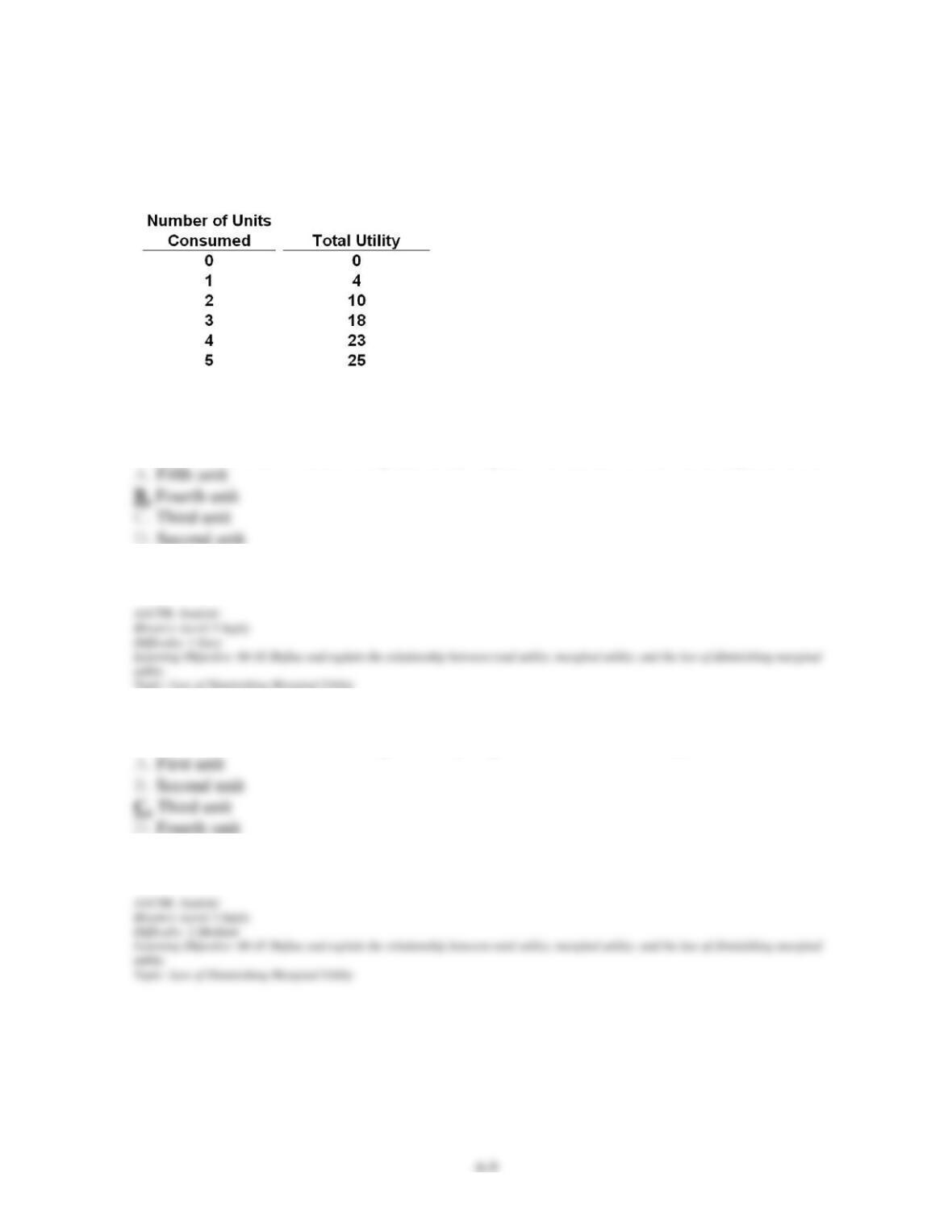
The table below shows a consumer’s utility schedule.
22. Refer to the above table. Marginal utility begins to diminish with the consumption of the:
23. Refer to the above table. Marginal utility is greatest with the consumption of the:
Chapter 06 – Consumer Behavior (+ Appendix)
24. Refer to the above table. Based on the data, you can conclude that the:
25. According to utility theory, when total utility reaches a maximum, then marginal utility
is:
26. A consumer’s consumption of a third unit of a product per day would increase total utility,
while the consumption of a fourth unit would reduce it. Which of the following statements is
true?
Chapter 06 – Consumer Behavior (+ Appendix)
27. The marginal utility of a second copy of today’s newspaper taken from a newspaper
vending machine is:
28. The reason why people are charged for an additional can of soda they get from a soda
machine, but are not charged for an additional paper taken from a newspaper dispensing
machine, is that the marginal utility of an additional:
29. The downward slope of the demand curve for a product shows the implications of:
Chapter 06 – Consumer Behavior (+ Appendix)
30. Which of the following is an assumption of the marginal-utility theory of consumer
behavior?
31. Which of the following is not an assumption of the marginal-utility theory of consumer
behavior?
32. A consumer with a fixed income will maximize utility when each good is purchased in
amounts such that the:
Chapter 06 – Consumer Behavior (+ Appendix)
33. In deciding what to buy, the consumer will choose the good with the:
34. A consumer makes purchases of an existing product X such that the marginal utility is 10
and the price is $5. The consumer also tries a new product Y and at the current level of
consumption it has a marginal utility of 8 and a price of $1. The utility-maximizing rule
suggests that this consumer should:
35. Assume that a consumer purchases a combination of product A and product B such that
the MUa/Pa = 8 and MUb/Pb = 6. To maximize utility without spending more money, the
consumer should:
Chapter 06 – Consumer Behavior (+ Appendix)
36. Assume that product Alpha and product Beta are both priced at $1 per unit and that Ellie
has $20 to spend on Alpha and Beta. She buys 8 units of Alpha and 12 units of Beta. The
marginal utility of Alpha is 40 and the marginal utility of Beta is 20. This indicates that:
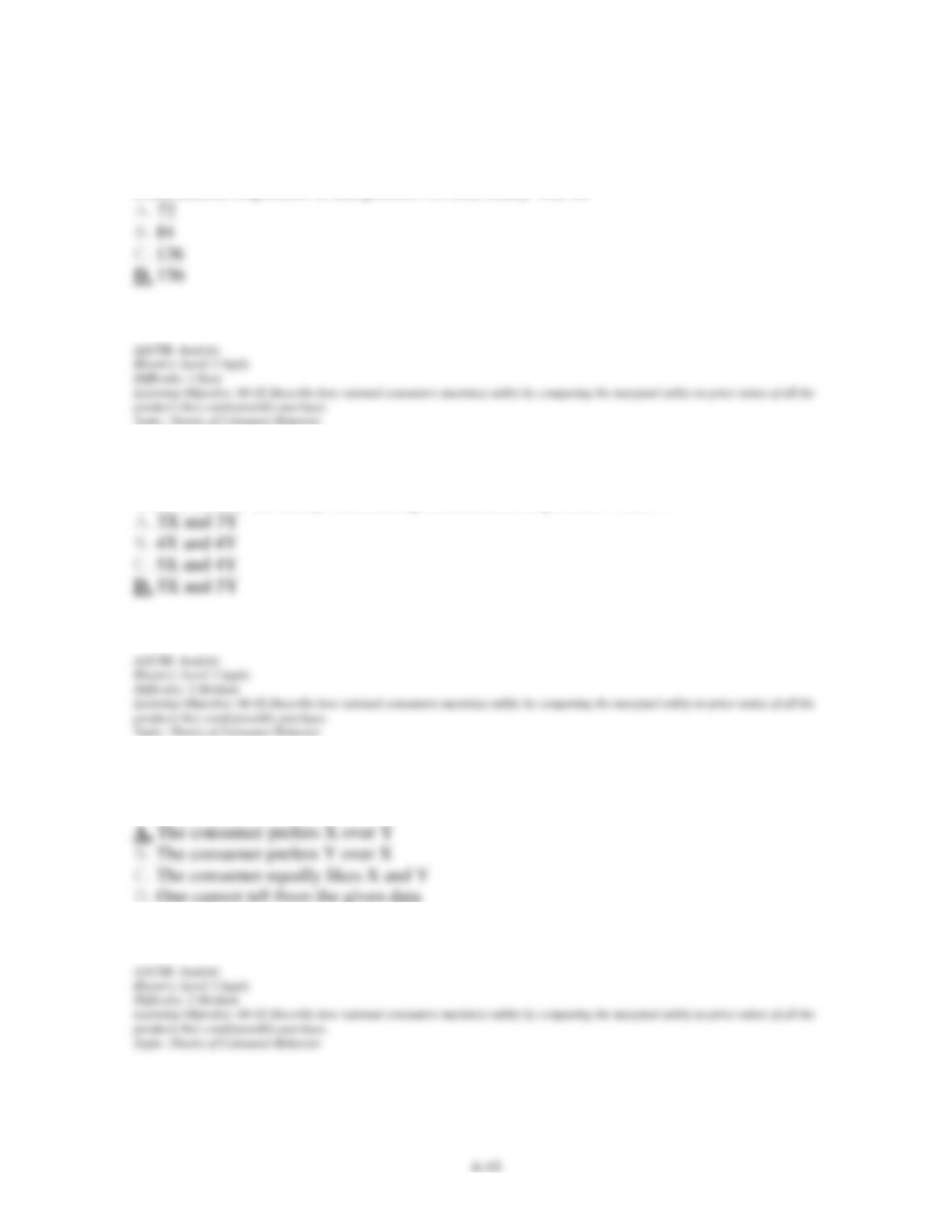
Answer the next question(s) based on the table below showing the marginal utility schedules
for product X and product Y for a hypothetical consumer. The price of product X is $4 and
the price of product Y is $2. The income of the consumer is $20.
37. Refer to the above table. If the consumer buys both product X and product Y, how much
will the consumer buy of each to maximize utility?
Chapter 06 – Consumer Behavior (+ Appendix)
38. Refer to the above table. When the consumer purchases the utility-maximizing
39. Refer to the above table. Suppose that the consumer’s income increased from $20 to $30.
What would be the utility-maximizing combination of products X and Y?
40. Refer to the above table. Based on taste and preference alone, which good does the
consumer prefer?
Chapter 06 – Consumer Behavior (+ Appendix)
41. A consumer is making purchases of products Alpha and Beta such that the marginal utility
of product Alpha is 30 and the marginal utility of product Beta is 40. The price of product
Alpha is $5 and the price of product Beta is $10. The utility-maximizing rule suggests that
this consumer should:
42. A consumer is in equilibrium and is spending income in such a way that the marginal
utility of product X is 40 units and Y is 16 units. The unit price of X is $5. The price of Y is:
Chapter 06 – Consumer Behavior (+ Appendix)
43. Assume that a consumer purchases a combination of products Y and Z and that the
MUy/Py= 25 and MUz/Pz = 20. To maximize utility, without spending more money, the
consumer should:
44. Assume that a consumer purchases a combination of products Y and Z and that the
MUy/Py= 25 and MUz/Pz = 25. To maximize utility, without spending more money, the
consumer should:
Chapter 06 – Consumer Behavior (+ Appendix)
45. Charles Goodson purchases two products from a given fixed budget, mineral water and
popcorn. The marginal utility of mineral water is 70 and the marginal utility of popcorn is 60.
The price of a bottle of mineral water is $2.00 and the price of a box of popcorn is $1.50. The
utility-maximizing rule suggests that Charles should:
46. Sharon Jones purchases two products with a given fixed budget, orange juice and soda.
Her marginal utility from orange juice is 60 and her marginal utility from soda is 30. The
price of a bottle of orange juice is $2.00 and the price of soda is $1.00. These data suggest
that:
Chapter 06 – Consumer Behavior (+ Appendix)
47. Betty Johnson is maximizing her satisfaction spending two items, movie rentals and music
downloads. If her marginal utility from the last movie rental is twice that from the last music
download, what is the price of a movie rental if the price of a music download is $.80?
48. Assume that A and B are both priced at $1 per unit and that Mary has $10 to spend on A
and B. She buys 6 units of A and 4 units of B. The marginal utility of A is 12 and the
marginal utility of B is 8. This indicates that:
Chapter 06 – Consumer Behavior (+ Appendix)
49. Frank Martin’s marginal utility from an additional dry martini is three times his marginal
utility from an additional bottle of beer. If the price of a bottle of beer is $1, then to maximize
utility Frank should buy:
50. In spending all his income on beer and pizza, Fred finds that the marginal utility of the last
pizza he consumed is 8, and the marginal utility of the last bottle of beer is 4. The price of a
bottle of beer is $1.50. If Fred has maximized his utility, the price of pizza must be: