30) According to dynamic tax analysis, continually increasing the tax rate will eventually
A) cause an increase in the tax base.
B) have no impact on the tax base.
C) cause a decrease in the tax base.
D) result in an initial decrease in the tax base followed ultimately by a rise in the tax base.
31) Dynamic tax analysis is an economic evaluation of tax rate changes
A) by the National Tax Institute in Burlington, Massachusetts.
B) by various state governments.
C) by the tax institutes established by a consortium of business schools.
D) based on the assumption that tax base declines if tax rates continuously increase.
32) Dynamic tax analysis generally predicts
A) that the higher the tax rate is, the higher the tax revenue will continue to be into the future.
B) that the higher tax rates lead to higher revenues only to a point at which revenues will begin
to decrease due to a diminishing tax base.
C) that lower tax rates will always and continuously lead to increased tax revenues.
D) that lower tax rates are always going to lead to decreased tax revenues.
33) In order for the government to collect taxes, the government must first establish a(n)
A) ad valorem taxation.
B) tax base.
C) philosophy of taxation.
D) justice system.
34) State sales taxes are operated as a system of
A) ad valorem taxation.
B) unit taxation.
C) income taxation.
D) revenue minimizing taxation.
35) To set a tax rate at the appropriate level to maximize its tax revenues, a government must
engage in
A) static tax analysis.
B) dynamic tax analysis.
C) debt-free tax analysis.
D) ad valorem tax analysis.
36) Static tax analysis assumes
A) all of the present tax rates will be in place for a minimum of twenty years.
B) changes in the tax rates have no effect on the tax base.
C) changes in the tax rates have no effect on tax revenue.
D) changes in the tax rates will change the tax base.
37) Dynamic tax analysis assumes
A) all of the present tax rates will be in place for a minimum of twenty years.
B) changes in the tax rates have no effect on the tax base.
C) changes in the tax rates have no effect on tax revenue.
D) changes in the tax rates will change the tax base.
38) Explain why an increase in the tax rate can result in lower tax revenues.
39) A government is thinking about increasing the sales tax rate. Should it use static or dynamic
tax analysis? Explain why one approach is better than the other.
40) According to dynamic tax analysis, will continuing to push up the tax lead to steady
increases in tax revenues? Why?
6.4 Taxation from the Point of View of Producers and Consumers
1) Imposing a tax on sales of a product
A) shifts the market demand curve for the product.
B) shifts the market supply curve for the product.
C) shifts both the market supply and demand curve for the product.
D) has no effect on either the market demand or the market supply curve for the product.
2) What happens when the government imposes a unit excise tax on a good?
A) The amount of the tax is added to the current equilibrium price.
B) The demand for the newly taxed good decreases.
C) That good’s supply curve shifts down by the amount of the tax.
D) The newly taxed good’s supply curve shifts vertically upward by the amount of the per-unit
tax being levied.
3) The imposition of a unit excise tax on red wine will
A) lower equilibrium price and quantity in the market.
B) increase equilibrium quantity and price in the market.
C) lower equilibrium quantity and raise equilibrium price in the market.
D) raise equilibrium quantity and lower equilibrium price in the market.
4) The government imposes a unit excise tax on bubble gum. What happens as a result?
A) The equilibrium quantity of bubble gum increases.
B) At the original market price, there will be a bubble gum surplus so price decreases.
C) At the original market price, there is a bubble gum shortage and so price rises.
D) There will be no change in either the market price or equilibrium quantity as long as the
excise tax rate is 5 percent or less.
5) Unit excise taxes imposed on gasoline are
A) largely paid by the producers because gasoline is a necessity.
B) largely paid by consumers because they are not very responsive to price changes.
C) shared equally between the producer and the consumer.
D) paid by the wholesalers of these products.
6) How can we anticipate the proportion of a newly imposed unit excise tax that consumers will
pay?
A) Consumers will pay most of the tax whenever their demand for a product is relatively
unresponsive to price changes.
B) Consumers will always pay 100 percent of an excise tax.
C) Consumers will pay most of the tax whenever their demand for the product is very price
sensitive.
D) Since producers always pay 100 percent of an excise tax, we know consumers will not pay
any of the tax.
7) Imposing a unit excise tax on the final sale of a good or service can be displayed graphically
as
A) a vertical shift upward of the demand curve.
B) a vertical shift upward of the supply curve.
C) a vertical shift downward of the demand curve.
D) a vertical shift downward of the supply curve.
8) Which of the following is TRUE about the effects of an excise tax if consumers are totally
unresponsive to price changes?
A) Consumers pay all of the excise tax.
B) Producers pay all of the excise tax.
C) Consumers and producers share the excise tax equally.
D) Neither consumers nor producers pay the excise tax.
9) A tax levied on purchases of a particular good or service
A) is illegal because it is discriminatory.
B) always leads to a reduction in total tax revenues.
C) always leads to an increase in total tax revenues.
D) is an excise tax.
10) A unit tax
A) is based on the value of the good being sold.
B) is a constant tax assessed on each unit of a good sold.
C) is the primary tax studied in dynamic tax analysis.
D) does not influence equilibrium price and quantity.
11) Which of the following is TRUE of an excise tax?
A) An excise tax is always a unit tax.
B) An excise tax is levied on purchases of particular good or service.
C) An excise tax is based on an individual’s income.
D) Imposing an excise tax shifts the market demand curve.
12) If we wanted to analyze the effects of a $2 unit tax graphically, we would shift the
A) supply curve upward by $2.
B) supply curve downward by $2.
C) demand curve upward by $2.
D) demand curve downward by $2.
13) The imposition of a new excise tax will
A) increase equilibrium price and increase equilibrium quantity.
B) increase equilibrium price and decrease equilibrium quantity.
C) decrease equilibrium price and increase equilibrium quantity.
D) decrease equilibrium price and decrease equilibrium quantity.
14) A unit tax of $10 has been levied on a good. The equilibrium price of the good will most
likely
A) increase by $10.
B) remain unchanged.
C) decrease by $10.
D) increase by an amount less than $10.
15) A unit tax of $1 will always
A) shift the supply curve upward by more than $1.
B) shift the supply curve upward by less than $1.
C) shift the supply curve up by exactly $1.
D) leave the supply curve unchanged.
49
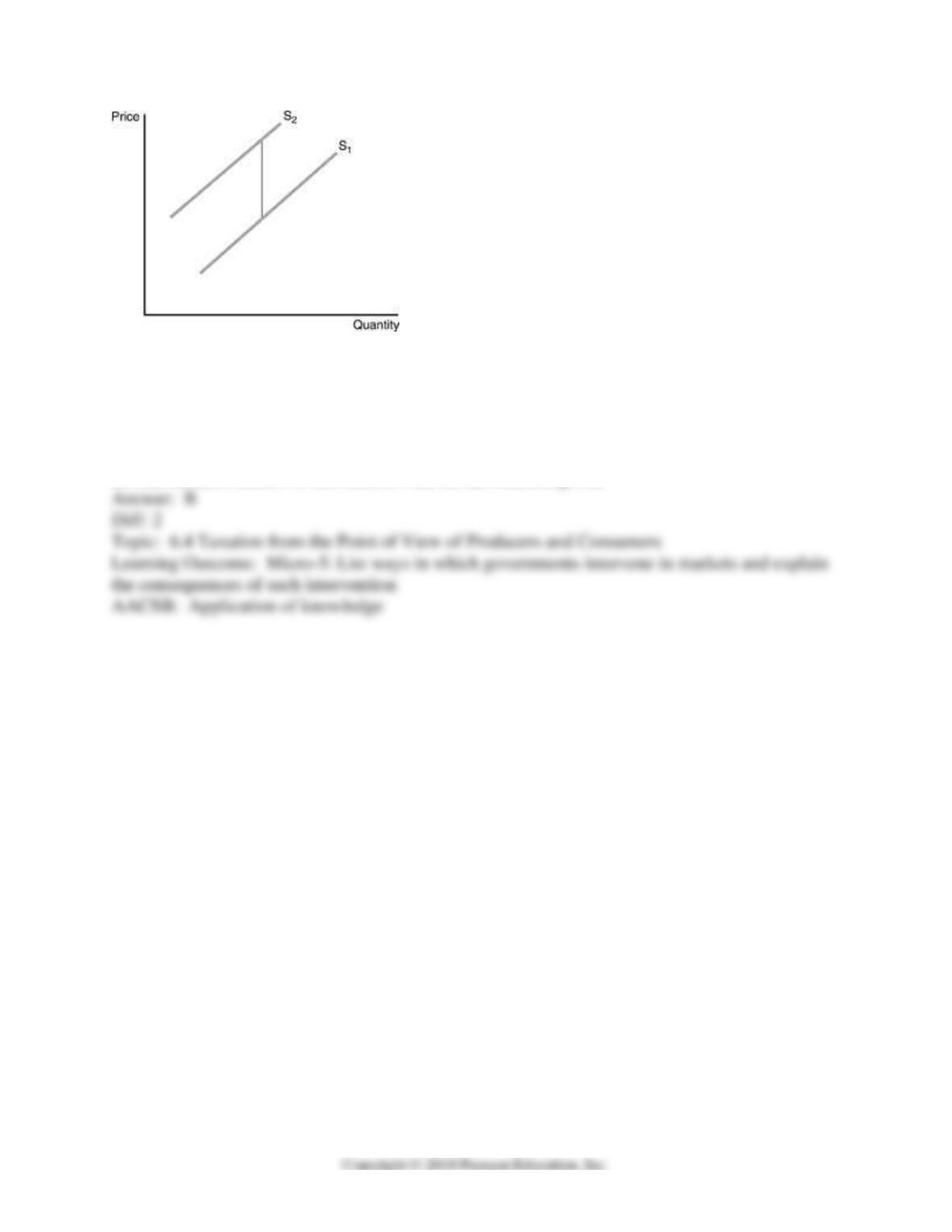
16) Refer to the above figure. A unit tax of $2 has been placed on the good. Which of the
following statements is TRUE about the vertical distance between S1 and S2?
A) The distance is less than $2.
B) The distance is $2.
C) The distance is more than $2.
D) The distance cannot be determined with the information given.
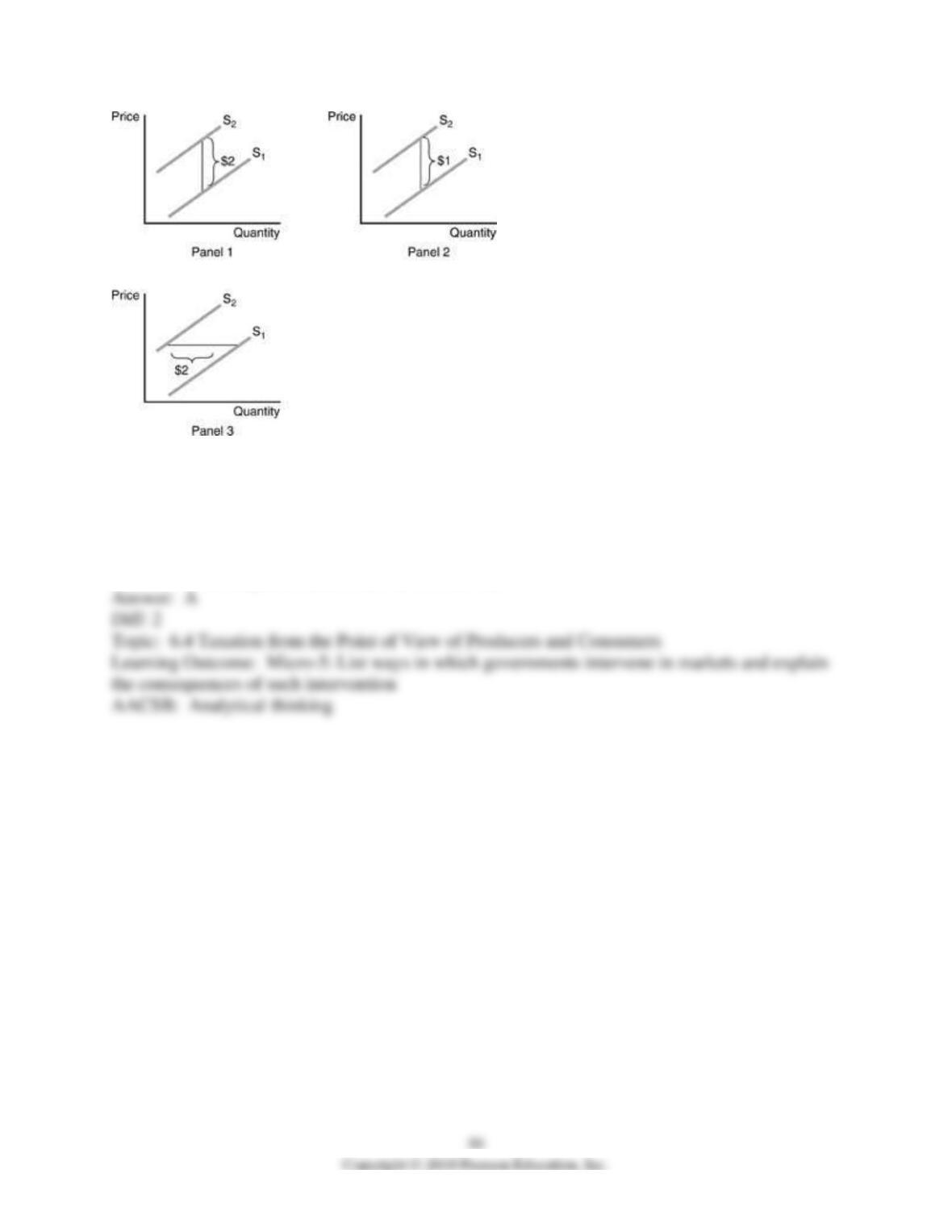
17) Refer to the above figures. A unit tax of $2 has been levied on a good. Which of the panels
depict the effect of the taxes?
A) Panel 1
B) Panel 2
C) Panel 3
D) None of the diagrams reflect the effect of the tax.
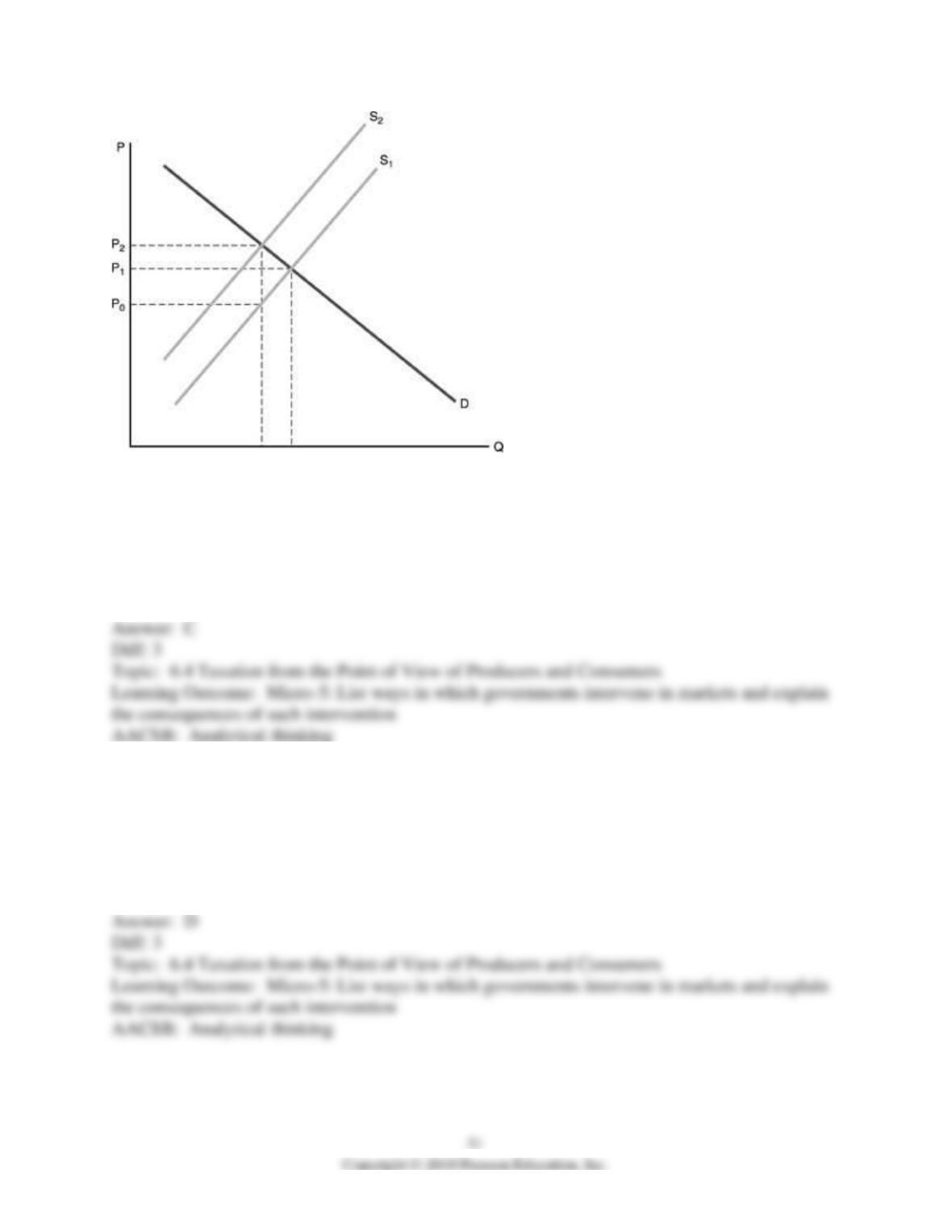
18) Refer to the above figure. A unit tax has been placed on the good. The consumer pays what
amount of the tax?
A) none of the tax
B) P2 – P0
C) P2 – P1
D) P1 – P0
19) Refer to the above figure. A unit tax has been placed on the good. The producer pays what
amount of the tax?
A) none of the tax
B) P2 – P0
C) P2 – P1
D) P1 – P0