
94) If real GDP is $13,500 billion and aggregate hours are 110 billion, labor productivity equals
A) $6.75 per hour.
B) $104 per hour.
C) $123 per hour.
D) $675 per hour.
95) If real GDP is $11,750 billion and aggregate hours are 175 billion, labor productivity equals
A) $23.50 per hour.
B) $52 per hour.
C) $67 per hour.
D) $235 per hour.
96) An increase in labor productivity relates to
A) working harder over time.
B) working longer over time.
C) producing the same output with fewer labor hours.
D) producing the same output with more labor hours.
97) When labor productivity increases, the demand for labor curve ________ and the supply of
labor curve ________.
A) shifts rightward; shifts rightward
B) shifts rightward; does not shift
C) shifts leftward; shifts rightward
D) shift s leftward; does not shift

98) If the nation’s capital stock increases so that workers become more productive, the
A) demand for labor will increase.
B) supply of labor will increase.
C) demand for labor will decrease.
D) supply of labor will decrease.
99) Which of the following statements is CORRECT?
A) When workers become more productive, the demand for labor curve shifts rightward.
B) When technology decreases, the supply of labor curve shifts leftward.
C) When labor force participation increases, the supply of labor curve shifts leftward.
D) When human capital increases, the demand for labor curve shifts leftward.
100) If both the supply of labor and the demand for labor increase, then
A) potential GDP decreases.
B) potential GDP increases.
C) full employment decreases.
D) the impact on potential GDP is uncertain
101) An increase in labor productivity ________ the real wage rate and an increase in population
________ the real wage rate.
A) raises; lowers
B) raises; raises
C) lowers; lowers
D) lowers; raises

102) If the demand for labor increases
I. employment increases.
II. the real wage rate increases.
A) Only I is correct.
B) Only II is correct.
C) Both I and II are correct.
D) Neither I nor II is correct.
103) An advance in technology that results in increased productivity results in a
A) rightward shift of the labor supply curve.
B) rightward shift of the labor demand curve.
C) rightward shift of both the labor supply and labor demand curves.
D) no change to the production function.
104) An advance in technology that increases productivity and an increase in the working-age
population results in a
A) rightward shift of the labor supply curve.
B) rightward shift of the labor demand curve.
C) rightward shift of the labor demand curve and of the labor supply curve.
D) no change to the production function.
105) An advance in technology increases the productivity of labor. As a result, the nation’s
production function shifts ________ and the ________ labor curve shifts rightward.
A) upward; demand for
B) downward; demand for
C) upward; supply of
D) downward; supply of

106) An increase in physical capital or a technological advance
A) raises the real wage rate.
B) decreases the quantity of labor employed.
C) shifts the production function downward.
D) decreases demand for labor.
107) An advance in technology will
A) not shift the production function but will lead to a movement down along the production
function.
B) shift the production function downward.
C) not shift the production function but will lead to a movement up along the production
function.
D) shift the production function upward.
108) An advance in technology shifts the production function upward and shifts the labor
A) demand curve leftward.
B) supply curve leftward.
C) demand curve rightward.
D) supply curve rightward.
109) An increase in labor productivity shifts the labor ________ curve ________.
A) demand; rightward
B) demand; leftward
C) supply; rightward
D) supply; leftward
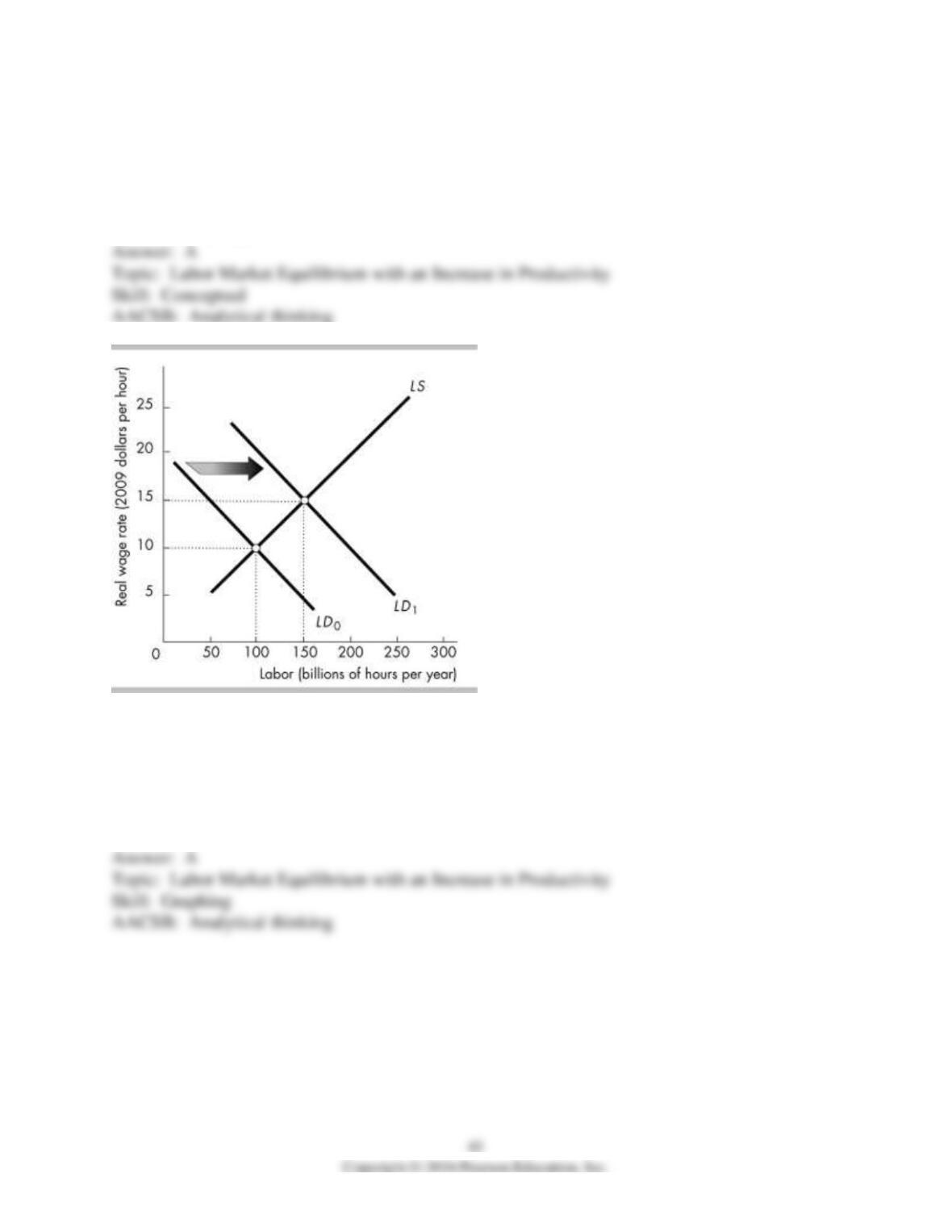
110) If new capital increases labor productivity, the supply of labor ________ and the demand
for labor ________.
A) stays the same; increases
B) increases; increases
C) increases; decreases
D) decreases; stays the same
111) As a result of the rightward shift in the demand curve for labor from LD0 to LD1, the
equilibrium level of employment ________ and potential GDP ________.
A) increases; increases
B) increases; decreases
C) decreases; increases
D) decreases; decreases
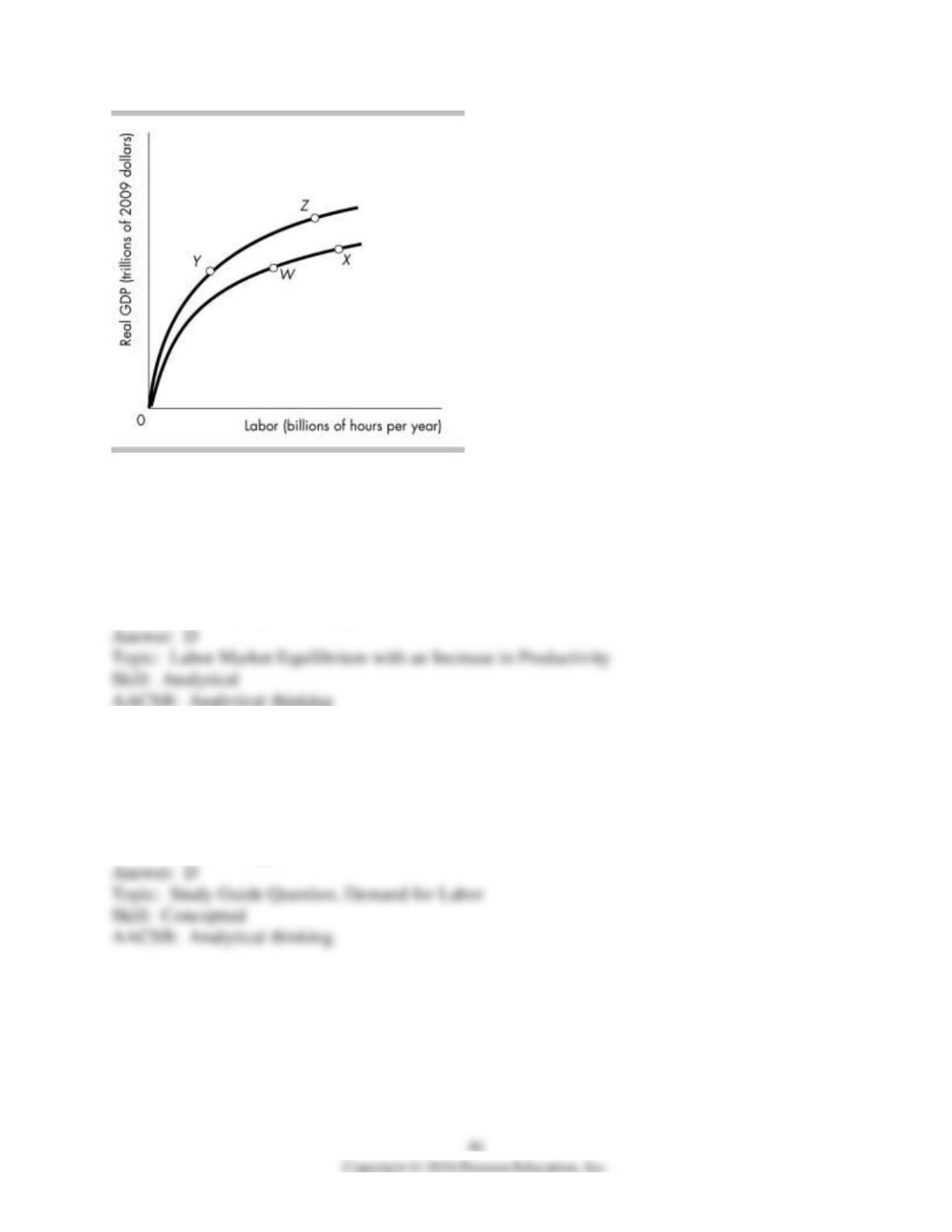
112) The figure above shows the U.S. production function. From 1986 to 2008 the United States
experienced major advances in technology as well as an increase in the working-age population.
The combined effect can best be shown by a
A) movement from point W to point X.
B) movement from point Y to point Z.
C) movement from point Y to point X.
D) movement from point W to point Z.
113) A decrease in the real wage rate
A) shifts the labor demand curve rightward.
B) shifts the labor demand curve leftward.
C) shifts the labor supply curve leftward.
D) none of the above because a change in the real wage rate does not shift either the labor
demand or labor supply curve.

114) The demand for labor curve
A) is downward sloping because productivity of labor diminishes as more workers are employed.
B) is upward sloping and the supply curve of labor is downward sloping.
C) is upward sloping because productivity of labor diminishes as more workers are employed.
D) shifts rightward when the real wage rate rises.
115) An increase in labor productivity shifts the
A) labor demand curve rightward.
B) labor demand curve leftward.
C) labor supply curve rightward.
D) labor supply curve leftward.
116) A decrease in population shifts the
A) labor demand curve rightward.
B) labor demand curve leftward.
C) labor supply curve rightward.
D) labor supply curve leftward.
4 Why Labor Productivity Grows
1) The Industrial Revolution in England in large was the result of
A) growth in human capital.
B) technological innovations encouraged by the patent system.
C) population growth.
D) technological innovations that were financed mainly by government spending.

2) Which of the following is NOT an important factor affecting growth in labor productivity?
A) the saving rate
B) the speed with which prices fall
C) the growth rate of physical capital
D) the growth rate of labor productivity
3) All of the following contribute to labor productivity growth EXCEPT
A) population growth.
B) physical capital growth.
C) human capital growth.
D) technological advancements.
4) Technological change
A) lowers the real wage rate.
B) decreases labor productivity.
C) has no effect on employment.
D) increases potential GDP.
5) A recent survey by India’s central bank reported that spending plans by firms on large new
projects
fell by 46 percent in the year ending March 2012, compared with the prior year. This decrease
will most directly impact
A) physical capital growth.
B) human capital growth.
C) technological change.
D) population growth.

6) Factors that influence labor productivity include ________.
A) the inflation rate, the real wage rate, and the exchange rate
B) the labor demand curve
C) physical capital, the real wage rate, and technology
D) physical capital, human capital, and technology
7) Labor productivity, real GDP per labor hour, increases if
A) saving and investment cause an increase in the quantity of capital per worker.
B) there is an increase in the accumulation of human capital.
C) new technologies are continuously discovered.
D) All of the above answers are correct.
8) Which of the following directly creates growth in labor productivity?
I. Growth in capital per hour of labor
II. Technological change
III. Population growth
A) I only
B) II only
C) I and II
D) I and III
9) Labor productivity rises
A) if the amount of capital per worker increases.
B) in the absence of technological progress.
C) if firms invest in hiring more workers rather than buying more capital.
D) if the amount of capital per worker decreases.

10) Which of the following contributes to an increase in labor productivity?
A) increased consumption expenditure
B) decreased investment
C) increased capital stock
D) All of the above contribute to an increase in labor productivity.
11) Which of the following does NOT increase labor productivity?
A) increases in aggregate hours
B) physical capital growth
C) human capital growth
D) technological advances
12) If capital per worker rises
A) labor productivity decreases.
B) no technological progress occurs.
C) labor productivity increases.
D) firms respond by raising their prices.
13) If the quantity of capital per worker in the economy increases
A) the amount of money held by workers increases.
B) labor productivity increases.
C) the stock of human capital necessarily increases.
D) the stock of financial assets held by the public increases.

14) Saving and investment that increase a nation’s capital lead to
A) slower growth because there is a lack of consumption.
B) a decrease in labor productivity as capital is used to replace labor.
C) a decrease in the amount of capital per worker.
D) an increase in labor productivity.
15) An increase in saving that leads to more capital accumulation ________ labor productivity.
A) increases
B) does not change
C) decreases
D) probably changes but in an ambiguous direction
16) A higher savings rate that leads to an increase in the capital stock
A) leads to higher interest rates.
B) leads to increases in labor productivity.
C) immediately decreases investment.
D) is associated with a decrease in the rate of growth of the population.
17) Labor productivity increases with
A) increases in consumption expenditure.
B) increases in depreciation.
C) increases in capital.
D) All of the above answers are correct.

18) If capital per hour of labor increases, real GDP per hour of labor
A) decreases for a given level of technology.
B) increases because the level of technology increases.
C) increases for a given level of technology.
D) decreases because the level of technology decreases.
19) If capital per hour of labor decreases, real GDP per hour of labor
A) decreases because the level of technology decreases.
B) increases because the level of technology increases.
C) increases for a given level of technology.
D) decreases for a given level of technology.
20) An increase in education and training
A) increases labor productivity.
B) increases aggregate hours.
C) decreases real GDP growth.
D) increases the employment-to-population ratio.
21) ________ is the knowledge and skill that people have obtained from education and on-the-
job training.
A) Labor productivity
B) Human capital
C) Capital
D) Technology

22) Human capital is the
A) machinery used by humans to produce GDP.
B) technology used by humans to produce GDP.
C) skill and knowledge accumulated by humans.
D) plant and equipment produced by humans and not by machines.
23) Human capital is
A) the saving done by human beings.
B) people’s knowledge and skills.
C) a measure of the labor productivity of workers.
D) the investment people make in industries that make capital goods.
24) Human capital is, in part, the
A) amount of money held by a worker.
B) stock of knowledge of a worker.
C) stock of plant and equipment.
D) stock of financial assets held by the public.
25) A worker’s stock of knowledge is known as
A) monetary capital.
B) human capital.
C) physical capital.
D) financial capital.

26) On-the-job-training is an example of
A) increasing labor force participation.
B) investment in human capital.
C) investment in physical capital.
D) technological change.
27) The more education that workers have, the ________ is their human capital and the
________ is their productivity.
A) larger; higher
B) larger; smaller
C) smaller; higher
D) smaller; smaller
28) During World War II, the increasing productivity of workers who built ships was due
primarily to
A) human capital accumulation through schooling and training.
B) human capital accumulation by repeatedly doing the same tasks.
C) discoveries of new and better technologies.
D) investments by shipyards in new capital equipment.
29) Which of the following statements regarding human capital is INCORRECT?
A) Human capital is the accumulated skill and knowledge of human beings.
B) Education is the only vehicle for the creation of human capital because training simply
reinforces what has already been learned.
C) The accumulation of human capital is the source of both increased productivity and
technological advance.
D) Writing and mathematics, the most basic of human skills, are crucial elements in economic
progress.

30) Workers who pursue an education directly increase their
A) financial capital.
B) physical capital.
C) human capital.
D) saving.
31) In addition to saving and investment in capital, making an even larger contribution to long-
term economic growth in real GDP per person
A) are technological advances.
B) is lower current consumption.
C) is higher current consumption.
D) is a larger work force.
32) Most ________ is embodied in physical capital.
A) human capital
B) technological change
C) labor productivity
D) economic growth
33) In developing nations, microloans
A) have increased the indebtedness of impoverished people, thereby slowing economic growth.
B) are primarily used to finance consumption expenditure, thereby leading to economic growth.
C) have enabled small businesses with limited access to credit to purchase capital and expand,
thus allowing greater economic growth.
D) are far too small to have any discernible effect.

5 Is Economic Growth Sustainable? Theories, Evidence, and Policies
1) Which of the following is associated with classical growth theory?
I. Growth in real GDP can continue indefinitely.
II. Technological growth increases as the population grows.
III. Population explosions bring real GDP per person back to subsistence levels.
A) I
B) II
C) III
D) I and III
2) The view that population growth occurs when real GDP per person exceeds the amount
necessary to sustain life is part of the ________.
A) classical growth theory
B) modern theory of population growth
C) neoclassical growth theory
D) new growth theory
3) An assumption of classical growth theory is that when ________ the population growth rate
________.
A) real GDP per person exceeds the subsistence level; increases
B) people become more skilled; decreases
C) the real wage rate falls; increases
D) saving declines; decreases
4) Classical growth theory asserts that
A) an increase in the labor supply raises real wage rates.
B) the economy can grow indefinitely.
C) real wage rates fall over time and, as they fall, they increase the population growth rate.
D) population growth is determined by the level of real GDP per person.

5) Which of the following is consistent with the classical theory of growth?
A) permanent increases in real wages
B) permanent growth in productivity
C) rapid population growth in poor countries
D) permanent increases in living standards
6) Classical growth theory states that
A) growth is maximized when everyone is fully employed.
B) growth is followed by increases in the population, eventually leaving real GDP per person
unchanged.
C) growth in real GDP per person is difficult in the beginning but easier in the later stages.
D) advances in technology will always insure a permanent increase in real GDP per person.
7) Which of the following predicts that there can be no sustained rise in real GDP per person
above the subsistence level?
A) classical growth theory
B) neoclassical growth theory
C) new growth theory
D) None of the above because all predict that there will be a sustained rise above the subsistence
level.
8) Classical growth theory argues that when real GDP per person rises above the subsistence
level
A) technological change slows down, stagnating the economy.
B) population growth increases, driving real GDP per person back to subsistence level.
C) people don’t want to work as much, decreasing labor supply.
D) the economy enjoys a period of permanent growth.

9) What best explains why real GDP per person is always driven to the subsistence level in the
classical model?
A) Population growth occurs, increasing the supply of labor.
B) Population growth occurs, shifting the labor supply curve leftward.
C) Growth is not possible so the demand for labor never changes.
D) Investment in capital decreases labor demand, decreasing the demand for labor.
10) Which of the following ideas are included in classical growth theory?
I. Subsistence real GDP per person
II. Growth in real GDP per person is temporary.
III. Technological change induces investment.
A) I only
B) I and II
C) II and III
D) I, II and III
11) The assumption that population growth will lead to a fall in real GDP per person rate back to
subsistence level is
A) accepted by all economists today.
B) associated with Malthusians.
C) part of the neoclassical school of growth theory.
D) central to the new growth theory.
12) According to the classical growth theory of Thomas Malthus
A) labor productivity increases continuously.
B) the population growth rate is fixed.
C) technological advances lead to permanent increases in real GDP per person.
D) increases in real GDP per person are only temporary.

13) Population increases are the limiting factor in the growth process in
A) classical growth theory.
B) neoclassical growth theory.
C) the new growth theory.
D) real growth theory.
14) Classical growth theory proposes that real GDP growth is ________ and that real GDP per
person will ________ the subsistence level.
A) permanent; temporarily be above
B) permanent; always be above
C) temporary; temporarily be above
D) temporary; be above and below
15) Classical economists believed that
A) real GDP per person would rise above its subsistence level in the long run.
B) real GDP per person would never rise above its subsistence level in the long run.
C) the demand for labor increases when the population increases.
D) population growth decreases as real GDP per person rises.
16) Classical growth theory asserts that
A) growth in real GDP per person is temporary.
B) only some countries can have economic growth.
C) real GDP growth will eventually be a constant 3 percent per year.
D) nominal GDP growth is most important.

17) The classical model of Malthus predicted that economies would
A) continue to grow indefinitely.
B) experience rapid technological progress.
C) reach a state where the growth of real GDP per person stopped.
D) experience significant productivity growth.
18) Which of the following is consistent with classical growth theory?
A) Real GDP per person will increase because technological change induces investment.
B) Real GDP per person will never permanently increase.
C) Competition destroys innovation and decreases profit.
D) As real GDP increases, there will be a decrease in the rate of population growth.
19) According to the neoclassical growth theory
A) increases in labor productivity are only temporary.
B) technological change depends on people’s choices.
C) forces other than GDP growth determine population growth.
D) higher saving rates generate permanently faster growth in GDP per person.
20) Neoclassical growth theory predicts that
A) population growth rates slow as employment opportunities for women increase.
B) population explosions decrease real GDP per person.
C) economic growth leads to technological change.
D) the pursuit of profit creates perpetual growth.