Macroeconomics, 9e (Abel/Bernanke/Croushore)
Chapter 6 Long-Run Economic Growth
6.1 The Sources of Economic Growth
1) Between 1870 and 2010, among the United States, Germany, Japan, and Australia, ________
grew at the fastest rate and ________ grew at the slowest rate.
A) United States; Germany
B) Germany; United States
C) Australia; Japan
D) Japan; Australia
2) The elasticity of output with respect to capital
A) is the increase in output resulting from an increase in the capital stock.
B) is the percentage increase in output resulting from a 1 % increase in the capital stock.
C) is always greater than one.
D) is the inverse of the elasticity of output with respect to labor.
3) Suppose the current level of output is 5000. A 10% increase in productivity would increase
the current level of output to
A) 5050.
B) 5100.
C) 5500.
D) 6000.
4) Suppose the current level of output is 5000 and the elasticity of output with respect to capital
is 0.4. A 10% increase in capital would increase the current level of output to
A) 5020.
B) 5050.
C) 5200.
D) 5500.
5) Suppose the current level of output is 5000 and the elasticity of output with respect to labor is
0.7. A 10% increase in labor would increase the current level of output to
A) 5035.
B) 5070.
C) 5350.
D) 5700.
6) Suppose the current level of output is 5000. If the elasticities of output with respect to capital
and labor are 0.3 and 0.7, respectively, a 10% increase in capital combined with a 5% increase in
labor and a 5% increase in productivity would increase the current level of output to
A) 5015.
B) 5325.
C) 5575.
D) 6000.
7) Over the past year, productivity grew 2%, capital grew 1%, and labor grew 1%. If the
elasticities of output with respect to capital and labor are 0.2 and 0.8, respectively, how much did
output grow?
A) 1%
B) 2%
C) 3%
D) 4%
8) Over the past year, productivity grew 1%, capital grew 2%, and labor grew 2%. If the
elasticities of output with respect to capital and labor are 0.3 and 0.7, respectively, how much did
output grow?
A) 1%
B) 2%
C) 3%
D) 4%
9) Over the past year, productivity grew 1%, capital grew 0%, and labor grew 5%. If the
elasticities of output with respect to capital and labor are 0.4 and 0.6, respectively, how much did
output grow?
A) 1%
B) 2%
C) 3%
D) 4%
10) Over the past year, productivity grew 1.8%, capital grew 2%, and labor grew 1%. If the
elasticities of output with respect to capital and labor are 0.2 and 0.8, respectively, how much did
output grow?
A) 1%
B) 2%
C) 3%
D) 4%
11) Over the past year, output grew 4%, capital grew 2%, and labor grew 1%. If the elasticities
of output with respect to capital and labor are 0.3 and 0.7, respectively, how much did
productivity grow?
A) 2.0%
B) 2.7%
C) 3.0%
D) 3.3%
12) The growth accounting equation is
A) Y = AaKK aNN
B) Y = AF(K, N)
C) ΔY/Y = ΔA/A + aKΔK/K + aNΔN/N
D) ΔY/Y = ΔA/A – aKΔK/K – aNΔN/N
13) The equation, ΔY/Y = ΔA/A + aKΔK/K + aNΔN/N, is known as
A) the production function.
B) the Solow model.
C) the productivity formula.
D) the growth accounting equation.
14) If capital and labor each grow 5% in a year, the elasticities of output with respect to capital
and labor sum to one, and productivity grows 2% in the year, by how much does output grow
during the year?
A) 2%
B) 3%
C) 5%
D) 7%
15) Total factor productivity growth is that part of economic growth due to
A) capital growth plus labor growth.
B) capital growth less labor growth.
C) capital growth times labor growth.
D) neither capital growth nor labor growth.
16) Over the past year, output grew 4%, capital grew 2%, and labor grew 1%. If the elasticities
of output with respect to capital and labor are 0.3 and 0.7, respectively, how much did
productivity grow?
A) 2.0%
B) 2.7%
C) 3.0%
D) 3.3%
17) Over the past year, output grew 5%, capital grew 5%, and labor grew 1%. If the elasticities
of output with respect to capital and labor are 0.3 and 0.7, respectively, how much did
productivity grow?
A) 0.5%
B) 1.0%
C) 2.2%
D) 2.8%
18) Over the past year, output grew 6%, capital grew 2%, and labor grew 4%. If the elasticities
of output with respect to capital and labor are 0.3 and 0.7, respectively, how much did
productivity grow?
A) 2.0%
B) 2.6%
C) 3.0%
D) 3.3%
19) Over the past year, output grew 5%, capital grew 5%, and labor grew 1%. If the elasticities
of output with respect to capital and labor are 0.5 and 0.5, respectively, how much did
productivity grow?
A) 0.5%
B) 1.0%
C) 1.5%
D) 2.0%
20) Labor productivity increased so much in the second half of the 1990s because of
A) improved information and communications technologies.
B) higher levels of educational attainment by workers.
C) cheaper foreign imports used in production.
D) increased foreign competition.
21) The computerization of police departments throughout the country has greatly reduced the
crime rate. What macroeconomic variable is likely to be directly affected by this change?
A) Productivity
B) Inflation
C) The real interest rate
D) The trade deficit
22) Edward Denison found that labor’s contribution to output growth in the United States since
1929 was attributable to all the factors below except
A) rising population.
B) an increase in the percentage of the population in the labor force.
C) an increase in the number of hours worked per person.
D) higher educational levels.
23) Edward Denison’s analysis of the American economy found that
A) total factor productivity was the largest source of economic growth since 1948.
B) the contribution of labor growth has been more variable than the contribution of capital
growth.
C) productivity growth has been positive over every period of more than five years since
WorldWar II.
D) the contribution of labor growth has been greater than the contribution of capital growth.
24) All of the following are explanations of the post-1973 productivity slowdown except
A) problems in measuring productivity.
B) changes in the legal and human environment.
C) higher oil prices.
D) greater competition from foreign imports.
25) The idea that measurement problems could explain the productivity slowdown since 1973 is
based on the fact that
A) official output measures make no adjustment for quality.
B) output can’t be measured.
C) capital can’t be measured.
D) quality improvements aren’t fully accounted for in the data.
26) A new pollution law requires businesses to pay for inspections of their plants by independent
pollution-monitoring firms. What effect is this likely to have?
A) Increase productivity
B) Increase the capital stock
C) Reduce productivity
D) Increase the demand for labor in those firms
27) Why do some people think that the productivity slowdown since 1973 is just a return to
normalcy after fast productivity growth during the previous 25 years?
A) Productivity growth of the previous 25 years was abnormally low.
B) The Great Depression and World War II had prevented technological opportunities from
being exploited.
C) The United States is the only country to face the slowdown, due to poor regulatory decisions.
D) The United States has allowed countries like Japan to steal its technological breakthroughs.
28) Greenwood and Yorukoglu view the post-1973 productivity slowdown as resulting from
A) the information technology revolution.
B) high oil prices.
C) measurement errors.
D) technological depletion.
29) Use the growth accounting equation to calculate productivity growth, given output growth of
3.5%, capital stock growth of 5%, labor employment growth of 2%, the output elasticity of
capital of 0.3, and the output elasticity of labor of 0.7.
30) From one year to the next, a country’s output rose from 4000 to 4500, its capital stock rose
from 10,000 to 12,000, and its labor force declined from 2000 to 1750. Suppose aK = 0.3 and
aN= 0.7.
(a) How much did capital contribute to economic growth over the year?
(b) How much did labor contribute to economic growth over the year?
(c) How much did productivity contribute to economic growth over the year?
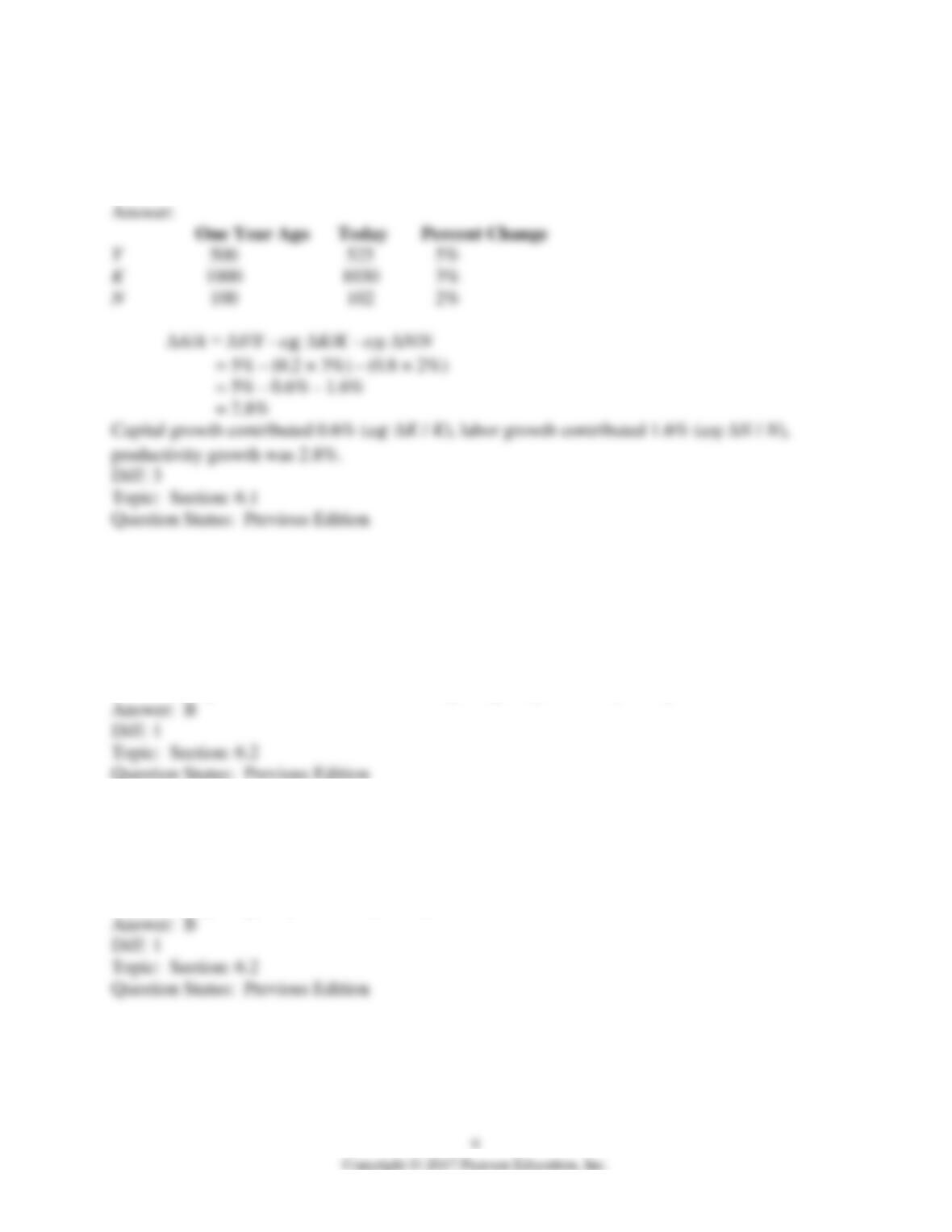
31) Over the past year, an economy’s labor supply increased from 100 to 102, its capital stock
increased from 1000 to 1030, and its output increased from 500 to 525. All measurements are in
real terms. Calculate the contributions to economic growth of growth in capital, labor, and
productivity if aK = 0.2 and aN = 0.8.
6.2 Long-Run Growth: The Solow Model
1) The per-worker production function in the Solow model assumes
A) constant returns to scale and increasing marginal productivity of capital.
B) constant returns to scale and diminishing marginal productivity of capital.
C) increasing returns to scale and diminishing marginal productivity of capital.
D) decreasing returns to scale and diminishing marginal productivity of capital.
2) The bowed shape of the per-worker production function is caused by
A) wealth effects that reduce labor supply.
B) diminishing marginal productivity of capital.
C) increasing marginal productivity of labor.
D) increasing marginal productivity of capital.
3) In the Solow model, if productivity doesn’t change,
A) the economy must eventually reach a steady state.
B) the capital—labor ratio must decline.
C) the capital—labor ratio must rise.
D) there can be no saving.
4) In a steady state
A) both consumption per worker and the capital—labor ratio are constant.
B) consumption per worker is constant, but the capital—labor ratio can change.
C) capital and labor, by definition, are inversely related to one another.
D) consumption per worker can change, but the capital—labor ratio is constant.
5) Which of the following best describes a steady state?
A) Political stability is maintained by the state.
B) The standard of living is increasing at a stable rate.
C) Each firm in the economy receives a steady stream of income.
D) Output per worker, consumption per worker, and capital per worker are constant.
6) Steady-state investment per worker is positively related to the capital—labor ratio because the
higher the capital—labor ratio
A) the lower the capital depreciation rate.
B) the greater the amount of resources available for capital investment.
C) the more investment per worker is required to replace depreciating capital.
D) the less the economy needs to equip new workers with the same high level of capital.
7) In the absence of productivity growth, in a steady-state economy
A) output per worker and consumption per worker remain constant over time.
B) output per worker remains constant over time, but consumption per worker grows over time.
C) output per worker grows over time, but consumption per worker remains constant over time.
D) output per worker and consumption per worker both grow over time.
8) According to the Solow model, an increase in the capital—labor ratio will
A) always reduce steady-state consumption per worker.
B) always increase steady-state consumption per worker.
C) reduce steady-state consumption per worker if the capital—labor ratio is below the Golden
rule capital stock.
D) increase steady-state consumption per worker if the capital—labor ratio is below the Golden
rule capital stock.
9) Steady-state consumption per worker is
A) larger in the short run than in the long run.
B) less than steady-state investment per worker.
C) less than steady-state saving per worker.
D) steady-state production per worker minus steady state investment per worker.
10) The level of the capital—labor ratio that maximizes consumption per worker in the steady
state is known as the
A) Solow residual capital—labor ratio.
B) Golden Rule capital—labor ratio.
C) q theory capital—labor ratio.
D) dynamically efficient capital—labor ratio.
11) The Golden Rule capital—labor ratio is the level of the capital—labor ratio that, in the
steady state,
A) maximizes output per worker.
B) maximizes investment per worker.
C) maximizes consumption per worker.
D) maximizes capital per worker.
12) If the steady-state capital—labor ratio is equal to the Golden Rule capital—labor ratio, then
in the steady state
A) output per worker equals investment per worker.
B) output per worker equals depreciation per worker.
C) investment per worker is as large as possible.
D) consumption per worker is as large as possible.
13) If the capital—labor ratio is above the Golden Rule capital—labor ratio, then in the steady
state,
A) capital per worker is above its maximum.
B) output per worker is less than it would be at the Golden Rule capital—labor ratio.
C) investment per worker exceeds output per worker.
D) consumption per worker is not at its maximum.
14) The idea that saving equals investment in the Solow model means that a steady state can be
reached only when
A) s = k.
B) s = n + d.
C) sf(k) = (s + d)k.
D) sf(k) = (n + d)k.
15) In the Solow model, if f(k) = 2k0.5, s = 0.3, n = 0.05, and d = 0.15, what is the value of k at
equilibrium?
A) 1
B) 3
C) 6
D) 9
16) In the Solow model, if f(k) = 2k0.5, s = 0.25, n = 0.05, and d = 0.2, what is the value of k at
equilibrium?
A) 1
B) 2
C) 3
D) 4
17) In the Solow model, if f(k) = 2k0.5, s = 0.1, n = 0.1, and d = 0.05, what is the value of f(k) at
equilibrium?
A) 2/3
B) 4/3
C) 2
D) 8/3
18) In the Solow model, if f(k) = 8k0.5, s = 0.2, n = 0.3, and d = 0.1, what is the value of k at
equilibrium?
A) 1
B) 4
C) 9
D) 16