5) Suppose you purchased 100 shares of stock in 2016 for $25 a share and you sell them today
for $30 a share. If the capital gains tax is 30 percent, your tax liability is
A) $70.
B) $150.
C) $500.
D) indeterminate without knowing the inflation rate.
6) Corporate profits are
A) taxed at too low a rate.
B) taxed only when a stockholder sells his or her shares of stock.
C) taxed twice—once by the corporate tax system, and again by personal tax system when they
are paid to stockholders as dividends.
D) taxed three times—once by the corporate tax system, again by the personal tax system, and
again as capital gains.
7) Some economists argue that corporate income taxes are typically not paid by firms, but by
A) stockholders, employees, and consumers.
B) the government.
C) bond holders.
D) the board of directors of the firm.
8) The corporate income tax in the United States
A) excludes dividends paid out.
B) only taxes retained earnings.
C) results in individuals’ being doubly taxed on corporate earnings.
D) does not apply to profits earned on exports.
9) Social Security taxes are
A) progressive because all workers pay the tax.
B) regressive because higher income workers pay taxes on a smaller percentage of their income.
C) proportional because everyone is charged the same percentage tax rate.
D) regressive because higher income workers don’t pay the tax.
10) Social Security taxes are regressive because
A) they apply only to rich people.
B) they are not applied to income beyond a certain amount.
C) they are applied to welfare recipients.
D) they are applied to retired people only.
11) The responsibility of paying for the Social Security benefits for currently retired individuals
falls on
A) current and future workers.
B) the retired people themselves.
C) no one, since the government prints the money.
D) only working people over 50 years of age.
12) The distribution of tax burdens among various groups in society is referred to as
A) sectioning.
B) regressive placement.
C) zero-base budgeting.
D) tax incidence.
13) Which of the following is an argument that the incidence of corporate taxation falls entirely
on consumers?
A) Corporations pass their tax burdens on to consumers by charging higher prices equal to the
amount of the tax.
B) Corporations pass their tax burdens on to consumers because consumers ultimately work for
the corporations.
C) Corporations always evade taxes so that consumers ultimately bear the tax burdens as
taxpayers.
D) Most taxes on consumers are collected by corporations through sales taxes.
14) The largest share of federal government tax receipts is derived from
A) corporate income taxes.
B) excise taxes.
C) social insurance contributions.
D) individual income taxes.
15) Which of the following forms of taxation accounts for the largest share of taxes received by
state and local governments?
A) sales, excise, and gross receipts taxes
B) personal and corporate income taxes
C) license and permit fees
D) property taxes
16) Local government expenditures depend on which taxes?
A) revenues from licenses and permits
B) local property, sales, and excise taxes
C) capital gains taxes
D) Social Security taxes
17) When the purchase price of an asset is less than its sale price, then there is a
A) budget deficit.
B) corporate income tax.
C) capital gain.
D) capital loss.
18) Suppose you purchased 500 shares of stock in 2013 for $15 a share, and the price now is $20
a share. If you sell the stock, then your capital gain is
A) $2500.
B) $1000.
C) $10000.
D) indeterminate without knowing the inflation rate.
19) Eight years ago you purchased an asset for $100,000 that has yielded a nominal capital gain
of $30,000. If you sold the asset today, your inflation-adjusted capital gains would be zero due to
inflation over the last eight years. The capital gains tax is 28 percent. If you sold the asset today
your tax liability would be
A) zero.
B) $28,000.
C) $8,400.
D) cannot be determined without more information.
20) Suppose the capital gains tax is 28 percent and you purchased a house ten years ago for
$80,000. If you sold the house today you would get $140,000. Your tax liability would be
A) $39,200.
B) $16,800.
C) indeterminate without knowing the inflation rate.
D) indeterminate without knowing the personal income tax rate.
21) The reason a corporation has retained earnings is to
A) pay unemployment taxes.
B) make investments that will increase the value of the stock.
C) avoid the double taxation of corporate profits.
D) be able to make unemployment payments.
22) Corporate profits are taxed twice because
A) taxes are collected on profits before profits are distributed to shareholders.
B) the government wants to minimize the amount of tax paid on capital gains.
C) it is economically efficient to reduce the amount of retained earnings.
D) capital gains are not indexed to the rate of inflation.
23) The earnings that a corporation saves for investment in other productive activities are
A) capital gains.
B) tax incidence.
C) transfers in kind.
D) retained earnings.
24) Retained earnings are
A) the funds held back to pay out dividends.
B) the funds used to pay corporate taxes.
C) profits not given out to stockholders.
D) the reason there is double taxation.
25) Tax incidence refers to
A) determining who sends the taxes into the government.
B) the tendency of some people to avoid paying taxes at all.
C) the distribution of tax burdens among groups, or who really pays a tax.
D) determining the marginal tax rate applied to any increase in income.
26) The distributions of tax burdens among various groups in society is known as
A) a proportional tax.
B) a progressive tax.
C) a regressive tax.
D) tax incidence.
27) The largest source of receipts for the federal government is
A) corporate income taxes.
B) personal income taxes.
C) capital gains taxes.
D) Social Security taxes.
28) Social Security taxes are paid by
A) employers only.
B) employees only.
C) both employers and employees.
D) neither employers nor employees.
29) When the profits of a corporation are taxed and the dividends paid to stockholders are also
taxed
A) the government is engaging in double taxation.
B) the government is engaging in capital gains taxation.
C) the government is engaging in regressive taxation.
D) the government is engaging in progressive taxation.
30) One criticism of the corporate income tax is that
A) it is too regressive.
B) it is too flat.
C) it is so complex to administer that corporate income taxes are rarely collected by the Internal
Revenue Service.
D) a portion of the corporations’ tax burden is passed on to consumers via higher prices for goods
and services and to workers via lower wages.
31) The tax that brings in the most revenue in the United States is the
A) capital gains tax.
B) corporate income tax.
C) Social Security tax.
D) personal income tax.
32) State and local governments receive most of their revenue from
A) sales and excise taxes, revenue from the federal government, and property taxes.
B) individual income taxes, social insurance contributions, and property taxes.
C) corporate income taxes, property taxes, and personal income taxes.
D) property taxes, sales and excise taxes, and Social Security contribution.
33) Which one of the following statements is TRUE?
A) In a proportional tax system, the marginal tax rate always exceeds the average tax rate.
B) In a proportional tax system, the average tax rate always exceeds the marginal tax rate.
C) The U.S. Social Security tax is proportional.
D) The U.S. Social Security tax is regressive.
34) Which of the following is subject to double taxation?
A) income earned by people in the lowest tax bracket
B) Social Security income
C) dividends and retained earnings
D) income earned by government employees
35) A friend tells you he is studying the incidence of the corporate income tax. What is the
subject of his study?
A) how frequently corporations should be taxed
B) how inflation affects the amount of tax revenue collected from firms
C) how corporations can aid the government in collecting delinquent taxes
D) how the burden of corporate taxation is distributed among stockholders, employees, and
consumers
36) The three possible sources of government funding include
A) explicit fees, taxes, and borrowing.
B) international income, personal income taxes, and export taxes.
C) foreign aid, revenues, and implicit fees.
D) None of the above are correct.
37) Which of the following is NOT an important source of revenue for the federal government?
A) individual income taxes
B) property taxes
C) social insurance taxes and contributions
D) corporate income taxes
38) Using the fiscal year 2017 estimates, the largest component of federal revenue is the
A) individual income tax.
B) corporate income tax.
C) excise tax.
D) social insurance and contributions.
39) Using the fiscal year 2017 estimates, the largest component of state and local revenue is the
A) individual income tax.
B) corporate income tax.
C) revenue from the federal government.
D) sales, excise, and gross receipts taxes.
40) For all employee earnings subject to Social Security taxes, what is the current Social Security
tax rate for employees?
A) 0.8%
B) 2.9%
C) 4.2%
D) 6.2%
41) For all employee earnings subject to Social Security taxes, what is the current Social Security
tax rate for employers?
A) 0.8%
B) 2.9%
C) 4.2%
D) 6.2%
42) The Social Security program is financed directly from
A) voluntary contributions by the elderly.
B) sales taxes on goods with inelastic demand.
C) payroll taxes.
D) poll taxes.
43) Social Security contributions are
A) a voluntary dollar amount that people contribute towards Social Security.
B) entirely paid by your employer.
C) mandatory taxes partially paid out of workers’ wages and salaries.
D) collected only from people earning more than $120,000 a year.
44) A current concern about Social Security is that
A) funds set aside by past generations to pay benefits for future generations are growing too
rapidly and may trigger inflation.
B) promised benefit payouts are growing more rapidly than likely sources of revenues, indicating
a future inability to keep the system operating.
C) continued political bickering between the president and Congress could lead to an end to any
funding of the program.
D) the payroll taxes used to fund the program are being eliminated as part of an effort to generate
employment increases, thus leaving the program bankrupt.
45) Current concern about Social Security is that
A) the fund is growing too rapidly and would trigger inflation.
B) the fund might be depleted before long and might not be there for workers who retire later.
C) the government is planning to phase out the program.
D) none of the above
46) Ultimately, the real burden of paying for Social Security benefits will be paid for by
A) taxes levied on workers.
B) Social Security trust fund bonds.
C) new federally issued Treasury bills.
D) a new tax levied on businesses.
47) The Social Security system was founded
A) during the Civil War, to pay pensions for veterans.
B) during the last years of the nineteenth century, as people who had once depended on having a
family farm found themselves without a means of support.
C) as the United States began to recover from the Great Depression.
D) in response to concerns that arose during the high inflation of the 1970s.
48) What is meant by the term “tax incidence”? What is the tax incidence of the personal income
tax? What is the tax incidence of the corporate income tax?
49) In what way is corporate income subject to double taxation?
50) Explain how corporate profits are taxed twice.
6.3 Tax Rates and Tax Revenues
1) Sales taxes are
A) assessed on the prices paid on a large set of goods and services.
B) levied on purchases of a particular good or service.
C) based on each individual taxpayer’s income level.
D) collected only by the U.S. government.
2) Ad valorem taxes
A) are not used in the United States.
B) are paid as a fixed percentage of a good’s unit price.
C) are based on income levels.
D) are accessed based on the costs of producing the goods or services.
3) An ad valorem sales tax can be thought of as
A) a proportional tax.
B) not part of the tax base.
C) a progressive tax.
D) none of the above.
4) Governments have to rely on taxes for financing because
A) they cannot borrow unlimited amounts.
B) they usually spend all of the gold reserves.
C) it is easier to collect taxes than to print money.
D) they are not allowed to sell bonds.
5) Which of the following statements is TRUE of static tax analysis?
A) A government receives lower tax revenues by raising the tax rate.
B) A government receives higher tax revenues by raising the tax rate.
C) A government cannot change it tax revenues by changing the tax rate.
D) A change in the tax rate can raise or lower tax revenues, depending on other factors.
6) Dynamic tax analysis is based on the recognition that as tax rates are increased
A) tax revenue collections will eventually decline.
B) tax revenue collections will continually increase.
C) tax revenue collections will change at the same rate as the tax rates.
D) tax revenue collections will increase at a faster rate than the tax rate change.
7) A government wishing to maximize its tax revenues should
A) always assess the highest possible tax rate.
B) always assess the lowest possible tax rate.
C) determine the highest possible tax rate and then back it down by exactly 4 percentage points.
D) push tax rates up to the point where revenues peak, but raise the tax rate no farther.
8) Which of the following statements is FALSE about the issues faced by the government when
contemplating a tax?
A) Consideration must be given to how tax rates relate to the amount actually received.
B) Consideration must be given to how taxes influence market prices.
C) Consideration must be given to how taxes influence equilibrium quantity.
D) Consideration must be given to the amount of funds the government will be receiving from
the transfer payments paid by the public to the government.
9) The value of goods, services, incomes or wealth subject to taxation is
A) the tax base.
B) a sales tax.
C) the collected tax revenue.
D) a unit tax.
10) A sales tax is
A) a tax assessed on personal income.
B) a tax assessed on the prices paid for numerous goods and services.
C) a tax assessed on a public good.
D) the total tax base.
11) Ad valorem taxation
A) refers to the personal income tax.
B) is used to tax goods but not services.
C) is assessed by charging a tax rate as a fraction of the market price of a good.
D) is a tax that is applied only to imported goods.
12) An example of ad valorem taxation is
A) a tax on luxury items.
B) the corporate income tax.
C) the personal income tax.
D) the Social Security tax.
13) Static tax analysis assumes that
A) an increase in a tax rate may lead to a decrease in the tax base.
B) an increase in a tax rate will lead to an increase in the tax base.
C) an increase in a tax rate will leave the tax base unchanged.
D) the tax base will always remain unchanged.
14) Dynamic tax analysis assumes that
A) an increase in a tax rate may lead to a decrease in the tax base.
B) an increase in a tax rate will lead to an increase in the tax base.
C) an increase in a tax rate will leave the tax base unchanged.
D) the tax base will always remain unchanged.
15) A 5 percent tax is going to be applied to a $100,000 tax base. What can be said about the
revenue collected assuming static tax analysis?
A) The total revenue will be zero.
B) The total revenue will be between $0 and $5,000.
C) The total revenue will be $5,000.
D) There is not enough information to determine what revenues will equal.
16) A 5 percent tax is going to be applied to a $100,000 tax base. What can be said about the
revenue collected assuming dynamic tax analysis?
A) The total revenue will be zero.
B) The total revenue will be between $0 and $5,000.
C) The total revenue will be $5,000.
D) There is not enough information to determine what revenues will equal.
17) In what type of analysis will an increase in the tax rate always lead to an increase in tax
revenues?
A) ad valorem taxation
B) excise taxation
C) dynamic tax analysis
D) static tax analysis
18) In what type of analysis could an increase in the tax rate lead to a decrease in tax revenues?
A) ad valorem taxation
B) excise taxation
C) dynamic tax analysis
D) static tax analysis
19) The Mayor of Stuckeyville is considering increasing the tax on bowling. He is confident that
tax revenues will increase but recognizes the possibility that they may decrease. The mayor is
engaging in
A) dynamic tax analysis.
B) static tax analysis.
C) a policy that will cause the tax base to increase.
D) a policy that will cause the tax base to remain unchanged.
20) A major criticism of static tax analysis is that it
A) uses only ad valorem taxes.
B) does not use ad valorem taxes.
C) ignores the incentive effects created by higher tax rates.
D) assumes that the tax base will not increase.
21) Which of the following statements about taxation is TRUE?
A) Increasing taxes will always increase tax revenues.
B) Static tax analysis recognizes that an increase in taxation could lead to a decrease in tax
revenues.
C) Dynamic tax analysis assumes that an increase in taxation will leave the tax base unchanged.
D) There is a tax rate at which tax revenues are maximized.
22) If the government wishes to maximize its tax revenue, it should
A) recognize that too high of a tax rate can decrease the tax base.
B) engage in static tax analysis.
C) recognize that an increase in the tax rate will lead to an increase in tax revenues.
D) use only flat taxes.
23) A local government currently has a tax base of $4 million and a tax rate of 5 percent. If the
tax rate is increased to 6 percent, the tax base will decrease to $3.5 million. If the goal is to
maximize tax revenues the tax rate should be
A) lowered below 5 percent.
B) kept at 5 percent.
C) raised to 6 percent.
D) abolished.
24) A local government currently has a tax base of $10 million and a tax rate of 10 percent. If the
tax rate is increased to 12 percent, the tax base becomes $8.5 million. If the goal is to maximize
tax revenues the tax rate should be
A) raised above 12 percent.
B) kept at 10 percent.
C) raised to 12 percent.
D) abolished.
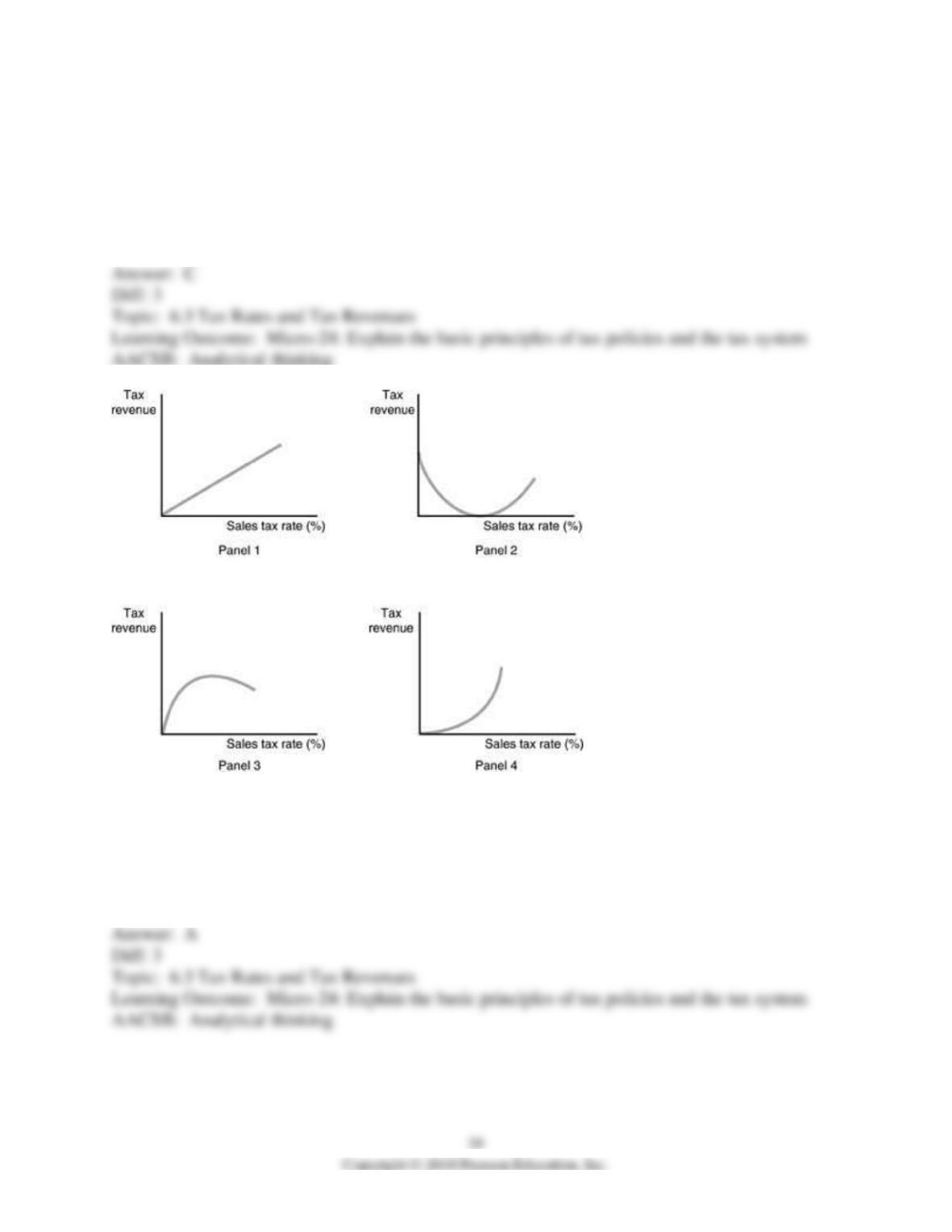
25) Refer to the above figures. Which panel represents the expected relationship between tax
revenue and the sales tax rate if static tax analysis is used?
A) Panel 1
B) Panel 2
C) Panel 3
D) Panel 4
26) Refer to the above figures. Which panel represents the expected relationship between tax
revenue and the sales tax rate if dynamic tax analysis is used?
A) Panel 1
B) Panel 2
C) Panel 3
D) Panel 4
27) Which of the following are considered ad valorem taxes?
A) taxes assessed by charging a rate equal to a percentage of an item’s price
B) taxes assessed by charging a flat amount per unit purchased
C) taxes based on the amount of debt that the government must repay
D) taxes based on the amount of spending the government will undertake
28) Assume that the government one day decides to tax greens fees at all state golf courses. To
the government’s dismay, not only was the amount of tax collected small, but there was a 90
percent decline in golfing. What type of tax analysis did the government apparently rely upon
when it imposed this tax?
A) static tax analysis
B) dynamic tax analysis
C) transaction cost analysis
D) ad hoc tax analysis
29) Ad valorem taxation means
A) that only the value added by a service provider is taxed.
B) that the tax rate is a percentage of the price paid for a product.
C) a negative income tax.
D) a progressive property tax imposed in some states.