20) Refer to the above figure. A unit tax has been placed on the good. What is the total amount
of the tax?
A) 0
B) P2 – P0
C) P2 – P1
D) P1 – P0
21) When a unit tax of $2 is levied on a product
A) the entire $2 is paid by the consumer.
B) the entire $2 is paid by the producer.
C) both the consumer and producer pay $2 each.
D) the consumer pays part of the $2 and the producer pays the rest.
22) Which of the following statements about excise taxes is TRUE?
A) The producer will increase the price of the good by the amount of the excise tax.
B) The equilibrium price will increase and the equilibrium quantity will remain unchanged.
C) Both the consumer and producer pay part of the excise tax.
D) Consumers will refuse to pay excise taxes forcing the producers to pay it.
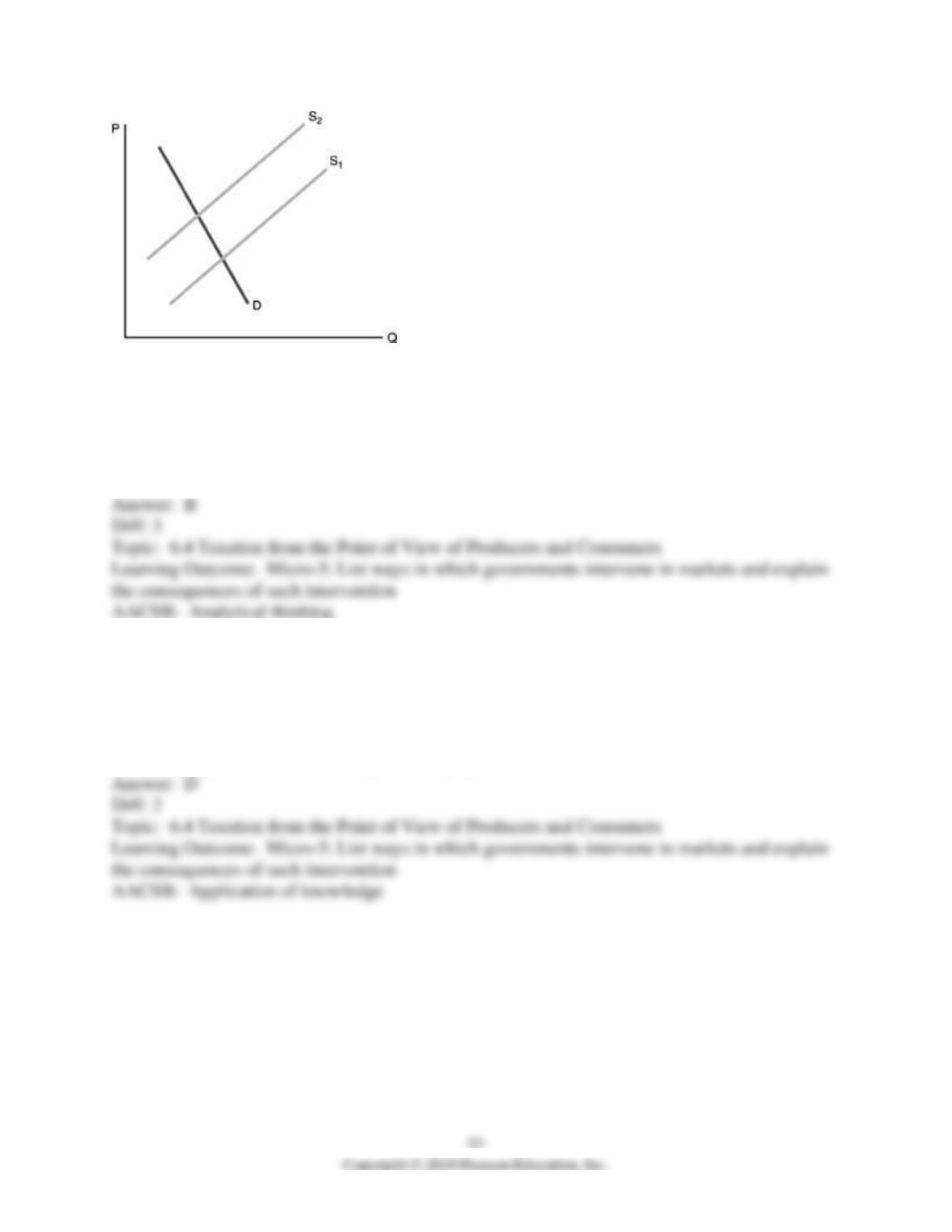
23) Refer to the above figure. An excise tax of $0.50 was imposed on this good. From the figure
we can see that the
A) producer will bear most of the tax.
B) consumer will bear most of the tax.
C) consumer and producer will share the tax.
D) amount of the tax collected is less than $0.50.
24) How would the market for coffee be affected if the government charged an excise tax of
$1.00 on each unit of coffee sold?
A) There would be a shortage of coffee.
B) The demand for coffee would increase.
C) The demand for coffee would decrease.
D) The supply curve would shift up vertically by $1.00.
25) How would the market for smartphones be affected if the government charged an excise tax
of $5.00 on each smartphone sold?
A) The supply of smartphones would decrease.
B) The demand for smartphones would increase.
C) The demand for smartphones would decrease.
D) The price of smartphones would rise by $5.00.
26) How does the imposition of an excise tax on a good affect its market equilibrium?
A) Equilibrium quantity decreases, and equilibrium price decreases.
B) Equilibrium quantity decreases, and equilibrium price increases.
C) Equilibrium quantity increases, and equilibrium price decreases.
D) Equilibrium quantity increases, and equilibrium price increases.
27) What determines the proportion of a unit excise tax that will be passed on to consumers in
the form of higher prices?
A) the nature of the projects funded by the tax
B) the number of additional taxes that consumers have to pay
C) the popularity of the tax
D) the degree to which quantity demanded and supplied of the good respond to price changes
28) The imposition of a tax on a product
A) shifts the supply curve to the right.
B) shifts the demand curve to the right.
C) shifts both the supply and the demand curve to the right.
D) shifts the supply curve to the left.
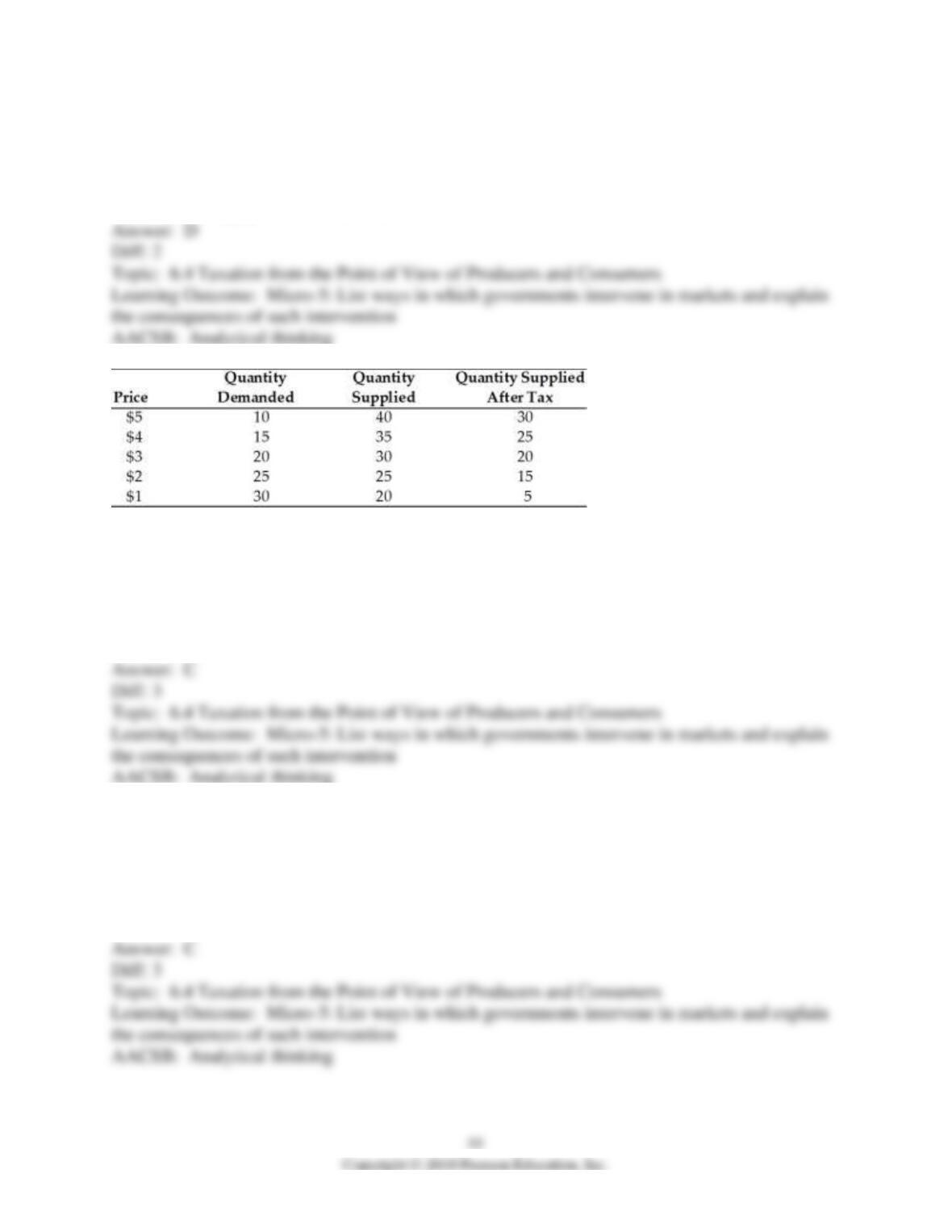
29) The demand and supply of a product is given in the above table. A unit tax of $2 is imposed
on the product. The equilibrium quantity for this product after the tax is imposed is equal to
A) 30 units.
B) 25 units.
C) 20 units.
D) 15 units.
30) Using the above table, a unit tax of $2 is imposed on the product. The equilibrium price of
this product after the tax is imposed is
A) $5.
B) $4.
C) $3.
D) $2.
31) Using the above table, a unit tax of $2 is imposed on the product. How much of the tax is
paid by the consumer?
A) $1
B) $2
C) $3
D) unable to determine
32) Using the above table, a unit tax of $2 is imposed on the product. How much of the tax is
paid by the producer?
A) $2
B) $1
C) $3
D) unable to determine
33) An excise tax on gasoline causes
A) supply of gasoline to shift to the left.
B) a reduction in the quantity of gasoline demanded.
C) the market clearing price of gasoline to rise.
D) All of the above are correct.
34) An excise tax is a tax that is levied on
A) the value of a piece of property.
B) the purchase of a given good or service.
C) the value of an estate.
D) that part of a person’s income coming from interest payments.
35) A tax levied on the purchase of a specific good or service is
A) an excise tax.
B) a consumption tax.
C) a purchase tax.
D) a value tax.
36) A state tax assessed specifically on cigarettes is an example of
A) an excise tax.
B) a consumption tax.
C) a social tax.
D) a tariff.
37) An excise tax
A) acts as a negative incentive to consume that good or service.
B) is illegal in Florida, Georgia, and Alaska.
C) is often used to encourage the use of a good.
D) is a value added tax (VAT).
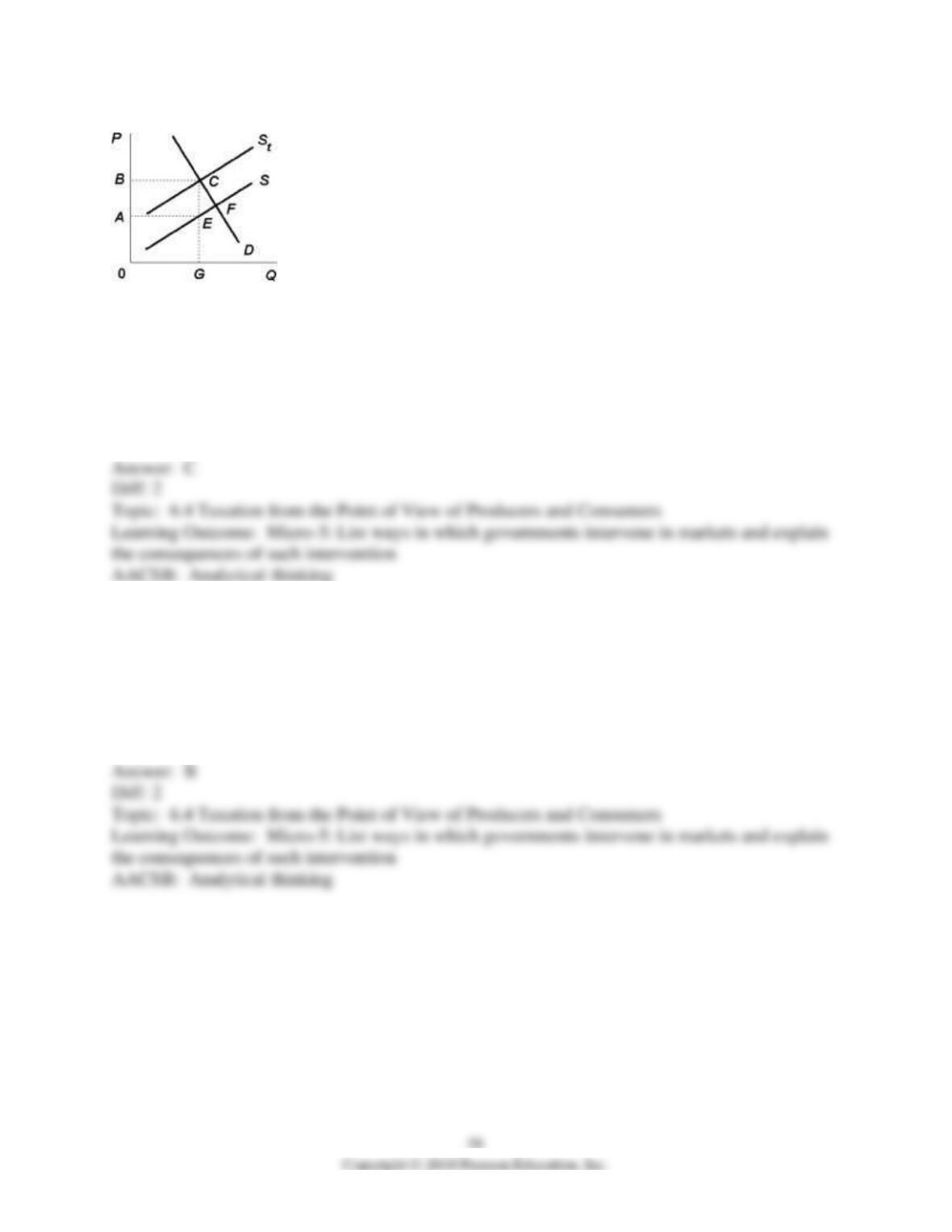
38) Using the above figure, if the government levies a new unit tax in this market, S represents
the original supply curve, and St represents the after-tax supply curve, then the revenues that the
government collects from imposing this tax is represented on this graph by
A) OAEG.
B) OBCG.
C) BAEC.
D) CEF.
39) Using the above figure, if the government levies a new unit tax in this market, S represents
the original supply curve, and St represents the after-tax supply curve, then the after-tax price
paid by consumers is the vertical distance from the origin to
A) point A.
B) point B.
C) somewhere between point B and point A.
D) point F.
40) If a unit excise tax is placed on a good for which the demand is very unresponsive to a price
change, then
A) the government generally pays the majority of the tax.
B) the consumers generally pay the majority of the tax.
C) the producers generally pay the majority of the tax.
D) producers and consumers pay equal portions of the tax.
41) Sales taxes are routinely collected by
A) the merchants selling the good or services.
B) the Internal Revenue Service.
C) the Department of Commerce.
D) the Federal Trade Commission.
42) Should the government wish to lower the price of gasoline to the consumer, one approach
might be
A) to raise the gasoline excise tax.
B) to reduce the gasoline excise tax.
C) to take action to shift the supply curve of gasoline to the left.
D) to lower taxes on automobiles.
43) How is the market for gasoline affected if the excise tax on gasoline is reduced?
A) The supply of gasoline decreases.
B) The supply of gasoline increases.
C) The equilibrium quantity of gasoline decreases.
D) The equilibrium price of gasoline increases.
44) If a state government wants to collect the maximum tax revenue from a unit excise tax,
which of the following would they tax?
A) cigarettes
B) beef hamburgers
C) luxury cars
D) hotdogs
45) If a new unit excise tax is levied on bottles of soda, the
A) demand for soda shifts to the left.
B) demand for soda shifts to the right.
C) supply of soda shifts to the right.
D) supply of soda shifts to the left.
46) Explain why it is that how much consumers pay for an excise tax depends on how responsive
they are to a given change in market price.