Economics Today, 19e (Miller)
Chapter 6 Funding the Public Sector
6.1 Paying for the Public Sector: Systems of Taxation
1) The fact that every dollar that the government spends or transfers must ultimately be provided
by the taxes and user charges it collects plus government borrowing is known as the
A) government balance sheet constraint.
B) government budget constraint.
C) tax collection constraint
D) user charge constraint.
2) The government budget constraint implies that
A) government borrowings = government spending+ transfers – taxes and user charges.
B) government borrowings = taxes and user charges + government spending – transfers
C) government spending = transfers – taxes and user charges – government borrowing.
D) government spending = government borrowing – transfers – taxes and user charges
3) How do taxation and user charges compare as government revenue sources?
A) Each generates about the same amount of government revenue.
B) Revenues from taxation are much greater than revenues from user charges.
C) User charges generate much more revenue than do taxes.
D) We don’t know because the government does not publish revenue figures broken down.
4) Over the long run, a government’s fundamental source of revenues is
A) printing money.
B) user fees and taxes.
C) exports.
D) gold sales.
5) The main source of government funding is
A) user fees.
B) taxes.
C) borrowing.
D) transfer payments.
6) The sum of public spending on goods and services and transfer payments during a given
period cannot exceed tax revenues plus borrowed funds. This is the statement for
A) ad valorem taxation.
B) an excise tax.
C) a sales tax.
D) the government budget constraint.
7) All of the following are possible funding sources for the government EXCEPT
A) user charges.
B) taxes.
C) earnings from investing in company stock shares.
D) borrowing.
8) Over the long run, the fundamental funding sources for the government include
A) borrowing.
B) transfers between government agencies.
C) taxes.
D) lending.
9) According to the government budget constraint, any excess of public expenditures and
transfers over taxes and user fees must be funded by
A) private borrowing.
B) government borrowing.
C) U.S. Treasury money creation.
D) Federal Reserve money creation.
10) Of the following, which is the largest source of government funds in the long run?
A) government borrowing
B) money creation
C) user fees
D) taxation
11) The marginal tax rate shows
A) the percentage of income which a typical family pays in tax.
B) the average rate of taxation in the economy.
C) the deductions which are permitted for child care and medical expenses.
D) the extra tax due on an extra dollar of income.
12) The marginal income tax rate is equal to
A) the total tax payment divided by total income.
B) the change in the tax payment divided by the change in income.
C) the average tax payment divided by the total tax payment.
D) the percent of total income that goes to taxes.
13) The marginal income tax rate applies to
A) all income earned by a family.
B) the income in the highest tax bracket reached.
C) the income of the highest income U.S. taxpayers.
D) the income received by people above the national average.
14) Suppose the income tax rate is 0 percent on the first $10,000; 10 percent on the next $20,000;
20 percent on the next $20,000; 30 percent on the next $20,000; and 40 percent on all income
above $70,000. Family A has income of $100,000 while Family B has income of $40,000. The
marginal tax rates faced by the two families are
A) 40 percent on A and 10 percent on B.
B) 40 percent on A and 20 percent on B.
C) 30 percent on A and 20 percent on B.
D) 30 percent on A and 30 percent on B.
15) Suppose the tax rate on the first $10,000 of income is 0 percent; 10 percent on the next
$20,000; 20 percent on the next $20,000; 30 percent on the next $20,000; and 40 percent on
income over $60,000. Family A has an income of $55,000. What is the tax liability of Family A?
A) $16,500
B) $6,600
C) $7,500
D) $3,400
16) Suppose the income tax rate schedule is 0 percent on the first $10,000; 10 percent on the next
$20,000; 20 percent on the next $20,000; 30 percent on the next $20,000; and 40 percent on any
income over $70,000. Family A earns $28,000 a year and Family B earns $65,000 a year. Both
receive a ten percent raise. What is the marginal tax rate of each and what is the extra tax paid by
each after the raise?
A) Family A: 10 percent marginal tax rate and $280 in extra taxes; Family B—30 percent
marginal tax rate and $1950 in extra taxes.
B) Family A: 10 percent marginal tax rate and $420 in extra taxes; Family B—30 percent
marginal tax rate and $2275 in extra taxes.
C) Family A: 20 percent marginal tax rate and $360 in extra taxes; Family B—40 percent
marginal tax rate and $2100 in extra taxes.
D) Family A: 20 percent marginal tax rate and $560 in extra taxes. Family B—40 percent
marginal tax rate and $2600 in extra taxes.
17) Suppose the tax rate on the first $10,000 income is 0 percent; 10 percent on the next $20,000;
20 percent on the next $20,000; 30 percent on the next $30,000; and 40 percent on any income
over $80,000. Family A has income of $50,000. What is the marginal and average tax rate for
Family A?
A) marginal—10 percent; average—12 percent
B) marginal—20 percent; average—12 percent
C) marginal—25 percent; average—15 percent
D) marginal—15 percent; average—25 percent
18) Suppose the tax amount on the first $10,000 income is $0; $2000 on the next $20,000; $4000
on the next $20,000; $6000 on the next $30,000; and 40 percent on any income over $80,000.
Family A has income of $30,000 and Family B has income of $80,000. What is the marginal and
average tax rate for each family?
A) Family A: marginal—10 percent; average—6.7 percent; Family B: marginal—30 percent;
average—15 percent.
B) Family A: marginal—10 percent; average—20 percent; Family B: marginal—30 percent;
average—23 percent.
C) Family A: marginal—10 percent; average—10 percent; Family B: marginal—40 percent;
average—40 percent.
D) Family A: marginal—10 percent; average—15 percent; Family B: marginal—40 percent;
average—20 percent.
19) The marginal tax rate and the average tax rate are the same under a
A) progressive income tax system.
B) regressive income tax system.
C) proportional income tax system.
D) none of the above.
20) A tax rate system characterized by higher marginal tax rates as income increases is known as
A) a progressive tax system.
B) a regressive tax system.
C) a proportional tax system.
D) a flat-rate tax system.
21) Assume a family that earns $20,000 pays $1,000 in income taxes, while a family that earns
$40,000 pays $3,750 in income taxes. In this situation, the income tax system is
A) progressive.
B) regressive.
C) proportional.
D) one of the above but we cannot tell which one without more information.
22) Assume a family that earns $20,000 pays $2,000 in income taxes, while a family that earns
$40,000 pays $3,000 in income taxes. In this situation, the income tax system is
A) progressive.
B) regressive.
C) proportional.
D) one of the above but we cannot tell which one without more information.
23) An example of a regressive tax is the
A) corporate income tax.
B) personal income tax.
C) Social Security tax.
D) state inheritance tax.
24) If the marginal tax rate is less than the average tax rate, the tax system is
A) progressive.
B) proportional.
C) regressive.
D) flat.
25) In a proportional income tax system
A) marginal tax rates are the same regardless of the level of taxable income.
B) marginal tax rates increase as the level of taxable income increases.
C) marginal tax rates decline as the level of taxable income declines.
D) everyone pays the same dollar amount in taxes.
26) A tax system that applies a lower marginal tax rate at higher levels of income is
A) progressive.
B) regressive.
C) proportional.
D) flat.
27) A “flat tax” on personal income, in which the same tax rate is applied to every dollar of
income earned by each taxpayer, is an example of
A) a regressive tax.
B) a proportional tax.
C) a progressive tax.
D) a value-added tax.
28) The average tax rate can be calculated by which of the following formulas?
A) the change in taxes due divided by the change in taxable income
B) the change in taxable income divided by the change in taxes due
C) total taxes due divided by total taxable income
D) total taxable income divided by total taxes due
29) The marginal tax rate can be calculated by which of the following formulas?
A) the change in taxes due divided by the change in taxable income
B) the change in taxable income divided by the change in taxes due
C) total taxes due divided by total taxable income
D) total taxable income divided by total taxes due
30) Suppose that in the economy of Boise, Amy earns an income of $50,000 a year and pays
$10,000 in income taxes; Bailey earns an income of $25,000 a year and pays $8,000 in income
taxes. Based on this information, we could say that Boise’s tax system is
A) proportional.
B) progressive.
C) regressive.
D) flat.
31) The federal income tax code of the United States is
A) progressive.
B) proportional.
C) regressive.
D) progressive for individuals but proportional for married couples.
32) Advocates of a progressive income tax use arguments EXCEPT for which of the following?
A) A progressive tax system taxes according to ability to pay.
B) A progressive tax system taxes according to benefits received.
C) A progressive tax system helps redistribute income away from the rich and towards the poor.
D) A progressive tax system maximizes government revenues.
33) Under a progressive income tax system, the marginal income tax rate paid by taxpayers
A) declines as their incomes increase.
B) rises as their incomes increase.
C) is unchanged as their incomes increase.
D) is unrelated to their incomes.
34) The average tax rate is defined as
A) total tax due/change in taxable income.
B) total tax due/total taxable income.
C) change in taxes due/change in taxable income.
D) change in taxes due/total taxable income.
35) The marginal tax rate is
A) total tax due/change in taxable income.
B) total tax due/total taxable income.
C) change in taxes due/change in taxable income.
D) change in taxes due/total taxable income.
36) A tax system in which the average and marginal tax rates are the same for every level of
taxable income and every change in income is an example of
A) regressive taxation.
B) proportional taxation.
C) progressive taxation.
D) premium taxation.
37) In a progressive tax system
A) the marginal tax rate and the average tax rate are the same for every income level and the
same as income increases.
B) the marginal tax rate increase as income increases but the average tax rate does not change as
income increases.
C) the marginal tax rate and the average tax rate increase as income levels increase and the
marginal tax rate exceeds the average tax rate.
D) the marginal tax rate and the average tax rate decrease as income levels increase and the
marginal tax rate is less than the average tax rate.
38) The tax base is
A) the minimum amount of tax revenue that government must collect each year.
B) the maximum amount of tax revenue that government must collect each year.
C) the sum of all incomes earned in the United States.
D) the value of all goods, services, incomes, or wealth subject to taxation.
39) The U.S. Social Security tax is an example of a
A) progressive tax.
B) proportional tax.
C) premium tax.
D) regressive tax.
40) Homer earns $10,000 per year. Each year he spends $5,000 and saves $5,000. He pays a 5
percent sales tax on all of his spending. Assuming the sales tax is the only tax he pays, his
average tax rate out of his income is
A) 0 percent.
B) 2.5 percent.
C) 3.5 percent.
D) 5.0 percent.
41) In a progressive income tax system
A) the marginal tax rate exceeds the average tax rate.
B) the average tax rate exceeds the marginal tax rate.
C) high income earners pay a lower percentage of their income in taxes than do low income
earners.
D) the tax rate depends solely on how long an individual has been in the labor force.
42) Jamal earns $160,000 per year and Josephina earns $80,000 per year. They both pay the
same price to buy the identical automobile and each pays $1,600 in sales tax. In relation to their
relative incomes, this is an example of a
A) regressive tax.
B) progressive tax.
C) proportional tax.
D) marginal tax.
43) Jamal earns $160,000 per year and Josephina earns $80,000 per year. If Jamal pays $16,000
in income taxes and Josephina pays $8,000 in income taxes, the income tax system would be
A) regressive.
B) progressive.
C) proportional.
D) marginal.
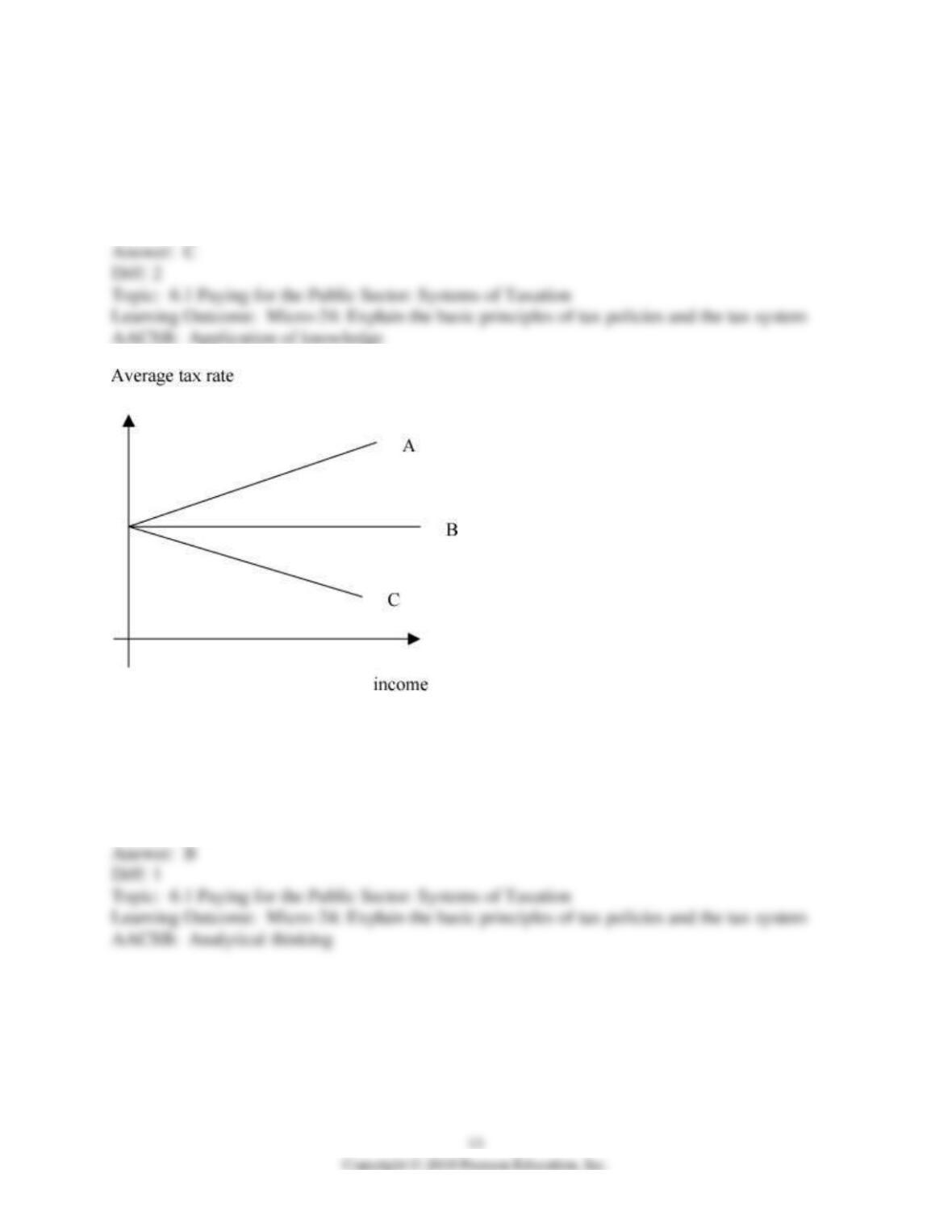
44) Using the above figure, which of the lines in the above diagram represents a proportional
tax?
A) A
B) B
C) C
D) none of them
45) Using the above figure, which of the lines in the above diagram represents a progressive tax?
A) A
B) B
C) C
D) none of them
46) Using the above figure, which of the lines in the above diagram represents a regressive tax?
A) A
B) B
C) C
D) none of them
47) Jamal earns $160,000 per year and Josephina earns $80,000 per year. If Jamal pays $16,000
in income taxes and Josephina pays $5,000 in income taxes, the income tax system would be
A) regressive.
B) progressive.
C) proportional.
D) marginal.
48) The Social Security tax is considered to be a
A) regressive tax.
B) progressive tax.
C) proportional tax.
D) marginal tax.
49) Another name for a “flat-rate tax” in which the same tax rate applies to all income earners is
a
A) proportional tax.
B) progressive tax.
C) regressive tax.
D) passive tax.
50) Assume that Mr. Smith’s income increased from $50,000 last year to $55,000 this year and
that he paid an additional $2,000 in taxes. This would indicate that his marginal tax rate is
A) 2 percent.
B) 3.6 percent.
C) 36 percent.
D) 40 percent.
51) If a tax system is progressive, then
A) the average and the marginal tax rates are equal.
B) the marginal tax rate is greater than the average tax rate as income rises.
C) the marginal tax rate is lower than the average tax rate as income rises.
D) the average tax rate is constant, but the dollar amount paid in taxes increases as income
increases.
52) The marginal tax rate is
A) the sum of all individual tax rates.
B) the total taxes paid as a percentage of total income.
C) the average tax rate paid by both individuals and corporations.
D) the increase in taxes as a percentage of the increase in income.
53) When income is $15,000, the amount of income taxes owed is $1,500; when income
increases to $20,000, the amount owed increases to $3,000. The average income tax rate when a
person earns $15,000 is
A) 75 percent.
B) 10 percent.
C) 13.3 percent.
D) 20 percent.
54) When income is $15,000, the amount of income income taxes owed is $2,000; when income
increases to $20,000, the amount owed increases to $3,000. The marginal tax rate in this case is
A) 20 percent.
B) 13.3 percent.
C) 15 percent.
D) 25 percent.
55) If you were to face a marginal tax rate of 20 percent, how much would your tax bill increase
when your income increased from $50,000 to $52,000?
A) $1,000
B) $400
C) $450
D) $10,400
56) Suppose you are making $50,000 per year and paying $5,000 per year in income taxes. You
get a $10,000 per year raise and your income taxes are now $6,500 per year. Based on this
information, the income tax system is
A) proportional.
B) progressive.
C) regressive.
D) bracketed.
57) Suppose you are making $50,000 per year and paying $5,000 per year in income taxes. You
get a $10,000 per year raise and your income taxes are now $6,000 per year. Based on this
information, the income tax system is
A) proportional.
B) progressive.
C) regressive.
D) bracketed.
58) What are the three sources of funding for the public sector? Can the government rely on all
of these sources in the long run? Explain.
59) What is a government’s budget constraint in the long run as opposed to a given time period?
60) Why is the government budget constraint different between the short run and the long run?
61) Suppose the income tax rate is 0 percent on the first $10,000; 10 percent on the next $20,000;
20 percent on the next $20,000; 30 percent on the next $20,000; and 40 percent on all income
above $70,000. Family A has income of $82,000 while Family B has income of $37,000. What
are the marginal tax rates faced by the two families?
62) Suppose the income tax rate schedule is 0 percent on the first $10,000; 10 percent on the next
$20,000; 20 percent on the next $20,000; 30 percent on the next $20,000; and 40 percent on any
income over $70,000. Family A earns $32,000 a year and Family B earns $70,000 a year. Both
families each receive a ten percent raise. What is the marginal tax rate of each and what is the
extra tax paid by each after the raise?
63) Briefly compare the three tax systems based on the relationship between the marginal tax
rate and the average tax rate as income rises.
64) “Only in a progressive tax system does the amount of taxes increase as income increases.”
Do you agree or disagree? Explain.
65) Suppose Jill has earned more income this year as compared to what she did last year. Her
income tax has also increased. Does it necessarily mean that the income tax system is
progressive? Explain.
6.2 The Most Important Federal Taxes
1) A typical capital gain is experienced by
A) selling stock or a mutual fund.
B) only rich people.
C) only investment bankers.
D) all shareholders in the United States.
2) A person experiences a capital gain if she
A) sells an asset for more than what she paid for it.
B) settles a debt.
C) invests in a physical capital project.
D) contributes to a country’s production of capital goods.
3) Reduction or elimination of dividend taxes is designed, in part, to
A) reduce the double taxation burden on individuals.
B) make rich people richer.
C) reduce inefficiencies in the production process.
D) increase corporate tax levels.
4) A capital gain is defined as
A) the tax paid when one sells an asset.
B) the positive difference between the sale price and the purchase price of an asset.
C) the tax rate one pays when one moves into a higher tax bracket.
D) an unanticipated increase in income.